Garner 1
Stephen Garner
Professor Jean Miller
Senior Seminar 4199-11
December 4, 2013
The Distractibility of Computer Mediated Interactions In Classrooms
Introduction
Sometimes sitting in class can be boring. Especially those late afternoon classes, when it
is sunny outside and all your friends are vigorously texting you, “Hey, when do you get out?”
and “Just leave now! Who takes a six o’clock class on a Friday?” the temptation to pull out your
cell phone can be difficult to resist. However, if students do in fact place high value on their
academics, they must resist. Cell phones can be detrimental to listening comprehension, and in a
classroom setting, can negatively impact the user’s ability to learn (Crawford, Fox, and Rosen 2).
Then why are students allowing themselves to be distracted? Is it due to a fear of missing out on
social interactions? Or is it just plain apathy for academics? This paper will aim to discover what
personal values and motivations are linked to student’s vulnerability to the distractions facilitated
by technology.
The fact is 95 percent of students bring their cell phones to class (Bohlander and Tindell
1). Additionally, Crawford, Fox, and Rosen found that attempting to hold an instant messaging
conversation, while trying to effectively comprehend the material, drastically slowed the rate at
which the participants completed the multiple choice quizzes meant to test their comprehension
ability (2). As the presence of cell phones in classrooms increases, so does the importance of
understanding why students so eagerly engage in non-academic use of technology during class.
Garner 2
This research project is dedicated to uncovering what motivates students to abuse
technology in class, despite its negative impact on learning. The next section of this study will
review previous literature dedicated to studying how cell phones are currently being used in the
classroom and to what extent cell phones are a distraction in a classroom setting. Following the
literature review, this paper describes the survey distribution and data coding involved in the
methodological procedures of this study. The following section provides an analysis of the
survey data using SPSS software. The final section of the paper is a discussion of the findings
and limitations of the study.
Literature Review
I. Introduction to the Literature Review
Cell phones have become a staple for the average college student; they act as a tool for
students to stay connected with peers, family members, and even teachers (Angster, Frank, and
Lester 402). With this growing dependency on cell phones, students are allowing themselves to
be distracted by their mobile phones during class, and in some cases, it is costing students some
of the most valuable pieces of their education: productive class time, and a positive student-
teacher relationship (Carpenter el al. 323). Most high school classes are smaller than a majority
of collegiate classes, which enables high school teachers to keep a closer watch over their
students (Charles 9). A study done by Gurrie and Johnson revealed that 295 of the 321 students
surveyed, that nearly 92 percent, reported using their phones in class while the teacher or a
fellow student was talking (20). With the increase in class size from high school to college, there
is much less authority presence, transferring the responsibility of regulating cell phone use to the
students (Klausner, Wang, and Wei 185). This literature review will examine the ways in which
students use cell phones in the classroom.
Garner 3
II. The Distractibility of CMC
Before mobile phones became prevalent on college campuses, students were using
laptops and internet connections to communicate via instant messaging (Crawford, Fox, and
Rosen 2). Crawford, Fox, and Rosen conducted a study that analyzed people’s ability to read
comprehensively while communicating through online channels. Their research found that the
distractions did not affect their subjects’ ability to comprehend the readings, or complete
assignments. However, the study did reveal that attempting to hold an instant messaging
conversation, while trying to effectively comprehend the material, drastically slowed the rate at
which the participants completed the multiple choice quizzes meant to test their comprehension
ability (Crawford, Fox, and Rosen 2). Similarly, Archer et al. found that students using non-
digital-based forms of note taking were more productive than those using laptops (365). These
findings highlight the distractibility that comes with being exposed to computer-mediated
communication (CMC).
Though the study did not take place within the classroom, these findings reveal a
correlation between students’ abilities to comprehend material in a time-sensitive scenario while
conducting CMC. In the classroom, the students and teachers are allotted a specific amount of
time in which to achieve effective learning. Reynol Junco extends the research done by Fox et al.
by examining students’ conducting CMC in a classroom setting (Junco 2242). Fox et al. pointed
out that the distraction of CMC lengthens the amount of time it takes for students to comprehend
information (52), while Junco’s studies examined the use of information and communication
technologies (ICTs), such as laptops and cell phones (2242). Though laptops and instant
messaging were the primary focus of these subsequent studies, there is a distinct transition
towards using cell phones as the primary means for CMC (Junco 2242). This shift between
Garner 4
instant messaging and cell phone usage demonstrates the importance of studying how this
increase of cell phone use affects learning, and students’ and teachers’ perceptions of the use of
cell phones in the classroom.
III. The Shift Towards Cell Phones
Many researchers have studied how frequently students use their mobile phones; all of
their studies included an examination of the use of texting and other “non-calling” features (402).
Angster, Frank, and Lester examined the frequency of texting and calling in relation to how
fulfilling those interactions were (403). Other researchers examined how the use of cell phones
intruded on face-to-face interactions (Beaver, Knox, and Zusman 629). Drumheller et al.
examined how time consuming the use of cell phones and handheld devices were on college
students, by asking students to keep a diary that outlined the amount of time they spent using
said devices in a day (25). Jin and Park’s study, In-Person Contact Begets Calling And Texting:
Interpersonal Motives For Cell Phone Use, Face-To-Face Interaction, And Loneliness,
examined the correlation between how frequently student encountered cell phone interactions
compared to face-to-face interactions (In-Person Contact 611). Another study conducted by Jin
and Park called, Mobile Voice Communication And Loneliness: Cell Phone Use And The Social
Skills Deficit Hypothesis, uncovered that “better social skills were related to more voice calling,
even with face-to- face interaction held constant, and more face-to-face interactions were
associated with more voice calling” (Mobile Voice Communication 1105) These studies, which
revealed the growth in students’ frequency of cell phone use outside the classroom, led
researchers to begin examining how cell phones were being used inside the classroom.
IV. The Distractibility of Cell Phones
Garner 5
Now, studies are starting to shift their focus towards how the presence of cell phones
affects classroom activities because more students are using cell phones during class. End et al.
took particular interest in understanding how cell phones created distractions during class (56).
The researchers examined two simulated lectures with different conditions. The first lecture they
examined was the control, in which no cell phone rings occurred; the second lecture had two cell
phone rings occur during the class (End et al. 56). Both test groups were asked to take notes, as
well as complete a multiple-choice exam at the end of the lecture. The researchers observed a
distinct drop in test scores, as well as a drop in the amount of notes taken by students during the
lecture with cell phones ringing (End et al. 56). This study provided future researchers with the
opportunity to test how the use of cell phones affected students’ ability to learn in classroom
situations where the use of cell phones was occurring.
More recently, researchers have begun extending the work of End et al. by focusing their
attention towards two related aspects of how cell phones are making their way into the
classroom. The first aspect being how frequently students use their phones, primarily for texting,
while in the classroom; the second aspect being how distracting phones were during class, with a
focus on how the use of phones affects students’ ability to learn (End et al. 55-57).
Bohlander and Tindell directed their research towards understanding exactly how often
students were using their phones during classroom lectures. They found that 92 percent of
students not only brought their phones to class, but also admitted to using their phone to send and
receive text messages during class time (Bohlander and Tindell 3). These investigations made it
possible for newer research to work under the relative assumption that most college students
were bringing their phone to class, and most importantly, using their phones while in class.
Garner 6
Carrier et al. expanded the research conducted by Bohlander and Tindell by examining
exactly how distracting it could be to send and receive text messages during an informative,
class-like presentation. Students in several test groups received anywhere from 0-19 texts during
the course of a 30 minute presentation. The researchers found that those who were subjected to
more text messages had lower memory recall of the presentations (Carrier et al. 168). These two
studies, conducted by Carrier et al. and Bohlander and Tindell, reveal the problem between the
frequency with which college students are texting, alongside actual evidence of the negative
effects of sending and receiving text messages on students’ ability to learn.
V. Perceptions of Cell Phones in the Classrooms and ‘Self-Regulation’
Acknowledging that the use of cell phones is a distraction in classrooms provoked
researchers to examine why students succumb to using cell phones despite the potential decrease
in learning. Klausner, Wang, and Wei extended the research of previous studies to include the
element of how students “self-regulate” their texting during class in relation to the attention they
pay during classroom learning (185). They found that, “self-regulated students were more likely
to sustain their attention on classroom learning, and, therefore, less likely to text message during
class. Subsequently, these students perceived themselves to have achieved better cognitive
learning outcomes, whereas students who frequently texted during class had difficulty
maintaining their sustained attention during classroom learning and, in turn, potentially
sacrificed cognitive learning outcomes” (200-201). By including research into how students
regulate the amount of texting they do while in class, information gathering is more closely
considering how individuals perceive texting as an acceptable classroom behavior. The data they
collected focused mostly on how frequently students text in class (Klausner, Wang, and Wei
Garner 7
195). The introduction of this self-evaluation is important to understanding why students text in
class, and what might motivate students to not use their phones in class.
On some level, students understand the detriment that cell phones cause to their learning.
Students use tactics, such as hiding their phones behind their legs while they type out a quick
message, in order to not disrespect their teacher. Students know they should not be using their
technology to socialize during class, but they continue to do so despite the academic
repercussions and damage to the student-teacher relationship. Anita Charles interviewed several
students and faculty at a high school in New England to try and uncover what motivates
students’ cell phone use in the classroom. The teachers in this study seemed to be aware of the
fact that students texted during class; however, there is no information about to what degree
teachers are aware of their students’ cell phone use in class (Charles 8-10). It becomes apparent
that students are more likely to use their phone based on which teacher’s class they are attending,
due to a variance in how teachers enforce the “no-texting” rule; not every teacher is as effective
at preventing cell phone use in their classes (Charles 10). Both college and high school students
use their phones during class; however, the sizes of lecture classes you find in college are a much
larger setting than high school classrooms. This lecture setting allows for more discrete ways for
students to use their phones.
Students and teachers understand that phones are distracting, but students seem to find
them to be less impeding than teachers. Burns and Lohenry surveyed students and teachers
about the etiquette of using cell phones during class. They found that both students and teachers
believed cell phones to be distracting (805). A study by Ahmad Alobiedat also found that
students and teachers shared similar perceptions of the appropriateness of using cell phones in
classrooms (7). Despite the finding that teachers and students both found phones to be
Garner 8
distracting, Baker, Lusk, and Neuhauser, concluded that students were much more accepting of
having cell phones, and similar technologies present in the classroom (284-285). A study done
by Scott W. Campbell revealed that students were less disturbed by ringing cell phones than
teachers (280). Students and teachers agree that smart phones are distracting, however students
have a much more apathetic attitude towards their presence and use during class, despite
knowing that their teachers are far more disapproving of these devices.
As mobile technology has developed, more room has opened for researchers to observe
the ways in which mobile phones are being used for “non-calling” purposes. Bohlander and
Tindell found 54 percent of students revealed that they believed professors would be “shocked”
if they knew how frequently students were texting during class (4). The use of vibrate, and the
less noticeable alerts have made communicating with cell phones much more discrete. It is now
possible to use a mobile phone to send and receive text messages without disturbing other
members in the class, or being caught by the teacher.
This discrete use of cell phones is leading to a drastic increase in cell phone use by
students while in class. Gurrie and Johnson administered a survey to a group of undergraduate
students, asking questions about their use of cell phones in the classroom. Astonishingly, 91.9
percent of the respondents admitted to using their phones in class while either a teacher or fellow
student was talking, and 74.9 percent of students reported using social media and email during
class. Students also reported an understanding that using their phones in class was rude to the
teacher, 78.5 percent said that they believe using their phone in class portrays them negatively
(15). Further research is required to examine what is motivating these students to succumb to this
distraction, despite the academic consequences. This heightened rate of students reporting their
Garner 9
CMC while in class, as well as the reports of using social media during class, suggest the
following hypothesis:
H1: The more socially inclined a student is, the more likely that student is to be distracted by CMC in
class.
Gurrie and Johnson study found that students reported boredom (11 percent) and
socializing (21 percent) as reasons for increased cell phone use in the classroom (21). As a
generalization, students who are more prone to boredom in class are less likely to pay
attention to the professor. This suggests the following hypotheses:
H2a: Students who reported “boredom” as a reason for using CMC in class are more likely to respond
than those who reported something other than boredom.
H2b: Students who reported “boredom” as a reason for using CMC in class are more likely to feel
distracted by their own technology than those who reported something other than boredom.
H2c: Students who reported “boredom” as a reason for using CMC in class are more likely to initiate
than those who reported something other than boredom.
VI. Conclusion to the Literature Review
In order to begin exploring the student’s motivations for using cell phones in class, it was
necessary to outline the previous research into the habits of cell phone use by students, such as
the link between a better social life and the frequency with which students use their cell phones
(Jin and Park, Mobile Voice Communication 1105). By understanding the immense frequency
with which students carry and use their cell phones, there is a clear path that leads to the
presence and inevitable use of cell phones in the classrooms.
Method
Research Question: What motivates students to use CMC to conduct extracurricular
interactions during class, despite knowing that it is a distraction from in-class learning?
Respondents
Garner 10
The participants for this online survey were 109 undergraduate students in an
intro-level communication course at The George Washington University. The students
received extra credit for participating. The extra-credit was given to every student after
they handed in a hard copy of the completion page of the online survey to their professor,
maintaining anonymity.
Procedure
The students were given one week to complete the online survey. The students
received extra credit after the entire class completed the survey, and only if the entire class
completed the survey, which they did. This practice allowed students to be confident in
their anonymity. The survey consisted of 20 questions. The professor distributed the
survey to her students through email. 109 students were administered the survey, and 110
surveys were completed. All 110 surveys were compiled into data sets that were then
analyzed. The response rate was 100 percent, this 100 percent response rate was expected
because the extra credit was only provided if every member of the class participated. We
therefore assume that a student accidentally submitted an extra response.
Instrumentation
Social tendency. Seven items on 5-point Likert scales (1 = never, 5 = always)
measured participants’ tendency to value their social lives over academics. Sample items
included: “Do you make social plans through text messages in class?”, and “How often do
you choose your social life over academics?” The internal consistency of the scale was
deemed satisfactory: Crombach’s alpha for social tendency was .87.
Garner 11
Distracted by their own technology. One item on the survey asked, “How often are
you distracted by your own technology in class?” This item is crucial in measuring the
distractibility of the student and will be used as the dependent variable.
Initiate versus respond. Two items on 5-point Likert scales (1 = never, 5 = always)
measured, respectively, a students’ tendency to initiate CMC in class, and to respond to
CMC in class. The items measuring students’ tendency to initiate CMC in class included: “Do
you initiate texting conversations during class?” and “Do you initiate instant messaging
conversations on sites like Google-chat and Facebook during class?” The items measuring
students’ tendency to respond to CMC in class included: “Do you respond to text messages
in class?” and “Do you respond to instant messages on sites like Google-chat and Facebook
during class?” The internal consistency of the 2 scales was deemed acceptable: Crombach’s
alpha for “intiate” was .65, and for “respond” was .69.
Students who reported boredom and students who did not report boredom.
The final instrument for data collection was an open ended question at the end of the
survey that asked students to list reasons for why they text and chat people during class.
These reasons were then sorted into two categories: “Students who reported boredom as a
cause for their use of CMC in class,” and “Students who did not report boredom as a cause
for their use of CMC in class.”
Coding. In order to examine correlations between how students reported being
“distracted by their own technology,” and their reported “social tendency,” I used the ‘Bi-
variate’ function in SPSS. I also used SPSS to analyze the differences between students who
reported boredom and students who did not report boredom in relation to how those
Garner 12
students reported their tendency to initiate CMC in class, respond to CMC in class, and
become distracted by their own technology in class.
Results
The survey data was analyzed using SPSS statistical analysis software. Variables
were correlated using the bi-variate function as well as analyzed through the use of a t-test.
Results showed significant correlations supporting hypothesis 1 using the bi-variate
function and marginally significant results were found supporting hypotheses 2a, b, and c
using the t-test.
Hypothesis 1 predicted that the more socially inclined a student is, the more likely
that student is to be distracted by CMC in class. Bi-variate correlation analysis was
performed between the social tendency sub-set variable, and the feeling distracted by their
own technology variable. Results indicated that social tendency and feeling distracted by
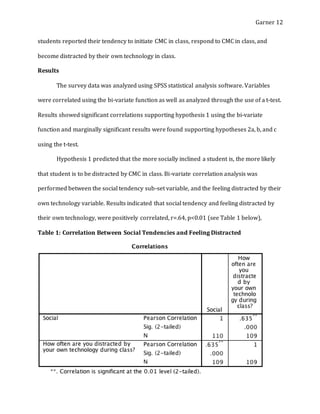
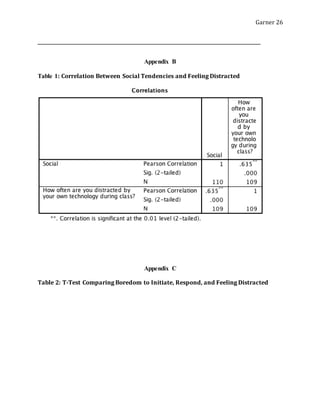
their own technology, were positively correlated, r=.64, p<0.01 (see Table 1 below),
Table 1: Correlation Between Social Tendencies and Feeling Distracted
Garner 13
therefore hypothesis 1 was supported.
Independent sample t-test was performed with ‘students who reported boredom’ as
the dependent variable and initiate, respond, and feeling distracted by their own
technology as the independent variables.
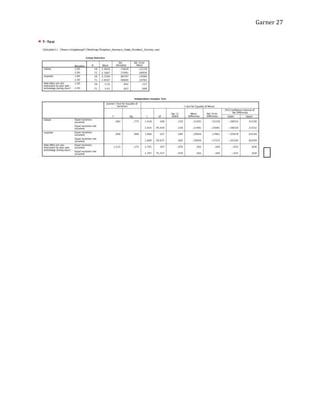
Hypothesis 2a predicted that students who reported boredom as a reason forusing
CMC in class are more likely to respond than those who reported something other than
boredom. The results of the t-test indicated that perceived boredom in class had a
marginally significant influence on 2 of the variables, responding, t(107) = 1.67, p<0.10,
and being distracted, t(107) = 1.79, p<0.10, specifically, those who reported boredom in
class as the primary reason for using social media while in class are more likely to respond
to CMC conversations (M = 3.25, SD = .87) than those who reported other reasons (M =
2.95, SD = .91) (e.g. “[I] Think of things I forgot to tell them, I need to get in contact [with
someone], or making plans for later”) Therefore, hypothesis 2a is supported.
Hypothesis 2b predicted that: Students who reported boredom as a reason forusing
CMC in class are more likely to feel distracted by their own technology than those who
reported something other than boredom. The t-test revealed that those who reported
boredom in class as the primary reason for using social media in class are more likely to
feel distracted (M = 3.32, SD = .84) than those who reported other reasons (M = 3.01, SD =
.84). Therefore hypothesis 2b is supported.
Hypothesis 2c predicted that students who reported “boredom” as a reason for
using CMC in class are more likely to initiate than those who reported something other
than boredom. The t-test revealed those who reported boredom in class as the primary
reason for using social media in class are slightly more likely to initiate CMC conversations
Garner 14
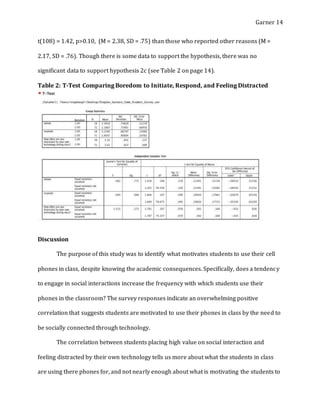
t(108) = 1.42, p>0.10, (M = 2.38, SD = .75) than those who reported other reasons (M =
2.17, SD = .76). Though there is some data to support the hypothesis, there was no
significant data to support hypothesis 2c (see Table 2 on page 14).
Table 2: T-Test Comparing Boredom to Initiate, Respond, and Feeling Distracted
Discussion
The purpose of this study was to identify what motivates students to use their cell
phones in class, despite knowing the academic consequences. Specifically, does a tendency
to engage in social interactions increase the frequency with which students use their
phones in the classroom? The survey responses indicate an overwhelming positive
correlation that suggests students are motivated to use their phones in class by the need to
be socially connected through technology.
The correlation between students placing high value on social interaction and
feeling distracted by their own technology tells us more about what the students in class
are using there phones for, and not nearly enough about what is motivating the students to
Garner 15
use their technology. In response to the question, “How often do you choose social life over
academics?”, which was examined under the “social tendency” subset, 57.7 percent of
participants reported that they “sometimes” choose social life over academics, 9.9 percent
reported they choose their social life over academics “most of the time,” and 3.6 percent
reported they “always” choose social life over academics. This variable was the most
concrete link between students placing high value on their social lives and their feeling
distracted by their own technology in class, however this questions had the lowest
reliability within the subset, slightly lowering the reliability of the correlation between
these social tendencies and feeling distracted by technology in class. The other questions
within the subset ask, specifically, what purposes students are using their phones for in
class, (e.g. “Do you make social plans through text messages in class?). Though hypothesis 1
is supported through relatively high reliability of the correlation, hypotheses 2a,b, and c,
may be more indicative of what motivates students to use their phones.
Hypotheses 2a,b, and c, predicted that students who reported boredom as their
primary reason for using their phones in class were more likely to initiate and respond to
CMC, as well as feel more distracted by their own technology. Though the hypotheses were
only marginally supported, the analysis suggests that students are more likely to succumb
to CMC distractions if they are feeling bored, or have a tendency to feel bored, in class.
Furthermore, there was hardly any statistical evidence to support hypothesis 2c,
which predicted that those who reported boredom to the open-ended question were more
likely to initiate CMC. This suggests that students’ feeling of boredom does not motivate an
active tendency to use technology for CMC in class; instead, the findings suggest that
boredom facilitates a passive motivation. In other words, students experiencing boredom
Garner 16
are not actively seeking distractions, but passively waiting for the distraction to present
itself.
According to Bohlander and Tindell, 92 percent of students not only brought their
phones to class, but also admitted to using their phone to send and receive text messages during
class time (3). With such an overwhelming presence of technology in the classroom there is no
need to actively seek out distraction. Through the many devices, including: laptops, tablets, and
smartphones, that students are bringing to class, and through all the mediums by which they are
connected, such as: Facebook, email, text messaging, and more, the distraction of CMC is so
omnipotent that students need not actively seek out distraction by initiating CMC interaction
because they are constantly flooded with texts and notifications that provoke a passive urge to
respond, and as this study suggests: this passive tendency is increased by boredom. However,
this is mostly speculation, due to the marginally significant correlations revealed by the t-test
between these variables.
There were several limitations to this study. The first was the sample of participants
was 109 students in an intro level communication class at The George Washington
University. Perhaps if the surveys were distributed across more classes in more
departments within the university, or better yet, other universities throughout the world,
the data would be more representative of the entire collegiate population.
Which leads to the second limitation: demographics. The only demographic that the
researcher was aware of is that all the participants were students enrolled in an intro-level
communication course at GWU. By asking the students to disclose their sex, expected
graduation date, age, and/or chosen field of study at the university, there would have been
more dependent variables to analyze, making the survey data more useful.
Garner 17
Third, the participants self-reported their use of technology in the classroom.
Despite students reporting fairly high levels of CMC interactions and other variables,
perhaps students self-reporting underreported their actual use of technology in the
classroom, as well as social tendencies and distractibility.
Finally, the data analysis found many of the questions on the survey to be
insignificant, and somewhat irrelevant. The study was limited by the lack of relevant survey
questions, perhaps further refinement and pre testing of the survey, before administering
the final survey, would yield more relevant data.
One potential flaw in the study was that students were given an extra-credit
incentive to complete the survey that all but guaranteed a 100 percent response rate. 109
students received the survey, and 110 surveys were completed. The professor also
explained that only 108 students were now taking the course, and the 109th participant
may have ignored the email contacting the survey, as they should have no interest in extra
credit for a class they are no longer enrolled in. Furthermore, the students were required to
hand in the final page of the survey, indicating that they had completed the survey.
However, there was no way to identify who handed in which piece of proof. The concern is
that certain students may have been aware that handing in multiple proofs might increase
the chances of the whole class receiving extra credit, thus the data would be skewed due to
students submitting multiple surveys.
Conclusion
The study revealed that students who place high value on socializing are more likely
to be distracted by their own technology in class. It also supported the hypothesis that
boredom increases the likelihood that students will be distracted by their own technology
Garner 18
in class. These findings will be essential to future research into what motivates students to
allow themselves to become distracted by technology, particularly when it is used for CMC
interactions during class.
The study found marginally significant correlation between boredom and
distractibility; this is an area that should be focused on more thoroughly in future studies.
Boredom was shown to increase distractibility, but in a passive function. Future studies
could analyze the differences between actively seeking social interactions through CMC,
versus passively allowing distraction to interrupt the attention of the students in class. A
research question that would be interesting for future studies to examine would be, “Are
there any motivations, characteristics, or values that pertain to students that increase the
likelihood that a student will actively seek CMC as a distraction?”
One primary variable that was left out of this study was demographics. Future
researchers attempting to replicate this study should include information about
demographics so that trends between gender, age, grade, and field of study could be
incorporated into the analysis of how social tendencies influence distractions by
technology in class.
Students’ tendency to become distracted by technology in class is causing reduced
learning. By understanding what influences motivate a student to become distracted, and
resort to using technology for CMC social interactions, the academic community can begin
to pinpoint those motivations in order to find solutions that may reduce this tendency to
become distracted during academic pursuits of all kinds.
Garner 19
Works Cited
Alobiedat, Ahmad. "Faculty And Student Perception Towards The Appropriate And
Inappropriate Use Of Mobile Phones In The Classroom At The University Of Granada."
International Journal Of Instructional Media 39.1 (2012): 7-16. Web. 28 Mar. 2013.
Angster, Alexa, Michael Frank, and David Lester. "An Exploratory Study Of Students' Use Of
Cell Phones, Texting, And Social Networking Sites." Psychological Reports 107.2
(2010): 402-404. Web. 18 Feb. 2013.
Archer, Karen et al. "Examining The Impact Of Off-Task Multi-Tasking With Technology On
Real-Time Classroom Learning." Computers & Education 58.1 (2012): 365-374. Web.
27 Mar. 2013.
Baker, William M., Edward J. Lusk, and Karyn L. Neuhauser. "On The Use Of Cell Phones And
Other Electronic Devices In The Classroom: Evidence From A Survey Of Faculty And
Students." Journal Of Education For Business 87.5 (2012): 275-289. Web. 5 Mar. 2013.
Beaver, Tiffany, David Knox, and Marty E. Zusman. "Hold The Phone!": Cell Phone Use And
Partner Reaction Among University Students." College Student Journal 44.3 (2010):
629-632. Web. 28 Mar. 2013.
Bohlander, Robert W., and Deborah R. Tindell. "The Use And Abuse Of Cell Phones And Text
Messaging In The Classroom: A Survey Of College Students." College Teaching 60.1
(2012): 1-9. AWeb. 4 Mar. 2013.
Burns, Shari M., and Kevin Lohenry. "Cellular Phone Use In Class: Implications For Teaching
And Learning A Pilot Study." College Student Journal 44.3 (2010): 805-810. Web. 27
Mar. 2013.
Garner 20
Campbell, Scott. "Perceptions Of Mobile Phones In College Classrooms: Ringing, Cheating,
And Classroom Policies." Communication Education 55.3 (2006): 280-294. Web. 4 Mar.
2013.
Carpenter, Christina N. et al. "Effects Of Classroom Cell Phone Use On Expected And Actual
Learning." College Student Journal 46.2 (2012): 323-332. Web. 4 Mar. 2013.
Carrier, L. Mark "An Empirical Examination Of The Educational Impact Of Text Message-
Induced Task Switching In The Classroom: Educational Implications And Strategies To
Enhance Learning." Psicologia Educativa 17.2 (2011): 163-177. Web. 23 Mar. 2013.
Charles, Anita S. "Cell Phones: Rule-Setting, Rule-Breaking, And Relationships In Classrooms."
American Secondary Education 40.3 (2012): 4-16. Academic Search Premier. Web. 18
Feb. 2013.
Crawford, Mary, Annie Beth Fox, Jonathan Rosen. "Distractions, Distractions: Does Instant
Messaging Affect College Students' Performance On A Concurrent Reading
Comprehension Task?." Cyberpsychology & Behavior 12.1 (2009): 51-53. Web. 23 Mar.
2013.
Drumheller, Kristina et al. "Cell Phones, Text Messaging, And Facebook: Competing Time
Demands Of Today's College Students." College Teaching 59.1 (2011): 23-30. Web. 23
Mar. 2013.
End, Christian M. et al. "Costly Cell Phones: The Impact Of Cell Phone Rings On Academic
Performance." Teaching Of Psychology 37.1 (2010): 55-57. Web. 4 Mar. 2013.
Gurrie, Chris, and Michelle Johnson. "What Are They Doing On Those Cell Phones? Bridging
The Gap To Better Understand Student Cell Phone Use And Motivations In Class."
Garner 21
Florida Communication Journal 39.2 (2011): 11-21. Communication & Mass Media
Complete. Web. 1 Dec. 2013.
Jin, Borae, and Namkee Park. "In-Person Contact Begets Calling And Texting: Interpersonal
Motives For Cell Phone Use, Face-To-Face Interaction, And Loneliness."
Cyberpsychology, Behavior & Social Networking 13.6 (2010): 611-618. Web. 27 Mar.
2013.
--- "Mobile Voice Communication And Loneliness: Cell Phone Use And The Social Skills
Deficit Hypothesis." New Media & Society 15.7 (2013): 1094-1111. Communication &
Mass Media Complete. Web. 1 Dec. 2013.
Junco, Reynol1. "In-Class Multitasking And Academic Performance." Computers In Human
Behavior 28.6 (2012): 2236-2243. Web. 23 Mar. 2013.
Klausner, Michael, Y. Ken Wang, and Fang-Yi Flora Wei. "Rethinking College Students' Self-
Regulation And Sustained Attention:Does Text Messaging During Class Influence
Cognitive Learning?." Communication Education 61.3 (2012): 185-204. Web. 27 Mar.
2013.
Garner 22
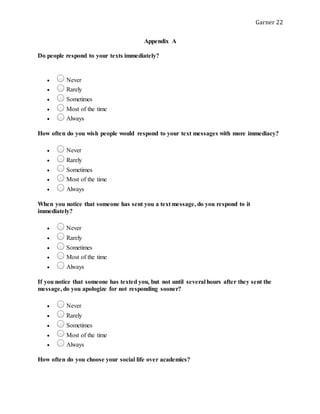
Appendix A
Do people respond to your texts immediately?
 Never
 Rarely
 Sometimes
 Most of the time
 Always
How often do you wish people would respond to your text messages with more immediacy?
 Never
 Rarely
 Sometimes
 Most of the time
 Always
When you notice that someone has sent you a text message, do you respond to it
immediately?
 Never
 Rarely
 Sometimes
 Most of the time
 Always
If you notice that someone has texted you, but not until several hours after they sent the
message, do you apologize for not responding sooner?
 Never
 Rarely
 Sometimes
 Most of the time
 Always
How often do you choose your social life over academics?
Garner 23
 Never
 Rarely
 Sometimes
 Most of the time
 Always
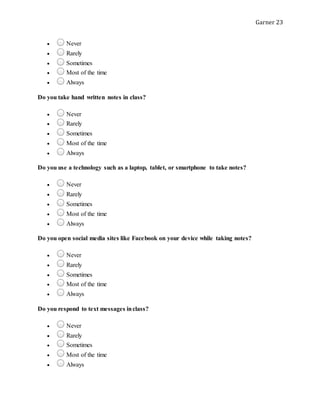
Do you take hand written notes in class?
 Never
 Rarely
 Sometimes
 Most of the time
 Always
Do you use a technology such as a laptop, tablet, or smartphone to take notes?
 Never
 Rarely
 Sometimes
 Most of the time
 Always
Do you open social media sites like Facebook on your device while taking notes?
 Never
 Rarely
 Sometimes
 Most of the time
 Always
Do you respond to text messages inclass?
 Never
 Rarely
 Sometimes
 Most of the time
 Always
Garner 24
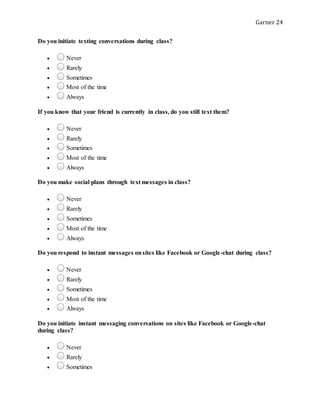
Do you initiate texting conversations during class?
 Never
 Rarely
 Sometimes
 Most of the time
 Always
If you know that your friend is currently in class, do you still text them?
 Never
 Rarely
 Sometimes
 Most of the time
 Always
Do you make social plans through text messages in class?
 Never
 Rarely
 Sometimes
 Most of the time
 Always
Do you respond to instant messages onsites like Facebook or Google-chat during class?
 Never
 Rarely
 Sometimes
 Most of the time
 Always
Do you initiate instant messaging conversations on sites like Facebook or Google-chat
during class?
 Never
 Rarely
 Sometimes
Garner 25
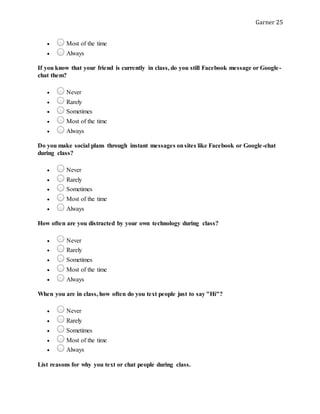
 Most of the time
 Always
If you know that your friend is currently in class, do you still Facebook message or Google-
chat them?
 Never
 Rarely
 Sometimes
 Most of the time
 Always
Do you make social plans through instant messages onsites like Facebook or Google-chat
during class?
 Never
 Rarely
 Sometimes
 Most of the time
 Always
How often are you distracted by your own technology during class?
 Never
 Rarely
 Sometimes
 Most of the time
 Always
When you are in class, how often do you text people just to say "Hi"?
 Never
 Rarely
 Sometimes
 Most of the time
 Always
List reasons for why you text or chat people during class.
Garner 26
_______________________________________________________________________
Appendix B
Table 1: Correlation Between Social Tendencies and Feeling Distracted
Appendix C
Table 2: T-Test Comparing Boredom to Initiate, Respond, and Feeling Distracted
Garner 27

Thesis Final Draft SCG

  • 1.
    Garner 1 Stephen Garner ProfessorJean Miller Senior Seminar 4199-11 December 4, 2013 The Distractibility of Computer Mediated Interactions In Classrooms Introduction Sometimes sitting in class can be boring. Especially those late afternoon classes, when it is sunny outside and all your friends are vigorously texting you, “Hey, when do you get out?” and “Just leave now! Who takes a six o’clock class on a Friday?” the temptation to pull out your cell phone can be difficult to resist. However, if students do in fact place high value on their academics, they must resist. Cell phones can be detrimental to listening comprehension, and in a classroom setting, can negatively impact the user’s ability to learn (Crawford, Fox, and Rosen 2). Then why are students allowing themselves to be distracted? Is it due to a fear of missing out on social interactions? Or is it just plain apathy for academics? This paper will aim to discover what personal values and motivations are linked to student’s vulnerability to the distractions facilitated by technology. The fact is 95 percent of students bring their cell phones to class (Bohlander and Tindell 1). Additionally, Crawford, Fox, and Rosen found that attempting to hold an instant messaging conversation, while trying to effectively comprehend the material, drastically slowed the rate at which the participants completed the multiple choice quizzes meant to test their comprehension ability (2). As the presence of cell phones in classrooms increases, so does the importance of understanding why students so eagerly engage in non-academic use of technology during class.
  • 2.
    Garner 2 This researchproject is dedicated to uncovering what motivates students to abuse technology in class, despite its negative impact on learning. The next section of this study will review previous literature dedicated to studying how cell phones are currently being used in the classroom and to what extent cell phones are a distraction in a classroom setting. Following the literature review, this paper describes the survey distribution and data coding involved in the methodological procedures of this study. The following section provides an analysis of the survey data using SPSS software. The final section of the paper is a discussion of the findings and limitations of the study. Literature Review I. Introduction to the Literature Review Cell phones have become a staple for the average college student; they act as a tool for students to stay connected with peers, family members, and even teachers (Angster, Frank, and Lester 402). With this growing dependency on cell phones, students are allowing themselves to be distracted by their mobile phones during class, and in some cases, it is costing students some of the most valuable pieces of their education: productive class time, and a positive student- teacher relationship (Carpenter el al. 323). Most high school classes are smaller than a majority of collegiate classes, which enables high school teachers to keep a closer watch over their students (Charles 9). A study done by Gurrie and Johnson revealed that 295 of the 321 students surveyed, that nearly 92 percent, reported using their phones in class while the teacher or a fellow student was talking (20). With the increase in class size from high school to college, there is much less authority presence, transferring the responsibility of regulating cell phone use to the students (Klausner, Wang, and Wei 185). This literature review will examine the ways in which students use cell phones in the classroom.
  • 3.
    Garner 3 II. TheDistractibility of CMC Before mobile phones became prevalent on college campuses, students were using laptops and internet connections to communicate via instant messaging (Crawford, Fox, and Rosen 2). Crawford, Fox, and Rosen conducted a study that analyzed people’s ability to read comprehensively while communicating through online channels. Their research found that the distractions did not affect their subjects’ ability to comprehend the readings, or complete assignments. However, the study did reveal that attempting to hold an instant messaging conversation, while trying to effectively comprehend the material, drastically slowed the rate at which the participants completed the multiple choice quizzes meant to test their comprehension ability (Crawford, Fox, and Rosen 2). Similarly, Archer et al. found that students using non- digital-based forms of note taking were more productive than those using laptops (365). These findings highlight the distractibility that comes with being exposed to computer-mediated communication (CMC). Though the study did not take place within the classroom, these findings reveal a correlation between students’ abilities to comprehend material in a time-sensitive scenario while conducting CMC. In the classroom, the students and teachers are allotted a specific amount of time in which to achieve effective learning. Reynol Junco extends the research done by Fox et al. by examining students’ conducting CMC in a classroom setting (Junco 2242). Fox et al. pointed out that the distraction of CMC lengthens the amount of time it takes for students to comprehend information (52), while Junco’s studies examined the use of information and communication technologies (ICTs), such as laptops and cell phones (2242). Though laptops and instant messaging were the primary focus of these subsequent studies, there is a distinct transition towards using cell phones as the primary means for CMC (Junco 2242). This shift between
  • 4.
    Garner 4 instant messagingand cell phone usage demonstrates the importance of studying how this increase of cell phone use affects learning, and students’ and teachers’ perceptions of the use of cell phones in the classroom. III. The Shift Towards Cell Phones Many researchers have studied how frequently students use their mobile phones; all of their studies included an examination of the use of texting and other “non-calling” features (402). Angster, Frank, and Lester examined the frequency of texting and calling in relation to how fulfilling those interactions were (403). Other researchers examined how the use of cell phones intruded on face-to-face interactions (Beaver, Knox, and Zusman 629). Drumheller et al. examined how time consuming the use of cell phones and handheld devices were on college students, by asking students to keep a diary that outlined the amount of time they spent using said devices in a day (25). Jin and Park’s study, In-Person Contact Begets Calling And Texting: Interpersonal Motives For Cell Phone Use, Face-To-Face Interaction, And Loneliness, examined the correlation between how frequently student encountered cell phone interactions compared to face-to-face interactions (In-Person Contact 611). Another study conducted by Jin and Park called, Mobile Voice Communication And Loneliness: Cell Phone Use And The Social Skills Deficit Hypothesis, uncovered that “better social skills were related to more voice calling, even with face-to- face interaction held constant, and more face-to-face interactions were associated with more voice calling” (Mobile Voice Communication 1105) These studies, which revealed the growth in students’ frequency of cell phone use outside the classroom, led researchers to begin examining how cell phones were being used inside the classroom. IV. The Distractibility of Cell Phones
  • 5.
    Garner 5 Now, studiesare starting to shift their focus towards how the presence of cell phones affects classroom activities because more students are using cell phones during class. End et al. took particular interest in understanding how cell phones created distractions during class (56). The researchers examined two simulated lectures with different conditions. The first lecture they examined was the control, in which no cell phone rings occurred; the second lecture had two cell phone rings occur during the class (End et al. 56). Both test groups were asked to take notes, as well as complete a multiple-choice exam at the end of the lecture. The researchers observed a distinct drop in test scores, as well as a drop in the amount of notes taken by students during the lecture with cell phones ringing (End et al. 56). This study provided future researchers with the opportunity to test how the use of cell phones affected students’ ability to learn in classroom situations where the use of cell phones was occurring. More recently, researchers have begun extending the work of End et al. by focusing their attention towards two related aspects of how cell phones are making their way into the classroom. The first aspect being how frequently students use their phones, primarily for texting, while in the classroom; the second aspect being how distracting phones were during class, with a focus on how the use of phones affects students’ ability to learn (End et al. 55-57). Bohlander and Tindell directed their research towards understanding exactly how often students were using their phones during classroom lectures. They found that 92 percent of students not only brought their phones to class, but also admitted to using their phone to send and receive text messages during class time (Bohlander and Tindell 3). These investigations made it possible for newer research to work under the relative assumption that most college students were bringing their phone to class, and most importantly, using their phones while in class.
  • 6.
    Garner 6 Carrier etal. expanded the research conducted by Bohlander and Tindell by examining exactly how distracting it could be to send and receive text messages during an informative, class-like presentation. Students in several test groups received anywhere from 0-19 texts during the course of a 30 minute presentation. The researchers found that those who were subjected to more text messages had lower memory recall of the presentations (Carrier et al. 168). These two studies, conducted by Carrier et al. and Bohlander and Tindell, reveal the problem between the frequency with which college students are texting, alongside actual evidence of the negative effects of sending and receiving text messages on students’ ability to learn. V. Perceptions of Cell Phones in the Classrooms and ‘Self-Regulation’ Acknowledging that the use of cell phones is a distraction in classrooms provoked researchers to examine why students succumb to using cell phones despite the potential decrease in learning. Klausner, Wang, and Wei extended the research of previous studies to include the element of how students “self-regulate” their texting during class in relation to the attention they pay during classroom learning (185). They found that, “self-regulated students were more likely to sustain their attention on classroom learning, and, therefore, less likely to text message during class. Subsequently, these students perceived themselves to have achieved better cognitive learning outcomes, whereas students who frequently texted during class had difficulty maintaining their sustained attention during classroom learning and, in turn, potentially sacrificed cognitive learning outcomes” (200-201). By including research into how students regulate the amount of texting they do while in class, information gathering is more closely considering how individuals perceive texting as an acceptable classroom behavior. The data they collected focused mostly on how frequently students text in class (Klausner, Wang, and Wei
  • 7.
    Garner 7 195). Theintroduction of this self-evaluation is important to understanding why students text in class, and what might motivate students to not use their phones in class. On some level, students understand the detriment that cell phones cause to their learning. Students use tactics, such as hiding their phones behind their legs while they type out a quick message, in order to not disrespect their teacher. Students know they should not be using their technology to socialize during class, but they continue to do so despite the academic repercussions and damage to the student-teacher relationship. Anita Charles interviewed several students and faculty at a high school in New England to try and uncover what motivates students’ cell phone use in the classroom. The teachers in this study seemed to be aware of the fact that students texted during class; however, there is no information about to what degree teachers are aware of their students’ cell phone use in class (Charles 8-10). It becomes apparent that students are more likely to use their phone based on which teacher’s class they are attending, due to a variance in how teachers enforce the “no-texting” rule; not every teacher is as effective at preventing cell phone use in their classes (Charles 10). Both college and high school students use their phones during class; however, the sizes of lecture classes you find in college are a much larger setting than high school classrooms. This lecture setting allows for more discrete ways for students to use their phones. Students and teachers understand that phones are distracting, but students seem to find them to be less impeding than teachers. Burns and Lohenry surveyed students and teachers about the etiquette of using cell phones during class. They found that both students and teachers believed cell phones to be distracting (805). A study by Ahmad Alobiedat also found that students and teachers shared similar perceptions of the appropriateness of using cell phones in classrooms (7). Despite the finding that teachers and students both found phones to be
  • 8.
    Garner 8 distracting, Baker,Lusk, and Neuhauser, concluded that students were much more accepting of having cell phones, and similar technologies present in the classroom (284-285). A study done by Scott W. Campbell revealed that students were less disturbed by ringing cell phones than teachers (280). Students and teachers agree that smart phones are distracting, however students have a much more apathetic attitude towards their presence and use during class, despite knowing that their teachers are far more disapproving of these devices. As mobile technology has developed, more room has opened for researchers to observe the ways in which mobile phones are being used for “non-calling” purposes. Bohlander and Tindell found 54 percent of students revealed that they believed professors would be “shocked” if they knew how frequently students were texting during class (4). The use of vibrate, and the less noticeable alerts have made communicating with cell phones much more discrete. It is now possible to use a mobile phone to send and receive text messages without disturbing other members in the class, or being caught by the teacher. This discrete use of cell phones is leading to a drastic increase in cell phone use by students while in class. Gurrie and Johnson administered a survey to a group of undergraduate students, asking questions about their use of cell phones in the classroom. Astonishingly, 91.9 percent of the respondents admitted to using their phones in class while either a teacher or fellow student was talking, and 74.9 percent of students reported using social media and email during class. Students also reported an understanding that using their phones in class was rude to the teacher, 78.5 percent said that they believe using their phone in class portrays them negatively (15). Further research is required to examine what is motivating these students to succumb to this distraction, despite the academic consequences. This heightened rate of students reporting their
  • 9.
    Garner 9 CMC whilein class, as well as the reports of using social media during class, suggest the following hypothesis: H1: The more socially inclined a student is, the more likely that student is to be distracted by CMC in class. Gurrie and Johnson study found that students reported boredom (11 percent) and socializing (21 percent) as reasons for increased cell phone use in the classroom (21). As a generalization, students who are more prone to boredom in class are less likely to pay attention to the professor. This suggests the following hypotheses: H2a: Students who reported “boredom” as a reason for using CMC in class are more likely to respond than those who reported something other than boredom. H2b: Students who reported “boredom” as a reason for using CMC in class are more likely to feel distracted by their own technology than those who reported something other than boredom. H2c: Students who reported “boredom” as a reason for using CMC in class are more likely to initiate than those who reported something other than boredom. VI. Conclusion to the Literature Review In order to begin exploring the student’s motivations for using cell phones in class, it was necessary to outline the previous research into the habits of cell phone use by students, such as the link between a better social life and the frequency with which students use their cell phones (Jin and Park, Mobile Voice Communication 1105). By understanding the immense frequency with which students carry and use their cell phones, there is a clear path that leads to the presence and inevitable use of cell phones in the classrooms. Method Research Question: What motivates students to use CMC to conduct extracurricular interactions during class, despite knowing that it is a distraction from in-class learning? Respondents
  • 10.
    Garner 10 The participantsfor this online survey were 109 undergraduate students in an intro-level communication course at The George Washington University. The students received extra credit for participating. The extra-credit was given to every student after they handed in a hard copy of the completion page of the online survey to their professor, maintaining anonymity. Procedure The students were given one week to complete the online survey. The students received extra credit after the entire class completed the survey, and only if the entire class completed the survey, which they did. This practice allowed students to be confident in their anonymity. The survey consisted of 20 questions. The professor distributed the survey to her students through email. 109 students were administered the survey, and 110 surveys were completed. All 110 surveys were compiled into data sets that were then analyzed. The response rate was 100 percent, this 100 percent response rate was expected because the extra credit was only provided if every member of the class participated. We therefore assume that a student accidentally submitted an extra response. Instrumentation Social tendency. Seven items on 5-point Likert scales (1 = never, 5 = always) measured participants’ tendency to value their social lives over academics. Sample items included: “Do you make social plans through text messages in class?”, and “How often do you choose your social life over academics?” The internal consistency of the scale was deemed satisfactory: Crombach’s alpha for social tendency was .87.
  • 11.
    Garner 11 Distracted bytheir own technology. One item on the survey asked, “How often are you distracted by your own technology in class?” This item is crucial in measuring the distractibility of the student and will be used as the dependent variable. Initiate versus respond. Two items on 5-point Likert scales (1 = never, 5 = always) measured, respectively, a students’ tendency to initiate CMC in class, and to respond to CMC in class. The items measuring students’ tendency to initiate CMC in class included: “Do you initiate texting conversations during class?” and “Do you initiate instant messaging conversations on sites like Google-chat and Facebook during class?” The items measuring students’ tendency to respond to CMC in class included: “Do you respond to text messages in class?” and “Do you respond to instant messages on sites like Google-chat and Facebook during class?” The internal consistency of the 2 scales was deemed acceptable: Crombach’s alpha for “intiate” was .65, and for “respond” was .69. Students who reported boredom and students who did not report boredom. The final instrument for data collection was an open ended question at the end of the survey that asked students to list reasons for why they text and chat people during class. These reasons were then sorted into two categories: “Students who reported boredom as a cause for their use of CMC in class,” and “Students who did not report boredom as a cause for their use of CMC in class.” Coding. In order to examine correlations between how students reported being “distracted by their own technology,” and their reported “social tendency,” I used the ‘Bi- variate’ function in SPSS. I also used SPSS to analyze the differences between students who reported boredom and students who did not report boredom in relation to how those
  • 12.
    Garner 12 students reportedtheir tendency to initiate CMC in class, respond to CMC in class, and become distracted by their own technology in class. Results The survey data was analyzed using SPSS statistical analysis software. Variables were correlated using the bi-variate function as well as analyzed through the use of a t-test. Results showed significant correlations supporting hypothesis 1 using the bi-variate function and marginally significant results were found supporting hypotheses 2a, b, and c using the t-test. Hypothesis 1 predicted that the more socially inclined a student is, the more likely that student is to be distracted by CMC in class. Bi-variate correlation analysis was performed between the social tendency sub-set variable, and the feeling distracted by their own technology variable. Results indicated that social tendency and feeling distracted by their own technology, were positively correlated, r=.64, p<0.01 (see Table 1 below), Table 1: Correlation Between Social Tendencies and Feeling Distracted
  • 13.
    Garner 13 therefore hypothesis1 was supported. Independent sample t-test was performed with ‘students who reported boredom’ as the dependent variable and initiate, respond, and feeling distracted by their own technology as the independent variables. Hypothesis 2a predicted that students who reported boredom as a reason forusing CMC in class are more likely to respond than those who reported something other than boredom. The results of the t-test indicated that perceived boredom in class had a marginally significant influence on 2 of the variables, responding, t(107) = 1.67, p<0.10, and being distracted, t(107) = 1.79, p<0.10, specifically, those who reported boredom in class as the primary reason for using social media while in class are more likely to respond to CMC conversations (M = 3.25, SD = .87) than those who reported other reasons (M = 2.95, SD = .91) (e.g. “[I] Think of things I forgot to tell them, I need to get in contact [with someone], or making plans for later”) Therefore, hypothesis 2a is supported. Hypothesis 2b predicted that: Students who reported boredom as a reason forusing CMC in class are more likely to feel distracted by their own technology than those who reported something other than boredom. The t-test revealed that those who reported boredom in class as the primary reason for using social media in class are more likely to feel distracted (M = 3.32, SD = .84) than those who reported other reasons (M = 3.01, SD = .84). Therefore hypothesis 2b is supported. Hypothesis 2c predicted that students who reported “boredom” as a reason for using CMC in class are more likely to initiate than those who reported something other than boredom. The t-test revealed those who reported boredom in class as the primary reason for using social media in class are slightly more likely to initiate CMC conversations
  • 14.
    Garner 14 t(108) =1.42, p>0.10, (M = 2.38, SD = .75) than those who reported other reasons (M = 2.17, SD = .76). Though there is some data to support the hypothesis, there was no significant data to support hypothesis 2c (see Table 2 on page 14). Table 2: T-Test Comparing Boredom to Initiate, Respond, and Feeling Distracted Discussion The purpose of this study was to identify what motivates students to use their cell phones in class, despite knowing the academic consequences. Specifically, does a tendency to engage in social interactions increase the frequency with which students use their phones in the classroom? The survey responses indicate an overwhelming positive correlation that suggests students are motivated to use their phones in class by the need to be socially connected through technology. The correlation between students placing high value on social interaction and feeling distracted by their own technology tells us more about what the students in class are using there phones for, and not nearly enough about what is motivating the students to
  • 15.
    Garner 15 use theirtechnology. In response to the question, “How often do you choose social life over academics?”, which was examined under the “social tendency” subset, 57.7 percent of participants reported that they “sometimes” choose social life over academics, 9.9 percent reported they choose their social life over academics “most of the time,” and 3.6 percent reported they “always” choose social life over academics. This variable was the most concrete link between students placing high value on their social lives and their feeling distracted by their own technology in class, however this questions had the lowest reliability within the subset, slightly lowering the reliability of the correlation between these social tendencies and feeling distracted by technology in class. The other questions within the subset ask, specifically, what purposes students are using their phones for in class, (e.g. “Do you make social plans through text messages in class?). Though hypothesis 1 is supported through relatively high reliability of the correlation, hypotheses 2a,b, and c, may be more indicative of what motivates students to use their phones. Hypotheses 2a,b, and c, predicted that students who reported boredom as their primary reason for using their phones in class were more likely to initiate and respond to CMC, as well as feel more distracted by their own technology. Though the hypotheses were only marginally supported, the analysis suggests that students are more likely to succumb to CMC distractions if they are feeling bored, or have a tendency to feel bored, in class. Furthermore, there was hardly any statistical evidence to support hypothesis 2c, which predicted that those who reported boredom to the open-ended question were more likely to initiate CMC. This suggests that students’ feeling of boredom does not motivate an active tendency to use technology for CMC in class; instead, the findings suggest that boredom facilitates a passive motivation. In other words, students experiencing boredom
  • 16.
    Garner 16 are notactively seeking distractions, but passively waiting for the distraction to present itself. According to Bohlander and Tindell, 92 percent of students not only brought their phones to class, but also admitted to using their phone to send and receive text messages during class time (3). With such an overwhelming presence of technology in the classroom there is no need to actively seek out distraction. Through the many devices, including: laptops, tablets, and smartphones, that students are bringing to class, and through all the mediums by which they are connected, such as: Facebook, email, text messaging, and more, the distraction of CMC is so omnipotent that students need not actively seek out distraction by initiating CMC interaction because they are constantly flooded with texts and notifications that provoke a passive urge to respond, and as this study suggests: this passive tendency is increased by boredom. However, this is mostly speculation, due to the marginally significant correlations revealed by the t-test between these variables. There were several limitations to this study. The first was the sample of participants was 109 students in an intro level communication class at The George Washington University. Perhaps if the surveys were distributed across more classes in more departments within the university, or better yet, other universities throughout the world, the data would be more representative of the entire collegiate population. Which leads to the second limitation: demographics. The only demographic that the researcher was aware of is that all the participants were students enrolled in an intro-level communication course at GWU. By asking the students to disclose their sex, expected graduation date, age, and/or chosen field of study at the university, there would have been more dependent variables to analyze, making the survey data more useful.
  • 17.
    Garner 17 Third, theparticipants self-reported their use of technology in the classroom. Despite students reporting fairly high levels of CMC interactions and other variables, perhaps students self-reporting underreported their actual use of technology in the classroom, as well as social tendencies and distractibility. Finally, the data analysis found many of the questions on the survey to be insignificant, and somewhat irrelevant. The study was limited by the lack of relevant survey questions, perhaps further refinement and pre testing of the survey, before administering the final survey, would yield more relevant data. One potential flaw in the study was that students were given an extra-credit incentive to complete the survey that all but guaranteed a 100 percent response rate. 109 students received the survey, and 110 surveys were completed. The professor also explained that only 108 students were now taking the course, and the 109th participant may have ignored the email contacting the survey, as they should have no interest in extra credit for a class they are no longer enrolled in. Furthermore, the students were required to hand in the final page of the survey, indicating that they had completed the survey. However, there was no way to identify who handed in which piece of proof. The concern is that certain students may have been aware that handing in multiple proofs might increase the chances of the whole class receiving extra credit, thus the data would be skewed due to students submitting multiple surveys. Conclusion The study revealed that students who place high value on socializing are more likely to be distracted by their own technology in class. It also supported the hypothesis that boredom increases the likelihood that students will be distracted by their own technology
  • 18.
    Garner 18 in class.These findings will be essential to future research into what motivates students to allow themselves to become distracted by technology, particularly when it is used for CMC interactions during class. The study found marginally significant correlation between boredom and distractibility; this is an area that should be focused on more thoroughly in future studies. Boredom was shown to increase distractibility, but in a passive function. Future studies could analyze the differences between actively seeking social interactions through CMC, versus passively allowing distraction to interrupt the attention of the students in class. A research question that would be interesting for future studies to examine would be, “Are there any motivations, characteristics, or values that pertain to students that increase the likelihood that a student will actively seek CMC as a distraction?” One primary variable that was left out of this study was demographics. Future researchers attempting to replicate this study should include information about demographics so that trends between gender, age, grade, and field of study could be incorporated into the analysis of how social tendencies influence distractions by technology in class. Students’ tendency to become distracted by technology in class is causing reduced learning. By understanding what influences motivate a student to become distracted, and resort to using technology for CMC social interactions, the academic community can begin to pinpoint those motivations in order to find solutions that may reduce this tendency to become distracted during academic pursuits of all kinds.
  • 19.
    Garner 19 Works Cited Alobiedat,Ahmad. "Faculty And Student Perception Towards The Appropriate And Inappropriate Use Of Mobile Phones In The Classroom At The University Of Granada." International Journal Of Instructional Media 39.1 (2012): 7-16. Web. 28 Mar. 2013. Angster, Alexa, Michael Frank, and David Lester. "An Exploratory Study Of Students' Use Of Cell Phones, Texting, And Social Networking Sites." Psychological Reports 107.2 (2010): 402-404. Web. 18 Feb. 2013. Archer, Karen et al. "Examining The Impact Of Off-Task Multi-Tasking With Technology On Real-Time Classroom Learning." Computers & Education 58.1 (2012): 365-374. Web. 27 Mar. 2013. Baker, William M., Edward J. Lusk, and Karyn L. Neuhauser. "On The Use Of Cell Phones And Other Electronic Devices In The Classroom: Evidence From A Survey Of Faculty And Students." Journal Of Education For Business 87.5 (2012): 275-289. Web. 5 Mar. 2013. Beaver, Tiffany, David Knox, and Marty E. Zusman. "Hold The Phone!": Cell Phone Use And Partner Reaction Among University Students." College Student Journal 44.3 (2010): 629-632. Web. 28 Mar. 2013. Bohlander, Robert W., and Deborah R. Tindell. "The Use And Abuse Of Cell Phones And Text Messaging In The Classroom: A Survey Of College Students." College Teaching 60.1 (2012): 1-9. AWeb. 4 Mar. 2013. Burns, Shari M., and Kevin Lohenry. "Cellular Phone Use In Class: Implications For Teaching And Learning A Pilot Study." College Student Journal 44.3 (2010): 805-810. Web. 27 Mar. 2013.
  • 20.
    Garner 20 Campbell, Scott."Perceptions Of Mobile Phones In College Classrooms: Ringing, Cheating, And Classroom Policies." Communication Education 55.3 (2006): 280-294. Web. 4 Mar. 2013. Carpenter, Christina N. et al. "Effects Of Classroom Cell Phone Use On Expected And Actual Learning." College Student Journal 46.2 (2012): 323-332. Web. 4 Mar. 2013. Carrier, L. Mark "An Empirical Examination Of The Educational Impact Of Text Message- Induced Task Switching In The Classroom: Educational Implications And Strategies To Enhance Learning." Psicologia Educativa 17.2 (2011): 163-177. Web. 23 Mar. 2013. Charles, Anita S. "Cell Phones: Rule-Setting, Rule-Breaking, And Relationships In Classrooms." American Secondary Education 40.3 (2012): 4-16. Academic Search Premier. Web. 18 Feb. 2013. Crawford, Mary, Annie Beth Fox, Jonathan Rosen. "Distractions, Distractions: Does Instant Messaging Affect College Students' Performance On A Concurrent Reading Comprehension Task?." Cyberpsychology & Behavior 12.1 (2009): 51-53. Web. 23 Mar. 2013. Drumheller, Kristina et al. "Cell Phones, Text Messaging, And Facebook: Competing Time Demands Of Today's College Students." College Teaching 59.1 (2011): 23-30. Web. 23 Mar. 2013. End, Christian M. et al. "Costly Cell Phones: The Impact Of Cell Phone Rings On Academic Performance." Teaching Of Psychology 37.1 (2010): 55-57. Web. 4 Mar. 2013. Gurrie, Chris, and Michelle Johnson. "What Are They Doing On Those Cell Phones? Bridging The Gap To Better Understand Student Cell Phone Use And Motivations In Class."
  • 21.
    Garner 21 Florida CommunicationJournal 39.2 (2011): 11-21. Communication & Mass Media Complete. Web. 1 Dec. 2013. Jin, Borae, and Namkee Park. "In-Person Contact Begets Calling And Texting: Interpersonal Motives For Cell Phone Use, Face-To-Face Interaction, And Loneliness." Cyberpsychology, Behavior & Social Networking 13.6 (2010): 611-618. Web. 27 Mar. 2013. --- "Mobile Voice Communication And Loneliness: Cell Phone Use And The Social Skills Deficit Hypothesis." New Media & Society 15.7 (2013): 1094-1111. Communication & Mass Media Complete. Web. 1 Dec. 2013. Junco, Reynol1. "In-Class Multitasking And Academic Performance." Computers In Human Behavior 28.6 (2012): 2236-2243. Web. 23 Mar. 2013. Klausner, Michael, Y. Ken Wang, and Fang-Yi Flora Wei. "Rethinking College Students' Self- Regulation And Sustained Attention:Does Text Messaging During Class Influence Cognitive Learning?." Communication Education 61.3 (2012): 185-204. Web. 27 Mar. 2013.
  • 22.
    Garner 22 Appendix A Dopeople respond to your texts immediately?  Never  Rarely  Sometimes  Most of the time  Always How often do you wish people would respond to your text messages with more immediacy?  Never  Rarely  Sometimes  Most of the time  Always When you notice that someone has sent you a text message, do you respond to it immediately?  Never  Rarely  Sometimes  Most of the time  Always If you notice that someone has texted you, but not until several hours after they sent the message, do you apologize for not responding sooner?  Never  Rarely  Sometimes  Most of the time  Always How often do you choose your social life over academics?
  • 23.
    Garner 23  Never Rarely  Sometimes  Most of the time  Always Do you take hand written notes in class?  Never  Rarely  Sometimes  Most of the time  Always Do you use a technology such as a laptop, tablet, or smartphone to take notes?  Never  Rarely  Sometimes  Most of the time  Always Do you open social media sites like Facebook on your device while taking notes?  Never  Rarely  Sometimes  Most of the time  Always Do you respond to text messages inclass?  Never  Rarely  Sometimes  Most of the time  Always
  • 24.
    Garner 24 Do youinitiate texting conversations during class?  Never  Rarely  Sometimes  Most of the time  Always If you know that your friend is currently in class, do you still text them?  Never  Rarely  Sometimes  Most of the time  Always Do you make social plans through text messages in class?  Never  Rarely  Sometimes  Most of the time  Always Do you respond to instant messages onsites like Facebook or Google-chat during class?  Never  Rarely  Sometimes  Most of the time  Always Do you initiate instant messaging conversations on sites like Facebook or Google-chat during class?  Never  Rarely  Sometimes
  • 25.
    Garner 25  Mostof the time  Always If you know that your friend is currently in class, do you still Facebook message or Google- chat them?  Never  Rarely  Sometimes  Most of the time  Always Do you make social plans through instant messages onsites like Facebook or Google-chat during class?  Never  Rarely  Sometimes  Most of the time  Always How often are you distracted by your own technology during class?  Never  Rarely  Sometimes  Most of the time  Always When you are in class, how often do you text people just to say "Hi"?  Never  Rarely  Sometimes  Most of the time  Always List reasons for why you text or chat people during class.
  • 26.
    Garner 26 _______________________________________________________________________ Appendix B Table1: Correlation Between Social Tendencies and Feeling Distracted Appendix C Table 2: T-Test Comparing Boredom to Initiate, Respond, and Feeling Distracted
  • 27.