Farhan Ali
MS(CS), BS(CS), PGD
B.Ed, M.Ed,
Lecturer, Research Supervisor, Resource Person
Govt. Ghazali Degree College Jhang
• Action research is a process of systematic
reflection, enquiry and action carried out by
individuals about their own practice.
• Action research is a term used to describe
professionals studying their own practice in
order to improve it.
Action Research In Education
• Action research in education is an enquiry which
is carried out in order to understand, evaluate
and then to change, in order to improve some
educational practices.
• When applied to teaching, action research
involves gathering and interpreting data to better
understand an aspect of teaching and learning
and applying the outcomes to improve practice.
A Brief History Of Action Research
• The term “action research” was used by Kurt Lewin, a
social-psychologist in 1940.
• According to Kurt Lewin, social conditions might be
enhanced through the group processes that involve four
steps-
• Planning
• Acting
• Observing
• Reflecting
These steps leads to the development of action research.
Contd….
• Development of action research took place in
three different stages-
• First stage- identification of a process for
addressing societal issues.
• Second stage- improving practice and the need
to involve practitioners.
• Third stage- participatory, emancipatory, or
community research in which groups assumed
responsibility for their own emancipation and
change.
Types Of Action Research Design
• Practical Action Research- enhances the
practice of education through the systematic
study of a local problem.
Examples of Practical Action Research
• An elementary teacher studies the disruptive
behavior of a child in his/her classroom.
• A college instructor studies his professional
development using technology in teaching.
Contd…
• Participatory Action Research-
• collaborative and community based research
• contributes to emancipation or change.
• addresses the social problems that constrain and
repress the lives of students and educators.
Examples:
Curricula that deny students enrolment.
Assessments that serve to confirm student
failure rather than learning.
K-12 classroom interactions that silence and
quiet the voices of certain students.
Inequitable distribution of college faculty
salaries that favour men over women.
Key Characteristics Of Action Research
• Addresses Practical Issues
• Self-reflective Research
• Collaborative Research
• Based on Plan of Action
• Sharing of Reports
Steps In Action Research
• Identification of a problem- problem to be
studied is identified.
• Locating Resources- to determine what others
have learned about solving a particular problem.
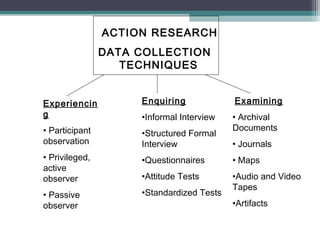
• Data Collection- through experiencing,
enquiring and examining.
ACTION RESEARCH
DATA COLLECTION
TECHNIQUES
Experiencin
g
• Participant
observation
• Privileged,
active
observer
• Passive
observer
Enquiring
•Informal Interview
•Structured Formal
Interview
•Questionnaires
•Attitude Tests
•Standardized Tests
Examining
• Archival
Documents
• Journals
• Maps
•Audio and Video
Tapes
•Artifacts
Contd…
• Data Analysis- data can be analyzed by the
researcher or the help of other educators or data
analysts can be sought.
• Developing a plan for Action-
• Presenting the data to important stakeholders.
• Establishing a pilot program
• Implementing an ongoing research agenda to
explore new practices.
Contd…
• Implementation of Plan- to monitor the impact
of the proposed solution.
• Reflection- to know what is learned or gained
from implementation of plan.
• Sharing of Reports- report is shared with
educators that can immediately use the results.
Action Research

Action Research

  • 1.
    Farhan Ali MS(CS), BS(CS),PGD B.Ed, M.Ed, Lecturer, Research Supervisor, Resource Person Govt. Ghazali Degree College Jhang
  • 2.
    • Action researchis a process of systematic reflection, enquiry and action carried out by individuals about their own practice. • Action research is a term used to describe professionals studying their own practice in order to improve it.
  • 3.
    Action Research InEducation • Action research in education is an enquiry which is carried out in order to understand, evaluate and then to change, in order to improve some educational practices. • When applied to teaching, action research involves gathering and interpreting data to better understand an aspect of teaching and learning and applying the outcomes to improve practice.
  • 4.
    A Brief HistoryOf Action Research • The term “action research” was used by Kurt Lewin, a social-psychologist in 1940. • According to Kurt Lewin, social conditions might be enhanced through the group processes that involve four steps- • Planning • Acting • Observing • Reflecting These steps leads to the development of action research.
  • 5.
    Contd…. • Development ofaction research took place in three different stages- • First stage- identification of a process for addressing societal issues. • Second stage- improving practice and the need to involve practitioners. • Third stage- participatory, emancipatory, or community research in which groups assumed responsibility for their own emancipation and change.
  • 6.
    Types Of ActionResearch Design • Practical Action Research- enhances the practice of education through the systematic study of a local problem. Examples of Practical Action Research • An elementary teacher studies the disruptive behavior of a child in his/her classroom. • A college instructor studies his professional development using technology in teaching.
  • 7.
    Contd… • Participatory ActionResearch- • collaborative and community based research • contributes to emancipation or change. • addresses the social problems that constrain and repress the lives of students and educators. Examples: Curricula that deny students enrolment. Assessments that serve to confirm student failure rather than learning. K-12 classroom interactions that silence and quiet the voices of certain students. Inequitable distribution of college faculty salaries that favour men over women.
  • 8.
    Key Characteristics OfAction Research • Addresses Practical Issues • Self-reflective Research • Collaborative Research • Based on Plan of Action • Sharing of Reports
  • 9.
    Steps In ActionResearch • Identification of a problem- problem to be studied is identified. • Locating Resources- to determine what others have learned about solving a particular problem. • Data Collection- through experiencing, enquiring and examining.
  • 10.
    ACTION RESEARCH DATA COLLECTION TECHNIQUES Experiencin g •Participant observation • Privileged, active observer • Passive observer Enquiring •Informal Interview •Structured Formal Interview •Questionnaires •Attitude Tests •Standardized Tests Examining • Archival Documents • Journals • Maps •Audio and Video Tapes •Artifacts
  • 11.
    Contd… • Data Analysis-data can be analyzed by the researcher or the help of other educators or data analysts can be sought. • Developing a plan for Action- • Presenting the data to important stakeholders. • Establishing a pilot program • Implementing an ongoing research agenda to explore new practices.
  • 12.
    Contd… • Implementation ofPlan- to monitor the impact of the proposed solution. • Reflection- to know what is learned or gained from implementation of plan. • Sharing of Reports- report is shared with educators that can immediately use the results.