ACTION POTENTIAL
Presnted to;.Dr Kalim ullah
Presented by;.Nusrat Begum
INTRODUCTION
 ACTION POTENTIAL
Electrical stimulation created by
a sequence of ion fluxes through specialized
channels in the membrane.
 The transmembrane potential (TMP) is the
electrical potential difference (voltage) between
the inside and the outside of a cell.
 When there is a net movement of +ve ions into
a cell, the TMP becomes more +ve, and when
there is a net movement of +ve ions out of a
cell, TMP becomes more –ve.
 Ion channels help maintain ionic concentration
gradients and charge differentials between the
inside and outside of the cell membrane.
• Two main forces drive ions across cell
membranes:
• Chemical potential:
• An ion will move down its concentration
gradient.
• Electrical potential:
• An ion will move away from ions/molecules of
like charge
PHASES OF ACTION POTENTIALS
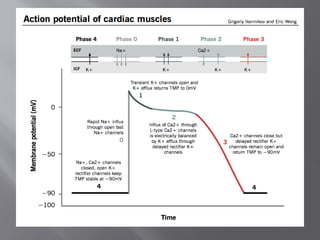
Phase 4:
 The resting phase
• The resting potential in a cardiomyocyte is −90
mV due to a constant outward leak of
K+
through inward rectifier channels.
• Na+
and Ca2+
channels are closed at resting
TMP.
 Phase 0: Depolarization
• An action potential triggered in a neighbouring
cardiomyocyte or pacemaker cell causes the
TMP to rise above −90 mV.
• Fast Na+
channels start to open one by one
and Na+
leaks into the cell, further raising the
TMP.
 Ca2+ channels open when the TMP is greater
than −40 mV and cause a small but steady
influx of Ca2+ down its concentration gradient
 Phase 1: Early repolarization
• TMP is now slightly positive.
• Some K+
channels open briefly and an outward
flow of K+
returns the TMP to approximately 0
mV.
 Phase 2: The plateau phase
• Ca2+
channels are still open and there is a
small, constant inward current of Ca2+
. This
becomes significant in the excitation-
contraction coupling process described below.
• K+
leaks out down its concentration gradient
through delayed K+
channels.
• These two countercurrents are electrically
balanced, and the TMP is maintained at
a plateau just below 0 mV throughout phase 2
 Phase 3: Repolarization
• Ca2+
channels are gradually inactivated.
• Persistent outflow of K+
, now exceeding
Ca2+
inflow, brings TMP back towards resting
potential of −90 mV to prepare the cell for a
new cycle of depolarization.
• Normal transmembrane ionic concentration
gradients are restored by returning Na+
and
Ca2+
ions to the extracellular environment, and
K+
ions to the cell interior.
THANK YOU
ACTION POTENTIAL. Cardiac Potential. Muscle Potential

ACTION POTENTIAL. Cardiac Potential. Muscle Potential

  • 1.
    ACTION POTENTIAL Presnted to;.DrKalim ullah Presented by;.Nusrat Begum
  • 2.
    INTRODUCTION  ACTION POTENTIAL Electricalstimulation created by a sequence of ion fluxes through specialized channels in the membrane.  The transmembrane potential (TMP) is the electrical potential difference (voltage) between the inside and the outside of a cell.
  • 3.
     When thereis a net movement of +ve ions into a cell, the TMP becomes more +ve, and when there is a net movement of +ve ions out of a cell, TMP becomes more –ve.  Ion channels help maintain ionic concentration gradients and charge differentials between the inside and outside of the cell membrane.
  • 4.
    • Two mainforces drive ions across cell membranes: • Chemical potential: • An ion will move down its concentration gradient. • Electrical potential: • An ion will move away from ions/molecules of like charge
  • 6.
    PHASES OF ACTIONPOTENTIALS Phase 4:  The resting phase • The resting potential in a cardiomyocyte is −90 mV due to a constant outward leak of K+ through inward rectifier channels. • Na+ and Ca2+ channels are closed at resting TMP.
  • 7.
     Phase 0:Depolarization • An action potential triggered in a neighbouring cardiomyocyte or pacemaker cell causes the TMP to rise above −90 mV. • Fast Na+ channels start to open one by one and Na+ leaks into the cell, further raising the TMP.
  • 8.
     Ca2+ channelsopen when the TMP is greater than −40 mV and cause a small but steady influx of Ca2+ down its concentration gradient
  • 9.
     Phase 1:Early repolarization • TMP is now slightly positive. • Some K+ channels open briefly and an outward flow of K+ returns the TMP to approximately 0 mV.
  • 10.
     Phase 2:The plateau phase • Ca2+ channels are still open and there is a small, constant inward current of Ca2+ . This becomes significant in the excitation- contraction coupling process described below. • K+ leaks out down its concentration gradient through delayed K+ channels.
  • 11.
    • These twocountercurrents are electrically balanced, and the TMP is maintained at a plateau just below 0 mV throughout phase 2
  • 12.
     Phase 3:Repolarization • Ca2+ channels are gradually inactivated. • Persistent outflow of K+ , now exceeding Ca2+ inflow, brings TMP back towards resting potential of −90 mV to prepare the cell for a new cycle of depolarization.
  • 13.
    • Normal transmembraneionic concentration gradients are restored by returning Na+ and Ca2+ ions to the extracellular environment, and K+ ions to the cell interior.
  • 16.