The Text:
Genres
• A genre is an organizational tool
• Groups scripts together by commonalities
• Historically, there are four major genres:
– Tragedy
– Comedy
– Melodrama
– Musical Theatre
The Text:
Tragedy
• A serious play with an unhappy ending
• Features a hero with a tragic flaw
– In Greek theatre, this is almost always pride
• Concerned specifically with moral and social questions or
problems
• Compels catharsis in the audience – the expulsion of feelings
of pity and fear
The Text:
Tragedies
Clockwise from top left: Medea,
The Crucible,
4.48 Psychosis, Long Day’s
Journey into Night
The Text:
Comedy
• Ordinary characters in extraordinary situations, ending happily.
• Unlike tragedy, comedy demands distance and objectivity
• Physical comedy is prevalent
– Sight gags: satyr plays had characters sporting large phalluses
– Slapstick: a device from commedia dell’arte
• Very few remain from Ancient Greek times
The Text:
Comedies
Clockwise from Top Left: Taming
of the Shrew, The Philadelphia
Story, The Foreigner, The
Lieutenant of Inishmore
The Text:
Melodrama
• Drama “with music”
• Hugely popular in 19th c. Europe and America
• Grows out of the Industrial Revolution
• Moral conflicts: good vs. evil
• Stock characters
• Audience expectations are fulfilled
– Good guy wins, evil is punished
– Hero gets the girl
– Values of society are reaffirmed
The Text:
Melodramas
From left: Dirty Work at
the Crossroads, The
Shaughraun
The Text:
Musical Theatre
• Combination of music and theatre
• Typical has actors singing onstage
• Accompanied by a live orchestra
• Usually some form of choreography
• Show Boat (1927) by Jerome Kern and Oscar Hammerstein II is
considered the birth of the American musical
• 1940’s the Golden Age of the Musical
The Text:
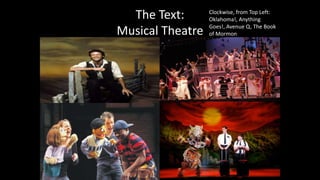
Musical Theatre
Clockwise, from Top Left:
Oklahoma!, Anything
Goes!, Avenue Q, The Book
of Mormon
Musical Theatre in Performance
• 2007 Tony Award – Lea Mechele, et. Al. – Spring Awakening
• 2008 – Passing Strange
• 2011 Tony Awards – Sutton Foster - Anything Goes
• 2013 Tony Awards – Neil Patrick Harris – Make it Bigger
Chapter 2: The Text
Major Questions
• Use Aristotle’s six elements to analyze a contemporary work of
theatrical fiction. How do they function? Do they still have value?
• Compare a contemporary comedy to an ancient comedy. What are
the similarities and differences? Look at structure, characters, etc.
• Identify three melodramas and compare how each follows or
breaks the “rules” of melodrama.
• Use Aristotle’s six elements to analyze a nontraditional text (a
painting, five minutes on Wescoe Beach, your favorite outfit.) How
do each of these elements highlight this nonlinear text?

Genres

  • 2.
    The Text: Genres • Agenre is an organizational tool • Groups scripts together by commonalities • Historically, there are four major genres: – Tragedy – Comedy – Melodrama – Musical Theatre
  • 3.
    The Text: Tragedy • Aserious play with an unhappy ending • Features a hero with a tragic flaw – In Greek theatre, this is almost always pride • Concerned specifically with moral and social questions or problems • Compels catharsis in the audience – the expulsion of feelings of pity and fear
  • 4.
    The Text: Tragedies Clockwise fromtop left: Medea, The Crucible, 4.48 Psychosis, Long Day’s Journey into Night
  • 5.
    The Text: Comedy • Ordinarycharacters in extraordinary situations, ending happily. • Unlike tragedy, comedy demands distance and objectivity • Physical comedy is prevalent – Sight gags: satyr plays had characters sporting large phalluses – Slapstick: a device from commedia dell’arte • Very few remain from Ancient Greek times
  • 6.
    The Text: Comedies Clockwise fromTop Left: Taming of the Shrew, The Philadelphia Story, The Foreigner, The Lieutenant of Inishmore
  • 7.
    The Text: Melodrama • Drama“with music” • Hugely popular in 19th c. Europe and America • Grows out of the Industrial Revolution • Moral conflicts: good vs. evil • Stock characters • Audience expectations are fulfilled – Good guy wins, evil is punished – Hero gets the girl – Values of society are reaffirmed
  • 8.
    The Text: Melodramas From left:Dirty Work at the Crossroads, The Shaughraun
  • 9.
    The Text: Musical Theatre •Combination of music and theatre • Typical has actors singing onstage • Accompanied by a live orchestra • Usually some form of choreography • Show Boat (1927) by Jerome Kern and Oscar Hammerstein II is considered the birth of the American musical • 1940’s the Golden Age of the Musical
  • 10.
    The Text: Musical Theatre Clockwise,from Top Left: Oklahoma!, Anything Goes!, Avenue Q, The Book of Mormon
  • 11.
    Musical Theatre inPerformance • 2007 Tony Award – Lea Mechele, et. Al. – Spring Awakening • 2008 – Passing Strange • 2011 Tony Awards – Sutton Foster - Anything Goes • 2013 Tony Awards – Neil Patrick Harris – Make it Bigger
  • 12.
    Chapter 2: TheText Major Questions • Use Aristotle’s six elements to analyze a contemporary work of theatrical fiction. How do they function? Do they still have value? • Compare a contemporary comedy to an ancient comedy. What are the similarities and differences? Look at structure, characters, etc. • Identify three melodramas and compare how each follows or breaks the “rules” of melodrama. • Use Aristotle’s six elements to analyze a nontraditional text (a painting, five minutes on Wescoe Beach, your favorite outfit.) How do each of these elements highlight this nonlinear text?