UNIVERSIDAD AUTONOMA DEL CARMEN
Lengua Inglesa
TICS aplicadas a la enseñanza en Ingles
ACT. 1.8
Carolina Ivanna Job Lòpez
3º Semester – Classroom Q102
1.  Behavioristic CALL.
•  Conceived in the 1950s and implemented in the ‘60s and '70s.
•  Based on the then-dominant behaviorist theories of learning
•  Programs of this phase entailed repetitive language drills ("drill
and practice”)
•  In the late ‘70s behavioristic approaches to language learning
had been rejected at both the theoretical and the pedagogical
level.
ž  Though CALL has developed gradually over the
last 30 years, this development can be categorized
in terms of three distinct phases:
2. Communicative CALL
•  Based on the communicative approach to teaching
which became prominent in the 1970s and 80s.
•  Focuses more on using forms rather than on the
forms themselves;
•  Teaches grammar implicitly rather than explicitly;
•  Allows and encourages students to generate
original utterances rather than just manipulate
prefabricated language;
3. Integrative CALL
•  Integrative approaches to CALL
are based on two important
technological developments of the
last decade - multimedia
computers and the Internet.
•  Allows a variety of media (text,
graphics, sound, animation, and
video) to be accessed on a single
machine
ICT
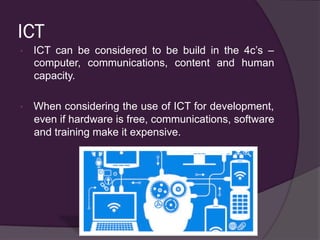
•  ICT can be considered to be build in the 4c’s –
computer, communications, content and human
capacity.
•  When considering the use of ICT for development,
even if hardware is free, communications, software
and training make it expensive.
ž  The applications of ICT can be divided under two broad
categories:
•  The first are those largely dependent on traditional
telecommunication networks to provide information
tailored to the user’s convenience and needs.
•  The second, we shall call human independent, where
information is processed and decisions are drived on the
basis of present criteria without human intervention at the
time of descion making.
ž  ICT is viewed as both, a means and an end for
development. It’s role should be seen best as
an enabler, primarily spanning several
dimesions:
1.  Efficiency and competitiveness.
2.  New business models an opportunities.
3.  Transparency and empowerment.
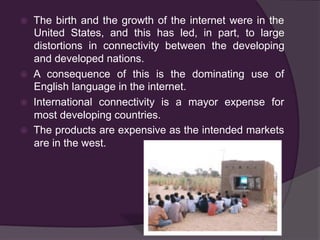
ž  The birth and the growth of the internet were in the
United States, and this has led, in part, to large
distortions in connectivity between the developing
and developed nations.
ž  A consequence of this is the dominating use of
English language in the internet.
ž  International connectivity is a mayor expense for
most developing countries.
ž  The products are expensive as the intended markets
are in the west.
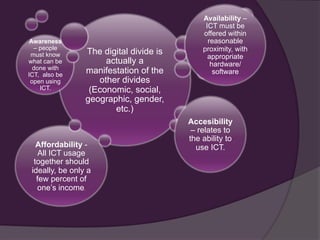
The digital divide is
actually a
manifestation of the
other divides
(Economic, social,
geographic, gender,
etc.)
Awareness
– people
must know
what can be
done with
ICT, also be
open using
ICT.
Availability –
ICT must be
offered within
reasonable
proximity, with
appropriate
hardware/
software
Accesibility
– relates to
the ability to
use ICT.Affordability -
All ICT usage
together should
ideally, be only a
few percent of
one’s income.
REFERENCES
ž  Warschauer M. (1996) "Computer Assisted
Language Learning: an Introduction".
In Fotos S. (ed.) Multimedia language teaching,
Tokyo: Logos International: 3-20.
http://www.ict4lt.org/en/warschauer.htm
ž  Chamos, M. (n.d.). INFORMATION AND
COMMUNICATIONS TECHNOLOGY. Retrieved
September 5, 2015, from
https://www.cs.cmu.edu/~rtongia/ICT4SD_Ch_2--
ICT.pdf

Act. 1.8

  • 1.
    UNIVERSIDAD AUTONOMA DELCARMEN Lengua Inglesa TICS aplicadas a la enseñanza en Ingles ACT. 1.8 Carolina Ivanna Job Lòpez 3º Semester – Classroom Q102
  • 2.
    1.  Behavioristic CALL. • Conceived in the 1950s and implemented in the ‘60s and '70s. •  Based on the then-dominant behaviorist theories of learning •  Programs of this phase entailed repetitive language drills ("drill and practice”) •  In the late ‘70s behavioristic approaches to language learning had been rejected at both the theoretical and the pedagogical level. ž  Though CALL has developed gradually over the last 30 years, this development can be categorized in terms of three distinct phases:
  • 3.
    2. Communicative CALL • Based on the communicative approach to teaching which became prominent in the 1970s and 80s. •  Focuses more on using forms rather than on the forms themselves; •  Teaches grammar implicitly rather than explicitly; •  Allows and encourages students to generate original utterances rather than just manipulate prefabricated language;
  • 4.
    3. Integrative CALL • Integrative approaches to CALL are based on two important technological developments of the last decade - multimedia computers and the Internet. •  Allows a variety of media (text, graphics, sound, animation, and video) to be accessed on a single machine
  • 5.
    ICT •  ICT canbe considered to be build in the 4c’s – computer, communications, content and human capacity. •  When considering the use of ICT for development, even if hardware is free, communications, software and training make it expensive.
  • 6.
    ž  The applicationsof ICT can be divided under two broad categories: •  The first are those largely dependent on traditional telecommunication networks to provide information tailored to the user’s convenience and needs. •  The second, we shall call human independent, where information is processed and decisions are drived on the basis of present criteria without human intervention at the time of descion making.
  • 7.
    ž  ICT isviewed as both, a means and an end for development. It’s role should be seen best as an enabler, primarily spanning several dimesions: 1.  Efficiency and competitiveness. 2.  New business models an opportunities. 3.  Transparency and empowerment.
  • 8.
    ž  The birthand the growth of the internet were in the United States, and this has led, in part, to large distortions in connectivity between the developing and developed nations. ž  A consequence of this is the dominating use of English language in the internet. ž  International connectivity is a mayor expense for most developing countries. ž  The products are expensive as the intended markets are in the west.
  • 9.
    The digital divideis actually a manifestation of the other divides (Economic, social, geographic, gender, etc.) Awareness – people must know what can be done with ICT, also be open using ICT. Availability – ICT must be offered within reasonable proximity, with appropriate hardware/ software Accesibility – relates to the ability to use ICT.Affordability - All ICT usage together should ideally, be only a few percent of one’s income.
  • 10.
    REFERENCES ž  Warschauer M.(1996) "Computer Assisted Language Learning: an Introduction". In Fotos S. (ed.) Multimedia language teaching, Tokyo: Logos International: 3-20. http://www.ict4lt.org/en/warschauer.htm ž  Chamos, M. (n.d.). INFORMATION AND COMMUNICATIONS TECHNOLOGY. Retrieved September 5, 2015, from https://www.cs.cmu.edu/~rtongia/ICT4SD_Ch_2-- ICT.pdf