Until quite recently, computer-assisted language learning
(CALL) was a topic of relevance mostly to those with a
special interest in that area. Recently, though, computers
have become so widespread in schools and homes and
their uses have expanded so dramatically that the
majority of language teachers must now begin to think
about the implications of computers for language
learning.
Though CALL has developed gradually over the last 30 years,
this development can be categorized in terms of three
somewhat distinct phases which I will refer to as behavioristic
CALL, communicative CALL, and integrative CALL. As we will
see, the introduction of a new phase does not necessarily
entail rejecting the programs and methods of a previous
phase; rather the old is subsumed within the new. In addition,
the phases do not gain prominence one fell swoop, but, like
all innovations, gain acceptance slowly and unevenly.
Was based on the then-
dominant behaviorist
theories of learning.
Programs of this phase
entailed repetitive
language drills and can
be referred to as "drill
and practice"
Repeated exposure to the same material is
beneficial or even essential to learning
A computer is ideal for carrying out repeated
drills, since the machine does not get bored with
presenting the same material and since it can
provide immediate non-judgmental feedback
A computer can present such material on an
individualized basis, allowing students to proceed
at their own pace and freeing up class time for
other activities
Was based on the
communicative approach to
teaching which became
prominent in the 1970s and
80s. Proponents of this
approach felt that the drill
and practice programs of the
previous decade did not allow
enough authentic
communication to be of much
value.
focuses more on using forms rather than on the forms themselves;
teaches grammar implicitly rather than explicitly;
allows and encourages students to generate original utterances rather than just
manipulate prefabricated language;
does not judge and evaluate everything the students nor reward them with
congratulatory messages, lights, or bells;
avoids telling students they are wrong and is flexible to a variety of student responses;
uses the target language exclusively and creates an environment in which using the
target language feels natural, both on and off the screen; and
will never try to do anything that a book can do just as well.
Integrative approaches to CALL
are based on two important
technological developments of
the last decade - multimedia
computers and the Internet.
Multimedia technology -
exemplified today by the CD-
ROM - allows a variety of media
(text, graphics, sound, animation,
and video) to be accessed on a
single machine. What makes
multimedia even more powerful is
that it also entails hypermedia.
For the first time, language learners can
communicate directly, inexpensively, and
conveniently with other learners or speakers of
the target language 24 hours a day, from
school, work, or home. This communication can
be asynchronous (not simultaneous) through
tools such as electronic mail (email), which
allows each participant to compose messages at
their time and pace, or in can be synchronous
(synchronous, "real time"), using programs such
as MOOs, which allow people all around the
world to have a simultaneous conversation by
typing at their keyboards. It also allows not only
one-to-one communication, but also one-to-
many, allowing a teacher or student to share a
message with a small group, the whole class, a
partner class, or an international discussion list
of hundreds or thousands of people.
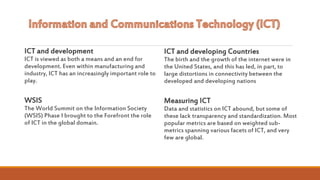
ICT and development
ICT is viewed as both a means and an end for
development. Even within manufacturing and
industry, ICT has an increasingly important role to
play.
WSIS
The World Summit on the Information Society
(WSIS) Phase I brought to the Forefront the role
of ICT in the global domain.
ICT and developing Countries
The birth and the growth of the internet were in
the United States, and this has led, in part, to
large distortions in connectivity between the
developed and developing nations
Measuring ICT
Data and statistics on ICT abound, but some of
these lack transparency and standardization. Most
popular metrics are based on weighted sub-
metrics spanning various facets of ICT, and very
few are global.
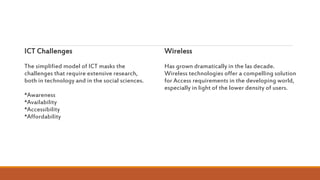
ICT Challenges
The simplified model of ICT masks the
challenges that require extensive research,
both in technology and in the social sciences.
*Awareness
*Availability
*Accessibility
*Affordability
Wireless
Has grown dramatically in the las decade.
Wireless technologies offer a compelling solution
for Access requirements in the developing world,
especially in light of the lower density of users.
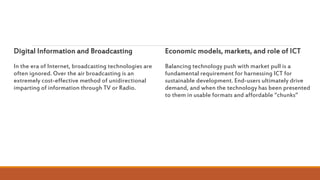
Digital Information and Broadcasting
In the era of Internet, broadcasting technologies are
often ignored. Over the air broadcasting is an
extremely cost-effective method of unidirectional
imparting of information through TV or Radio.
Economic models, markets, and role of ICT
Balancing technology push with market pull is a
fundamental requirement for harnessing ICT for
sustainable development. End-users ultimately drive
demand, and when the technology has been presented
to them in usable formats and affordable “chunks”
References
http://www.ict4lt.org/en/warschauer.htm
https://www.cs.cmu.edu/~rtongia/ICT4SD_Ch_2--ICT.pdf

Act 1.8 presentation

  • 2.
    Until quite recently,computer-assisted language learning (CALL) was a topic of relevance mostly to those with a special interest in that area. Recently, though, computers have become so widespread in schools and homes and their uses have expanded so dramatically that the majority of language teachers must now begin to think about the implications of computers for language learning.
  • 3.
    Though CALL hasdeveloped gradually over the last 30 years, this development can be categorized in terms of three somewhat distinct phases which I will refer to as behavioristic CALL, communicative CALL, and integrative CALL. As we will see, the introduction of a new phase does not necessarily entail rejecting the programs and methods of a previous phase; rather the old is subsumed within the new. In addition, the phases do not gain prominence one fell swoop, but, like all innovations, gain acceptance slowly and unevenly.
  • 4.
    Was based onthe then- dominant behaviorist theories of learning. Programs of this phase entailed repetitive language drills and can be referred to as "drill and practice" Repeated exposure to the same material is beneficial or even essential to learning A computer is ideal for carrying out repeated drills, since the machine does not get bored with presenting the same material and since it can provide immediate non-judgmental feedback A computer can present such material on an individualized basis, allowing students to proceed at their own pace and freeing up class time for other activities
  • 5.
    Was based onthe communicative approach to teaching which became prominent in the 1970s and 80s. Proponents of this approach felt that the drill and practice programs of the previous decade did not allow enough authentic communication to be of much value. focuses more on using forms rather than on the forms themselves; teaches grammar implicitly rather than explicitly; allows and encourages students to generate original utterances rather than just manipulate prefabricated language; does not judge and evaluate everything the students nor reward them with congratulatory messages, lights, or bells; avoids telling students they are wrong and is flexible to a variety of student responses; uses the target language exclusively and creates an environment in which using the target language feels natural, both on and off the screen; and will never try to do anything that a book can do just as well.
  • 6.
    Integrative approaches toCALL are based on two important technological developments of the last decade - multimedia computers and the Internet. Multimedia technology - exemplified today by the CD- ROM - allows a variety of media (text, graphics, sound, animation, and video) to be accessed on a single machine. What makes multimedia even more powerful is that it also entails hypermedia. For the first time, language learners can communicate directly, inexpensively, and conveniently with other learners or speakers of the target language 24 hours a day, from school, work, or home. This communication can be asynchronous (not simultaneous) through tools such as electronic mail (email), which allows each participant to compose messages at their time and pace, or in can be synchronous (synchronous, "real time"), using programs such as MOOs, which allow people all around the world to have a simultaneous conversation by typing at their keyboards. It also allows not only one-to-one communication, but also one-to- many, allowing a teacher or student to share a message with a small group, the whole class, a partner class, or an international discussion list of hundreds or thousands of people.
  • 7.
    ICT and development ICTis viewed as both a means and an end for development. Even within manufacturing and industry, ICT has an increasingly important role to play. WSIS The World Summit on the Information Society (WSIS) Phase I brought to the Forefront the role of ICT in the global domain. ICT and developing Countries The birth and the growth of the internet were in the United States, and this has led, in part, to large distortions in connectivity between the developed and developing nations Measuring ICT Data and statistics on ICT abound, but some of these lack transparency and standardization. Most popular metrics are based on weighted sub- metrics spanning various facets of ICT, and very few are global.
  • 8.
    ICT Challenges The simplifiedmodel of ICT masks the challenges that require extensive research, both in technology and in the social sciences. *Awareness *Availability *Accessibility *Affordability Wireless Has grown dramatically in the las decade. Wireless technologies offer a compelling solution for Access requirements in the developing world, especially in light of the lower density of users.
  • 9.
    Digital Information andBroadcasting In the era of Internet, broadcasting technologies are often ignored. Over the air broadcasting is an extremely cost-effective method of unidirectional imparting of information through TV or Radio. Economic models, markets, and role of ICT Balancing technology push with market pull is a fundamental requirement for harnessing ICT for sustainable development. End-users ultimately drive demand, and when the technology has been presented to them in usable formats and affordable “chunks”
  • 10.