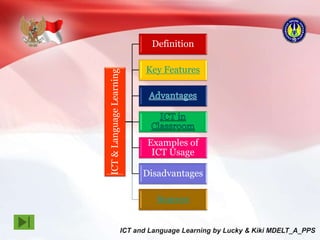
ICT&LanguageLearning
Definition
Key Features
Examples of
ICT Usage
Disadvantages
Sources
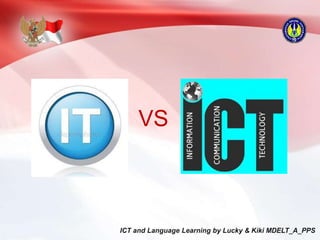
VS
THE DIFFERENCE BETWEEN IT AND ICT
IT (Information Technologies)
refers to an entire industry that uses
computers, networking, software and other
equipment to manage information. Generally,
IT departments are responsible for storing,
processing, retrieving and protecting digital
information of the company. For achieving
these tasks, they are equipped with
computers, DBMS, servers and security
mechanisms, etc. Professionals working in IT
departments range from system
administrators, database administrators to
programmers, network engineers and IT
managers.
ICT (Information and Communication
Technologies)
can be seen as an integration of IT with
mediation broadcasting technologies,
audio/ video processing and
transmission and telephony. Therefore,
ICT can be seen as an extended
acronym for IT. The term ICT is widely
used in the context of education,
whereas IT is a term widely used in the
industry. In addition, ICT is also used to
refer to the integration of telephone and
audio/ visual networks with computer
networks.
The United Nations
Development Programme
(UNDP, 2003) defines
ICTs as basically
information-handling
tools-avaried set of goods,
applications and services
that are used to produce,
store, process, distribute
and exchange
information. They include the ‘old'
ICTs of radio, television
and telephone, and the
‘new’ ICTs of computers,
satellite and wireless
technology and the
Internet.
These different tools are
now able to work together,
and combine to form our
`networked world' a
massive infrastructure of
interconnected telephone
services, standardized
computing hardware, the
internet, radio and
television, which reaches
into every corner of the
globe
ICT + EDUCATION
ICT in education point of view refers to Information and
communication technology such as computers,
communications facilities and features that variously
support teaching, learning and a range of activities in
education.
ICT has become essential in the language learning
because it gives a chance to the users to increase their
language knowledge as well as skills (e.g. learners) and to
provide interesting materials (e.g. teachers).
ICT has become essential tool for educational change and
reform as it leads us from “traditional” to “modern” learning
process.
THE KEY FEATURES OF ICT
 Speed.
 Capacity.
 Automation.
 Communicability.
 Replication.
 Provisionality.
 Interactivity.
 Non-linearity.
 Multi-modality.
(Pritchard, 2007)
• The Internet provides an easy and fast access to the use of current
and authentic materials in the language being studied.
• Such authentic materials include, for instance, online newspapers,
webcasts, podcasts, newsroom video clips or even video sharing
websites such as YouTube.
• Learners become more innovative with the help of ICT.
• ICT provides information to the learners which will be useful for
them to compete with this competitive world.
• Learners or classes could write letters or later even e-mails to each
other.
• Using ICT, learners can use Skype or online chatting where they not
only can write to each other in real-time, but also see and speak to
each other online.
• Learners are able to write, read, speak, listen, and react to a
conversation using ICT as part of the language learning process.
• They are motivated to communicate and collaborate with peers.
• Teachers are able to give individual and personalized guidance to the
learners that might lead them to be independent learners.
• The use of several media–audio, video, authentic contexts, and real-
world experiences help language learners with different learning styles to
assimilate the content according to their needs.
• The language teacher/tutor can use different approaches for the learners
and accommodate their different learning styles, needs, and
characteristics (fast, slow, or handicapped).
• The teacher can exert powerful motivation and provide bored learners
with exciting new ways to learn such as providing pictorial description in
the materials.
ICT-Based Teaching in
Classroom
a. Teachers should consider the possibility of using
ICT in the classroom.
b. Teachers should have adequate skill in using the
ICT tool.
c. Teachers know their position such as being
fasilitator, controller, navigator, etc.
d. Teachers explain the importance of using ICT in
supporting the learning process.
e. Teachers know how to scaffold the learning
process.
f. Teachers know how to assess and evaluate the
learning process.
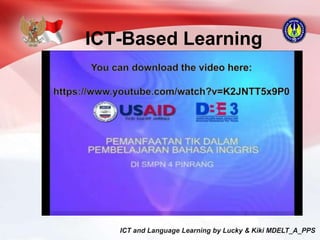
ICT-Based Learning
You can download the video here:
https://www.youtube.com/watch?v=Zy2l9QH3SYk
EXAMPLES OF ICT
USAGE IN LANGUAGE
LEARNING
Learn English Audio
and Video
The app helps the users improve
their listening skill by making
them listen to and watch
most popular English
learning podcasts and videos
in LearnEnglish Audio &
Video!
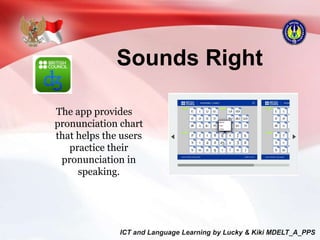
Sounds Right
The app provides
pronunciation chart
that helps the users
practice their
pronunciation in
speaking.
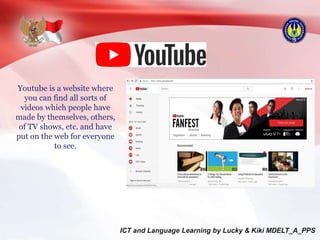
Youtube is a website where
you can find all sorts of
videos which people have
made by themselves, others,
of TV shows, etc. and have
put on the web for everyone
to see.
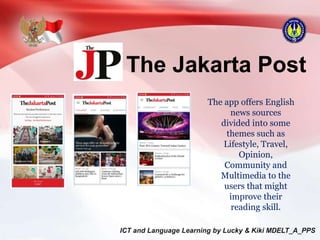
The Jakarta Post
The app offers English
news sources
divided into some
themes such as
Lifestyle, Travel,
Opinion,
Community and
Multimedia to the
users that might
improve their
reading skill.
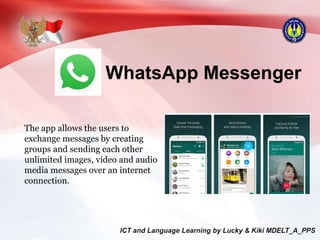
WhatsApp Messenger
The app allows the users to
exchange messages by creating
groups and sending each other
unlimited images, video and audio
media messages over an internet
connection.
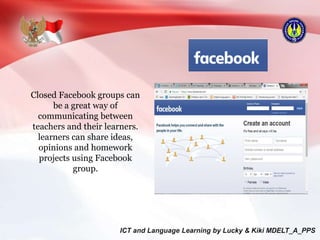
Closed Facebook groups can
be a great way of
communicating between
teachers and their learners.
learners can share ideas,
opinions and homework
projects using Facebook
group.
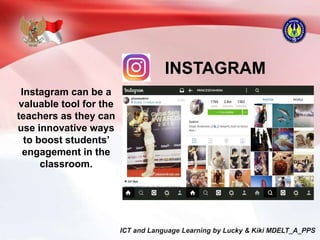
INSTAGRAM
Instagram can be a
valuable tool for the
teachers as they can
use innovative ways
to boost students’
engagement in the
classroom.
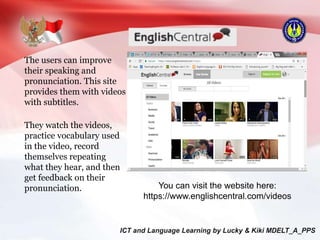
The users can improve
their speaking and
pronunciation. This site
provides them with videos
with subtitles.
They watch the videos,
practice vocabulary used
in the video, record
themselves repeating
what they hear, and then
get feedback on their
pronunciation. You can visit the website here:
https://www.englishcentral.com/videos
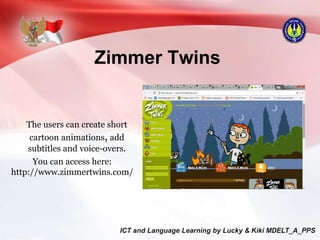
Zimmer Twins
The users can create short
cartoon animations, add
subtitles and voice-overs.
You can access here:
http://www.zimmertwins.com/
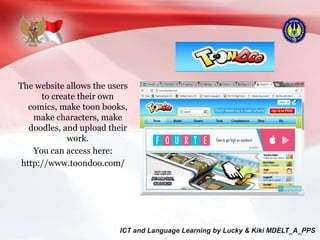
The website allows the users
to create their own
comics, make toon books,
make characters, make
doodles, and upload their
work.
You can access here:
http://www.toondoo.com/
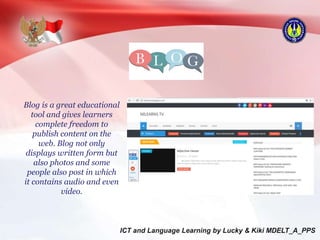
Blog is a great educational
tool and gives learners
complete freedom to
publish content on the
web. Blog not only
displays written form but
also photos and some
people also post in which
it contains audio and even
video.
How many Indonesians use the
Internet?
You can download the video here:
https://www.youtube.com/watch?v=G2RRVf_kmHo
Disadvantages of ICT
in
Language Learning
 Learners get short span of attention because of the ICT in
language learning.
 Online learning cannot offer human interaction.
 Learners may open or log on to the unnecessary websites to play
games or to watch movies etc.
 Intense requirement for self-discipline and self direction.
 Good infrastructure and trained man power is required to use
the ICT tools in teaching and learning.
 Communication is taking place between learners.
 The teacher is only a mediator.
SOURCES
Ammanni & Aparanjani. (2016). The Role of ICT in English Language
Teaching and Learning. International Journal of Scientific &
Engineering Research, Volume 7, Issue 7, July-2016, ISSN 2229-5518.
https://www.britishcouncil.org/voices-magazine/how-can-film-help-you-
teach-or-learn-english
https://www.britishcouncil.org/voices-magazine/mobile-learning-improve-
english-anytime-anywhere
http://www.differencebetween.com/difference-between-it-and-vs-ict/
https://www.teachertoolkit.co.uk/2017/07/21/instagram/
https://www.uscranton.com/resources/teaching-tips/ten-ways-to-use-
instagram-in-your-classroom/#.Wd-F1miCzIU
Leask, Marilyn and Pachler, Noerbert. (2014). Learning to Teach Using ICT
in the Secondary School a Companinon to School Experience: 3rd
Edition. New York: Routledge.
Poore, Megan. (2014). Using Soacial Media in the Classroom a Best Practice Guide.
London: Sage Publications Ltd.
Turvey, Keith et. al. (2014). Primary Computing & ICT Knowledge, Understanding, &
Practice: 6th Edition. London: Sage Publications Ltd.
Gordon Lev, et.al.(2004). Information and Communication Technologies in the Teaching
and Learning of Foreign Languages: State-of-the-Art, Needs and Perspectives.
Analytical Survey. Rusia: UNESCO.
THANK YOU

ICT AND LANGUAGE LEARNING

  • 2.
  • 3.
  • 4.
    THE DIFFERENCE BETWEENIT AND ICT IT (Information Technologies) refers to an entire industry that uses computers, networking, software and other equipment to manage information. Generally, IT departments are responsible for storing, processing, retrieving and protecting digital information of the company. For achieving these tasks, they are equipped with computers, DBMS, servers and security mechanisms, etc. Professionals working in IT departments range from system administrators, database administrators to programmers, network engineers and IT managers. ICT (Information and Communication Technologies) can be seen as an integration of IT with mediation broadcasting technologies, audio/ video processing and transmission and telephony. Therefore, ICT can be seen as an extended acronym for IT. The term ICT is widely used in the context of education, whereas IT is a term widely used in the industry. In addition, ICT is also used to refer to the integration of telephone and audio/ visual networks with computer networks.
  • 5.
    The United Nations DevelopmentProgramme (UNDP, 2003) defines ICTs as basically information-handling tools-avaried set of goods, applications and services that are used to produce, store, process, distribute and exchange information. They include the ‘old' ICTs of radio, television and telephone, and the ‘new’ ICTs of computers, satellite and wireless technology and the Internet. These different tools are now able to work together, and combine to form our `networked world' a massive infrastructure of interconnected telephone services, standardized computing hardware, the internet, radio and television, which reaches into every corner of the globe
  • 6.
    ICT + EDUCATION ICTin education point of view refers to Information and communication technology such as computers, communications facilities and features that variously support teaching, learning and a range of activities in education. ICT has become essential in the language learning because it gives a chance to the users to increase their language knowledge as well as skills (e.g. learners) and to provide interesting materials (e.g. teachers). ICT has become essential tool for educational change and reform as it leads us from “traditional” to “modern” learning process.
  • 7.
    THE KEY FEATURESOF ICT  Speed.  Capacity.  Automation.  Communicability.  Replication.  Provisionality.  Interactivity.  Non-linearity.  Multi-modality. (Pritchard, 2007)
  • 9.
    • The Internetprovides an easy and fast access to the use of current and authentic materials in the language being studied. • Such authentic materials include, for instance, online newspapers, webcasts, podcasts, newsroom video clips or even video sharing websites such as YouTube. • Learners become more innovative with the help of ICT. • ICT provides information to the learners which will be useful for them to compete with this competitive world.
  • 10.
    • Learners orclasses could write letters or later even e-mails to each other. • Using ICT, learners can use Skype or online chatting where they not only can write to each other in real-time, but also see and speak to each other online. • Learners are able to write, read, speak, listen, and react to a conversation using ICT as part of the language learning process. • They are motivated to communicate and collaborate with peers.
  • 11.
    • Teachers areable to give individual and personalized guidance to the learners that might lead them to be independent learners. • The use of several media–audio, video, authentic contexts, and real- world experiences help language learners with different learning styles to assimilate the content according to their needs. • The language teacher/tutor can use different approaches for the learners and accommodate their different learning styles, needs, and characteristics (fast, slow, or handicapped). • The teacher can exert powerful motivation and provide bored learners with exciting new ways to learn such as providing pictorial description in the materials.
  • 12.
  • 13.
    a. Teachers shouldconsider the possibility of using ICT in the classroom. b. Teachers should have adequate skill in using the ICT tool. c. Teachers know their position such as being fasilitator, controller, navigator, etc.
  • 14.
    d. Teachers explainthe importance of using ICT in supporting the learning process. e. Teachers know how to scaffold the learning process. f. Teachers know how to assess and evaluate the learning process.
  • 15.
  • 16.
    You can downloadthe video here: https://www.youtube.com/watch?v=Zy2l9QH3SYk
  • 17.
    EXAMPLES OF ICT USAGEIN LANGUAGE LEARNING
  • 18.
    Learn English Audio andVideo The app helps the users improve their listening skill by making them listen to and watch most popular English learning podcasts and videos in LearnEnglish Audio & Video!
  • 19.
    Sounds Right The appprovides pronunciation chart that helps the users practice their pronunciation in speaking.
  • 20.
    Youtube is awebsite where you can find all sorts of videos which people have made by themselves, others, of TV shows, etc. and have put on the web for everyone to see.
  • 21.
    The Jakarta Post Theapp offers English news sources divided into some themes such as Lifestyle, Travel, Opinion, Community and Multimedia to the users that might improve their reading skill.
  • 22.
    WhatsApp Messenger The appallows the users to exchange messages by creating groups and sending each other unlimited images, video and audio media messages over an internet connection.
  • 23.
    Closed Facebook groupscan be a great way of communicating between teachers and their learners. learners can share ideas, opinions and homework projects using Facebook group.
  • 24.
    INSTAGRAM Instagram can bea valuable tool for the teachers as they can use innovative ways to boost students’ engagement in the classroom.
  • 25.
    The users canimprove their speaking and pronunciation. This site provides them with videos with subtitles. They watch the videos, practice vocabulary used in the video, record themselves repeating what they hear, and then get feedback on their pronunciation. You can visit the website here: https://www.englishcentral.com/videos
  • 26.
    Zimmer Twins The userscan create short cartoon animations, add subtitles and voice-overs. You can access here: http://www.zimmertwins.com/
  • 27.
    The website allowsthe users to create their own comics, make toon books, make characters, make doodles, and upload their work. You can access here: http://www.toondoo.com/
  • 28.
    Blog is agreat educational tool and gives learners complete freedom to publish content on the web. Blog not only displays written form but also photos and some people also post in which it contains audio and even video.
  • 29.
    How many Indonesiansuse the Internet? You can download the video here: https://www.youtube.com/watch?v=G2RRVf_kmHo
  • 30.
  • 31.
     Learners getshort span of attention because of the ICT in language learning.  Online learning cannot offer human interaction.  Learners may open or log on to the unnecessary websites to play games or to watch movies etc.  Intense requirement for self-discipline and self direction.  Good infrastructure and trained man power is required to use the ICT tools in teaching and learning.  Communication is taking place between learners.  The teacher is only a mediator.
  • 32.
    SOURCES Ammanni & Aparanjani.(2016). The Role of ICT in English Language Teaching and Learning. International Journal of Scientific & Engineering Research, Volume 7, Issue 7, July-2016, ISSN 2229-5518. https://www.britishcouncil.org/voices-magazine/how-can-film-help-you- teach-or-learn-english https://www.britishcouncil.org/voices-magazine/mobile-learning-improve- english-anytime-anywhere http://www.differencebetween.com/difference-between-it-and-vs-ict/ https://www.teachertoolkit.co.uk/2017/07/21/instagram/ https://www.uscranton.com/resources/teaching-tips/ten-ways-to-use- instagram-in-your-classroom/#.Wd-F1miCzIU Leask, Marilyn and Pachler, Noerbert. (2014). Learning to Teach Using ICT in the Secondary School a Companinon to School Experience: 3rd Edition. New York: Routledge.
  • 33.
    Poore, Megan. (2014).Using Soacial Media in the Classroom a Best Practice Guide. London: Sage Publications Ltd. Turvey, Keith et. al. (2014). Primary Computing & ICT Knowledge, Understanding, & Practice: 6th Edition. London: Sage Publications Ltd. Gordon Lev, et.al.(2004). Information and Communication Technologies in the Teaching and Learning of Foreign Languages: State-of-the-Art, Needs and Perspectives. Analytical Survey. Rusia: UNESCO.
  • 34.