ACOUSTICAL MATERIALS
SUBMITTED BY :
ALEN JOSEPH JAMES
S5 MASAP
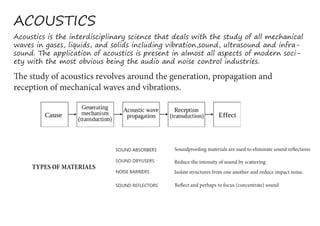
ACOUSTICS
Acoustics is the interdisciplinary science that deals with the study of all mechanical
waves in gases, liquids, and solids including vibration,sound, ultrasound and infra-
sound. The application of acoustics is present in almost all aspects of modern soci-
ety with the most obvious being the audio and noise control industries.
The study of acoustics revolves around the generation, propagation and
reception of mechanical waves and vibrations.
SOUND ABSORBERS
SOUND DIFFUSERS
NOISE BARRIERS
SOUND REFLECTORS
TYPES OF MATERIALS
Soundproofing materials are used to eliminate sound reflections
Reduce the intensity of sound by scattering
Isolate structures from one another and reduce impact noise.
Reflect and perhaps to focus (concentrate) sound
SOUND ABSORBERS Acoustical foam panels
White paintable acoustical wall panels
Fabric wrapped panels
Acoustical wall coverings
Ceiling tiles
Baffles and banners for ceiling
Fibre glass blankets and roll
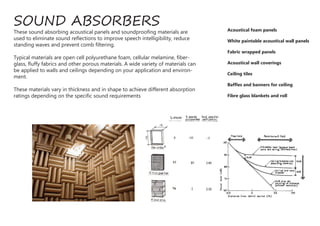
These sound absorbing acoustical panels and soundproofing materials are
used to eliminate sound reflections to improve speech intelligibility, reduce
standing waves and prevent comb filtering.
Typical materials are open cell polyurethane foam, cellular melamine, fiber-
glass, fluffy fabrics and other porous materials. A wide variety of materials can
be applied to walls and ceilings depending on your application and environ-
ment.
These materials vary in thickness and in shape to achieve different absorption
ratings depending on the specific sound requirements
Acoustical foam panelsSOUND ABSORBERS
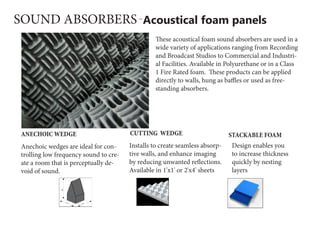
These acoustical foam sound absorbers are used in a
wide variety of applications ranging from Recording
and Broadcast Studios to Commercial and Industri-
al Facilities. Available in Polyurethane or in a Class
1 Fire Rated foam.  These products can be applied
directly to walls, hung as baffles or used as free-
standing absorbers.
Anechoic wedges are ideal for con-
trolling low frequency sound to cre-
ate a room that is perceptually de-
void of sound.
ANECHOIC WEDGE
Installs to create seamless absorp-
tive walls, and enhance imaging
by reducing unwanted reflections.
Available in 1'x1' or 2'x4' sheets
CUTTING WEDGE
Design enables you
to increase thickness
quickly by nesting
layers
STACKABLE FOAM
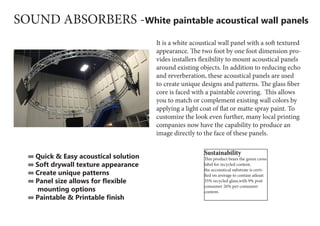
SOUND ABSORBERS -White paintable acoustical wall panels
It is a white acoustical wall panel with a soft textured
appearance. The two foot by one foot dimension pro-
vides installers flexibility to mount acoustical panels
around existing objects. In addition to reducing echo
and reverberation, these acoustical panels are used
to create unique designs and patterns. The glass fiber
core is faced with a paintable covering.  This allows
you to match or complement existing wall colors by
applying a light coat of flat or matte spray paint. To
customize the look even further, many local printing
companies now have the capability to produce an
image directly to the face of these panels.
∞ Quick & Easy acoustical solution
∞ Soft drywall texture appearance
∞ Create unique patterns
∞ Panel size allows for flexible
mounting options
∞ Paintable & Printable finish 
Sustainability
This product bears the green cross
label for recycled content.
the accoustical substrate is certi-
fied on average to contain atleast
35% recycled glass,with 9% post
consumer 26% per-consumer
content.
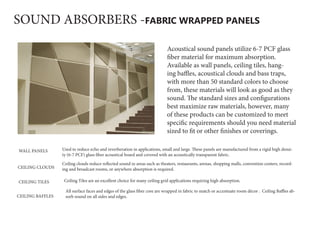
SOUND ABSORBERS -FABRIC WRAPPED PANELS
Acoustical sound panels utilize 6-7 PCF glass
fiber material for maximum absorption.
Available as wall panels, ceiling tiles, hang-
ing baffles, acoustical clouds and bass traps,
with more than 50 standard colors to choose
from, these materials will look as good as they
sound. The standard sizes and configurations
best maximize raw materials, however, many
of these products can be customized to meet
specific requirements should you need material
sized to fit or other finishes or coverings.
WALL PANELS Used to reduce echo and reverberation in applications, small and large. These panels are manufactured from a rigid high densi-
ty (6-7 PCF) glass fiber acoustical board and covered with an acoustically transparent fabric.
CEILING CLOUDS
CEILING TILES  Ceiling Tiles are an excellent choice for many ceiling grid applications requiring high absorption.
Ceiling clouds reduce reflected sound in areas such as theaters, restaurants, arenas, shopping malls, convention centers, record-
ing and broadcast rooms, or anywhere absorption is required.
CEILING BAFFLES
All surface faces and edges of the glass fiber core are wrapped in fabric to match or accentuate room décor .  Ceiling Baffles ab-
sorb sound on all sides and edges.
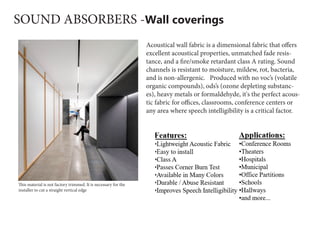
SOUND ABSORBERS -Wall coverings
Acoustical wall fabric is a dimensional fabric that offers
excellent acoustical properties, unmatched fade resis-
tance, and a fire/smoke retardant class A rating. Sound
channels is resistant to moisture, mildew, rot, bacteria,
and is non-allergenic.   Produced with no voc’s (volatile
organic compounds), ods’s (ozone depleting substanc-
es), heavy metals or formaldehyde, it's the perfect acous-
tic fabric for offices, classrooms, conference centers or
any area where speech intelligibility is a critical factor.
This material is not factory trimmed. It is necessary for the
installer to cut a straight vertical edge
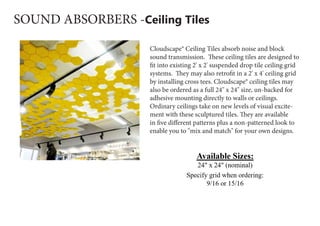
SOUND ABSORBERS -Ceiling Tiles
Cloudscape® Ceiling Tiles absorb noise and block
sound transmission.  These ceiling tiles are designed to
fit into existing 2' x 2' suspended drop tile ceiling grid
systems.  They may also retrofit in a 2' x 4' ceiling grid
by installing cross tees. Cloudscape® ceiling tiles may
also be ordered as a full 24" x 24" size, un-backed for
adhesive mounting directly to walls or ceilings.
Ordinary ceilings take on new levels of visual excite-
ment with these sculptured tiles. They are available
in five different patterns plus a non-patterned look to
enable you to "mix and match" for your own designs.
SOUND ABSORBERS -Baffles and Banners
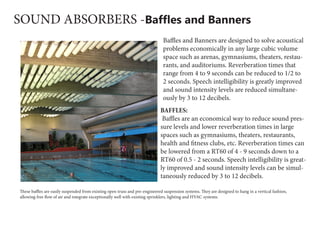
Baffles and Banners are designed to solve acoustical
problems economically in any large cubic volume
space such as arenas, gymnasiums, theaters, restau-
rants, and auditoriums. Reverberation times that
range from 4 to 9 seconds can be reduced to 1/2 to
2 seconds. Speech intelligibility is greatly improved
and sound intensity levels are reduced simultane-
ously by 3 to 12 decibels.
BAFFLES:
 Baffles are an economical way to reduce sound pres-
sure levels and lower reverberation times in large
spaces such as gymnasiums, theaters, restaurants,
health and fitness clubs, etc. Reverberation times can
be lowered from a RT60 of 4 - 9 seconds down to a
RT60 of 0.5 - 2 seconds. Speech intelligibility is great-
ly improved and sound intensity levels can be simul-
taneously reduced by 3 to 12 decibels.
These baffles are easily suspended from existing open truss and pre-engineered suspension systems. They are designed to hang in a vertical fashion,
allowing free flow of air and integrate exceptionally well with existing sprinklers, lighting and HVAC systems.
SOUND ABSORBERS -Baffles and Banners
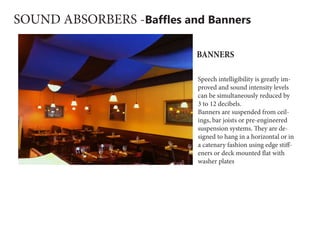
Speech intelligibility is greatly im-
proved and sound intensity levels
can be simultaneously reduced by
3 to 12 decibels.
Banners are suspended from ceil-
ings, bar joists or pre-engineered
suspension systems. They are de-
signed to hang in a horizontal or in
a catenary fashion using edge stiff-
eners or deck mounted flat with
washer plates
BANNERS
SOUND DIFFUSERS
SOUND DIFFUSERS
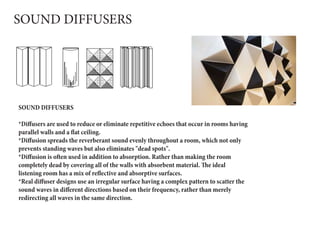
*Diffusers are used to reduce or eliminate repetitive echoes that occur in rooms having
parallel walls and a flat ceiling.
*Diffusion spreads the reverberant sound evenly throughout a room, which not only
prevents standing waves but also eliminates "dead spots".
*Diffusion is often used in addition to absorption. Rather than making the room
completely dead by covering all of the walls with absorbent material. The ideal
listening room has a mix of reflective and absorptive surfaces.
*Real diffuser designs use an irregular surface having a complex pattern to scatter the
sound waves in different directions based on their frequency, rather than merely
redirecting all waves in the same direction.
SOUND DIFFUSERS
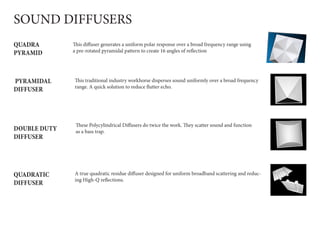
QUADRA
PYRAMID
This diffuser generates a uniform polar response over a broad frequency range using
a pre-rotated pyramidal pattern to create 16 angles of reflection
This traditional industry workhorse disperses sound uniformly over a broad frequency
range. A quick solution to reduce flutter echo.
PYRAMIDAL
DIFFUSER
DOUBLE DUTY
DIFFUSER
These Polycylindrical Diffusers do twice the work. They scatter sound and function
as a bass trap.
A true quadratic residue diffuser designed for uniform broadband scattering and reduc-
ing High-Q reflections.
QUADRATIC
DIFFUSER
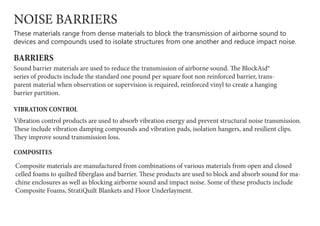
NOISE BARRIERS
These materials range from dense materials to block the transmission of airborne sound to
devices and compounds used to isolate structures from one another and reduce impact noise.
BARRIERS
Sound barrier materials are used to reduce the transmission of airborne sound. The BlockAid®
series of products include the standard one pound per square foot non reinforced barrier, trans-
parent material when observation or supervision is required, reinforced vinyl to create a hanging
barrier partition.
VIBRATION CONTROL
Vibration control products are used to absorb vibration energy and prevent structural noise transmission.
These include vibration damping compounds and vibration pads, isolation hangers, and resilient clips.
They improve sound transmission loss.
Composite materials are manufactured from combinations of various materials from open and closed
celled foams to quilted fiberglass and barrier. These products are used to block and absorb sound for ma-
chine enclosures as well as blocking airborne sound and impact noise. Some of these products include
Composite Foams, StratiQuilt Blankets and Floor Underlayment.
COMPOSITES
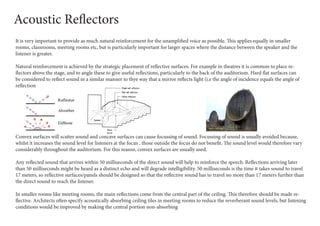
It is very important to provide as much natural reinforcement for the unamplified voice as possible. This applies equally in smaller
rooms, classrooms, meeting rooms etc, but is particularly important for larger spaces where the distance between the speaker and the
listener is greater.
Natural reinforcement is achieved by the strategic placement of reflective surfaces. For example in theatres it is common to place re-
flectors above the stage, and to angle these to give useful reflections, particularly to the back of the auditorium. Hard flat surfaces can
be considered to reflect sound in a similar manner to thye way that a mirror reflects light (i.e the angle of incidence equals the angle of
reflection
Convex surfaces will scatter sound and concave surfaces can cause focussing of sound. Focussing of sound is usually avoided because,
whilst it increases the sound level for listeners at the focus , those outside the focus do not benefit. The sound level would therefore vary
considerably throughout the auditorium. For this reason, convex surfaces are usually used.
Any reflected sound that arrives within 50 milliseconds of the direct sound will help to reinforce the speech. Reflections arriving later
than 50 milliseconds might be heard as a distinct echo and will degrade intelligibility. 50 milliseconds is the time it takes sound to travel
17 meters, so reflective surfaces/panels should be designed so that the reflective sound has to travel no more than 17 meters further than
the direct sound to reach the listener.
In smaller rooms like meeting rooms, the main reflections come from the central part of the ceiling. This therefore should be made re-
flective. Architects often specify acoustically absorbing ceiling tiles in meeting rooms to reduce the reverberant sound levels, but listening
conditions would be improved by making the central portion non-absorbing
Acoustic Reflectors

Acoustical materials . by- Alen Joseph James

  • 1.
    ACOUSTICAL MATERIALS SUBMITTED BY: ALEN JOSEPH JAMES S5 MASAP
  • 2.
    ACOUSTICS Acoustics is the interdisciplinaryscience that deals with the study of all mechanical waves in gases, liquids, and solids including vibration,sound, ultrasound and infra- sound. The application of acoustics is present in almost all aspects of modern soci- ety with the most obvious being the audio and noise control industries. The study of acoustics revolves around the generation, propagation and reception of mechanical waves and vibrations. SOUND ABSORBERS SOUND DIFFUSERS NOISE BARRIERS SOUND REFLECTORS TYPES OF MATERIALS Soundproofing materials are used to eliminate sound reflections Reduce the intensity of sound by scattering Isolate structures from one another and reduce impact noise. Reflect and perhaps to focus (concentrate) sound
  • 3.
    SOUND ABSORBERS Acousticalfoam panels White paintable acoustical wall panels Fabric wrapped panels Acoustical wall coverings Ceiling tiles Baffles and banners for ceiling Fibre glass blankets and roll These sound absorbing acoustical panels and soundproofing materials are used to eliminate sound reflections to improve speech intelligibility, reduce standing waves and prevent comb filtering. Typical materials are open cell polyurethane foam, cellular melamine, fiber- glass, fluffy fabrics and other porous materials. A wide variety of materials can be applied to walls and ceilings depending on your application and environ- ment. These materials vary in thickness and in shape to achieve different absorption ratings depending on the specific sound requirements
  • 4.
    Acoustical foam panelsSOUNDABSORBERS These acoustical foam sound absorbers are used in a wide variety of applications ranging from Recording and Broadcast Studios to Commercial and Industri- al Facilities. Available in Polyurethane or in a Class 1 Fire Rated foam.  These products can be applied directly to walls, hung as baffles or used as free- standing absorbers. Anechoic wedges are ideal for con- trolling low frequency sound to cre- ate a room that is perceptually de- void of sound. ANECHOIC WEDGE Installs to create seamless absorp- tive walls, and enhance imaging by reducing unwanted reflections. Available in 1'x1' or 2'x4' sheets CUTTING WEDGE Design enables you to increase thickness quickly by nesting layers STACKABLE FOAM
  • 5.
    SOUND ABSORBERS -Whitepaintable acoustical wall panels It is a white acoustical wall panel with a soft textured appearance. The two foot by one foot dimension pro- vides installers flexibility to mount acoustical panels around existing objects. In addition to reducing echo and reverberation, these acoustical panels are used to create unique designs and patterns. The glass fiber core is faced with a paintable covering.  This allows you to match or complement existing wall colors by applying a light coat of flat or matte spray paint. To customize the look even further, many local printing companies now have the capability to produce an image directly to the face of these panels. ∞ Quick & Easy acoustical solution ∞ Soft drywall texture appearance ∞ Create unique patterns ∞ Panel size allows for flexible mounting options ∞ Paintable & Printable finish  Sustainability This product bears the green cross label for recycled content. the accoustical substrate is certi- fied on average to contain atleast 35% recycled glass,with 9% post consumer 26% per-consumer content.
  • 6.
    SOUND ABSORBERS -FABRICWRAPPED PANELS Acoustical sound panels utilize 6-7 PCF glass fiber material for maximum absorption. Available as wall panels, ceiling tiles, hang- ing baffles, acoustical clouds and bass traps, with more than 50 standard colors to choose from, these materials will look as good as they sound. The standard sizes and configurations best maximize raw materials, however, many of these products can be customized to meet specific requirements should you need material sized to fit or other finishes or coverings. WALL PANELS Used to reduce echo and reverberation in applications, small and large. These panels are manufactured from a rigid high densi- ty (6-7 PCF) glass fiber acoustical board and covered with an acoustically transparent fabric. CEILING CLOUDS CEILING TILES  Ceiling Tiles are an excellent choice for many ceiling grid applications requiring high absorption. Ceiling clouds reduce reflected sound in areas such as theaters, restaurants, arenas, shopping malls, convention centers, record- ing and broadcast rooms, or anywhere absorption is required. CEILING BAFFLES All surface faces and edges of the glass fiber core are wrapped in fabric to match or accentuate room décor .  Ceiling Baffles ab- sorb sound on all sides and edges.
  • 7.
    SOUND ABSORBERS -Wallcoverings Acoustical wall fabric is a dimensional fabric that offers excellent acoustical properties, unmatched fade resis- tance, and a fire/smoke retardant class A rating. Sound channels is resistant to moisture, mildew, rot, bacteria, and is non-allergenic.   Produced with no voc’s (volatile organic compounds), ods’s (ozone depleting substanc- es), heavy metals or formaldehyde, it's the perfect acous- tic fabric for offices, classrooms, conference centers or any area where speech intelligibility is a critical factor. This material is not factory trimmed. It is necessary for the installer to cut a straight vertical edge
  • 8.
    SOUND ABSORBERS -CeilingTiles Cloudscape® Ceiling Tiles absorb noise and block sound transmission.  These ceiling tiles are designed to fit into existing 2' x 2' suspended drop tile ceiling grid systems.  They may also retrofit in a 2' x 4' ceiling grid by installing cross tees. Cloudscape® ceiling tiles may also be ordered as a full 24" x 24" size, un-backed for adhesive mounting directly to walls or ceilings. Ordinary ceilings take on new levels of visual excite- ment with these sculptured tiles. They are available in five different patterns plus a non-patterned look to enable you to "mix and match" for your own designs.
  • 9.
    SOUND ABSORBERS -Bafflesand Banners Baffles and Banners are designed to solve acoustical problems economically in any large cubic volume space such as arenas, gymnasiums, theaters, restau- rants, and auditoriums. Reverberation times that range from 4 to 9 seconds can be reduced to 1/2 to 2 seconds. Speech intelligibility is greatly improved and sound intensity levels are reduced simultane- ously by 3 to 12 decibels. BAFFLES:  Baffles are an economical way to reduce sound pres- sure levels and lower reverberation times in large spaces such as gymnasiums, theaters, restaurants, health and fitness clubs, etc. Reverberation times can be lowered from a RT60 of 4 - 9 seconds down to a RT60 of 0.5 - 2 seconds. Speech intelligibility is great- ly improved and sound intensity levels can be simul- taneously reduced by 3 to 12 decibels. These baffles are easily suspended from existing open truss and pre-engineered suspension systems. They are designed to hang in a vertical fashion, allowing free flow of air and integrate exceptionally well with existing sprinklers, lighting and HVAC systems.
  • 10.
    SOUND ABSORBERS -Bafflesand Banners Speech intelligibility is greatly im- proved and sound intensity levels can be simultaneously reduced by 3 to 12 decibels. Banners are suspended from ceil- ings, bar joists or pre-engineered suspension systems. They are de- signed to hang in a horizontal or in a catenary fashion using edge stiff- eners or deck mounted flat with washer plates BANNERS
  • 11.
    SOUND DIFFUSERS SOUND DIFFUSERS *Diffusersare used to reduce or eliminate repetitive echoes that occur in rooms having parallel walls and a flat ceiling. *Diffusion spreads the reverberant sound evenly throughout a room, which not only prevents standing waves but also eliminates "dead spots". *Diffusion is often used in addition to absorption. Rather than making the room completely dead by covering all of the walls with absorbent material. The ideal listening room has a mix of reflective and absorptive surfaces. *Real diffuser designs use an irregular surface having a complex pattern to scatter the sound waves in different directions based on their frequency, rather than merely redirecting all waves in the same direction.
  • 12.
    SOUND DIFFUSERS QUADRA PYRAMID This diffusergenerates a uniform polar response over a broad frequency range using a pre-rotated pyramidal pattern to create 16 angles of reflection This traditional industry workhorse disperses sound uniformly over a broad frequency range. A quick solution to reduce flutter echo. PYRAMIDAL DIFFUSER DOUBLE DUTY DIFFUSER These Polycylindrical Diffusers do twice the work. They scatter sound and function as a bass trap. A true quadratic residue diffuser designed for uniform broadband scattering and reduc- ing High-Q reflections. QUADRATIC DIFFUSER
  • 13.
    NOISE BARRIERS These materialsrange from dense materials to block the transmission of airborne sound to devices and compounds used to isolate structures from one another and reduce impact noise. BARRIERS Sound barrier materials are used to reduce the transmission of airborne sound. The BlockAid® series of products include the standard one pound per square foot non reinforced barrier, trans- parent material when observation or supervision is required, reinforced vinyl to create a hanging barrier partition. VIBRATION CONTROL Vibration control products are used to absorb vibration energy and prevent structural noise transmission. These include vibration damping compounds and vibration pads, isolation hangers, and resilient clips. They improve sound transmission loss. Composite materials are manufactured from combinations of various materials from open and closed celled foams to quilted fiberglass and barrier. These products are used to block and absorb sound for ma- chine enclosures as well as blocking airborne sound and impact noise. Some of these products include Composite Foams, StratiQuilt Blankets and Floor Underlayment. COMPOSITES
  • 14.
    It is veryimportant to provide as much natural reinforcement for the unamplified voice as possible. This applies equally in smaller rooms, classrooms, meeting rooms etc, but is particularly important for larger spaces where the distance between the speaker and the listener is greater. Natural reinforcement is achieved by the strategic placement of reflective surfaces. For example in theatres it is common to place re- flectors above the stage, and to angle these to give useful reflections, particularly to the back of the auditorium. Hard flat surfaces can be considered to reflect sound in a similar manner to thye way that a mirror reflects light (i.e the angle of incidence equals the angle of reflection Convex surfaces will scatter sound and concave surfaces can cause focussing of sound. Focussing of sound is usually avoided because, whilst it increases the sound level for listeners at the focus , those outside the focus do not benefit. The sound level would therefore vary considerably throughout the auditorium. For this reason, convex surfaces are usually used. Any reflected sound that arrives within 50 milliseconds of the direct sound will help to reinforce the speech. Reflections arriving later than 50 milliseconds might be heard as a distinct echo and will degrade intelligibility. 50 milliseconds is the time it takes sound to travel 17 meters, so reflective surfaces/panels should be designed so that the reflective sound has to travel no more than 17 meters further than the direct sound to reach the listener. In smaller rooms like meeting rooms, the main reflections come from the central part of the ceiling. This therefore should be made re- flective. Architects often specify acoustically absorbing ceiling tiles in meeting rooms to reduce the reverberant sound levels, but listening conditions would be improved by making the central portion non-absorbing Acoustic Reflectors