
Agenda What is an Accountable Care Organization? What kinds of organizational structures are being used? What are the requirements? What payment arrangements and how do they work? Framework for success Private market for ACOs are humming Variations on a theme
DeMarco and Associates  Founded in 1980 Researches, designs, develops and implements successful strategies to build community based health care organizations. Optimizes the relationship between providers and payers. Integrates clinical care improvements and reimbursement. Aligns purchasers and providers, physicians and hospitals. This collaboration helps to prepare for future opportunities and  to work together for the mutual benefit of patients, physicians, hospitals and employers.
Pendulum HealthCare  Development Corporation Formed in 2001 Provides supporting infrastructure and connectivity among physicians, hospitals, health plans, employers and vendors to create a sustainable clinical integration model on a local or regional basis by: Accelerating legacy to web information technology conversion. Creating enterprise-wide data exchanges and dashboards. Building and supporting pay for performance systems allowing providers and purchasers to share in savings created through more efficient and effective care. Assisting clients in using data at all levels to identify gaps in processes and performance to assure consistent, measurable and effective care coordination and management. Designs, develops and manages Accountable Care Organizations (ACOs).
What is an Accountable Care Organization?
What is an Accountable Care Organization? An ACO is a local health care organization and a related set of providers (at a minimum, primary care physicians, specialists, and hospitals) that can be held accountable for the cost and quality of care delivered to a defined population. The goal of the ACO is to deliver coordinated and efficient care. A Guide to Accountable Care Organizations and Their Role in the Senate’s Health Reform Bill, March 11, 2010 by  Jordan T. Cohen .  http://www.rwjf.org/files/research/acosummaryfinal.pdf
What Is an Accountable Care Organization? The ability to provide, and manage with patients, the continuum of care across different institutional settings, including at least ambulatory and inpatient hospital care and possibly post acute care;  The capability of prospectively planning budgets and resource needs; and  Sufficient size to support comprehensive, valid, and reliable performance measurement.  Can Accountable Care Organizations Improve the Value of Health Care by Solving the Cost and Quality Quandaries? (Berenson, p. 2)
To qualify as an ACO an organization would have to meet at least the following criteria :   (1) Agree to a minimum three-year participation,  (2) Have a formal legal structure that would allow the organization to receive/distribute bonuses to participating providers,  (3) Include the primary care providers of at least 5,000 Medicare beneficiaries,  (4) Provide CMS with a list of the primary care and specialist physicians participating in the organization,  (5) Have contracts in place with a core group of specialist physicians,  (6) Have a management and leadership structure in place that allows for joint decision making (e.g., for capital purchases), and  (7) Defined processes to promote evidence-based medicine, report on quality and cost measures, and coordinate care. Source: Senate Finance Committee Report
To earn the incentive payment the organization would have to meet certain quality thresholds ACOs must agree to report annually to the Secretary of Health and Human Services on a specified set of quality indicators. ACOs would be allowed to report at the group or individual level on measures specified by the Secretary, including measures of:  (1) clinical processes and outcomes (e.g. mortality, improvements in  functionality),  (2) patient perspectives on care, and  (3) utilization and costs (e.g. ambulatory-sensitive admissions).  For the purposes of calculating quality and cost performance, CMS would assign beneficiaries to ACOs based on the physician from whom the beneficiary received the most primary care services in the preceding year. [Note: This is for the purpose of gauging performance only, and does not impact the ability of beneficiaries to choose their own site of care.] ACOs would [in addition to the bonus] continue to be paid on a fee-for-service basis.
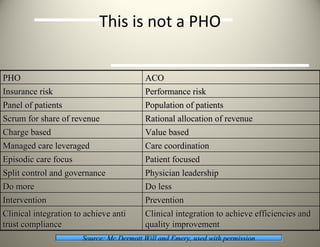
This is not a PHO Source: Mc Dermott Will and Emery, used with permission PHO ACO Insurance risk Performance risk Panel of patients Population of patients Scrum for share of revenue Rational allocation of revenue Charge based Value based Managed care leveraged Care coordination Episodic care focus Patient focused Split control and governance Physician leadership Do more Do less Intervention Prevention Clinical integration to achieve anti trust compliance Clinical integration to achieve efficiencies and quality improvement
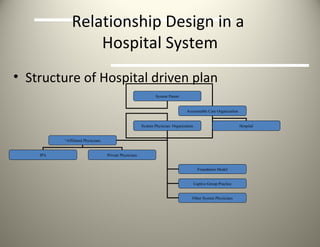
Relationship Design in a  Hospital System Structure of Hospital driven plan System   Parent Accountable Care Organization System Physician  Organization Foundation Model Captive Group Practice Other System Physicians Hospital “ Affiliated Physicians IPA Private Physicians
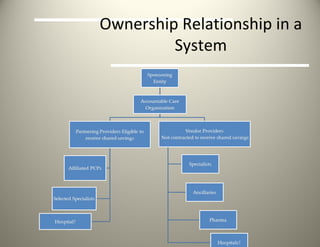
Ownership Relationship in a System
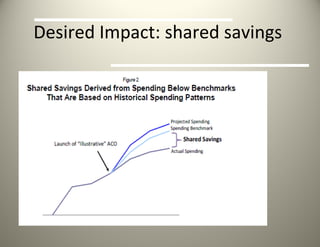
Desired Impact: shared savings
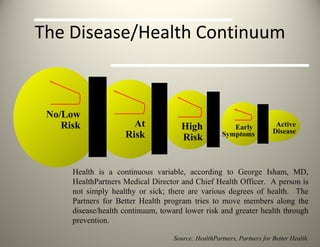
The Disease/Health Continuum Health is a continuous variable, according to George Isham, MD, HealthPartners Medical Director and Chief Health Officer.  A person is not simply healthy or sick; there are various degrees of health.  The Partners for Better Health program tries to move members along the disease/health continuum, toward lower risk and greater health through prevention. Source: HealthPartners, Partners for Better Health. Active Disease Early  Symptoms High Risk At Risk No/Low Risk
Pathway To Get From Where You Are  Setting clinical benchmarks Setting spending benchmarks Measuring performance Quality and efficiency metrics analysis Care management process Performance payment adjustments
Episode Treatment Groups
Episode of Care – Definition All clinically related services for a discrete diagnostic condition from the onset of symptoms until treatment is complete.
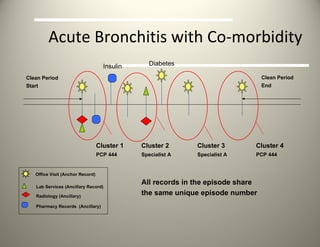
Acute Bronchitis with Co-morbidity  Clean Period Start Clean Period End Office Visit (Anchor Record) Lab Services (Ancillary Record) Radiology (Ancillary) Pharmacy Records  (Ancillary) Cluster 1 PCP 444 Cluster 2  Specialist A Cluster 4 PCP 444 Cluster 3  Specialist A Insulin Diabetes All records in the episode share  the same unique episode number
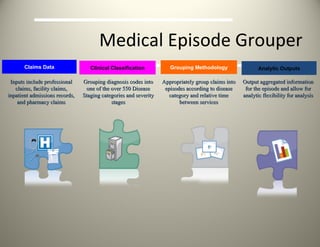
Medical Episode Grouper Claims Data Clinical Classification Grouping Methodology Analytic   Outputs Inputs include professional claims, facility claims, inpatient admissions records, and pharmacy claims Grouping diagnosis codes into one of the over 550 Disease Staging categories and severity stages Appropriately group claims into episodes according to disease category and relative time between services Output aggregated information for the episode and allow for analytic flexibility for analysis
Infrastructure Health Information Exchange Capability Patient  Centric  Database Specialty Care Providers & Staff Retail Pharmacies Ambulatory Clinics Patients and Family Caregivers Primary Care Providers & Staff
Re-engineering System Redesign Financial Redesign Patient Financial Interface
Financial redesign Business Plan Management  Systems Operations Marketing Governance Application development
Management  Operations Manager:  Operations must be managed by an executive, officer, manager, or general partner. Medical Director:  Clinical management and oversight would be managed by a senior-level medical director who is a board certified physician, licensed in the State in which the ACO operates, and physically present in that State. Meaningful Commitment:  Participants must have a meaningful commitment to the ACO's clinical integration program to ensure its likely success. Quality Assurance:  ACOs must have a physician-directed quality assurance and process improvement committee. Clinical Guidelines:  ACOs must develop and implement evidence-based medical practice or clinical guidelines for delivering coordinated care. Data Collection Infrastructure:  ACOs must have an infrastructure (i.e. information technology) that allows the ACO to collect and evaluate data and provide feedback across the organization, and report data to CMS.
Benchmarks The actual benchmark will be the weighted average of the three years’ averages, after trending and risk adjusting.  Proposed weights are: 10% in Year 1; 30% in Year 2; and 60% in Year 3. CMS says this approach is more statistically stable than using a simple average of the three years.  This benchmark determination approach means that the ACO will have to beat its own performance in each 3-year contract period.  ACOs will experience diminishing returns as their cost efficiency improves. This will earn them savings in one contract period but will become the benchmark they have to beat in the next contract period.
An ACO: Medicare Shares Savings Program (MSSP) Is defined in Section 3022 of the PPACA (new Health Reform Act) Is very  similar  to globally capitated IPAs/Medical Groups Must: Demonstrate how they take accountability for a patient population (PCP network, care mgt P&Ps, etc) Coordinate services under Medicare and Medicaid Encourage investment in infrastructure Design processes for high quality and efficient service delivery Bonus payments must include quality metric. Optionally PCPs could be positioned as “certified” Medical Homes  PGP demonstration quality metrics are starting points With passage of the law, its now an ongoing program of CMS w/ operational start date of no later than 1/1/2012 Existing demonstration will not be expanded – just continued. Not a pilot program, MSSP is now a statutory program.
ACO/MSSP .vs globally capitated IPA/Medical Group (FYI, 80%+ of Medicare HMO lives in Florida are contracted through globally capitated networks/medical groups.) Financial Risk: ACO is 50% of upside: 0% downside Globally capitated IPA/medical group is 100% upside and 100% downside Capitation benchmark: ACO 98% of  risk adjusted  historical FFS costs Globally capitated IPA is  83% of CMS payments to Medicare HMOs Health Benefit Costs: ACO only traditional Medicare benefits Globally capitated IPAs must pay for all the extra HMO benefits  Admin  Costs: Simple ACO need only have PCP network –  no explicit requirement for hospitals contracts – hospitals cannot hold an ACO hostage! FI continues to pay claims ACO does analysis from adjudicated claim data files 5% cost advantage to ACO  Marketing and Enrollment: ACO patients are “assigned” by historical claim pattern effective 1 st  day of operations – no sales commissions, etc.  ALL Medicare patients of the PCP not otherwise enrolled in a Medicare HMO/PPO are assigned to the ACO.  3:1 enrollment advantage to ACO. 5-6% cost advantage to ACO
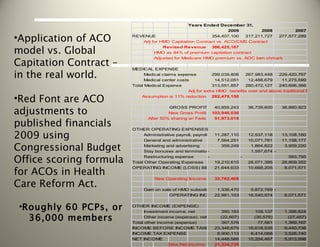
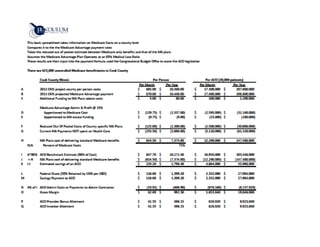
Application of ACO model vs. Global Capitation Contract – in the real world. Red Font are ACO adjustments to published financials 2009 using Congressional Budget Office scoring formula for ACOs in Health Care Reform Act. Roughly 60 PCPs, or 36,000 members
Advantages to Physician  “Why doctors will do it?” Potential for substantial additional revenue from shared savings program Physician guaranteed current FFS level of Medicare/Medicaid No downside financial risk to join the ACO Opportunity to gain and/or preserve market share Additional services from the ACO Physician groups barrier to entry is the working capital requirement for the anticipated case mgt, info processing, other admin activities and timelines to bonus payment
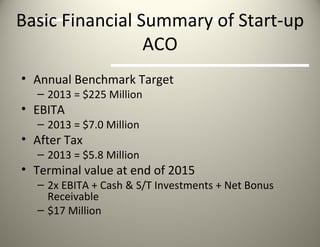
Basic Financial Summary of Start-up ACO Annual Benchmark Target 2013 = $225 Million EBITA 2013 = $7.0 Million After Tax 2013 = $5.8 Million Terminal value at end of 2015 2x EBITA + Cash & S/T Investments + Net Bonus Receivable $17 Million
What is that we are looking from You? Equity or Contract Joint Venture PCP recruitment and selection 50% sharing of operating income 50% of budget of CMS Application CMS Application Budget $550,000 ($250,000 +/- your share) Legal entity and contracts, QI committee P&P Provider contracting Application development, submission,  interrogatories, etc.
Pendulum Will Bring For Medicare ACO (Summarized) Working Capital from 2012 through 2013 Projected total working capital $5.5 million. Administrative: Precise Program and Legal Structures Demographic and claims info: Data, data, data, and reconciliations Claims submissions “clearing house for par” Non “par” audit, contesting incorrectly paid claims and tracking Demographic, Claims (Dx, CPT, DRG, etc), quality reporting. Compliance reporting (QA, program integrity, etc) Credentialing process for ACO PCPs to become NCQA “Medical Homes” Care Management 90 – 90 – 90 Program and Integrated Health Risk Assessment process Road map to deploy best practices intra/inter market Road map to deploy evidence based medical protocols CM/UM/SW personnel, P&Ps, etc. Provider development and contracting Robust quality metric reporting Detailed treatment plan development and patient compliance reporting
Summary “ Whatever form ACOs eventually take, one thing is certain: the era of fragmented care delivery should draw to a close. Too many Medicare beneficiaries — like many other patients — have suffered at the hands of wasteful, ineffective, and poorly coordinated systems of care, with consequent costs that are proving unsustainable.  CMS believes that with enhanced cooperation among beneficiaries, hospitals, physicians, and other health care providers, ACOs will be an important new tool for giving Medicare beneficiaries the affordable, high-quality care they want, need, and deserve.”  Donald M. Berwick, M.D., M.P.P., Administrator, Centers for Medicare and Medicaid Services
Private Market Commercial Employers Cities, Counties, School Districts Labor Unions, Taft Hartley Trusts, Trade Associations
IPA Opportunities Strengthening an IPA and its medical staff relationship with hospitals through direct contracting with employers who have become dissatisfied with local third party controls Recasting physicians in their new role as managers of quality standards and review Direct linkages to employers who have joined the community organization to share data and have a better understanding of how care can be delivered Give employers a “Go to” source for help with care management and billing questions Collaborative approach between buyer and physician earns more trust and sets expectations for patient and employers as to what is reasonable care versus excessive or unnecessary
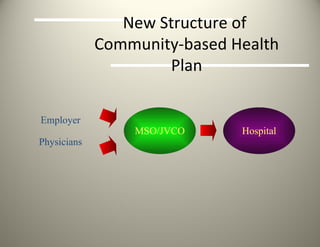
New Structure of  Community-based Health Plan Employer Physicians MSO/JVCO Hospital
Employer Coalition “ ACOs simply call for organizing and providing care in a systematic fashion. Done well, they should provide a bunch of win-wins, but there will also be some squeezes. These may well hit the hospitals.  Therefore, to protect their interests, physicians - who actually are positioned to create the organization, incentives and processes to be successful - should take the lead in ACO formation and implementation and contract for hospital services, rather than allowing the hospitals to do so and contract the physicians. Ultimately, in hospital-based ACOs the financial needs of the hospitals will take priority over rewarding the physicians for their effort and, therefore, they are likely to be less effective in achieving employer or government goals, i.e. generating greater efficiency, better outcomes and lower cost.” - Ned Lamkin, MD, FACP   President   Indiana Employers Quality Health Alliance
Potential IPA or Medical Society Role
So Show Me the Money Calculation of the bonus follows three published numbers involving what is now being paid to Medicare Advantage plans minus what is used for non health care benefits and what is paid to CMS. We have estimated administrative costs and now must put a 7.5% limit on the top under proposed rules.
 
Creating the Accountable Care Organization Step 1 A feasibility study is conducted to answer four questions Is there a market? Is there a market with a need? Can our organization fill that need with current or proposed products ? Is this strategy sustainable over time? Assuming the answers to these questions are favorable and a decision is made to move forward the plan can follow this general framework: Step 2:  Form and capitalize a viable Physician Organization (PO) develop and accept participation guidelines review and respond to insurance and liability issues file appropriate organizing and securities documents Decision on physician participation criteria and credentialing service Step 3:  Identify other provider partners, including: hospital(s) free-standing institutional providers ancillary care providers Decision on initial delivery system participants Step 4:  Identify non-provider stakeholders in the Local Delivery System Employers, residents, investors, vendors (e.g., TPAs)
Creating the Accountable Care Organization (cont) Step 5:  Develop an initial business plan for the ACO employer market assessment and enrollment plan regulatory and legal feasibility estimate budgets and financial forecasts health service delivery quality and utilization guidelines Letters of Intent from employers and providers Timetable  Decision to create a licensed health plan or affiliate with (and invest in) a licensed risk-bearing entity (HMO) Step 6:  Create and capitalize the Local Delivery System enter into development and management agreements as necessary create the appropriate corporate form successfully solicit capital enter into provider agreements hire local staff to implement plans and programs Decision to manage the operations of a clinically integrated accountable provider organization
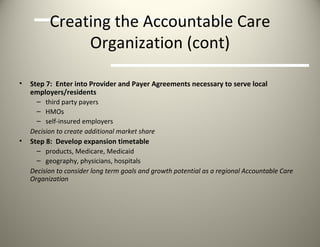
Creating the Accountable Care Organization (cont) Step 7:  Enter into Provider and Payer Agreements necessary to serve local employers/residents third party payers HMOs self-insured employers Decision to create additional market share Step 8:  Develop expansion timetable products, Medicare, Medicaid geography, physicians, hospitals Decision to consider long term goals and growth potential as a regional Accountable Care Organization
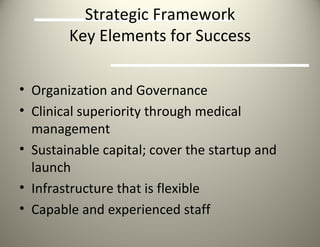
Strategic Framework Key Elements for Success Organization and Governance Clinical superiority through medical management Sustainable capital; cover the startup and launch Infrastructure that is flexible Capable and experienced staff
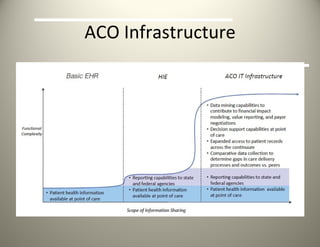
ACO Infrastructure
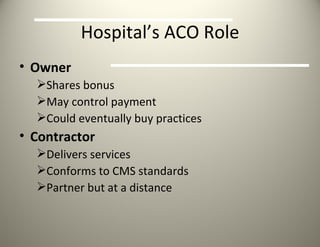
Hospital’s ACO Role Owner Shares bonus May control payment Could eventually buy practices Contractor Delivers services  Conforms to CMS standards Partner but at a distance
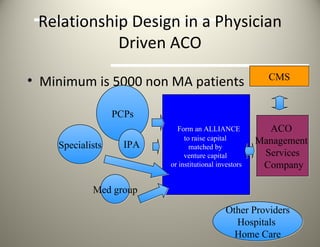
Relationship Design in a Physician Driven ACO Minimum is 5000 non MA patients PCPs Specialists Med group IPA Form an ALLIANCE to raise capital  matched by  venture capital  or institutional investors ACO  Management  Services Company CMS Other Providers Hospitals  Home Care
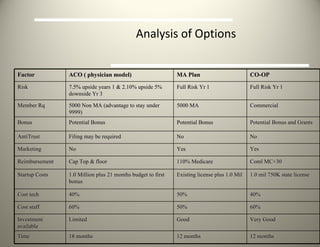
Analysis of Options Factor ACO ( physician model)  MA Plan CO-OP Risk 7.5% upside years 1 & 2.10% upside 5% downside Yr 3 Full Risk Yr 1 Full Risk Yr 1 Member Rq 5000 Non MA (advantage to stay under 9999) 5000 MA Commercial Bonus Potential Bonus Potential Bonus Potential Bonus and Grants AntiTrust Filing may be required No No Marketing No Yes Yes Reimbursement Cap Top & floor 110% Medicare Coml MC+30 Startup Costs 1.0 Million plus 21 months budget to first bonus Existing license plus 1.0 Mil  1.0 mil 750K state license  Cost tech 40% 50% 40% Cost staff 60% 50% 60% Investment available Limited Good Very Good Time 18 months 12 months 12 months
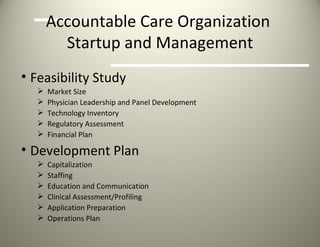
Accountable Care Organization  Startup and Management Feasibility Study  Market Size Physician Leadership and Panel Development  Technology Inventory Regulatory Assessment Financial Plan Development Plan  Capitalization Staffing Education and Communication Clinical Assessment/Profiling Application Preparation Operations Plan
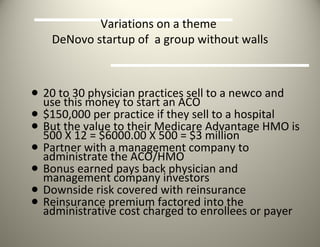
Variations on a theme  DeNovo startup of  a group without walls 20 to 30 physician practices sell to a newco and use this money to start an ACO $150,000 per practice if they sell to a hospital But the value to their Medicare Advantage HMO is 500 X 12 = $6000.00 X 500 = $3 million  Partner with a management company to administrate the ACO/HMO Bonus earned pays back physician and management company investors Downside risk covered with reinsurance  Reinsurance premium factored into the administrative cost charged to enrollees or payer
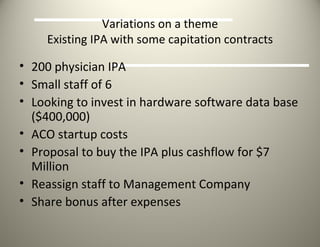
Variations on a theme Existing IPA with some capitation contracts 200 physician IPA Small staff of 6 Looking to invest in hardware software data base ($400,000) ACO startup costs Proposal to buy the IPA plus cashflow for $7 Million Reassign staff to Management Company Share bonus after expenses
Benefits of a Physician driven ACO Current opportunities to gather market share and earn a bonus  Future opportunities to reduce overhead through collective purchasing Positioned well for MA Plan, Commercial Plan or Cooperative  Less reliance on one or two carriers Genuine possibility to improve the value of the practice asset and leverage it into a larger and stronger group Potential to sell practice at a higher asset value and retire or move to a new practice site
Thank you

Pendulum Physician ACO

  • 1.
  • 2.
  • 3.
    Agenda What isan Accountable Care Organization? What kinds of organizational structures are being used? What are the requirements? What payment arrangements and how do they work? Framework for success Private market for ACOs are humming Variations on a theme
  • 4.
    DeMarco and Associates Founded in 1980 Researches, designs, develops and implements successful strategies to build community based health care organizations. Optimizes the relationship between providers and payers. Integrates clinical care improvements and reimbursement. Aligns purchasers and providers, physicians and hospitals. This collaboration helps to prepare for future opportunities and to work together for the mutual benefit of patients, physicians, hospitals and employers.
  • 5.
    Pendulum HealthCare Development Corporation Formed in 2001 Provides supporting infrastructure and connectivity among physicians, hospitals, health plans, employers and vendors to create a sustainable clinical integration model on a local or regional basis by: Accelerating legacy to web information technology conversion. Creating enterprise-wide data exchanges and dashboards. Building and supporting pay for performance systems allowing providers and purchasers to share in savings created through more efficient and effective care. Assisting clients in using data at all levels to identify gaps in processes and performance to assure consistent, measurable and effective care coordination and management. Designs, develops and manages Accountable Care Organizations (ACOs).
  • 6.
    What is anAccountable Care Organization?
  • 7.
    What is anAccountable Care Organization? An ACO is a local health care organization and a related set of providers (at a minimum, primary care physicians, specialists, and hospitals) that can be held accountable for the cost and quality of care delivered to a defined population. The goal of the ACO is to deliver coordinated and efficient care. A Guide to Accountable Care Organizations and Their Role in the Senate’s Health Reform Bill, March 11, 2010 by Jordan T. Cohen . http://www.rwjf.org/files/research/acosummaryfinal.pdf
  • 8.
    What Is anAccountable Care Organization? The ability to provide, and manage with patients, the continuum of care across different institutional settings, including at least ambulatory and inpatient hospital care and possibly post acute care; The capability of prospectively planning budgets and resource needs; and Sufficient size to support comprehensive, valid, and reliable performance measurement. Can Accountable Care Organizations Improve the Value of Health Care by Solving the Cost and Quality Quandaries? (Berenson, p. 2)
  • 9.
    To qualify asan ACO an organization would have to meet at least the following criteria : (1) Agree to a minimum three-year participation, (2) Have a formal legal structure that would allow the organization to receive/distribute bonuses to participating providers, (3) Include the primary care providers of at least 5,000 Medicare beneficiaries, (4) Provide CMS with a list of the primary care and specialist physicians participating in the organization, (5) Have contracts in place with a core group of specialist physicians, (6) Have a management and leadership structure in place that allows for joint decision making (e.g., for capital purchases), and (7) Defined processes to promote evidence-based medicine, report on quality and cost measures, and coordinate care. Source: Senate Finance Committee Report
  • 10.
    To earn theincentive payment the organization would have to meet certain quality thresholds ACOs must agree to report annually to the Secretary of Health and Human Services on a specified set of quality indicators. ACOs would be allowed to report at the group or individual level on measures specified by the Secretary, including measures of: (1) clinical processes and outcomes (e.g. mortality, improvements in functionality), (2) patient perspectives on care, and (3) utilization and costs (e.g. ambulatory-sensitive admissions). For the purposes of calculating quality and cost performance, CMS would assign beneficiaries to ACOs based on the physician from whom the beneficiary received the most primary care services in the preceding year. [Note: This is for the purpose of gauging performance only, and does not impact the ability of beneficiaries to choose their own site of care.] ACOs would [in addition to the bonus] continue to be paid on a fee-for-service basis.
  • 11.
    This is nota PHO Source: Mc Dermott Will and Emery, used with permission PHO ACO Insurance risk Performance risk Panel of patients Population of patients Scrum for share of revenue Rational allocation of revenue Charge based Value based Managed care leveraged Care coordination Episodic care focus Patient focused Split control and governance Physician leadership Do more Do less Intervention Prevention Clinical integration to achieve anti trust compliance Clinical integration to achieve efficiencies and quality improvement
  • 12.
    Relationship Design ina Hospital System Structure of Hospital driven plan System Parent Accountable Care Organization System Physician Organization Foundation Model Captive Group Practice Other System Physicians Hospital “ Affiliated Physicians IPA Private Physicians
  • 13.
  • 14.
  • 15.
    The Disease/Health ContinuumHealth is a continuous variable, according to George Isham, MD, HealthPartners Medical Director and Chief Health Officer. A person is not simply healthy or sick; there are various degrees of health. The Partners for Better Health program tries to move members along the disease/health continuum, toward lower risk and greater health through prevention. Source: HealthPartners, Partners for Better Health. Active Disease Early Symptoms High Risk At Risk No/Low Risk
  • 16.
    Pathway To GetFrom Where You Are Setting clinical benchmarks Setting spending benchmarks Measuring performance Quality and efficiency metrics analysis Care management process Performance payment adjustments
  • 17.
  • 18.
    Episode of Care– Definition All clinically related services for a discrete diagnostic condition from the onset of symptoms until treatment is complete.
  • 19.
    Acute Bronchitis withCo-morbidity Clean Period Start Clean Period End Office Visit (Anchor Record) Lab Services (Ancillary Record) Radiology (Ancillary) Pharmacy Records (Ancillary) Cluster 1 PCP 444 Cluster 2 Specialist A Cluster 4 PCP 444 Cluster 3 Specialist A Insulin Diabetes All records in the episode share the same unique episode number
  • 20.
    Medical Episode GrouperClaims Data Clinical Classification Grouping Methodology Analytic Outputs Inputs include professional claims, facility claims, inpatient admissions records, and pharmacy claims Grouping diagnosis codes into one of the over 550 Disease Staging categories and severity stages Appropriately group claims into episodes according to disease category and relative time between services Output aggregated information for the episode and allow for analytic flexibility for analysis
  • 21.
    Infrastructure Health InformationExchange Capability Patient Centric Database Specialty Care Providers & Staff Retail Pharmacies Ambulatory Clinics Patients and Family Caregivers Primary Care Providers & Staff
  • 22.
    Re-engineering System RedesignFinancial Redesign Patient Financial Interface
  • 23.
    Financial redesign BusinessPlan Management Systems Operations Marketing Governance Application development
  • 24.
    Management OperationsManager: Operations must be managed by an executive, officer, manager, or general partner. Medical Director: Clinical management and oversight would be managed by a senior-level medical director who is a board certified physician, licensed in the State in which the ACO operates, and physically present in that State. Meaningful Commitment: Participants must have a meaningful commitment to the ACO's clinical integration program to ensure its likely success. Quality Assurance: ACOs must have a physician-directed quality assurance and process improvement committee. Clinical Guidelines: ACOs must develop and implement evidence-based medical practice or clinical guidelines for delivering coordinated care. Data Collection Infrastructure: ACOs must have an infrastructure (i.e. information technology) that allows the ACO to collect and evaluate data and provide feedback across the organization, and report data to CMS.
  • 25.
    Benchmarks The actualbenchmark will be the weighted average of the three years’ averages, after trending and risk adjusting. Proposed weights are: 10% in Year 1; 30% in Year 2; and 60% in Year 3. CMS says this approach is more statistically stable than using a simple average of the three years. This benchmark determination approach means that the ACO will have to beat its own performance in each 3-year contract period. ACOs will experience diminishing returns as their cost efficiency improves. This will earn them savings in one contract period but will become the benchmark they have to beat in the next contract period.
  • 26.
    An ACO: MedicareShares Savings Program (MSSP) Is defined in Section 3022 of the PPACA (new Health Reform Act) Is very similar to globally capitated IPAs/Medical Groups Must: Demonstrate how they take accountability for a patient population (PCP network, care mgt P&Ps, etc) Coordinate services under Medicare and Medicaid Encourage investment in infrastructure Design processes for high quality and efficient service delivery Bonus payments must include quality metric. Optionally PCPs could be positioned as “certified” Medical Homes PGP demonstration quality metrics are starting points With passage of the law, its now an ongoing program of CMS w/ operational start date of no later than 1/1/2012 Existing demonstration will not be expanded – just continued. Not a pilot program, MSSP is now a statutory program.
  • 27.
    ACO/MSSP .vs globallycapitated IPA/Medical Group (FYI, 80%+ of Medicare HMO lives in Florida are contracted through globally capitated networks/medical groups.) Financial Risk: ACO is 50% of upside: 0% downside Globally capitated IPA/medical group is 100% upside and 100% downside Capitation benchmark: ACO 98% of risk adjusted historical FFS costs Globally capitated IPA is 83% of CMS payments to Medicare HMOs Health Benefit Costs: ACO only traditional Medicare benefits Globally capitated IPAs must pay for all the extra HMO benefits Admin Costs: Simple ACO need only have PCP network – no explicit requirement for hospitals contracts – hospitals cannot hold an ACO hostage! FI continues to pay claims ACO does analysis from adjudicated claim data files 5% cost advantage to ACO Marketing and Enrollment: ACO patients are “assigned” by historical claim pattern effective 1 st day of operations – no sales commissions, etc. ALL Medicare patients of the PCP not otherwise enrolled in a Medicare HMO/PPO are assigned to the ACO. 3:1 enrollment advantage to ACO. 5-6% cost advantage to ACO
  • 28.
    Application of ACOmodel vs. Global Capitation Contract – in the real world. Red Font are ACO adjustments to published financials 2009 using Congressional Budget Office scoring formula for ACOs in Health Care Reform Act. Roughly 60 PCPs, or 36,000 members
  • 29.
    Advantages to Physician “Why doctors will do it?” Potential for substantial additional revenue from shared savings program Physician guaranteed current FFS level of Medicare/Medicaid No downside financial risk to join the ACO Opportunity to gain and/or preserve market share Additional services from the ACO Physician groups barrier to entry is the working capital requirement for the anticipated case mgt, info processing, other admin activities and timelines to bonus payment
  • 30.
    Basic Financial Summaryof Start-up ACO Annual Benchmark Target 2013 = $225 Million EBITA 2013 = $7.0 Million After Tax 2013 = $5.8 Million Terminal value at end of 2015 2x EBITA + Cash & S/T Investments + Net Bonus Receivable $17 Million
  • 31.
    What is thatwe are looking from You? Equity or Contract Joint Venture PCP recruitment and selection 50% sharing of operating income 50% of budget of CMS Application CMS Application Budget $550,000 ($250,000 +/- your share) Legal entity and contracts, QI committee P&P Provider contracting Application development, submission, interrogatories, etc.
  • 32.
    Pendulum Will BringFor Medicare ACO (Summarized) Working Capital from 2012 through 2013 Projected total working capital $5.5 million. Administrative: Precise Program and Legal Structures Demographic and claims info: Data, data, data, and reconciliations Claims submissions “clearing house for par” Non “par” audit, contesting incorrectly paid claims and tracking Demographic, Claims (Dx, CPT, DRG, etc), quality reporting. Compliance reporting (QA, program integrity, etc) Credentialing process for ACO PCPs to become NCQA “Medical Homes” Care Management 90 – 90 – 90 Program and Integrated Health Risk Assessment process Road map to deploy best practices intra/inter market Road map to deploy evidence based medical protocols CM/UM/SW personnel, P&Ps, etc. Provider development and contracting Robust quality metric reporting Detailed treatment plan development and patient compliance reporting
  • 33.
    Summary “ Whateverform ACOs eventually take, one thing is certain: the era of fragmented care delivery should draw to a close. Too many Medicare beneficiaries — like many other patients — have suffered at the hands of wasteful, ineffective, and poorly coordinated systems of care, with consequent costs that are proving unsustainable. CMS believes that with enhanced cooperation among beneficiaries, hospitals, physicians, and other health care providers, ACOs will be an important new tool for giving Medicare beneficiaries the affordable, high-quality care they want, need, and deserve.” Donald M. Berwick, M.D., M.P.P., Administrator, Centers for Medicare and Medicaid Services
  • 34.
    Private Market CommercialEmployers Cities, Counties, School Districts Labor Unions, Taft Hartley Trusts, Trade Associations
  • 35.
    IPA Opportunities Strengtheningan IPA and its medical staff relationship with hospitals through direct contracting with employers who have become dissatisfied with local third party controls Recasting physicians in their new role as managers of quality standards and review Direct linkages to employers who have joined the community organization to share data and have a better understanding of how care can be delivered Give employers a “Go to” source for help with care management and billing questions Collaborative approach between buyer and physician earns more trust and sets expectations for patient and employers as to what is reasonable care versus excessive or unnecessary
  • 36.
    New Structure of Community-based Health Plan Employer Physicians MSO/JVCO Hospital
  • 37.
    Employer Coalition “ACOs simply call for organizing and providing care in a systematic fashion. Done well, they should provide a bunch of win-wins, but there will also be some squeezes. These may well hit the hospitals. Therefore, to protect their interests, physicians - who actually are positioned to create the organization, incentives and processes to be successful - should take the lead in ACO formation and implementation and contract for hospital services, rather than allowing the hospitals to do so and contract the physicians. Ultimately, in hospital-based ACOs the financial needs of the hospitals will take priority over rewarding the physicians for their effort and, therefore, they are likely to be less effective in achieving employer or government goals, i.e. generating greater efficiency, better outcomes and lower cost.” - Ned Lamkin, MD, FACP President Indiana Employers Quality Health Alliance
  • 38.
    Potential IPA orMedical Society Role
  • 39.
    So Show Methe Money Calculation of the bonus follows three published numbers involving what is now being paid to Medicare Advantage plans minus what is used for non health care benefits and what is paid to CMS. We have estimated administrative costs and now must put a 7.5% limit on the top under proposed rules.
  • 40.
  • 41.
    Creating the AccountableCare Organization Step 1 A feasibility study is conducted to answer four questions Is there a market? Is there a market with a need? Can our organization fill that need with current or proposed products ? Is this strategy sustainable over time? Assuming the answers to these questions are favorable and a decision is made to move forward the plan can follow this general framework: Step 2: Form and capitalize a viable Physician Organization (PO) develop and accept participation guidelines review and respond to insurance and liability issues file appropriate organizing and securities documents Decision on physician participation criteria and credentialing service Step 3: Identify other provider partners, including: hospital(s) free-standing institutional providers ancillary care providers Decision on initial delivery system participants Step 4: Identify non-provider stakeholders in the Local Delivery System Employers, residents, investors, vendors (e.g., TPAs)
  • 42.
    Creating the AccountableCare Organization (cont) Step 5: Develop an initial business plan for the ACO employer market assessment and enrollment plan regulatory and legal feasibility estimate budgets and financial forecasts health service delivery quality and utilization guidelines Letters of Intent from employers and providers Timetable Decision to create a licensed health plan or affiliate with (and invest in) a licensed risk-bearing entity (HMO) Step 6: Create and capitalize the Local Delivery System enter into development and management agreements as necessary create the appropriate corporate form successfully solicit capital enter into provider agreements hire local staff to implement plans and programs Decision to manage the operations of a clinically integrated accountable provider organization
  • 43.
    Creating the AccountableCare Organization (cont) Step 7: Enter into Provider and Payer Agreements necessary to serve local employers/residents third party payers HMOs self-insured employers Decision to create additional market share Step 8: Develop expansion timetable products, Medicare, Medicaid geography, physicians, hospitals Decision to consider long term goals and growth potential as a regional Accountable Care Organization
  • 44.
    Strategic Framework KeyElements for Success Organization and Governance Clinical superiority through medical management Sustainable capital; cover the startup and launch Infrastructure that is flexible Capable and experienced staff
  • 45.
  • 46.
    Hospital’s ACO RoleOwner Shares bonus May control payment Could eventually buy practices Contractor Delivers services Conforms to CMS standards Partner but at a distance
  • 47.
    Relationship Design ina Physician Driven ACO Minimum is 5000 non MA patients PCPs Specialists Med group IPA Form an ALLIANCE to raise capital matched by venture capital or institutional investors ACO Management Services Company CMS Other Providers Hospitals Home Care
  • 48.
    Analysis of OptionsFactor ACO ( physician model) MA Plan CO-OP Risk 7.5% upside years 1 & 2.10% upside 5% downside Yr 3 Full Risk Yr 1 Full Risk Yr 1 Member Rq 5000 Non MA (advantage to stay under 9999) 5000 MA Commercial Bonus Potential Bonus Potential Bonus Potential Bonus and Grants AntiTrust Filing may be required No No Marketing No Yes Yes Reimbursement Cap Top & floor 110% Medicare Coml MC+30 Startup Costs 1.0 Million plus 21 months budget to first bonus Existing license plus 1.0 Mil 1.0 mil 750K state license Cost tech 40% 50% 40% Cost staff 60% 50% 60% Investment available Limited Good Very Good Time 18 months 12 months 12 months
  • 49.
    Accountable Care Organization Startup and Management Feasibility Study Market Size Physician Leadership and Panel Development Technology Inventory Regulatory Assessment Financial Plan Development Plan Capitalization Staffing Education and Communication Clinical Assessment/Profiling Application Preparation Operations Plan
  • 50.
    Variations on atheme DeNovo startup of a group without walls 20 to 30 physician practices sell to a newco and use this money to start an ACO $150,000 per practice if they sell to a hospital But the value to their Medicare Advantage HMO is 500 X 12 = $6000.00 X 500 = $3 million Partner with a management company to administrate the ACO/HMO Bonus earned pays back physician and management company investors Downside risk covered with reinsurance Reinsurance premium factored into the administrative cost charged to enrollees or payer
  • 51.
    Variations on atheme Existing IPA with some capitation contracts 200 physician IPA Small staff of 6 Looking to invest in hardware software data base ($400,000) ACO startup costs Proposal to buy the IPA plus cashflow for $7 Million Reassign staff to Management Company Share bonus after expenses
  • 52.
    Benefits of aPhysician driven ACO Current opportunities to gather market share and earn a bonus Future opportunities to reduce overhead through collective purchasing Positioned well for MA Plan, Commercial Plan or Cooperative Less reliance on one or two carriers Genuine possibility to improve the value of the practice asset and leverage it into a larger and stronger group Potential to sell practice at a higher asset value and retire or move to a new practice site
  • 53.

Editor's Notes

  • #14 Which side and how far up?