Accountable Care Organizations:Overview and the Role of Information TechnologyColin Konschak, MBA, FHIMSSMary Sirois, MBA, CPHIMSDavid Shiple© 2010 DIVURGENT. All rights reserved.1
ObjectivesDescribe the intention and programmatic features of the Medicare Shared Savings ProgramIdentify financial impacts associated with the accountable care organizationDescribe potential delivery models for the accountable care organizationDescribe quality reporting requirements and issuesIdentify HIT requirements for the Medicare Shared Savings ProgramIdentify alignment between Meaningful Use requirements and Shared Savings requirementsDescribe a potential ACO IT reference model© 2010 DIVURGENT. All rights reserved.2
Level SettingCommercial Accountable Care Organizations (ACOs)Medicare Shared Savings Program ACOsNotice of Proposed Rulemaking (NPRM) Definition of an Accountable Care OrganizationLegal entityComprised of an eligible group of ACO participants Established a mechanism for shared governance© 2010 DIVURGENT. All rights reserved.3
Affordable Care ActPatient Protection and Affordable Care Act / Health Care and Education Reconciliation Act of 2010Goals:Improve quality of Medicare servicesSupport innovationEstablish new payment modelsAlign payments with costsStrengthen program integritySecure financial future of the programRequires the Secretary to establish the Medicare Shared Savings Program with a three part aim:Better care for individualsBetter health for populationsLower growth in expenditures© 2010 DIVURGENT. All rights reserved.4
Value Based PurchasingLinks payments directly to the quality of care deliveredRewards providers for high quality, efficient careImprove QualityLower growth in expenditures© 2010 DIVURGENT. All rights reserved.5
Shared Savings ProgramIntentionsPromote accountability for a populationImprove coordination of items and servicesEncourage investment in infrastructureRedesign care processes to improved quality and efficiencyShare savings with the ACOAchieve at the highest level, the three-part aimReduce growth in expendituresThe Program ItselfAllows for providers to work togetherEstablishes shared savings paymentsSecretary given discretion to determine assignment of beneficiaries Establishes principles and requirements for payments and treatment of savingsPayments will continue under FFSEstablishes the methodology to calculate savingsACOs must not avoid at-risk patients© 2010 DIVURGENT. All rights reserved.6
Two Distinct ModelsShared savings modelEntry point for less experienced organizations in accepting financial riskAllows for time to gain experience, while under the FFS modelProposed that these organizations will transition to the two-sided model in their final year of their initial agreementShared savings / losses modelFor those organizations experienced with managing population health and accepting riskGreater reward for those accepting risk© 2010 DIVURGENT. All rights reserved.7
© 2010 DIVURGENT. All rights reserved.8ACO Roadmap:  Navigating the Financial Issues for Your ACOSource: Accountable Care Organizations: A Roadmap for Success by Bruce Flareau, MD
© 2010 DIVURGENT. All rights reserved.9
Organizational Models© 2010 DIVURGENT. All rights reserved.10
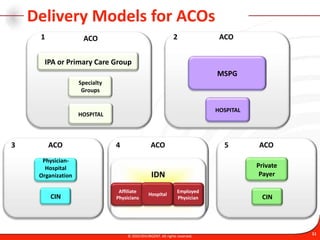
ACO12ACOIPA or Primary Care GroupMSPGSpecialty GroupsHOSPITALHOSPITALACOACOACO435Private PayerPhysician-Hospital OrganizationIDNHospitalAffiliate PhysiciansEmployedPhysicianCINCINDelivery Models for ACOs11© 2010 DIVURGENT. All rights reserved.
© 2010 DIVURGENT. All rights reserved.12Principles of Successful Integration
“Relational Model of How High-Performance Work Systems Work”High Performance Work PracticesSelection for Cross-functional TeamworkCross-functional Conflict ResolutionCross-functional Performance MeasurementCross-functional RewardsCross-functional MeetingsCross-functional Boundary SpannersQuality OutcomesPatient-PerceivedQuality of CareRelational CoordinationShared GoalsShared KnowledgeMutual RespectFrequent Comm.Timely Comm.Accurate Comm.Problem Solving Comm.Efficiency OutcomesPatient Length of StayNote: Model from the work of Dr. Jody Gittell on Relational Coordination in Healthcare Organizations. http://www.jodyhoffergittell.info/content/rc2c.html  13© 2010 DIVURGENT. All rights reserved.
ACO Change Management Model14© 2010 DIVURGENT. All rights reserved.
© 2010 DIVURGENT. All rights reserved.15ACO Roadmap: Governance and Launch
Quality Measurement© 2010 DIVURGENT. All rights reserved.16
Measurement Areas for ACOsOutcomesProcessPatient ExperienceUtilizationCareCoordinationAccessTo Care17© 2010 DIVURGENT. All rights reserved.
Leverages Current Quality Measures18© 2010 DIVURGENT. All rights reserved.
Reflects Chronic Care ModelWagner EH. Chronic disease management: what will it take to improve care for chronic illness? Eff Clin Pract. 1998;1:2-4.  (The Chronic Care Model image first appeared in its current format in this article)Wagner EH, Austin BT, Davis C, Hindmarsh M, Schaefer J, Bonomi A. Improving chronic illness care: translating evidence into action. Health Aff (Millwood). 2001;20:64-78.Copyright 1996-2011 The MacColl Institute.  The Improving Chronic Illness Care program is supported by The Robert Wood Johnson Foundation, with direction and technical assistance provided by Group Health's MacColl Institute for Healthcare Innovation19© 2010 DIVURGENT. All rights reserved.
Quality Reporting MeasuresBetter Care for Individuals Better Health for Populations42 CFR Part 425 [CMS-1345-P]RIN 0938-AQ22 Medicare Program; Medicare Shared Savings Program: Accountable Care Organizations20© 2010 DIVURGENT. All rights reserved.
Patient/Caregiver ExperienceTimely care, appointments and informationHow well doctors communicateHelpful, courteous, respectful office staffPatient’s rating of doctorShared decision makingHealth status/functional statusAll measures collected via patient survey
All based on NQF standards21© 2010 DIVURGENT. All rights reserved.
Care Coordination30-day acute care readmission rates30-day post discharge physician visitMedication reconciliation 60 days following hospital dischargeQuality of preparation for care transitionAmbulatory Sensitive ConditionsDiabetes short-term complicationsUncontrolled diabetesCOPDCHFDehydrationBacterial pneumoniaUrinary tract infectionStage 1 Meaningful Use% ALL physicians% PCP% PCPs using clinical decision support% PCPs using eRxPatient registry useData submission via claims, GPRO, patient survey
Measures based on CMS, NQF and HITECH22© 2010 DIVURGENT. All rights reserved.
Patient SafetyHealth Care Acquired Conditions:Foreign object retained after surgeryAir embolismBlood incompatibilityStage II and IV pressure ulcersFalls and traumaCatheter-associated UTIManifestations of poor glycemic controlCentral line associated blood stream infectionSurgical site infectionAHRQ Patient Safety indicatorsAccidental puncture or lacerationIatrogenic pneumothoraxPost op DVT or PEPost op wound dihiscenceDecubitus ulcerSelected infections due to medical carePost op hip fracturePost op sepsisCLABSI bundleData submission via claims or CDC National Healthcare Safety Network
Measures based on CMS and NQF standards23© 2010 DIVURGENT. All rights reserved.
Preventive HealthInfluenza immunizationPneumococcal vaccinationMammography screening within 24 monthsColorectal screeningCholesterol management for patients with cardiovascular conditionsAdult weight screening and follow-upBlood pressure measurement in patient with hypertensionTobacco use assessment and tobacco cessation interventionDepression screeningData submission via GPRO data collection tool Measures based on PQRS, HITECH and NQF measures24© 2010 DIVURGENT. All rights reserved.
At-Risk PopulationsDiabetes – 10 measuresHeart Failure – 7 measuresCoronary Artery Disease – 6 measuresHypertension – 2 measuresCOPD – 3 measuresFrail Elderly – 3 measuresData submission via GPRO data collection tool and claims(1)
Measures based on CMS, PQRS, HITECH and NQF measures25© 2010 DIVURGENT. All rights reserved.
Technologies Involved in Quality Management26© 2010 DIVURGENT. All rights reserved.
© 2010 DIVURGENT. All rights reserved.27Results of Physician Group Practice Demonstration (Through 12/2010)
ACO Roadmap: Quality28© 2010 DIVURGENT. All rights reserved.
Information Technology Implications© 2010 DIVURGENT. All rights reserved.29
May “require the use of specific decision support tools...”In the application, an ACO must provide documentation describing plans to:Promote evidence based medicinePromote beneficiary engagementReport internally on quality and cost metricsCoordinate careBeneficiaries should have access to their own medical recordsAct mentions processes for the electronic exchange of informationProcess for evaluating health needs of the population“Should have a process in place (or clear path) to electronically exchange summary of care information when patients transition to another provider or setting of care, both within and outside the ACO, consistent with MU requirements.”Individualized care plans shared throughout the continuum© 2010 DIVURGENT. All rights reserved.30Medicare ACO IT RequirementsRequires an ACO to “define processes to promote evidence-based medicine and patient engagement, report on quality and cost measures, and coordinate care, such as through the use of telehealth, remote patient monitoring, and other such enabling technologies.”
© 2010 DIVURGENT. All rights reserved.31ACO IT Reference ModelKey Themes:While much of the required IT investment for ACOs overlaps with Meaningful Use, most of it does not, and will require a new IT strategic planning approach
Much of  the technology called for is not readily available in the marketplace
Expect many HIT products used by payers to be modified for use by providers
As the incentives build to keep patients healthy and out of provider facilities, home health & telehealth technology innovation will accelerate
Privacy and security infrastructure will take on heightened importance and complexity
Key ACO IT building blocks – such as HIEs – will quickly expand into new functionality areas
While CMS may be calling for end-to-end HIT capabilities at ACO start-up, many private ACO’s can start with HIT “baby-steps” ACO IT Reference ModelLegend:  What is/ will be on the radar screen for:PatientPayersACO'sProvidersSurvey ToolsPHRSelf-ServiceSecure CommunicationsCoordinated Care PlansHealth PlanHospitalSpecialistPrimary CareCommunity Support ProvidersClaimsEHREHREHREHRMember RegistryEMPISecurity InfrastructureHealth Information ExchangeDisease MgtEnterprise Data WarehouseCare MgtDisease RegistriesEnrollmentData Analytics32© 2010 DIVURGENT. All rights reserved.Risk MgtACO Revenue Cycle Management
© 2010 DIVURGENT. All rights reserved.33ACO Alignment w. MULegend:  Alignment to Meaningful UsePatientNot ApplicableStage 2Stage 1Survey ToolsPHRSelf-ServiceSecure CommunicationsCoordinated Care PlansHealth PlanHospitalSpecialistPrimary CareCommunity Support ProvidersClaimsEHREHREHREHRMember RegistryEMPISecurity InfrastructureHealth Information ExchangeDisease MgtEnterprise Data WarehouseCare MgtDisease RegistriesEnrollmentData Analytics© 2010 DIVURGENT. All rights reserved.Risk MgtACO Revenue Cycle Management
ACO IT Reference ModelPatientHIE’s are the key IT enabler for care coordination, giving all providers a view of a patient’s longitudinal record
Besides clinical data sharing, HIEs support handoff’s such as referrals and care transitions

As prez4web061611

  • 1.
    Accountable Care Organizations:Overviewand the Role of Information TechnologyColin Konschak, MBA, FHIMSSMary Sirois, MBA, CPHIMSDavid Shiple© 2010 DIVURGENT. All rights reserved.1
  • 2.
    ObjectivesDescribe the intentionand programmatic features of the Medicare Shared Savings ProgramIdentify financial impacts associated with the accountable care organizationDescribe potential delivery models for the accountable care organizationDescribe quality reporting requirements and issuesIdentify HIT requirements for the Medicare Shared Savings ProgramIdentify alignment between Meaningful Use requirements and Shared Savings requirementsDescribe a potential ACO IT reference model© 2010 DIVURGENT. All rights reserved.2
  • 3.
    Level SettingCommercial AccountableCare Organizations (ACOs)Medicare Shared Savings Program ACOsNotice of Proposed Rulemaking (NPRM) Definition of an Accountable Care OrganizationLegal entityComprised of an eligible group of ACO participants Established a mechanism for shared governance© 2010 DIVURGENT. All rights reserved.3
  • 4.
    Affordable Care ActPatientProtection and Affordable Care Act / Health Care and Education Reconciliation Act of 2010Goals:Improve quality of Medicare servicesSupport innovationEstablish new payment modelsAlign payments with costsStrengthen program integritySecure financial future of the programRequires the Secretary to establish the Medicare Shared Savings Program with a three part aim:Better care for individualsBetter health for populationsLower growth in expenditures© 2010 DIVURGENT. All rights reserved.4
  • 5.
    Value Based PurchasingLinkspayments directly to the quality of care deliveredRewards providers for high quality, efficient careImprove QualityLower growth in expenditures© 2010 DIVURGENT. All rights reserved.5
  • 6.
    Shared Savings ProgramIntentionsPromoteaccountability for a populationImprove coordination of items and servicesEncourage investment in infrastructureRedesign care processes to improved quality and efficiencyShare savings with the ACOAchieve at the highest level, the three-part aimReduce growth in expendituresThe Program ItselfAllows for providers to work togetherEstablishes shared savings paymentsSecretary given discretion to determine assignment of beneficiaries Establishes principles and requirements for payments and treatment of savingsPayments will continue under FFSEstablishes the methodology to calculate savingsACOs must not avoid at-risk patients© 2010 DIVURGENT. All rights reserved.6
  • 7.
    Two Distinct ModelsSharedsavings modelEntry point for less experienced organizations in accepting financial riskAllows for time to gain experience, while under the FFS modelProposed that these organizations will transition to the two-sided model in their final year of their initial agreementShared savings / losses modelFor those organizations experienced with managing population health and accepting riskGreater reward for those accepting risk© 2010 DIVURGENT. All rights reserved.7
  • 8.
    © 2010 DIVURGENT.All rights reserved.8ACO Roadmap: Navigating the Financial Issues for Your ACOSource: Accountable Care Organizations: A Roadmap for Success by Bruce Flareau, MD
  • 9.
    © 2010 DIVURGENT.All rights reserved.9
  • 10.
    Organizational Models© 2010DIVURGENT. All rights reserved.10
  • 11.
    ACO12ACOIPA or PrimaryCare GroupMSPGSpecialty GroupsHOSPITALHOSPITALACOACOACO435Private PayerPhysician-Hospital OrganizationIDNHospitalAffiliate PhysiciansEmployedPhysicianCINCINDelivery Models for ACOs11© 2010 DIVURGENT. All rights reserved.
  • 12.
    © 2010 DIVURGENT.All rights reserved.12Principles of Successful Integration
  • 13.
    “Relational Model ofHow High-Performance Work Systems Work”High Performance Work PracticesSelection for Cross-functional TeamworkCross-functional Conflict ResolutionCross-functional Performance MeasurementCross-functional RewardsCross-functional MeetingsCross-functional Boundary SpannersQuality OutcomesPatient-PerceivedQuality of CareRelational CoordinationShared GoalsShared KnowledgeMutual RespectFrequent Comm.Timely Comm.Accurate Comm.Problem Solving Comm.Efficiency OutcomesPatient Length of StayNote: Model from the work of Dr. Jody Gittell on Relational Coordination in Healthcare Organizations. http://www.jodyhoffergittell.info/content/rc2c.html 13© 2010 DIVURGENT. All rights reserved.
  • 14.
    ACO Change ManagementModel14© 2010 DIVURGENT. All rights reserved.
  • 15.
    © 2010 DIVURGENT.All rights reserved.15ACO Roadmap: Governance and Launch
  • 16.
    Quality Measurement© 2010DIVURGENT. All rights reserved.16
  • 17.
    Measurement Areas forACOsOutcomesProcessPatient ExperienceUtilizationCareCoordinationAccessTo Care17© 2010 DIVURGENT. All rights reserved.
  • 18.
    Leverages Current QualityMeasures18© 2010 DIVURGENT. All rights reserved.
  • 19.
    Reflects Chronic CareModelWagner EH. Chronic disease management: what will it take to improve care for chronic illness? Eff Clin Pract. 1998;1:2-4.  (The Chronic Care Model image first appeared in its current format in this article)Wagner EH, Austin BT, Davis C, Hindmarsh M, Schaefer J, Bonomi A. Improving chronic illness care: translating evidence into action. Health Aff (Millwood). 2001;20:64-78.Copyright 1996-2011 The MacColl Institute.  The Improving Chronic Illness Care program is supported by The Robert Wood Johnson Foundation, with direction and technical assistance provided by Group Health's MacColl Institute for Healthcare Innovation19© 2010 DIVURGENT. All rights reserved.
  • 20.
    Quality Reporting MeasuresBetterCare for Individuals Better Health for Populations42 CFR Part 425 [CMS-1345-P]RIN 0938-AQ22 Medicare Program; Medicare Shared Savings Program: Accountable Care Organizations20© 2010 DIVURGENT. All rights reserved.
  • 21.
    Patient/Caregiver ExperienceTimely care,appointments and informationHow well doctors communicateHelpful, courteous, respectful office staffPatient’s rating of doctorShared decision makingHealth status/functional statusAll measures collected via patient survey
  • 22.
    All based onNQF standards21© 2010 DIVURGENT. All rights reserved.
  • 23.
    Care Coordination30-day acutecare readmission rates30-day post discharge physician visitMedication reconciliation 60 days following hospital dischargeQuality of preparation for care transitionAmbulatory Sensitive ConditionsDiabetes short-term complicationsUncontrolled diabetesCOPDCHFDehydrationBacterial pneumoniaUrinary tract infectionStage 1 Meaningful Use% ALL physicians% PCP% PCPs using clinical decision support% PCPs using eRxPatient registry useData submission via claims, GPRO, patient survey
  • 24.
    Measures based onCMS, NQF and HITECH22© 2010 DIVURGENT. All rights reserved.
  • 25.
    Patient SafetyHealth CareAcquired Conditions:Foreign object retained after surgeryAir embolismBlood incompatibilityStage II and IV pressure ulcersFalls and traumaCatheter-associated UTIManifestations of poor glycemic controlCentral line associated blood stream infectionSurgical site infectionAHRQ Patient Safety indicatorsAccidental puncture or lacerationIatrogenic pneumothoraxPost op DVT or PEPost op wound dihiscenceDecubitus ulcerSelected infections due to medical carePost op hip fracturePost op sepsisCLABSI bundleData submission via claims or CDC National Healthcare Safety Network
  • 26.
    Measures based onCMS and NQF standards23© 2010 DIVURGENT. All rights reserved.
  • 27.
    Preventive HealthInfluenza immunizationPneumococcalvaccinationMammography screening within 24 monthsColorectal screeningCholesterol management for patients with cardiovascular conditionsAdult weight screening and follow-upBlood pressure measurement in patient with hypertensionTobacco use assessment and tobacco cessation interventionDepression screeningData submission via GPRO data collection tool Measures based on PQRS, HITECH and NQF measures24© 2010 DIVURGENT. All rights reserved.
  • 28.
    At-Risk PopulationsDiabetes –10 measuresHeart Failure – 7 measuresCoronary Artery Disease – 6 measuresHypertension – 2 measuresCOPD – 3 measuresFrail Elderly – 3 measuresData submission via GPRO data collection tool and claims(1)
  • 29.
    Measures based onCMS, PQRS, HITECH and NQF measures25© 2010 DIVURGENT. All rights reserved.
  • 30.
    Technologies Involved inQuality Management26© 2010 DIVURGENT. All rights reserved.
  • 31.
    © 2010 DIVURGENT.All rights reserved.27Results of Physician Group Practice Demonstration (Through 12/2010)
  • 32.
    ACO Roadmap: Quality28©2010 DIVURGENT. All rights reserved.
  • 33.
    Information Technology Implications©2010 DIVURGENT. All rights reserved.29
  • 34.
    May “require theuse of specific decision support tools...”In the application, an ACO must provide documentation describing plans to:Promote evidence based medicinePromote beneficiary engagementReport internally on quality and cost metricsCoordinate careBeneficiaries should have access to their own medical recordsAct mentions processes for the electronic exchange of informationProcess for evaluating health needs of the population“Should have a process in place (or clear path) to electronically exchange summary of care information when patients transition to another provider or setting of care, both within and outside the ACO, consistent with MU requirements.”Individualized care plans shared throughout the continuum© 2010 DIVURGENT. All rights reserved.30Medicare ACO IT RequirementsRequires an ACO to “define processes to promote evidence-based medicine and patient engagement, report on quality and cost measures, and coordinate care, such as through the use of telehealth, remote patient monitoring, and other such enabling technologies.”
  • 35.
    © 2010 DIVURGENT.All rights reserved.31ACO IT Reference ModelKey Themes:While much of the required IT investment for ACOs overlaps with Meaningful Use, most of it does not, and will require a new IT strategic planning approach
  • 36.
    Much of the technology called for is not readily available in the marketplace
  • 37.
    Expect many HITproducts used by payers to be modified for use by providers
  • 38.
    As the incentivesbuild to keep patients healthy and out of provider facilities, home health & telehealth technology innovation will accelerate
  • 39.
    Privacy and securityinfrastructure will take on heightened importance and complexity
  • 40.
    Key ACO ITbuilding blocks – such as HIEs – will quickly expand into new functionality areas
  • 41.
    While CMS maybe calling for end-to-end HIT capabilities at ACO start-up, many private ACO’s can start with HIT “baby-steps” ACO IT Reference ModelLegend: What is/ will be on the radar screen for:PatientPayersACO'sProvidersSurvey ToolsPHRSelf-ServiceSecure CommunicationsCoordinated Care PlansHealth PlanHospitalSpecialistPrimary CareCommunity Support ProvidersClaimsEHREHREHREHRMember RegistryEMPISecurity InfrastructureHealth Information ExchangeDisease MgtEnterprise Data WarehouseCare MgtDisease RegistriesEnrollmentData Analytics32© 2010 DIVURGENT. All rights reserved.Risk MgtACO Revenue Cycle Management
  • 42.
    © 2010 DIVURGENT.All rights reserved.33ACO Alignment w. MULegend: Alignment to Meaningful UsePatientNot ApplicableStage 2Stage 1Survey ToolsPHRSelf-ServiceSecure CommunicationsCoordinated Care PlansHealth PlanHospitalSpecialistPrimary CareCommunity Support ProvidersClaimsEHREHREHREHRMember RegistryEMPISecurity InfrastructureHealth Information ExchangeDisease MgtEnterprise Data WarehouseCare MgtDisease RegistriesEnrollmentData Analytics© 2010 DIVURGENT. All rights reserved.Risk MgtACO Revenue Cycle Management
  • 43.
    ACO IT ReferenceModelPatientHIE’s are the key IT enabler for care coordination, giving all providers a view of a patient’s longitudinal record
  • 44.
    Besides clinical datasharing, HIEs support handoff’s such as referrals and care transitions

Editor's Notes

  • #4 NPRM released March 31, 2011Accountable Care Organization (ACO) means a legal entity that is recognized and authorized under applicable State law, as identified by a TIN, and comprised of an eligible group of ACO participants that work together to manage and coordinate care for Medicare FFS beneficiaries and have established a mechanism for shared governance that provides all ACO participants with an appropriate proportionate control over the ACO’s decision making processACO participant means a Medicare-enrolled provider of services and/or a supplierACO provider/supplier means a provider of services and/or a supplier that bills for items and services it furnishes to Medicare beneficiaries under a Medicare billing number assigned to the TIN of an ACO participant in accordance with applicable Medicare rules and regulations
  • #5 In March of ‘10 PPACA was enacted, The HCERA was then enacted which amended it. Together, they are known as the Affordable Care ActDefinition of the Shared Savings Program, “a program that promotes accountability for a patient population and coordinates items and services under Parts A and B, and encourages investment in infrastructure and redesigned care processes for high quality and efficient service delivery”
  • #6 Links payments directly to the quality of care deliveredRewards providers for high quality, efficient careImprove QualityUse of adjusted outcome and patient experience measuresMeasures aligned cross Medicare and MedicaidAligned with MU measures and best practicesLower growth in expendituresReward providers for reducing unnecessary expendituresContinual improvement of qualityUse of ongoing cost reducing and quality improving redesigned care processes across the entire patient population
  • #7 Reduce growth in expendituresEstimated net savings for CY’s 2012 through 2014 = $510MEstimate 75-150 ACOs in first 3 years of the program
  • #8 Shared savings model (one-sided model)Entry point for less experienced organizations in accepting financial riskAllows for time to gain experience, while under the FFS modelProposed that these organizations will transition to the two-sided model in their final year of their initial agreementShared savings/losses model (two-sided model)For those organizations experienced with managing population health and accepting riskGreater reward for those accepting riskOnly for MSS, Commercial ACOs come in a variety of flavors
  • #10 Previous slide we talked about expectations, the NPRM gives us clearer direction on the requirements:
  • #31 Technology such as CDS or a paper based methodology would likely sufficeTechnology such as portals, PHR’s, or paper based education as well as just engaging them in the processSuch reporting may include “developing a population health data management capability” or “implementing practice and physician level data capabilities with Point of service reminder systems” Measuring physician clinical and service performance, and coordinate care, such as through the use of telehealth, remote patient monitoring, and other such enabling technologies.” They are looking for ACOs to coordinate care across the ENTIRE continuum. They give examples such as:Capability to use predictive modeling to anticipate likely care needsUtilization of case managers in primary care officesRemote monitoringTelehealthEstablishment and use of HIT, including EHR and HIE to enable the provision of a beneficiary’s summary of care record during transitions of care both within and outside of the ACO.
  • #37 Transaction based vs. Value basedCommercial vs. CMS ACOShared SavingsTriple AimStructure and GovernanceLegal ConsiderationsFundamentally different than the HMOFee for Service paymentsLegislative Next StepsOngoing alignment between ACO and MUInvestments in HIT are expected and required
  • #44 Traditionally non radiologists referred patients needing MRI to hospitals and other facilitiesThose factilities billed for the services, the referring physician did not bill anythingOver 1.5M episodes of care with 11,844 total orthodpedists and 6k neurologists- The 6% increase in spending was not only accounted for by MRI. Other services and procedures also accounted for the increase.Why? Financial? Convenience? Quality?Convenience: easier to make a referral, less paperwork, patient doesn’t have to go somewhere else. **However, much of the MRI useage did not occur on the day of the first visit but on a subsequent visit.