Acid/Base and ABG
Acid/Base and ABG
Interpretation Made
Interpretation Made
Simple
Simple
A
A-
-a Gradient
a Gradient
ƒ
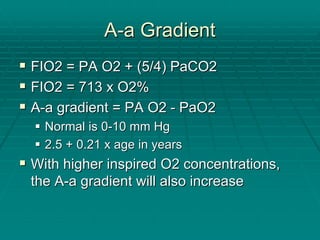
ƒ FIO2 = PA O2 + (5/4) PaCO2
FIO2 = PA O2 + (5/4) PaCO2
ƒ
ƒ FIO2 = 713 x O2%
FIO2 = 713 x O2%
ƒ
ƒ A
A-
-a gradient = PA O2
a gradient = PA O2 -
- PaO2
PaO2
ƒ
ƒ Normal is 0
Normal is 0-
-10 mm Hg
10 mm Hg
ƒ
ƒ 2.5 + 0.21 x age in years
2.5 + 0.21 x age in years
ƒ
ƒ With higher inspired O2 concentrations,
With higher inspired O2 concentrations,
the A
the A-
-a gradient will also increase
a gradient will also increase
PaO2
PaO2-
-FiO2 ratio
FiO2 ratio
ƒ
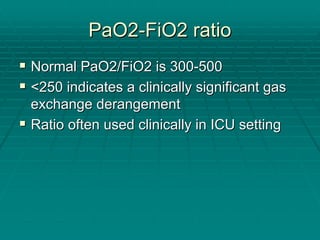
ƒ Normal PaO2/FiO2 is 300
Normal PaO2/FiO2 is 300-
-500
500
ƒ
ƒ <250 indicates a clinically significant gas
<250 indicates a clinically significant gas
exchange derangement
ƒ
ƒ Ratio often used clinically in ICU setting
Ratio often used clinically in ICU setting
Hypoxemia
Hypoxemia
ƒ
ƒ Hypoventilation
Hypoventilation
ƒ
ƒ V/Q mismatch
V/Q mismatch
ƒ
ƒ Right
Right-
-Left shunting
Left shunting
ƒ
ƒ Diffusion impairment
Diffusion impairment
ƒ
ƒ Reduced inspired oxygen tension
Reduced inspired oxygen tension
Hypoventilation
Hypoventilation
ƒ
ƒ CNS depression (OD or
CNS depression (OD or
structural/ischemic CNS lesions involving
respiratory center)
respiratory center)
ƒ
ƒ Neural conduction D/O
Neural conduction D/O’
’s (amyotrophic
s (amyotrophic
lateral sclerosis,
lateral sclerosis, Guillain
Guillain-
-Barre
Barre, high
, high
cervical spine injury)
ƒ
ƒ Muscular weakness (
Muscular weakness (polymositis
polymositis, MD)
, MD)
ƒ
ƒ Diseases of chest wall (flail chest,
Diseases of chest wall (flail chest,
kyphoscoliosis
kyphoscoliosis)
)
V/Q mismatch
V/Q mismatch
ƒ
ƒ Lung regions with low ventilation
Lung regions with low ventilation
compared to perfusion will have low
alveolar oxygen content and high CO2
content
content
ƒ
ƒ Lung regions with high ventilation
Lung regions with high ventilation
compared to perfusion will have a low
CO2 content and high oxygen content
ƒ
ƒ V/Q varies with position in lung (lower in
V/Q varies with position in lung (lower in
basilar than apical)
basilar than apical) –
– WEST ZONES
WEST ZONES
Diseases that affect V/Q
ƒ
ƒ Obstructive lung diseases
Obstructive lung diseases
ƒ
ƒ Pulmonary vascular diseases
Pulmonary vascular diseases
ƒ
ƒ Parenchymal
Parenchymal lung diseases
lung diseases
Right to Left Shunt
Right to Left Shunt
ƒ
ƒ Extreme example of V/Q mismatch
Extreme example of V/Q mismatch
ƒ
ƒ Shunt physiology may result from
Shunt physiology may result from
parenchymal
parenchymal diseases leading to
diseases leading to
atelectasis
atelectasis or alveolar flooding (lobar
or alveolar flooding (lobar
pneumonia or ARDS)
pneumonia or ARDS)
ƒ
ƒ Can also occur from pathologic vascular
Can also occur from pathologic vascular
communications (AVM or
communications (AVM or intracardiac
intracardiac
shunts)
shunts)
Diffusion Impairment
ƒ
ƒ When available path for movement of
When available path for movement of
oxygen from alveolus to capillary is altered
ƒ
ƒ Diffuse
Diffuse fibrotic
fibrotic diseases are the classic
diseases are the classic
entities
entities
Reduced inspired oxygen
delivery
delivery
ƒ
ƒ Delivery to tissue beds determined by
Delivery to tissue beds determined by
arterial oxygen content and cardiac output
ƒ
ƒ Oxygen content of blood is affected by
Oxygen content of blood is affected by
level and affinity state of hemoglobin
ƒ
ƒ Example is CO poisoning: reduction of arterial O2 content
Example is CO poisoning: reduction of arterial O2 content
despite normal PaO2 and
despite normal PaO2 and Hgb
Hgb caused by reduction in available
caused by reduction in available
O2 binding sites on the
O2 binding sites on the Hgb
Hgb molecule
molecule
ƒ
ƒ Reduced CO will lead to impairment in
Reduced CO will lead to impairment in
tissue O2 delivery and hypoxemia and
lactic acidosis
lactic acidosis
Oxygen Delivery, cont.
ƒ
ƒ Tissue hypoxia may occur despite
Tissue hypoxia may occur despite
adequate oxygen delivery
ƒ
ƒ CN poisoning causes interference with oxygen utilization by the
CN poisoning causes interference with oxygen utilization by the
cellular
cellular cytochrome
cytochrome system, leading to cellular hypoxia
system, leading to cellular hypoxia
ƒ
ƒ Disease states such as sepsis may result
Disease states such as sepsis may result
in tissue ischemia possibly because of
diversion of blood flow away from vital
organs
organs
ACID/BASE
ACID/BASE
ƒ
ƒ 15,000
15,000 mmol
mmol of CO2 (generates H2CO2)
of CO2 (generates H2CO2)
and 50
and 50-
-100
100 meq
meq of nonvolatile acid
of nonvolatile acid
(mostly sulfuric from sulfur
(mostly sulfuric from sulfur-
-containing
containing
amino acids) are made
ƒ
ƒ Balance is maintained by normal
Balance is maintained by normal
pulmonary and renal excretion of these
acids
acids
Renal excretion
Renal excretion
ƒ
ƒ Involves the combination of hydrogen ions
Involves the combination of hydrogen ions
with urinary
with urinary titratable
titratable acid, particularly
acid, particularly
phosphate (HPO42
phosphate (HPO42-
- + H+ to H2PO4
+ H+ to H2PO4-
-) or
) or
with ammonia to form ammonium
ƒ
ƒ Ammonium is the primary adaptive
Ammonium is the primary adaptive
response since ammonia production from
the metabolism of glutamine can be
increased in the presence of an acid load
Definitions
Definitions
ƒ
ƒ Acidosis: process that lowers the ECF pH by a
Acidosis: process that lowers the ECF pH by a
fall in HCO3 or elevation in PCO2
ƒ
ƒ Alkalosis: process that raises ECF pH by an
Alkalosis: process that raises ECF pH by an
elevation in ECF HCO3 or fall in PCO2
ƒ
ƒ Met Acidosis: low pH and low
Met Acidosis: low pH and low bicarb
bicarb
ƒ
ƒ Met Alkalosis: high pH and high
Met Alkalosis: high pH and high bicarb
bicarb
ƒ
ƒ Resp
Resp Acidosis: low pH and high PCO2
Acidosis: low pH and high PCO2
ƒ
ƒ Resp
Resp Alkalosis: high pH and low PCO2
Alkalosis: high pH and low PCO2
Metabolic Acidosis
Metabolic Acidosis
ƒ
ƒ Respiratory compensation results in 1.2 mm Hg
Respiratory compensation results in 1.2 mm Hg
fall in PCO2 for every 1
fall in PCO2 for every 1 meq
meq/L fall in
/L fall in bicarb
bicarb
ƒ
ƒ pCO2 = 1.5 (HCO3) + 8
pCO2 = 1.5 (HCO3) + 8
ƒ
ƒ DON
DON’
’T LEARN IT!!!
T LEARN IT!!!
ƒ
ƒ OR Last two digits of pH should equal PCO2
OR Last two digits of pH should equal PCO2
ƒ
ƒ if equal = no respiratory disturbances
if equal = no respiratory disturbances
ƒ
ƒ if PCO2 high = overlapping respiratory acidosis
if PCO2 high = overlapping respiratory acidosis
ƒ
ƒ if PCO2 low = overlapping respiratory alkalosis
if PCO2 low = overlapping respiratory alkalosis
Metabolic Acidosis, cont.
ƒ
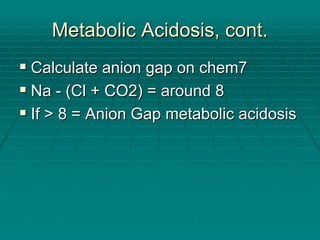
ƒ Calculate anion gap on chem7
Calculate anion gap on chem7
ƒ
ƒ Na
Na -
- (
(Cl
Cl + CO2) = around 8
+ CO2) = around 8
ƒ
ƒ If > 8 = Anion Gap metabolic acidosis
If > 8 = Anion Gap metabolic acidosis
Metabolic Acidosis
Metabolic Acidosis…
…continued
continued
ƒ
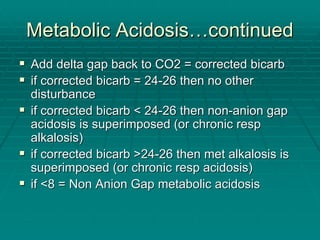
ƒ Add delta gap back to CO2 = corrected
Add delta gap back to CO2 = corrected bicarb
bicarb
ƒ
ƒ if corrected
if corrected bicarb
bicarb = 24
= 24-
-26 then no other
26 then no other
disturbance
disturbance
ƒ
ƒ if corrected
if corrected bicarb
bicarb < 24
< 24-
-26 then non
26 then non-
-anion gap
anion gap
acidosis is superimposed (or chronic
acidosis is superimposed (or chronic resp
resp
alkalosis)
alkalosis)
ƒ
ƒ if corrected
if corrected bicarb
bicarb >24
>24-
-26 then met alkalosis is
26 then met alkalosis is
superimposed (or chronic
superimposed (or chronic resp
resp acidosis)
acidosis)
ƒ
ƒ if <8 = Non Anion Gap metabolic acidosis
if <8 = Non Anion Gap metabolic acidosis
Metabolic Alkalosis
Metabolic Alkalosis
ƒ
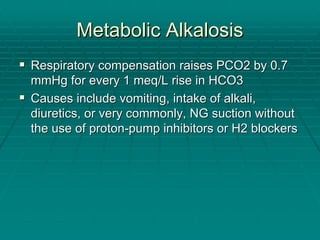
ƒ Respiratory compensation raises PCO2 by 0.7
Respiratory compensation raises PCO2 by 0.7
mmHg for every 1
mmHg for every 1 meq
meq/L rise in HCO3
/L rise in HCO3
ƒ
ƒ Causes include vomiting, intake of alkali,
Causes include vomiting, intake of alkali,
diuretics, or very commonly, NG suction without
the use of proton
the use of proton-
-pump inhibitors or H2 blockers
pump inhibitors or H2 blockers
Respiratory Acidosis
ƒ
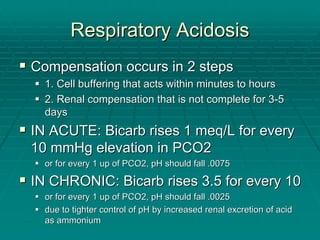
ƒ Compensation occurs in 2 steps
Compensation occurs in 2 steps
ƒ
ƒ 1. Cell buffering that acts within minutes to hours
1. Cell buffering that acts within minutes to hours
ƒ
ƒ 2. Renal compensation that is not complete for 3
2. Renal compensation that is not complete for 3-
-5
5
days
days
ƒ
ƒ IN ACUTE:
IN ACUTE: Bicarb
Bicarb rises 1
rises 1 meq
meq/L for every
/L for every
10 mmHg elevation in PCO2
ƒ
ƒ or for every 1 up of PCO2, pH should fall .0075
or for every 1 up of PCO2, pH should fall .0075
ƒ
ƒ IN CHRONIC:
IN CHRONIC: Bicarb
Bicarb rises 3.5 for every 10
rises 3.5 for every 10
ƒ
ƒ or for every 1 up of PCO2, pH should fall .0025
or for every 1 up of PCO2, pH should fall .0025
ƒ
ƒ due to tighter control of pH by increased renal excretion of aci
due to tighter control of pH by increased renal excretion of acid
d
as ammonium
as ammonium
Respiratory Alkalosis
ƒ
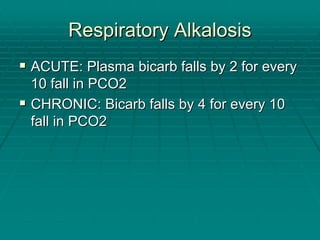
ƒ ACUTE: Plasma
ACUTE: Plasma bicarb
bicarb falls by 2 for every
falls by 2 for every
10 fall in PCO2
10 fall in PCO2
ƒ
ƒ CHRONIC:
CHRONIC: Bicarb
Bicarb falls by 4 for every 10
falls by 4 for every 10
fall in PCO2
fall in PCO2
TO SUM UP
TO SUM UP…
…
ƒ
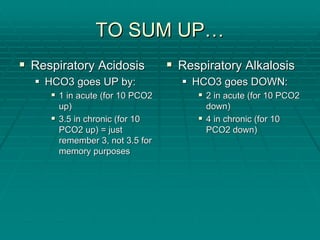
ƒ Respiratory Acidosis
Respiratory Acidosis
ƒ
ƒ HCO3 goes UP by:
HCO3 goes UP by:
ƒ
ƒ 1 in acute (for 10 PCO2
1 in acute (for 10 PCO2
up)
up)
ƒ
ƒ 3.5 in chronic (for 10
3.5 in chronic (for 10
PCO2 up) = just
PCO2 up) = just
remember 3, not 3.5 for
memory purposes
ƒ
ƒ Respiratory Alkalosis
Respiratory Alkalosis
ƒ
ƒ HCO3 goes DOWN:
HCO3 goes DOWN:
ƒ
ƒ 2 in acute (for 10 PCO2
2 in acute (for 10 PCO2
down)
down)
ƒ
ƒ 4 in chronic (for 10
4 in chronic (for 10
PCO2 down)
PCO2 down)
memory purposes
SO
SO…
…
ƒ
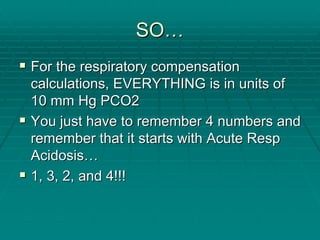
ƒ For the respiratory compensation
For the respiratory compensation
calculations, EVERYTHING is in units of
10 mm Hg PCO2
10 mm Hg PCO2
ƒ
ƒ You just have to remember 4 numbers and
You just have to remember 4 numbers and
remember that it starts with Acute
remember that it starts with Acute Resp
Resp
Acidosis
Acidosis…
…
ƒ
ƒ 1, 3, 2, and
1, 3, 2, and 4!!!
4!!!
Anion Gap
Anion Gap
ƒ
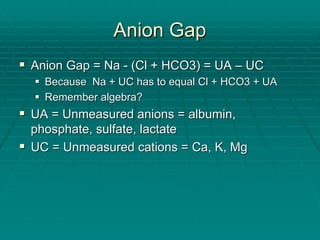
ƒ Anion Gap = Na
Anion Gap = Na -
- (
(Cl
Cl + HCO3) = UA
+ HCO3) = UA –
– UC
UC
ƒ
ƒ Because Na + UC has to equal
Because Na + UC has to equal Cl
Cl + HCO3 + UA
+ HCO3 + UA
ƒ
ƒ Remember algebra?
Remember algebra?
ƒ
ƒ UA = Unmeasured anions = albumin,
UA = Unmeasured anions = albumin,
phosphate, sulfate, lactate
ƒ
ƒ UC = Unmeasured
UC = Unmeasured cations
cations = Ca, K, Mg
= Ca, K, Mg
Low Anion Gap
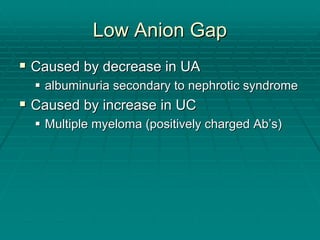
Low Anion Gap
ƒ
ƒ Caused by decrease in UA
Caused by decrease in UA
ƒ
ƒ albuminuria
albuminuria secondary to
secondary to nephrotic
nephrotic syndrome
syndrome
ƒ
ƒ Caused by increase in UC
Caused by increase in UC
ƒ
ƒ Multiple
Multiple myeloma
myeloma (positively charged
(positively charged Ab
Ab’
’s
s)
)
Delta Gap
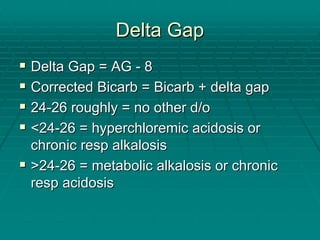
Delta Gap
ƒ
ƒ Delta Gap = AG
Delta Gap = AG -
- 8
8
ƒ
ƒ Corrected
Corrected Bicarb
Bicarb =
= Bicarb
Bicarb + delta gap
+ delta gap
ƒ
ƒ 24
24-
-26 roughly = no other d/o
26 roughly = no other d/o
ƒ
ƒ <24
<24-
-26 =
26 = hyperchloremic
hyperchloremic acidosis or
acidosis or
chronic
chronic resp
resp alkalosis
alkalosis
ƒ
ƒ >24
>24-
-26 = metabolic alkalosis or chronic
26 = metabolic alkalosis or chronic
resp
resp acidosis
acidosis
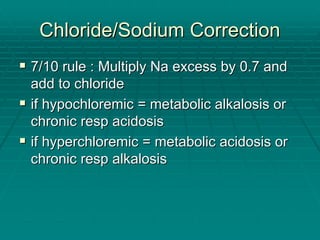
Chloride/Sodium Correction
ƒ
ƒ 7/10 rule : Multiply Na excess by 0.7 and
7/10 rule : Multiply Na excess by 0.7 and
add to chloride
add to chloride
ƒ
ƒ if
if hypochloremic
hypochloremic = metabolic alkalosis or
= metabolic alkalosis or
chronic
chronic resp
resp acidosis
acidosis
ƒ
ƒ if
if hyperchloremic
hyperchloremic = metabolic acidosis or
= metabolic acidosis or
chronic
chronic resp
resp alkalosis
alkalosis
Approach To ALL Acid/Base
Problems
Problems
ƒ
ƒ Don
Don’
’t get overwhelmed by all the numbers
t get overwhelmed by all the numbers
at once!
at once!
ƒ
ƒ Use a methodical system to dissect the
Use a methodical system to dissect the
numbers, and you will never be stumped
(almost never).
(almost never).
ƒ
ƒ Don
Don’
’t jump ahead when doing
t jump ahead when doing
calculations.
calculations.
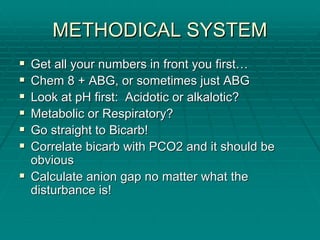
METHODICAL SYSTEM
METHODICAL SYSTEM
ƒ
ƒ Get all your numbers in front you first
Get all your numbers in front you first…
…
ƒ
ƒ Chem
Chem 8 + ABG, or sometimes just ABG
8 + ABG, or sometimes just ABG
ƒ
ƒ Look at pH first:
Look at pH first: Acidotic
Acidotic or
or alkalotic
alkalotic?
?
ƒ
ƒ Metabolic or Respiratory?
Metabolic or Respiratory?
ƒ
ƒ Go straight to
Go straight to Bicarb
Bicarb!
!
ƒ
ƒ Correlate
Correlate bicarb
bicarb with PCO2 and it should be
with PCO2 and it should be
obvious
obvious
ƒ
ƒ Calculate anion gap no matter what the
Calculate anion gap no matter what the
disturbance is!
disturbance is!
SYSTEM
SYSTEM…
…continued
continued
ƒ
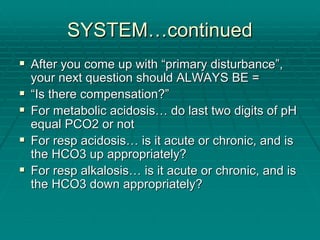
ƒ After you come up with
After you come up with “
“primary disturbance
primary disturbance”
”,
,
your next question should ALWAYS BE =
ƒ
ƒ “
“Is there compensation?
Is there compensation?”
”
ƒ
ƒ For metabolic acidosis
For metabolic acidosis…
… do last two digits of pH
do last two digits of pH
equal PCO2 or not
equal PCO2 or not
ƒ
ƒ For
For resp
resp acidosis
acidosis…
… is it acute or chronic, and is
is it acute or chronic, and is
the HCO3 up appropriately?
ƒ
ƒ For
For resp
resp alkalosis
alkalosis…
… is it acute or chronic, and is
is it acute or chronic, and is
the HCO3 down appropriately?
Compensation
Compensation
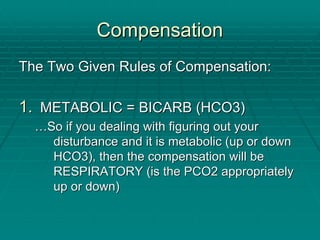
The Two Given Rules of Compensation:
1.
1. METABOLIC = BICARB (HCO3)
METABOLIC = BICARB (HCO3)
…
…So if you dealing with figuring out your
So if you dealing with figuring out your
disturbance and it is metabolic (up or down
HCO3), then the compensation will be
RESPIRATORY (is the PCO2 appropriately
up or down)
up or down)
Compensation
Compensation…
…continued
continued
2.
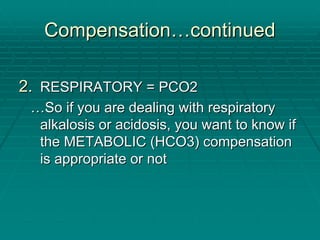
2. RESPIRATORY = PCO2
RESPIRATORY = PCO2
…
…So if you are dealing with respiratory
So if you are dealing with respiratory
alkalosis or acidosis, you want to know if
the METABOLIC (HCO3) compensation
is appropriate or not
SYSTEM
SYSTEM…
…continued
continued
ƒ
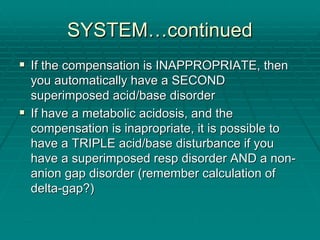
ƒ If the compensation is INAPPROPRIATE, then
If the compensation is INAPPROPRIATE, then
you automatically have a SECOND
superimposed acid/base disorder
ƒ
ƒ If have a metabolic acidosis, and the
If have a metabolic acidosis, and the
compensation is
compensation is inapropriate
inapropriate, it is possible to
, it is possible to
have a TRIPLE acid/base disturbance if you
have a superimposed
have a superimposed resp
resp disorder AND a non
disorder AND a non-
-
anion gap disorder (remember calculation of
delta
delta-
-gap?)
gap?)
EXAMPLE 1
EXAMPLE 1
ƒ
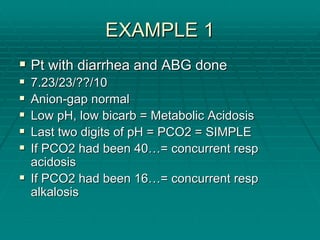
ƒ Pt with diarrhea and ABG done
Pt with diarrhea and ABG done
ƒ
ƒ 7.23/23/??/10
7.23/23/??/10
ƒ
ƒ Anion
Anion-
-gap normal
gap normal
ƒ
ƒ Low pH, low
Low pH, low bicarb
bicarb = Metabolic Acidosis
= Metabolic Acidosis
ƒ
ƒ Last two digits of pH = PCO2 = SIMPLE
Last two digits of pH = PCO2 = SIMPLE
ƒ
ƒ If PCO2 had been 40
If PCO2 had been 40…
…= concurrent
= concurrent resp
resp
acidosis
acidosis
ƒ
ƒ If PCO2 had been 16
If PCO2 had been 16…
…= concurrent
= concurrent resp
resp
alkalosis
alkalosis
EXAMPLE 2
EXAMPLE 2
ƒ
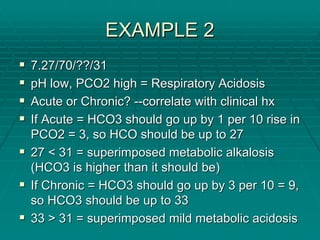
ƒ 7.27/70/??/31
7.27/70/??/31
ƒ
ƒ pH low, PCO2 high = Respiratory Acidosis
pH low, PCO2 high = Respiratory Acidosis
ƒ
ƒ Acute or Chronic?
Acute or Chronic? --
--correlate with clinical
correlate with clinical hx
hx
ƒ
ƒ If Acute = HCO3 should go up by 1 per 10 rise in
If Acute = HCO3 should go up by 1 per 10 rise in
PCO2 = 3, so HCO should be up to 27
ƒ
ƒ 27 < 31 = superimposed metabolic alkalosis
27 < 31 = superimposed metabolic alkalosis
(HCO3 is higher than it should be)
ƒ
ƒ If Chronic = HCO3 should go up by 3 per 10 = 9,
If Chronic = HCO3 should go up by 3 per 10 = 9,
so HCO3 should be up to 33
ƒ
ƒ 33 > 31 = superimposed mild metabolic acidosis
33 > 31 = superimposed mild metabolic acidosis
EXAMPLE 3
EXAMPLE 3
ƒ
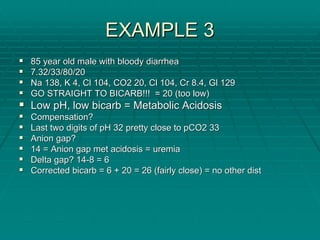
ƒ 85 year old male with bloody diarrhea
85 year old male with bloody diarrhea
ƒ
ƒ 7.32/33/80/20
7.32/33/80/20
ƒ
ƒ Na 138, K 4,
Na 138, K 4, Cl
Cl 104, CO2 20,
104, CO2 20, Cl
Cl 104, Cr 8.4,
104, Cr 8.4, Gl
Gl 129
129
ƒ
ƒ GO STRAIGHT TO BICARB!!! = 20 (too low)
GO STRAIGHT TO BICARB!!! = 20 (too low)
ƒ
ƒ Low pH, low
Low pH, low bicarb
bicarb = Metabolic Acidosis
= Metabolic Acidosis
ƒ
ƒ Compensation?
Compensation?
ƒ
ƒ Last two digits of pH 32 pretty close to pCO2 33
Last two digits of pH 32 pretty close to pCO2 33
ƒ
ƒ Anion gap?
Anion gap?
ƒ
ƒ 14 = Anion gap met acidosis = uremia
14 = Anion gap met acidosis = uremia
ƒ
ƒ Delta gap? 14
Delta gap? 14-
-8 = 6
8 = 6
ƒ
ƒ Corrected
Corrected bicarb
bicarb = 6 + 20 = 26 (fairly close) = no other dist
= 6 + 20 = 26 (fairly close) = no other dist
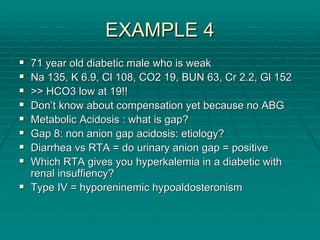
EXAMPLE 4
EXAMPLE 4
ƒ
ƒ 71 year old diabetic male who is weak
71 year old diabetic male who is weak
ƒ
ƒ Na 135, K 6.9,
Na 135, K 6.9, Cl
Cl 108, CO2 19, BUN 63, Cr 2.2,
108, CO2 19, BUN 63, Cr 2.2, Gl
Gl 152
152
ƒ
ƒ >> HCO3 low at 19!!
>> HCO3 low at 19!!
ƒ
ƒ Don
Don’
’t know about compensation yet because no ABG
t know about compensation yet because no ABG
ƒ
ƒ Metabolic Acidosis : what is gap?
Metabolic Acidosis : what is gap?
ƒ
ƒ Gap 8: non anion gap acidosis: etiology?
Gap 8: non anion gap acidosis: etiology?
ƒ
ƒ Diarrhea
Diarrhea vs
vs RTA = do urinary anion gap = positive
RTA = do urinary anion gap = positive
ƒ
ƒ Which RTA gives you
Which RTA gives you hyperkalemia
hyperkalemia in a diabetic with
in a diabetic with
renal
renal insuffiency
insuffiency?
?
ƒ
ƒ Type IV =
Type IV = hyporeninemic
hyporeninemic hypoaldosteronism
hypoaldosteronism
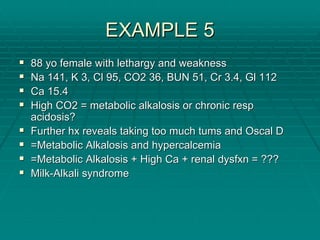
EXAMPLE 5
EXAMPLE 5
ƒ
ƒ 88
88 yo
yo female with lethargy and weakness
female with lethargy and weakness
ƒ
ƒ Na 141, K 3,
Na 141, K 3, Cl
Cl 95, CO2 36, BUN 51, Cr 3.4,
95, CO2 36, BUN 51, Cr 3.4, Gl
Gl 112
112
ƒ
ƒ Ca 15.4
Ca 15.4
ƒ
ƒ High CO2 = metabolic alkalosis or chronic
High CO2 = metabolic alkalosis or chronic resp
resp
acidosis?
acidosis?
ƒ
ƒ Further
Further hx
hx reveals taking too much
reveals taking too much tums
tums and
and Oscal
Oscal D
D
ƒ
ƒ =Metabolic Alkalosis and
=Metabolic Alkalosis and hypercalcemia
hypercalcemia
ƒ
ƒ =Metabolic Alkalosis + High Ca + renal
=Metabolic Alkalosis + High Ca + renal dysfxn
dysfxn = ???
= ???
ƒ
ƒ Milk
Milk-
-Alkali syndrome
Alkali syndrome
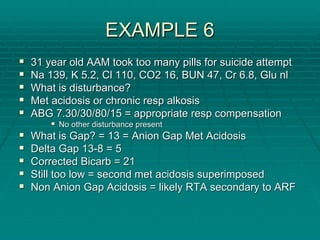
EXAMPLE 6
EXAMPLE 6
ƒ
ƒ 31 year old AAM took too many pills for suicide attempt
31 year old AAM took too many pills for suicide attempt
ƒ
ƒ Na 139, K 5.2,
Na 139, K 5.2, Cl
Cl 110, CO2 16, BUN 47, Cr 6.8,
110, CO2 16, BUN 47, Cr 6.8, Glu
Glu nl
nl
ƒ
ƒ What is disturbance?
What is disturbance?
ƒ
ƒ Met acidosis or chronic
Met acidosis or chronic resp
resp alkosis
alkosis
ƒ
ƒ ABG 7.30/30/80/15 = appropriate
ABG 7.30/30/80/15 = appropriate resp
resp compensation
compensation
ƒ
ƒ No other disturbance present
No other disturbance present
ƒ
ƒ What is Gap? = 13 = Anion Gap Met Acidosis
What is Gap? = 13 = Anion Gap Met Acidosis
ƒ
ƒ Delta Gap 13
Delta Gap 13-
-8 = 5
8 = 5
ƒ
ƒ Corrected
Corrected Bicarb
Bicarb = 21
= 21
ƒ
ƒ Still too low = second met acidosis superimposed
Still too low = second met acidosis superimposed
ƒ
ƒ Non Anion Gap Acidosis = likely RTA secondary to ARF
Non Anion Gap Acidosis = likely RTA secondary to ARF
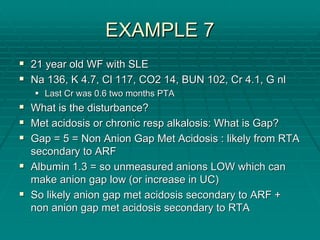
EXAMPLE 7
EXAMPLE 7
ƒ
ƒ 21 year old WF with SLE
21 year old WF with SLE
ƒ
ƒ Na 136, K 4.7,
Na 136, K 4.7, Cl
Cl 117, CO2 14, BUN 102, Cr 4.1, G
117, CO2 14, BUN 102, Cr 4.1, G nl
nl
ƒ
ƒ Last Cr was 0.6 two months PTA
Last Cr was 0.6 two months PTA
ƒ
ƒ What is the disturbance?
What is the disturbance?
ƒ
ƒ Met acidosis or chronic
Met acidosis or chronic resp
resp alkalosis: What is Gap?
alkalosis: What is Gap?
ƒ
ƒ Gap = 5 = Non Anion Gap Met Acidosis : likely from RTA
Gap = 5 = Non Anion Gap Met Acidosis : likely from RTA
secondary to ARF
secondary to ARF
ƒ
ƒ Albumin 1.3 = so unmeasured anions LOW which can
Albumin 1.3 = so unmeasured anions LOW which can
make anion gap low (or increase in UC)
ƒ
ƒ So likely anion gap met acidosis secondary to ARF +
So likely anion gap met acidosis secondary to ARF +
non anion gap met acidosis secondary to RTA
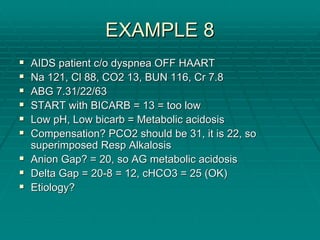
EXAMPLE 8
EXAMPLE 8
ƒ
ƒ AIDS patient c/o
AIDS patient c/o dyspnea
dyspnea OFF HAART
OFF HAART
ƒ
ƒ Na 121,
Na 121, Cl
Cl 88, CO2 13, BUN 116, Cr 7.8
88, CO2 13, BUN 116, Cr 7.8
ƒ
ƒ ABG 7.31/22/63
ABG 7.31/22/63
ƒ
ƒ START with BICARB = 13 = too low
START with BICARB = 13 = too low
ƒ
ƒ Low pH, Low
Low pH, Low bicarb
bicarb = Metabolic acidosis
= Metabolic acidosis
ƒ
ƒ Compensation? PCO2 should be 31, it is 22, so
Compensation? PCO2 should be 31, it is 22, so
superimposed
superimposed Resp
Resp Alkalosis
Alkalosis
ƒ
ƒ Anion Gap? = 20, so AG metabolic acidosis
Anion Gap? = 20, so AG metabolic acidosis
ƒ
ƒ Delta Gap = 20
Delta Gap = 20-
-8 = 12, cHCO3 = 25 (OK)
8 = 12, cHCO3 = 25 (OK)
ƒ
ƒ Etiology?
Etiology?
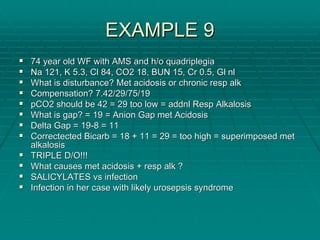
EXAMPLE 9
EXAMPLE 9
ƒ
ƒ 74 year old WF with AMS and h/o quadriplegia
74 year old WF with AMS and h/o quadriplegia
ƒ
ƒ Na 121, K 5.3,
Na 121, K 5.3, Cl
Cl 84, CO2 18, BUN 15, Cr 0.5,
84, CO2 18, BUN 15, Cr 0.5, Gl
Gl nl
nl
ƒ
ƒ What is disturbance? Met acidosis or chronic
What is disturbance? Met acidosis or chronic resp
resp alk
alk
ƒ
ƒ Compensation? 7.42/29/75/19
Compensation? 7.42/29/75/19
ƒ
ƒ pCO2 should be 42 = 29 too low =
pCO2 should be 42 = 29 too low = addnl
addnl Resp
Resp Alkalosis
Alkalosis
ƒ
ƒ What is gap? = 19 = Anion Gap met Acidosis
What is gap? = 19 = Anion Gap met Acidosis
ƒ
ƒ Delta Gap = 19
Delta Gap = 19-
-8 = 11
8 = 11
ƒ
ƒ Correctected
Correctected Bicarb
Bicarb = 18 + 11 = 29 = too high = superimposed met
= 18 + 11 = 29 = too high = superimposed met
alkalosis
alkalosis
ƒ
ƒ TRIPLE D/O!!!
TRIPLE D/O!!!
ƒ
ƒ What causes met acidosis +
What causes met acidosis + resp
resp alk
alk ?
?
ƒ
ƒ SALICYLATES
SALICYLATES vs
vs infection
infection
ƒ
ƒ Infection in her case with likely
Infection in her case with likely urosepsis
urosepsis syndrome
syndrome
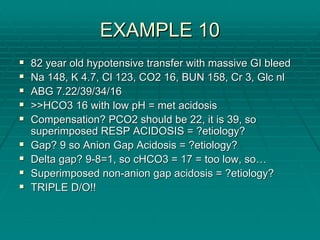
EXAMPLE 10
EXAMPLE 10
ƒ
ƒ 82 year old
82 year old hypotensive
hypotensive transfer with massive GI bleed
transfer with massive GI bleed
ƒ
ƒ Na 148, K 4.7,
Na 148, K 4.7, Cl
Cl 123, CO2 16, BUN 158, Cr 3,
123, CO2 16, BUN 158, Cr 3, Glc
Glc nl
nl
ƒ
ƒ ABG 7.22/39/34/16
ABG 7.22/39/34/16
ƒ
ƒ >>HCO3 16 with low pH = met acidosis
>>HCO3 16 with low pH = met acidosis
ƒ
ƒ Compensation? PCO2 should be 22, it is 39, so
Compensation? PCO2 should be 22, it is 39, so
superimposed RESP ACIDOSIS = ?etiology?
ƒ
ƒ Gap? 9 so Anion Gap Acidosis = ?etiology?
Gap? 9 so Anion Gap Acidosis = ?etiology?
ƒ
ƒ Delta gap? 9
Delta gap? 9-
-8=1, so cHCO3 = 17 = too low, so
8=1, so cHCO3 = 17 = too low, so…
…
ƒ
ƒ Superimposed non
Superimposed non-
-anion gap acidosis = ?etiology?
anion gap acidosis = ?etiology?
ƒ
ƒ TRIPLE D/O!!
TRIPLE D/O!!
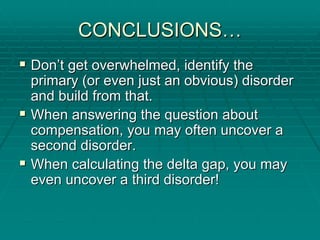
CONCLUSIONS
CONCLUSIONS…
…
ƒ
ƒ Don
Don’
’t get overwhelmed, identify the
t get overwhelmed, identify the
primary (or even just an obvious) disorder
and build from that.
ƒ
ƒ When answering the question about
When answering the question about
compensation, you may often uncover a
second disorder.
second disorder.
ƒ
ƒ When calculating the delta gap, you may
When calculating the delta gap, you may
even uncover a third disorder!
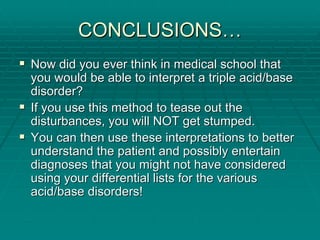
CONCLUSIONS
CONCLUSIONS…
…
ƒ
ƒ Now did you ever think in medical school that
Now did you ever think in medical school that
you would be able to interpret a triple acid/base
disorder?
disorder?
ƒ
ƒ If you use this method to tease out the
If you use this method to tease out the
disturbances, you will NOT get stumped.
ƒ
ƒ You can then use these interpretations to better
You can then use these interpretations to better
understand the patient and possibly entertain
diagnoses that you might not have considered
using your differential lists for the various
acid/base disorders!
The End
The End…
…

Acid/ Base and ABG Interpretation made simple

  • 1.
    Acid/Base and ABG Acid/Baseand ABG Interpretation Made Interpretation Made Simple Simple
  • 2.
    A A- -a Gradient a Gradient ƒ ƒFIO2 = PA O2 + (5/4) PaCO2 FIO2 = PA O2 + (5/4) PaCO2 ƒ ƒ FIO2 = 713 x O2% FIO2 = 713 x O2% ƒ ƒ A A- -a gradient = PA O2 a gradient = PA O2 - - PaO2 PaO2 ƒ ƒ Normal is 0 Normal is 0- -10 mm Hg 10 mm Hg ƒ ƒ 2.5 + 0.21 x age in years 2.5 + 0.21 x age in years ƒ ƒ With higher inspired O2 concentrations, With higher inspired O2 concentrations, the A the A- -a gradient will also increase a gradient will also increase
  • 3.
    PaO2 PaO2- -FiO2 ratio FiO2 ratio ƒ ƒNormal PaO2/FiO2 is 300 Normal PaO2/FiO2 is 300- -500 500 ƒ ƒ <250 indicates a clinically significant gas <250 indicates a clinically significant gas exchange derangement exchange derangement ƒ ƒ Ratio often used clinically in ICU setting Ratio often used clinically in ICU setting
  • 4.
    Hypoxemia Hypoxemia ƒ ƒ Hypoventilation Hypoventilation ƒ ƒ V/Qmismatch V/Q mismatch ƒ ƒ Right Right- -Left shunting Left shunting ƒ ƒ Diffusion impairment Diffusion impairment ƒ ƒ Reduced inspired oxygen tension Reduced inspired oxygen tension
  • 5.
    Hypoventilation Hypoventilation ƒ ƒ CNS depression(OD or CNS depression (OD or structural/ischemic CNS lesions involving structural/ischemic CNS lesions involving respiratory center) respiratory center) ƒ ƒ Neural conduction D/O Neural conduction D/O’ ’s (amyotrophic s (amyotrophic lateral sclerosis, lateral sclerosis, Guillain Guillain- -Barre Barre, high , high cervical spine injury) cervical spine injury) ƒ ƒ Muscular weakness ( Muscular weakness (polymositis polymositis, MD) , MD) ƒ ƒ Diseases of chest wall (flail chest, Diseases of chest wall (flail chest, kyphoscoliosis kyphoscoliosis) )
  • 6.
    V/Q mismatch V/Q mismatch ƒ ƒLung regions with low ventilation Lung regions with low ventilation compared to perfusion will have low compared to perfusion will have low alveolar oxygen content and high CO2 alveolar oxygen content and high CO2 content content ƒ ƒ Lung regions with high ventilation Lung regions with high ventilation compared to perfusion will have a low compared to perfusion will have a low CO2 content and high oxygen content CO2 content and high oxygen content ƒ ƒ V/Q varies with position in lung (lower in V/Q varies with position in lung (lower in basilar than apical) basilar than apical) – – WEST ZONES WEST ZONES
  • 7.
    Diseases that affectV/Q Diseases that affect V/Q ƒ ƒ Obstructive lung diseases Obstructive lung diseases ƒ ƒ Pulmonary vascular diseases Pulmonary vascular diseases ƒ ƒ Parenchymal Parenchymal lung diseases lung diseases
  • 8.
    Right to LeftShunt Right to Left Shunt ƒ ƒ Extreme example of V/Q mismatch Extreme example of V/Q mismatch ƒ ƒ Shunt physiology may result from Shunt physiology may result from parenchymal parenchymal diseases leading to diseases leading to atelectasis atelectasis or alveolar flooding (lobar or alveolar flooding (lobar pneumonia or ARDS) pneumonia or ARDS) ƒ ƒ Can also occur from pathologic vascular Can also occur from pathologic vascular communications (AVM or communications (AVM or intracardiac intracardiac shunts) shunts)
  • 9.
    Diffusion Impairment Diffusion Impairment ƒ ƒWhen available path for movement of When available path for movement of oxygen from alveolus to capillary is altered oxygen from alveolus to capillary is altered ƒ ƒ Diffuse Diffuse fibrotic fibrotic diseases are the classic diseases are the classic entities entities
  • 10.
    Reduced inspired oxygen Reducedinspired oxygen delivery delivery ƒ ƒ Delivery to tissue beds determined by Delivery to tissue beds determined by arterial oxygen content and cardiac output arterial oxygen content and cardiac output ƒ ƒ Oxygen content of blood is affected by Oxygen content of blood is affected by level and affinity state of hemoglobin level and affinity state of hemoglobin ƒ ƒ Example is CO poisoning: reduction of arterial O2 content Example is CO poisoning: reduction of arterial O2 content despite normal PaO2 and despite normal PaO2 and Hgb Hgb caused by reduction in available caused by reduction in available O2 binding sites on the O2 binding sites on the Hgb Hgb molecule molecule ƒ ƒ Reduced CO will lead to impairment in Reduced CO will lead to impairment in tissue O2 delivery and hypoxemia and tissue O2 delivery and hypoxemia and lactic acidosis lactic acidosis
  • 11.
    Oxygen Delivery, cont. OxygenDelivery, cont. ƒ ƒ Tissue hypoxia may occur despite Tissue hypoxia may occur despite adequate oxygen delivery adequate oxygen delivery ƒ ƒ CN poisoning causes interference with oxygen utilization by the CN poisoning causes interference with oxygen utilization by the cellular cellular cytochrome cytochrome system, leading to cellular hypoxia system, leading to cellular hypoxia ƒ ƒ Disease states such as sepsis may result Disease states such as sepsis may result in tissue ischemia possibly because of in tissue ischemia possibly because of diversion of blood flow away from vital diversion of blood flow away from vital organs organs
  • 12.
    ACID/BASE ACID/BASE ƒ ƒ 15,000 15,000 mmol mmolof CO2 (generates H2CO2) of CO2 (generates H2CO2) and 50 and 50- -100 100 meq meq of nonvolatile acid of nonvolatile acid (mostly sulfuric from sulfur (mostly sulfuric from sulfur- -containing containing amino acids) are made amino acids) are made ƒ ƒ Balance is maintained by normal Balance is maintained by normal pulmonary and renal excretion of these pulmonary and renal excretion of these acids acids
  • 13.
    Renal excretion Renal excretion ƒ ƒInvolves the combination of hydrogen ions Involves the combination of hydrogen ions with urinary with urinary titratable titratable acid, particularly acid, particularly phosphate (HPO42 phosphate (HPO42- - + H+ to H2PO4 + H+ to H2PO4- -) or ) or with ammonia to form ammonium with ammonia to form ammonium ƒ ƒ Ammonium is the primary adaptive Ammonium is the primary adaptive response since ammonia production from response since ammonia production from the metabolism of glutamine can be the metabolism of glutamine can be increased in the presence of an acid load increased in the presence of an acid load
  • 14.
    Definitions Definitions ƒ ƒ Acidosis: processthat lowers the ECF pH by a Acidosis: process that lowers the ECF pH by a fall in HCO3 or elevation in PCO2 fall in HCO3 or elevation in PCO2 ƒ ƒ Alkalosis: process that raises ECF pH by an Alkalosis: process that raises ECF pH by an elevation in ECF HCO3 or fall in PCO2 elevation in ECF HCO3 or fall in PCO2 ƒ ƒ Met Acidosis: low pH and low Met Acidosis: low pH and low bicarb bicarb ƒ ƒ Met Alkalosis: high pH and high Met Alkalosis: high pH and high bicarb bicarb ƒ ƒ Resp Resp Acidosis: low pH and high PCO2 Acidosis: low pH and high PCO2 ƒ ƒ Resp Resp Alkalosis: high pH and low PCO2 Alkalosis: high pH and low PCO2
  • 15.
    Metabolic Acidosis Metabolic Acidosis ƒ ƒRespiratory compensation results in 1.2 mm Hg Respiratory compensation results in 1.2 mm Hg fall in PCO2 for every 1 fall in PCO2 for every 1 meq meq/L fall in /L fall in bicarb bicarb ƒ ƒ pCO2 = 1.5 (HCO3) + 8 pCO2 = 1.5 (HCO3) + 8 ƒ ƒ DON DON’ ’T LEARN IT!!! T LEARN IT!!! ƒ ƒ OR Last two digits of pH should equal PCO2 OR Last two digits of pH should equal PCO2 ƒ ƒ if equal = no respiratory disturbances if equal = no respiratory disturbances ƒ ƒ if PCO2 high = overlapping respiratory acidosis if PCO2 high = overlapping respiratory acidosis ƒ ƒ if PCO2 low = overlapping respiratory alkalosis if PCO2 low = overlapping respiratory alkalosis
  • 16.
    Metabolic Acidosis, cont. MetabolicAcidosis, cont. ƒ ƒ Calculate anion gap on chem7 Calculate anion gap on chem7 ƒ ƒ Na Na - - ( (Cl Cl + CO2) = around 8 + CO2) = around 8 ƒ ƒ If > 8 = Anion Gap metabolic acidosis If > 8 = Anion Gap metabolic acidosis
  • 17.
    Metabolic Acidosis Metabolic Acidosis… …continued continued ƒ ƒAdd delta gap back to CO2 = corrected Add delta gap back to CO2 = corrected bicarb bicarb ƒ ƒ if corrected if corrected bicarb bicarb = 24 = 24- -26 then no other 26 then no other disturbance disturbance ƒ ƒ if corrected if corrected bicarb bicarb < 24 < 24- -26 then non 26 then non- -anion gap anion gap acidosis is superimposed (or chronic acidosis is superimposed (or chronic resp resp alkalosis) alkalosis) ƒ ƒ if corrected if corrected bicarb bicarb >24 >24- -26 then met alkalosis is 26 then met alkalosis is superimposed (or chronic superimposed (or chronic resp resp acidosis) acidosis) ƒ ƒ if <8 = Non Anion Gap metabolic acidosis if <8 = Non Anion Gap metabolic acidosis
  • 18.
    Metabolic Alkalosis Metabolic Alkalosis ƒ ƒRespiratory compensation raises PCO2 by 0.7 Respiratory compensation raises PCO2 by 0.7 mmHg for every 1 mmHg for every 1 meq meq/L rise in HCO3 /L rise in HCO3 ƒ ƒ Causes include vomiting, intake of alkali, Causes include vomiting, intake of alkali, diuretics, or very commonly, NG suction without diuretics, or very commonly, NG suction without the use of proton the use of proton- -pump inhibitors or H2 blockers pump inhibitors or H2 blockers
  • 19.
    Respiratory Acidosis Respiratory Acidosis ƒ ƒCompensation occurs in 2 steps Compensation occurs in 2 steps ƒ ƒ 1. Cell buffering that acts within minutes to hours 1. Cell buffering that acts within minutes to hours ƒ ƒ 2. Renal compensation that is not complete for 3 2. Renal compensation that is not complete for 3- -5 5 days days ƒ ƒ IN ACUTE: IN ACUTE: Bicarb Bicarb rises 1 rises 1 meq meq/L for every /L for every 10 mmHg elevation in PCO2 10 mmHg elevation in PCO2 ƒ ƒ or for every 1 up of PCO2, pH should fall .0075 or for every 1 up of PCO2, pH should fall .0075 ƒ ƒ IN CHRONIC: IN CHRONIC: Bicarb Bicarb rises 3.5 for every 10 rises 3.5 for every 10 ƒ ƒ or for every 1 up of PCO2, pH should fall .0025 or for every 1 up of PCO2, pH should fall .0025 ƒ ƒ due to tighter control of pH by increased renal excretion of aci due to tighter control of pH by increased renal excretion of acid d as ammonium as ammonium
  • 20.
    Respiratory Alkalosis Respiratory Alkalosis ƒ ƒACUTE: Plasma ACUTE: Plasma bicarb bicarb falls by 2 for every falls by 2 for every 10 fall in PCO2 10 fall in PCO2 ƒ ƒ CHRONIC: CHRONIC: Bicarb Bicarb falls by 4 for every 10 falls by 4 for every 10 fall in PCO2 fall in PCO2
  • 21.
    TO SUM UP TOSUM UP… … ƒ ƒ Respiratory Acidosis Respiratory Acidosis ƒ ƒ HCO3 goes UP by: HCO3 goes UP by: ƒ ƒ 1 in acute (for 10 PCO2 1 in acute (for 10 PCO2 up) up) ƒ ƒ 3.5 in chronic (for 10 3.5 in chronic (for 10 PCO2 up) = just PCO2 up) = just remember 3, not 3.5 for remember 3, not 3.5 for memory purposes ƒ ƒ Respiratory Alkalosis Respiratory Alkalosis ƒ ƒ HCO3 goes DOWN: HCO3 goes DOWN: ƒ ƒ 2 in acute (for 10 PCO2 2 in acute (for 10 PCO2 down) down) ƒ ƒ 4 in chronic (for 10 4 in chronic (for 10 PCO2 down) PCO2 down) memory purposes
  • 22.
    SO SO… … ƒ ƒ For therespiratory compensation For the respiratory compensation calculations, EVERYTHING is in units of calculations, EVERYTHING is in units of 10 mm Hg PCO2 10 mm Hg PCO2 ƒ ƒ You just have to remember 4 numbers and You just have to remember 4 numbers and remember that it starts with Acute remember that it starts with Acute Resp Resp Acidosis Acidosis… … ƒ ƒ 1, 3, 2, and 1, 3, 2, and 4!!! 4!!!
  • 23.
    Anion Gap Anion Gap ƒ ƒAnion Gap = Na Anion Gap = Na - - ( (Cl Cl + HCO3) = UA + HCO3) = UA – – UC UC ƒ ƒ Because Na + UC has to equal Because Na + UC has to equal Cl Cl + HCO3 + UA + HCO3 + UA ƒ ƒ Remember algebra? Remember algebra? ƒ ƒ UA = Unmeasured anions = albumin, UA = Unmeasured anions = albumin, phosphate, sulfate, lactate phosphate, sulfate, lactate ƒ ƒ UC = Unmeasured UC = Unmeasured cations cations = Ca, K, Mg = Ca, K, Mg
  • 24.
    Low Anion Gap LowAnion Gap ƒ ƒ Caused by decrease in UA Caused by decrease in UA ƒ ƒ albuminuria albuminuria secondary to secondary to nephrotic nephrotic syndrome syndrome ƒ ƒ Caused by increase in UC Caused by increase in UC ƒ ƒ Multiple Multiple myeloma myeloma (positively charged (positively charged Ab Ab’ ’s s) )
  • 25.
    Delta Gap Delta Gap ƒ ƒDelta Gap = AG Delta Gap = AG - - 8 8 ƒ ƒ Corrected Corrected Bicarb Bicarb = = Bicarb Bicarb + delta gap + delta gap ƒ ƒ 24 24- -26 roughly = no other d/o 26 roughly = no other d/o ƒ ƒ <24 <24- -26 = 26 = hyperchloremic hyperchloremic acidosis or acidosis or chronic chronic resp resp alkalosis alkalosis ƒ ƒ >24 >24- -26 = metabolic alkalosis or chronic 26 = metabolic alkalosis or chronic resp resp acidosis acidosis
  • 26.
    Chloride/Sodium Correction Chloride/Sodium Correction ƒ ƒ7/10 rule : Multiply Na excess by 0.7 and 7/10 rule : Multiply Na excess by 0.7 and add to chloride add to chloride ƒ ƒ if if hypochloremic hypochloremic = metabolic alkalosis or = metabolic alkalosis or chronic chronic resp resp acidosis acidosis ƒ ƒ if if hyperchloremic hyperchloremic = metabolic acidosis or = metabolic acidosis or chronic chronic resp resp alkalosis alkalosis
  • 27.
    Approach To ALLAcid/Base Approach To ALL Acid/Base Problems Problems ƒ ƒ Don Don’ ’t get overwhelmed by all the numbers t get overwhelmed by all the numbers at once! at once! ƒ ƒ Use a methodical system to dissect the Use a methodical system to dissect the numbers, and you will never be stumped numbers, and you will never be stumped (almost never). (almost never). ƒ ƒ Don Don’ ’t jump ahead when doing t jump ahead when doing calculations. calculations.
  • 28.
    METHODICAL SYSTEM METHODICAL SYSTEM ƒ ƒGet all your numbers in front you first Get all your numbers in front you first… … ƒ ƒ Chem Chem 8 + ABG, or sometimes just ABG 8 + ABG, or sometimes just ABG ƒ ƒ Look at pH first: Look at pH first: Acidotic Acidotic or or alkalotic alkalotic? ? ƒ ƒ Metabolic or Respiratory? Metabolic or Respiratory? ƒ ƒ Go straight to Go straight to Bicarb Bicarb! ! ƒ ƒ Correlate Correlate bicarb bicarb with PCO2 and it should be with PCO2 and it should be obvious obvious ƒ ƒ Calculate anion gap no matter what the Calculate anion gap no matter what the disturbance is! disturbance is!
  • 29.
    SYSTEM SYSTEM… …continued continued ƒ ƒ After youcome up with After you come up with “ “primary disturbance primary disturbance” ”, , your next question should ALWAYS BE = your next question should ALWAYS BE = ƒ ƒ “ “Is there compensation? Is there compensation?” ” ƒ ƒ For metabolic acidosis For metabolic acidosis… … do last two digits of pH do last two digits of pH equal PCO2 or not equal PCO2 or not ƒ ƒ For For resp resp acidosis acidosis… … is it acute or chronic, and is is it acute or chronic, and is the HCO3 up appropriately? the HCO3 up appropriately? ƒ ƒ For For resp resp alkalosis alkalosis… … is it acute or chronic, and is is it acute or chronic, and is the HCO3 down appropriately? the HCO3 down appropriately?
  • 30.
    Compensation Compensation The Two GivenRules of Compensation: The Two Given Rules of Compensation: 1. 1. METABOLIC = BICARB (HCO3) METABOLIC = BICARB (HCO3) … …So if you dealing with figuring out your So if you dealing with figuring out your disturbance and it is metabolic (up or down disturbance and it is metabolic (up or down HCO3), then the compensation will be HCO3), then the compensation will be RESPIRATORY (is the PCO2 appropriately RESPIRATORY (is the PCO2 appropriately up or down) up or down)
  • 31.
    Compensation Compensation… …continued continued 2. 2. RESPIRATORY =PCO2 RESPIRATORY = PCO2 … …So if you are dealing with respiratory So if you are dealing with respiratory alkalosis or acidosis, you want to know if alkalosis or acidosis, you want to know if the METABOLIC (HCO3) compensation the METABOLIC (HCO3) compensation is appropriate or not is appropriate or not
  • 32.
    SYSTEM SYSTEM… …continued continued ƒ ƒ If thecompensation is INAPPROPRIATE, then If the compensation is INAPPROPRIATE, then you automatically have a SECOND you automatically have a SECOND superimposed acid/base disorder superimposed acid/base disorder ƒ ƒ If have a metabolic acidosis, and the If have a metabolic acidosis, and the compensation is compensation is inapropriate inapropriate, it is possible to , it is possible to have a TRIPLE acid/base disturbance if you have a TRIPLE acid/base disturbance if you have a superimposed have a superimposed resp resp disorder AND a non disorder AND a non- - anion gap disorder (remember calculation of anion gap disorder (remember calculation of delta delta- -gap?) gap?)
  • 33.
    EXAMPLE 1 EXAMPLE 1 ƒ ƒPt with diarrhea and ABG done Pt with diarrhea and ABG done ƒ ƒ 7.23/23/??/10 7.23/23/??/10 ƒ ƒ Anion Anion- -gap normal gap normal ƒ ƒ Low pH, low Low pH, low bicarb bicarb = Metabolic Acidosis = Metabolic Acidosis ƒ ƒ Last two digits of pH = PCO2 = SIMPLE Last two digits of pH = PCO2 = SIMPLE ƒ ƒ If PCO2 had been 40 If PCO2 had been 40… …= concurrent = concurrent resp resp acidosis acidosis ƒ ƒ If PCO2 had been 16 If PCO2 had been 16… …= concurrent = concurrent resp resp alkalosis alkalosis
  • 34.
    EXAMPLE 2 EXAMPLE 2 ƒ ƒ7.27/70/??/31 7.27/70/??/31 ƒ ƒ pH low, PCO2 high = Respiratory Acidosis pH low, PCO2 high = Respiratory Acidosis ƒ ƒ Acute or Chronic? Acute or Chronic? -- --correlate with clinical correlate with clinical hx hx ƒ ƒ If Acute = HCO3 should go up by 1 per 10 rise in If Acute = HCO3 should go up by 1 per 10 rise in PCO2 = 3, so HCO should be up to 27 PCO2 = 3, so HCO should be up to 27 ƒ ƒ 27 < 31 = superimposed metabolic alkalosis 27 < 31 = superimposed metabolic alkalosis (HCO3 is higher than it should be) (HCO3 is higher than it should be) ƒ ƒ If Chronic = HCO3 should go up by 3 per 10 = 9, If Chronic = HCO3 should go up by 3 per 10 = 9, so HCO3 should be up to 33 so HCO3 should be up to 33 ƒ ƒ 33 > 31 = superimposed mild metabolic acidosis 33 > 31 = superimposed mild metabolic acidosis
  • 35.
    EXAMPLE 3 EXAMPLE 3 ƒ ƒ85 year old male with bloody diarrhea 85 year old male with bloody diarrhea ƒ ƒ 7.32/33/80/20 7.32/33/80/20 ƒ ƒ Na 138, K 4, Na 138, K 4, Cl Cl 104, CO2 20, 104, CO2 20, Cl Cl 104, Cr 8.4, 104, Cr 8.4, Gl Gl 129 129 ƒ ƒ GO STRAIGHT TO BICARB!!! = 20 (too low) GO STRAIGHT TO BICARB!!! = 20 (too low) ƒ ƒ Low pH, low Low pH, low bicarb bicarb = Metabolic Acidosis = Metabolic Acidosis ƒ ƒ Compensation? Compensation? ƒ ƒ Last two digits of pH 32 pretty close to pCO2 33 Last two digits of pH 32 pretty close to pCO2 33 ƒ ƒ Anion gap? Anion gap? ƒ ƒ 14 = Anion gap met acidosis = uremia 14 = Anion gap met acidosis = uremia ƒ ƒ Delta gap? 14 Delta gap? 14- -8 = 6 8 = 6 ƒ ƒ Corrected Corrected bicarb bicarb = 6 + 20 = 26 (fairly close) = no other dist = 6 + 20 = 26 (fairly close) = no other dist
  • 36.
    EXAMPLE 4 EXAMPLE 4 ƒ ƒ71 year old diabetic male who is weak 71 year old diabetic male who is weak ƒ ƒ Na 135, K 6.9, Na 135, K 6.9, Cl Cl 108, CO2 19, BUN 63, Cr 2.2, 108, CO2 19, BUN 63, Cr 2.2, Gl Gl 152 152 ƒ ƒ >> HCO3 low at 19!! >> HCO3 low at 19!! ƒ ƒ Don Don’ ’t know about compensation yet because no ABG t know about compensation yet because no ABG ƒ ƒ Metabolic Acidosis : what is gap? Metabolic Acidosis : what is gap? ƒ ƒ Gap 8: non anion gap acidosis: etiology? Gap 8: non anion gap acidosis: etiology? ƒ ƒ Diarrhea Diarrhea vs vs RTA = do urinary anion gap = positive RTA = do urinary anion gap = positive ƒ ƒ Which RTA gives you Which RTA gives you hyperkalemia hyperkalemia in a diabetic with in a diabetic with renal renal insuffiency insuffiency? ? ƒ ƒ Type IV = Type IV = hyporeninemic hyporeninemic hypoaldosteronism hypoaldosteronism
  • 37.
    EXAMPLE 5 EXAMPLE 5 ƒ ƒ88 88 yo yo female with lethargy and weakness female with lethargy and weakness ƒ ƒ Na 141, K 3, Na 141, K 3, Cl Cl 95, CO2 36, BUN 51, Cr 3.4, 95, CO2 36, BUN 51, Cr 3.4, Gl Gl 112 112 ƒ ƒ Ca 15.4 Ca 15.4 ƒ ƒ High CO2 = metabolic alkalosis or chronic High CO2 = metabolic alkalosis or chronic resp resp acidosis? acidosis? ƒ ƒ Further Further hx hx reveals taking too much reveals taking too much tums tums and and Oscal Oscal D D ƒ ƒ =Metabolic Alkalosis and =Metabolic Alkalosis and hypercalcemia hypercalcemia ƒ ƒ =Metabolic Alkalosis + High Ca + renal =Metabolic Alkalosis + High Ca + renal dysfxn dysfxn = ??? = ??? ƒ ƒ Milk Milk- -Alkali syndrome Alkali syndrome
  • 38.
    EXAMPLE 6 EXAMPLE 6 ƒ ƒ31 year old AAM took too many pills for suicide attempt 31 year old AAM took too many pills for suicide attempt ƒ ƒ Na 139, K 5.2, Na 139, K 5.2, Cl Cl 110, CO2 16, BUN 47, Cr 6.8, 110, CO2 16, BUN 47, Cr 6.8, Glu Glu nl nl ƒ ƒ What is disturbance? What is disturbance? ƒ ƒ Met acidosis or chronic Met acidosis or chronic resp resp alkosis alkosis ƒ ƒ ABG 7.30/30/80/15 = appropriate ABG 7.30/30/80/15 = appropriate resp resp compensation compensation ƒ ƒ No other disturbance present No other disturbance present ƒ ƒ What is Gap? = 13 = Anion Gap Met Acidosis What is Gap? = 13 = Anion Gap Met Acidosis ƒ ƒ Delta Gap 13 Delta Gap 13- -8 = 5 8 = 5 ƒ ƒ Corrected Corrected Bicarb Bicarb = 21 = 21 ƒ ƒ Still too low = second met acidosis superimposed Still too low = second met acidosis superimposed ƒ ƒ Non Anion Gap Acidosis = likely RTA secondary to ARF Non Anion Gap Acidosis = likely RTA secondary to ARF
  • 39.
    EXAMPLE 7 EXAMPLE 7 ƒ ƒ21 year old WF with SLE 21 year old WF with SLE ƒ ƒ Na 136, K 4.7, Na 136, K 4.7, Cl Cl 117, CO2 14, BUN 102, Cr 4.1, G 117, CO2 14, BUN 102, Cr 4.1, G nl nl ƒ ƒ Last Cr was 0.6 two months PTA Last Cr was 0.6 two months PTA ƒ ƒ What is the disturbance? What is the disturbance? ƒ ƒ Met acidosis or chronic Met acidosis or chronic resp resp alkalosis: What is Gap? alkalosis: What is Gap? ƒ ƒ Gap = 5 = Non Anion Gap Met Acidosis : likely from RTA Gap = 5 = Non Anion Gap Met Acidosis : likely from RTA secondary to ARF secondary to ARF ƒ ƒ Albumin 1.3 = so unmeasured anions LOW which can Albumin 1.3 = so unmeasured anions LOW which can make anion gap low (or increase in UC) make anion gap low (or increase in UC) ƒ ƒ So likely anion gap met acidosis secondary to ARF + So likely anion gap met acidosis secondary to ARF + non anion gap met acidosis secondary to RTA non anion gap met acidosis secondary to RTA
  • 40.
    EXAMPLE 8 EXAMPLE 8 ƒ ƒAIDS patient c/o AIDS patient c/o dyspnea dyspnea OFF HAART OFF HAART ƒ ƒ Na 121, Na 121, Cl Cl 88, CO2 13, BUN 116, Cr 7.8 88, CO2 13, BUN 116, Cr 7.8 ƒ ƒ ABG 7.31/22/63 ABG 7.31/22/63 ƒ ƒ START with BICARB = 13 = too low START with BICARB = 13 = too low ƒ ƒ Low pH, Low Low pH, Low bicarb bicarb = Metabolic acidosis = Metabolic acidosis ƒ ƒ Compensation? PCO2 should be 31, it is 22, so Compensation? PCO2 should be 31, it is 22, so superimposed superimposed Resp Resp Alkalosis Alkalosis ƒ ƒ Anion Gap? = 20, so AG metabolic acidosis Anion Gap? = 20, so AG metabolic acidosis ƒ ƒ Delta Gap = 20 Delta Gap = 20- -8 = 12, cHCO3 = 25 (OK) 8 = 12, cHCO3 = 25 (OK) ƒ ƒ Etiology? Etiology?
  • 41.
    EXAMPLE 9 EXAMPLE 9 ƒ ƒ74 year old WF with AMS and h/o quadriplegia 74 year old WF with AMS and h/o quadriplegia ƒ ƒ Na 121, K 5.3, Na 121, K 5.3, Cl Cl 84, CO2 18, BUN 15, Cr 0.5, 84, CO2 18, BUN 15, Cr 0.5, Gl Gl nl nl ƒ ƒ What is disturbance? Met acidosis or chronic What is disturbance? Met acidosis or chronic resp resp alk alk ƒ ƒ Compensation? 7.42/29/75/19 Compensation? 7.42/29/75/19 ƒ ƒ pCO2 should be 42 = 29 too low = pCO2 should be 42 = 29 too low = addnl addnl Resp Resp Alkalosis Alkalosis ƒ ƒ What is gap? = 19 = Anion Gap met Acidosis What is gap? = 19 = Anion Gap met Acidosis ƒ ƒ Delta Gap = 19 Delta Gap = 19- -8 = 11 8 = 11 ƒ ƒ Correctected Correctected Bicarb Bicarb = 18 + 11 = 29 = too high = superimposed met = 18 + 11 = 29 = too high = superimposed met alkalosis alkalosis ƒ ƒ TRIPLE D/O!!! TRIPLE D/O!!! ƒ ƒ What causes met acidosis + What causes met acidosis + resp resp alk alk ? ? ƒ ƒ SALICYLATES SALICYLATES vs vs infection infection ƒ ƒ Infection in her case with likely Infection in her case with likely urosepsis urosepsis syndrome syndrome
  • 42.
    EXAMPLE 10 EXAMPLE 10 ƒ ƒ82 year old 82 year old hypotensive hypotensive transfer with massive GI bleed transfer with massive GI bleed ƒ ƒ Na 148, K 4.7, Na 148, K 4.7, Cl Cl 123, CO2 16, BUN 158, Cr 3, 123, CO2 16, BUN 158, Cr 3, Glc Glc nl nl ƒ ƒ ABG 7.22/39/34/16 ABG 7.22/39/34/16 ƒ ƒ >>HCO3 16 with low pH = met acidosis >>HCO3 16 with low pH = met acidosis ƒ ƒ Compensation? PCO2 should be 22, it is 39, so Compensation? PCO2 should be 22, it is 39, so superimposed RESP ACIDOSIS = ?etiology? superimposed RESP ACIDOSIS = ?etiology? ƒ ƒ Gap? 9 so Anion Gap Acidosis = ?etiology? Gap? 9 so Anion Gap Acidosis = ?etiology? ƒ ƒ Delta gap? 9 Delta gap? 9- -8=1, so cHCO3 = 17 = too low, so 8=1, so cHCO3 = 17 = too low, so… … ƒ ƒ Superimposed non Superimposed non- -anion gap acidosis = ?etiology? anion gap acidosis = ?etiology? ƒ ƒ TRIPLE D/O!! TRIPLE D/O!!
  • 43.
    CONCLUSIONS CONCLUSIONS… … ƒ ƒ Don Don’ ’t getoverwhelmed, identify the t get overwhelmed, identify the primary (or even just an obvious) disorder primary (or even just an obvious) disorder and build from that. and build from that. ƒ ƒ When answering the question about When answering the question about compensation, you may often uncover a compensation, you may often uncover a second disorder. second disorder. ƒ ƒ When calculating the delta gap, you may When calculating the delta gap, you may even uncover a third disorder! even uncover a third disorder!
  • 44.
    CONCLUSIONS CONCLUSIONS… … ƒ ƒ Now didyou ever think in medical school that Now did you ever think in medical school that you would be able to interpret a triple acid/base you would be able to interpret a triple acid/base disorder? disorder? ƒ ƒ If you use this method to tease out the If you use this method to tease out the disturbances, you will NOT get stumped. disturbances, you will NOT get stumped. ƒ ƒ You can then use these interpretations to better You can then use these interpretations to better understand the patient and possibly entertain understand the patient and possibly entertain diagnoses that you might not have considered diagnoses that you might not have considered using your differential lists for the various using your differential lists for the various acid/base disorders! acid/base disorders!
  • 45.