ACE Leadership Training Prepared by ACE Adopted from Sierra Student Coalition
Building a Successful Project The 7 Step Guide to Turn Ideas Into Realities
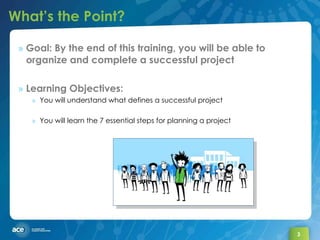
What’s the Point? Goal: By the end of this training, you will be able to organize and complete a successful project Learning Objectives: You will understand what defines a successful project You will learn the 7 essential steps for planning a project
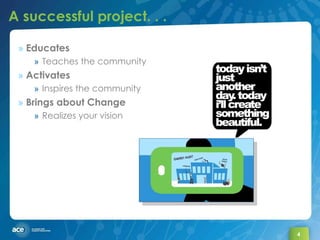
A successful project. . . Educates Teaches the community Activates Inspires the community  Brings about Change Realizes your vision
The Project Plan: Getting Started KEY: Go through these 7 steps at the beginning of project planning with a small group of core team members. Write down all 7 steps!
The Project Plan: Step 1 Project Focus What  do you want to work on?  Why  do you want to choose this project? Where  does the work need to be done? Will this contribute to overall team goals? Then, get everyone on the same page.
The Project Plan: Step 2 Discovery Stage Become an expert! Good background research will help inform your project goals
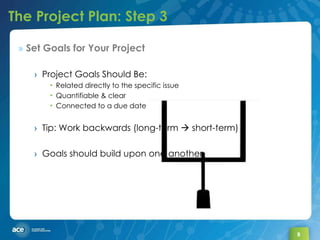
The Project Plan: Step 3 Set Goals for Your Project Project Goals Should Be: Related directly to the specific issue Quantifiable & clear Connected to a due date Tip: Work backwards (long-term    short-term) Goals should build upon one another
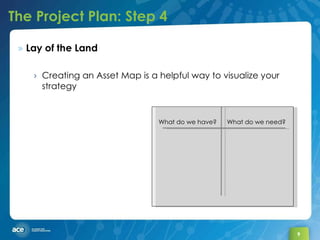
The Project Plan: Step 4
The Project Plan: Step 5 Strategy, Tactics & Timeline Strategy – “ How  are we going to achieve our goals?” The big picture and your method for achieving your goals Tactics –“ What  are we going to do achieve our goals?” Specific types of actions you’ll take to help reach your goals Timeline –  When?   Plan backwards; be realistic and don’t over-schedule Have a hardcopy; living, breathing document
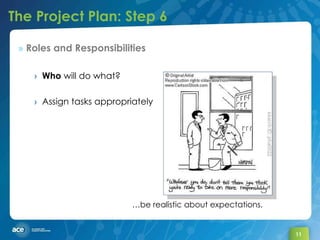
The Project Plan: Step 6 Roles and Responsibilities Who  will do what? Assign tasks appropriately  … be realistic about expectations.
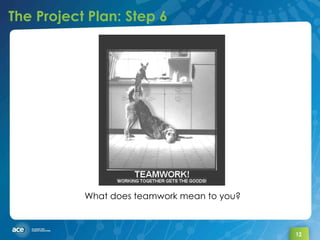
The Project Plan: Step 6 What does teamwork mean to you?
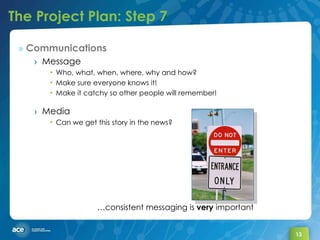
The Project Plan: Step 7 Communications Message Who, what, when, where, why and how? Make sure everyone knows it! Make it catchy so other people will remember! Media Can we get this story in the news? … consistent messaging is  very  important
And don’t forget to. . . Check in with your team regularly Continually recognize hard work and accomplishments Proactively and adaptively deal with situations and conflicts Celebrate successes! Both big and small
Recap: Smaller groups (core) better for creating project plan - - Focus on one issue and become experts - - Set specific, measurable, and achievable goals - - Write out a timeline and keep it updated - Develop your story and stay on message - - Have Fun!
Questions? [email_address]

Ace training building a successful project_02.16.10

  • 1.
    ACE Leadership TrainingPrepared by ACE Adopted from Sierra Student Coalition
  • 2.
    Building a SuccessfulProject The 7 Step Guide to Turn Ideas Into Realities
  • 3.
    What’s the Point?Goal: By the end of this training, you will be able to organize and complete a successful project Learning Objectives: You will understand what defines a successful project You will learn the 7 essential steps for planning a project
  • 4.
    A successful project.. . Educates Teaches the community Activates Inspires the community Brings about Change Realizes your vision
  • 5.
    The Project Plan:Getting Started KEY: Go through these 7 steps at the beginning of project planning with a small group of core team members. Write down all 7 steps!
  • 6.
    The Project Plan:Step 1 Project Focus What do you want to work on? Why do you want to choose this project? Where does the work need to be done? Will this contribute to overall team goals? Then, get everyone on the same page.
  • 7.
    The Project Plan:Step 2 Discovery Stage Become an expert! Good background research will help inform your project goals
  • 8.
    The Project Plan:Step 3 Set Goals for Your Project Project Goals Should Be: Related directly to the specific issue Quantifiable & clear Connected to a due date Tip: Work backwards (long-term  short-term) Goals should build upon one another
  • 9.
  • 10.
    The Project Plan:Step 5 Strategy, Tactics & Timeline Strategy – “ How are we going to achieve our goals?” The big picture and your method for achieving your goals Tactics –“ What are we going to do achieve our goals?” Specific types of actions you’ll take to help reach your goals Timeline – When? Plan backwards; be realistic and don’t over-schedule Have a hardcopy; living, breathing document
  • 11.
    The Project Plan:Step 6 Roles and Responsibilities Who will do what? Assign tasks appropriately … be realistic about expectations.
  • 12.
    The Project Plan:Step 6 What does teamwork mean to you?
  • 13.
    The Project Plan:Step 7 Communications Message Who, what, when, where, why and how? Make sure everyone knows it! Make it catchy so other people will remember! Media Can we get this story in the news? … consistent messaging is very important
  • 14.
    And don’t forgetto. . . Check in with your team regularly Continually recognize hard work and accomplishments Proactively and adaptively deal with situations and conflicts Celebrate successes! Both big and small
  • 15.
    Recap: Smaller groups(core) better for creating project plan - - Focus on one issue and become experts - - Set specific, measurable, and achievable goals - - Write out a timeline and keep it updated - Develop your story and stay on message - - Have Fun!
  • 16.

Editor's Notes

  • #3 Deep breath. You’ve got this. It’ll be great.
  • #4 Facilitator explains (briefly) how objectives are steps to achieving the goal “ Goal” and “objectives” are also helpful ways to frame an agenda for a team meeting
  • #5 Educates: -Teach people about the issue What is the problem? Why is it important? What are the consequences if we do nothing? What are the solutions? How can people take part in the solutions? Activates: Arouse passion in others to get involved in this issue - Empower others to have an impact - Encourage others to challenge the status quo if they can imagine something better Brings about change: Engage and mobilize large groups of people
  • #6 Facilitator note: The goal of this training is to be able write down and create actual living, breathing documents—a changing document: documents like timeline, roles and responsibilities, an asset map, etc .
  • #9 Goals are important because they will help frame the entire project, measure success, drive work ethic. Go to the finish line and work backwards: after setting the long term/ultimate goal, interim goals can be more-easily identified and will help the bigger picture stay clear and succinct.