Accreditation for Cardiovascular
Excellence (ACE)


Jane Kiah, M.S., R.N., Director, Invasive Services
Any new process fails or succeeds according to
the participants viewpoint….
• But despite the work involved in the process, we
would benefit from a review of the FACTS of ACE
Accreditation despite a warning from Rex W.
Huppke, the Chicago Tribune reporter who declared
several weeks ago that FACTS died at the age of
2372….

  ā€ To the shock of most sentient beings, Facts died
  Wednesday, April 18, after a long battle for relevancy
  with the 24-hour news cycle, blogs and the Internet
  ….Facts is survived by two brothers, Rumor and
  Innuendo, and a sister, Emphatic Assertion.ā€
 Obviously quite a few
  regulatory agencies have
  not accepted this
  paradigm shift…. Elvis is
  still in the Healthcare
  industry it seems since
  we are increasingly
  governed by factually
  based criteria and not by
  ā€œemphatic assertionā€ of
  appropriateness.
Administrative Benefits of
   ACE Accreditation
Quality Measures Reporting
Now a Fact of Life in Healthcare
Data Registry Participation is Required
        or at Least Expected
                        Hospital Level

                                         Internal Decision
                                              Support


Service Line Specific
Pay for Performance
      Way Beyond Core Measures


                                   ARRA and HITECH


                                        Improper Payment
                                   Elimination and Recovery Act
Comprehensive Error Rate Testing              (IPERA)
        (Cert) Program

      www.cms.gov/CERT
What are these measures and
where did they come from…?
 RAC Program = $
 Comprehensive Error Rate Testing
  (Cert) Program = $

 Efforts by the government to control
  healthcare costs
Recovery Audit Contractor (RAC) Program

• Made permanent by the The Tax Relief and Health Care
  Act of 2006 to identify improper Medicare payments -
  both overpayments and underpayments-in all 50
  states.


• RACs are paid on a contingency fee basis, receiving a
  percentage of the improper overpayments and
  underpayments they collect from providers


• RACs may review the last three years
RAC Program:
Major Causes of Improper Payments


 Physician orders missing


 Illegible/missing signatures


 National policy or Local policy requirements not met


 The medical record does not support medical necessity
Comprehensive Error Rate Testing
                  (Cert) Program
January -February, 2012- Cardiac
 DRG 247 Percutaneous Cardiovascular Procedure    30% review
   w/ Drug Eluting Stent w/o MCC

 DRG 253 Other Vascular Procedures w/CC           30% review

 DRG 264 Other Circulatory System OR Procedures   30% review

 DRG 287 Circulatory Disorders Except             30% review
   AMI w/Cardiac Cath w/o MCC

 DRG 251 Percutaneous Cardiovascular              30% review
   Procedure w/o Coronary Artery Stent w/o MCC
Comprehensive Error Rate Testing
                   (Cert) Program
Amended the Improper Payments Information Act of 2002. Signed by
the President on July 20, 2010
• Designed to improve agency efforts to reduce and recover improper
  payments
• Identification and estimation and risk of improper payments.
• Improper Payment: Any payment to the wrong provider for the
  wrong services or in the wrong amount
• Overpayments and underpayments:
      Didnā€Ÿt meet the statutory coverage requests
      Didnā€Ÿt meet the Medical necessity requirements
      Incorrectly coded
      Didnā€Ÿt submit sufficient documentation
Hospitals and Physicians
all have skin in the game and need to
         work it out together
ACE Accreditation

is the best tool
currently available
to make sure
youā€Ÿre rolling down
the right path.
The ACE Accreditation Process
5 Steps:
1. ACE Standards Review

2. Data Collection and Application Preparation

3. ACE Initial Review of Application

4. Onsite Review
5. Ongoing Reporting of Data, Lab or Operator
   Changes, Significant Events
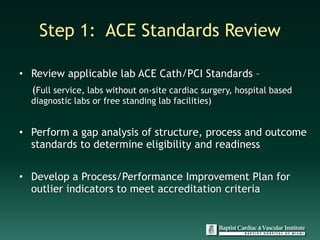
Step 1: ACE Standards Review

• Review applicable lab ACE Cath/PCI Standards –
  (Full service, labs without on-site cardiac surgery, hospital based
  diagnostic labs or free standing lab facilities)


• Perform a gap analysis of structure, process and outcome
  standards to determine eligibility and readiness


• Develop a Process/Performance Improvement Plan for
  outlier indicators to meet accreditation criteria
Domains
• Facility                  • Medical Records – Clinical
• Equipment                   documentation and
                              results reporting
• Leadership structure
                            • Procedure indications
• Fellows and physician       and informed consent
  extenders
                            • Procedure preparation
• Nursing personnel           and conduct
• Technologists and other   • Outcomes: Data
  personnel                   collection
                            • QA Program and CQI
                              processes
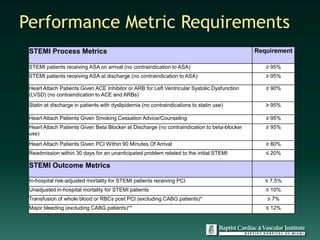
Performance Metric Requirements
 STEMI Process Metrics                                                                        Requirement

 STEMI patients receiving ASA on arrival (no contraindication to ASA)                            ≄ 95%
 STEMI patients receiving ASA at discharge (no contraindication to ASA)                          ≄ 95%

 Heart Attach Patients Given ACE Inhibitor or ARB for Left Ventricular Systolic Dysfunction      ≄ 90%
 (LVSD) (no contraindication to ACE and ARBs)
 Statin at discharge in patients with dyslipidemia (no contraindications to statin use)          ≄ 95%

 Heart Attach Patients Given Smoking Cessation Advice/Counseling                                 ≄ 95%
 Heart Attach Patients Given Beta Blocker at Discharge (no contraindication to beta-blocker      ≄ 95%
 use)
 Heart Attach Patients Given PCI Within 90 Minutes Of Arrival                                    ≄ 80%
 Readmission within 30 days for an unanticipated problem related to the initial STEMI            ≤ 20%

 STEMI Outcome Metrics

 In-hospital risk-adjusted mortality for STEMI patients receiving PCI                            ≤ 7.5%
 Unadjusted in-hospital mortality for STEMI patients                                             ≤ 10%
 Transfusion of whole blood or RBCs post PCI (excluding CABG patients)*                          ≤ 7%
 Major bleeding (excluding CABG patients)**                                                      ≤ 12%
Robust Quality Assurance and Improvement
                 Program
                         Credentialing and
                         Re-Credentialing


      Clinical Outcome                       Peer Review of All
          Indicators                             Operator
                                               Performance


              Accurate and          Assessment of AUC,
               informative          angiographic quality,
                                     completeness and
               reports and          accuracy, fluoro time
             documentation              and contrast
Step 2: Data Collection and
        Application Preparation
Documentation to support standards compliance:
• Credentialing
• Education and training
• Policies
• Procedures and indications
• Equipment
• Quality Improvement Program
• Performance improvement project in process or
  completed
• Peer Review Process
• Clinical Outcomes
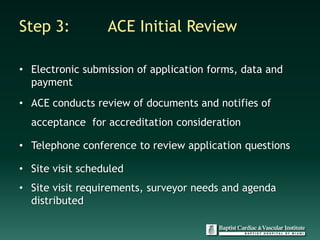
Step 3:           ACE Initial Review

• Electronic submission of application forms, data and
  payment
• ACE conducts review of documents and notifies of
  acceptance for accreditation consideration

• Telephone conference to review application questions

• Site visit scheduled
• Site visit requirements, surveyor needs and agenda
  distributed
Step 4:            Onsite Review

• 3 Experienced Nurse Reviewers and a 2 ½ day survey
• Require access to computer terminals and a navigator to
  help
• Review of 10 records of each operator including
  hemodynamic logs, and angiograms, non-invasive studies
• Policy and Procedure Manual review
• Tour of facility, labs, prep and recovery areas
• Review of equipment and PM logs
• Observation of procedures
• Personnel files and staff interviews
Step 4:            Onsite Review

• Interviews with Medical Director, leadership team, data
  coordinator Quality Assurance and Peer Review Coordinators
• Review of QA process and documentation
• Download studies and records to bring to Medical Review
  Board
• Prepare summary report

• Medical Review Board review
• Final review and recommendation for full or provisional
  accreditation in 2 to 3 months
Step 5:          Ongoing Reporting to ACE


• Quarterly NCDR CathPCI Registry
                           Institutional Outcome Reports
• Major program changes-
    Medical Director
    Operators
    Equipment or procedures
    Sentinel event
Helpful Hints
• Address gaps in structure, process or outcomes early
  (SCAI Quality Improvement Toolkit a great resource)

• Audit to ensure protocols and practices are consistently
  followed

• Ensure HIM department has process to store outside
  functional studies

• Structured reporting templates that include all
  required data elements is vital

• ā€žDo Not Useā€Ÿ abbreviations in dictation
  PCI transcribed as ā€œPost Coronal Irradiationā€
Helpful Hints
• Implement an ā€žAppropriate Useā€Ÿ process ASAP


• Transfer of medical records and images to ACE remote
  server requires planning and dedicated personnel


• Schedule site visit when all key team members are
  available


• ACE Reviewers give great advice!!
Is the process worth the
pain?
Here are some ā€œEmphatic
Assertionsā€
Thank You!

ACE Accreditation

  • 1.
    Accreditation for Cardiovascular Excellence(ACE) Jane Kiah, M.S., R.N., Director, Invasive Services
  • 2.
    Any new processfails or succeeds according to the participants viewpoint….
  • 3.
    • But despitethe work involved in the process, we would benefit from a review of the FACTS of ACE Accreditation despite a warning from Rex W. Huppke, the Chicago Tribune reporter who declared several weeks ago that FACTS died at the age of 2372…. ā€ To the shock of most sentient beings, Facts died Wednesday, April 18, after a long battle for relevancy with the 24-hour news cycle, blogs and the Internet ….Facts is survived by two brothers, Rumor and Innuendo, and a sister, Emphatic Assertion.ā€
  • 4.
     Obviously quitea few regulatory agencies have not accepted this paradigm shift…. Elvis is still in the Healthcare industry it seems since we are increasingly governed by factually based criteria and not by ā€œemphatic assertionā€ of appropriateness.
  • 5.
    Administrative Benefits of ACE Accreditation
  • 6.
    Quality Measures Reporting Nowa Fact of Life in Healthcare
  • 7.
    Data Registry Participationis Required or at Least Expected Hospital Level Internal Decision Support Service Line Specific
  • 8.
    Pay for Performance Way Beyond Core Measures ARRA and HITECH Improper Payment Elimination and Recovery Act Comprehensive Error Rate Testing (IPERA) (Cert) Program www.cms.gov/CERT
  • 9.
    What are thesemeasures and where did they come from…?  RAC Program = $  Comprehensive Error Rate Testing (Cert) Program = $  Efforts by the government to control healthcare costs
  • 10.
    Recovery Audit Contractor(RAC) Program • Made permanent by the The Tax Relief and Health Care Act of 2006 to identify improper Medicare payments - both overpayments and underpayments-in all 50 states. • RACs are paid on a contingency fee basis, receiving a percentage of the improper overpayments and underpayments they collect from providers • RACs may review the last three years
  • 11.
    RAC Program: Major Causesof Improper Payments  Physician orders missing  Illegible/missing signatures  National policy or Local policy requirements not met  The medical record does not support medical necessity
  • 12.
    Comprehensive Error RateTesting (Cert) Program January -February, 2012- Cardiac  DRG 247 Percutaneous Cardiovascular Procedure 30% review w/ Drug Eluting Stent w/o MCC  DRG 253 Other Vascular Procedures w/CC 30% review  DRG 264 Other Circulatory System OR Procedures 30% review  DRG 287 Circulatory Disorders Except 30% review AMI w/Cardiac Cath w/o MCC  DRG 251 Percutaneous Cardiovascular 30% review Procedure w/o Coronary Artery Stent w/o MCC
  • 13.
    Comprehensive Error RateTesting (Cert) Program Amended the Improper Payments Information Act of 2002. Signed by the President on July 20, 2010 • Designed to improve agency efforts to reduce and recover improper payments • Identification and estimation and risk of improper payments. • Improper Payment: Any payment to the wrong provider for the wrong services or in the wrong amount • Overpayments and underpayments:  Didnā€Ÿt meet the statutory coverage requests  Didnā€Ÿt meet the Medical necessity requirements  Incorrectly coded  Didnā€Ÿt submit sufficient documentation
  • 14.
    Hospitals and Physicians allhave skin in the game and need to work it out together
  • 15.
    ACE Accreditation is thebest tool currently available to make sure youā€Ÿre rolling down the right path.
  • 16.
  • 17.
    The ACE AccreditationProcess 5 Steps: 1. ACE Standards Review 2. Data Collection and Application Preparation 3. ACE Initial Review of Application 4. Onsite Review 5. Ongoing Reporting of Data, Lab or Operator Changes, Significant Events
  • 18.
    Step 1: ACEStandards Review • Review applicable lab ACE Cath/PCI Standards – (Full service, labs without on-site cardiac surgery, hospital based diagnostic labs or free standing lab facilities) • Perform a gap analysis of structure, process and outcome standards to determine eligibility and readiness • Develop a Process/Performance Improvement Plan for outlier indicators to meet accreditation criteria
  • 19.
    Domains • Facility • Medical Records – Clinical • Equipment documentation and results reporting • Leadership structure • Procedure indications • Fellows and physician and informed consent extenders • Procedure preparation • Nursing personnel and conduct • Technologists and other • Outcomes: Data personnel collection • QA Program and CQI processes
  • 20.
    Performance Metric Requirements STEMI Process Metrics Requirement STEMI patients receiving ASA on arrival (no contraindication to ASA) ≄ 95% STEMI patients receiving ASA at discharge (no contraindication to ASA) ≄ 95% Heart Attach Patients Given ACE Inhibitor or ARB for Left Ventricular Systolic Dysfunction ≄ 90% (LVSD) (no contraindication to ACE and ARBs) Statin at discharge in patients with dyslipidemia (no contraindications to statin use) ≄ 95% Heart Attach Patients Given Smoking Cessation Advice/Counseling ≄ 95% Heart Attach Patients Given Beta Blocker at Discharge (no contraindication to beta-blocker ≄ 95% use) Heart Attach Patients Given PCI Within 90 Minutes Of Arrival ≄ 80% Readmission within 30 days for an unanticipated problem related to the initial STEMI ≤ 20% STEMI Outcome Metrics In-hospital risk-adjusted mortality for STEMI patients receiving PCI ≤ 7.5% Unadjusted in-hospital mortality for STEMI patients ≤ 10% Transfusion of whole blood or RBCs post PCI (excluding CABG patients)* ≤ 7% Major bleeding (excluding CABG patients)** ≤ 12%
  • 21.
    Robust Quality Assuranceand Improvement Program Credentialing and Re-Credentialing Clinical Outcome Peer Review of All Indicators Operator Performance Accurate and Assessment of AUC, informative angiographic quality, completeness and reports and accuracy, fluoro time documentation and contrast
  • 22.
    Step 2: DataCollection and Application Preparation Documentation to support standards compliance: • Credentialing • Education and training • Policies • Procedures and indications • Equipment • Quality Improvement Program • Performance improvement project in process or completed • Peer Review Process • Clinical Outcomes
  • 23.
    Step 3: ACE Initial Review • Electronic submission of application forms, data and payment • ACE conducts review of documents and notifies of acceptance for accreditation consideration • Telephone conference to review application questions • Site visit scheduled • Site visit requirements, surveyor needs and agenda distributed
  • 24.
    Step 4: Onsite Review • 3 Experienced Nurse Reviewers and a 2 ½ day survey • Require access to computer terminals and a navigator to help • Review of 10 records of each operator including hemodynamic logs, and angiograms, non-invasive studies • Policy and Procedure Manual review • Tour of facility, labs, prep and recovery areas • Review of equipment and PM logs • Observation of procedures • Personnel files and staff interviews
  • 25.
    Step 4: Onsite Review • Interviews with Medical Director, leadership team, data coordinator Quality Assurance and Peer Review Coordinators • Review of QA process and documentation • Download studies and records to bring to Medical Review Board • Prepare summary report • Medical Review Board review • Final review and recommendation for full or provisional accreditation in 2 to 3 months
  • 26.
    Step 5: Ongoing Reporting to ACE • Quarterly NCDR CathPCI Registry Institutional Outcome Reports • Major program changes-  Medical Director  Operators  Equipment or procedures  Sentinel event
  • 27.
    Helpful Hints • Addressgaps in structure, process or outcomes early (SCAI Quality Improvement Toolkit a great resource) • Audit to ensure protocols and practices are consistently followed • Ensure HIM department has process to store outside functional studies • Structured reporting templates that include all required data elements is vital • ā€žDo Not Useā€Ÿ abbreviations in dictation PCI transcribed as ā€œPost Coronal Irradiationā€
  • 28.
    Helpful Hints • Implementan ā€žAppropriate Useā€Ÿ process ASAP • Transfer of medical records and images to ACE remote server requires planning and dedicated personnel • Schedule site visit when all key team members are available • ACE Reviewers give great advice!!
  • 29.
    Is the processworth the pain? Here are some ā€œEmphatic Assertionsā€
  • 30.