Avoiding 30-day Readmissions of Acute
MI Patients Utilizing Cardiac
Rehabilitation
DNP Project Presentation
Pat Forsberg, DNPc, MBA, RN, NE-BC
November 17, 2014
Setting
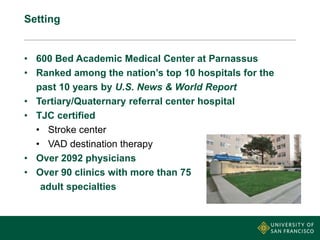
• 600 Bed Academic Medical Center at Parnassus
• Ranked among the nation’s top 10 hospitals for the
past 10 years by U.S. News & World Report
• Tertiary/Quaternary referral center hospital
• TJC certified
• Stroke center
• VAD destination therapy
• Over 2092 physicians
• Over 90 clinics with more than 75
adult specialties
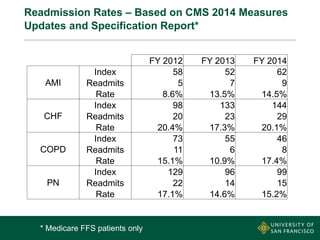
Readmission Rates – Based on CMS 2014 Measures
Updates and Specification Report*
FY 2012 FY 2013 FY 2014
AMI
Index 58 52 62
Readmits 5 7 9
Rate 8.6% 13.5% 14.5%
CHF
Index 98 133 144
Readmits 20 23 29
Rate 20.4% 17.3% 20.1%
COPD
Index 73 55 46
Readmits 11 6 8
Rate 15.1% 10.9% 17.4%
PN
Index 129 96 99
Readmits 22 14 15
Rate 17.1% 14.6% 15.2%
* Medicare FFS patients only
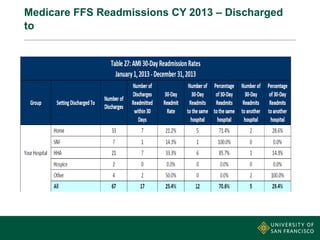
Medicare FFS Readmissions CY 2013 – Discharged
to
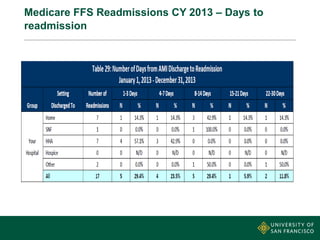
Medicare FFS Readmissions CY 2013 – Days to
readmission
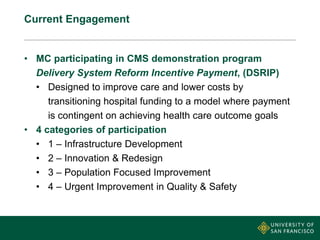
Current Engagement
• MC participating in CMS demonstration program
Delivery System Reform Incentive Payment, (DSRIP)
• Designed to improve care and lower costs by
transitioning hospital funding to a model where payment
is contingent on achieving health care outcome goals
• 4 categories of participation
• 1 – Infrastructure Development
• 2 – Innovation & Redesign
• 3 – Population Focused Improvement
• 4 – Urgent Improvement in Quality & Safety
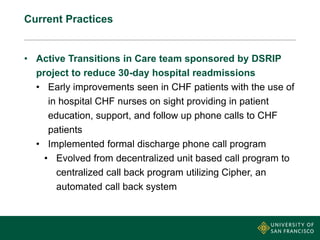
Current Practices
• Active Transitions in Care team sponsored by DSRIP
project to reduce 30-day hospital readmissions
• Early improvements seen in CHF patients with the use of
in hospital CHF nurses on sight providing in patient
education, support, and follow up phone calls to CHF
patients
• Implemented formal discharge phone call program
• Evolved from decentralized unit based call program to
centralized call back program utilizing Cipher, an
automated call back system
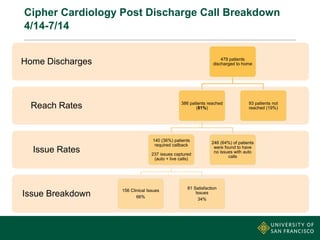
Cipher Cardiology Post Discharge Call Breakdown
4/14-7/14
Issue Breakdown
Issue Rates
Reach Rates
Home Discharges 479 patients
discharged to home
386 patients reached
(81%)
140 (36%) patients
required callback
237 issues captured
(auto + live calls)
156 Clinical Issues
66%
81 Satisfaction
Issues
34%
246 (64%) of patients
were found to have
no issues with auto
calls
93 patients not
reached (19%)
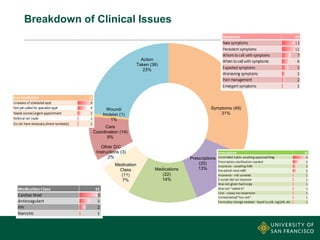
Breakdown of Clinical Issues
Symptoms (49)
31%
Prescriptions
(20)
13%Medications
(22)
14%
Medication
Class
(11)
7%
Other D/C
Instructions (3)
2%
Care
Coordination (14)
9%
Wound/
Incision (1)
1%
Action
Taken (36)
23%
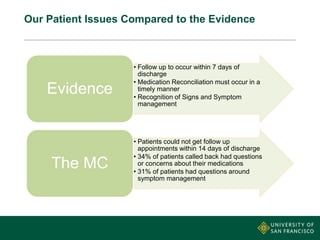
Our Patient Issues Compared to the Evidence
• Follow up to occur within 7 days of
discharge
• Medication Reconciliation must occur in a
timely manner
• Recognition of Signs and Symptom
management
Evidence
• Patients could not get follow up
appointments within 14 days of discharge
• 34% of patients called back had questions
or concerns about their medications
• 31% of patients had questions around
symptom management
The MC
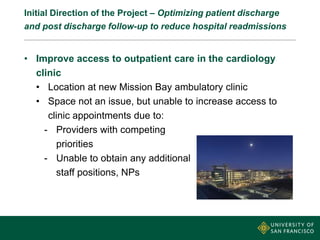
Initial Direction of the Project – Optimizing patient discharge
and post discharge follow-up to reduce hospital readmissions
• Improve access to outpatient care in the cardiology
clinic
• Location at new Mission Bay ambulatory clinic
• Space not an issue, but unable to increase access to
clinic appointments due to:
- Providers with competing
priorities
- Unable to obtain any additional
staff positions, NPs
What About Cardiac Rehabilitation?
• Currently have an active pulmonary rehab program at
the Mt Zion campus
• Funded by donation with strong medical director
• Cardiac Rehabilitation program was dissolved in 2000
when the MC and Stanford de-merged
• Cost savings effort as recommended by The Hunter
Consulting Group
• What would it take to re-establish the program at the
MC?
• Patients could be seen for intake soon after discharge
• Medication reconciliation and symptom management
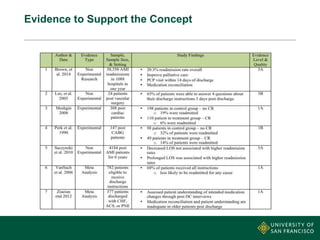
Evidence to Support the Concept
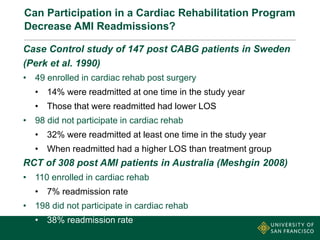
Can Participation in a Cardiac Rehabilitation Program
Decrease AMI Readmissions?
Case Control study of 147 post CABG patients in Sweden
(Perk et al. 1990)
• 49 enrolled in cardiac rehab post surgery
• 14% were readmitted at one time in the study year
• Those that were readmitted had lower LOS
• 98 did not participate in cardiac rehab
• 32% were readmitted at least one time in the study year
• When readmitted had a higher LOS than treatment group
RCT of 308 post AMI patients in Australia (Meshgin 2008)
• 110 enrolled in cardiac rehab
• 7% readmission rate
• 198 did not participate in cardiac rehab
• 38% readmission rate
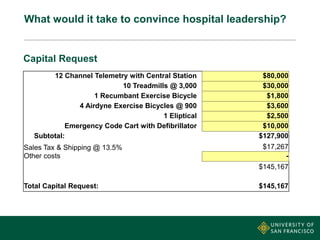
What would it take to convince hospital leadership?
Capital Request
12 Channel Telemetry with Central Station $80,000
10 Treadmills @ 3,000 $30,000
1 Recumbant Exercise Bicycle $1,800
4 Airdyne Exercise Bicycles @ 900 $3,600
1 Eliptical $2,500
Emergency Code Cart with Defibrillator $10,000
Subtotal: $127,900
Sales Tax & Shipping @ 13.5% $17,267
Other costs -
$145,167
Total Capital Request: $145,167
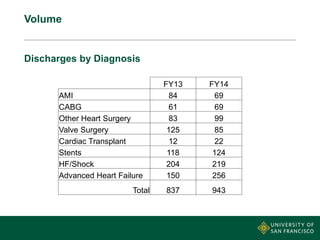
Volume
Discharges by Diagnosis
FY13 FY14
AMI 84 69
CABG 61 69
Other Heart Surgery 83 99
Valve Surgery 125 85
Cardiac Transplant 12 22
Stents 118 124
HF/Shock 204 219
Advanced Heart Failure 150 256
Total 837 943
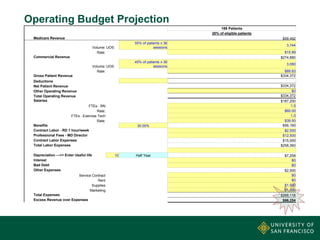
Operating Budget Projection
189 Patients
20% of eligible patients
Medicare Revenue $59,492
Volume: UOS
55% of patients x 36
sessions
3,744
Rate: $15.89
Commercial Revenue $274,880
Volume: UOS
45% of patients x 36
sessions
3,060
Rate: $89.83
Gross Patient Revenue $334,372
Deductions
Net Patient Revenue $334,372
Other Operating Revenue $0
Total Operating Revenue $334,372
Salaries $187,200
FTEs - RN 1.5
Rate: $60.00
FTEs - Exercise Tech 1.0
Rate: $39.50
Benefits 30.00% $56,160
Contract Labor - RD 1 hour/week $2,500
Professional Fees - MD Director $12,500
Contract Labor Expenses $15,000
Total Labor Expenses $258,360
Depreciation --->> Enter Useful life 10 Half Year $7,258
Interest $0
Bad Debt $0
Other Expenses $2,500
Service Contract $0
Rent $0
Supplies $1,500
Marketing $1,000
Total Expenses $268,118
Excess Revenue over Expenses $66,254
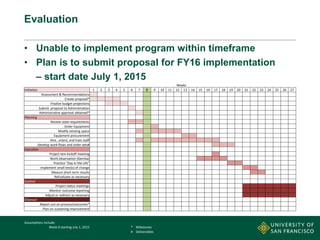
Evaluation
• Unable to implement program within timeframe
• Plan is to submit proposal for FY16 implementation
– start date July 1, 2015
Weeks
Initiation 1 2 3 4 5 6 7 8 9 10 11 12 13 14 15 16 17 18 19 20 21 22 23 24 25 26 27
Assessment & Recommendations
Create proposal*
Finalize budget projections
Submit proposal to Administration
Administrative approval obtained*
Planning
Review state requirements
Order Equipment
Modify existing space
Equipment procurement
Hire , orient, and train staff
Develop work flows and order sets#
Execution
Project tem kickoff meeting
Work observation (Gemba)
Practice "Day in the Life"
Implement small test(s) of change
Meaure short term results
ReEvaluate as necessary
Control
Project status meetings
Monitor outcome reporting
Adjust or redirect as necessary
Closeout
Report out on process/outcomes*
Plan on sustaining improvement
Assumptions include:
Week 8 starting July 1, 2015 * Milestones
# Deliverables
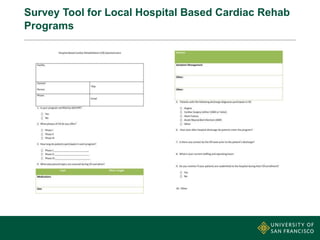
Survey Tool for Local Hospital Based Cardiac Rehab
Programs
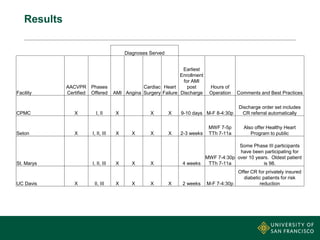
Results
Diagnoses Served
Facility
AACVPR
Certified
Phases
Offered AMI Angina
Cardiac
Surgery
Heart
Failure
Earliest
Enrollment
for AMI
post
Discharge
Hours of
Operation Comments and Best Practices
CPMC X I, II X X X 9-10 days M-F 8-4:30p
Discharge order set includes
CR referral automatically
Seton X I, II, III X X X X 2-3 weeks
MWF 7-5p
TTh 7-11a
Also offer Healthy Heart
Program to public
St. Marys I, II, III X X X 4 weeks
MWF 7-4:30p
TTh 7-11a
Some Phase III participants
have been participating for
over 10 years. Oldest patient
is 98.
UC Davis X II, III X X X X 2 weeks M-F 7-4:30p
Offer CR for privately insured
diabetic patients for risk
reduction
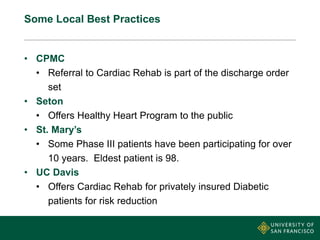
Some Local Best Practices
• CPMC
• Referral to Cardiac Rehab is part of the discharge order
set
• Seton
• Offers Healthy Heart Program to the public
• St. Mary’s
• Some Phase III patients have been participating for over
10 years. Eldest patient is 98.
• UC Davis
• Offers Cardiac Rehab for privately insured Diabetic
patients for risk reduction
Intervention – Educational Power Point
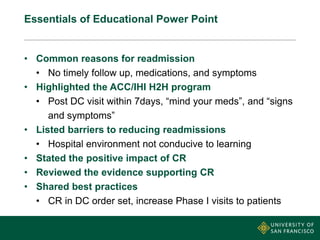
Essentials of Educational Power Point
• Common reasons for readmission
• No timely follow up, medications, and symptoms
• Highlighted the ACC/IHI H2H program
• Post DC visit within 7days, “mind your meds”, and “signs
and symptoms”
• Listed barriers to reducing readmissions
• Hospital environment not conducive to learning
• Stated the positive impact of CR
• Reviewed the evidence supporting CR
• Shared best practices
• CR in DC order set, increase Phase I visits to patients
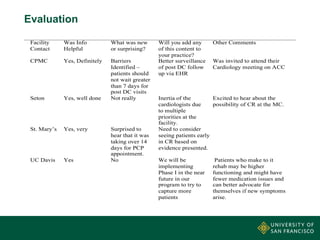
Evaluation
Facility
Contact
Was Info
Helpful
What was new
or surprising?
Will you add any
of this content to
your practice?
Other Comments
CPMC Yes, Definitely Barriers
Identified –
patients should
not wait greater
than 7 days for
post DC visits
Better surveillance
of post DC follow
up via EHR
Was invited to attend their
Cardiology meeting on ACC
Seton Yes, well done Not really Inertia of the
cardiologists due
to multiple
priorities at the
facility.
Excited to hear about the
possibility of CR at the MC.
St. Mary’s Yes, very Surprised to
hear that it was
taking over 14
days for PCP
appointment.
Need to consider
seeing patients early
in CR based on
evidence presented.
UC Davis Yes No We will be
implementing
Phase I in the near
future in our
program to try to
capture more
patients
Patients who make to it
rehab may be higher
functioning and might have
fewer medication issues and
can better advocate for
themselves if new symptoms
arise.
Lessons Learned
• Cardiac Rehab can be revenue producing
• Revenue is also enhanced by decreasing readmissions
and the associated fines to the facility
• Also enhanced by lower incidence of lack of payment to
the facility for patients readmitted within 30 days
• Start on a smaller scale
• Could a smaller project – Cardiology service line CNL
implementation decreased the readmission rate of AMI
patients?
• Great deal of camaraderie and support among the
participating CR programs surveyed
Summary
• Strong evidence to support implementation of CR
program at the MC
• Poor recall of discharge instructions after discharge
including medications and symptom management
• Decreased LOS not associated with higher readmissions
• 2 RCT demonstrated lower readmission rates in subjects
that participated in CR programs
• Findings from survey will be incorporated into MC
proposal
• Including order for CR in discharge order set in HER
• Consider other populations – Diabetes risk reduction
Summary - continued
• Medical staff leadership very optimistic about the
proposal
• Planning to present proposal utilizing Aristotle’s Modes
of Persuasion
• Ethos – credibility of the speaker – evidenced based
• Pathos – emotional influence – right thing to do for the
patient population
• Logos – sound and logical – positive ROI
• Dr. Dean Ornish interested in partnering with the MC to
establish his CMS reimbursable Intensive Cardiac
Rehabilitation Program at the MC
Thank you….time for questions
“Nothing worthwhile is ever easy”
Anne V. Turton, RN
Thank you Frosty…

Project Presentation

  • 1.
    Avoiding 30-day Readmissionsof Acute MI Patients Utilizing Cardiac Rehabilitation DNP Project Presentation Pat Forsberg, DNPc, MBA, RN, NE-BC November 17, 2014
  • 2.
    Setting • 600 BedAcademic Medical Center at Parnassus • Ranked among the nation’s top 10 hospitals for the past 10 years by U.S. News & World Report • Tertiary/Quaternary referral center hospital • TJC certified • Stroke center • VAD destination therapy • Over 2092 physicians • Over 90 clinics with more than 75 adult specialties
  • 3.
    Readmission Rates –Based on CMS 2014 Measures Updates and Specification Report* FY 2012 FY 2013 FY 2014 AMI Index 58 52 62 Readmits 5 7 9 Rate 8.6% 13.5% 14.5% CHF Index 98 133 144 Readmits 20 23 29 Rate 20.4% 17.3% 20.1% COPD Index 73 55 46 Readmits 11 6 8 Rate 15.1% 10.9% 17.4% PN Index 129 96 99 Readmits 22 14 15 Rate 17.1% 14.6% 15.2% * Medicare FFS patients only
  • 4.
    Medicare FFS ReadmissionsCY 2013 – Discharged to
  • 5.
    Medicare FFS ReadmissionsCY 2013 – Days to readmission
  • 6.
    Current Engagement • MCparticipating in CMS demonstration program Delivery System Reform Incentive Payment, (DSRIP) • Designed to improve care and lower costs by transitioning hospital funding to a model where payment is contingent on achieving health care outcome goals • 4 categories of participation • 1 – Infrastructure Development • 2 – Innovation & Redesign • 3 – Population Focused Improvement • 4 – Urgent Improvement in Quality & Safety
  • 7.
    Current Practices • ActiveTransitions in Care team sponsored by DSRIP project to reduce 30-day hospital readmissions • Early improvements seen in CHF patients with the use of in hospital CHF nurses on sight providing in patient education, support, and follow up phone calls to CHF patients • Implemented formal discharge phone call program • Evolved from decentralized unit based call program to centralized call back program utilizing Cipher, an automated call back system
  • 8.
    Cipher Cardiology PostDischarge Call Breakdown 4/14-7/14 Issue Breakdown Issue Rates Reach Rates Home Discharges 479 patients discharged to home 386 patients reached (81%) 140 (36%) patients required callback 237 issues captured (auto + live calls) 156 Clinical Issues 66% 81 Satisfaction Issues 34% 246 (64%) of patients were found to have no issues with auto calls 93 patients not reached (19%)
  • 9.
    Breakdown of ClinicalIssues Symptoms (49) 31% Prescriptions (20) 13%Medications (22) 14% Medication Class (11) 7% Other D/C Instructions (3) 2% Care Coordination (14) 9% Wound/ Incision (1) 1% Action Taken (36) 23%
  • 10.
    Our Patient IssuesCompared to the Evidence • Follow up to occur within 7 days of discharge • Medication Reconciliation must occur in a timely manner • Recognition of Signs and Symptom management Evidence • Patients could not get follow up appointments within 14 days of discharge • 34% of patients called back had questions or concerns about their medications • 31% of patients had questions around symptom management The MC
  • 11.
    Initial Direction ofthe Project – Optimizing patient discharge and post discharge follow-up to reduce hospital readmissions • Improve access to outpatient care in the cardiology clinic • Location at new Mission Bay ambulatory clinic • Space not an issue, but unable to increase access to clinic appointments due to: - Providers with competing priorities - Unable to obtain any additional staff positions, NPs
  • 12.
    What About CardiacRehabilitation? • Currently have an active pulmonary rehab program at the Mt Zion campus • Funded by donation with strong medical director • Cardiac Rehabilitation program was dissolved in 2000 when the MC and Stanford de-merged • Cost savings effort as recommended by The Hunter Consulting Group • What would it take to re-establish the program at the MC? • Patients could be seen for intake soon after discharge • Medication reconciliation and symptom management
  • 13.
  • 14.
    Can Participation ina Cardiac Rehabilitation Program Decrease AMI Readmissions? Case Control study of 147 post CABG patients in Sweden (Perk et al. 1990) • 49 enrolled in cardiac rehab post surgery • 14% were readmitted at one time in the study year • Those that were readmitted had lower LOS • 98 did not participate in cardiac rehab • 32% were readmitted at least one time in the study year • When readmitted had a higher LOS than treatment group RCT of 308 post AMI patients in Australia (Meshgin 2008) • 110 enrolled in cardiac rehab • 7% readmission rate • 198 did not participate in cardiac rehab • 38% readmission rate
  • 15.
    What would ittake to convince hospital leadership? Capital Request 12 Channel Telemetry with Central Station $80,000 10 Treadmills @ 3,000 $30,000 1 Recumbant Exercise Bicycle $1,800 4 Airdyne Exercise Bicycles @ 900 $3,600 1 Eliptical $2,500 Emergency Code Cart with Defibrillator $10,000 Subtotal: $127,900 Sales Tax & Shipping @ 13.5% $17,267 Other costs - $145,167 Total Capital Request: $145,167
  • 16.
    Volume Discharges by Diagnosis FY13FY14 AMI 84 69 CABG 61 69 Other Heart Surgery 83 99 Valve Surgery 125 85 Cardiac Transplant 12 22 Stents 118 124 HF/Shock 204 219 Advanced Heart Failure 150 256 Total 837 943
  • 17.
    Operating Budget Projection 189Patients 20% of eligible patients Medicare Revenue $59,492 Volume: UOS 55% of patients x 36 sessions 3,744 Rate: $15.89 Commercial Revenue $274,880 Volume: UOS 45% of patients x 36 sessions 3,060 Rate: $89.83 Gross Patient Revenue $334,372 Deductions Net Patient Revenue $334,372 Other Operating Revenue $0 Total Operating Revenue $334,372 Salaries $187,200 FTEs - RN 1.5 Rate: $60.00 FTEs - Exercise Tech 1.0 Rate: $39.50 Benefits 30.00% $56,160 Contract Labor - RD 1 hour/week $2,500 Professional Fees - MD Director $12,500 Contract Labor Expenses $15,000 Total Labor Expenses $258,360 Depreciation --->> Enter Useful life 10 Half Year $7,258 Interest $0 Bad Debt $0 Other Expenses $2,500 Service Contract $0 Rent $0 Supplies $1,500 Marketing $1,000 Total Expenses $268,118 Excess Revenue over Expenses $66,254
  • 18.
    Evaluation • Unable toimplement program within timeframe • Plan is to submit proposal for FY16 implementation – start date July 1, 2015 Weeks Initiation 1 2 3 4 5 6 7 8 9 10 11 12 13 14 15 16 17 18 19 20 21 22 23 24 25 26 27 Assessment & Recommendations Create proposal* Finalize budget projections Submit proposal to Administration Administrative approval obtained* Planning Review state requirements Order Equipment Modify existing space Equipment procurement Hire , orient, and train staff Develop work flows and order sets# Execution Project tem kickoff meeting Work observation (Gemba) Practice "Day in the Life" Implement small test(s) of change Meaure short term results ReEvaluate as necessary Control Project status meetings Monitor outcome reporting Adjust or redirect as necessary Closeout Report out on process/outcomes* Plan on sustaining improvement Assumptions include: Week 8 starting July 1, 2015 * Milestones # Deliverables
  • 19.
    Survey Tool forLocal Hospital Based Cardiac Rehab Programs
  • 20.
    Results Diagnoses Served Facility AACVPR Certified Phases Offered AMIAngina Cardiac Surgery Heart Failure Earliest Enrollment for AMI post Discharge Hours of Operation Comments and Best Practices CPMC X I, II X X X 9-10 days M-F 8-4:30p Discharge order set includes CR referral automatically Seton X I, II, III X X X X 2-3 weeks MWF 7-5p TTh 7-11a Also offer Healthy Heart Program to public St. Marys I, II, III X X X 4 weeks MWF 7-4:30p TTh 7-11a Some Phase III participants have been participating for over 10 years. Oldest patient is 98. UC Davis X II, III X X X X 2 weeks M-F 7-4:30p Offer CR for privately insured diabetic patients for risk reduction
  • 21.
    Some Local BestPractices • CPMC • Referral to Cardiac Rehab is part of the discharge order set • Seton • Offers Healthy Heart Program to the public • St. Mary’s • Some Phase III patients have been participating for over 10 years. Eldest patient is 98. • UC Davis • Offers Cardiac Rehab for privately insured Diabetic patients for risk reduction
  • 22.
  • 23.
    Essentials of EducationalPower Point • Common reasons for readmission • No timely follow up, medications, and symptoms • Highlighted the ACC/IHI H2H program • Post DC visit within 7days, “mind your meds”, and “signs and symptoms” • Listed barriers to reducing readmissions • Hospital environment not conducive to learning • Stated the positive impact of CR • Reviewed the evidence supporting CR • Shared best practices • CR in DC order set, increase Phase I visits to patients
  • 24.
    Evaluation Facility Contact Was Info Helpful What wasnew or surprising? Will you add any of this content to your practice? Other Comments CPMC Yes, Definitely Barriers Identified – patients should not wait greater than 7 days for post DC visits Better surveillance of post DC follow up via EHR Was invited to attend their Cardiology meeting on ACC Seton Yes, well done Not really Inertia of the cardiologists due to multiple priorities at the facility. Excited to hear about the possibility of CR at the MC. St. Mary’s Yes, very Surprised to hear that it was taking over 14 days for PCP appointment. Need to consider seeing patients early in CR based on evidence presented. UC Davis Yes No We will be implementing Phase I in the near future in our program to try to capture more patients Patients who make to it rehab may be higher functioning and might have fewer medication issues and can better advocate for themselves if new symptoms arise.
  • 25.
    Lessons Learned • CardiacRehab can be revenue producing • Revenue is also enhanced by decreasing readmissions and the associated fines to the facility • Also enhanced by lower incidence of lack of payment to the facility for patients readmitted within 30 days • Start on a smaller scale • Could a smaller project – Cardiology service line CNL implementation decreased the readmission rate of AMI patients? • Great deal of camaraderie and support among the participating CR programs surveyed
  • 26.
    Summary • Strong evidenceto support implementation of CR program at the MC • Poor recall of discharge instructions after discharge including medications and symptom management • Decreased LOS not associated with higher readmissions • 2 RCT demonstrated lower readmission rates in subjects that participated in CR programs • Findings from survey will be incorporated into MC proposal • Including order for CR in discharge order set in HER • Consider other populations – Diabetes risk reduction
  • 27.
    Summary - continued •Medical staff leadership very optimistic about the proposal • Planning to present proposal utilizing Aristotle’s Modes of Persuasion • Ethos – credibility of the speaker – evidenced based • Pathos – emotional influence – right thing to do for the patient population • Logos – sound and logical – positive ROI • Dr. Dean Ornish interested in partnering with the MC to establish his CMS reimbursable Intensive Cardiac Rehabilitation Program at the MC
  • 28.
    Thank you….time forquestions “Nothing worthwhile is ever easy” Anne V. Turton, RN Thank you Frosty…