ABEM

              EMCC
      What you need to do.
Generally your certificate will expire
    10 years after initial or re-
           certification.
Turns out Obama will not help you.
ABEM EMCC (                                       Emergency Medicine Continuous Certification              )

Four Components: 1-3 Implemented in 2004.
  1.Professional Standing
       You must hold at least one medical license.
  2.LLSA (Lifelong Learning and Self Assessment)
       8 completed out of the ten years between
     certification/renewal or renewal/renewal.
       Exceptions: renew 2011 6, renew 2012 7 needed.
The primary goal of LLSA is to promote continuous learning by diplomates. ABEM facilitates this learning by identifying an annual set
of LLSA readings to guide diplomates in self-study of recent EM literature. Readings are intended to address issues of relevance to
current clinical practice at the time they are posted. ABEM recognizes that EM is an ever-evolving science and that new knowledge
becomes available on a continual basis.
LLSA readings are designed as study tools and should be read critically. They are not intended to be all-inclusive and are not meant
to define the standard of care for the clinical practice of EM. ABEM does not endorse a specific research finding or treatment modality
by virtue of its being the subject of a selected LLSA reading.
LLSA into CME @ EMedHome.com

$99 per year to join.   $85 this year for up to 25 CME
                        credits (less this year due to
                        less articles). 20 CME credits
                        for completing the test (has
                        been 25 in the past).
3. Concert: Assessment of Cognitive Expertise

Component three of the EMCC program, the Continuous Certification (ConCert)
examination, is available annually. Like the previous recertification examination, it
measures the knowledge base for the practice of Emergency Medicine (EM).
 The ConCert examination is a comprehensive examination based on the EM
Model.
 ConCert will typically occur in the tenth year of each diplomate’s EMCC cycle.
 ConCert is a half-day examination.
 ConCert is administered at computer-based testing centers around the country
4. Assessment of Practice Performance

"Assessment of Practice Performance (APP) is the fourth component of EMCC. Clinically active diplomates assess the quality of care
they provide compared to peers and then apply the best evidence or consensus recommendations to maintain or improve that care.
APP focuses on practice-based learning and improvement, particularly in the competencies of patient care, interpersonal and
communication skills, and professionalism. APP is based on diplomates’ involvement in a national, regional, or local practice
                                                   A specific goal of the APP program is to
improvement plan of their choice that meets ABEM’s basic requirements.
recognize quality improvement activities in which most diplomates are already
participating."
Started 2010.
First Attestations are required 2011 for 2013 certificates.
Two components:
1.Communication/Professionalism (CP) Activity
2. Patient Care Practice Improvement (PI) Activity
Communication / Professionalism (CP)

"Communication / Professionalism (CP) feedback program, such as the
patient surveys used by most hospitals, in years one through eight."
MAPPS will cover this.
Chief of the department will be the attestor.

Not able/need to attest to yet, starts for certificates expiring in 2017.
Patient Care Practice Improvement (PI)
"A PI activity must include the following four steps:
1. Review patient clinical care data from ten of your patients. The data must be related to a single
presentation, disease, or clinical care process that is part of the Model of the Clinical Practice of
Emergency Medicine (EM Model) for example
  • clinical care processes
  • feedback from patients that relates to the clinical care given
  • outcomes of clinical care
  • access to care such as time for through-put, left without being seen, etc.
Group data and data collected through a national, regional, or local practice improvement program in which
you participate is acceptable.
2. Compare the data to evidence-based guidelines. Evidence-based guidelines are based on published
research subject to peer-review. Only if such guidelines are not available, you may use guidelines set by
expert consensus or comparable peer data. Guidelines set by expert consensus are published, accepted,
national standards, and guidelines set by peer data are set by individuals who practice in like or similar
circumstances.
3. Develop and implement a plan to improve the practice issue measured in Step #1. You may plan for an
individual or group improvement effort.
4. After implementing the improvement plan, review patient clinical care data from ten additional patients
with the same presentation, disease, or clinical process as the first patient data review. Use this data to
evaluate whether clinical performance has been improved or maintained."
Acceptable Types of Patient Care
Practice Improvement Activity
 ABMS Patient Safety Module
 Core Measures
o Acute Myocardial Infarction: aspirin on arrival
o Acute Myocardial Infarction: ACE inhibitor or ARB given for LVSD
o Acute Myocardial Infarction: Beta-blocker within 24 hours of arrival
o Acute Myocardial Infarction: Fibrinolytic within 30 minutes of arrival
o Acute Myocardial Infarction: PCI within 90 minutes of arrival
o Pneumonia: Oxygenation assessment
o Pneumonia: Blood cultures for ICU
o Pneumonia: Blood culture before first antibiotic
o Pneumonia: Antibiotic timing (within 4 hours; within 8 hours)
 PQRS Measures
o Aspirin at arrival for acute myocardial infarction.
o Stroke and stroke rehabilitation: deep vein thrombosis prophylaxis (DVT) for stroke or intracranial hemorrhage.
o 12-lead electrocardiogram (ECG) performed for non-traumatic chest pain.
o 12-lead electrocardiogram (ECG) performed for syncope.
o Community-acquired pneumonia (CAP): vital signs.
o Community-acquired pneumonia (CAP): assessment of oxygen saturation.
o Community-acquired pneumonia (CAP): assessment of mental status.
o Community-acquired pneumonia (CAP): empiric antibiotic.
o Prevention of catheter-related bloodstream infections (CRBSI): CVP insertion protocol
 Door to Balloon Time
 Sepsis Pathways


 Stroke Protocol/Pathways Activation
 Asthma Pathways
 Throughput Time Measures
 Door to Doctor Times
 Left without Being Seen
 Unscheduled Return Visits
 Patient Call Back Program: Assessment of Clinical Care Given (not a satisfaction survey)


 
atient Care Practice Improvement
                                                 P
Paulo the Attestor
When to attest

One required year in year 1-4 and one in years 5-8.
For those required (year 2013 and on) one one PI done and
attested to in 2010 through 2013.
Stroke care pathway will cover initially until we need a new
project 2015.

I would recommend everyone attest to completing the project
this year.
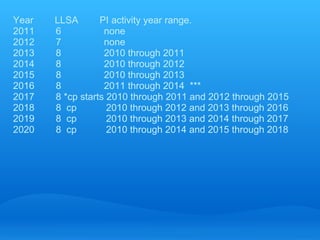
Year   LLSA       PI activity year range.
2011   6           none
2012   7           none
2013   8           2010 through 2011
2014   8           2010 through 2012
2015   8           2010 through 2013
2016   8           2011 through 2014 ***
2017   8 *cp starts 2010 through 2011 and 2012 through 2015
2018   8 cp         2010 through 2012 and 2013 through 2016
2019   8 cp         2010 through 2013 and 2014 through 2017
2020   8 cp         2010 through 2014 and 2015 through 2018
Bottom Line this will not impact you. You must go
              online and attest only.
Activity Details
Activity
  Local Activity
Activity / Program Name
  Acute Stroke Care Activity Location / Organization Name
  San Diego Medical Center/Kaiser Foundation Hospital Dates you performed the activity:
04/01/2010-04/18/2011
Step 1. My program included reviewing the following patient care data from at least ten of my
patients:
Clinical care processes
Outcomes of clinical care
Step 2. I compared my data to the following clinical standards:
Evidence-based guidelines
Expert consensus
Comparable peer data
Step 3. I developed and implemented a PI plan, either individually or as part of a group, in the
following areas:
Clinical reminders
Personal education
Change in systems or process
Clinical pathway

Step 4. Using patient care clinical data from at least ten additional patients of mine, with the same
presentation, disease or clinical process as the first patient data review, I re-measured my clinical
performance:
Yes
My clinical performance improved or maintained the standard I used in Step 2:
Yes
Step by Step Instruction for Attestation


After signing into ABEM.org, click on EMCC Online
Step by Step Instruction for Attestation


Click on Assessment of Practice
Step by Step Instruction for Attestation


 Click on Attest for PI
Step by Step Instruction for Attestation


 Click on Update License(s)
Step by Step Instruction for Attestation


 After updating License Info, Select Stroke
 Protocol/Pathways
Step by Step Instruction for Attestation


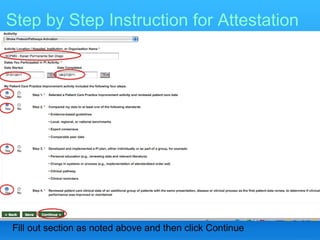
Fill out section as noted above and then click Continue
Step by Step Instruction for Attestation


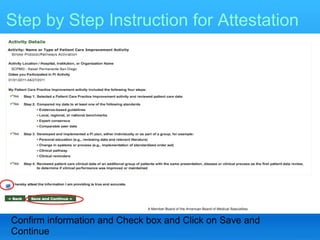
Confirm information and Check box and Click on Save and
Continue
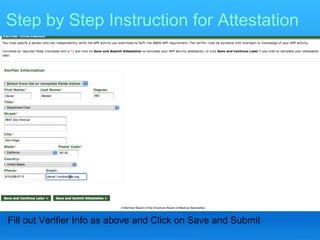
Step by Step Instruction for Attestation


Fill out Verifier Info as above and Click on Save and
Submit
Step by Step Instruction for Attestation


 Click on Attest for Communication and Professionalism
Step by Step Instruction for Attestation


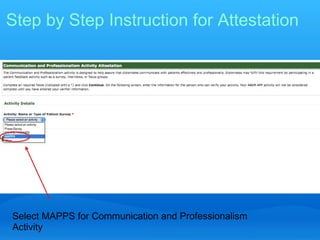
Select MAPPS for Communication and Professionalism
Activity
Step by Step Instruction for Attestation


Fill out Attestation as noted above and Click
Continue
Step by Step Instruction for Attestation


Verify info, Check box and Click Save and
Continue
Step by Step Instruction for Attestation


Fill out Verifier Info as above and Click on Save and Submit
Questions?

ABEM MOC

  • 1.
    ABEM EMCC What you need to do. Generally your certificate will expire 10 years after initial or re- certification.
  • 2.
    Turns out Obamawill not help you.
  • 3.
    ABEM EMCC ( Emergency Medicine Continuous Certification ) Four Components: 1-3 Implemented in 2004. 1.Professional Standing You must hold at least one medical license. 2.LLSA (Lifelong Learning and Self Assessment) 8 completed out of the ten years between certification/renewal or renewal/renewal. Exceptions: renew 2011 6, renew 2012 7 needed. The primary goal of LLSA is to promote continuous learning by diplomates. ABEM facilitates this learning by identifying an annual set of LLSA readings to guide diplomates in self-study of recent EM literature. Readings are intended to address issues of relevance to current clinical practice at the time they are posted. ABEM recognizes that EM is an ever-evolving science and that new knowledge becomes available on a continual basis. LLSA readings are designed as study tools and should be read critically. They are not intended to be all-inclusive and are not meant to define the standard of care for the clinical practice of EM. ABEM does not endorse a specific research finding or treatment modality by virtue of its being the subject of a selected LLSA reading.
  • 4.
    LLSA into CME@ EMedHome.com $99 per year to join. $85 this year for up to 25 CME credits (less this year due to less articles). 20 CME credits for completing the test (has been 25 in the past).
  • 5.
    3. Concert: Assessmentof Cognitive Expertise Component three of the EMCC program, the Continuous Certification (ConCert) examination, is available annually. Like the previous recertification examination, it measures the knowledge base for the practice of Emergency Medicine (EM).  The ConCert examination is a comprehensive examination based on the EM Model.  ConCert will typically occur in the tenth year of each diplomate’s EMCC cycle.  ConCert is a half-day examination.  ConCert is administered at computer-based testing centers around the country
  • 6.
    4. Assessment ofPractice Performance "Assessment of Practice Performance (APP) is the fourth component of EMCC. Clinically active diplomates assess the quality of care they provide compared to peers and then apply the best evidence or consensus recommendations to maintain or improve that care. APP focuses on practice-based learning and improvement, particularly in the competencies of patient care, interpersonal and communication skills, and professionalism. APP is based on diplomates’ involvement in a national, regional, or local practice A specific goal of the APP program is to improvement plan of their choice that meets ABEM’s basic requirements. recognize quality improvement activities in which most diplomates are already participating." Started 2010. First Attestations are required 2011 for 2013 certificates. Two components: 1.Communication/Professionalism (CP) Activity 2. Patient Care Practice Improvement (PI) Activity
  • 7.
    Communication / Professionalism(CP) "Communication / Professionalism (CP) feedback program, such as the patient surveys used by most hospitals, in years one through eight." MAPPS will cover this. Chief of the department will be the attestor. Not able/need to attest to yet, starts for certificates expiring in 2017.
  • 8.
    Patient Care PracticeImprovement (PI) "A PI activity must include the following four steps: 1. Review patient clinical care data from ten of your patients. The data must be related to a single presentation, disease, or clinical care process that is part of the Model of the Clinical Practice of Emergency Medicine (EM Model) for example • clinical care processes • feedback from patients that relates to the clinical care given • outcomes of clinical care • access to care such as time for through-put, left without being seen, etc. Group data and data collected through a national, regional, or local practice improvement program in which you participate is acceptable. 2. Compare the data to evidence-based guidelines. Evidence-based guidelines are based on published research subject to peer-review. Only if such guidelines are not available, you may use guidelines set by expert consensus or comparable peer data. Guidelines set by expert consensus are published, accepted, national standards, and guidelines set by peer data are set by individuals who practice in like or similar circumstances. 3. Develop and implement a plan to improve the practice issue measured in Step #1. You may plan for an individual or group improvement effort. 4. After implementing the improvement plan, review patient clinical care data from ten additional patients with the same presentation, disease, or clinical process as the first patient data review. Use this data to evaluate whether clinical performance has been improved or maintained."
  • 9.
    Acceptable Types ofPatient Care Practice Improvement Activity  ABMS Patient Safety Module  Core Measures o Acute Myocardial Infarction: aspirin on arrival o Acute Myocardial Infarction: ACE inhibitor or ARB given for LVSD o Acute Myocardial Infarction: Beta-blocker within 24 hours of arrival o Acute Myocardial Infarction: Fibrinolytic within 30 minutes of arrival o Acute Myocardial Infarction: PCI within 90 minutes of arrival o Pneumonia: Oxygenation assessment o Pneumonia: Blood cultures for ICU o Pneumonia: Blood culture before first antibiotic o Pneumonia: Antibiotic timing (within 4 hours; within 8 hours)  PQRS Measures o Aspirin at arrival for acute myocardial infarction. o Stroke and stroke rehabilitation: deep vein thrombosis prophylaxis (DVT) for stroke or intracranial hemorrhage. o 12-lead electrocardiogram (ECG) performed for non-traumatic chest pain. o 12-lead electrocardiogram (ECG) performed for syncope. o Community-acquired pneumonia (CAP): vital signs. o Community-acquired pneumonia (CAP): assessment of oxygen saturation. o Community-acquired pneumonia (CAP): assessment of mental status. o Community-acquired pneumonia (CAP): empiric antibiotic. o Prevention of catheter-related bloodstream infections (CRBSI): CVP insertion protocol  Door to Balloon Time  Sepsis Pathways  Stroke Protocol/Pathways Activation  Asthma Pathways  Throughput Time Measures  Door to Doctor Times  Left without Being Seen  Unscheduled Return Visits  Patient Call Back Program: Assessment of Clinical Care Given (not a satisfaction survey)   atient Care Practice Improvement  P
  • 10.
  • 11.
    When to attest Onerequired year in year 1-4 and one in years 5-8. For those required (year 2013 and on) one one PI done and attested to in 2010 through 2013. Stroke care pathway will cover initially until we need a new project 2015. I would recommend everyone attest to completing the project this year.
  • 12.
    Year LLSA PI activity year range. 2011 6 none 2012 7 none 2013 8 2010 through 2011 2014 8 2010 through 2012 2015 8 2010 through 2013 2016 8 2011 through 2014 *** 2017 8 *cp starts 2010 through 2011 and 2012 through 2015 2018 8 cp 2010 through 2012 and 2013 through 2016 2019 8 cp 2010 through 2013 and 2014 through 2017 2020 8 cp 2010 through 2014 and 2015 through 2018
  • 13.
    Bottom Line thiswill not impact you. You must go online and attest only.
  • 14.
    Activity Details Activity Local Activity Activity / Program Name Acute Stroke Care Activity Location / Organization Name San Diego Medical Center/Kaiser Foundation Hospital Dates you performed the activity: 04/01/2010-04/18/2011 Step 1. My program included reviewing the following patient care data from at least ten of my patients: Clinical care processes Outcomes of clinical care Step 2. I compared my data to the following clinical standards: Evidence-based guidelines Expert consensus Comparable peer data Step 3. I developed and implemented a PI plan, either individually or as part of a group, in the following areas: Clinical reminders Personal education Change in systems or process Clinical pathway Step 4. Using patient care clinical data from at least ten additional patients of mine, with the same presentation, disease or clinical process as the first patient data review, I re-measured my clinical performance: Yes My clinical performance improved or maintained the standard I used in Step 2: Yes
  • 15.
    Step by StepInstruction for Attestation After signing into ABEM.org, click on EMCC Online
  • 16.
    Step by StepInstruction for Attestation Click on Assessment of Practice
  • 17.
    Step by StepInstruction for Attestation Click on Attest for PI
  • 18.
    Step by StepInstruction for Attestation Click on Update License(s)
  • 19.
    Step by StepInstruction for Attestation After updating License Info, Select Stroke Protocol/Pathways
  • 20.
    Step by StepInstruction for Attestation Fill out section as noted above and then click Continue
  • 21.
    Step by StepInstruction for Attestation Confirm information and Check box and Click on Save and Continue
  • 22.
    Step by StepInstruction for Attestation Fill out Verifier Info as above and Click on Save and Submit
  • 23.
    Step by StepInstruction for Attestation Click on Attest for Communication and Professionalism
  • 24.
    Step by StepInstruction for Attestation Select MAPPS for Communication and Professionalism Activity
  • 25.
    Step by StepInstruction for Attestation Fill out Attestation as noted above and Click Continue
  • 26.
    Step by StepInstruction for Attestation Verify info, Check box and Click Save and Continue
  • 27.
    Step by StepInstruction for Attestation Fill out Verifier Info as above and Click on Save and Submit
  • 28.