• OPER ATIONS
AUDITING
• MODULE 1
Definitions and Characteristics of Operations Audit
Objectives and Phases of Operational Audits
Learning Objectives
After studying the resources and accomplishing the activities given for
this lesson, you are expected to be able to:
1. Describe the characteristics of operational auditing
2. Understand the objectives of Operations audit.
3. Identify the phases of Operational audits.
4. Explain an audit program and types of evidence
Definition and Characteristics
Operational Auditing
is a future oriented, systematic, and independent
evaluation of organizational activities. Financial
data may be used but the primary sources of
evidence are the operational policies and
achievements related to organization objectives.
Internal controls and efficiencies may be
evaluated during this type of review.
Definition and Characteristics
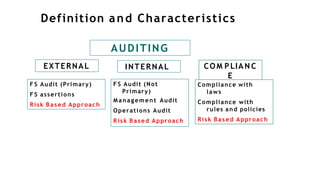
AUDITING
EXTERNAL INTERNAL COM PLIAN C
E
F S Audit (Primary)
F S assertions
Risk Based Approach
F S Audit (Not
Primary)
Management Audit
Operations Audit
Risk Based Approach
Compliance with
laws
Compliance with
rules and policies
Risk Based Approach
Definition and Characteristics
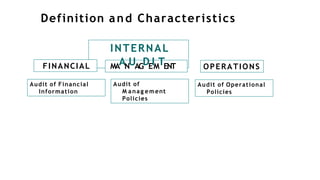
FINANCIAL
INTERNAL
MAANUAGDEIMTENT OPERATIONS
Audit of Financial
Information
Audit of
M anag ement
Policies
Audit of Operational
Policies
Definition and Characteristics
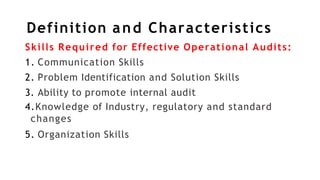
Skills Required for Effective Operational Audits:
1. Communication Skills
2. Problem Identification and Solution Skills
3. Ability to promote internal audit
4.Knowledge of Industry, regulatory and standard
changes
5. Organization Skills
Definition and Characteristics
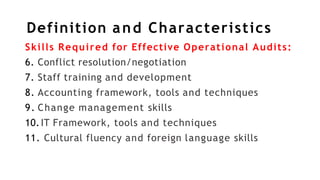
Skills Required for Effective Operational Audits:
6. Conflict resolution/negotiation
7. Staff training and development
8. Accounting framework, tools and techniques
9. Change management skills
10.IT Framework, tools and techniques
11. Cultural fluency and foreign language skills
Definition and Characteristics
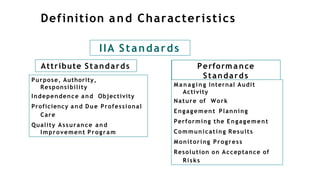
IIA Standards
Attribute Standards Perform a nce
Standards
Purpose, Authority,
Responsibility
Independence and Objectivity
Proficiency and Due Professional
Care
Quality Assurance and
Improvement Program
M a n a gi n g Internal Audit
Activity
Nature of Work
Engagement Planning
Performing the Engagement
Communicating Results
Monitoring Progress
Resolution on Acceptance of
Risks
Definition and Characteristics
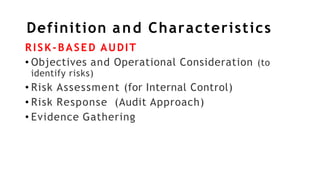
RISK-BASED AUDIT
• Objectives and Operational Consideration (to
identify risks)
• Risk Assessment (for Internal Control)
• Risk Response (Audit Approach)
• Evidence Gathering
Definition and Characteristics
INTEGRATED AUDITING
• Inclusion of business and IT subjects in the review
• Designed to address IT questions while
simultaneously examining business dynamics
• (over time it became apparent that accounting/financial controls
are increasingly dependent on computer systems)
Definition and Characteristics
IN SUMMARY:
• Internal audit is an evolving profession
• Internal auditors’ scope of work is expanding to
examining how effective an organization in its
pursuit of its stated mission and vision.
• Skills requirements are increasingly diverse.
• OPER ATIONS
AUDITING
• MODULE 1
Definitions and Characteristics of Operations Audit
Objectives and Phases of Operational Audits
Objectives and Phases
Objectives of Operational Audits review could
be driven by:
• New rules
• Poor Performance
• Compliance Issues
• Anomalous Revenues /Expenses
Objectives and Phases
Phases of Operational Audit:
• Planning
• Fieldwork
• Reporting
• Follow-Up
Objectives and Phases
Planning
• includes scoping, budgeting, defining the
population of interest, how testing will be
performed and announcing the audit
• performance of the risk assessment
Objectives and Phases
Fieldwork
• Determining if the process or program under review is
designed effectively so that the related goals and
objectives are likely to be achieved
• Verify that the controls in place are performing as
designed by management
Objectives and Phases
Types of Audit Evidence:
• Strongest
• Document Inspection
• Observation
• Inspection
• Professional Skepticism
• Inquiry ( 3rd party)
Objectives and Phases
• Moderate
• Recalculation/Reperformance
• Working Papers
• Flowcharts
• Internal Control questionnaire
• Weak
• Testimonial (Employees)
• Inquiry (Employees)
Objectives and Phases
Reporting
• Consists of communicating findings, observations,
and best practices noted during the review and
developing recommendations for corrective
action.
Objectives and Phases
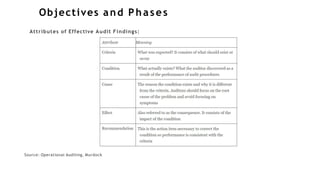
Attributes of Effective Audit Findings:
Source: Operational Auditing, Murdock
Objectives and Phases
Follow-Up
• A follow-up review means that the auditor is
checking to make sure the corrective action was
performed, so it consists of checking what
management did to address the issue reported.
Objectives and Phases
Metrics
• Metrics exist to assess the performance and
provide a comparison between what should have
been done and what was actually done.
Objectives and Phases
In Summary:
• Operational audits are versatile
• Identification of risks play a pivotal role
• Audit evidence is essential to document the
arguments made by the auditor.
Module 1- Introduction to Operational Audit
Seatwork:
Do you think operational audit is versatile /
flexible?
Discuss and cite examples
Module 1- Introduction to Operational Audit
THANK YOU!
Module 1- Introduction to Operational Audit
References:
Operational Auditing, Hernan Murdock
The Operational Auditing Handbook. Andrew Chambers and
Graham Rand

Module_1_Acctg440.pptx

  • 1.
    • OPER ATIONS AUDITING •MODULE 1 Definitions and Characteristics of Operations Audit Objectives and Phases of Operational Audits
  • 2.
    Learning Objectives After studyingthe resources and accomplishing the activities given for this lesson, you are expected to be able to: 1. Describe the characteristics of operational auditing 2. Understand the objectives of Operations audit. 3. Identify the phases of Operational audits. 4. Explain an audit program and types of evidence
  • 3.
    Definition and Characteristics OperationalAuditing is a future oriented, systematic, and independent evaluation of organizational activities. Financial data may be used but the primary sources of evidence are the operational policies and achievements related to organization objectives. Internal controls and efficiencies may be evaluated during this type of review.
  • 4.
    Definition and Characteristics AUDITING EXTERNALINTERNAL COM PLIAN C E F S Audit (Primary) F S assertions Risk Based Approach F S Audit (Not Primary) Management Audit Operations Audit Risk Based Approach Compliance with laws Compliance with rules and policies Risk Based Approach
  • 5.
    Definition and Characteristics FINANCIAL INTERNAL MAANUAGDEIMTENTOPERATIONS Audit of Financial Information Audit of M anag ement Policies Audit of Operational Policies
  • 6.
    Definition and Characteristics SkillsRequired for Effective Operational Audits: 1. Communication Skills 2. Problem Identification and Solution Skills 3. Ability to promote internal audit 4.Knowledge of Industry, regulatory and standard changes 5. Organization Skills
  • 7.
    Definition and Characteristics SkillsRequired for Effective Operational Audits: 6. Conflict resolution/negotiation 7. Staff training and development 8. Accounting framework, tools and techniques 9. Change management skills 10.IT Framework, tools and techniques 11. Cultural fluency and foreign language skills
  • 8.
    Definition and Characteristics IIAStandards Attribute Standards Perform a nce Standards Purpose, Authority, Responsibility Independence and Objectivity Proficiency and Due Professional Care Quality Assurance and Improvement Program M a n a gi n g Internal Audit Activity Nature of Work Engagement Planning Performing the Engagement Communicating Results Monitoring Progress Resolution on Acceptance of Risks
  • 9.
    Definition and Characteristics RISK-BASEDAUDIT • Objectives and Operational Consideration (to identify risks) • Risk Assessment (for Internal Control) • Risk Response (Audit Approach) • Evidence Gathering
  • 10.
    Definition and Characteristics INTEGRATEDAUDITING • Inclusion of business and IT subjects in the review • Designed to address IT questions while simultaneously examining business dynamics • (over time it became apparent that accounting/financial controls are increasingly dependent on computer systems)
  • 11.
    Definition and Characteristics INSUMMARY: • Internal audit is an evolving profession • Internal auditors’ scope of work is expanding to examining how effective an organization in its pursuit of its stated mission and vision. • Skills requirements are increasingly diverse.
  • 12.
    • OPER ATIONS AUDITING •MODULE 1 Definitions and Characteristics of Operations Audit Objectives and Phases of Operational Audits
  • 13.
    Objectives and Phases Objectivesof Operational Audits review could be driven by: • New rules • Poor Performance • Compliance Issues • Anomalous Revenues /Expenses
  • 14.
    Objectives and Phases Phasesof Operational Audit: • Planning • Fieldwork • Reporting • Follow-Up
  • 15.
    Objectives and Phases Planning •includes scoping, budgeting, defining the population of interest, how testing will be performed and announcing the audit • performance of the risk assessment
  • 16.
    Objectives and Phases Fieldwork •Determining if the process or program under review is designed effectively so that the related goals and objectives are likely to be achieved • Verify that the controls in place are performing as designed by management
  • 17.
    Objectives and Phases Typesof Audit Evidence: • Strongest • Document Inspection • Observation • Inspection • Professional Skepticism • Inquiry ( 3rd party)
  • 18.
    Objectives and Phases •Moderate • Recalculation/Reperformance • Working Papers • Flowcharts • Internal Control questionnaire • Weak • Testimonial (Employees) • Inquiry (Employees)
  • 19.
    Objectives and Phases Reporting •Consists of communicating findings, observations, and best practices noted during the review and developing recommendations for corrective action.
  • 20.
    Objectives and Phases Attributesof Effective Audit Findings: Source: Operational Auditing, Murdock
  • 21.
    Objectives and Phases Follow-Up •A follow-up review means that the auditor is checking to make sure the corrective action was performed, so it consists of checking what management did to address the issue reported.
  • 22.
    Objectives and Phases Metrics •Metrics exist to assess the performance and provide a comparison between what should have been done and what was actually done.
  • 23.
    Objectives and Phases InSummary: • Operational audits are versatile • Identification of risks play a pivotal role • Audit evidence is essential to document the arguments made by the auditor.
  • 24.
    Module 1- Introductionto Operational Audit Seatwork: Do you think operational audit is versatile / flexible? Discuss and cite examples
  • 25.
    Module 1- Introductionto Operational Audit THANK YOU!
  • 26.
    Module 1- Introductionto Operational Audit References: Operational Auditing, Hernan Murdock The Operational Auditing Handbook. Andrew Chambers and Graham Rand