PLEDGE AND CHATTEL MORTGAGE
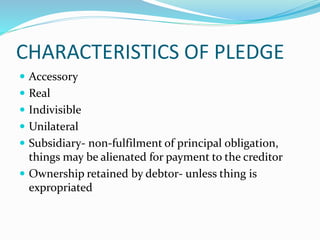
CHARACTERISTICS OF PLEDGE
 Accessory
 Real
 Indivisible
 Unilateral
 Subsidiary- non-fulfilment of principal obligation,
things may be alienated for payment to the creditor
 Ownership retained by debtor- unless thing is
expropriated
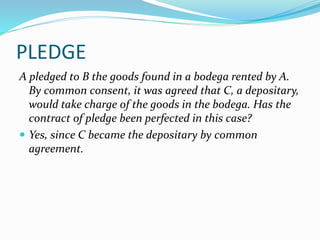
PLEDGE
A pledged to B the goods found in a bodega rented by A.
By common consent, it was agreed that C, a depositary,
would take charge of the goods in the bodega. Has the
contract of pledge been perfected in this case?
 Yes, since C became the depositary by common
agreement.
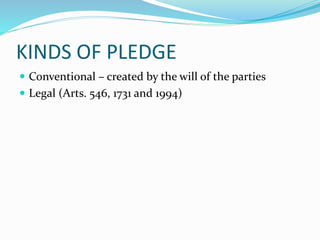
KINDS OF PLEDGE
 Conventional – created by the will of the parties
 Legal (Arts. 546, 1731 and 1994)
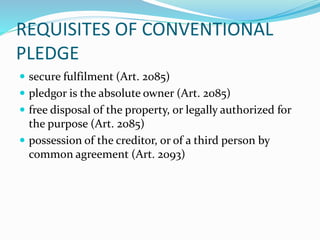
REQUISITES OF CONVENTIONAL
PLEDGE
 secure fulfilment (Art. 2085)
 pledgor is the absolute owner (Art. 2085)
 free disposal of the property, or legally authorized for
the purpose (Art. 2085)
 possession of the creditor, or of a third person by
common agreement (Art. 2093)
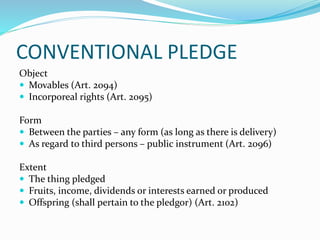
CONVENTIONAL PLEDGE
Object
 Movables (Art. 2094)
 Incorporeal rights (Art. 2095)
Form
 Between the parties – any form (as long as there is delivery)
 As regard to third persons – public instrument (Art. 2096)
Extent
 The thing pledged
 Fruits, income, dividends or interests earned or produced
 Offspring (shall pertain to the pledgor) (Art. 2102)
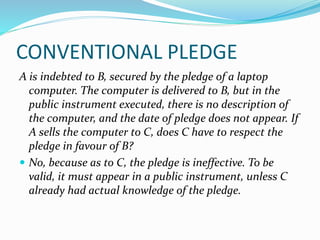
CONVENTIONAL PLEDGE
A is indebted to B, secured by the pledge of a laptop
computer. The computer is delivered to B, but in the
public instrument executed, there is no description of
the computer, and the date of pledge does not appear. If
A sells the computer to C, does C have to respect the
pledge in favour of B?
 No, because as to C, the pledge is ineffective. To be
valid, it must appear in a public instrument, unless C
already had actual knowledge of the pledge.
CONVENTIONAL PLEDGE
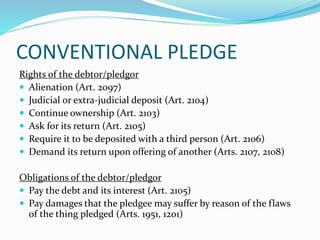
Rights of the debtor/pledgor
 Alienation (Art. 2097)
 Judicial or extra-judicial deposit (Art. 2104)
 Continue ownership (Art. 2103)
 Ask for its return (Art. 2105)
 Require it to be deposited with a third person (Art. 2106)
 Demand its return upon offering of another (Arts. 2107, 2108)
Obligations of the debtor/pledgor
 Pay the debt and its interest (Art. 2105)
 Pay damages that the pledgee may suffer by reason of the flaws
of the thing pledged (Arts. 1951, 1201)
CONVENTIONAL PLEDGE
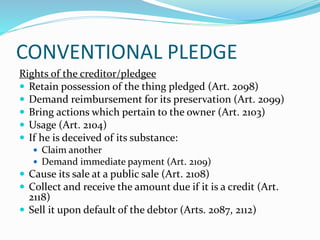
Rights of the creditor/pledgee
 Retain possession of the thing pledged (Art. 2098)
 Demand reimbursement for its preservation (Art. 2099)
 Bring actions which pertain to the owner (Art. 2103)
 Usage (Art. 2104)
 If he is deceived of its substance:
 Claim another
 Demand immediate payment (Art. 2109)
 Cause its sale at a public sale (Art. 2108)
 Collect and receive the amount due if it is a credit (Art.
2118)
 Sell it upon default of the debtor (Arts. 2087, 2112)
CONVENTIONAL PLEDGE
A pledged her ring with B. the debt was not paid on time,
and a public auction took place. Can either A or B bid?
 A can bid; she has a better right if she is the highest
bidder because the ring belongs to her. B may also bid
unless he is the only bidder.
CONVENTIONAL PLEDGE
A borrowed from B P1,000. This was secured by a
negotiable promissory note made by C in favour of A to
the amount of P1,900. The negotiable promissory note
was endorsed by A in B’s favour. If the note becomes
due before it is redeemed, can B collect and receive the
P1,900?
 Yes. B should get P1,000 and deliver the P900 to A.
CONVENTIONAL PLEDGE
Obligations of the creditor/pledgee
 To take care of it (Art. 2099)
 To be liable for its loss or deterioration (Art. 2099)
 Not to deposit it with a third person (Art. 2100)
 To be responsible for the acts of his agents or
employees with respect to it (Art. 2100)
 Not to use it, unless:
 Authorized
 Necessary for its preservation
 To deliver the surplus (Art. 2108)
CONVENTIONAL PLEDGE
P pledged grapes with J. because the grapes were in
danger of being spoiled, J sold them for P1,000. Who
owns the P1,000?
 P owns the P1,000 but J shall keep it as security in the
same manner as the grapes originally pledged. The sale
must be in a public sale.
CONVENTIONAL PLEDGE
L pledged with V a car to secure a loan of P10,000. It
was agreed that after a month, V would return the car
although the debt would be paid in six months. It was
also agreed that although L would once more be in
possession of the car, the pledge would continue. After
a month as stipulated, V returned the car. Has the
pledge been extinguished?
 Yes, but not the principal obligation.
CONVENTIONAL PLEDGE
A pledged with B a ring. A week later, the ring was found
in the possession of A. There is a presumption here that
B has returned the ring to A and that therefore the
pledge has been extinguished. May the presumption be
opposed?
 Yes. It could only be that B returned the ring and asked
that it be substituted; or a stranger may have stolen it
and gave it to A.
CONVENTIONAL PLEDGE
Rights of a third person pledgor
 To be indemnified by the debtor if he pays the creditor
 To be subrogated to all the rights of the creditor if he pays
the creditor (Arts. 2067, 2120)
 To be released from liability in the following cases:
 If the creditor voluntarily accepts immovable or other
property in payment of the (Arts. 2077, 2120)
 Creditor grants debtor extension without pledgor’s (third
person) consent (Arts. 2079, 2080)
 If through some act of the creditor, the pledgor cannot be
subrogated to the rights of the creditor. (Arts. 2080, 2120)
CONVENTIONAL PLEDGE
 D obtained a loan of P10 from C. the debt is secured by
the guarantee of G and the pledge by T of his ring. If T
pays C, T steps into the place of C. he can demand the
debt from D or go after G.
 D borrowed P50 from C. the debt is secured by a pledge
of T’s ring. On due date, C accepted a parcel of land
from D in payment of the debt. T can demand that he
be released from the pledge. He shall be released even if
later, C should lose the lot by eviction in case there is a
rightful owner.
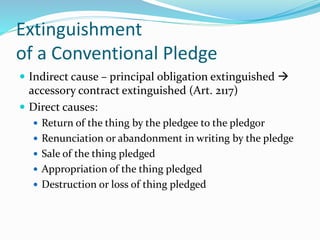
Extinguishment
of a Conventional Pledge
 Indirect cause – principal obligation extinguished 
accessory contract extinguished (Art. 2117)
 Direct causes:
 Return of the thing by the pledgee to the pledgor
 Renunciation or abandonment in writing by the pledge
 Sale of the thing pledged
 Appropriation of the thing pledged
 Destruction or loss of thing pledged
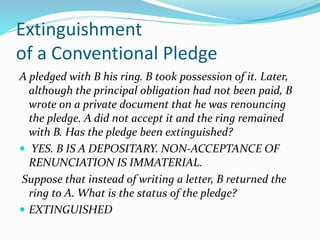
Extinguishment
of a Conventional Pledge
A pledged with B his ring. B took possession of it. Later,
although the principal obligation had not been paid, B
wrote on a private document that he was renouncing
the pledge. A did not accept it and the ring remained
with B. Has the pledge been extinguished?
 YES. B IS A DEPOSITARY. NON-ACCEPTANCE OF
RENUNCIATION IS IMMATERIAL.
Suppose that instead of writing a letter, B returned the
ring to A. What is the status of the pledge?
 EXTINGUISHED
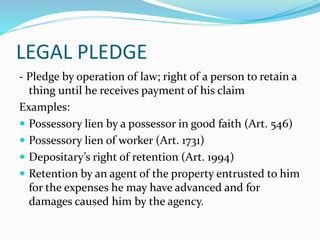
LEGAL PLEDGE
- Pledge by operation of law; right of a person to retain a
thing until he receives payment of his claim
Examples:
 Possessory lien by a possessor in good faith (Art. 546)
 Possessory lien of worker (Art. 1731)
 Depositary’s right of retention (Art. 1994)
 Retention by an agent of the property entrusted to him
for the expenses he may have advanced and for
damages caused him by the agency.
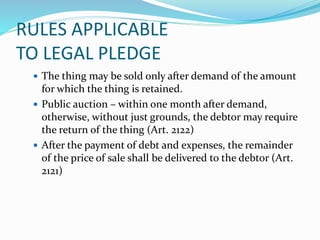
RULES APPLICABLE
TO LEGAL PLEDGE
 The thing may be sold only after demand of the amount
for which the thing is retained.
 Public auction – within one month after demand,
otherwise, without just grounds, the debtor may require
the return of the thing (Art. 2122)
 After the payment of debt and expenses, the remainder
of the price of sale shall be delivered to the debtor (Art.
2121)
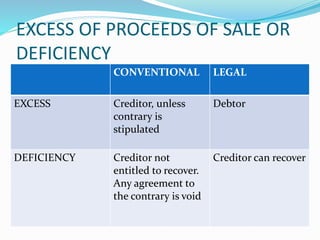
EXCESS OF PROCEEDS OF SALE OR
DEFICIENCY
CONVENTIONAL LEGAL
EXCESS Creditor, unless
contrary is
stipulated
Debtor
DEFICIENCY Creditor not
entitled to recover.
Any agreement to
the contrary is void
Creditor can recover
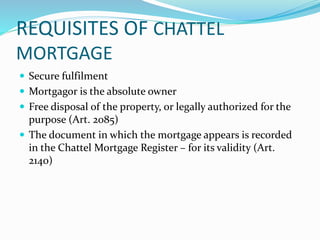
REQUISITES OF CHATTEL
MORTGAGE
 Secure fulfilment
 Mortgagor is the absolute owner
 Free disposal of the property, or legally authorized for the
purpose (Art. 2085)
 The document in which the mortgage appears is recorded
in the Chattel Mortgage Register – for its validity (Art.
2140)
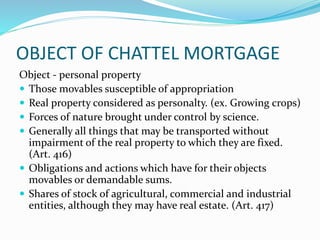
OBJECT OF CHATTEL MORTGAGE
Object - personal property
 Those movables susceptible of appropriation
 Real property considered as personalty. (ex. Growing crops)
 Forces of nature brought under control by science.
 Generally all things that may be transported without
impairment of the real property to which they are fixed.
(Art. 416)
 Obligations and actions which have for their objects
movables or demandable sums.
 Shares of stock of agricultural, commercial and industrial
entities, although they may have real estate. (Art. 417)
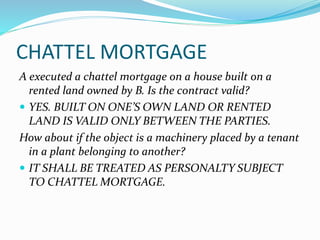
CHATTEL MORTGAGE
A executed a chattel mortgage on a house built on a
rented land owned by B. Is the contract valid?
 YES. BUILT ON ONE’S OWN LAND OR RENTED
LAND IS VALID ONLY BETWEEN THE PARTIES.
How about if the object is a machinery placed by a tenant
in a plant belonging to another?
 IT SHALL BE TREATED AS PERSONALTY SUBJECT
TO CHATTEL MORTGAGE.
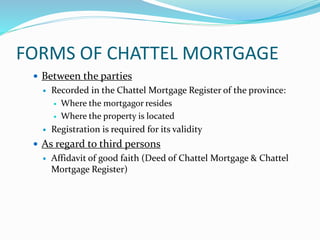
FORMS OF CHATTEL MORTGAGE
 Between the parties
 Recorded in the Chattel Mortgage Register of the province:
 Where the mortgagor resides
 Where the property is located
 Registration is required for its validity
 As regard to third persons
 Affidavit of good faith (Deed of Chattel Mortgage & Chattel
Mortgage Register)
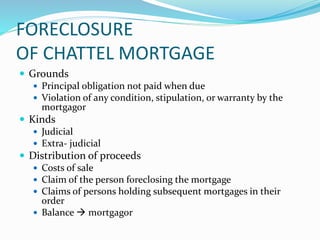
FORECLOSURE
OF CHATTEL MORTGAGE
 Grounds
 Principal obligation not paid when due
 Violation of any condition, stipulation, or warranty by the
mortgagor
 Kinds
 Judicial
 Extra- judicial
 Distribution of proceeds
 Costs of sale
 Claim of the person foreclosing the mortgage
 Claims of persons holding subsequent mortgages in their
order
 Balance  mortgagor
Pledge and Chattel Mortgage

Pledge and Chattel Mortgage

  • 1.
  • 3.
    CHARACTERISTICS OF PLEDGE Accessory  Real  Indivisible  Unilateral  Subsidiary- non-fulfilment of principal obligation, things may be alienated for payment to the creditor  Ownership retained by debtor- unless thing is expropriated
  • 4.
    PLEDGE A pledged toB the goods found in a bodega rented by A. By common consent, it was agreed that C, a depositary, would take charge of the goods in the bodega. Has the contract of pledge been perfected in this case?  Yes, since C became the depositary by common agreement.
  • 5.
    KINDS OF PLEDGE Conventional – created by the will of the parties  Legal (Arts. 546, 1731 and 1994)
  • 6.
    REQUISITES OF CONVENTIONAL PLEDGE secure fulfilment (Art. 2085)  pledgor is the absolute owner (Art. 2085)  free disposal of the property, or legally authorized for the purpose (Art. 2085)  possession of the creditor, or of a third person by common agreement (Art. 2093)
  • 7.
    CONVENTIONAL PLEDGE Object  Movables(Art. 2094)  Incorporeal rights (Art. 2095) Form  Between the parties – any form (as long as there is delivery)  As regard to third persons – public instrument (Art. 2096) Extent  The thing pledged  Fruits, income, dividends or interests earned or produced  Offspring (shall pertain to the pledgor) (Art. 2102)
  • 8.
    CONVENTIONAL PLEDGE A isindebted to B, secured by the pledge of a laptop computer. The computer is delivered to B, but in the public instrument executed, there is no description of the computer, and the date of pledge does not appear. If A sells the computer to C, does C have to respect the pledge in favour of B?  No, because as to C, the pledge is ineffective. To be valid, it must appear in a public instrument, unless C already had actual knowledge of the pledge.
  • 9.
    CONVENTIONAL PLEDGE Rights ofthe debtor/pledgor  Alienation (Art. 2097)  Judicial or extra-judicial deposit (Art. 2104)  Continue ownership (Art. 2103)  Ask for its return (Art. 2105)  Require it to be deposited with a third person (Art. 2106)  Demand its return upon offering of another (Arts. 2107, 2108) Obligations of the debtor/pledgor  Pay the debt and its interest (Art. 2105)  Pay damages that the pledgee may suffer by reason of the flaws of the thing pledged (Arts. 1951, 1201)
  • 10.
    CONVENTIONAL PLEDGE Rights ofthe creditor/pledgee  Retain possession of the thing pledged (Art. 2098)  Demand reimbursement for its preservation (Art. 2099)  Bring actions which pertain to the owner (Art. 2103)  Usage (Art. 2104)  If he is deceived of its substance:  Claim another  Demand immediate payment (Art. 2109)  Cause its sale at a public sale (Art. 2108)  Collect and receive the amount due if it is a credit (Art. 2118)  Sell it upon default of the debtor (Arts. 2087, 2112)
  • 11.
    CONVENTIONAL PLEDGE A pledgedher ring with B. the debt was not paid on time, and a public auction took place. Can either A or B bid?  A can bid; she has a better right if she is the highest bidder because the ring belongs to her. B may also bid unless he is the only bidder.
  • 12.
    CONVENTIONAL PLEDGE A borrowedfrom B P1,000. This was secured by a negotiable promissory note made by C in favour of A to the amount of P1,900. The negotiable promissory note was endorsed by A in B’s favour. If the note becomes due before it is redeemed, can B collect and receive the P1,900?  Yes. B should get P1,000 and deliver the P900 to A.
  • 13.
    CONVENTIONAL PLEDGE Obligations ofthe creditor/pledgee  To take care of it (Art. 2099)  To be liable for its loss or deterioration (Art. 2099)  Not to deposit it with a third person (Art. 2100)  To be responsible for the acts of his agents or employees with respect to it (Art. 2100)  Not to use it, unless:  Authorized  Necessary for its preservation  To deliver the surplus (Art. 2108)
  • 14.
    CONVENTIONAL PLEDGE P pledgedgrapes with J. because the grapes were in danger of being spoiled, J sold them for P1,000. Who owns the P1,000?  P owns the P1,000 but J shall keep it as security in the same manner as the grapes originally pledged. The sale must be in a public sale.
  • 15.
    CONVENTIONAL PLEDGE L pledgedwith V a car to secure a loan of P10,000. It was agreed that after a month, V would return the car although the debt would be paid in six months. It was also agreed that although L would once more be in possession of the car, the pledge would continue. After a month as stipulated, V returned the car. Has the pledge been extinguished?  Yes, but not the principal obligation.
  • 16.
    CONVENTIONAL PLEDGE A pledgedwith B a ring. A week later, the ring was found in the possession of A. There is a presumption here that B has returned the ring to A and that therefore the pledge has been extinguished. May the presumption be opposed?  Yes. It could only be that B returned the ring and asked that it be substituted; or a stranger may have stolen it and gave it to A.
  • 17.
    CONVENTIONAL PLEDGE Rights ofa third person pledgor  To be indemnified by the debtor if he pays the creditor  To be subrogated to all the rights of the creditor if he pays the creditor (Arts. 2067, 2120)  To be released from liability in the following cases:  If the creditor voluntarily accepts immovable or other property in payment of the (Arts. 2077, 2120)  Creditor grants debtor extension without pledgor’s (third person) consent (Arts. 2079, 2080)  If through some act of the creditor, the pledgor cannot be subrogated to the rights of the creditor. (Arts. 2080, 2120)
  • 18.
    CONVENTIONAL PLEDGE  Dobtained a loan of P10 from C. the debt is secured by the guarantee of G and the pledge by T of his ring. If T pays C, T steps into the place of C. he can demand the debt from D or go after G.  D borrowed P50 from C. the debt is secured by a pledge of T’s ring. On due date, C accepted a parcel of land from D in payment of the debt. T can demand that he be released from the pledge. He shall be released even if later, C should lose the lot by eviction in case there is a rightful owner.
  • 19.
    Extinguishment of a ConventionalPledge  Indirect cause – principal obligation extinguished  accessory contract extinguished (Art. 2117)  Direct causes:  Return of the thing by the pledgee to the pledgor  Renunciation or abandonment in writing by the pledge  Sale of the thing pledged  Appropriation of the thing pledged  Destruction or loss of thing pledged
  • 20.
    Extinguishment of a ConventionalPledge A pledged with B his ring. B took possession of it. Later, although the principal obligation had not been paid, B wrote on a private document that he was renouncing the pledge. A did not accept it and the ring remained with B. Has the pledge been extinguished?  YES. B IS A DEPOSITARY. NON-ACCEPTANCE OF RENUNCIATION IS IMMATERIAL. Suppose that instead of writing a letter, B returned the ring to A. What is the status of the pledge?  EXTINGUISHED
  • 21.
    LEGAL PLEDGE - Pledgeby operation of law; right of a person to retain a thing until he receives payment of his claim Examples:  Possessory lien by a possessor in good faith (Art. 546)  Possessory lien of worker (Art. 1731)  Depositary’s right of retention (Art. 1994)  Retention by an agent of the property entrusted to him for the expenses he may have advanced and for damages caused him by the agency.
  • 22.
    RULES APPLICABLE TO LEGALPLEDGE  The thing may be sold only after demand of the amount for which the thing is retained.  Public auction – within one month after demand, otherwise, without just grounds, the debtor may require the return of the thing (Art. 2122)  After the payment of debt and expenses, the remainder of the price of sale shall be delivered to the debtor (Art. 2121)
  • 23.
    EXCESS OF PROCEEDSOF SALE OR DEFICIENCY CONVENTIONAL LEGAL EXCESS Creditor, unless contrary is stipulated Debtor DEFICIENCY Creditor not entitled to recover. Any agreement to the contrary is void Creditor can recover
  • 25.
    REQUISITES OF CHATTEL MORTGAGE Secure fulfilment  Mortgagor is the absolute owner  Free disposal of the property, or legally authorized for the purpose (Art. 2085)  The document in which the mortgage appears is recorded in the Chattel Mortgage Register – for its validity (Art. 2140)
  • 26.
    OBJECT OF CHATTELMORTGAGE Object - personal property  Those movables susceptible of appropriation  Real property considered as personalty. (ex. Growing crops)  Forces of nature brought under control by science.  Generally all things that may be transported without impairment of the real property to which they are fixed. (Art. 416)  Obligations and actions which have for their objects movables or demandable sums.  Shares of stock of agricultural, commercial and industrial entities, although they may have real estate. (Art. 417)
  • 27.
    CHATTEL MORTGAGE A executeda chattel mortgage on a house built on a rented land owned by B. Is the contract valid?  YES. BUILT ON ONE’S OWN LAND OR RENTED LAND IS VALID ONLY BETWEEN THE PARTIES. How about if the object is a machinery placed by a tenant in a plant belonging to another?  IT SHALL BE TREATED AS PERSONALTY SUBJECT TO CHATTEL MORTGAGE.
  • 28.
    FORMS OF CHATTELMORTGAGE  Between the parties  Recorded in the Chattel Mortgage Register of the province:  Where the mortgagor resides  Where the property is located  Registration is required for its validity  As regard to third persons  Affidavit of good faith (Deed of Chattel Mortgage & Chattel Mortgage Register)
  • 29.
    FORECLOSURE OF CHATTEL MORTGAGE Grounds  Principal obligation not paid when due  Violation of any condition, stipulation, or warranty by the mortgagor  Kinds  Judicial  Extra- judicial  Distribution of proceeds  Costs of sale  Claim of the person foreclosing the mortgage  Claims of persons holding subsequent mortgages in their order  Balance  mortgagor