ACCOUNTING
PRINCIPLES
(CONCEPTS AND
CONVENTIONS)
Indu Gupta
PGT-COMMERCE
1
NATURE OF ACCOUNTING
PRINCIPLES
• Accounting principles are general guidelines to establish
standards for sound accounting practices and procedures in
recording and reporting financial performance and status of a
business.
• Derived from experience and reason.
• To ensure uniformity and easy understanding of accounting
information.
• These principles can be classified into two categories (i)
Accounting concepts; and (ii) Accounting conventions.
2
ACCOUNTING CONCEPTS
• Accounting concepts are defined as basic assumptions on the basis of
which financial statements of a business entity are prepared.
• They are used as a foundation for formulating various accounting
methods and procedures for recording and presenting the business
transactions.
• An assumption is something which is accepted as true which may not
be true in real life.
3
BUSINESS ENTITY CONCEPT
• For the purpose of accounting, it is assumed that the
business has a separate and distinct entity from its owner(s)
and all other entities having transactions with it.
• Transactions between owner and business are recorded in the
accounting books – Capital A/c and Drawings A/c.
• If this assumption is not followed, the results (profits or
losses) of the business will not be true and fair and the
financial status of the business may not be correctly
measured.
4
EFFECT OF ADOPTING
BUSINESS ENTITY
CONCEPT:
• Only the business transactions are recorded and reported and not
the personal transactions of the owners.
• Income or profit is the property of the business unless distributed
among the owners.
• The personal assets of the owners or shareholders are not
considered while recording and reporting the assets of the
business entity.
5
MONEY MEASUREMENT
CONCEPT
• According to this assumption all business transactions
should be recorded in terms of money, i.e., currency of the
country.
• Only such transactions and events which can be
interpreted in terms of money are recorded.
• Events which cannot be expressed in money terms do not
find place in the books of account though they may be
very important for the business.
• The system of accounting treats all units of money as the
same irrespective of their time dimension.
6
COST CONCEPT OR HISTORICAL COST
CONCEPT
• According to this concept, the various assets acquired by a firm
should be recorded on the basis of the actual amounts involved or
spent.
• If nothing has been paid for acquiring an asset, it would not be
shown in the accounting books as an asset.
• The cost concept does not mean that the assets will always be shown
at cost. The fixed asset will be recorded at cost at the time of its
purchase but it may systematically be reduced in its value by charging
depreciation.
7
GOING CONCERN CONCEPT
• According to this concept, it is assumed that the business enterprise
is a continuing one, not on the verge of closure. Business
transactions are recorded from this point of view.
• On the basis of this concept, a clear distinction is made between
assets and expenses.
• Because of this concept that fixed assets are valued on the basis of
cost less proper depreciation.
• If it is certain that a business will continue for a specified period,
then the accounting records will be kept on the basis of expected
life of the business.
8
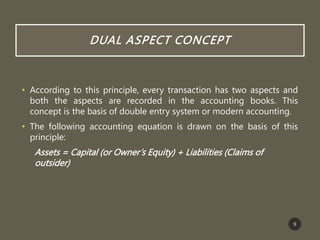
DUAL ASPECT CONCEPT
• According to this principle, every transaction has two aspects and
both the aspects are recorded in the accounting books. This
concept is the basis of double entry system or modern accounting.
• The following accounting equation is drawn on the basis of this
principle:
Assets = Capital (or Owner’s Equity) + Liabilities (Claims of
outsider)
9
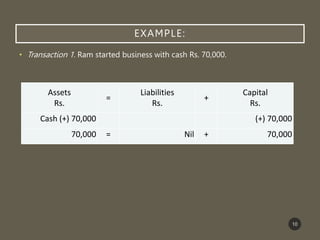
EXAMPLE:
• Transaction 1. Ram started business with cash Rs. 70,000.
10
Assets
Rs.
=
Liabilities
Rs.
+
Capital
Rs.
Cash (+) 70,000 (+) 70,000
70,000 = Nil + 70,000
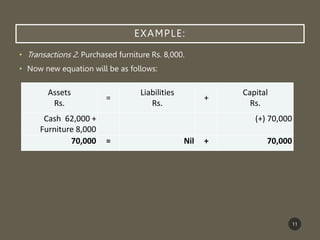
EXAMPLE:
• Transactions 2. Purchased furniture Rs. 8,000.
• Now new equation will be as follows:
11
Assets
Rs.
=
Liabilities
Rs.
+
Capital
Rs.
Cash 62,000 +
Furniture 8,000
(+) 70,000
70,000 = Nil + 70,000
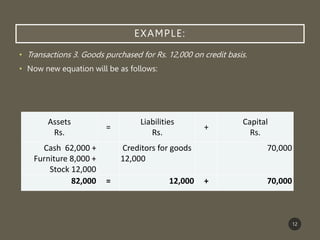
EXAMPLE:
• Transactions 3. Goods purchased for Rs. 12,000 on credit basis.
• Now new equation will be as follows:
12
Assets
Rs.
=
Liabilities
Rs.
+
Capital
Rs.
Cash 62,000 +
Furniture 8,000 +
Stock 12,000
Creditors for goods
12,000
70,000
82,000 = 12,000 + 70,000
REALIZATION OR REVENUE RECOGNITION
CONCEPT:
• According to this concept revenue is recognized only when a
sale is made.
• No sale can be said to have taken place, unless money has
been realized i.e., cash has been received or a legal obligation
to pay has been assumed by the customer.
• It prevents business firms from inflating their profits by
recording incomes that are likely to accrue i.e. expected
incomes or gains are not recorded.
13
ACCRUAL CONCEPT
• Business transactions are recorded as and when they occur and
not when the related payments are received or made. This concept
is called accrual basis of accounting.
• Accrued revenues and costs are recognized as they are earned and
incurred and recorded in the financial statements of the period.
• On the basis of this concept, adjustment entries relating to
outstanding and prepaid expenses and income received in
advance etc. are made.
• They have their impact on the Income Statement and the Balance
Sheet.
14
ACCOUNTING PERIOD CONCEPT
• The users of financial information need periodical reporting
relating to the performance of the business.
• It is an interval of time at the end of which financial statements
are prepared and communicated.
• Normally, the accounting period consists of twelve months.
• However, there is no restrictions on the business entities on
providing information at more frequently intervals to investors, if
they wish.
15
MATCHING CONCEPT
• According to matching principle, the revenue of a given period
should be matched with the expenses of the same period.
• According to this concept, adjustments should be made for all
outstanding expenses, accrued incomes, prepaid expenses and
unearned incomes etc. while preparing the final accounts at the end
of the accounting period.
16
ACCOUNTING CONVENTIONS
• The term ‘convention’ denotes custom or tradition or practice
based on general agreement or common consent among the
accounting bodies which guide the accountant while preparing the
financial statements.
• Following are the important accounting conventions:
• Consistency Convention
• Conservatism or Prudence Convention
• Convention of Full Disclosure
• Convention of Materiality
17
CONSISTENCY CONVENTION
• According to this convention, financial statements
should be prepared on the same basis as that of
the preceding period.
• Whatever may be the accounting policies or
methods, once decided, these are to be followed
consistently.
• This provides comparability to accounting data of
the same enterprise over the periods or data of
different enterprises of the same period or both.
(Contd.)
18
CONSISTENCY CONVENTION (CONTD.)
• Whenever there is any change in policy the
results of the enterprise and financial position
may be affected.
• Nature and effect of such change and the
justification of the change must be informed to
the users of accounting information by way of
foot notes.
19
CONSISTENCY CONVENTION:
EXAMPLES
Following are the examples of such changes:
• Change in the method of valuation of stock.
• Change in the method of providing depreciation.
• Change in the basis of making provision for bad and doubtful
debts.
• It is assumed that accounting policies are consistent from one
period to another. This provides comparability to accounting
data. If comparability is lost the relevance of accounting data for
users’ judgment and decision making is gone.
20
CONSERVATISM OR PRUDENCE
CONVENTION
It is a policy of playing safe or with caution. According to Conservatism
or Prudence convention,
• The accountant should not anticipate income and should provide
for all possible losses, and
• Faced with the choice between two methods of valuing an asset
the accountant should choose a method which leads to the lesser
value.
• The main objective this convention is that the financial statements
should disclose the actual results.
• It should be noted that no deliberate attempt be made to
understate the profits and values of assets.
21
CONSERVATISM CONVENTION: SOME
EXAMPLES
• Closing stock is valued at cost or market price whichever is less.
• A provision for bad and doubtful debts on debtors is made in
anticipation of actual bad debts in future.
• In the accounting books of a partnership firm, joint life policy is
shown either nil or at surrender value as against the sum assured or
premium paid.
22
CONVENTION OF FULL DISCLOSURE
• According to this Convention, all facts which are
significant and necessary to make financial
statements complete and understandable, must be
disclosed.
• Significance of information is viewed from the point
of the users of financial information.
• The disclosure can be done either in financial
statements or in foot notes given at the end of
financial statements.
(Contd.)
23
CONVENTION OF FULL DISCLOSURE
(CONTD.)
• Disclosure of many facts is required not only under legal
provisions but also to make the accounting system fair and
transparent.
• The information to be disclosed may relate to current
accounting period, previous period or to post-Balance Sheet
date.
24
CONVENTION OF FULL DISCLOSURE:
EXAMPLES
Following are the important facts usually disclosed in the financial
statements:
Change in method of providing depreciation.
Change in method of valuation of closing stock.
Basis of making provision for bad and doubtful debts.
A big loan taken by the company, after the date of preparing
balance sheet.
Contingent liabilities are always shown as foot notes.
25
CONVENTION OF MATERIALITY
• The full disclosure principle requires that all facts which are significant
and necessary to make financial statements complete and
understandable, must be disclosed.
• The materiality principle is an exception to the full disclosure.
According to the materiality principle, items or events, having
insignificant economic effect, or not being relevant to the user, need
not to disclosed.
26
CONVENTION OF MATERIALITY
(CONTD.)
• Materiality is a relative term and depends on its nature and the
amount involved.
• An item should be regarded as material if there is reason to believe
that knowledge of it would influence the decision of informed
investors.
• Thus, what is material is a matter of exercising discretion. It is to be
noted that an item may be material for one company and the same
item may be immaterial for the other company.
27
CONVENTION OF MATERIALITY
(CONTD.)
Following are the few examples:
• A small tool costing Rs. 400 is material for a small workshop, but
may not be material for a big company like Carrier Aircon Ltd.
• If a pocket calculator is purchased for Rs. 600 strictly it should be
capitalised under the head of office equipment's since it will serve
for several years. But it will be better to write off it as a revenue
expenditure as the amount is small.
28

(MBA SEM 1) SEM 1 Accounting Principles.pptx

  • 1.
  • 2.
    NATURE OF ACCOUNTING PRINCIPLES •Accounting principles are general guidelines to establish standards for sound accounting practices and procedures in recording and reporting financial performance and status of a business. • Derived from experience and reason. • To ensure uniformity and easy understanding of accounting information. • These principles can be classified into two categories (i) Accounting concepts; and (ii) Accounting conventions. 2
  • 3.
    ACCOUNTING CONCEPTS • Accountingconcepts are defined as basic assumptions on the basis of which financial statements of a business entity are prepared. • They are used as a foundation for formulating various accounting methods and procedures for recording and presenting the business transactions. • An assumption is something which is accepted as true which may not be true in real life. 3
  • 4.
    BUSINESS ENTITY CONCEPT •For the purpose of accounting, it is assumed that the business has a separate and distinct entity from its owner(s) and all other entities having transactions with it. • Transactions between owner and business are recorded in the accounting books – Capital A/c and Drawings A/c. • If this assumption is not followed, the results (profits or losses) of the business will not be true and fair and the financial status of the business may not be correctly measured. 4
  • 5.
    EFFECT OF ADOPTING BUSINESSENTITY CONCEPT: • Only the business transactions are recorded and reported and not the personal transactions of the owners. • Income or profit is the property of the business unless distributed among the owners. • The personal assets of the owners or shareholders are not considered while recording and reporting the assets of the business entity. 5
  • 6.
    MONEY MEASUREMENT CONCEPT • Accordingto this assumption all business transactions should be recorded in terms of money, i.e., currency of the country. • Only such transactions and events which can be interpreted in terms of money are recorded. • Events which cannot be expressed in money terms do not find place in the books of account though they may be very important for the business. • The system of accounting treats all units of money as the same irrespective of their time dimension. 6
  • 7.
    COST CONCEPT ORHISTORICAL COST CONCEPT • According to this concept, the various assets acquired by a firm should be recorded on the basis of the actual amounts involved or spent. • If nothing has been paid for acquiring an asset, it would not be shown in the accounting books as an asset. • The cost concept does not mean that the assets will always be shown at cost. The fixed asset will be recorded at cost at the time of its purchase but it may systematically be reduced in its value by charging depreciation. 7
  • 8.
    GOING CONCERN CONCEPT •According to this concept, it is assumed that the business enterprise is a continuing one, not on the verge of closure. Business transactions are recorded from this point of view. • On the basis of this concept, a clear distinction is made between assets and expenses. • Because of this concept that fixed assets are valued on the basis of cost less proper depreciation. • If it is certain that a business will continue for a specified period, then the accounting records will be kept on the basis of expected life of the business. 8
  • 9.
    DUAL ASPECT CONCEPT •According to this principle, every transaction has two aspects and both the aspects are recorded in the accounting books. This concept is the basis of double entry system or modern accounting. • The following accounting equation is drawn on the basis of this principle: Assets = Capital (or Owner’s Equity) + Liabilities (Claims of outsider) 9
  • 10.
    EXAMPLE: • Transaction 1.Ram started business with cash Rs. 70,000. 10 Assets Rs. = Liabilities Rs. + Capital Rs. Cash (+) 70,000 (+) 70,000 70,000 = Nil + 70,000
  • 11.
    EXAMPLE: • Transactions 2.Purchased furniture Rs. 8,000. • Now new equation will be as follows: 11 Assets Rs. = Liabilities Rs. + Capital Rs. Cash 62,000 + Furniture 8,000 (+) 70,000 70,000 = Nil + 70,000
  • 12.
    EXAMPLE: • Transactions 3.Goods purchased for Rs. 12,000 on credit basis. • Now new equation will be as follows: 12 Assets Rs. = Liabilities Rs. + Capital Rs. Cash 62,000 + Furniture 8,000 + Stock 12,000 Creditors for goods 12,000 70,000 82,000 = 12,000 + 70,000
  • 13.
    REALIZATION OR REVENUERECOGNITION CONCEPT: • According to this concept revenue is recognized only when a sale is made. • No sale can be said to have taken place, unless money has been realized i.e., cash has been received or a legal obligation to pay has been assumed by the customer. • It prevents business firms from inflating their profits by recording incomes that are likely to accrue i.e. expected incomes or gains are not recorded. 13
  • 14.
    ACCRUAL CONCEPT • Businesstransactions are recorded as and when they occur and not when the related payments are received or made. This concept is called accrual basis of accounting. • Accrued revenues and costs are recognized as they are earned and incurred and recorded in the financial statements of the period. • On the basis of this concept, adjustment entries relating to outstanding and prepaid expenses and income received in advance etc. are made. • They have their impact on the Income Statement and the Balance Sheet. 14
  • 15.
    ACCOUNTING PERIOD CONCEPT •The users of financial information need periodical reporting relating to the performance of the business. • It is an interval of time at the end of which financial statements are prepared and communicated. • Normally, the accounting period consists of twelve months. • However, there is no restrictions on the business entities on providing information at more frequently intervals to investors, if they wish. 15
  • 16.
    MATCHING CONCEPT • Accordingto matching principle, the revenue of a given period should be matched with the expenses of the same period. • According to this concept, adjustments should be made for all outstanding expenses, accrued incomes, prepaid expenses and unearned incomes etc. while preparing the final accounts at the end of the accounting period. 16
  • 17.
    ACCOUNTING CONVENTIONS • Theterm ‘convention’ denotes custom or tradition or practice based on general agreement or common consent among the accounting bodies which guide the accountant while preparing the financial statements. • Following are the important accounting conventions: • Consistency Convention • Conservatism or Prudence Convention • Convention of Full Disclosure • Convention of Materiality 17
  • 18.
    CONSISTENCY CONVENTION • Accordingto this convention, financial statements should be prepared on the same basis as that of the preceding period. • Whatever may be the accounting policies or methods, once decided, these are to be followed consistently. • This provides comparability to accounting data of the same enterprise over the periods or data of different enterprises of the same period or both. (Contd.) 18
  • 19.
    CONSISTENCY CONVENTION (CONTD.) •Whenever there is any change in policy the results of the enterprise and financial position may be affected. • Nature and effect of such change and the justification of the change must be informed to the users of accounting information by way of foot notes. 19
  • 20.
    CONSISTENCY CONVENTION: EXAMPLES Following arethe examples of such changes: • Change in the method of valuation of stock. • Change in the method of providing depreciation. • Change in the basis of making provision for bad and doubtful debts. • It is assumed that accounting policies are consistent from one period to another. This provides comparability to accounting data. If comparability is lost the relevance of accounting data for users’ judgment and decision making is gone. 20
  • 21.
    CONSERVATISM OR PRUDENCE CONVENTION Itis a policy of playing safe or with caution. According to Conservatism or Prudence convention, • The accountant should not anticipate income and should provide for all possible losses, and • Faced with the choice between two methods of valuing an asset the accountant should choose a method which leads to the lesser value. • The main objective this convention is that the financial statements should disclose the actual results. • It should be noted that no deliberate attempt be made to understate the profits and values of assets. 21
  • 22.
    CONSERVATISM CONVENTION: SOME EXAMPLES •Closing stock is valued at cost or market price whichever is less. • A provision for bad and doubtful debts on debtors is made in anticipation of actual bad debts in future. • In the accounting books of a partnership firm, joint life policy is shown either nil or at surrender value as against the sum assured or premium paid. 22
  • 23.
    CONVENTION OF FULLDISCLOSURE • According to this Convention, all facts which are significant and necessary to make financial statements complete and understandable, must be disclosed. • Significance of information is viewed from the point of the users of financial information. • The disclosure can be done either in financial statements or in foot notes given at the end of financial statements. (Contd.) 23
  • 24.
    CONVENTION OF FULLDISCLOSURE (CONTD.) • Disclosure of many facts is required not only under legal provisions but also to make the accounting system fair and transparent. • The information to be disclosed may relate to current accounting period, previous period or to post-Balance Sheet date. 24
  • 25.
    CONVENTION OF FULLDISCLOSURE: EXAMPLES Following are the important facts usually disclosed in the financial statements: Change in method of providing depreciation. Change in method of valuation of closing stock. Basis of making provision for bad and doubtful debts. A big loan taken by the company, after the date of preparing balance sheet. Contingent liabilities are always shown as foot notes. 25
  • 26.
    CONVENTION OF MATERIALITY •The full disclosure principle requires that all facts which are significant and necessary to make financial statements complete and understandable, must be disclosed. • The materiality principle is an exception to the full disclosure. According to the materiality principle, items or events, having insignificant economic effect, or not being relevant to the user, need not to disclosed. 26
  • 27.
    CONVENTION OF MATERIALITY (CONTD.) •Materiality is a relative term and depends on its nature and the amount involved. • An item should be regarded as material if there is reason to believe that knowledge of it would influence the decision of informed investors. • Thus, what is material is a matter of exercising discretion. It is to be noted that an item may be material for one company and the same item may be immaterial for the other company. 27
  • 28.
    CONVENTION OF MATERIALITY (CONTD.) Followingare the few examples: • A small tool costing Rs. 400 is material for a small workshop, but may not be material for a big company like Carrier Aircon Ltd. • If a pocket calculator is purchased for Rs. 600 strictly it should be capitalised under the head of office equipment's since it will serve for several years. But it will be better to write off it as a revenue expenditure as the amount is small. 28