Meaning Of Accounting
Accounting is the language of BUSINESS. It conveys
the financial position of the firm or business to
anyone who wants to know.
It helps to translate the workings of a firm into
tangible reports that can be compared.
Accounting is all about the process that helps to
record, summarize, analyze, and report data that
concerns financial transactions.
Definition Of Accounting
The American Institute of Certified Public Accountants
(AICPA) defines accounting as
“the art of RECORDING, CLASSIFYING and
SUMMARIZING in a significant manner and in terms of
money transactions and events which are, in part at least, of
a financial character and INTERPRETING the results
thereof ”
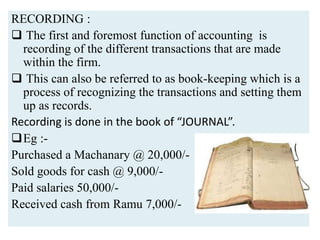
RECORDING :
 The first and foremost function of accounting is
recording of the different transactions that are made
within the firm.
 This can also be referred to as book-keeping which is a
process of recognizing the transactions and setting them
up as records.
Recording is done in the book of “JOURNAL”.
Eg :-
Purchased a Machanary @ 20,000/-
Sold goods for cash @ 9,000/-
Paid salaries 50,000/-
Received cash from Ramu 7,000/-
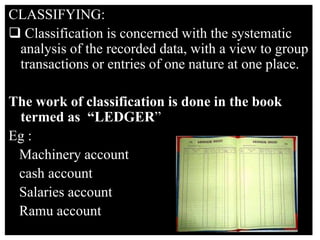
CLASSIFYING:
 Classification is concerned with the systematic
analysis of the recorded data, with a view to group
transactions or entries of one nature at one place.
The work of classification is done in the book
termed as “LEDGER”
Eg :
Machinery account
cash account
Salaries account
Ramu account
SUMMARIZING:
 This involves presenting the classified data in a manner
which is understandable and useful to the internal as
well as external end-users of accounting statements.
This process leads to the preparation of the following
statements :
Trial balance
Income statement and
Balance sheet
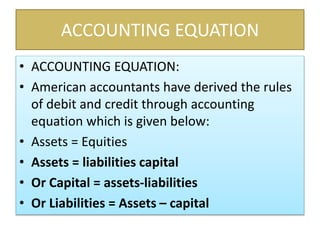
ACCOUNTING EQUATION
• ACCOUNTING EQUATION:
• American accountants have derived the rules
of debit and credit through accounting
equation which is given below:
• Assets = Equities
• Assets = liabilities capital
• Or Capital = assets-liabilities
• Or Liabilities = Assets – capital
IMPORTANCE OF ACCOUNTING
 Replacement of Human Memory
 Helpful In The Determination Of Financial Results And
Presentation Of Financial Position
 Helpful in assessing the tax liability
 Helpful in the case of insolvency
 Helpful in the valuation of business
 Helpful in the valuation of goodwill and shares
 Accounting makes comparative statement possible
 It helps to make inter period and interfirm comparison
 It is an aid to the management
 It is needed for legal reasons
1 Replacement of Human Memory:
As the human’s memory is limited and short, it is difficult
to remember all the transactions of the business.
Therefore, all the financial transactions of the
business are recorded in the books
By this way the businessmen cannot only see the records
at the required time but can also remember them for a
long time.
2 Helpful In The Determination Of Financial Results
And Presentation Of Financial Position:
Accounting is very useful in the determination of
the profit and loss of a business and showing the
financial position of the business.
3 Helpful in assessing the tax liability:
A businessman has to pay corporate tax, VAT and
excise duty, etc. therefore, it is necessary that proper
accounts should be maintained to compute the tax
liability of the business
4 Helpful in the case of insolvency:
Sometimes the businessman becomes the insolvent. If
he has properly maintained the accounts, he will not face
the problems in explaining few things in the court.
5 Helpful in the valuation of business:
If the business is shut down and sold, accounting helps
the businessman to determine the value of business. It would
be possible only in that case when the accounts of the
business are properly maintained.
•
6 Helpful in the valuation of goodwill and shares:
If accounts of the business are properly maintained, it
would be quite convenient to determine the value of
goodwill. Goodwill is very important for the
determination of the value of shares of the company.
7 Accounting makes comparative statement possible:
proper and adequate accounting helps in comparing the
income, expenditure, purchase, sale of the current year
with that of the previous years. And then future plans,
policies and forecasting may be possible.
8 It helps to make inter period and interfirm comparison:
Accounting information recorded properly can be used
to compare the results of one year with those of previous
years and with those of their other enterprises.
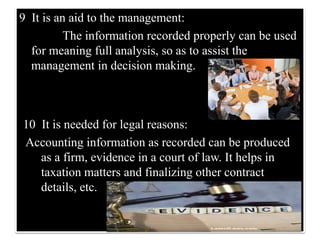
9 It is an aid to the management:
The information recorded properly can be used
for meaning full analysis, so as to assist the
management in decision making.
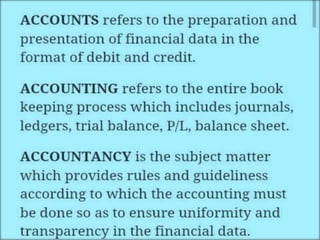
10 It is needed for legal reasons:
Accounting information as recorded can be produced
as a firm, evidence in a court of law. It helps in
taxation matters and finalizing other contract
details, etc.
OBJECTIVES OF ACCOUNTING
1. Designing Work
2. To maintain records of business
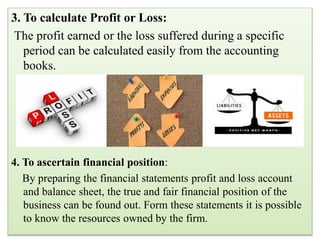
3. To calculate Profit or Loss
4. To ascertain financial position
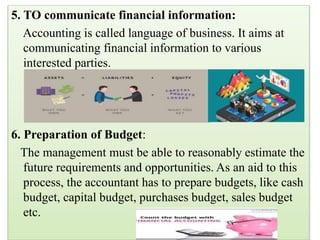
5. TO communicate financial information
6. Preparation of Budget
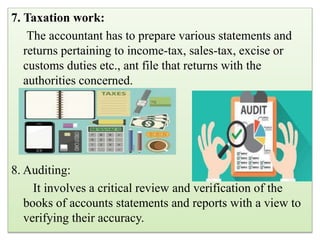
7. Taxation work
8. Auditing
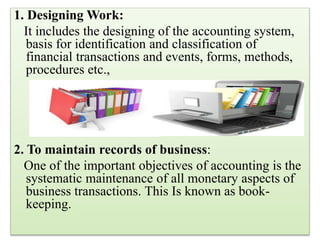
1. Designing Work:
It includes the designing of the accounting system,
basis for identification and classification of
financial transactions and events, forms, methods,
procedures etc.,
2. To maintain records of business:
One of the important objectives of accounting is the
systematic maintenance of all monetary aspects of
business transactions. This Is known as book-
keeping.
3. To calculate Profit or Loss:
The profit earned or the loss suffered during a specific
period can be calculated easily from the accounting
books.
4. To ascertain financial position:
By preparing the financial statements profit and loss account
and balance sheet, the true and fair financial position of the
business can be found out. Form these statements it is possible
to know the resources owned by the firm.
5. TO communicate financial information:
Accounting is called language of business. It aims at
communicating financial information to various
interested parties.
6. Preparation of Budget:
The management must be able to reasonably estimate the
future requirements and opportunities. As an aid to this
process, the accountant has to prepare budgets, like cash
budget, capital budget, purchases budget, sales budget
etc.
7. Taxation work:
The accountant has to prepare various statements and
returns pertaining to income-tax, sales-tax, excise or
customs duties etc., ant file that returns with the
authorities concerned.
8. Auditing:
It involves a critical review and verification of the
books of accounts statements and reports with a view to
verifying their accuracy.
BASIC ACCOUNTING
PRINCIPLES
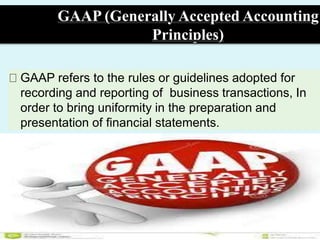
GAAP (Generally Accepted Accounting
Principles)
GAAP refers to the rules or guidelines adopted for
recording and reporting of business transactions, In
order to bring uniformity in the preparation and
presentation of financial statements.
G A AP Principles
• The GAAP principles are divided into two
categories:
1. Accounting Concepts: Accounting
Concepts are basic assumptions or
conditions upon which science of
accounting is based.
2. 2. Accounting Conventions: Accounting
Conventions include those customs and
traditions which are followed up by an
accountant while preparing a financial
statement.
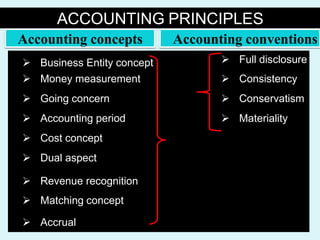
ACCOUNTING PRINCIPLES
 Business Entity concept  Full disclosure
 Money measurement  Consistency
 Going concern  Conservatism
 Accounting period  Materiality
 Cost concept
 Dual aspect
 Revenue recognition
 Matching concept
 Accrual
Accounting concepts Accounting conventions
BUSINESS ENTITY CONCEPT
This concept assumes that owners and business are
two different entities. It means that for the purpose
of accounting, the business and its owners are to be
treated as two separate entities.
Going Concern Concept
Assumes that a business firm would continue to carry out its
operations indefinitely, i.e. for a fairly long period of time
and would not be liquidated in the foreseeable future. This
is an important assumption of accounting as it provides the
very basis for showing the value of assets in the balance
sheet.
MONEY MEASUREMENT CONCEPT
Its states that only those transactions and happenings
in an organization which can be expressed in terms
of money such as sale of goods or payment of
expenses or receipt of income, etc. are to be
recorded in the book of accounts
Accounting Period Concept
Accounting period refers to the span of time at the
end of which the financial statements of an enterprise
are prepared, to know whether it has earned profits or
incurred losses during that period and what exactly is
the position of its assets and liabilities at the end of
that period.
2
0
2
2
2
0
2
3
Cost Concept
The cost concept requires that all assets
are recorded in the book of accounts at
their purchase price, which includes cost of
acquisition, transportation, installation and
making the asset ready to use.
Dual Aspect Concept
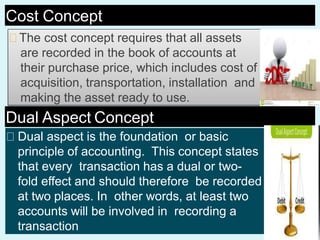
Dual aspect is the foundation or basic
principle of accounting. This concept states
that every transaction has a dual or two-
fold effect and should therefore be recorded
at two places. In other words, at least two
accounts will be involved in recording a
transaction
Matching Concept
The process of ascertaining the amount of profit
earned or the loss incurred during a particular
period involves deduction of related expenses
from the revenue earned during that period.
Revenue Recognition (Realization)
Concept
The concept of revenue recognition requires that the
revenue for a business transaction should be included in
the accounting records only when it is realized
Objectivity Concept or Accrual
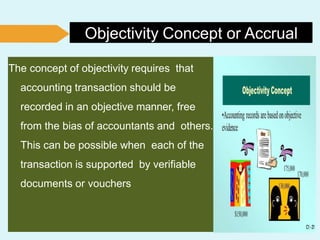
The concept of objectivity requires that
accounting transaction should be
recorded in an objective manner, free
from the bias of accountants and others.
This can be possible when each of the
transaction is supported by verifiable
documents or vouchers
Convention Of Full Disclosure
The principle of full disclosure requires that all material
and relevant facts concerning financial performance of
an enterprise must be fully and completely disclosed in
the financial statements and their accompanying
footnotes.
Convention Of Consistency
This principle states that accounting policies and
practices followed by enterprises are uniform and
are consistent over the period of time.
Convention Of Conservatism
The concept of conservatism requires that profits should not
to be recorded until realised but all losses, even those
which may have a remote possibility, are to be provided for
in the books of account.
Convention Of Materiality
The concept of materiality requires that accounting should
focus on material facts. The materiality of a fact depends
on its nature and the amount involved.
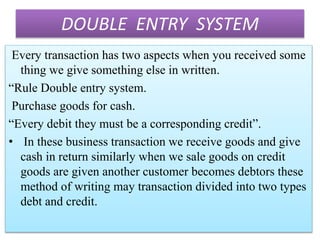
USES OF ACCOUNTING
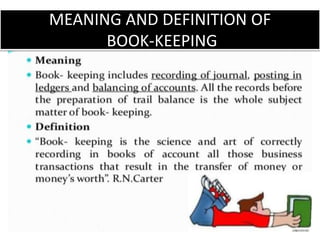
MEANING AND DEFINITION OF
BOOK-KEEPING
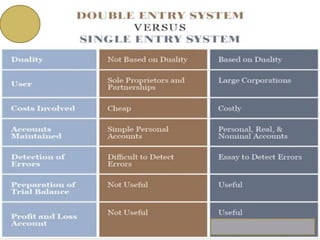
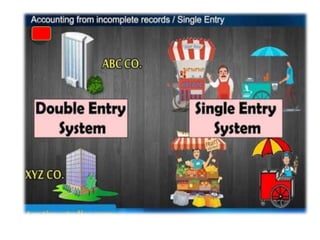
SINGLE ENTRY SYSTEM
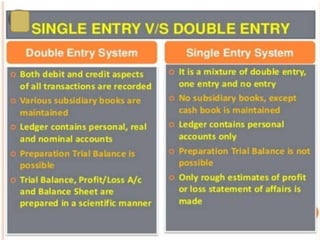
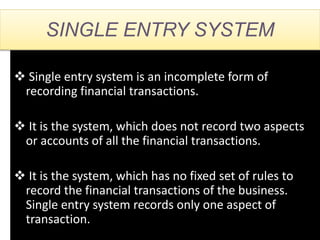
 Single entry system is an incomplete form of
recording financial transactions.
 It is the system, which does not record two aspects
or accounts of all the financial transactions.
 It is the system, which has no fixed set of rules to
record the financial transactions of the business.
Single entry system records only one aspect of
transaction.
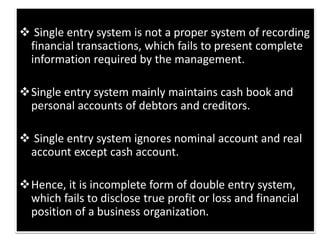
 Single entry system is not a proper system of recording
financial transactions, which fails to present complete
information required by the management.
Single entry system mainly maintains cash book and
personal accounts of debtors and creditors.
 Single entry system ignores nominal account and real
account except cash account.
Hence, it is incomplete form of double entry system,
which fails to disclose true profit or loss and financial
position of a business organization.
DOUBLE ENTRY SYSTEM
Every transaction has two aspects when you received some
thing we give something else in written.
“Rule Double entry system.
Purchase goods for cash.
“Every debit they must be a corresponding credit”.
• In these business transaction we receive goods and give
cash in return similarly when we sale goods on credit
goods are given another customer becomes debtors these
method of writing may transaction divided into two types
debt and credit.
• One account is to be debt and another account is
credit for every transaction in order to have a
complete record of the same.
• Every transaction effects two accounts in opposite
direction a transaction is to be recorded in two
different accounts in opposite side for annual value
both the accounts cannot be debited and another
account is to be credit the basic principle of double
entry systems is to every debt they must be
corresponding credit of equal value.
• Double entry system is a scientific way of presenting
accounts. As such all the business concerns feel it
convenient to prepare the accounts under double
entry syatem
• The taxation authorities also compel the businessmen
to prepare the accounts under double entry system.
• Under dual aspect concept the Accountant deals
with the two aspects of business transaction. i.e.
1. Receiving aspect (Debit Aspect)
2. Giving aspect(Credit Aspect)
ADVANTAGES DOUBLE ENTRY SYSTEM:
1.Scientific System:
Double entry system records, classifies and
summarizes business transactions in a systematic manner
and, thus, produces useful information for decision-
makers.
2.Full Information:
Full and authentic information can be had about all
transactions as the trader maintains the ledger with all
types of account.
3. Assessment of Profit and Loss:
The business man/trader will be able to known
correctly whether he had earned profit or sustained loss.
It facilitates the trade to take such steps so as to increase
the efficiency of the firm
4. Knowledge of debtors:
The trader will be able to know exactly what amounts
are owed by different customers to the firm. If any
amount is pending for a long time from any customer, he
may stop credit facility to that customer.
5.Knowledge of Creditors:
The trader also knows the exact amounts owed by the
firm to others and he will be able to arrange prompt
payment to obtain cash discount.
6.Arithmetical accuracy:
The arithmetical accuracy of the books can be proved
by preparing trail balance.
7.Assessment of Financial Position:
The trader will be able to prepare the balance sheet
which will help the interested parties to know fully about
the financial position of the firm.
8.Comparison of results:
It facilitates the comparison of current year’s results
with of previous years.
9.Maintenance according to Income Tax Rules:
Proper maintenance of books will satisfy the tax
authorities and facilitates accurate assessment. In India
joint stock companies should maintain accounts under
double entry system
10. Detection of frauds:
The frauds or errors can be easily detected by
vouching. Verification and auditing of accounts.
Disadvantage double entry systems:
1.Errors of Omission:
In case the entire transaction is not recorded in the
double of accounts the mistake cannot be detected by
accounting. The Trail Balance will tally in spite of the
mistakes.
2.Errors of principle:
Double entry is based upon the fact that every debit has to
corresponding credit. It will not be able to detect the
mistake such as debiting Ram’s account instead of Rao’s
account or building account in place of repairs account.
3.Compensating errors:
If Rahim’s account is by mistake debited with Rs.15
lesser and Mohan’s account is also by mistake credited
with Rs.15 lesser, the Trail balance will tally but mistake
will remain in accounts.
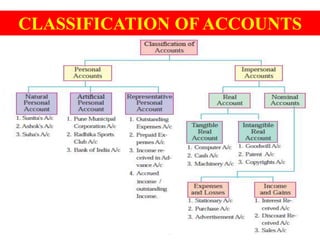
CLASSIFICATION OF ACCOUNTS
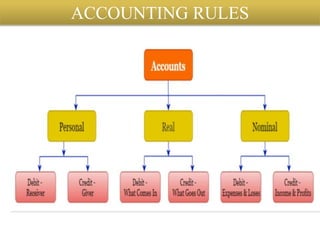
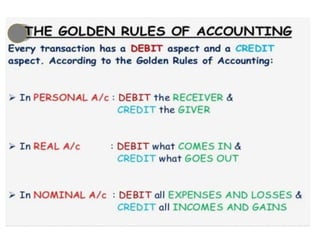
ACCOUNTING RULES
KEY WORDS
ACCOUNT:
A summarized statement of transactions
relating to a particular person, thing, expense or income.
TRANSACTION:
It refers to any happening event which is
measurable in terms of money and which changes the
financial position of the business concern.
Any sale or purchase of goods or services is called the
transaction
a. Cash Transaction : [ purchased furniture for cash ]
b. Credit Transaction :[ purchased furniture on credit]
CAPITAL:
It is the part of wealth which is used for further production and thus
capital costs of all current assets and fixed assets. Cash in hand, cash
at bank, buildings, plant and furniture etc., are the capital of the
business.
Capital is classified as 1 Fixed capital 2 Working Capital
Fixed Capital: The amount invested in acquiring fixed assets is called
fixed capital.
Eg : Plant and machinery, vehicles, furniture and buildings etc.
Working Capital: The part of capital available with the firm for day to-
day working of the business.
Eg: cash, inventory, accounts receivable, accounts payable , the portion
of debt due within one year.
Working Capital =Current Assets – Current Liabilities
ASSETS:
The valuable things owned by the business are known as
assets. These are the properties owned by the business.
Fixed Assets:
These assets are acquired for long-term use in the
business.
Eg : Land and Building, plant and machinery, vehicles
and furniture etc.,
Liquid Assets:
These assets also known as circulating, fluctuating or
current assets. These assets can be converted into cash
as early as possible.
Eg : cash, bank balance, debtors, stock, and investments.
Fictitious assets:
Fictitious assets are those assets, which do not have
physical form. They do not have any real value. The
example of these assets are loss on issue of shares,
preliminary expenses etc.,
Intangible assets:
Intangible assets are those having no physical
existence
Eg : goodwill, patents, trademarks.
Wasting Assets:
Wasting assets are those assets which are consumed
through being worked or used.
Eg : Mines.
LIABILITIES:
Liabilities are the obligations or debts payable by the
enterprise in the future in the form of money or goods.
Liabilities can be classified as
a. Fixed Liabilities
b. Current Liabilities
c. Contingent Liabilities
Fixed Liabilities:
These liabilities are payable generally, after a long period.
Eg :Capital, Loans, debentures, mortgage etc.,
Current Liabilities: Liabilities payable within a year are termed as
current liabilities.
Eg : Creditors, bills payable and outstanding expenses etc.,
Contingent Liabilities: These are not the real liabilities. Future events
can only decide whether it is really a liability or not. Due to their
uncertainty,
PROPRIETOR:
Proprietor is the person, who owns the business.
He invests capital in the business with the object of
earning profits.
Proprietor is an individual in case of sole trading, partner
in case of partnership firms and shareholder in case of
companies.
DRAWINGS:
Cash or goods withdrawn by the proprietor from
business for his personal or household use are termed
as ‘drawings’.
SOLVENT:
One who is able to pay one’s debts when they become due.
INSOLVENT:
The inability of a person to pay his debts when they become
due. The condition in which the liabilities exceed assets.
DEBTORS:
Debtor means a person who owes money to the trader.
CREDITOR:
A creditor is a person to whom something is owned by the
business. He is a person to whom some amount is payable for
loan taken, services obtained or goods bought.
EQUITY:
A claim which can be enforced against the assets of a
firm is called equity. The equities of a firm are of two types
a. Owner’s equity or capital
b. Creditor’s equity
GOODS:
All those things which a firm purchases for resale are
called goods. Goods refers to commodities, articles,
services or things.
REVENUE:
Revenue in accounting means the amount released or receivable
from the sale of goods.
DISCOUNT: There are two types of discount.
Cash Discount: An allowance made to encourage prompt
payment or before the expiration of the period allowed for
credit.
Trade discount: A deduction from the gross or catalogue price
allowed to traders who buys them for resale.
VOUCHER:
Accounting transactions must be supported by
documents. These documentary proofs in support of the
transactions are termed as vouchers.
RESERVE:
An amount set aside out of profits or other
surplus and designed to meet contingencies.
LOSSES:
It is to be distinguished from expense. An
expense is supposed to bring some benefit to the firm,
whereas a loss will not. Loss by fire or theft is an
example.
ACCOUNTING PERIOD: A period of 12 months for
which the accounts are usually kept.
It may be calendar year (Jan 1st to Dec 31st) or
financial year(April 1st to March 31st).
REVENUE OR INCOME:
Revenue refers to the earning of a business it
include the sale process of goods, receipts for
services rendered and earning from interest,
commission.
Eg: Earnings from interest, dividend, rent,
commission, discount etc.
GROSS PROFIT:
he difference between the selling price
and the cost price of goods, before the deduction
of any expenses incurred in selling goods.
NET PROFIT:
The profit that remains after deducting all the
expenses from the gross profit. It represents the real
gain of the business.
PROFIT AND LOSS ACCOUNT:
It is a statement prepared by the businessman for
the ascertainment of profit or loss during the accounting
period
BALANCE SHEET:
It is a statement of assets and liabilities prepared with a
view to measure the exact financial position of a
business on particular date, generally the last of the
accounting period

FAFM UNIT - 1.pptx financial accounts for managers

  • 3.
    Meaning Of Accounting Accountingis the language of BUSINESS. It conveys the financial position of the firm or business to anyone who wants to know. It helps to translate the workings of a firm into tangible reports that can be compared. Accounting is all about the process that helps to record, summarize, analyze, and report data that concerns financial transactions.
  • 4.
    Definition Of Accounting TheAmerican Institute of Certified Public Accountants (AICPA) defines accounting as “the art of RECORDING, CLASSIFYING and SUMMARIZING in a significant manner and in terms of money transactions and events which are, in part at least, of a financial character and INTERPRETING the results thereof ”
  • 5.
    RECORDING :  Thefirst and foremost function of accounting is recording of the different transactions that are made within the firm.  This can also be referred to as book-keeping which is a process of recognizing the transactions and setting them up as records. Recording is done in the book of “JOURNAL”. Eg :- Purchased a Machanary @ 20,000/- Sold goods for cash @ 9,000/- Paid salaries 50,000/- Received cash from Ramu 7,000/-
  • 6.
    CLASSIFYING:  Classification isconcerned with the systematic analysis of the recorded data, with a view to group transactions or entries of one nature at one place. The work of classification is done in the book termed as “LEDGER” Eg : Machinery account cash account Salaries account Ramu account
  • 7.
    SUMMARIZING:  This involvespresenting the classified data in a manner which is understandable and useful to the internal as well as external end-users of accounting statements. This process leads to the preparation of the following statements : Trial balance Income statement and Balance sheet
  • 8.
    ACCOUNTING EQUATION • ACCOUNTINGEQUATION: • American accountants have derived the rules of debit and credit through accounting equation which is given below: • Assets = Equities • Assets = liabilities capital • Or Capital = assets-liabilities • Or Liabilities = Assets – capital
  • 9.
    IMPORTANCE OF ACCOUNTING Replacement of Human Memory  Helpful In The Determination Of Financial Results And Presentation Of Financial Position  Helpful in assessing the tax liability  Helpful in the case of insolvency  Helpful in the valuation of business  Helpful in the valuation of goodwill and shares  Accounting makes comparative statement possible  It helps to make inter period and interfirm comparison  It is an aid to the management  It is needed for legal reasons
  • 10.
    1 Replacement ofHuman Memory: As the human’s memory is limited and short, it is difficult to remember all the transactions of the business. Therefore, all the financial transactions of the business are recorded in the books By this way the businessmen cannot only see the records at the required time but can also remember them for a long time.
  • 11.
    2 Helpful InThe Determination Of Financial Results And Presentation Of Financial Position: Accounting is very useful in the determination of the profit and loss of a business and showing the financial position of the business. 3 Helpful in assessing the tax liability: A businessman has to pay corporate tax, VAT and excise duty, etc. therefore, it is necessary that proper accounts should be maintained to compute the tax liability of the business
  • 12.
    4 Helpful inthe case of insolvency: Sometimes the businessman becomes the insolvent. If he has properly maintained the accounts, he will not face the problems in explaining few things in the court. 5 Helpful in the valuation of business: If the business is shut down and sold, accounting helps the businessman to determine the value of business. It would be possible only in that case when the accounts of the business are properly maintained. •
  • 13.
    6 Helpful inthe valuation of goodwill and shares: If accounts of the business are properly maintained, it would be quite convenient to determine the value of goodwill. Goodwill is very important for the determination of the value of shares of the company.
  • 14.
    7 Accounting makescomparative statement possible: proper and adequate accounting helps in comparing the income, expenditure, purchase, sale of the current year with that of the previous years. And then future plans, policies and forecasting may be possible. 8 It helps to make inter period and interfirm comparison: Accounting information recorded properly can be used to compare the results of one year with those of previous years and with those of their other enterprises.
  • 15.
    9 It isan aid to the management: The information recorded properly can be used for meaning full analysis, so as to assist the management in decision making. 10 It is needed for legal reasons: Accounting information as recorded can be produced as a firm, evidence in a court of law. It helps in taxation matters and finalizing other contract details, etc.
  • 17.
    OBJECTIVES OF ACCOUNTING 1.Designing Work 2. To maintain records of business 3. To calculate Profit or Loss 4. To ascertain financial position 5. TO communicate financial information 6. Preparation of Budget 7. Taxation work 8. Auditing
  • 18.
    1. Designing Work: Itincludes the designing of the accounting system, basis for identification and classification of financial transactions and events, forms, methods, procedures etc., 2. To maintain records of business: One of the important objectives of accounting is the systematic maintenance of all monetary aspects of business transactions. This Is known as book- keeping.
  • 19.
    3. To calculateProfit or Loss: The profit earned or the loss suffered during a specific period can be calculated easily from the accounting books. 4. To ascertain financial position: By preparing the financial statements profit and loss account and balance sheet, the true and fair financial position of the business can be found out. Form these statements it is possible to know the resources owned by the firm.
  • 20.
    5. TO communicatefinancial information: Accounting is called language of business. It aims at communicating financial information to various interested parties. 6. Preparation of Budget: The management must be able to reasonably estimate the future requirements and opportunities. As an aid to this process, the accountant has to prepare budgets, like cash budget, capital budget, purchases budget, sales budget etc.
  • 21.
    7. Taxation work: Theaccountant has to prepare various statements and returns pertaining to income-tax, sales-tax, excise or customs duties etc., ant file that returns with the authorities concerned. 8. Auditing: It involves a critical review and verification of the books of accounts statements and reports with a view to verifying their accuracy.
  • 22.
  • 23.
    GAAP (Generally AcceptedAccounting Principles) GAAP refers to the rules or guidelines adopted for recording and reporting of business transactions, In order to bring uniformity in the preparation and presentation of financial statements.
  • 24.
    G A APPrinciples • The GAAP principles are divided into two categories: 1. Accounting Concepts: Accounting Concepts are basic assumptions or conditions upon which science of accounting is based. 2. 2. Accounting Conventions: Accounting Conventions include those customs and traditions which are followed up by an accountant while preparing a financial statement.
  • 25.
    ACCOUNTING PRINCIPLES  BusinessEntity concept  Full disclosure  Money measurement  Consistency  Going concern  Conservatism  Accounting period  Materiality  Cost concept  Dual aspect  Revenue recognition  Matching concept  Accrual Accounting concepts Accounting conventions
  • 26.
    BUSINESS ENTITY CONCEPT Thisconcept assumes that owners and business are two different entities. It means that for the purpose of accounting, the business and its owners are to be treated as two separate entities. Going Concern Concept Assumes that a business firm would continue to carry out its operations indefinitely, i.e. for a fairly long period of time and would not be liquidated in the foreseeable future. This is an important assumption of accounting as it provides the very basis for showing the value of assets in the balance sheet.
  • 27.
    MONEY MEASUREMENT CONCEPT Itsstates that only those transactions and happenings in an organization which can be expressed in terms of money such as sale of goods or payment of expenses or receipt of income, etc. are to be recorded in the book of accounts Accounting Period Concept Accounting period refers to the span of time at the end of which the financial statements of an enterprise are prepared, to know whether it has earned profits or incurred losses during that period and what exactly is the position of its assets and liabilities at the end of that period. 2 0 2 2 2 0 2 3
  • 28.
    Cost Concept The costconcept requires that all assets are recorded in the book of accounts at their purchase price, which includes cost of acquisition, transportation, installation and making the asset ready to use. Dual Aspect Concept Dual aspect is the foundation or basic principle of accounting. This concept states that every transaction has a dual or two- fold effect and should therefore be recorded at two places. In other words, at least two accounts will be involved in recording a transaction
  • 29.
    Matching Concept The processof ascertaining the amount of profit earned or the loss incurred during a particular period involves deduction of related expenses from the revenue earned during that period. Revenue Recognition (Realization) Concept The concept of revenue recognition requires that the revenue for a business transaction should be included in the accounting records only when it is realized
  • 30.
    Objectivity Concept orAccrual The concept of objectivity requires that accounting transaction should be recorded in an objective manner, free from the bias of accountants and others. This can be possible when each of the transaction is supported by verifiable documents or vouchers
  • 31.
    Convention Of FullDisclosure The principle of full disclosure requires that all material and relevant facts concerning financial performance of an enterprise must be fully and completely disclosed in the financial statements and their accompanying footnotes. Convention Of Consistency This principle states that accounting policies and practices followed by enterprises are uniform and are consistent over the period of time.
  • 32.
    Convention Of Conservatism Theconcept of conservatism requires that profits should not to be recorded until realised but all losses, even those which may have a remote possibility, are to be provided for in the books of account. Convention Of Materiality The concept of materiality requires that accounting should focus on material facts. The materiality of a fact depends on its nature and the amount involved.
  • 33.
  • 34.
    MEANING AND DEFINITIONOF BOOK-KEEPING
  • 37.
    SINGLE ENTRY SYSTEM Single entry system is an incomplete form of recording financial transactions.  It is the system, which does not record two aspects or accounts of all the financial transactions.  It is the system, which has no fixed set of rules to record the financial transactions of the business. Single entry system records only one aspect of transaction.
  • 38.
     Single entrysystem is not a proper system of recording financial transactions, which fails to present complete information required by the management. Single entry system mainly maintains cash book and personal accounts of debtors and creditors.  Single entry system ignores nominal account and real account except cash account. Hence, it is incomplete form of double entry system, which fails to disclose true profit or loss and financial position of a business organization.
  • 39.
    DOUBLE ENTRY SYSTEM Everytransaction has two aspects when you received some thing we give something else in written. “Rule Double entry system. Purchase goods for cash. “Every debit they must be a corresponding credit”. • In these business transaction we receive goods and give cash in return similarly when we sale goods on credit goods are given another customer becomes debtors these method of writing may transaction divided into two types debt and credit.
  • 40.
    • One accountis to be debt and another account is credit for every transaction in order to have a complete record of the same. • Every transaction effects two accounts in opposite direction a transaction is to be recorded in two different accounts in opposite side for annual value both the accounts cannot be debited and another account is to be credit the basic principle of double entry systems is to every debt they must be corresponding credit of equal value.
  • 41.
    • Double entrysystem is a scientific way of presenting accounts. As such all the business concerns feel it convenient to prepare the accounts under double entry syatem • The taxation authorities also compel the businessmen to prepare the accounts under double entry system. • Under dual aspect concept the Accountant deals with the two aspects of business transaction. i.e. 1. Receiving aspect (Debit Aspect) 2. Giving aspect(Credit Aspect)
  • 42.
    ADVANTAGES DOUBLE ENTRYSYSTEM: 1.Scientific System: Double entry system records, classifies and summarizes business transactions in a systematic manner and, thus, produces useful information for decision- makers. 2.Full Information: Full and authentic information can be had about all transactions as the trader maintains the ledger with all types of account.
  • 43.
    3. Assessment ofProfit and Loss: The business man/trader will be able to known correctly whether he had earned profit or sustained loss. It facilitates the trade to take such steps so as to increase the efficiency of the firm 4. Knowledge of debtors: The trader will be able to know exactly what amounts are owed by different customers to the firm. If any amount is pending for a long time from any customer, he may stop credit facility to that customer.
  • 44.
    5.Knowledge of Creditors: Thetrader also knows the exact amounts owed by the firm to others and he will be able to arrange prompt payment to obtain cash discount. 6.Arithmetical accuracy: The arithmetical accuracy of the books can be proved by preparing trail balance. 7.Assessment of Financial Position: The trader will be able to prepare the balance sheet which will help the interested parties to know fully about the financial position of the firm.
  • 45.
    8.Comparison of results: Itfacilitates the comparison of current year’s results with of previous years. 9.Maintenance according to Income Tax Rules: Proper maintenance of books will satisfy the tax authorities and facilitates accurate assessment. In India joint stock companies should maintain accounts under double entry system 10. Detection of frauds: The frauds or errors can be easily detected by vouching. Verification and auditing of accounts.
  • 47.
    Disadvantage double entrysystems: 1.Errors of Omission: In case the entire transaction is not recorded in the double of accounts the mistake cannot be detected by accounting. The Trail Balance will tally in spite of the mistakes. 2.Errors of principle: Double entry is based upon the fact that every debit has to corresponding credit. It will not be able to detect the mistake such as debiting Ram’s account instead of Rao’s account or building account in place of repairs account. 3.Compensating errors: If Rahim’s account is by mistake debited with Rs.15 lesser and Mohan’s account is also by mistake credited with Rs.15 lesser, the Trail balance will tally but mistake will remain in accounts.
  • 48.
  • 50.
  • 52.
    KEY WORDS ACCOUNT: A summarizedstatement of transactions relating to a particular person, thing, expense or income. TRANSACTION: It refers to any happening event which is measurable in terms of money and which changes the financial position of the business concern. Any sale or purchase of goods or services is called the transaction a. Cash Transaction : [ purchased furniture for cash ] b. Credit Transaction :[ purchased furniture on credit]
  • 53.
    CAPITAL: It is thepart of wealth which is used for further production and thus capital costs of all current assets and fixed assets. Cash in hand, cash at bank, buildings, plant and furniture etc., are the capital of the business. Capital is classified as 1 Fixed capital 2 Working Capital Fixed Capital: The amount invested in acquiring fixed assets is called fixed capital. Eg : Plant and machinery, vehicles, furniture and buildings etc. Working Capital: The part of capital available with the firm for day to- day working of the business. Eg: cash, inventory, accounts receivable, accounts payable , the portion of debt due within one year. Working Capital =Current Assets – Current Liabilities
  • 54.
    ASSETS: The valuable thingsowned by the business are known as assets. These are the properties owned by the business. Fixed Assets: These assets are acquired for long-term use in the business. Eg : Land and Building, plant and machinery, vehicles and furniture etc., Liquid Assets: These assets also known as circulating, fluctuating or current assets. These assets can be converted into cash as early as possible. Eg : cash, bank balance, debtors, stock, and investments.
  • 55.
    Fictitious assets: Fictitious assetsare those assets, which do not have physical form. They do not have any real value. The example of these assets are loss on issue of shares, preliminary expenses etc., Intangible assets: Intangible assets are those having no physical existence Eg : goodwill, patents, trademarks. Wasting Assets: Wasting assets are those assets which are consumed through being worked or used. Eg : Mines.
  • 56.
    LIABILITIES: Liabilities are theobligations or debts payable by the enterprise in the future in the form of money or goods. Liabilities can be classified as a. Fixed Liabilities b. Current Liabilities c. Contingent Liabilities Fixed Liabilities: These liabilities are payable generally, after a long period. Eg :Capital, Loans, debentures, mortgage etc., Current Liabilities: Liabilities payable within a year are termed as current liabilities. Eg : Creditors, bills payable and outstanding expenses etc., Contingent Liabilities: These are not the real liabilities. Future events can only decide whether it is really a liability or not. Due to their uncertainty,
  • 57.
    PROPRIETOR: Proprietor is theperson, who owns the business. He invests capital in the business with the object of earning profits. Proprietor is an individual in case of sole trading, partner in case of partnership firms and shareholder in case of companies. DRAWINGS: Cash or goods withdrawn by the proprietor from business for his personal or household use are termed as ‘drawings’.
  • 58.
    SOLVENT: One who isable to pay one’s debts when they become due. INSOLVENT: The inability of a person to pay his debts when they become due. The condition in which the liabilities exceed assets. DEBTORS: Debtor means a person who owes money to the trader. CREDITOR: A creditor is a person to whom something is owned by the business. He is a person to whom some amount is payable for loan taken, services obtained or goods bought.
  • 59.
    EQUITY: A claim whichcan be enforced against the assets of a firm is called equity. The equities of a firm are of two types a. Owner’s equity or capital b. Creditor’s equity GOODS: All those things which a firm purchases for resale are called goods. Goods refers to commodities, articles, services or things. REVENUE: Revenue in accounting means the amount released or receivable from the sale of goods.
  • 60.
    DISCOUNT: There aretwo types of discount. Cash Discount: An allowance made to encourage prompt payment or before the expiration of the period allowed for credit. Trade discount: A deduction from the gross or catalogue price allowed to traders who buys them for resale. VOUCHER: Accounting transactions must be supported by documents. These documentary proofs in support of the transactions are termed as vouchers.
  • 61.
    RESERVE: An amount setaside out of profits or other surplus and designed to meet contingencies. LOSSES: It is to be distinguished from expense. An expense is supposed to bring some benefit to the firm, whereas a loss will not. Loss by fire or theft is an example. ACCOUNTING PERIOD: A period of 12 months for which the accounts are usually kept. It may be calendar year (Jan 1st to Dec 31st) or financial year(April 1st to March 31st).
  • 62.
    REVENUE OR INCOME: Revenuerefers to the earning of a business it include the sale process of goods, receipts for services rendered and earning from interest, commission. Eg: Earnings from interest, dividend, rent, commission, discount etc. GROSS PROFIT: he difference between the selling price and the cost price of goods, before the deduction of any expenses incurred in selling goods.
  • 63.
    NET PROFIT: The profitthat remains after deducting all the expenses from the gross profit. It represents the real gain of the business. PROFIT AND LOSS ACCOUNT: It is a statement prepared by the businessman for the ascertainment of profit or loss during the accounting period BALANCE SHEET: It is a statement of assets and liabilities prepared with a view to measure the exact financial position of a business on particular date, generally the last of the accounting period