HEALTH TALK
Child health nursing
TOPIC Exclusive Breast Feeding
Submitted To: Submitted By
Mrs. Pallavi Mehra SWATI SHARMA
Associate professor (CHN) M.Sc. (N) 1st
year
Submitted On 09-06-2022
LESSON PLAN
NAME OF THE EVALUATOR : Mrs, Pallavi
NAME OF THE STUDENT : Swati Sharma
NAME OF THE SUBJECT : Child health Nsg.
TOPIC : Exclusive breast feeding
DATE : 09-06-2023
TIME : 11am
VENUE : Zonal hospital Mandi
METHODS OF TEACHING : Lecture cum Discussion
AV AIDS : charts, flash card
GENERAL OBJECTIVES : At the end of teaching group will be able to answer the
questions & knowledge regarding exclusive breast feeding
SPEIFIC OBJECTIVES : At the end of the teaching the group will be able to
 explain the composition of milk.
 describe the benefits of breast feeding
 explain the feeding reflexes in the baby
 enlist the steps of successful breast feeding.
SR. TIME CONTRIBUTING CONTENT TEACHING A.V. AIDS EVALUATION
NO. OBJECTIVES LEARNING
ACTIVITY
1. 1 min. To introduce self Good Morning Myself Swati Sharma
student of M.Sc.(N) 1st
year in abhilashi
college of nursing
2. 1 min To announce the
topic
Today .I will teach the topic exclusive
breast feeding.
3. 3min To identify the
previous knowledge
Students have little bit knowledge
regarding diet in lactating mother.
Pre test
4. ½ min To introduce the
topic
INTRODUCTION
Breast milk is the perfect food for normal
neonates. It is the best gift mother can
give to her newborn baby. It contain all
the nutrients for normal growth and
development of a baby from the time of
birth to the first six month of life,
proportion and in a form that is easily
digested and absorbed
5. 3min. To define the breast
feeding & exclusive
breast feeding.
Definition:
Breast feeding:
Breastfeeding is the feeding ofan infant or
young child with breast milk directly from
Lecture cum
discussion
SR.
NO.
TIME CONTRIBUTING
OBJECTIVES
CONTENT TEACHING
LEARNING
ACTIVITY
A.V. AIDS EVALUATION
a woman's breasts, not from a baby
bottle or other container.
Exclusive breast feeding:
It is defined as an infant consumption of
milk with no supplementation of any type
like water or juice except vitamin, mineral
and medication. It is recommended for
first six month of life. Newborn babies
consume 30-90 ml of feed.
6. 5min. To explain the
composition of
breast milk.
Composition of breast milk:
 Carbohydrates:
Lactose is in a high concentration (
6-7g/dl) in breast milk. Lactose
helps in the absorption of calcium.
 Proteins:
The protein content of breastmilk
is low (0.9-1.1 g/dl) in the breast
milk as the baby cannot effectively
Lecture cum
discussion
Chart
SR. TIME CONTRIBUTING CONTENT TEACHING A.V. AIDS EVALUATION
NO. OBJECTIVES LEARNING
ACTIVITY
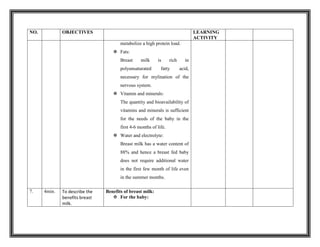
metabolize a high protein load.
 Fats:
Breast milk is rich in
polyunsaturated fatty acid,
necessary for mylination of the
nervous system.
 Vitamin and minerals:
The quantity and bioavailability of
vitamins and minerals is sufficient
for the needs of the baby in the
first 4-6 months of life.
 Water and electrolyte:
Breast milk has a water content of
88% and hence a breast fed baby
does not require additional water
in the first few month of life even
in the summer months.
7. 4min. To describe the
benefits breast
milk.
Benefits of breast milk:
 For the baby:
SR.
NO.
TIME CONTRIBUTING
OBJECTIVES
CONTENT TEACHING
LEARNING
ACTIVITY
A.V. AIDS EVALUATION
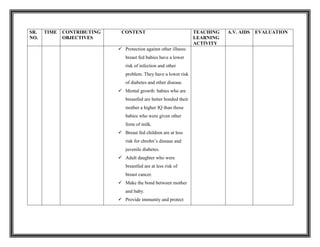
 Protection against other illness:
breast fed babies have a lower
risk of infection and other
problem. They have a lower risk
of diabetes and other disease.
 Mental growth: babies who are
breastfed are better bonded their
mother a higher IQ than those
babies who were given other
form of milk.
 Breast fed children are at less
risk for chrohn’s disease and
juvenile diabetes.
 Adult daughter who were
breastfed are at less risk of
breast cancer.
 Make the bond between mother
and baby.
 Provide immunity and protect
SR.
NO.
TIME CONTRIBUTING
OBJECTIVES
CONTENT TEACHING
LEARNING
ACTIVITY
A.V. AIDS EVALUATION
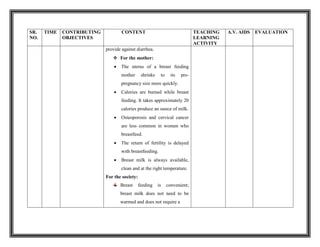
provide against diarrhea.
 For the mother:
 The uterus of a breast feeding
mother shrinks to its pre-
pregnancy size more quickly.
 Calories are burned while breast
feeding. It takes approximately 20
calories produce an ounce of milk.
 Osteoporosis and cervical cancer
are less common in women who
breastfeed.
 The return of fertility is delayed
with breastfeeding.
 Breast milk is always available,
clean and at the right temperature.
For the society:
Breast feeding is convenient;
breast milk does not need to be
warmed and does not require a
SR.
NO.
TIME CONTRIBUTING
OBJECTIVES
CONTENT TEACHING
LEARNING
ACTIVITY
A.V. AIDS EVALUATION
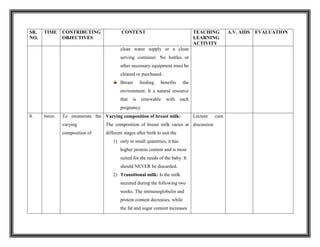
clean water supply or a clean
serving container. No bottles or
other necessary equipment must be
cleaned or purchased.
Breast feeding benefits the
environment. It a natural resource
that is renewable with each
pregnancy
8. 6min. To enumerate the
varying
composition of
Varying composition of breast milk:
The composition of breast milk varies at
different stages after birth to suit the
1) only in small quantities, it has
higher protein content and is most
suited for the needs of the baby. It
should NEVER be discarded.
2) Transitional milk: Is the milk
secreted during the following two
weeks. The immunoglobulin and
protein content decreases, while
the fat and sugar content increases
Lecture cum
discussion
SR.
NO.
TIME CONTRIBUTING
OBJECTIVES
CONTENT TEACHING
LEARNING
ACTIVITY
A.V. AIDS EVALUATION
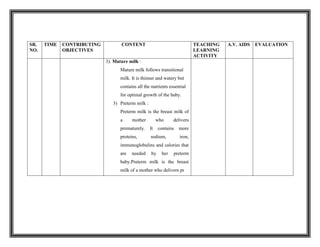
3). Mature milk :
Mature milk follows transitional
milk. It is thinner and watery but
contains all the nutrients essential
for optimal growth of the baby.
3) Preterm milk :
Preterm milk is the breast milk of
a mother who delivers
prematurely. It contains more
proteins, sodium, iron,
immunoglobulins and calories that
are needed by her preterm
baby.Preterm milk is the breast
milk of a mother who delivers pr
SR.
NO.
TIME CONTRIBUTING
OBJECTIVES
CONTENT TEACHING
LEARNING
ACTIVITY
A.V. AIDS EVALUATION
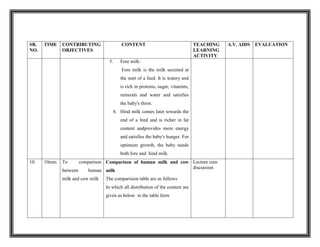
5. Fore milk:
Fore milk is the milk secreted at
the start of a feed. It is watery and
is rich in proteins, sugar, vitamins,
minerals and water and satisfies
the baby's thirst.
6. Hind milk comes later towards the
end of a feed and is richer in fat
content andprovides more energy
and satisfies the baby's hunger. For
optimum growth, the baby needs
both fore and hind milk.
10. 10min. To comparison
between human
milk and cow milk
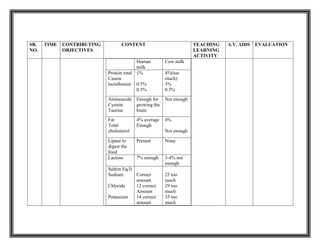
Comparison of human milk and cow
milk
The comparision table are as follows
In which all distribution of the content are
given as below in the table form
Lecture cum
discussion
SR.
NO.
TIME CONTRIBUTING
OBJECTIVES
CONTENT TEACHING
LEARNING
ACTIVITY
A.V. AIDS EVALUATION
Human
milk
Cow milk
Protein total
Casein
lactalbumin
1%
0.5%
0.5%
4%(too
much)
3%
0.5%
Aminoacids
Cystein
Taurine
Enough for
growing the
brain
Not enough
Fat
Total
cholesterol
4% average
Enough
4%
Not enough
Lipase to
digest the
food
Present None
Lactose 7% enough 3-4% not
enough
Salt(m Eq/l)
Sodium
Chloride
Potassium
Correct
amount
12 correct
Amount
14 correct
amount
25 too
much
29 too
much
35 too
much
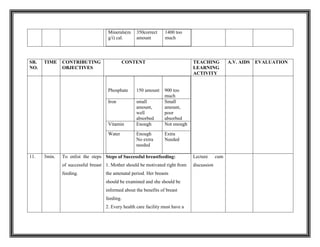
Minerals(m
g/i) cal.
350correct
amount
1400 too
much
SR.
NO.
TIME CONTRIBUTING
OBJECTIVES
CONTENT TEACHING
LEARNING
ACTIVITY
A.V. AIDS EVALUATION
Phosphate 150 amount 900 too
much
Iron small
amount,
well
absorbed
Small
amount,
poor
absorbed
Vitamin Enough Not enough
Water Enough
No extra
needed
Extra
Needed
11. 3min. To enlist the steps
of successful breast
feeding.
Steps of Successful breastfeeding:
1. Mother should be motivated right from
the antenatal period. Her breasts
should be examined and she should be
informed about the benefits of breast
feeding.
2. Every health care facility must have a
Lecture cum
discussion
written breastfeeding policy .One should
arrange mother craft classes in the
hospitals.
SR.
NO.
TIME CONTRIBUTING
OBJECTIVES
CONTENT TEACHING
LEARNING
ACTIVITY
A.V. AIDS EVALUATION
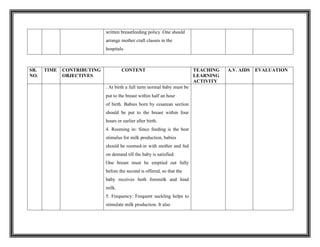
. At birth a full term normal baby must be
put to the breast within half an hour
of birth. Babies born by cesarean section
should be put to the breast within four
hours or earlier after birth.
4. Rooming in: Since feeding is the best
stimulus for milk production, babies
should be roomed-in with mother and fed
on demand till the baby is satisfied.
One breast must be emptied out fully
before the second is offered, so that the
baby receives both foremilk and hind
milk.
5. Frequency: Frequent suckling helps to
stimulate milk production. It also
prevents engorgement of breasts. The
baby should be fed whenever hungry.
Initially, some babies feed at short
intervals of 1 to 2 hours. Later the babies
SR.
NO.
TIME CONTRIBUTING
OBJECTIVES
CONTENT TEACHING
LEARNING
ACTIVITY
A.V. AIDS EVALUATION
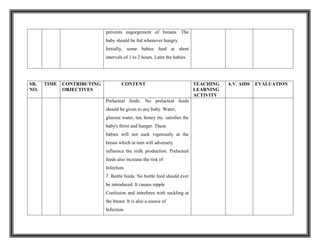
Prelacteal feeds: No prelacteal feeds
should be given to any baby. Water,
glucose water, tea, honey etc. satisfies the
baby's thirst and hunger. These
babies will not suck vigorously at the
breast which in turn will adversely
influence the milk production. Prelacteal
feeds also increase the risk of
Infection.
7. Bottle feeds: No bottle feed should ever
be introduced. It causes nipple
Confusion and interferes with suckling at
the breast. It is also a source of
Infection.
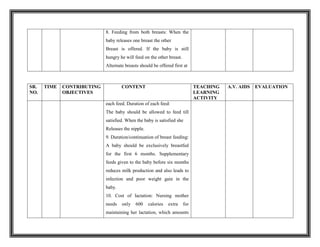
8. Feeding from both breasts: When the
baby releases one breast the other
Breast is offered. If the baby is still
hungry he will feed on the other breast.
Alternate breasts should be offered first at
SR.
NO.
TIME CONTRIBUTING
OBJECTIVES
CONTENT TEACHING
LEARNING
ACTIVITY
A.V. AIDS EVALUATION
each feed. Duration of each feed:
The baby should be allowed to feed till
satisfied. When the baby is satisfied she
Releases the nipple.
9. Duration/continuation of breast feeding:
A baby should be exclusively breastfed
for the first 6 months. Supplementary
feeds given to the baby before six months
reduces milk production and also leads to
infection and poor weight gain in the
baby.
10. Cost of lactation: Nursing mother
needs only 600 calories extra for
maintaining her lactation, which amounts
to additional (x 1 ½ times) home-made
food and fluids
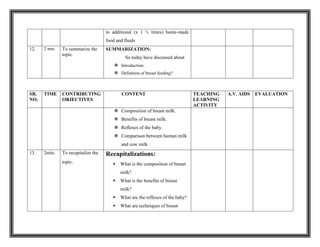
12. 2 min. To summarize the
topic.
SUMMARIZATION:
So today have discussed about
 Introduction.
 Definition of breast feeding?
SR.
NO.
TIME CONTRIBUTING
OBJECTIVES
CONTENT TEACHING
LEARNING
ACTIVITY
A.V. AIDS EVALUATION
 Composition of breast milk.
 Benefits of breast milk.
 Reflexes of the baby.
 Comparison between human milk
and cow milk
13. 2min. To recapitalize the
topic.
Recapitalizations:
 What is the composition of breast
milk?
 What is the benefits of breast
milk?
 What are the reflexes of the baby?
 What are techniques of breast
feeding ?
1
5
.
 Bibliography:
 .Myles. Text book of midwife,
Edition 8th
.published by Elsevier,
New delhi,2009.
 Dutta DC.Text book of obstetrics,
Edition 6th.published
SR.
NO.
TIME CONTRIBUTING
OBJECTIVES
CONTENT TEACHING
LEARNING
ACTIVITY
A.V. AIDS EVALUATION
by New central book agency Kolkata,
2009.
 Jacob Annnama, a comprehensive
text book of midwife, 2nd edition,
Jaypee, New delhi, 2008
 Daftary N Shirish .Manual of
Obstetrics. Edition 2003. Elsevier
publisher.
 www.nlm.nih.gov/medlineplus/enc
y/article/
 www.rn.ca.gov/pdfs/regulations
health talk.docx

health talk.docx

  • 1.
    HEALTH TALK Child healthnursing TOPIC Exclusive Breast Feeding Submitted To: Submitted By Mrs. Pallavi Mehra SWATI SHARMA Associate professor (CHN) M.Sc. (N) 1st year Submitted On 09-06-2022 LESSON PLAN
  • 2.
    NAME OF THEEVALUATOR : Mrs, Pallavi NAME OF THE STUDENT : Swati Sharma NAME OF THE SUBJECT : Child health Nsg. TOPIC : Exclusive breast feeding DATE : 09-06-2023 TIME : 11am VENUE : Zonal hospital Mandi METHODS OF TEACHING : Lecture cum Discussion AV AIDS : charts, flash card GENERAL OBJECTIVES : At the end of teaching group will be able to answer the questions & knowledge regarding exclusive breast feeding SPEIFIC OBJECTIVES : At the end of the teaching the group will be able to  explain the composition of milk.  describe the benefits of breast feeding  explain the feeding reflexes in the baby  enlist the steps of successful breast feeding. SR. TIME CONTRIBUTING CONTENT TEACHING A.V. AIDS EVALUATION
  • 3.
    NO. OBJECTIVES LEARNING ACTIVITY 1.1 min. To introduce self Good Morning Myself Swati Sharma student of M.Sc.(N) 1st year in abhilashi college of nursing 2. 1 min To announce the topic Today .I will teach the topic exclusive breast feeding. 3. 3min To identify the previous knowledge Students have little bit knowledge regarding diet in lactating mother. Pre test 4. ½ min To introduce the topic INTRODUCTION Breast milk is the perfect food for normal neonates. It is the best gift mother can give to her newborn baby. It contain all the nutrients for normal growth and development of a baby from the time of birth to the first six month of life, proportion and in a form that is easily digested and absorbed 5. 3min. To define the breast feeding & exclusive breast feeding. Definition: Breast feeding: Breastfeeding is the feeding ofan infant or young child with breast milk directly from Lecture cum discussion
  • 4.
    SR. NO. TIME CONTRIBUTING OBJECTIVES CONTENT TEACHING LEARNING ACTIVITY A.V.AIDS EVALUATION a woman's breasts, not from a baby bottle or other container. Exclusive breast feeding: It is defined as an infant consumption of milk with no supplementation of any type like water or juice except vitamin, mineral and medication. It is recommended for first six month of life. Newborn babies consume 30-90 ml of feed. 6. 5min. To explain the composition of breast milk. Composition of breast milk:  Carbohydrates: Lactose is in a high concentration ( 6-7g/dl) in breast milk. Lactose helps in the absorption of calcium.  Proteins: The protein content of breastmilk is low (0.9-1.1 g/dl) in the breast milk as the baby cannot effectively Lecture cum discussion Chart SR. TIME CONTRIBUTING CONTENT TEACHING A.V. AIDS EVALUATION
  • 5.
    NO. OBJECTIVES LEARNING ACTIVITY metabolizea high protein load.  Fats: Breast milk is rich in polyunsaturated fatty acid, necessary for mylination of the nervous system.  Vitamin and minerals: The quantity and bioavailability of vitamins and minerals is sufficient for the needs of the baby in the first 4-6 months of life.  Water and electrolyte: Breast milk has a water content of 88% and hence a breast fed baby does not require additional water in the first few month of life even in the summer months. 7. 4min. To describe the benefits breast milk. Benefits of breast milk:  For the baby:
  • 6.
    SR. NO. TIME CONTRIBUTING OBJECTIVES CONTENT TEACHING LEARNING ACTIVITY A.V.AIDS EVALUATION  Protection against other illness: breast fed babies have a lower risk of infection and other problem. They have a lower risk of diabetes and other disease.  Mental growth: babies who are breastfed are better bonded their mother a higher IQ than those babies who were given other form of milk.  Breast fed children are at less risk for chrohn’s disease and juvenile diabetes.  Adult daughter who were breastfed are at less risk of breast cancer.  Make the bond between mother and baby.  Provide immunity and protect
  • 7.
    SR. NO. TIME CONTRIBUTING OBJECTIVES CONTENT TEACHING LEARNING ACTIVITY A.V.AIDS EVALUATION provide against diarrhea.  For the mother:  The uterus of a breast feeding mother shrinks to its pre- pregnancy size more quickly.  Calories are burned while breast feeding. It takes approximately 20 calories produce an ounce of milk.  Osteoporosis and cervical cancer are less common in women who breastfeed.  The return of fertility is delayed with breastfeeding.  Breast milk is always available, clean and at the right temperature. For the society: Breast feeding is convenient; breast milk does not need to be warmed and does not require a
  • 8.
    SR. NO. TIME CONTRIBUTING OBJECTIVES CONTENT TEACHING LEARNING ACTIVITY A.V.AIDS EVALUATION clean water supply or a clean serving container. No bottles or other necessary equipment must be cleaned or purchased. Breast feeding benefits the environment. It a natural resource that is renewable with each pregnancy 8. 6min. To enumerate the varying composition of Varying composition of breast milk: The composition of breast milk varies at different stages after birth to suit the 1) only in small quantities, it has higher protein content and is most suited for the needs of the baby. It should NEVER be discarded. 2) Transitional milk: Is the milk secreted during the following two weeks. The immunoglobulin and protein content decreases, while the fat and sugar content increases Lecture cum discussion
  • 9.
    SR. NO. TIME CONTRIBUTING OBJECTIVES CONTENT TEACHING LEARNING ACTIVITY A.V.AIDS EVALUATION 3). Mature milk : Mature milk follows transitional milk. It is thinner and watery but contains all the nutrients essential for optimal growth of the baby. 3) Preterm milk : Preterm milk is the breast milk of a mother who delivers prematurely. It contains more proteins, sodium, iron, immunoglobulins and calories that are needed by her preterm baby.Preterm milk is the breast milk of a mother who delivers pr
  • 10.
    SR. NO. TIME CONTRIBUTING OBJECTIVES CONTENT TEACHING LEARNING ACTIVITY A.V.AIDS EVALUATION 5. Fore milk: Fore milk is the milk secreted at the start of a feed. It is watery and is rich in proteins, sugar, vitamins, minerals and water and satisfies the baby's thirst. 6. Hind milk comes later towards the end of a feed and is richer in fat content andprovides more energy and satisfies the baby's hunger. For optimum growth, the baby needs both fore and hind milk. 10. 10min. To comparison between human milk and cow milk Comparison of human milk and cow milk The comparision table are as follows In which all distribution of the content are given as below in the table form Lecture cum discussion
  • 11.
    SR. NO. TIME CONTRIBUTING OBJECTIVES CONTENT TEACHING LEARNING ACTIVITY A.V.AIDS EVALUATION Human milk Cow milk Protein total Casein lactalbumin 1% 0.5% 0.5% 4%(too much) 3% 0.5% Aminoacids Cystein Taurine Enough for growing the brain Not enough Fat Total cholesterol 4% average Enough 4% Not enough Lipase to digest the food Present None Lactose 7% enough 3-4% not enough Salt(m Eq/l) Sodium Chloride Potassium Correct amount 12 correct Amount 14 correct amount 25 too much 29 too much 35 too much
  • 12.
    Minerals(m g/i) cal. 350correct amount 1400 too much SR. NO. TIMECONTRIBUTING OBJECTIVES CONTENT TEACHING LEARNING ACTIVITY A.V. AIDS EVALUATION Phosphate 150 amount 900 too much Iron small amount, well absorbed Small amount, poor absorbed Vitamin Enough Not enough Water Enough No extra needed Extra Needed 11. 3min. To enlist the steps of successful breast feeding. Steps of Successful breastfeeding: 1. Mother should be motivated right from the antenatal period. Her breasts should be examined and she should be informed about the benefits of breast feeding. 2. Every health care facility must have a Lecture cum discussion
  • 13.
    written breastfeeding policy.One should arrange mother craft classes in the hospitals. SR. NO. TIME CONTRIBUTING OBJECTIVES CONTENT TEACHING LEARNING ACTIVITY A.V. AIDS EVALUATION . At birth a full term normal baby must be put to the breast within half an hour of birth. Babies born by cesarean section should be put to the breast within four hours or earlier after birth. 4. Rooming in: Since feeding is the best stimulus for milk production, babies should be roomed-in with mother and fed on demand till the baby is satisfied. One breast must be emptied out fully before the second is offered, so that the baby receives both foremilk and hind milk. 5. Frequency: Frequent suckling helps to stimulate milk production. It also
  • 14.
    prevents engorgement ofbreasts. The baby should be fed whenever hungry. Initially, some babies feed at short intervals of 1 to 2 hours. Later the babies SR. NO. TIME CONTRIBUTING OBJECTIVES CONTENT TEACHING LEARNING ACTIVITY A.V. AIDS EVALUATION Prelacteal feeds: No prelacteal feeds should be given to any baby. Water, glucose water, tea, honey etc. satisfies the baby's thirst and hunger. These babies will not suck vigorously at the breast which in turn will adversely influence the milk production. Prelacteal feeds also increase the risk of Infection. 7. Bottle feeds: No bottle feed should ever be introduced. It causes nipple Confusion and interferes with suckling at the breast. It is also a source of Infection.
  • 15.
    8. Feeding fromboth breasts: When the baby releases one breast the other Breast is offered. If the baby is still hungry he will feed on the other breast. Alternate breasts should be offered first at SR. NO. TIME CONTRIBUTING OBJECTIVES CONTENT TEACHING LEARNING ACTIVITY A.V. AIDS EVALUATION each feed. Duration of each feed: The baby should be allowed to feed till satisfied. When the baby is satisfied she Releases the nipple. 9. Duration/continuation of breast feeding: A baby should be exclusively breastfed for the first 6 months. Supplementary feeds given to the baby before six months reduces milk production and also leads to infection and poor weight gain in the baby. 10. Cost of lactation: Nursing mother needs only 600 calories extra for maintaining her lactation, which amounts
  • 16.
    to additional (x1 ½ times) home-made food and fluids 12. 2 min. To summarize the topic. SUMMARIZATION: So today have discussed about  Introduction.  Definition of breast feeding? SR. NO. TIME CONTRIBUTING OBJECTIVES CONTENT TEACHING LEARNING ACTIVITY A.V. AIDS EVALUATION  Composition of breast milk.  Benefits of breast milk.  Reflexes of the baby.  Comparison between human milk and cow milk 13. 2min. To recapitalize the topic. Recapitalizations:  What is the composition of breast milk?  What is the benefits of breast milk?  What are the reflexes of the baby?  What are techniques of breast
  • 17.
    feeding ? 1 5 .  Bibliography: .Myles. Text book of midwife, Edition 8th .published by Elsevier, New delhi,2009.  Dutta DC.Text book of obstetrics, Edition 6th.published SR. NO. TIME CONTRIBUTING OBJECTIVES CONTENT TEACHING LEARNING ACTIVITY A.V. AIDS EVALUATION by New central book agency Kolkata, 2009.  Jacob Annnama, a comprehensive text book of midwife, 2nd edition, Jaypee, New delhi, 2008  Daftary N Shirish .Manual of Obstetrics. Edition 2003. Elsevier publisher.  www.nlm.nih.gov/medlineplus/enc y/article/  www.rn.ca.gov/pdfs/regulations