Procedia Computer Science 65 (2015) 562 – 571
1877-0509 © 2015 The Authors. Published by Elsevier B.V. This is an open access article under the CC BY-NC-ND license
(http://creativecommons.org/licenses/by-nc-nd/4.0/).
Peer-review under responsibility of Universal Society for Applied Research
doi:10.1016/j.procs.2015.09.131
ScienceDirect
Available online at www.sciencedirect.com
International Conference on Communication, Management and Information Technology (ICCMIT 2015)
Key factors influencing the usage of MRI in Saudi Arabia
A.Karim Jabalia
, Khalid Yousuf Faridb
, Abdel-aziz Matanib
, Fatma Al Mulhimc
a
Corresponding author, Associate Professor, Health Information Management and Technology Department, College of Applied Medical Sciences,
University of Dammam, Eastern Provence, Saudi Arabia.
b
Assistant Professor, Radiological Sciences Department, College of Applied Medical Sciences, University of Dammam, Eastern Provence, Saudi
Arabia.
c
Professor, Radiology Department Head, King Fahad Hospital of the University (KFHU), University of Dammam, Eastern Provence, Saudi Arabia.
Abstract
This article explores the current status of MRI utilisation trends in King Fahd Hospital of the University (KFHU), as one of
the major government hospitals of the Eastern Province in Saudi Arabia. The study covers a period of five years (2007-
2011). The factors and indications of utilisation levels were identified, grouped and categorised according to their nature
and according to their impact on MRI utilisation. Among other results it was revealed that the portion of “Non-Eligible”
patients underwent MRI scan is not negligible (≈9%).
The results showed serious obstacles in data collection so not all factors were found and incorporated in the analysis. Other
utilisation factors of diagnostic imaging procedures- need to be considered carefully in respect to the appropriateness and
effectiveness of policies and planning procedures. The outcome of this study is a start and can be benchmarked to other
similar research studies in the field covering other hospitals and medical establishments in the region.
Key Words: MRI, Utilisation, Teaching Hospital, Eastern Province, Saudi Arabia.
Introduction
Magnetic Resonance Imaging (MRI) is a form of non-invasive medical examination that greatly facilitates the diagnoses of
wide-ranging medical conditions. MRI scanners do not use ionizing radiation rather they use a powerful static magnetic
field, varying magnetic fields, radio frequency pulses and computer processing to produce detailed images of organs’ soft
tissues and practically all other internal body structures.
To be effectively utilised MR images can be displayed on the scanner’s computer monitor, transmitted electronically to
workstations, printed or copied to any storage device e.g. hard drive, CD, DVD, magneto-optical and optical desks. MRI is
mainly used with cases that cannot be assessed adequately with other more common and cheaper imaging modalities such
as X-rays, ultrasound (US) or computed tomography (CT) [1].
With today’s escalating cost of health services coupled with economic recession in addition to the fact that Saudi healthcare
system is currently being transformed from government financed and managed welfare system to a market oriented and
employment based insurance driven system, there is an urgent need to re-evaluate and reduce healthcare expenditures
without sacrificing the quality of patient care.
Medical imaging in particular MRI is of high cost services that needs to be transformed to be more rational and more
economic.
563A. Karim Jabali et al. / Procedia Computer Science 65 (2015) 562 – 571
The cost and quality of provided health services is directly linked to the proper management of the available resources [1].
Utilisation management encompasses a set of activities designed to influence the use of the health service, like MRI, and
hence constrain their consumption [1]. Huge growth and rapid developments in imaging technology are raising concerns
about the appropriate utilisation of available MRI services. Medical imaging, including MRI, are one of the reasons health
costs are rising so rapidly and insurance that covers the cost of such service has become unaffordable for middle class
people in countries like the USA for instance [1]. Because of the spiralling costs, some medical establishments have started
resorting to outsourcing instead [1, 2], increasing working hours, renting MRI scanners [1] or rearranging patients’
management strategies, by separating inpatient from outpatients to cut waiting time and using paperless and PACS to
reduce expenses and speed up administration work [3-5]. This change raises the need to study medical service utilisation in
order to maximise efficiency and minimise expenditure.
So we can say that “utilisation” is a branch of science dedicated to the measurement of how effective the use of a service,
within an establishment, is compared to some predetermined reference values. Sounds common sense, dictates poor MRI
use, costs time and money, but unfortunately measurement of the extent of its use, or lack of it, is not a straight forward
process [6] because there is a countless number of influencing factors involved [7]. These factors differ in the degree of
their influence depending on the specific case studied. Apart from a few exceptions, [5, 8] comprehensive studies related to
MRI utilisation is not as common as needed in literature. Some medical establishments used computer programs to improve
tracing MRI use and utilisation [6], and some specialised studies focused on emerging trends by comparing MRI utilisation
with other techniques’ utilisation, such as diagnostic arthroscopy, to see if MRI is actually replacing this traditional
technique, because the increase of MRI use and decrease of the particular technique use, seems to suggest so [7].
Furthermore, despite the importance and wide spread of MRI technology, the idea to investigate the utilisation profile of
MRI is an almost untouched area by researchers in many developing countries. Likewise locally in KSA the topic has not
been explored enough, although there are some studies that touch it indirectly as [9]. So the topics of utilisation of medical
equipment, including MRI, is an emerging topic and this research work can form a crucial addition of a high value to
healthcare management and technology research and exploitation in the region.
Generally, physicians are not in favour of developing medical service utilisation or its managements’ activities because
they see it as restrictive to their work and involves an intolerable, administrative burden. However stakeholders think
otherwise and see utilisation management, although imperfect, as a necessary practice [4]. During the last two decades,
conferences and symposiums were regularly held to discuss research work on different aspects and issues associated with
MRI and other types of radiological imaging [10]. In most cases “cost effectiveness” is the key and knowing how to
measure this factor will determine if the investment was worth it [5]. Many studies aimed to expose ineffective MRI use; for
instance, it was found in a USA military study that 62% of MRI scanning to the knee was unjustified hence incurring
unnecessary resources depletion [11].
In each case, as it seems, there are always dominant factors that greatly influence MRI utilisation. In countries like USA and
Japan for instance, it was found that “Volume” is what makes considerable difference in effective MRI utilisation because
volume is what keeps “ends meet”. So analysing the MRI volume market there is an essential action needed to help
dependent organisations survive [8]. In Sweden however, it was found that in spite of a homogeneous medical care system
and services across the country, effective MRI utilisation with dissemination, access and use varied tremendously from
region to region. In depth research showed that the socio-demographical factors such as age variations and regional
population fluctuation are what play an influencing role in this case [12]. It was concluded that the high maintenance and
operating costs of MRI scanners, account for the low numbers of scanners in the country [13]. A study in Turkey that
covered the trend use of MRI scanners from 1995 to 2003, recognised the factor: “utilisation rates of new diagnostic
imaging procedures” such as MRI, as a key issue and emphasised that this factor needs to be considered carefully with
respect to appropriateness of policies and procedures and planning of medical imaging services [14].
Most recently in the light of economic crisis faced by many countries, particularly in Europe, in the UK reports by tax
payers alliance organisations are increasingly being published. These reports go deep into scrutinising government health
service, including MRI utilisation, and in some cases expose, with evidence, the inadequacy of many NHS Trusts in
utilising such an expensive, but essential, medical service. The main factor considered in the UK report is the relative
comparison of the usage rate of scanners in different trusts [15]. In Japan, some cases have proved to be difficult to decide
upon as far as MRI Utilisation is concerned, such as terminal illness cases [16].
564 A. Karim Jabali et al. / Procedia Computer Science 65 (2015) 562 – 571
Design and Methodology
Defining a set of key factors influencing the usage of MRI equipment was a starting step toward investigating the question
of the extent this medical imaging system is utilised. Therefore these factors, their relative importance and reference values
were identified. Based on that, chronological institutional data records of all patients who underwent MRI scanning in
KFHU over the period of study (2007-2011) were looked at. The database covers a reasonable time span and gives a
sufficient insight into the problem of this research. As a necessary step, the obtained data was reviewed, cleansed and after
that analytically processed using available software to explore patterns, trends, and evaluate anomalies.
The factors were then categorised, according to the organised groups, with emphasis on factors related to their practicality
and relevancy to the aims of this research. Subsequently, these factors were analysed in such a way that their trends and
variations are looked at as a function of time. This shed some light about MRI which will be a base for further investigation.
Factors Categorisation
There is no published standard categorisation of the various factors affecting MRI Utilisation, as different studies used a
different set of factors. In this study, factors were categorised based on their nature and their inter-relationships. They were
classified into four categories: demographic, hospital, machine, and performance related. In the first category factors are
directly related to the patients’ personal data e.g. age, gender, resident city, culture, nationality and marital status, the
climate, wealth and living standards, population counts and location. In the second category factors are directly related to
the hospital such as shifts, physicians’ ranks, type of the patient which could be in or outpatient, remote and visitor,
hospital’s policies and procedures, whether public or private sectors, patient eligibility, ordering source department and so
on. The third category is concerned with scanners’ specifications, type, strength, running and maintenance costs, scanners’
number, capability and scanning procedures available. The fourth and last category deals with factors such as the frequency
of the carried out examinations, application of referral procedures, advanced or simple routines, waiting time between order
and execution, working hours/ days, seasonal holidays, unexpected operation interruptions for technical or other reasons,
data storing and processing strategies, numbers of “no-show” cases and orders status. Studying these factors especially the
most influential ones and measuring the extent of their influence has been shown to be instrumental in finding the extent
and level of MRI utilisation.
KFHU started its service in 1981 and the first MRI (FONAR brand 0.5Tesla) was installed in 1991, ten years later. It was
then replaced by a Siemen Symphony 1.5 Tesla scanner. The hospital has 470 beds and serves-besides other hospitals- the
4.1 million population of the Eastern Province and surrounding areas. Despite the fact that the available data is limited to
this hospital, it is projected in future work, to widen the scope of research to include others hospitals in the region.
The ultimate aim behind this study is to promote MRI services and its effective utilisation and to remove the difficulties in
achieving this across all regions in the country. Also, it aims to address issues such as over and under usage and recommend
to stakeholders the needed changes in MRI services within the region. Furthermore, to assist in improving regulations e.g.
referral procedures, and to establish a smooth and effective workflow pattern within all hospitals. Finally to devise an
effective strategy that can anticipate and maintain effective use by improving the use of resources.
Results
In order to be consistent with the above categorisation, the results of different factors were presented according to the
category to which they belong. Only factors of the first two categories were presented here. The factors of the other two
categories will be published in a follow up papers.
565A. Karim Jabali et al. / Procedia Computer Science 65 (2015) 562 – 571
Category One
Dealing with available data from KFHU, it was revealed that it contains information on patients’ age, gender, city of
residence and nationality as a demographic factor. In order to uncover the age groups of the patients whom underwent MRI,
the patients were divided into age groups with 10- year intervals, table (1).
Table 1 Volume of MRI orders for different age groups
Age Y2007 Y2008 Y2009 Y2010 Y2011 Total
From 0 to 10 2.2% 2.5% 2.9% 3.1% 2.6% 13.2%
From 10 to 20 1.0% 1.5% 1.6% 2.3% 1.9% 8.4%
From 20 to 30 2.4% 2.6% 3.2% 3.9% 3.7% 15.8%
From 30 to 40 2.8% 3.8% 3.8% 4.0% 4.2% 18.5%
From 40 to 50 3.4% 4.1% 4.3% 5.0% 5.4% 22.3%
From 50 to 60 2.2% 2.5% 2.8% 3.2% 3.5% 14.2%
From 60 to 70 0.7% 1.0% 1.0% 1.2% 1.4% 5.3%
From 70 to 80 0.2% 0.4% 0.4% 0.4% 0.5% 1.9%
From 80 to 90 0.0% 0.1% 0.1% 0.1% 0.1% 0.4%
More than 90 0.0% 0.0% 0.0% 0.0% 0.0% 0.0%
Total 15.0% 18.5% 19.9% 23.3% 23.3% 100.0%
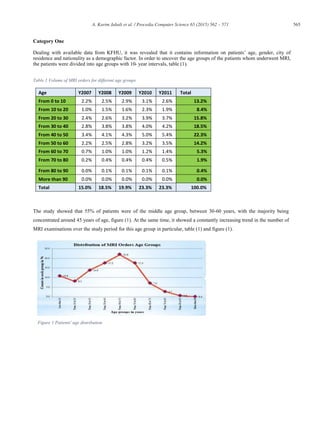
The study showed that 55% of patients were of the middle age group, between 30-60 years, with the majority being
concentrated around 45 years of age, figure (1). At the same time, it showed a constantly increasing trend in the number of
MRI examinations over the study period for this age group in particular, table (1) and figure (1).
Figure 1 Patients' age distribution
566 A. Karim Jabali et al. / Procedia Computer Science 65 (2015) 562 – 571
Another feature of MRI utilisation in this category is the spread of orders between male and female patients. In this
context, it is shown that the average distribution of MRI orders with respect to gender shows that 48.7% of scans were
prescribed for female patients and 51.3% were for male patients, table (2).
Table 2 Gender of MRI patients over 5 years
Year F M
2007 49.0% 51.0%
2008 46.8% 53.2%
2009 48.9% 51.1%
2010 48.6% 51.4%
2011 50.0% 50.0%
Average 48.7% 51.3%
These percentages correlate closely to national statistics of the population, 49.8% females and 50.2% males [17].
It was also found that Khobar city is the major city in which, 51.9% of served patients, actually live. While Dammam city
occupies only 19.8% of patients. Moreover 92.2 % of patients were from all other cities within the Eastern Province, while
7.8% only are from outside the region, table (3). This occurrence is allowed as all Saudi citizens, regardless oftheir place of
residence are eligible to be served in all governments’ hospitals.
Table 3 Patients’ Cities of residence
City Frequency Percentage
Khobar 7070 51.9%
Dammam 2701 19.8%
Dhahran 1180 8.7%
Qatif 811 6.0%
Ehsa 791 5.8%
Unknown 532 3.9%
Others 413 3.0%
Hafrulbaten 128 0.9%
Total 13626 100%
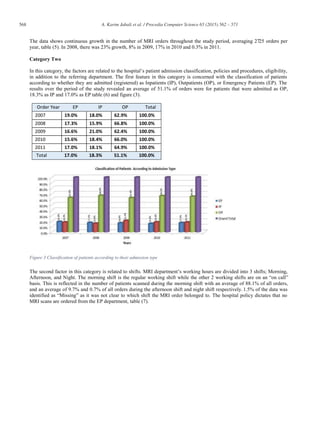
Patients who underwent MRI examinations were grouped according to their nationalities. The data show that an
average of 79.9% of the orders were for Saudi citizens and an average of 20.1% were for non-Saudis, table (4) and figure
(2).
567A. Karim Jabali et al. / Procedia Computer Science 65 (2015) 562 – 571
Figure 2 Distribution of patients into Saudis and Non-Saudis
The average growth of population for both Saudi and Non-Saudis in KSA is about 3.4% in the period of the study
[17]. Saudi citizens served in KFHU has increased from 75.37% 2007 to 81.12% in 2011 and consequently, the portion of
non-Saudi patients over the period of the study ranges from 24.0% (2007) to 18.88% (2011), table (5).
Table 4 Saudi and Non Saudi patients over 5 year
Furthermore, non-Saudi patients were classified according to their nationalities and most of them were from
Egypt, India, Sudan, Yemen, Philippines, Pakistan, and Jordan with 22.8%, 11.1%, 10.0%, 9.6%, 7.6%, 6.7%,
and 6.6% respectively, table (5) .
Table 5 Non-Saudi Patients underwent MRI
Egypt 22.8%
India 11.1%
Sudan 10.0%
Yemen 9.6%
Philippines 7.6%
Pakistan 6.7%
Jordan 6.6%
Others 25.6%
Year Non Saudi Saudi
2007 24.6% 75.4%
2008 20.0% 80.0%
2009 20.5% 79.5%
2010 18.1% 82.0%
2011 18.9% 81.1%
Average 20.1% 79.9%
568 A. Karim Jabali et al. / Procedia Computer Science 65 (2015) 562 – 571
The data shows continuous growth in the number of MRI orders throughout the study period, averaging 2725 orders per
year, table (5). In 2008, there was 23% growth, 8% in 2009, 17% in 2010 and 0.3% in 2011.
Category Two
In this category, the factors are related to the hospital’s patient admission classification, policies and procedures, eligibility,
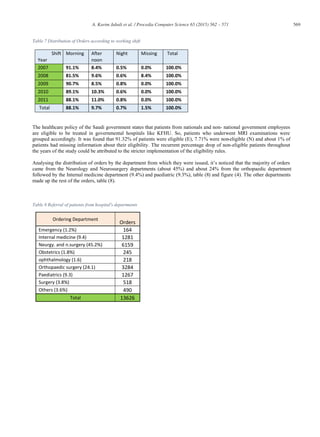
in addition to the referring department. The first feature in this category is concerned with the classification of patients
according to whether they are admitted (registered) as Inpatients (IP), Outpatients (OP), or Emergency Patients (EP). The
results over the period of the study revealed an average of 51.1% of orders were for patients that were admitted as OP,
18.3% as IP and 17.0% as EP table (6) and figure (3).
Order Year EP IP OP Total
2007 19.0% 18.0% 62.9% 100.0%
2008 17.3% 15.9% 66.8% 100.0%
2009 16.6% 21.0% 62.4% 100.0%
2010 15.6% 18.4% 66.0% 100.0%
2011 17.0% 18.1% 64.9% 100.0%
Total 17.0% 18.3% 51.1% 100.0%
Figure 3 Classification of patients according to their admission type
The second factor in this category is related to shifts. MRI department’s working hours are divided into 3 shifts; Morning,
Afternoon, and Night. The morning shift is the regular working shift while the other 2 working shifts are on an “on call”
basis. This is reflected in the number of patients scanned during the morning shift with an average of 88.1% of all orders,
and an average of 9.7% and 0.7% of all orders during the afternoon shift and night shift respectively. 1.5% of the data was
identified as “Missing” as it was not clear to which shift the MRI order belonged to. The hospital policy dictates that no
MRI scans are ordered from the EP department, table (7).
569A. Karim Jabali et al. / Procedia Computer Science 65 (2015) 562 – 571
Table 7 Distribution of Orders according to working shift
Shift
Year
Morning After
noon
Night Missing Total
2007 91.1% 8.4% 0.5% 0.0% 100.0%
2008 81.5% 9.6% 0.6% 8.4% 100.0%
2009 90.7% 8.5% 0.8% 0.0% 100.0%
2010 89.1% 10.3% 0.6% 0.0% 100.0%
2011 88.1% 11.0% 0.8% 0.0% 100.0%
Total 88.1% 9.7% 0.7% 1.5% 100.0%
The healthcare policy of the Saudi government states that patients from nationals and non- national government employees
are eligible to be treated in governmental hospitals like KFHU. So, patients who underwent MRI examinations were
grouped accordingly. It was found that 91.32% of patients were eligible (E), 7.71% were non-eligible (N) and about 1% of
patients had missing information about their eligibility. The recurrent percentage drop of non-eligible patients throughout
the years of the study could be attributed to the stricter implementation of the eligibility rules.
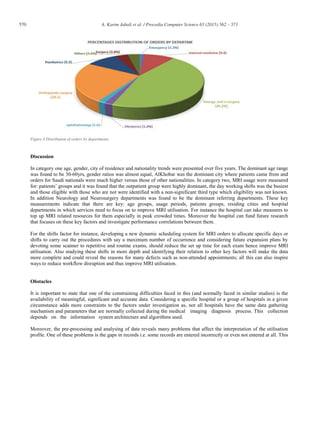
Analysing the distribution of orders by the department from which they were issued, it’s noticed that the majority of orders
came from the Neurology and Neurosurgery departments (about 45%) and about 24% from the orthopaedic department
followed by the Internal medicine department (9.4%) and paediatric (9.3%), table (8) and figure (4). The other departments
made up the rest of the orders, table (8).
Table 8 Referral of patients from hospital's departments
Ordering Department
Orders
Emergency (1.2%) 164
Internal medicine (9.4) 1281
Neurgy. and n.surgery (45.2%) 6159
Obstetrics (1.8%) 245
ophthalmology (1.6) 218
Orthopaedic surgery (24.1) 3284
Paediatrics (9.3) 1267
Surgery (3.8%) 518
Others (3.6%) 490
Total 13626
570 A. Karim Jabali et al. / Procedia Computer Science 65 (2015) 562 – 571
Figure 4 Distribution of orders by departments
Discussion
In category one age, gender, city of residence and nationality trends were presented over five years. The dominant age range
was found to be 30-60yrs, gender ratios was almost equal, AlKhobar was the dominant city where patients came from and
orders for Saudi nationals were much higher versus those of other nationalities. In category two, MRI usage were measured
for: patients’ groups and it was found that the outpatient group were highly dominant, the day working shifts was the busiest
and those eligible with those who are not were identified with a non-significant third type which eligibility was not known.
In addition Neurology and Neurosurgery departments was found to be the dominant referring departments. These key
measurements indicate that there are key: age groups, usage periods, patients groups, residing cities and hospital
departments in which services need to focus on to improve MRI utilisation. For instance the hospital can take measures to
top up MRI related resources for them especially in peak crowded times. Moreover the hospital can fund future research
that focuses on these key factors and investigate performance correlations between them.
For the shifts factor for instance, developing a new dynamic scheduling system for MRI orders to allocate specific days or
shifts to carry out the procedures with say a maximum number of occurrence and considering future expansion plans by
devoting some scanner to repetitive and routine exams, should reduce the set up time for each exam hence improve MRI
utilisation. Also studying these shifts in more depth and identifying their relation to other key factors will make the data
more complete and could reveal the reasons for many defects such as non-attended appointments; all this can also inspire
ways to reduce workflow disruption and thus improve MRI utilisation.
Obstacles
It is important to state that one of the constraining difficulties faced in this (and normally faced in similar studies) is the
availability of meaningful, significant and accurate data. Considering a specific hospital or a group of hospitals in a given
circumstance adds more constraints to the factors under investigation as, not all hospitals have the same data gathering
mechanism and parameters that are normally collected during the medical imaging diagnosis process. This collection
depends on the information system architecture and algorithms used.
Moreover, the pre-processing and analysing of data reveals many problems that affect the interpretation of the utilisation
profile. One of these problems is the gaps in records i.e. some records are entered incorrectly or even not entered at all. This
571A. Karim Jabali et al. / Procedia Computer Science 65 (2015) 562 – 571
is because the loose constraints of the health information system allow users to fill in the data using their own words instead
of using a pre-specified menu or proceeding without filling in all fields and without any alert mechanism that ought to alarm
the user to rectify entered errors.
Another problem emerges as a result of concentrating all efforts on gathering “mountains of data” among which all
meaningful and significant factors are lost. This adds more obstacles and difficulties to sorting data in a useable manner to
be deployed for research and strategic development within the hospital i.e. the hospital data gathering system is more
concerned with collecting all types of data about patients, physicians, machines and so on, without formal standard
definitions and without reference keys.
Conclusion
With some useful findings that potentially can lead to better insight into MRI utilisation, analysing the obtained database
revealed that the KFHU MRI usage throughout the period of the study could be improved substantially by improving data
collection mechanisms, including more constraints in the health information system enhancing viability and worthiness.
Working towards standardised performance measurements should focus on having an agreed reference categorisation of
factors affecting the performance with unified measurement units. The work done here is a starting point that highlight
issues and eventually will lead to standardised performance categorisation and measurements.
Future work
This research is a first step among thousand steps of concentrated effort that is needed to reach a full insight into optimal
MRI utilisation. The next step should focus on effective data collection especially for data related to the other two
categories and should also focus on effective correlations between all key dominant factors.
References:
1. RadiologyInfo.org MRI of The Body. 2015.
2. search.proquest.com, News & Newspapers, B.C. Maple Ridge , M.R. More MRI service weighed. The News, 2006. DOI: 2010-06-24.
3 euro.who.int, Guidance on developing quality and safety strategies with a health system approach, 2008, WHO Regional Office for Europe:
Copenhagen, Denmark. p. 63.
4. Thomas Wichizer, D.L., Utilization Management: Issues, Effect and Future Prospects. Annual Review of Public Health, 2002. 23: p. 233-254.
5. K. K. Yu, H. Hricak, Can MRI of the pelvis be cost effective? Abdominal Imaging, 1997. 22: p. 597-601.
6. David C. Levin, Victor Sarro, Utilization Trends Affect Proper Management of your Imaging Business. Diagnostic Imaging, 2001. 23(4): p. 49-51.
7. Nicole Glynn, William B. Morrison., Laurence Parker, Mark E. Schweitzer, John A. Carrino, Trends in utilization: has extremity MR imaging
replaced diagnostic arthroscopy? Skeletal Radiology, 2004. 33: p. 272-276.
8. Hisashige, A., MR Imaging in Japan and the United States: Analysis of Utilization and Economics. American Journal of Roentgenology, 1994.
162(3): p. 507-510.
9. Al-Mulhim FA, Ibrahim EM., Magnetic Resonance Imaging of the spine: An initial experience. Annals of Saudi Medicine 1994.
4: p. 333-337.
10. Burkhardt JH, Utilization of radiologic services in different payment systems and patient populations. Radiology, 1996. 200(1).
11. Hooker, M., Magnetic Resonance in Military Setting: A Utilization Analysis. Military Medicine, 2001. 2: p. 126-131.
12. Olsson, S., Diffusion, utilisation and regional variations in the use of CT and MRI in Sweden. Computer Methods and Programs in
Biomedicine, 2001. 66: p. 129-135.
13. Raymond C. W. Hutubessy , Piya Hanvoravongchai and Tessa Tan-Torres Edejer, Diffusion and Utilization of Magnetic Resonance Imaging in
Asia. International Journal of Technology Assessment in Health Care, 2002. 18(3.): p. 690-704.
14. Semih Semin, Yucel Demiral., Oguz Dicle, Trends in diagnostic imaging utilization in a university hospital in Turkey. International Journal
of Technology Assessment in Health Care, 2006. 22(4): p. 532-536.
15. Andrew, K., NHS Machines Utilisation of High-Value Equipment at NHS Trusts, NHS, Editor 2011: 83
Victoria Street, London SW1H 0HW. p. 38.
16. Y Hu, A. Kwok, W Jiang, N Taback, G Ting, J.C. Weeks, C.C. Greenberg, Utilization Of High Cost Imaging In Stage IV Cancer Patients –
Abstracts. Association for Academic Surgery and Society of University Surgeons, 2007
17. Saudi Arabian Statistical Year Book, 2013

mri key factor fatma

  • 1.
    Procedia Computer Science65 (2015) 562 – 571 1877-0509 © 2015 The Authors. Published by Elsevier B.V. This is an open access article under the CC BY-NC-ND license (http://creativecommons.org/licenses/by-nc-nd/4.0/). Peer-review under responsibility of Universal Society for Applied Research doi:10.1016/j.procs.2015.09.131 ScienceDirect Available online at www.sciencedirect.com International Conference on Communication, Management and Information Technology (ICCMIT 2015) Key factors influencing the usage of MRI in Saudi Arabia A.Karim Jabalia , Khalid Yousuf Faridb , Abdel-aziz Matanib , Fatma Al Mulhimc a Corresponding author, Associate Professor, Health Information Management and Technology Department, College of Applied Medical Sciences, University of Dammam, Eastern Provence, Saudi Arabia. b Assistant Professor, Radiological Sciences Department, College of Applied Medical Sciences, University of Dammam, Eastern Provence, Saudi Arabia. c Professor, Radiology Department Head, King Fahad Hospital of the University (KFHU), University of Dammam, Eastern Provence, Saudi Arabia. Abstract This article explores the current status of MRI utilisation trends in King Fahd Hospital of the University (KFHU), as one of the major government hospitals of the Eastern Province in Saudi Arabia. The study covers a period of five years (2007- 2011). The factors and indications of utilisation levels were identified, grouped and categorised according to their nature and according to their impact on MRI utilisation. Among other results it was revealed that the portion of “Non-Eligible” patients underwent MRI scan is not negligible (≈9%). The results showed serious obstacles in data collection so not all factors were found and incorporated in the analysis. Other utilisation factors of diagnostic imaging procedures- need to be considered carefully in respect to the appropriateness and effectiveness of policies and planning procedures. The outcome of this study is a start and can be benchmarked to other similar research studies in the field covering other hospitals and medical establishments in the region. Key Words: MRI, Utilisation, Teaching Hospital, Eastern Province, Saudi Arabia. Introduction Magnetic Resonance Imaging (MRI) is a form of non-invasive medical examination that greatly facilitates the diagnoses of wide-ranging medical conditions. MRI scanners do not use ionizing radiation rather they use a powerful static magnetic field, varying magnetic fields, radio frequency pulses and computer processing to produce detailed images of organs’ soft tissues and practically all other internal body structures. To be effectively utilised MR images can be displayed on the scanner’s computer monitor, transmitted electronically to workstations, printed or copied to any storage device e.g. hard drive, CD, DVD, magneto-optical and optical desks. MRI is mainly used with cases that cannot be assessed adequately with other more common and cheaper imaging modalities such as X-rays, ultrasound (US) or computed tomography (CT) [1]. With today’s escalating cost of health services coupled with economic recession in addition to the fact that Saudi healthcare system is currently being transformed from government financed and managed welfare system to a market oriented and employment based insurance driven system, there is an urgent need to re-evaluate and reduce healthcare expenditures without sacrificing the quality of patient care. Medical imaging in particular MRI is of high cost services that needs to be transformed to be more rational and more economic.
  • 2.
    563A. Karim Jabaliet al. / Procedia Computer Science 65 (2015) 562 – 571 The cost and quality of provided health services is directly linked to the proper management of the available resources [1]. Utilisation management encompasses a set of activities designed to influence the use of the health service, like MRI, and hence constrain their consumption [1]. Huge growth and rapid developments in imaging technology are raising concerns about the appropriate utilisation of available MRI services. Medical imaging, including MRI, are one of the reasons health costs are rising so rapidly and insurance that covers the cost of such service has become unaffordable for middle class people in countries like the USA for instance [1]. Because of the spiralling costs, some medical establishments have started resorting to outsourcing instead [1, 2], increasing working hours, renting MRI scanners [1] or rearranging patients’ management strategies, by separating inpatient from outpatients to cut waiting time and using paperless and PACS to reduce expenses and speed up administration work [3-5]. This change raises the need to study medical service utilisation in order to maximise efficiency and minimise expenditure. So we can say that “utilisation” is a branch of science dedicated to the measurement of how effective the use of a service, within an establishment, is compared to some predetermined reference values. Sounds common sense, dictates poor MRI use, costs time and money, but unfortunately measurement of the extent of its use, or lack of it, is not a straight forward process [6] because there is a countless number of influencing factors involved [7]. These factors differ in the degree of their influence depending on the specific case studied. Apart from a few exceptions, [5, 8] comprehensive studies related to MRI utilisation is not as common as needed in literature. Some medical establishments used computer programs to improve tracing MRI use and utilisation [6], and some specialised studies focused on emerging trends by comparing MRI utilisation with other techniques’ utilisation, such as diagnostic arthroscopy, to see if MRI is actually replacing this traditional technique, because the increase of MRI use and decrease of the particular technique use, seems to suggest so [7]. Furthermore, despite the importance and wide spread of MRI technology, the idea to investigate the utilisation profile of MRI is an almost untouched area by researchers in many developing countries. Likewise locally in KSA the topic has not been explored enough, although there are some studies that touch it indirectly as [9]. So the topics of utilisation of medical equipment, including MRI, is an emerging topic and this research work can form a crucial addition of a high value to healthcare management and technology research and exploitation in the region. Generally, physicians are not in favour of developing medical service utilisation or its managements’ activities because they see it as restrictive to their work and involves an intolerable, administrative burden. However stakeholders think otherwise and see utilisation management, although imperfect, as a necessary practice [4]. During the last two decades, conferences and symposiums were regularly held to discuss research work on different aspects and issues associated with MRI and other types of radiological imaging [10]. In most cases “cost effectiveness” is the key and knowing how to measure this factor will determine if the investment was worth it [5]. Many studies aimed to expose ineffective MRI use; for instance, it was found in a USA military study that 62% of MRI scanning to the knee was unjustified hence incurring unnecessary resources depletion [11]. In each case, as it seems, there are always dominant factors that greatly influence MRI utilisation. In countries like USA and Japan for instance, it was found that “Volume” is what makes considerable difference in effective MRI utilisation because volume is what keeps “ends meet”. So analysing the MRI volume market there is an essential action needed to help dependent organisations survive [8]. In Sweden however, it was found that in spite of a homogeneous medical care system and services across the country, effective MRI utilisation with dissemination, access and use varied tremendously from region to region. In depth research showed that the socio-demographical factors such as age variations and regional population fluctuation are what play an influencing role in this case [12]. It was concluded that the high maintenance and operating costs of MRI scanners, account for the low numbers of scanners in the country [13]. A study in Turkey that covered the trend use of MRI scanners from 1995 to 2003, recognised the factor: “utilisation rates of new diagnostic imaging procedures” such as MRI, as a key issue and emphasised that this factor needs to be considered carefully with respect to appropriateness of policies and procedures and planning of medical imaging services [14]. Most recently in the light of economic crisis faced by many countries, particularly in Europe, in the UK reports by tax payers alliance organisations are increasingly being published. These reports go deep into scrutinising government health service, including MRI utilisation, and in some cases expose, with evidence, the inadequacy of many NHS Trusts in utilising such an expensive, but essential, medical service. The main factor considered in the UK report is the relative comparison of the usage rate of scanners in different trusts [15]. In Japan, some cases have proved to be difficult to decide upon as far as MRI Utilisation is concerned, such as terminal illness cases [16].
  • 3.
    564 A. KarimJabali et al. / Procedia Computer Science 65 (2015) 562 – 571 Design and Methodology Defining a set of key factors influencing the usage of MRI equipment was a starting step toward investigating the question of the extent this medical imaging system is utilised. Therefore these factors, their relative importance and reference values were identified. Based on that, chronological institutional data records of all patients who underwent MRI scanning in KFHU over the period of study (2007-2011) were looked at. The database covers a reasonable time span and gives a sufficient insight into the problem of this research. As a necessary step, the obtained data was reviewed, cleansed and after that analytically processed using available software to explore patterns, trends, and evaluate anomalies. The factors were then categorised, according to the organised groups, with emphasis on factors related to their practicality and relevancy to the aims of this research. Subsequently, these factors were analysed in such a way that their trends and variations are looked at as a function of time. This shed some light about MRI which will be a base for further investigation. Factors Categorisation There is no published standard categorisation of the various factors affecting MRI Utilisation, as different studies used a different set of factors. In this study, factors were categorised based on their nature and their inter-relationships. They were classified into four categories: demographic, hospital, machine, and performance related. In the first category factors are directly related to the patients’ personal data e.g. age, gender, resident city, culture, nationality and marital status, the climate, wealth and living standards, population counts and location. In the second category factors are directly related to the hospital such as shifts, physicians’ ranks, type of the patient which could be in or outpatient, remote and visitor, hospital’s policies and procedures, whether public or private sectors, patient eligibility, ordering source department and so on. The third category is concerned with scanners’ specifications, type, strength, running and maintenance costs, scanners’ number, capability and scanning procedures available. The fourth and last category deals with factors such as the frequency of the carried out examinations, application of referral procedures, advanced or simple routines, waiting time between order and execution, working hours/ days, seasonal holidays, unexpected operation interruptions for technical or other reasons, data storing and processing strategies, numbers of “no-show” cases and orders status. Studying these factors especially the most influential ones and measuring the extent of their influence has been shown to be instrumental in finding the extent and level of MRI utilisation. KFHU started its service in 1981 and the first MRI (FONAR brand 0.5Tesla) was installed in 1991, ten years later. It was then replaced by a Siemen Symphony 1.5 Tesla scanner. The hospital has 470 beds and serves-besides other hospitals- the 4.1 million population of the Eastern Province and surrounding areas. Despite the fact that the available data is limited to this hospital, it is projected in future work, to widen the scope of research to include others hospitals in the region. The ultimate aim behind this study is to promote MRI services and its effective utilisation and to remove the difficulties in achieving this across all regions in the country. Also, it aims to address issues such as over and under usage and recommend to stakeholders the needed changes in MRI services within the region. Furthermore, to assist in improving regulations e.g. referral procedures, and to establish a smooth and effective workflow pattern within all hospitals. Finally to devise an effective strategy that can anticipate and maintain effective use by improving the use of resources. Results In order to be consistent with the above categorisation, the results of different factors were presented according to the category to which they belong. Only factors of the first two categories were presented here. The factors of the other two categories will be published in a follow up papers.
  • 4.
    565A. Karim Jabaliet al. / Procedia Computer Science 65 (2015) 562 – 571 Category One Dealing with available data from KFHU, it was revealed that it contains information on patients’ age, gender, city of residence and nationality as a demographic factor. In order to uncover the age groups of the patients whom underwent MRI, the patients were divided into age groups with 10- year intervals, table (1). Table 1 Volume of MRI orders for different age groups Age Y2007 Y2008 Y2009 Y2010 Y2011 Total From 0 to 10 2.2% 2.5% 2.9% 3.1% 2.6% 13.2% From 10 to 20 1.0% 1.5% 1.6% 2.3% 1.9% 8.4% From 20 to 30 2.4% 2.6% 3.2% 3.9% 3.7% 15.8% From 30 to 40 2.8% 3.8% 3.8% 4.0% 4.2% 18.5% From 40 to 50 3.4% 4.1% 4.3% 5.0% 5.4% 22.3% From 50 to 60 2.2% 2.5% 2.8% 3.2% 3.5% 14.2% From 60 to 70 0.7% 1.0% 1.0% 1.2% 1.4% 5.3% From 70 to 80 0.2% 0.4% 0.4% 0.4% 0.5% 1.9% From 80 to 90 0.0% 0.1% 0.1% 0.1% 0.1% 0.4% More than 90 0.0% 0.0% 0.0% 0.0% 0.0% 0.0% Total 15.0% 18.5% 19.9% 23.3% 23.3% 100.0% The study showed that 55% of patients were of the middle age group, between 30-60 years, with the majority being concentrated around 45 years of age, figure (1). At the same time, it showed a constantly increasing trend in the number of MRI examinations over the study period for this age group in particular, table (1) and figure (1). Figure 1 Patients' age distribution
  • 5.
    566 A. KarimJabali et al. / Procedia Computer Science 65 (2015) 562 – 571 Another feature of MRI utilisation in this category is the spread of orders between male and female patients. In this context, it is shown that the average distribution of MRI orders with respect to gender shows that 48.7% of scans were prescribed for female patients and 51.3% were for male patients, table (2). Table 2 Gender of MRI patients over 5 years Year F M 2007 49.0% 51.0% 2008 46.8% 53.2% 2009 48.9% 51.1% 2010 48.6% 51.4% 2011 50.0% 50.0% Average 48.7% 51.3% These percentages correlate closely to national statistics of the population, 49.8% females and 50.2% males [17]. It was also found that Khobar city is the major city in which, 51.9% of served patients, actually live. While Dammam city occupies only 19.8% of patients. Moreover 92.2 % of patients were from all other cities within the Eastern Province, while 7.8% only are from outside the region, table (3). This occurrence is allowed as all Saudi citizens, regardless oftheir place of residence are eligible to be served in all governments’ hospitals. Table 3 Patients’ Cities of residence City Frequency Percentage Khobar 7070 51.9% Dammam 2701 19.8% Dhahran 1180 8.7% Qatif 811 6.0% Ehsa 791 5.8% Unknown 532 3.9% Others 413 3.0% Hafrulbaten 128 0.9% Total 13626 100% Patients who underwent MRI examinations were grouped according to their nationalities. The data show that an average of 79.9% of the orders were for Saudi citizens and an average of 20.1% were for non-Saudis, table (4) and figure (2).
  • 6.
    567A. Karim Jabaliet al. / Procedia Computer Science 65 (2015) 562 – 571 Figure 2 Distribution of patients into Saudis and Non-Saudis The average growth of population for both Saudi and Non-Saudis in KSA is about 3.4% in the period of the study [17]. Saudi citizens served in KFHU has increased from 75.37% 2007 to 81.12% in 2011 and consequently, the portion of non-Saudi patients over the period of the study ranges from 24.0% (2007) to 18.88% (2011), table (5). Table 4 Saudi and Non Saudi patients over 5 year Furthermore, non-Saudi patients were classified according to their nationalities and most of them were from Egypt, India, Sudan, Yemen, Philippines, Pakistan, and Jordan with 22.8%, 11.1%, 10.0%, 9.6%, 7.6%, 6.7%, and 6.6% respectively, table (5) . Table 5 Non-Saudi Patients underwent MRI Egypt 22.8% India 11.1% Sudan 10.0% Yemen 9.6% Philippines 7.6% Pakistan 6.7% Jordan 6.6% Others 25.6% Year Non Saudi Saudi 2007 24.6% 75.4% 2008 20.0% 80.0% 2009 20.5% 79.5% 2010 18.1% 82.0% 2011 18.9% 81.1% Average 20.1% 79.9%
  • 7.
    568 A. KarimJabali et al. / Procedia Computer Science 65 (2015) 562 – 571 The data shows continuous growth in the number of MRI orders throughout the study period, averaging 2725 orders per year, table (5). In 2008, there was 23% growth, 8% in 2009, 17% in 2010 and 0.3% in 2011. Category Two In this category, the factors are related to the hospital’s patient admission classification, policies and procedures, eligibility, in addition to the referring department. The first feature in this category is concerned with the classification of patients according to whether they are admitted (registered) as Inpatients (IP), Outpatients (OP), or Emergency Patients (EP). The results over the period of the study revealed an average of 51.1% of orders were for patients that were admitted as OP, 18.3% as IP and 17.0% as EP table (6) and figure (3). Order Year EP IP OP Total 2007 19.0% 18.0% 62.9% 100.0% 2008 17.3% 15.9% 66.8% 100.0% 2009 16.6% 21.0% 62.4% 100.0% 2010 15.6% 18.4% 66.0% 100.0% 2011 17.0% 18.1% 64.9% 100.0% Total 17.0% 18.3% 51.1% 100.0% Figure 3 Classification of patients according to their admission type The second factor in this category is related to shifts. MRI department’s working hours are divided into 3 shifts; Morning, Afternoon, and Night. The morning shift is the regular working shift while the other 2 working shifts are on an “on call” basis. This is reflected in the number of patients scanned during the morning shift with an average of 88.1% of all orders, and an average of 9.7% and 0.7% of all orders during the afternoon shift and night shift respectively. 1.5% of the data was identified as “Missing” as it was not clear to which shift the MRI order belonged to. The hospital policy dictates that no MRI scans are ordered from the EP department, table (7).
  • 8.
    569A. Karim Jabaliet al. / Procedia Computer Science 65 (2015) 562 – 571 Table 7 Distribution of Orders according to working shift Shift Year Morning After noon Night Missing Total 2007 91.1% 8.4% 0.5% 0.0% 100.0% 2008 81.5% 9.6% 0.6% 8.4% 100.0% 2009 90.7% 8.5% 0.8% 0.0% 100.0% 2010 89.1% 10.3% 0.6% 0.0% 100.0% 2011 88.1% 11.0% 0.8% 0.0% 100.0% Total 88.1% 9.7% 0.7% 1.5% 100.0% The healthcare policy of the Saudi government states that patients from nationals and non- national government employees are eligible to be treated in governmental hospitals like KFHU. So, patients who underwent MRI examinations were grouped accordingly. It was found that 91.32% of patients were eligible (E), 7.71% were non-eligible (N) and about 1% of patients had missing information about their eligibility. The recurrent percentage drop of non-eligible patients throughout the years of the study could be attributed to the stricter implementation of the eligibility rules. Analysing the distribution of orders by the department from which they were issued, it’s noticed that the majority of orders came from the Neurology and Neurosurgery departments (about 45%) and about 24% from the orthopaedic department followed by the Internal medicine department (9.4%) and paediatric (9.3%), table (8) and figure (4). The other departments made up the rest of the orders, table (8). Table 8 Referral of patients from hospital's departments Ordering Department Orders Emergency (1.2%) 164 Internal medicine (9.4) 1281 Neurgy. and n.surgery (45.2%) 6159 Obstetrics (1.8%) 245 ophthalmology (1.6) 218 Orthopaedic surgery (24.1) 3284 Paediatrics (9.3) 1267 Surgery (3.8%) 518 Others (3.6%) 490 Total 13626
  • 9.
    570 A. KarimJabali et al. / Procedia Computer Science 65 (2015) 562 – 571 Figure 4 Distribution of orders by departments Discussion In category one age, gender, city of residence and nationality trends were presented over five years. The dominant age range was found to be 30-60yrs, gender ratios was almost equal, AlKhobar was the dominant city where patients came from and orders for Saudi nationals were much higher versus those of other nationalities. In category two, MRI usage were measured for: patients’ groups and it was found that the outpatient group were highly dominant, the day working shifts was the busiest and those eligible with those who are not were identified with a non-significant third type which eligibility was not known. In addition Neurology and Neurosurgery departments was found to be the dominant referring departments. These key measurements indicate that there are key: age groups, usage periods, patients groups, residing cities and hospital departments in which services need to focus on to improve MRI utilisation. For instance the hospital can take measures to top up MRI related resources for them especially in peak crowded times. Moreover the hospital can fund future research that focuses on these key factors and investigate performance correlations between them. For the shifts factor for instance, developing a new dynamic scheduling system for MRI orders to allocate specific days or shifts to carry out the procedures with say a maximum number of occurrence and considering future expansion plans by devoting some scanner to repetitive and routine exams, should reduce the set up time for each exam hence improve MRI utilisation. Also studying these shifts in more depth and identifying their relation to other key factors will make the data more complete and could reveal the reasons for many defects such as non-attended appointments; all this can also inspire ways to reduce workflow disruption and thus improve MRI utilisation. Obstacles It is important to state that one of the constraining difficulties faced in this (and normally faced in similar studies) is the availability of meaningful, significant and accurate data. Considering a specific hospital or a group of hospitals in a given circumstance adds more constraints to the factors under investigation as, not all hospitals have the same data gathering mechanism and parameters that are normally collected during the medical imaging diagnosis process. This collection depends on the information system architecture and algorithms used. Moreover, the pre-processing and analysing of data reveals many problems that affect the interpretation of the utilisation profile. One of these problems is the gaps in records i.e. some records are entered incorrectly or even not entered at all. This
  • 10.
    571A. Karim Jabaliet al. / Procedia Computer Science 65 (2015) 562 – 571 is because the loose constraints of the health information system allow users to fill in the data using their own words instead of using a pre-specified menu or proceeding without filling in all fields and without any alert mechanism that ought to alarm the user to rectify entered errors. Another problem emerges as a result of concentrating all efforts on gathering “mountains of data” among which all meaningful and significant factors are lost. This adds more obstacles and difficulties to sorting data in a useable manner to be deployed for research and strategic development within the hospital i.e. the hospital data gathering system is more concerned with collecting all types of data about patients, physicians, machines and so on, without formal standard definitions and without reference keys. Conclusion With some useful findings that potentially can lead to better insight into MRI utilisation, analysing the obtained database revealed that the KFHU MRI usage throughout the period of the study could be improved substantially by improving data collection mechanisms, including more constraints in the health information system enhancing viability and worthiness. Working towards standardised performance measurements should focus on having an agreed reference categorisation of factors affecting the performance with unified measurement units. The work done here is a starting point that highlight issues and eventually will lead to standardised performance categorisation and measurements. Future work This research is a first step among thousand steps of concentrated effort that is needed to reach a full insight into optimal MRI utilisation. The next step should focus on effective data collection especially for data related to the other two categories and should also focus on effective correlations between all key dominant factors. References: 1. RadiologyInfo.org MRI of The Body. 2015. 2. search.proquest.com, News & Newspapers, B.C. Maple Ridge , M.R. More MRI service weighed. The News, 2006. DOI: 2010-06-24. 3 euro.who.int, Guidance on developing quality and safety strategies with a health system approach, 2008, WHO Regional Office for Europe: Copenhagen, Denmark. p. 63. 4. Thomas Wichizer, D.L., Utilization Management: Issues, Effect and Future Prospects. Annual Review of Public Health, 2002. 23: p. 233-254. 5. K. K. Yu, H. Hricak, Can MRI of the pelvis be cost effective? Abdominal Imaging, 1997. 22: p. 597-601. 6. David C. Levin, Victor Sarro, Utilization Trends Affect Proper Management of your Imaging Business. Diagnostic Imaging, 2001. 23(4): p. 49-51. 7. Nicole Glynn, William B. Morrison., Laurence Parker, Mark E. Schweitzer, John A. Carrino, Trends in utilization: has extremity MR imaging replaced diagnostic arthroscopy? Skeletal Radiology, 2004. 33: p. 272-276. 8. Hisashige, A., MR Imaging in Japan and the United States: Analysis of Utilization and Economics. American Journal of Roentgenology, 1994. 162(3): p. 507-510. 9. Al-Mulhim FA, Ibrahim EM., Magnetic Resonance Imaging of the spine: An initial experience. Annals of Saudi Medicine 1994. 4: p. 333-337. 10. Burkhardt JH, Utilization of radiologic services in different payment systems and patient populations. Radiology, 1996. 200(1). 11. Hooker, M., Magnetic Resonance in Military Setting: A Utilization Analysis. Military Medicine, 2001. 2: p. 126-131. 12. Olsson, S., Diffusion, utilisation and regional variations in the use of CT and MRI in Sweden. Computer Methods and Programs in Biomedicine, 2001. 66: p. 129-135. 13. Raymond C. W. Hutubessy , Piya Hanvoravongchai and Tessa Tan-Torres Edejer, Diffusion and Utilization of Magnetic Resonance Imaging in Asia. International Journal of Technology Assessment in Health Care, 2002. 18(3.): p. 690-704. 14. Semih Semin, Yucel Demiral., Oguz Dicle, Trends in diagnostic imaging utilization in a university hospital in Turkey. International Journal of Technology Assessment in Health Care, 2006. 22(4): p. 532-536. 15. Andrew, K., NHS Machines Utilisation of High-Value Equipment at NHS Trusts, NHS, Editor 2011: 83 Victoria Street, London SW1H 0HW. p. 38. 16. Y Hu, A. Kwok, W Jiang, N Taback, G Ting, J.C. Weeks, C.C. Greenberg, Utilization Of High Cost Imaging In Stage IV Cancer Patients – Abstracts. Association for Academic Surgery and Society of University Surgeons, 2007 17. Saudi Arabian Statistical Year Book, 2013