Accessibility & Acceptability
Effectively Reaching Communities


                      Jo A Valentine , MSW
      Associate Director, Office of Health Equity
   Division of STD Prevention, NCHHSTP

                                January 2012


    National Center for HIV/AIDS, Viral Hepatitis, STD, and TB Prevention
    Place Division name here
“It is a peculiar sensation, this double-
consciousness, this sense of always
looking at one’s self through the eyes of
others, of measuring one’s soul by the tape
of a world that looks on in amused
contempt and pity.”
                        WEB Dubois, 1965
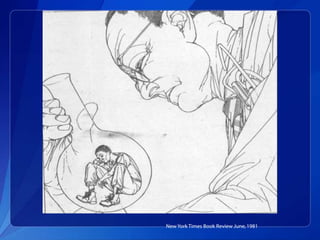
New York Times Book Review June, 1981
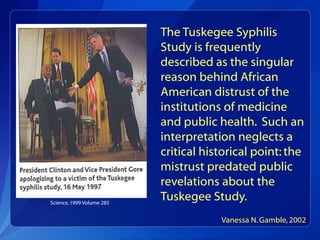
The Tuskegee Syphilis
                           Study is frequently
                           described as the singular
                           reason behind African
                           American distrust of the
                           institutions of medicine
                           and public health. Such an
                           interpretation neglects a
                           critical historical point: the
                           mistrust predated public
                           revelations about the
Science, 1999 Volume 285
                           Tuskegee Study.
                                       Vanessa N. Gamble, 2002
Framing STD Disparities—Historical Context
                        Early 20th Century
“The Negro men love to frolic with the women; and the
women love to frolic with the men; so they frolic.”

“The gravest problem to be faced in dealing with the Negro is
not his or her industrial future or right to social equality with
the white man or woman. It is the danger to the public of his
or her contagiousness and infections from the standpoint of
physical and moral disease.”

Myers, NJ. Black Hearts: The Development of Black Sexuality in America. British
Columbia, Vancouver, Canada, Trafford Publishing, 2003.
What We Were Told…..
“We don’t criticize the existence of     “There is a real dearth of
the government’s figures, but their      scientifically arrived at
accuracy is not good because             knowledge of the social
their statistics are derived from        organization of blacks in
studies only of those who are            America because there is no
treated in public clinics.”              such thing as a monolithic
                                         black community.”

“There is some over-reporting from
public clinics in the data we have and
there are a number of biases in the
                                         “If we frame the programs to
data, but syphilis surveillance and      focus on blacks in the south,
reporting is better than for gonorrhea   then it will go nowhere
and Chlamydia.”                          among blacks in the south.”
“Healthy Cultural Paranoia”

In the book, Black Rage, the authors described the
tendency to be suspicious of or distrust institutions
or agencies regarded as being “white” as “healthy
cultural paranoia” that African Americans have
developed over generations in response to racism,
oppression, and discrimination

Grier and Cobbs, 1980
“The nine most terrifying words in
the English language are: I’m from
the government and I’m here to
help.”

Ronald Reagan, Chicago, August 12, 1986
Some Lessons Learned about Reducing STD Disparities
Multiple factors contribute to STD disparities including
  social determinants, e.g.:
   – Racial inequality
   – High levels of uninsured
   – Low educational attainment
   – High incarceration rates

• To address STD disparities, involvement of affected
  communities at all steps in the process is required
   – Appropriate framing to minimize stigma

• Integration of strategies with HIV essential to maximize
  impact
   – “people should look into what can be done to break
     down the silos of overlapping epidemics…”
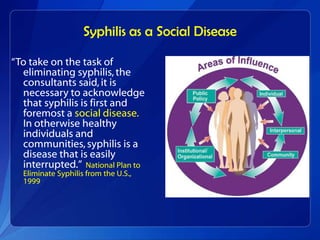
Syphilis as a Social Disease

“To take on the task of
  eliminating syphilis, the
  consultants said, it is
  necessary to acknowledge
  that syphilis is first and
  foremost a social disease.
  In otherwise healthy
  individuals and
  communities, syphilis is a
  disease that is easily
  interrupted.” National Plan to
  Eliminate Syphilis from the U.S.,
  1999
Community Involvement & Organizational
                  Partnerships
• Acknowledgement & response to the effects of
  racism, poverty, & other social issues on the
  persistence of syphilis
• Development & maintenance of partnerships to
  increase access to prevention & care services
• Assurance that affected communities are
  collaborative partners in developing, delivering, &
  evaluating interventions
The Value of
                Community Involvement
The involvement of affected communities can:
• facilitate more effective communication;
• restore, build, and maintain trust;
• improve access to utilization of services;
• ensure the development of culturally competent
  interventions; and
• mobilize participation to develop community capacity to
  eliminate syphilis.
Defining Community Participation


• Advise and Consent

• Endorse and Cooperate

• Advise, Guide, Support, Execute

• Define, Decide, Design, Analyze, and Interpret

            Hatch, et.al, 1993
“Upstream Solutions”
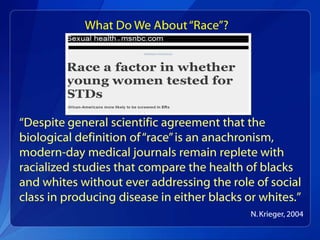
What Do We About “Race”?


“Despite general scientific agreement that the
biological definition of “race” is an anachronism,
modern-day medical journals remain replete with
racialized studies that compare the health of blacks
and whites without ever addressing the role of social
class in producing disease in either blacks or whites.”
                                             N. Krieger, 2004
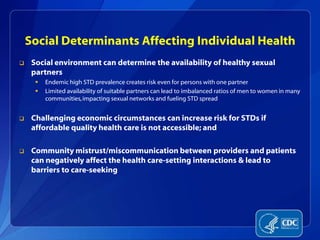
Social Determinants Affecting Individual Health
    Social environment can determine the availability of healthy sexual
     partners
         Endemic high STD prevalence creates risk even for persons with one partner
         Limited availability of suitable partners can lead to imbalanced ratios of men to women in many
          communities, impacting sexual networks and fueling STD spread


    Challenging economic circumstances can increase risk for STDs if
     affordable quality health care is not accessible; and

    Community mistrust/miscommunication between providers and patients
     can negatively affect the health care-setting interactions & lead to
     barriers to care-seeking
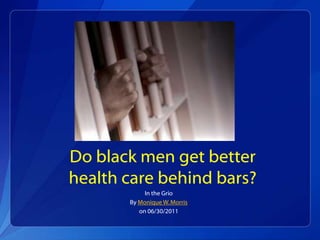
Do black men get better
health care behind bars?
            In the Grio
       By Monique W. Morris
          on 06/30/2011
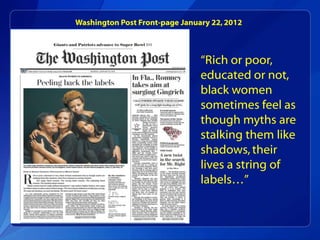
Washington Post Front-page January 22, 2012


                                “Rich or poor,
                                educated or not,
                                black women
                                sometimes feel as
                                though myths are
                                stalking them like
                                shadows, their
                                lives a string of
                                labels…”
“Take those like us who are willing
  to share and say we’ve had
  enough. We see what you’re
  doing. Let us be part of the
  reforms.”
           Male Inmate, Guilford County, NC March 1998
For more information please contact Centers for
Disease Control and Prevention

1600 Clifton Road NE, Atlanta, GA 30333
Telephone: 1-800-CDC-INFO (232-4636)/TTY: 1-888-232-6348
E-mail: cdcinfo@cdc.gov         Web: http://www.cdc.gov

The findings and conclusions in this report are those of the authors and do not necessarily
represent the official position of the Centers for Disease Control and Prevention.

               National Center for HIV/AIDS, Viral Hepatitis, STD, and TB Prevention
               Place Division name here

Accessibility & Acceptability Effectively Reaching Communities

  • 1.
    Accessibility & Acceptability EffectivelyReaching Communities Jo A Valentine , MSW Associate Director, Office of Health Equity Division of STD Prevention, NCHHSTP January 2012 National Center for HIV/AIDS, Viral Hepatitis, STD, and TB Prevention Place Division name here
  • 2.
    “It is apeculiar sensation, this double- consciousness, this sense of always looking at one’s self through the eyes of others, of measuring one’s soul by the tape of a world that looks on in amused contempt and pity.” WEB Dubois, 1965
  • 3.
    New York TimesBook Review June, 1981
  • 4.
    The Tuskegee Syphilis Study is frequently described as the singular reason behind African American distrust of the institutions of medicine and public health. Such an interpretation neglects a critical historical point: the mistrust predated public revelations about the Science, 1999 Volume 285 Tuskegee Study. Vanessa N. Gamble, 2002
  • 5.
    Framing STD Disparities—HistoricalContext Early 20th Century “The Negro men love to frolic with the women; and the women love to frolic with the men; so they frolic.” “The gravest problem to be faced in dealing with the Negro is not his or her industrial future or right to social equality with the white man or woman. It is the danger to the public of his or her contagiousness and infections from the standpoint of physical and moral disease.” Myers, NJ. Black Hearts: The Development of Black Sexuality in America. British Columbia, Vancouver, Canada, Trafford Publishing, 2003.
  • 6.
    What We WereTold….. “We don’t criticize the existence of “There is a real dearth of the government’s figures, but their scientifically arrived at accuracy is not good because knowledge of the social their statistics are derived from organization of blacks in studies only of those who are America because there is no treated in public clinics.” such thing as a monolithic black community.” “There is some over-reporting from public clinics in the data we have and there are a number of biases in the “If we frame the programs to data, but syphilis surveillance and focus on blacks in the south, reporting is better than for gonorrhea then it will go nowhere and Chlamydia.” among blacks in the south.”
  • 7.
    “Healthy Cultural Paranoia” Inthe book, Black Rage, the authors described the tendency to be suspicious of or distrust institutions or agencies regarded as being “white” as “healthy cultural paranoia” that African Americans have developed over generations in response to racism, oppression, and discrimination Grier and Cobbs, 1980
  • 8.
    “The nine mostterrifying words in the English language are: I’m from the government and I’m here to help.” Ronald Reagan, Chicago, August 12, 1986
  • 10.
    Some Lessons Learnedabout Reducing STD Disparities Multiple factors contribute to STD disparities including social determinants, e.g.: – Racial inequality – High levels of uninsured – Low educational attainment – High incarceration rates • To address STD disparities, involvement of affected communities at all steps in the process is required – Appropriate framing to minimize stigma • Integration of strategies with HIV essential to maximize impact – “people should look into what can be done to break down the silos of overlapping epidemics…”
  • 11.
    Syphilis as aSocial Disease “To take on the task of eliminating syphilis, the consultants said, it is necessary to acknowledge that syphilis is first and foremost a social disease. In otherwise healthy individuals and communities, syphilis is a disease that is easily interrupted.” National Plan to Eliminate Syphilis from the U.S., 1999
  • 12.
    Community Involvement &Organizational Partnerships • Acknowledgement & response to the effects of racism, poverty, & other social issues on the persistence of syphilis • Development & maintenance of partnerships to increase access to prevention & care services • Assurance that affected communities are collaborative partners in developing, delivering, & evaluating interventions
  • 13.
    The Value of Community Involvement The involvement of affected communities can: • facilitate more effective communication; • restore, build, and maintain trust; • improve access to utilization of services; • ensure the development of culturally competent interventions; and • mobilize participation to develop community capacity to eliminate syphilis.
  • 14.
    Defining Community Participation •Advise and Consent • Endorse and Cooperate • Advise, Guide, Support, Execute • Define, Decide, Design, Analyze, and Interpret Hatch, et.al, 1993
  • 15.
  • 16.
    What Do WeAbout “Race”? “Despite general scientific agreement that the biological definition of “race” is an anachronism, modern-day medical journals remain replete with racialized studies that compare the health of blacks and whites without ever addressing the role of social class in producing disease in either blacks or whites.” N. Krieger, 2004
  • 17.
    Social Determinants AffectingIndividual Health  Social environment can determine the availability of healthy sexual partners  Endemic high STD prevalence creates risk even for persons with one partner  Limited availability of suitable partners can lead to imbalanced ratios of men to women in many communities, impacting sexual networks and fueling STD spread  Challenging economic circumstances can increase risk for STDs if affordable quality health care is not accessible; and  Community mistrust/miscommunication between providers and patients can negatively affect the health care-setting interactions & lead to barriers to care-seeking
  • 18.
    Do black menget better health care behind bars? In the Grio By Monique W. Morris on 06/30/2011
  • 19.
    Washington Post Front-pageJanuary 22, 2012 “Rich or poor, educated or not, black women sometimes feel as though myths are stalking them like shadows, their lives a string of labels…”
  • 20.
    “Take those likeus who are willing to share and say we’ve had enough. We see what you’re doing. Let us be part of the reforms.” Male Inmate, Guilford County, NC March 1998
  • 21.
    For more informationplease contact Centers for Disease Control and Prevention 1600 Clifton Road NE, Atlanta, GA 30333 Telephone: 1-800-CDC-INFO (232-4636)/TTY: 1-888-232-6348 E-mail: cdcinfo@cdc.gov Web: http://www.cdc.gov The findings and conclusions in this report are those of the authors and do not necessarily represent the official position of the Centers for Disease Control and Prevention. National Center for HIV/AIDS, Viral Hepatitis, STD, and TB Prevention Place Division name here