FINANCIAL LITERACY PROGRAM A THREE-YEAR GROWTH STRATEGY Grace Baranowski ACCESS Development Services
Overview of Workshop Content Credit linkage strategies Numeracy Addition, subtraction, multiplication, division Symbol budget Teaching skills
Why does ACCESS need this? ACCESS has developed advanced agricultural practices to increase ginger yield. ACCESS expects farmers to manage their own Producer Company in the future. Yet this requires financial skills that the farmers lack.
The members and directors of the PC are the ginger farmers themselves.
Review of Pilot Workshop July 5, 14, 15
Pilot Program Overview 8 women from 4 SHGs 5 consecutive days One lesson per day Carefully planned curriculum 12 women, 6 SHGs 3 nonconsecutive days Consolidated lessons Workshop as much a class as a laboratory Original Plan Actual
July 5 – Credit Linkage Strategies 4 banker-borrower skits: women council the banker whether or not to grant the loan to the borrower Assemble credit linkage necklaces
To test comprehension and build confidence, I asked for a volunteer to explain the lesson to the teacher.
July 14 – Numeracy and Arithmetic Introduced number system with Snakes and Ladders Reviewed numbers on chalkboard Completed basic arithmetic exercises with seeds and cardboard cartons
In spite of little prior experience, the women learned quickly and helped each other.
July 15 – Budget and Teaching Skills Reviewed number system and basic arithmetic. Introduced symbol-based budget. Discussed techniques for teaching peers.
Symbol Budget    Food    Clothing    Transportation    Medicine    Education    Festivals/Weddings    Livestock     Housing Costs
The women demonstrated teaching skills by presenting budget examples to the class.
Total Reach of Pilot Program Represented Self Help Groups (SHGs) Number of Members Ambika 15 Avri Mata 18 Durga 20 Lakshmi 18 Parvati 12 Satnam 12 Total 95
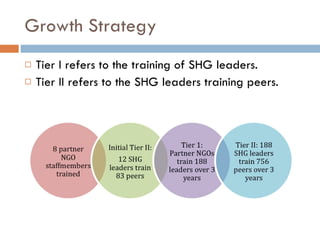
How to Complete Pilot Program Train 8 partner NGO staff members. Partner NGOs meet once with the SHG leaders to reinforce workshop lessons and schedule the next stage of lessons. The 12 leaders of the 6 SHGs teach their 83 peers in 6 separate workshops in the villages.
Schedule for Tier I and NGO Trainings Time Activity 11 – 2 pm Lesson 1 (credit linkage) 2 – 2:30 pm Lunch 2:30 – 5:30 pm Lessons 2-4 (numeracy and arithmetic) 5:30 – 5:45 pm Chai 5:45 – 7:45 pm Lessons 5-6 (multiplication and division) 7:45 – 8:15 pm Dinner Participants stay overnight Lodging at partner NGO office space. 9 – 11:30 am Lesson 7 (symbol budget) 11:30 – 11:45 am Chai 11:45 – 2:30 pm Lesson 8 (teaching skills) 2:30 – 3 pm Lunch
Quantitative Evaluation Strategies How many participants have discontinued lending from unsafe venders 3 months after the workshop? How many participants can correctly complete the basic math that the budget booklet requires?  How many of the participants are still using their personal budget 3 months after the workshop?
Growth Strategy Tier I refers to the training of SHG leaders. Tier II refers to the SHG leaders training peers.
Three-Year Participant Breakdown Year of Project 0 I II III Targeted SHG Leaders (2 per Group) 12 62 62 64 Targeted SHG Groups 6 31 31 32 Targeted SHG Peers  83 248 248 250 Total Trained 95 310 310 320 Progressive Total Members 95 405 715 1035 Progressive Total Groups 6 37 68 100
Participant Benefits Avoid losing money to the village moneylender or other unsafe lending options. Knowing one’s income prevents unnecessary spending. Participants said keeping a budget would keep them from getting cheated. If each participant is in contact with 3 families, each containing 12 people, one person could transfer information to 54 people.
Cost of Program Total cost of program is under Rs.215,000. Cost per participant is about Rs.213. Year of Project 0 I II III Cost per Year 17,259.25 65,800 65,800 65,800 Progressive Cost Total 17,259.25 83,059.25 148,859.25 214,659.25
Future Growth – Gender Relations Originally composed for an all-female audience – female literacy rate less than a third that of men. The SHG ratio is currently 80/20 male/female. Encourage participants to consider questions of gender roles throughout workshop. Push for a quota of female PC directors.
Future Growth – Math Education Math can only be introduced in a matter of days. Partner NGOs will incorporate math lessons into monthly meetings and check that participants have kept their symbol budgets. One partner NGO has already agreed to have participants keep their own SHG records.  Partner NGOs will also encourage participants to play math games on their own.
Future PC sustainability requires this project. Without financial skills, the farmers won’t be able to manage the PC business operations. This program also addresses the education gap between men and women. Low cost brings high impact.
Thank you!

ACCESS Financial Literacy Program Proposal

  • 1.
    FINANCIAL LITERACY PROGRAMA THREE-YEAR GROWTH STRATEGY Grace Baranowski ACCESS Development Services
  • 2.
    Overview of WorkshopContent Credit linkage strategies Numeracy Addition, subtraction, multiplication, division Symbol budget Teaching skills
  • 3.
    Why does ACCESSneed this? ACCESS has developed advanced agricultural practices to increase ginger yield. ACCESS expects farmers to manage their own Producer Company in the future. Yet this requires financial skills that the farmers lack.
  • 4.
    The members anddirectors of the PC are the ginger farmers themselves.
  • 5.
    Review of PilotWorkshop July 5, 14, 15
  • 6.
    Pilot Program Overview8 women from 4 SHGs 5 consecutive days One lesson per day Carefully planned curriculum 12 women, 6 SHGs 3 nonconsecutive days Consolidated lessons Workshop as much a class as a laboratory Original Plan Actual
  • 7.
    July 5 –Credit Linkage Strategies 4 banker-borrower skits: women council the banker whether or not to grant the loan to the borrower Assemble credit linkage necklaces
  • 8.
    To test comprehensionand build confidence, I asked for a volunteer to explain the lesson to the teacher.
  • 9.
    July 14 –Numeracy and Arithmetic Introduced number system with Snakes and Ladders Reviewed numbers on chalkboard Completed basic arithmetic exercises with seeds and cardboard cartons
  • 10.
    In spite oflittle prior experience, the women learned quickly and helped each other.
  • 11.
    July 15 –Budget and Teaching Skills Reviewed number system and basic arithmetic. Introduced symbol-based budget. Discussed techniques for teaching peers.
  • 12.
    Symbol Budget  Food  Clothing  Transportation  Medicine  Education  Festivals/Weddings  Livestock    Housing Costs
  • 13.
    The women demonstratedteaching skills by presenting budget examples to the class.
  • 14.
    Total Reach ofPilot Program Represented Self Help Groups (SHGs) Number of Members Ambika 15 Avri Mata 18 Durga 20 Lakshmi 18 Parvati 12 Satnam 12 Total 95
  • 15.
    How to CompletePilot Program Train 8 partner NGO staff members. Partner NGOs meet once with the SHG leaders to reinforce workshop lessons and schedule the next stage of lessons. The 12 leaders of the 6 SHGs teach their 83 peers in 6 separate workshops in the villages.
  • 16.
    Schedule for TierI and NGO Trainings Time Activity 11 – 2 pm Lesson 1 (credit linkage) 2 – 2:30 pm Lunch 2:30 – 5:30 pm Lessons 2-4 (numeracy and arithmetic) 5:30 – 5:45 pm Chai 5:45 – 7:45 pm Lessons 5-6 (multiplication and division) 7:45 – 8:15 pm Dinner Participants stay overnight Lodging at partner NGO office space. 9 – 11:30 am Lesson 7 (symbol budget) 11:30 – 11:45 am Chai 11:45 – 2:30 pm Lesson 8 (teaching skills) 2:30 – 3 pm Lunch
  • 17.
    Quantitative Evaluation StrategiesHow many participants have discontinued lending from unsafe venders 3 months after the workshop? How many participants can correctly complete the basic math that the budget booklet requires? How many of the participants are still using their personal budget 3 months after the workshop?
  • 18.
    Growth Strategy TierI refers to the training of SHG leaders. Tier II refers to the SHG leaders training peers.
  • 19.
    Three-Year Participant BreakdownYear of Project 0 I II III Targeted SHG Leaders (2 per Group) 12 62 62 64 Targeted SHG Groups 6 31 31 32 Targeted SHG Peers 83 248 248 250 Total Trained 95 310 310 320 Progressive Total Members 95 405 715 1035 Progressive Total Groups 6 37 68 100
  • 20.
    Participant Benefits Avoidlosing money to the village moneylender or other unsafe lending options. Knowing one’s income prevents unnecessary spending. Participants said keeping a budget would keep them from getting cheated. If each participant is in contact with 3 families, each containing 12 people, one person could transfer information to 54 people.
  • 21.
    Cost of ProgramTotal cost of program is under Rs.215,000. Cost per participant is about Rs.213. Year of Project 0 I II III Cost per Year 17,259.25 65,800 65,800 65,800 Progressive Cost Total 17,259.25 83,059.25 148,859.25 214,659.25
  • 22.
    Future Growth –Gender Relations Originally composed for an all-female audience – female literacy rate less than a third that of men. The SHG ratio is currently 80/20 male/female. Encourage participants to consider questions of gender roles throughout workshop. Push for a quota of female PC directors.
  • 23.
    Future Growth –Math Education Math can only be introduced in a matter of days. Partner NGOs will incorporate math lessons into monthly meetings and check that participants have kept their symbol budgets. One partner NGO has already agreed to have participants keep their own SHG records. Partner NGOs will also encourage participants to play math games on their own.
  • 24.
    Future PC sustainabilityrequires this project. Without financial skills, the farmers won’t be able to manage the PC business operations. This program also addresses the education gap between men and women. Low cost brings high impact.
  • 25.