#ChannelWeek
Accelerate Your Partners’ Digital Transformation
With Point-Based Rewards
SPONSORED BY:
#ChannelWeek
Covering The Latest Channel
News, Trends & Strategies
channelmarketerreport.com
twitter.com/channelmktr
https://dg-r.co/ChannelMarketer
Your Source For The Latest B2B
Marketing News & Trends
demandgenreport.com
twitter.com/DG_Report
https://dg-r.co/DG-Specialists
February 25–27, 2019
SAVE THE DATE:
Join Our B2BMXperts community:
b2bmx.influitive.com/join/now
Hyatt Regency, Scottsdale
www.b2bmarketing.exchange
#ChannelWeek
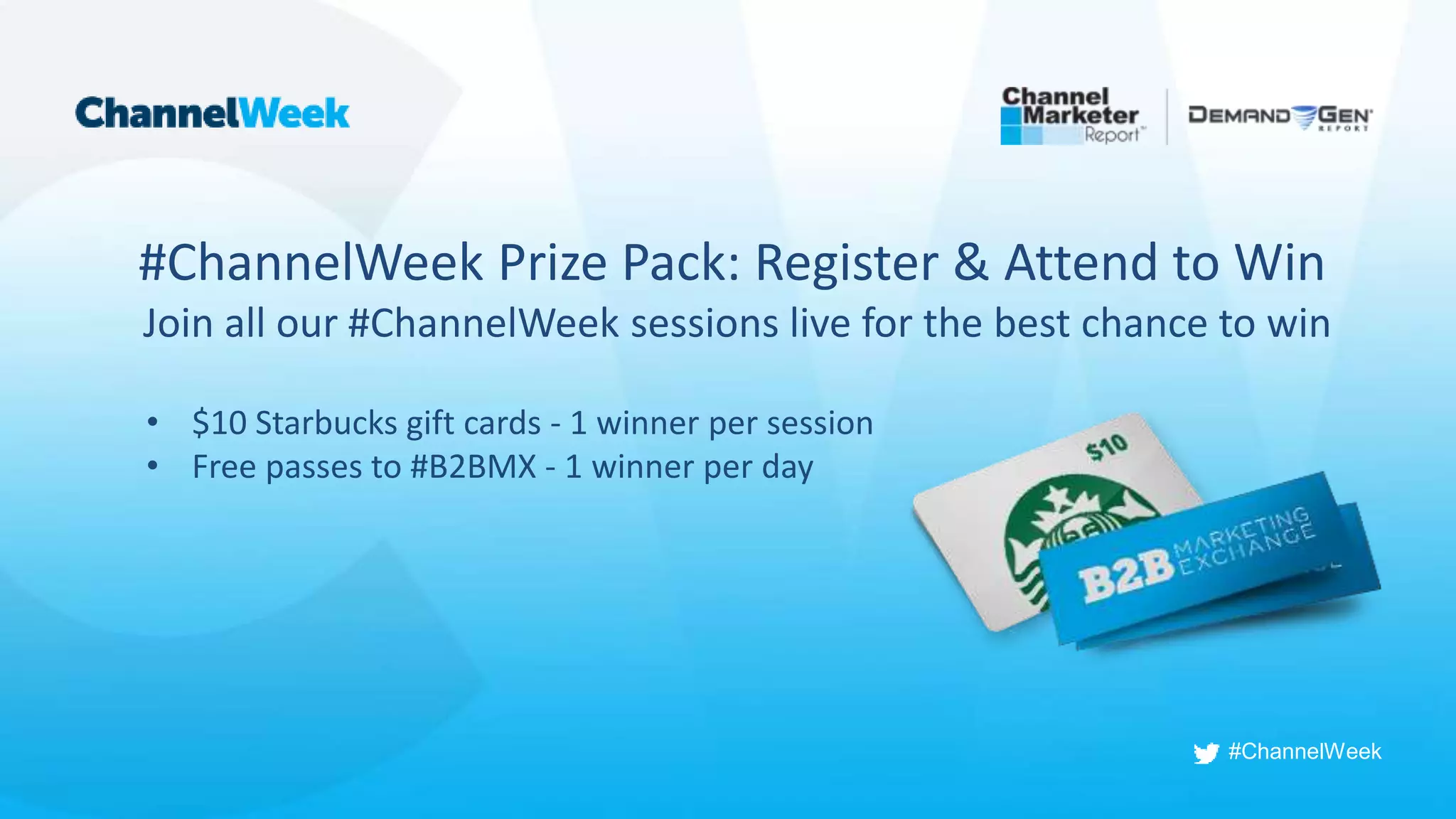
#ChannelWeek Prize Pack: Register & Attend to Win
Join all our #ChannelWeek sessions live for the best chance to win
• $10 Starbucks gift cards - 1 winner per session
• Free passes to #B2BMX - 1 winner per day
How are we doing?
#ChannelWeek
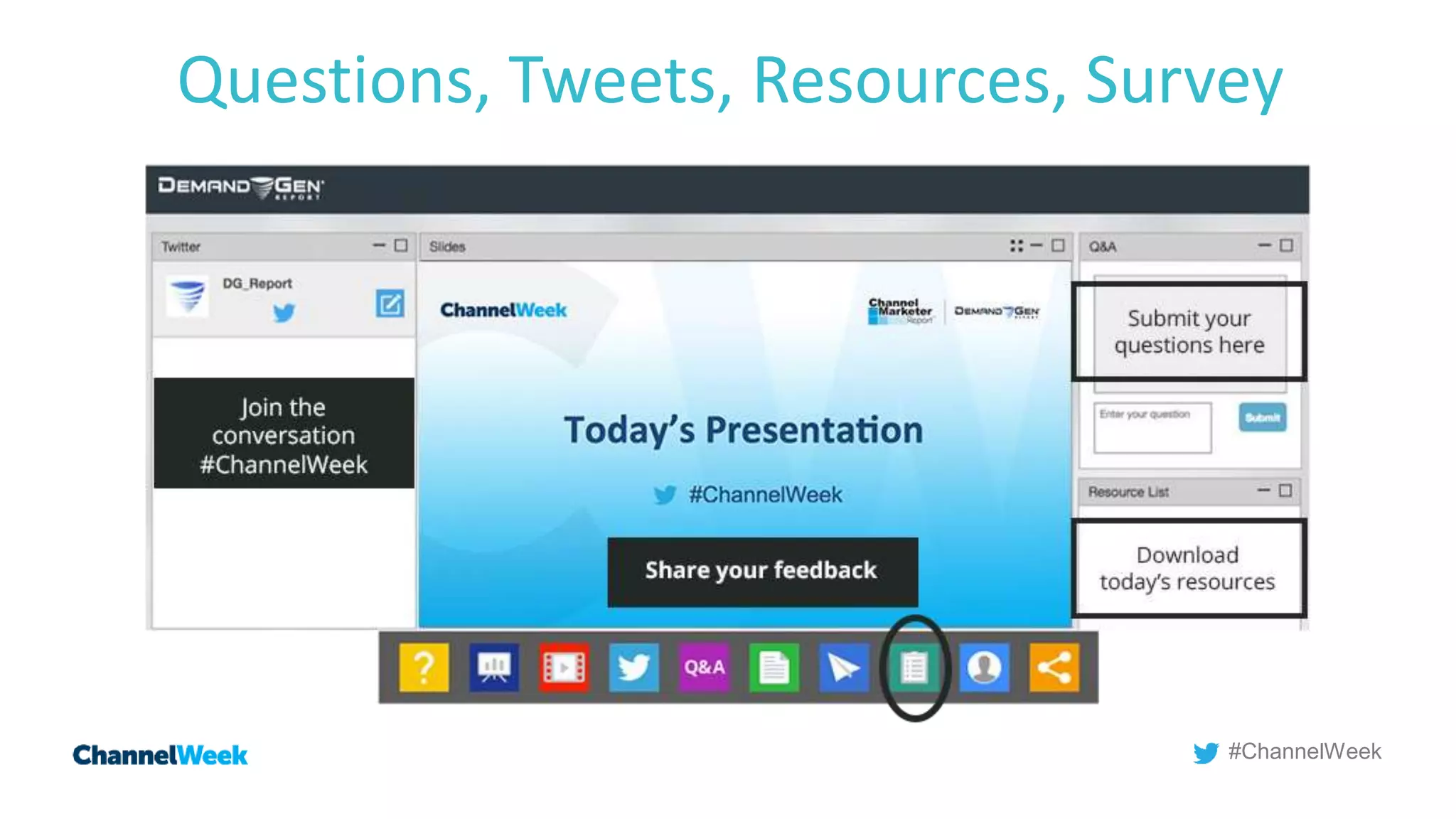
Questions, Tweets, Resources, Survey
#ChannelWeek
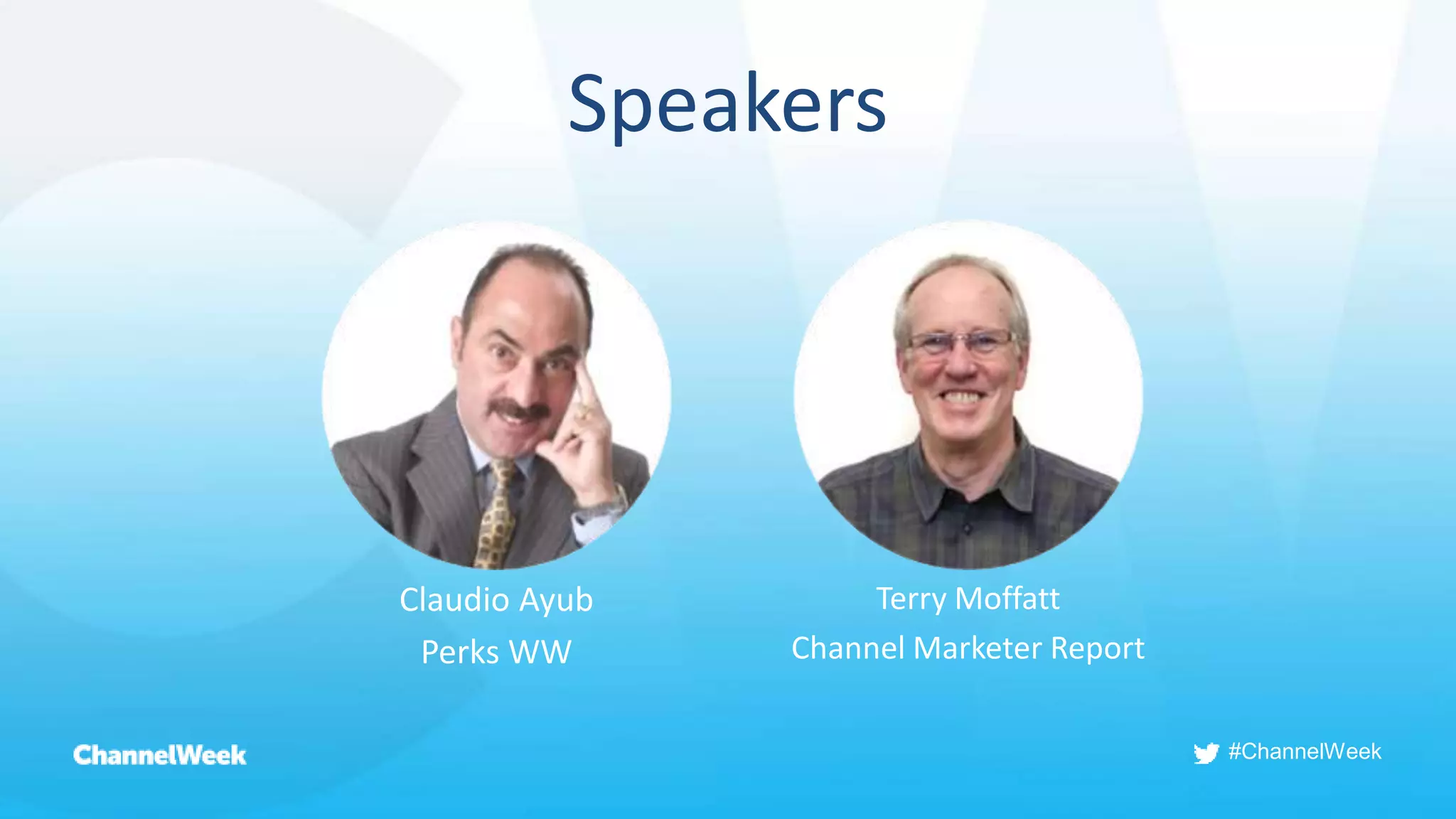
Speakers
Terry Moffatt
Channel Marketer Report
Claudio Ayub
Perks WW
Accelerate your Partner’s
Digital Transformation
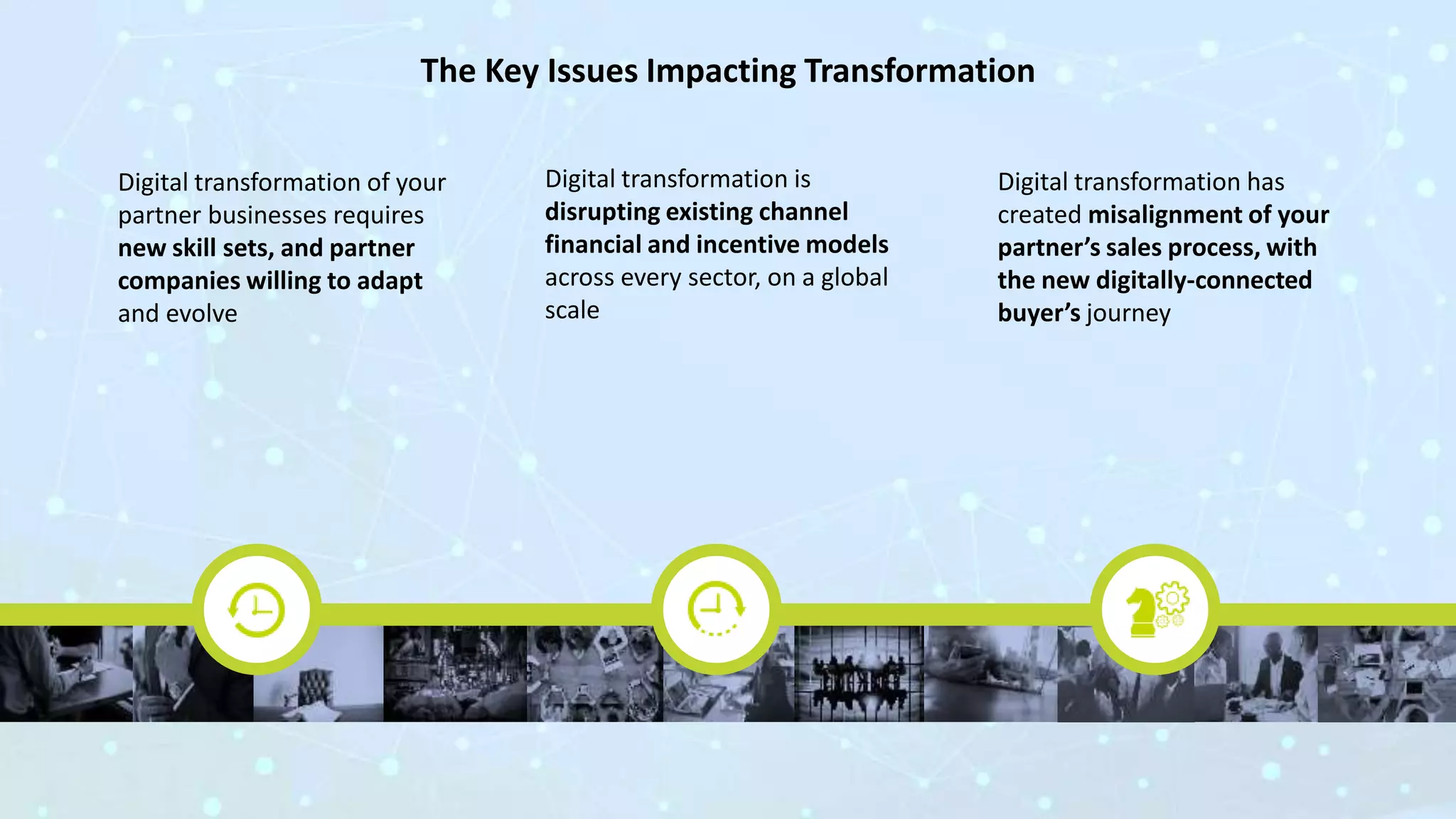
The Key Issues Impacting Transformation
Digital transformation of your
partner businesses requires
new skill sets, and partner
companies willing to adapt
and evolve
Digital transformation is
disrupting existing channel
financial and incentive models
across every sector, on a global
scale
Digital transformation has
created misalignment of your
partner’s sales process, with
the new digitally-connected
buyer’s journey
Can Be Addressed With “Incentive Engineering”
Behaviors are easier to track,
it is their collective impact that
improves channel performance
Incentives must be used to remove
the “friction” in the transformation
process to streamline lead to
revenue
You can change behaviors, and by
extension, the outcome of the
cumulative transformation motion
The Takeaway Today
A step-by-step approach to
identifying the most effective
combination of incentives at
the company, team, and
individual level - to deliver
partner results
Demonstrates that a sales is
the results on a number of
productive activities and
behaviors which when
properly orchestrated lead to
that sale
Aligning the partner’s sales
process to the buyers journey,
improving demand generation,
lead management, and
opportunity management;
accelerating time to revenue
Current State of Channel Demand
Business and market realities have created an unprecedented opportunity
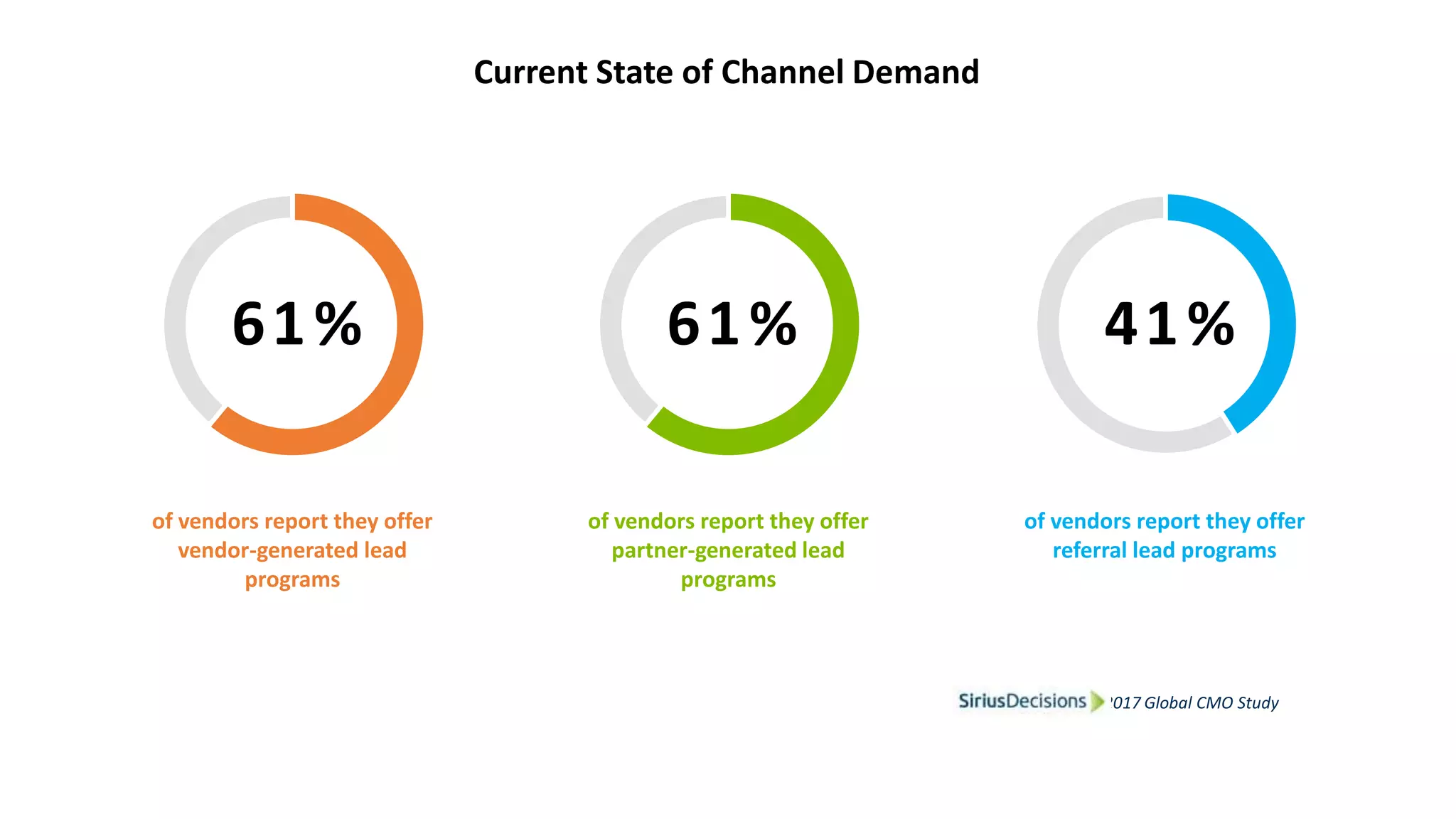
Current State of Channel Demand
61%
of vendors report they offer
partner-generated lead
programs
61%
of vendors report they offer
vendor-generated lead
programs
41%
of vendors report they offer
referral lead programs
SiriusDecisions 2017 Global CMO Study
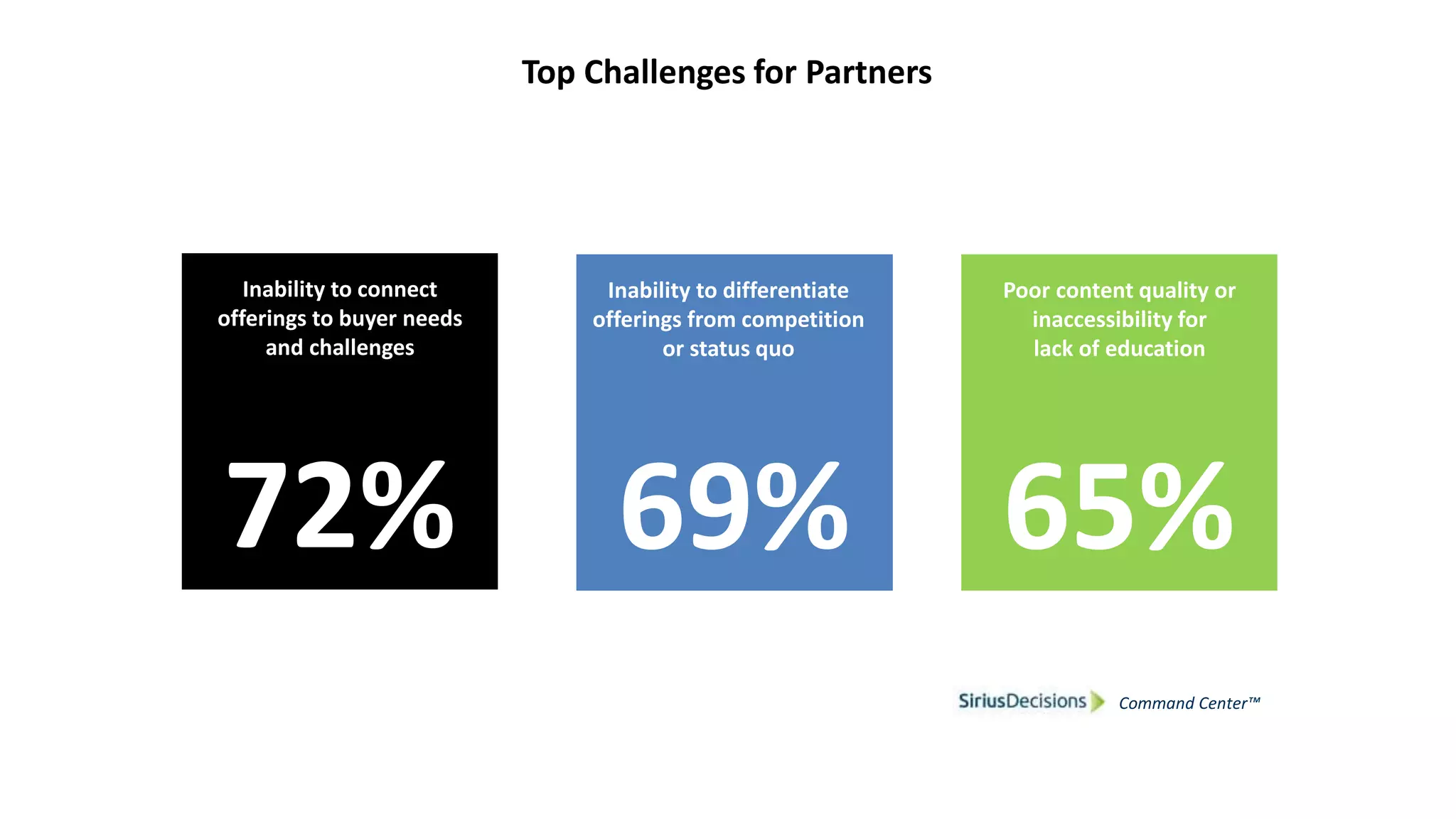
Top Challenges for Partners
72%
Inability to connect
offerings to buyer needs
and challenges
69%
Inability to differentiate
offerings from competition
or status quo
65%
Poor content quality or
inaccessibility for
lack of education
Command Center™
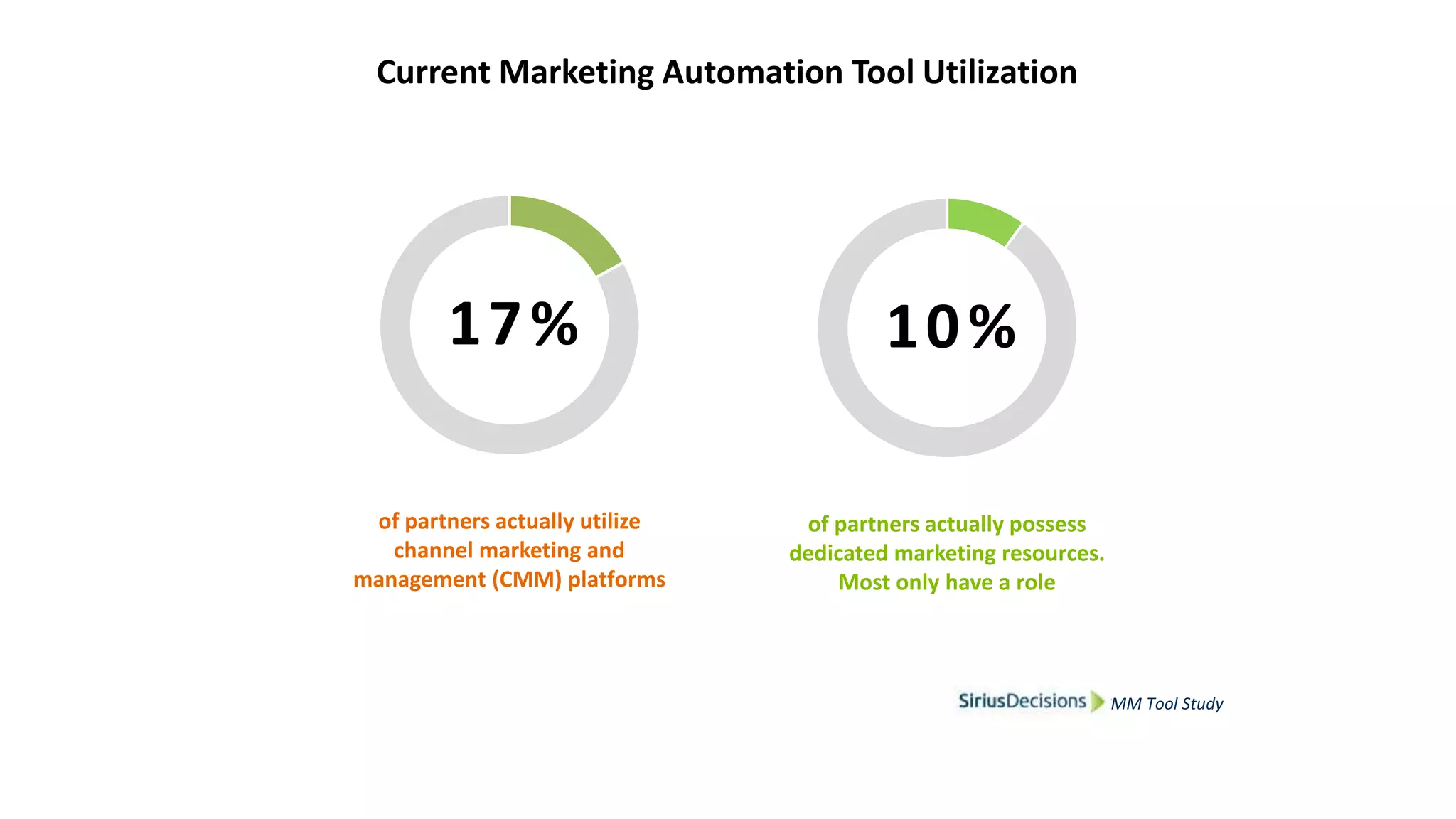
Current Marketing Automation Tool Utilization
SiriusDecisions CMM Tool Study
17%
of partners actually utilize
channel marketing and
management (CMM) platforms
10%
of partners actually possess
dedicated marketing resources.
Most only have a role
What Can We Do About It?
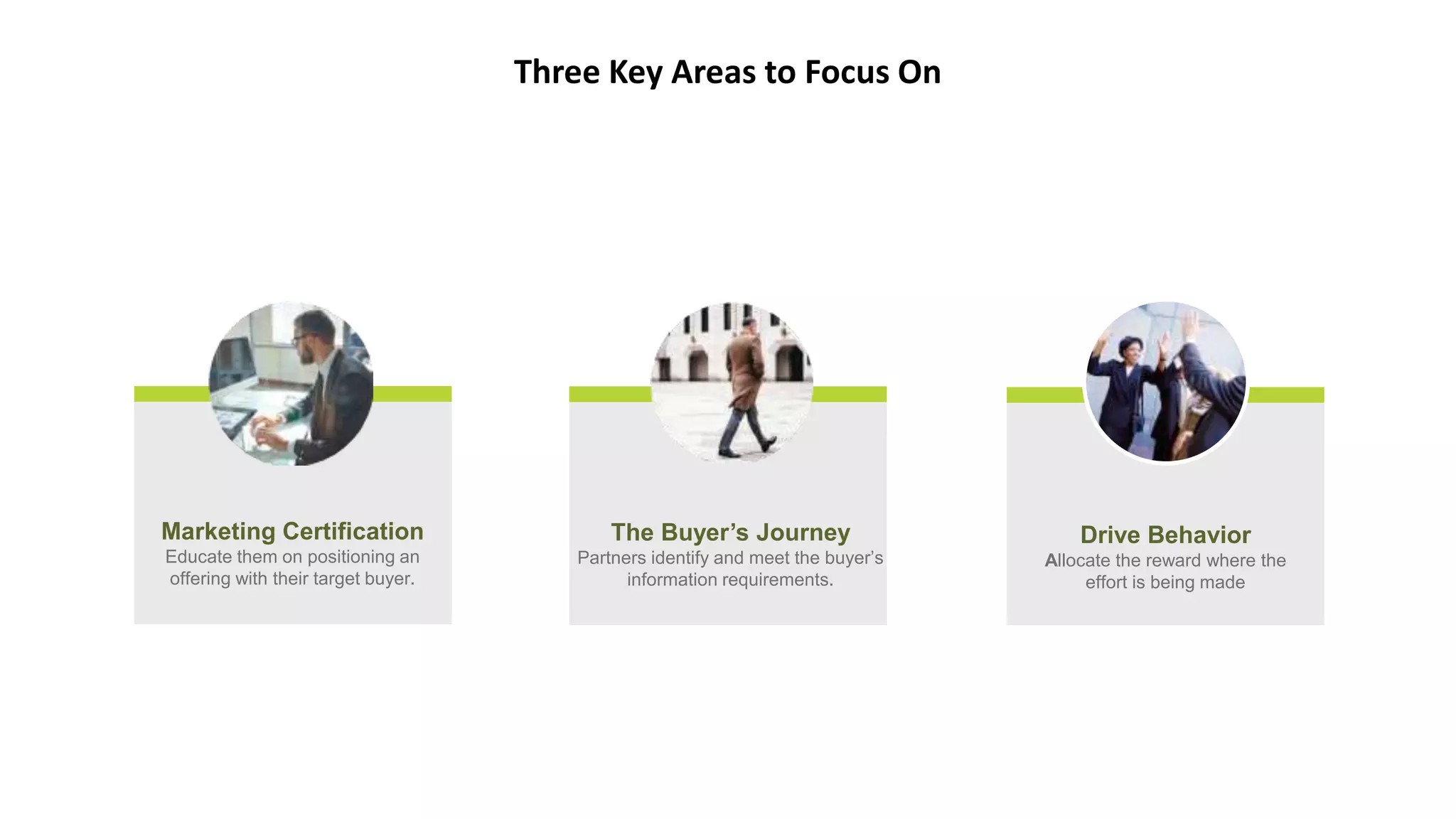
Three Key Areas to Focus On
The Buyer’s Journey
Partners identify and meet the buyer’s
information requirements.
Marketing Certification
Educate them on positioning an
offering with their target buyer.
Drive Behavior
Allocate the reward where the
effort is being made
Marketing Certification
Partner enablement is moving beyond product and sales training
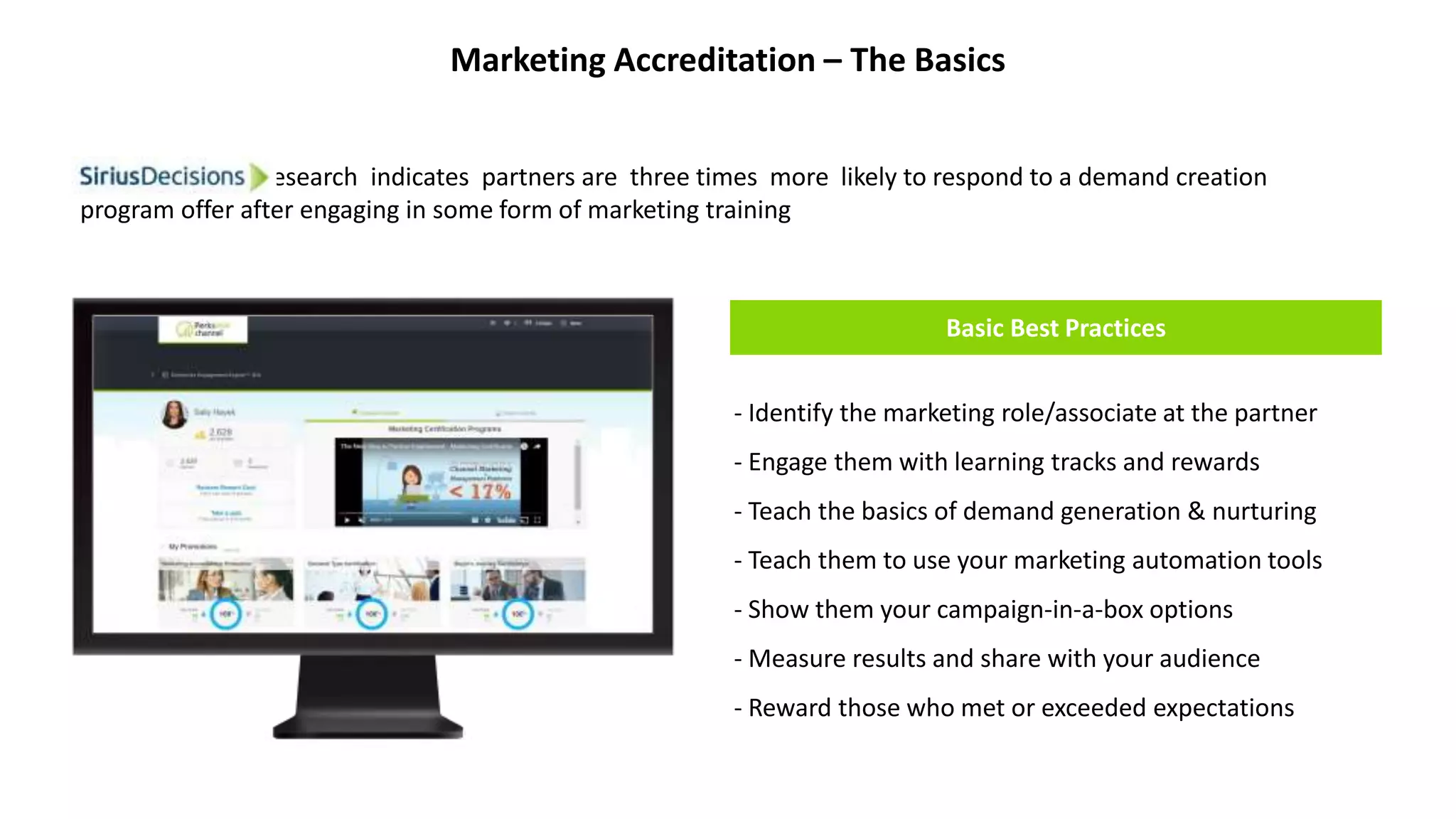
Marketing Accreditation – The Basics
Basic Best Practices
- Identify the marketing role/associate at the partner
- Engage them with learning tracks and rewards
- Teach the basics of demand generation & nurturing
- Teach them to use your marketing automation tools
- Show them your campaign-in-a-box options
- Measure results and share with your audience
- Reward those who met or exceeded expectations
SiriusDecisions research indicates partners are three times more likely to respond to a demand creation
program offer after engaging in some form of marketing training
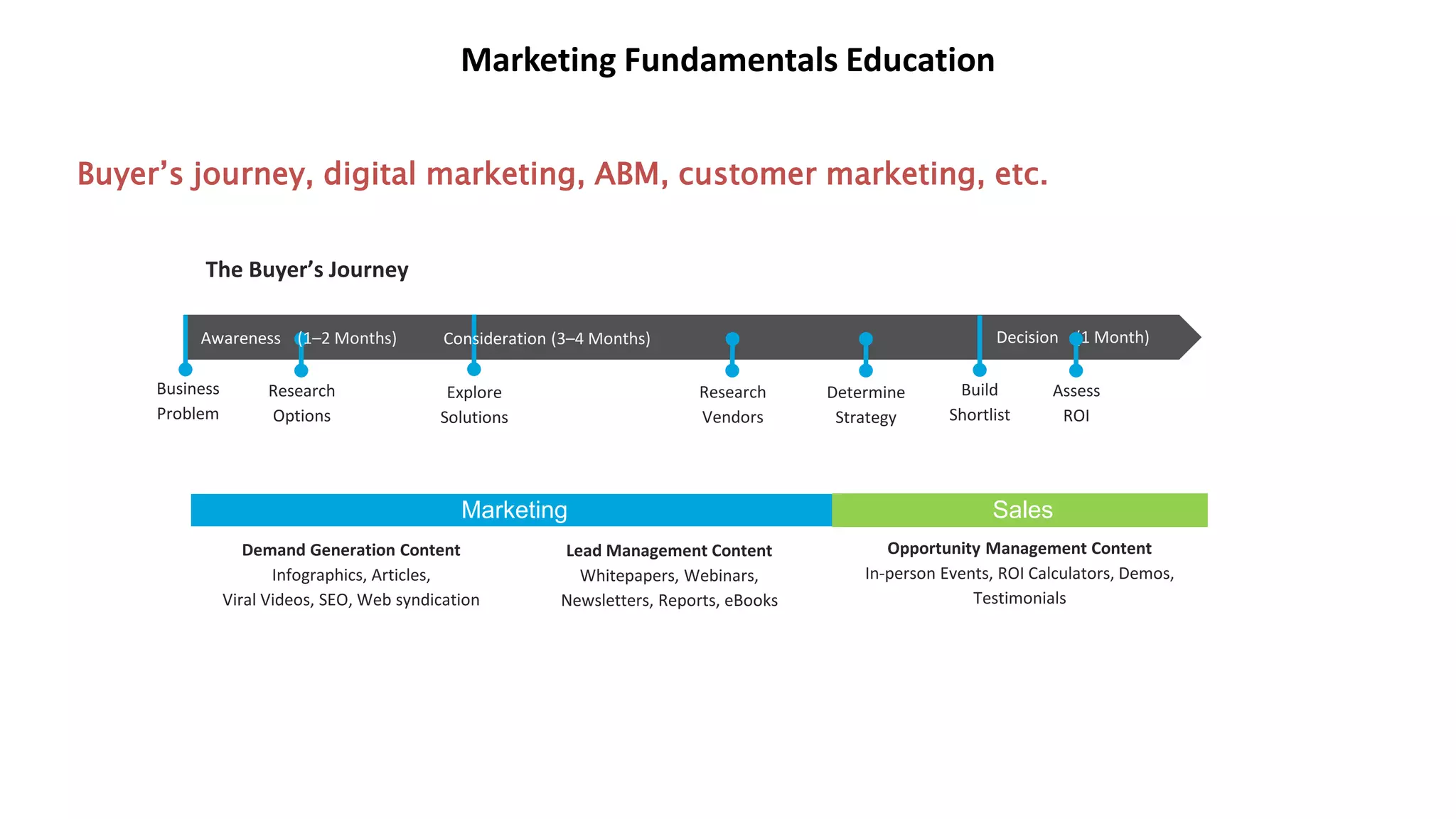
Marketing Fundamentals Education
Buyer’s journey, digital marketing, ABM, customer marketing, etc.
Marketing Sales
Demand Generation Content
Infographics, Articles,
Viral Videos, SEO, Web syndication
Lead Management Content
Whitepapers, Webinars,
Newsletters, Reports, eBooks
Opportunity Management Content
In-person Events, ROI Calculators, Demos,
Testimonials
Research
Options
Business
Problem
Explore
Solutions
Research
Vendors
Determine
Strategy
Build
Shortlist
Assess
ROI
Decision (1 Month)Consideration (3–4 Months)
The Buyer’s Journey
Awareness (1–2 Months)
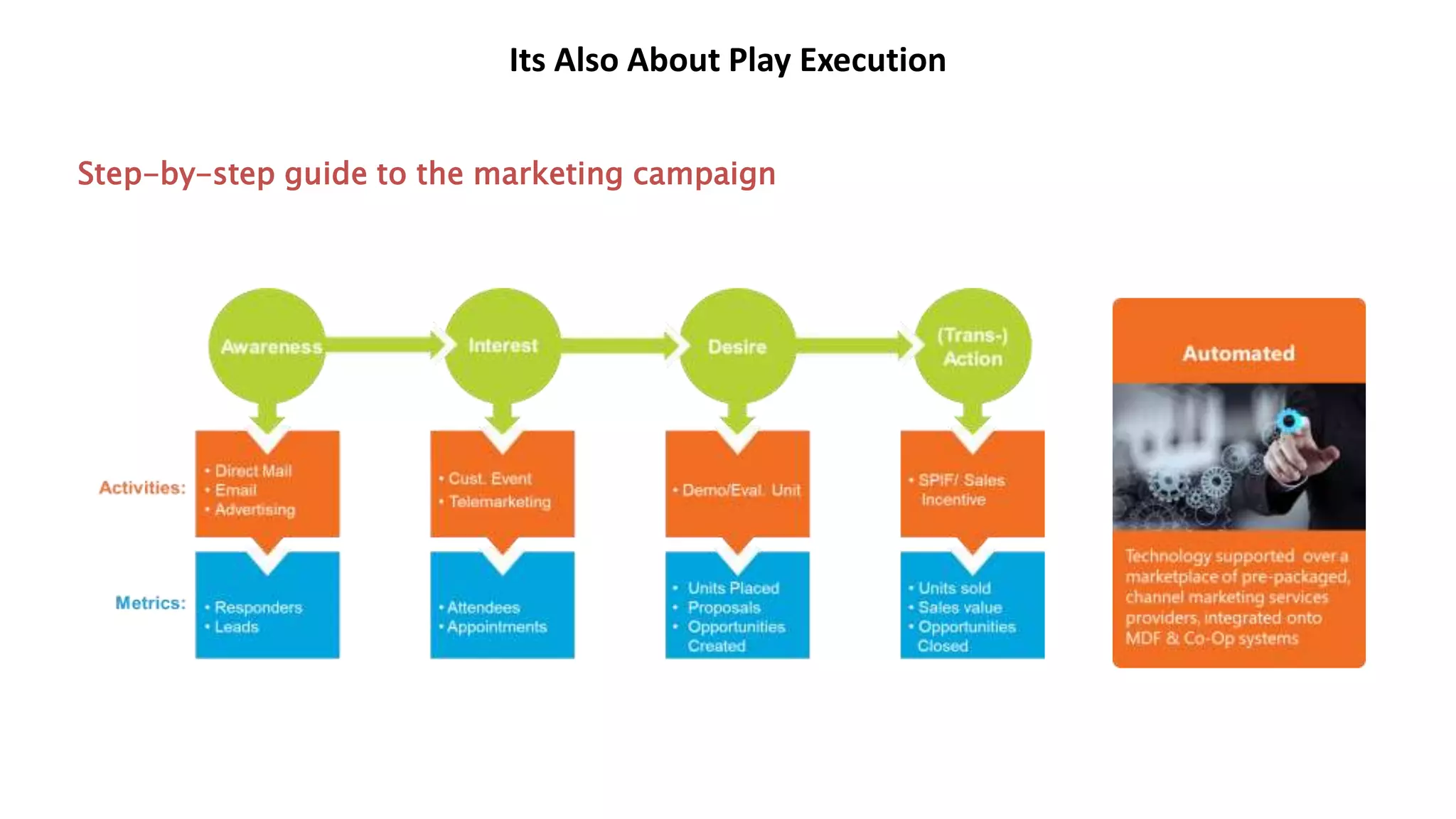
Its Also About Play Execution
Step-by-step guide to the marketing campaign
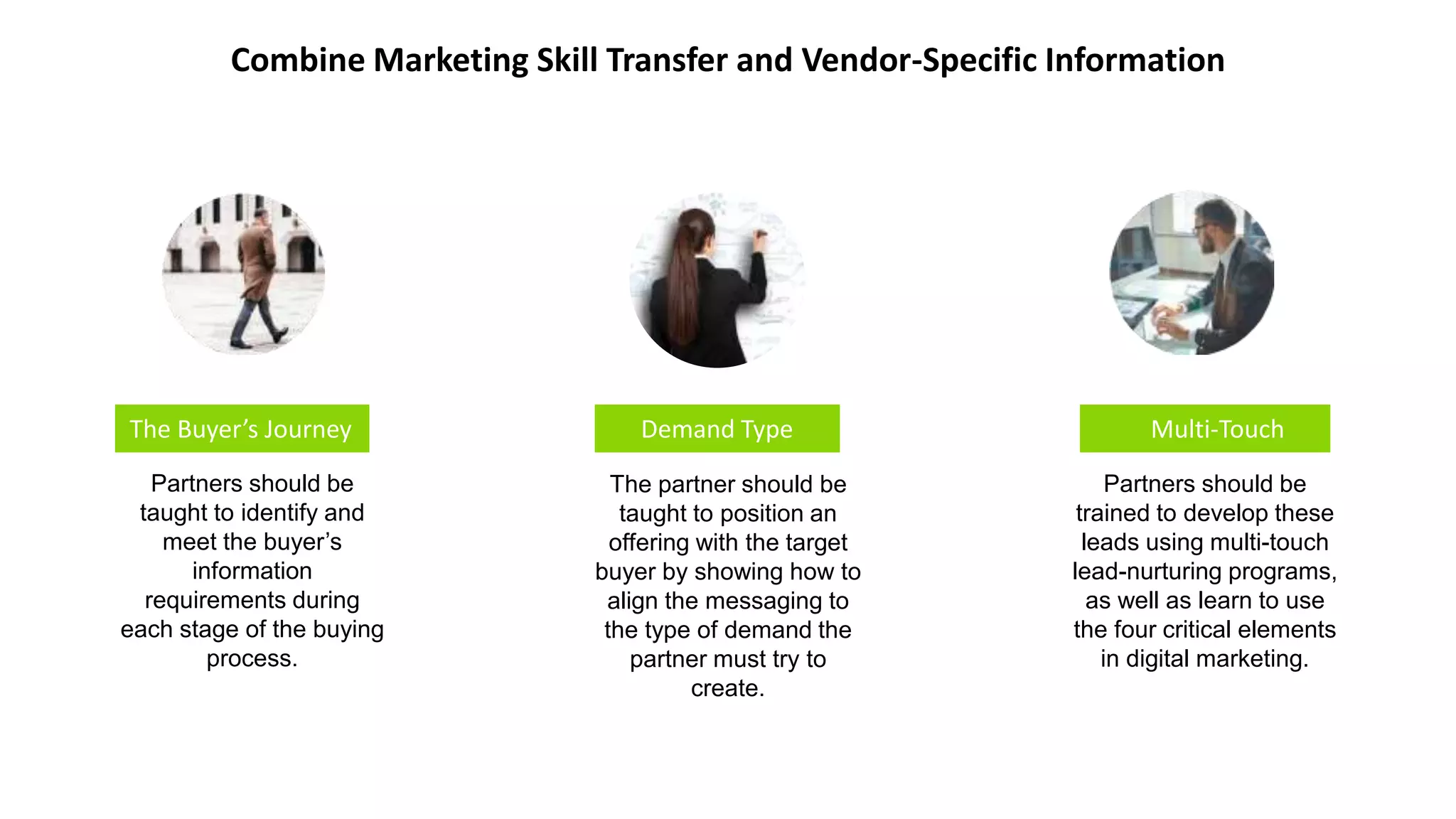
Partners should be
taught to identify and
meet the buyer’s
information
requirements during
each stage of the buying
process.
Combine Marketing Skill Transfer and Vendor-Specific Information
The partner should be
taught to position an
offering with the target
buyer by showing how to
align the messaging to
the type of demand the
partner must try to
create.
Partners should be
trained to develop these
leads using multi-touch
lead-nurturing programs,
as well as learn to use
the four critical elements
in digital marketing.
The Buyer’s Journey Demand Type Multi-Touch
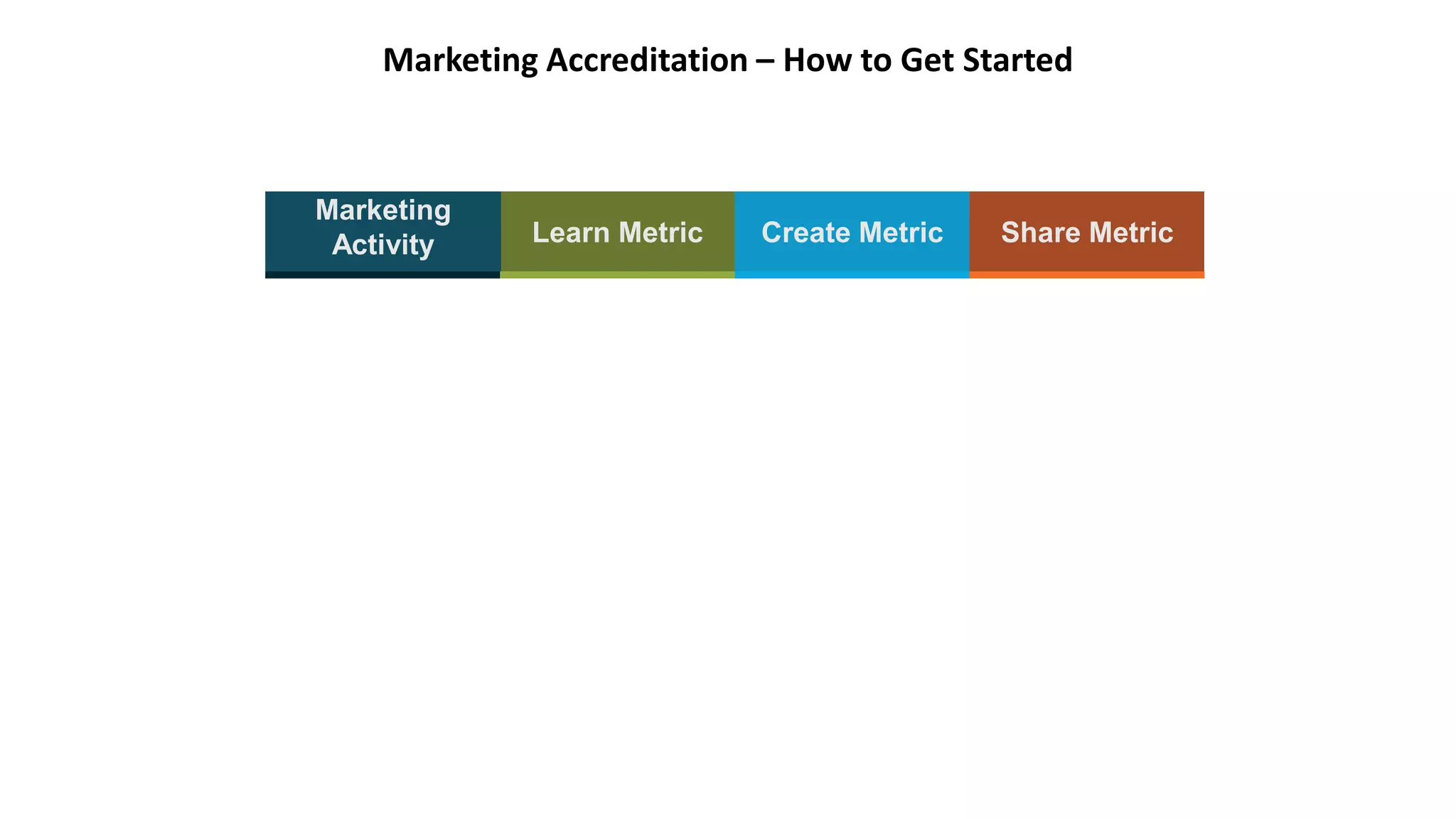
Marketing Accreditation – How to Get Started
Share Incentive
1,350 points ($150)
25 registered
attendees
Content deployed
on the partner
website
Email sent to
100 contacts
Create Incentive:
900 points ($100)
Creation within
the CMM platform
Learn Incentive:
450 points ($50)
Passed quiz in the
incentive center (with
training material)
Incentive
Event
Landing Page
+ Email
Content Syndication
Share MetricCreate MetricLearn Metric
Marketing
Activity
Passed
training/quiz in the
incentive center
Passed
training/quiz in the
incentive center
Creation or
Implementation of
the code
Selection within
the CMM platform
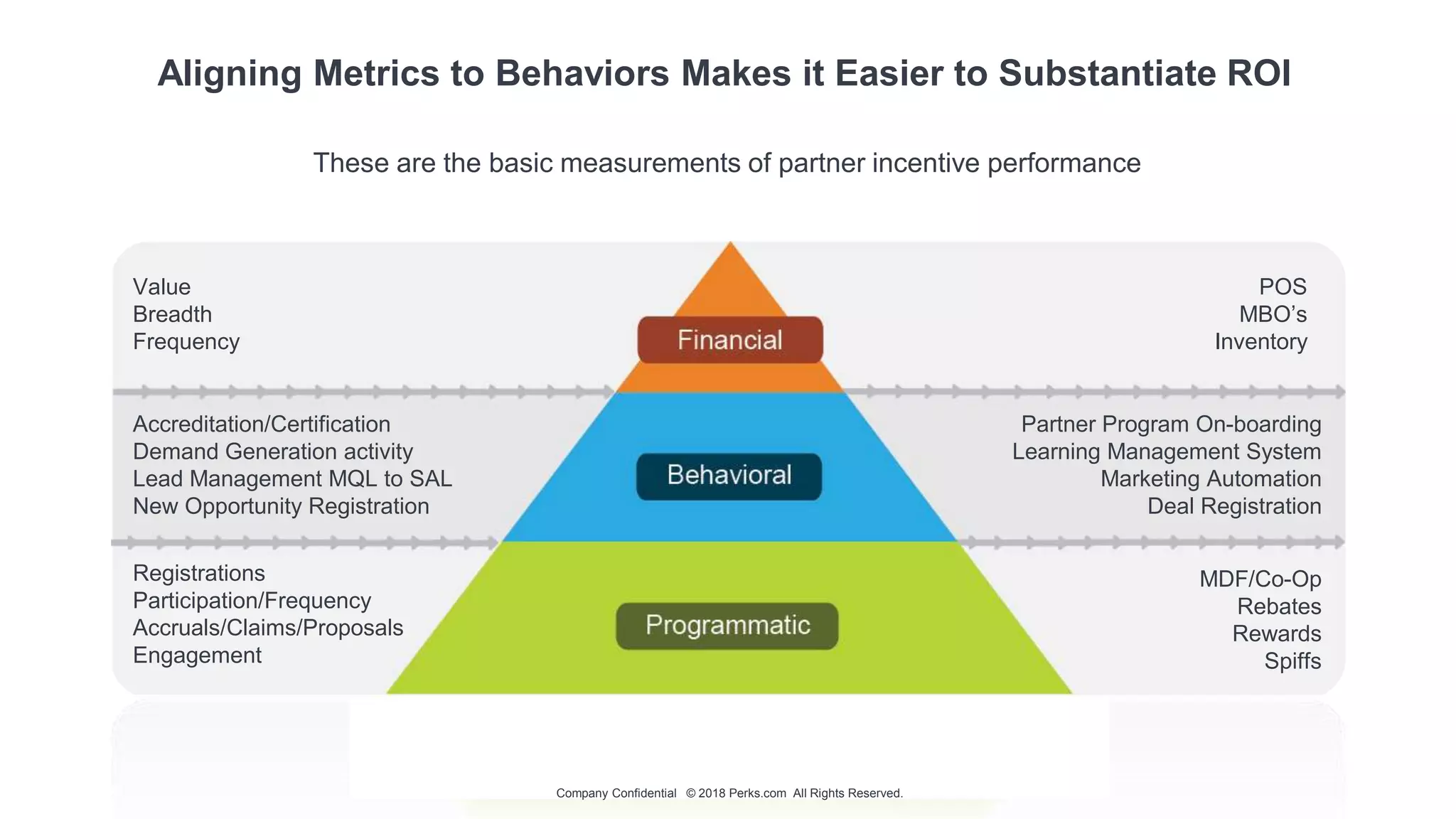
Aligning Metrics to Behaviors Makes it Easier to Substantiate ROI
These are the basic measurements of partner incentive performance
Registrations
Participation/Frequency
Accruals/Claims/Proposals
Engagement
Value
Breadth
Frequency
Accreditation/Certification
Demand Generation activity
Lead Management MQL to SAL
New Opportunity Registration
Partner Program On-boarding
Learning Management System
Marketing Automation
Deal Registration
POS
MBO’s
Inventory
MDF/Co-Op
Rebates
Rewards
Spiffs
Company Confidential © 2018 Perks.com All Rights Reserved.
Digital Buyer’s Journey
Aligning the partner’s sales process to the new digital buyer’s journey
Commit
to
Change
Loose
Status Quo
Explore
Solutions
Research
Vendors
Determin
e
Strategy
Build
Shortlist
Assess
ROI
Decision (1 Month)Solution Stage (3–4 Months)
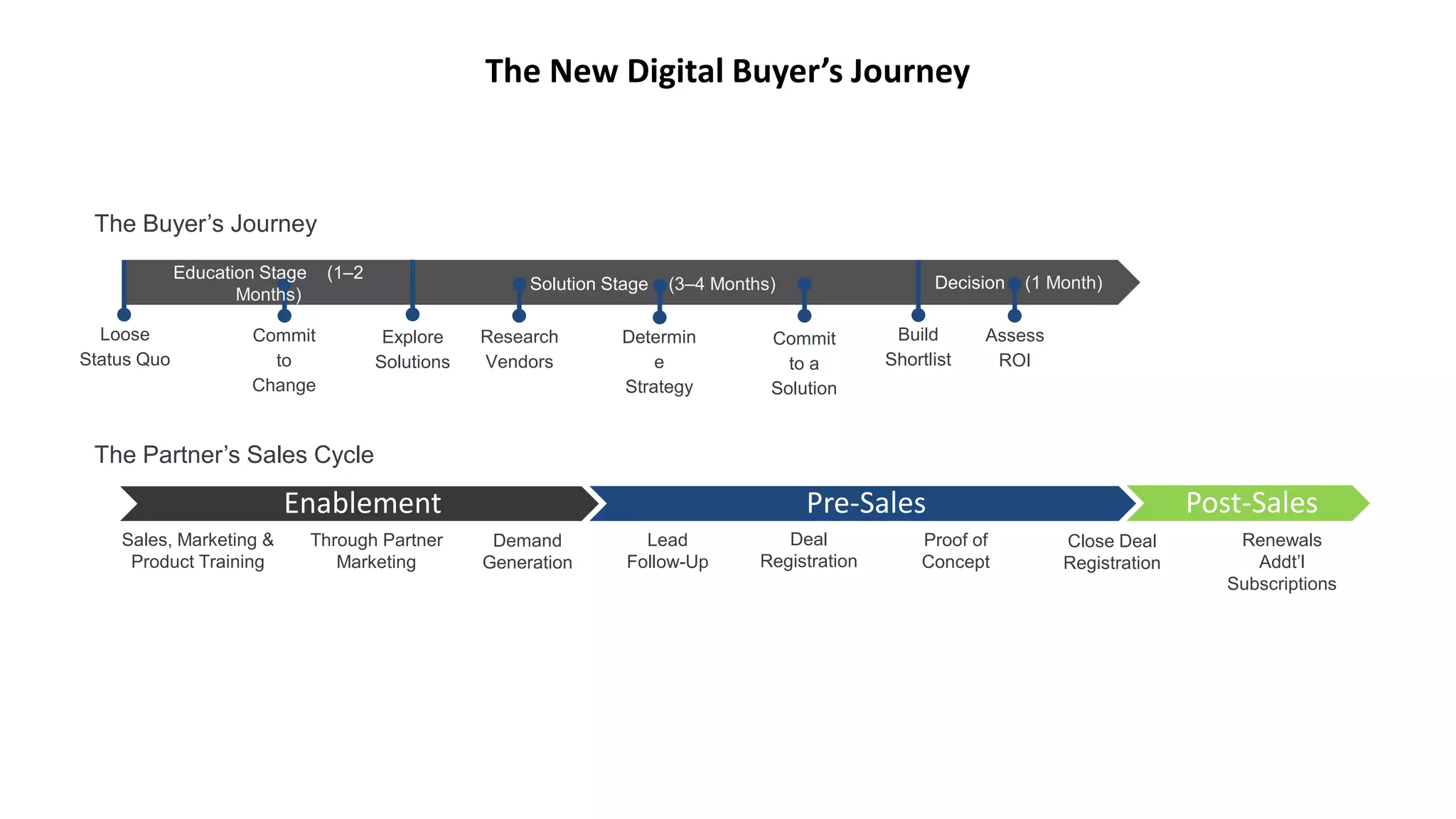
The Buyer’s Journey
Education Stage (1–2
Months)
Commit
to a
Solution
The New Digital Buyer’s Journey
Enablement Pre-Sales Post-Sales
The Partner’s Sales Cycle
Through Partner
Marketing
Sales, Marketing &
Product Training
Demand
Generation
Deal
Registration
Lead
Follow-Up
Close Deal
Registration
Proof of
Concept
Renewals
Addt’l
Subscriptions
Enablement Pre-Sales Post-Sales
Commit
to
Change
Loose
Status Quo
Explore
Solutions
Research
Vendors
Determin
e
Strategy
Build
Shortlist
Assess
ROI
Decision (1 Month)Solution Stage (3–4 Months)
The Buyer’s Journey
Education Stage (1–2
Months)
Commit
to a
Solution
The Partner’s Sales Cycle
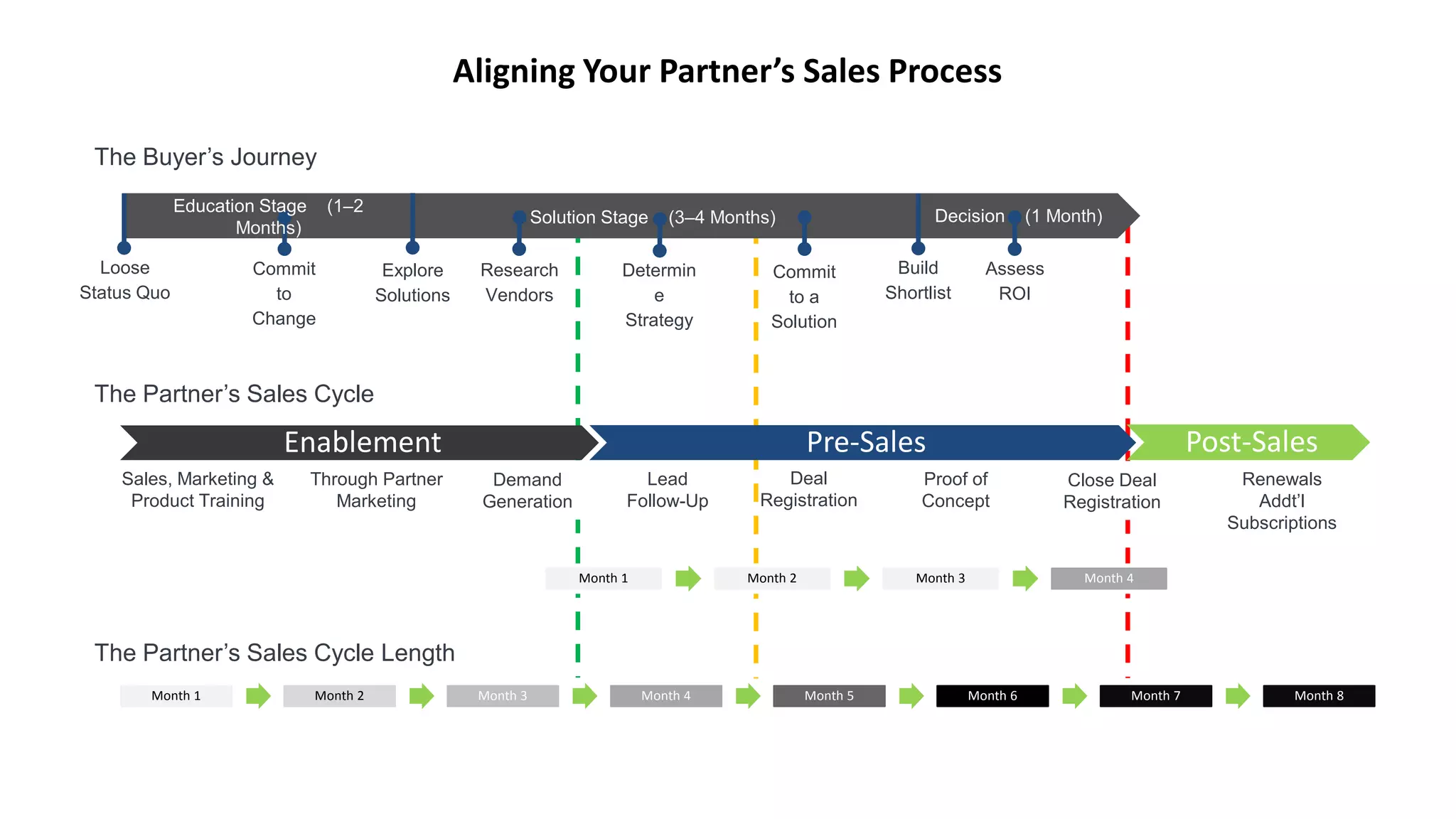
The Partner’s Sales Cycle Length
Month 1 Month 2 Month 3 Month 4 Month 5 Month 6 Month 7 Month 8
Through Partner
Marketing
Sales, Marketing &
Product Training
Demand
Generation
Deal
Registration
Lead
Follow-Up
Close Deal
Registration
Proof of
Concept
Renewals
Addt’l
Subscriptions
Month 1 Month 2 Month 3 Month 4
Aligning Your Partner’s Sales Process
Enablement Pre-Sales Post-Sales
The Partner’s Sales Cycle
Through Partner
Marketing
Sales, Marketing &
Product Training
Demand
Generation
Deal
Registration
Lead
Follow-Up
Close Deal
Registration
Appointment
Setting
Month 1 Month 2 Month 3 Month 4
Renewals
Addt’l
Subscriptions
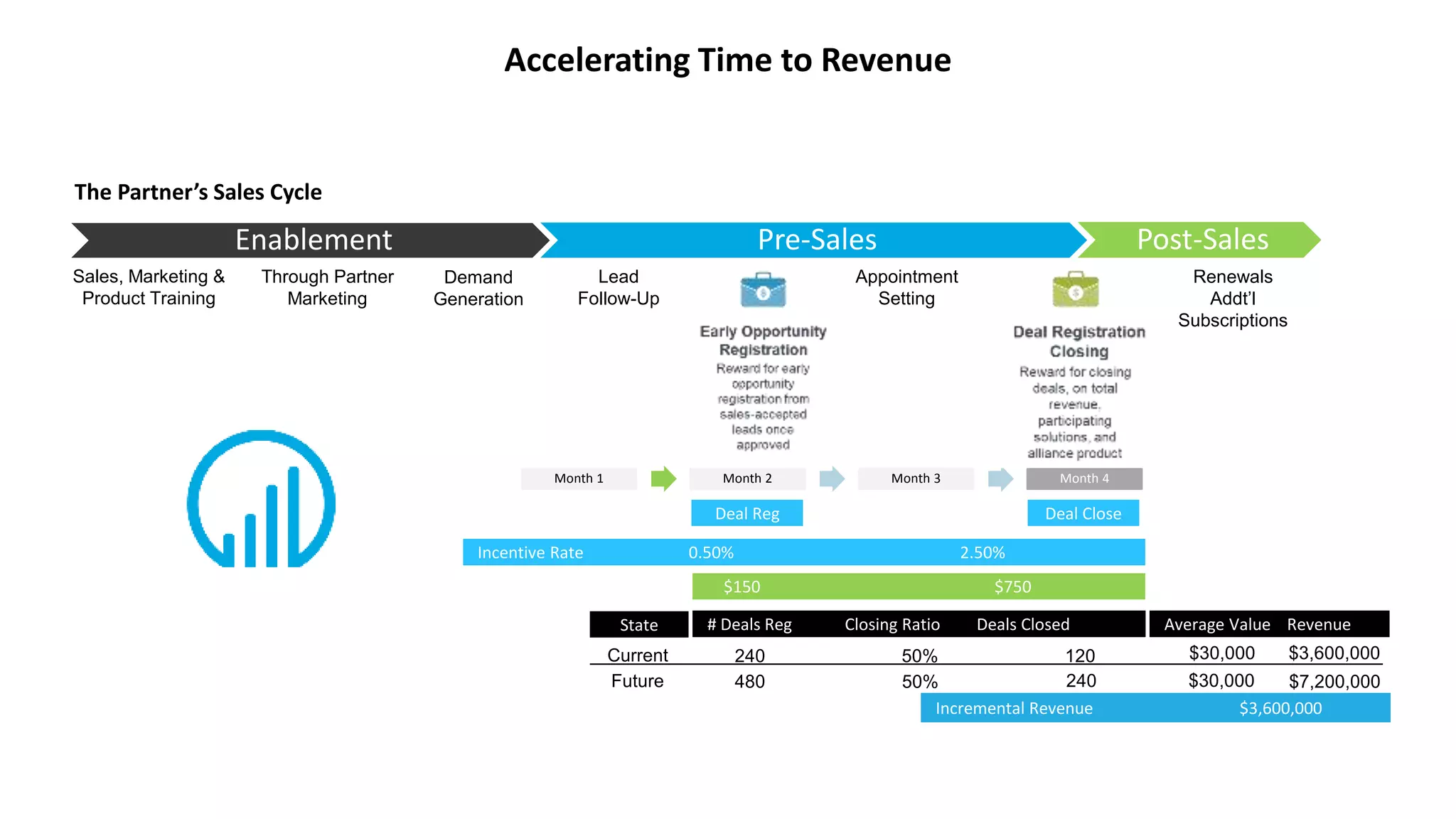
Deal Reg Deal Close
Incentive Rate 0.50% 2.50%
$150 $750
# Deals Reg Closing Ratio Deals Closed Average Value Revenue
240
480
50%
50%
120
240
$30,000 $3,600,000
$7,200,000$30,000
Incremental Revenue $3,600,000
Accelerating Time to Revenue
State
Current
Future
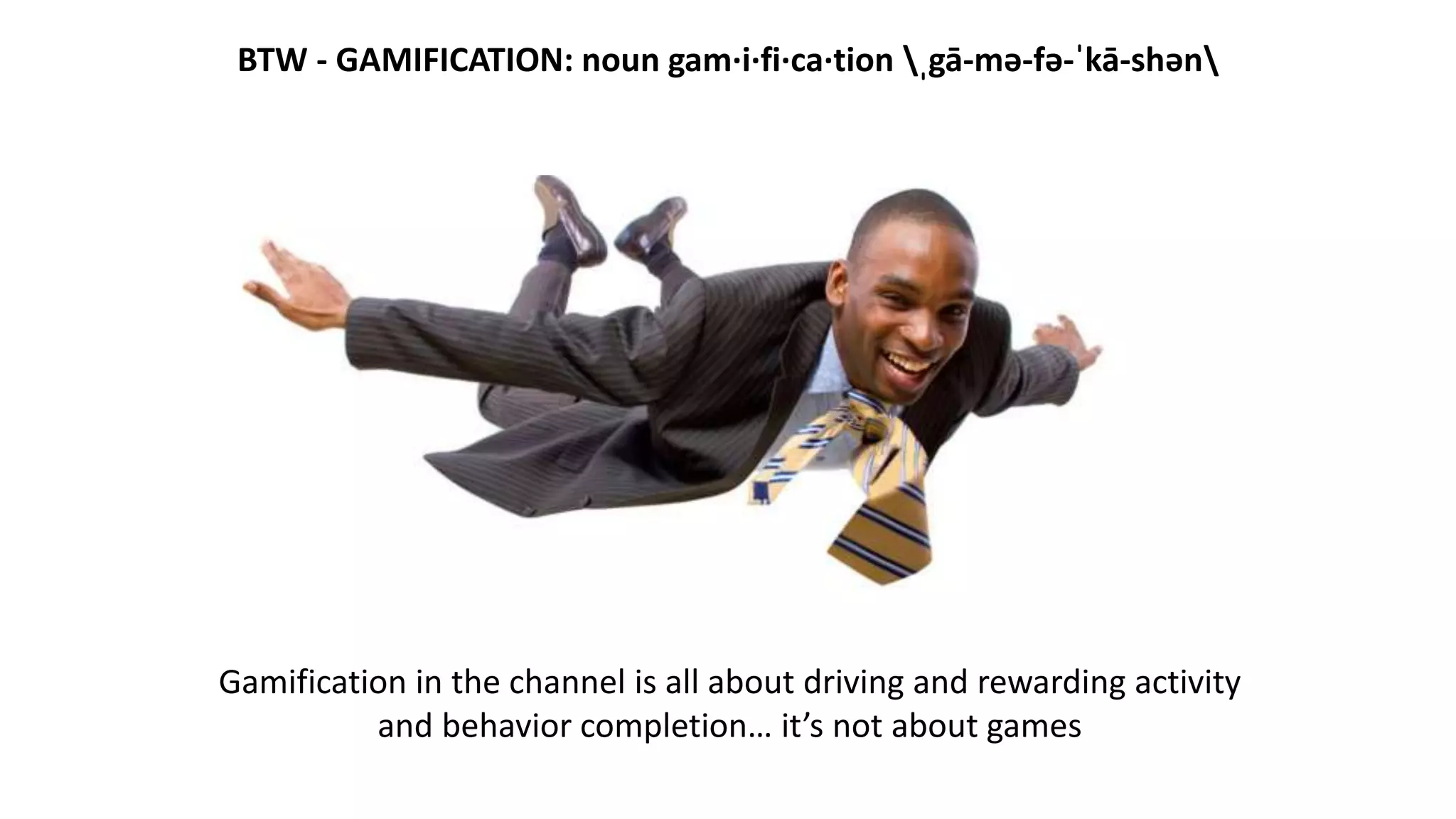
BTW - GAMIFICATION: noun gam·i·fi·ca·tion ˌgā-mə-fə-ˈkā-shən
Gamification in the channel is all about driving and rewarding activity
and behavior completion… it’s not about games
Drive Partner Behavior
Allocating the reward where the effort is being made
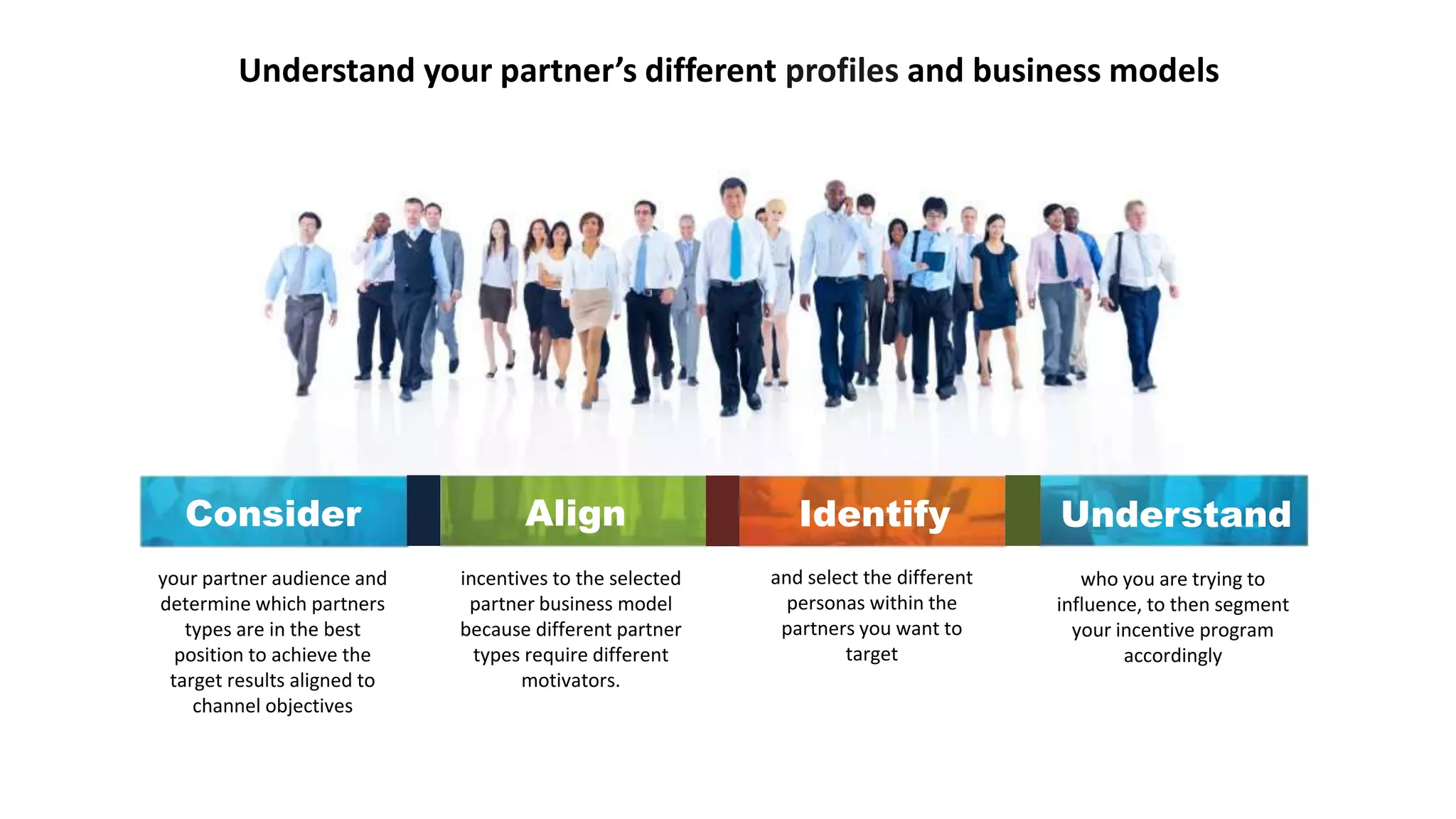
Understand your partner’s different profiles and business models
incentives to the selected
partner business model
because different partner
types require different
motivators.
Align
and select the different
personas within the
partners you want to
target
Identify
who you are trying to
influence, to then segment
your incentive program
accordingly
Understand
your partner audience and
determine which partners
types are in the best
position to achieve the
target results aligned to
channel objectives
Consider
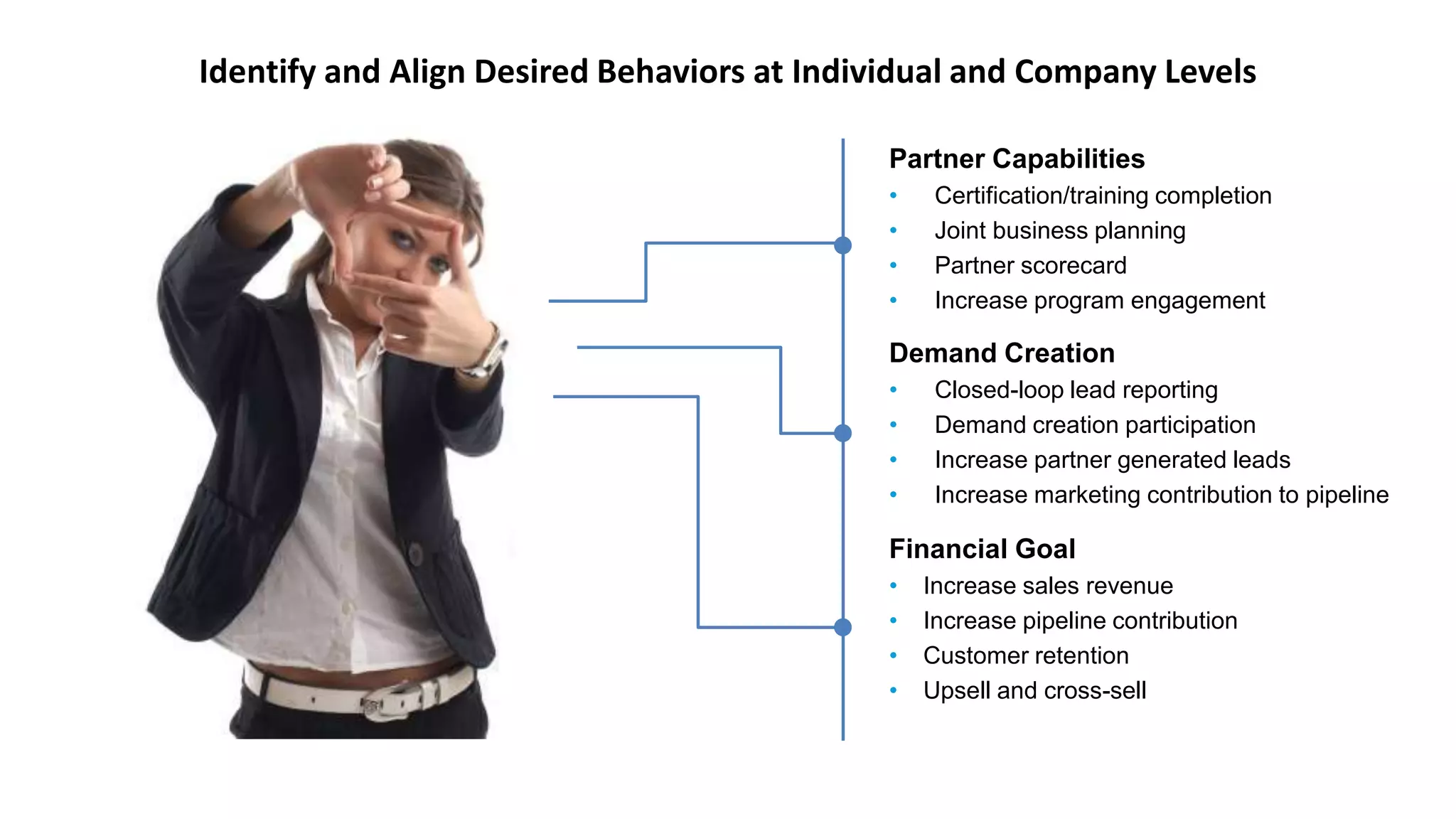
Identify and Align Desired Behaviors at Individual and Company Levels
Financial Goal
• Increase sales revenue
• Increase pipeline contribution
• Customer retention
• Upsell and cross-sell
Partner Capabilities
• Certification/training completion
• Joint business planning
• Partner scorecard
• Increase program engagement
Demand Creation
• Closed-loop lead reporting
• Demand creation participation
• Increase partner generated leads
• Increase marketing contribution to pipeline
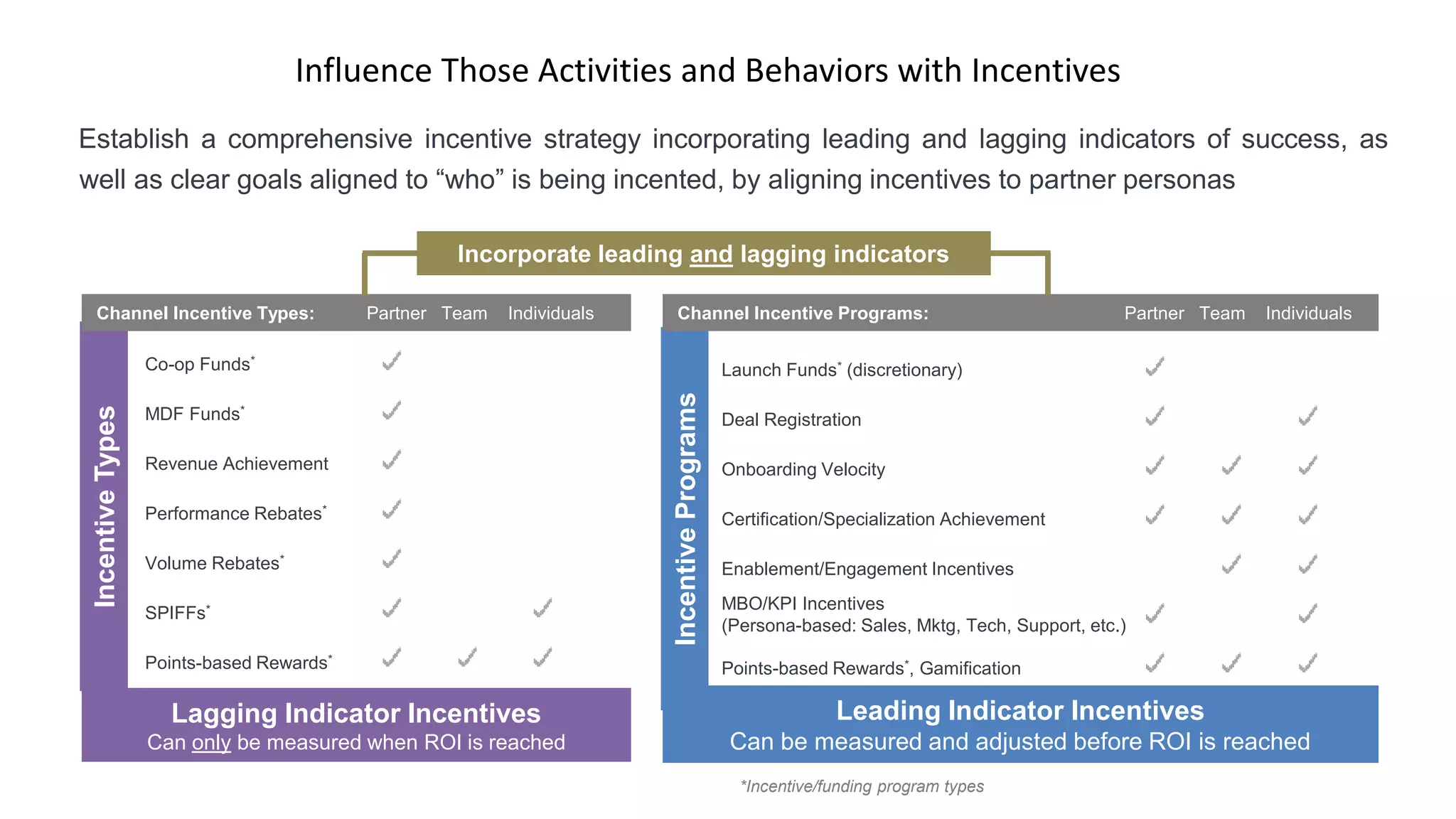
Influence Those Activities and Behaviors with Incentives
*Incentive/funding program types
Establish a comprehensive incentive strategy incorporating leading and lagging indicators of success, as
well as clear goals aligned to “who” is being incented, by aligning incentives to partner personas
Co-op Funds*
MDF Funds*
Revenue Achievement
Performance Rebates*
Volume Rebates*
SPIFFs*
Points-based Rewards*
Lagging Indicator Incentives
Can only be measured when ROI is reached
IncentiveTypes
Channel Incentive Types: Partner Team Individuals
Launch Funds* (discretionary)
Deal Registration
Onboarding Velocity
Certification/Specialization Achievement
Enablement/Engagement Incentives
MBO/KPI Incentives
(Persona-based: Sales, Mktg, Tech, Support, etc.)
Points-based Rewards*, Gamification
Leading Indicator Incentives
Can be measured and adjusted before ROI is reached
IncentivePrograms
Channel Incentive Programs: Partner Team Individuals
Incorporate leading and lagging indicators
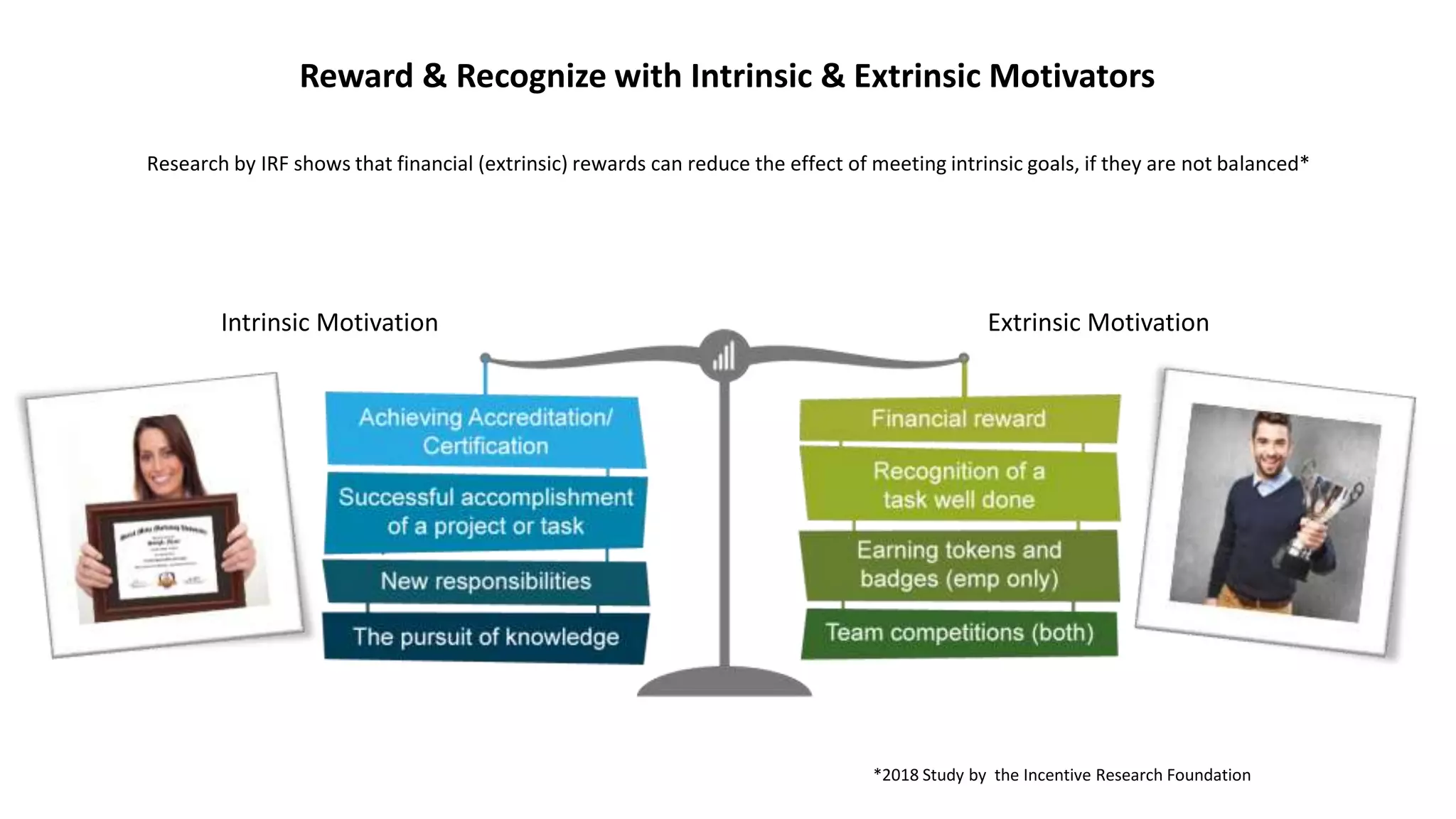
Reward & Recognize with Intrinsic & Extrinsic Motivators
Research by IRF shows that financial (extrinsic) rewards can reduce the effect of meeting intrinsic goals, if they are not balanced*
Extrinsic MotivationIntrinsic Motivation
*2018 Study by the Incentive Research Foundation
The incentives
framework in action
A systematic approach
to incentive plan design
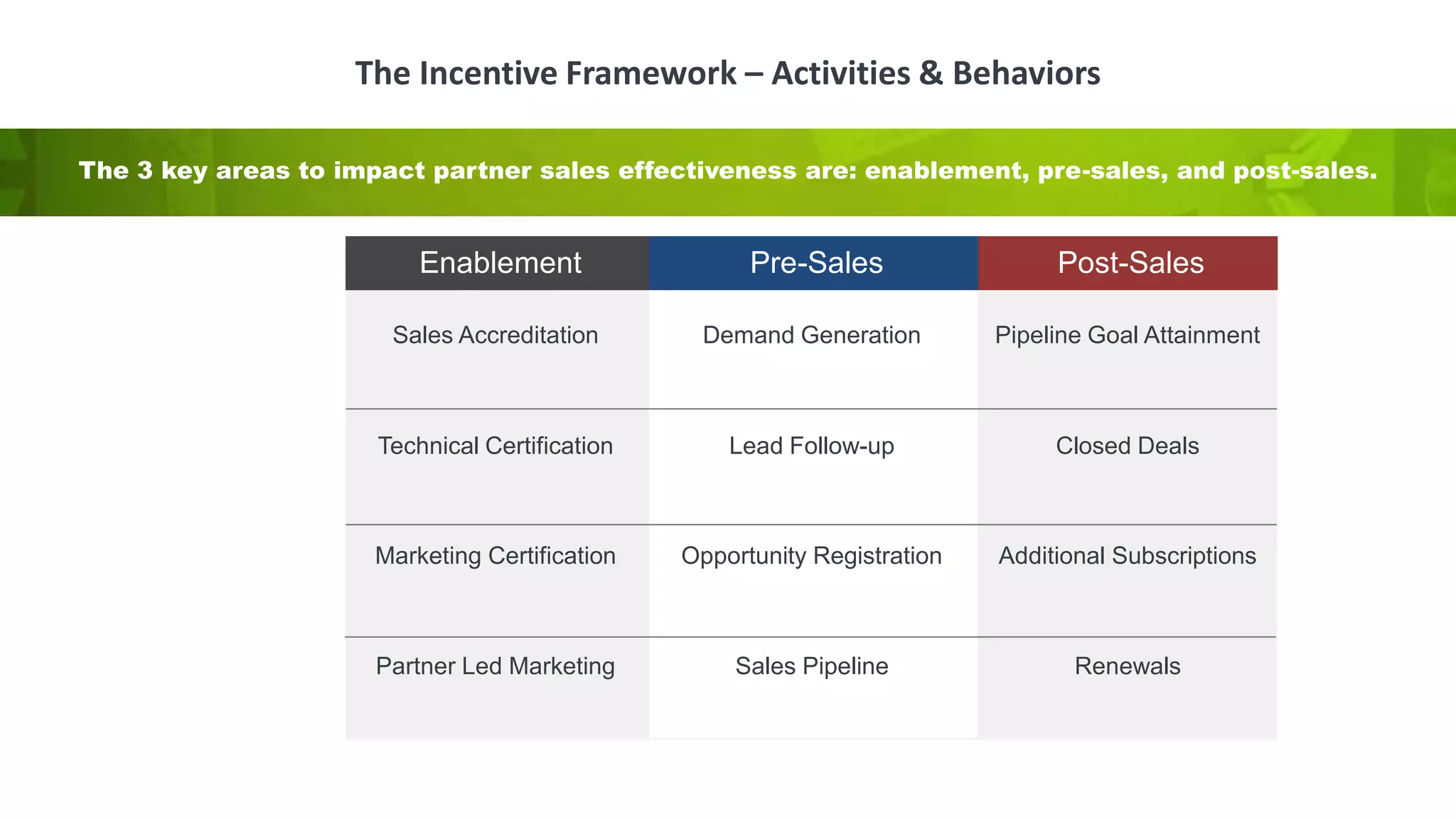
The Incentive Framework – Activities & Behaviors
Sales Accreditation
Technical Certification
Enablement Pre-Sales Post-Sales
Marketing Certification
Partner Led Marketing
Demand Generation
Lead Follow-up
Opportunity Registration
Sales Pipeline
Pipeline Goal Attainment
Closed Deals
Additional Subscriptions
Renewals
The 3 key areas to impact partner sales effectiveness are: enablement, pre-sales, and post-sales.
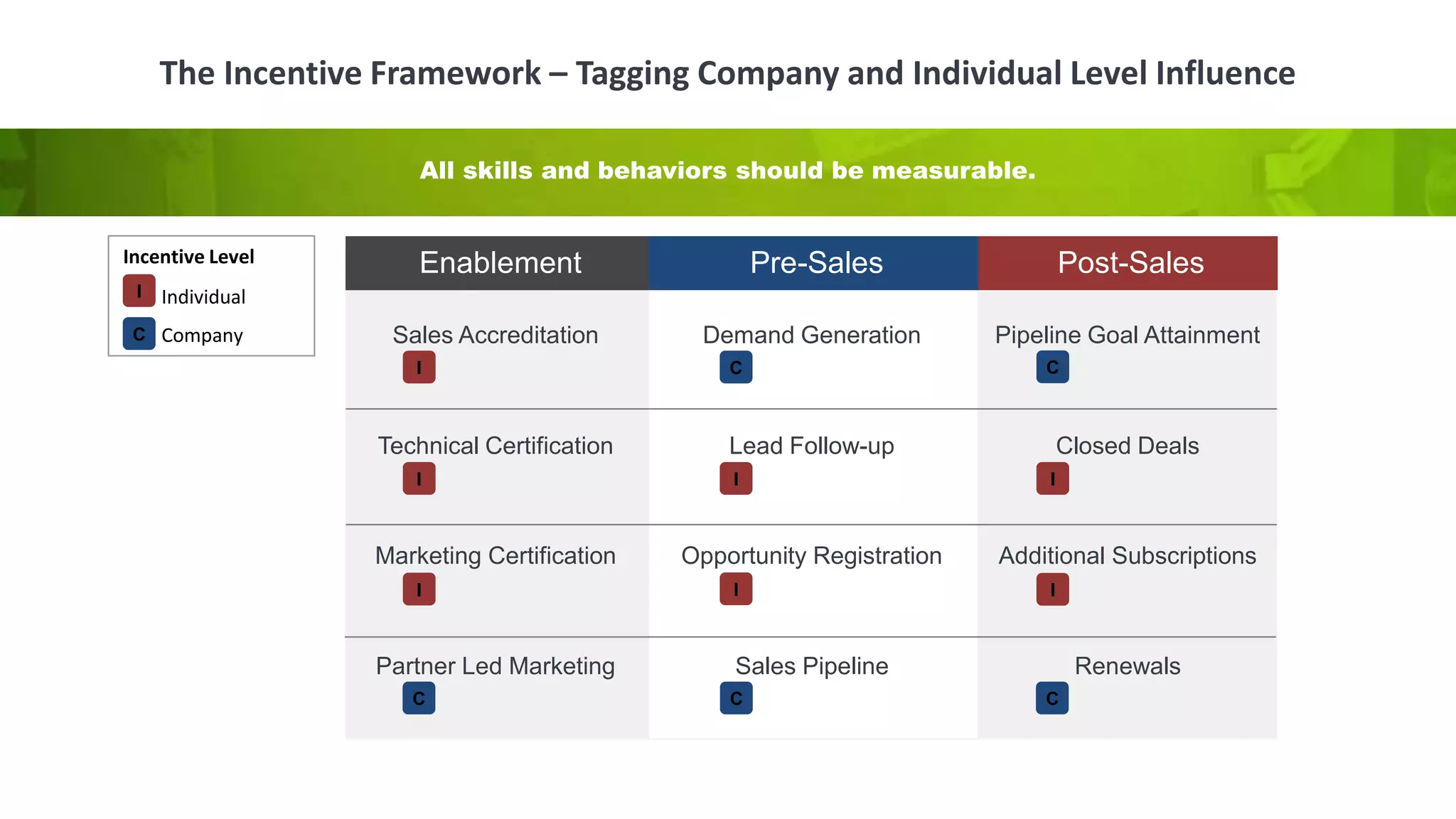
The Incentive Framework – Tagging Company and Individual Level Influence
Sales Accreditation
Technical Certification
Enablement Pre-Sales Post-Sales
Marketing Certification
Partner Led Marketing
Demand Generation
Lead Follow-up
Opportunity Registration
Sales Pipeline
Pipeline Goal Attainment
Closed Deals
Additional Subscriptions
Renewals
I
CI
I
I
I
CC
C
I
I
C
Incentive Level
Individual
Company
I
C
All skills and behaviors should be measurable.
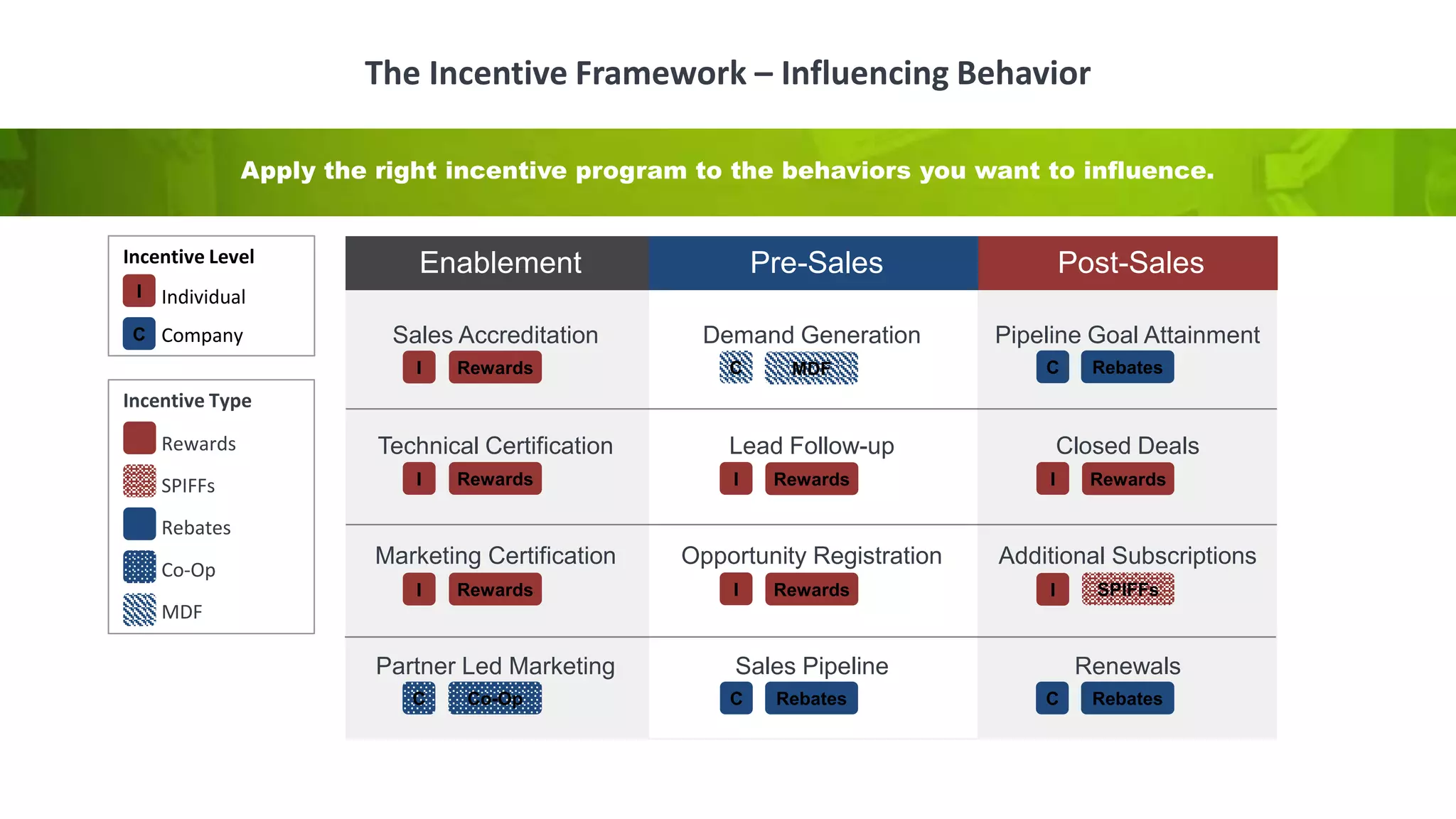
The Incentive Framework – Influencing Behavior
Sales Accreditation
Technical Certification
Enablement Pre-Sales Post-Sales
Marketing Certification
Partner Led Marketing
Demand Generation
Lead Follow-up
Opportunity Registration
Sales Pipeline
Pipeline Goal Attainment
Closed Deals
Additional Subscriptions
Renewals
Rewards
Co-Op
SPIFFsI
C MDF
Rebates
Rewards
I
RewardsI
RewardsI
I Rewards
CC
RebatesC
I Rewards
I
RebatesC
Incentive Level
Individual
Company
I
C
Incentive Type
Rewards
SPIFFs
Rebates
Co-Op
MDF
Apply the right incentive program to the behaviors you want to influence.
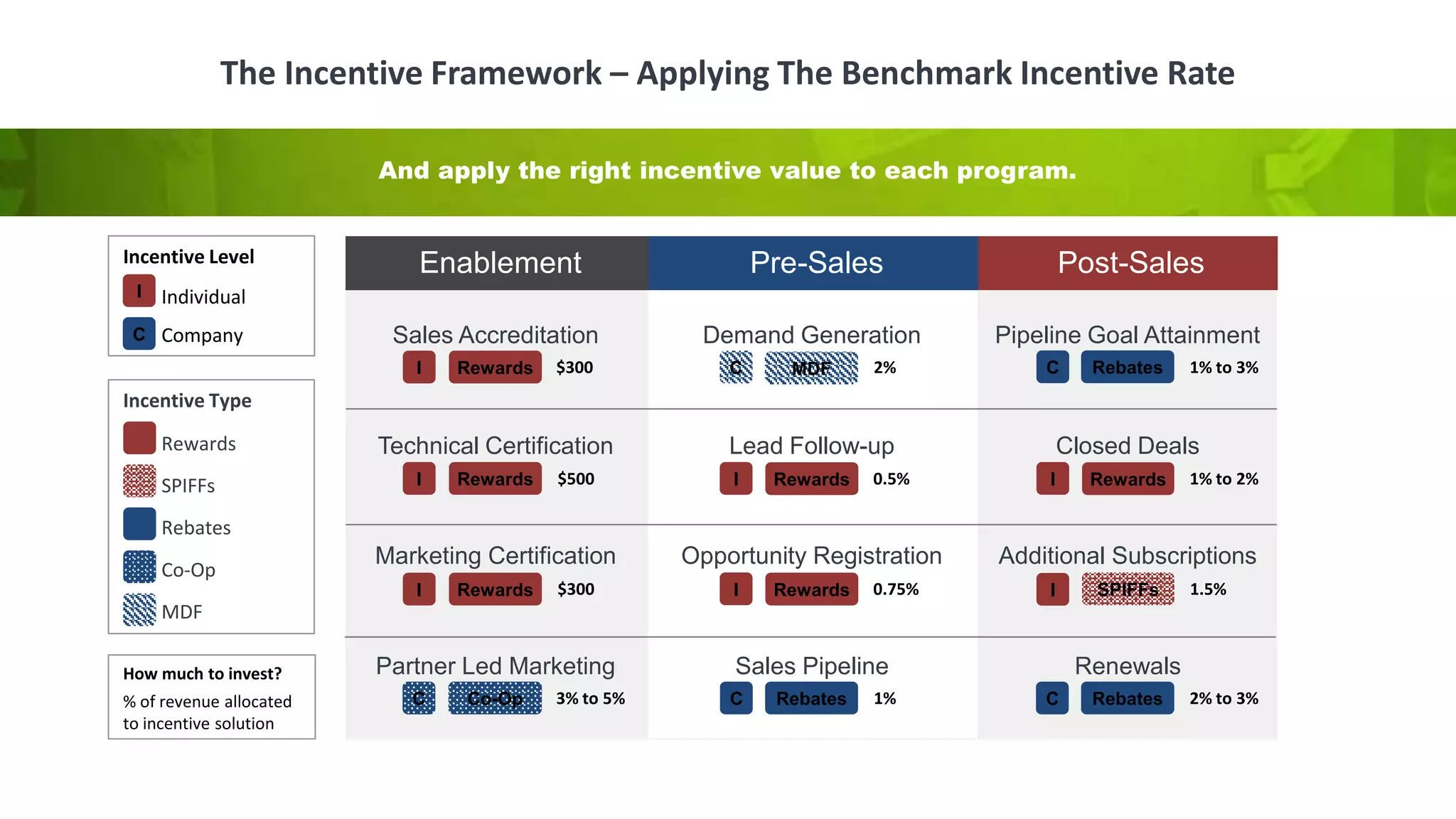
The Incentive Framework – Applying The Benchmark Incentive Rate
Sales Accreditation
Technical Certification
Enablement Pre-Sales Post-Sales
Marketing Certification
Partner Led Marketing
Demand Generation
Lead Follow-up
Opportunity Registration
Sales Pipeline
Pipeline Goal Attainment
Closed Deals
Additional Subscriptions
Renewals
Rewards
Co-Op
SPIFFsI
C MDF
Rebates
Rewards
I
RewardsI
RewardsI
I Rewards
CC
RebatesC
I Rewards
I
RebatesC
Incentive Level
Individual
Company
I
C
Incentive Type
Rewards
SPIFFs
Rebates
Co-Op
MDF
$300
$500
$300
3% to 5%
2%
0.5%
0.75%
1%
1% to 3%
1% to 2%
1.5%
2% to 3%
How much to invest?
% of revenue allocated
to incentive solution
And apply the right incentive value to each program.
Marketing Sales
Demand Generation Content
Infographics, Articles,
Viral Videos, SEO, Web syndication
Lead Management Content
Whitepapers, Webinars,
Newsletters, Reports, eBooks
Opportunity Management Content
In-person Events, ROI Calculators,
Demos, Testimonials
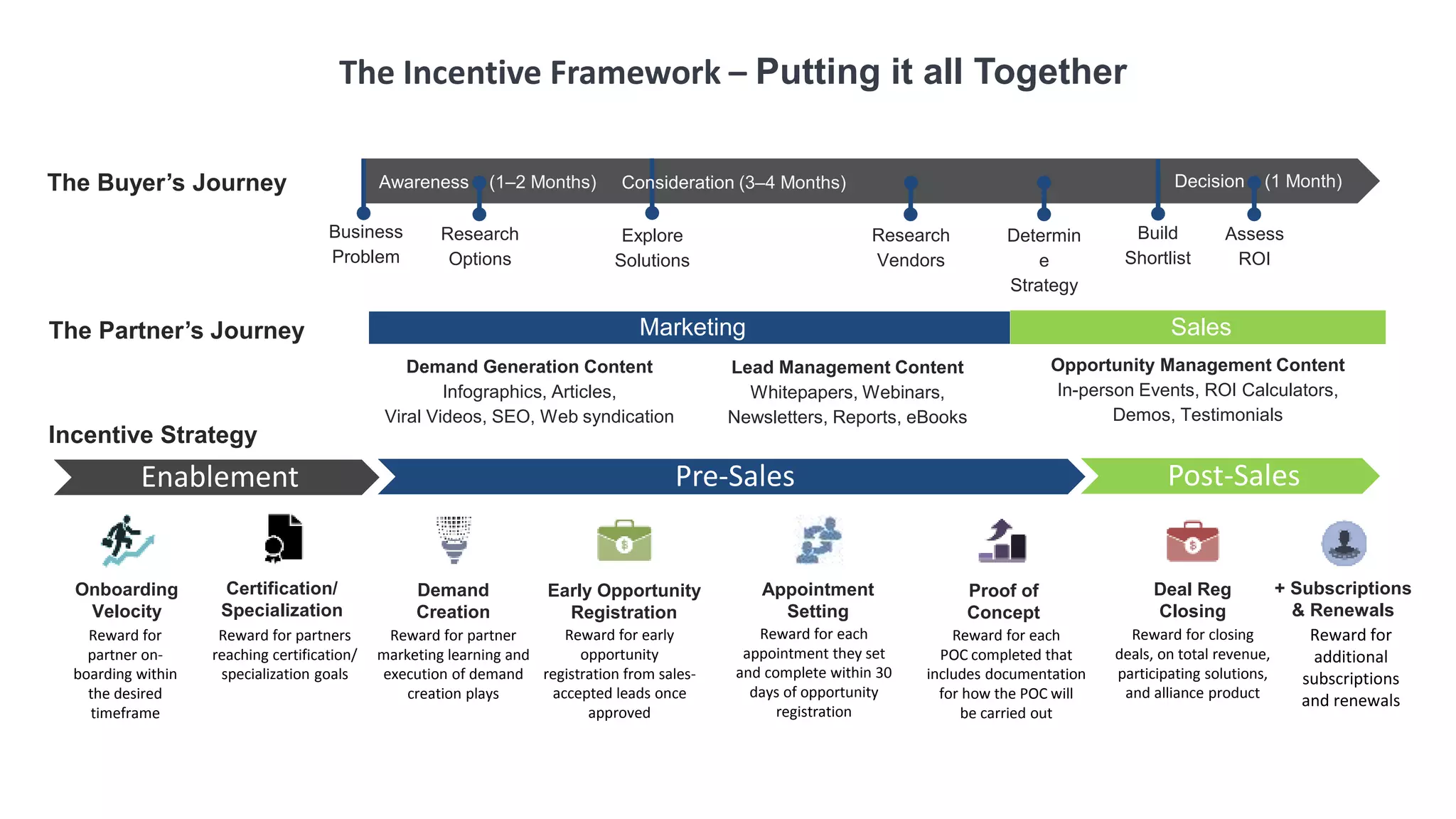
The Incentive Framework – Putting it all Together
Early Opportunity
Registration
Onboarding
Velocity
Demand
Creation
Certification/
Specialization
Enablement Pre-Sales Post-Sales
Appointment
Setting
Proof of
Concept
Deal Reg
Closing
+ Subscriptions
& Renewals
Research
Options
Business
Problem
Explore
Solutions
Research
Vendors
Determin
e
Strategy
Build
Shortlist
Assess
ROI
Decision (1 Month)Consideration (3–4 Months)The Buyer’s Journey Awareness (1–2 Months)
Reward for
partner on-
boarding within
the desired
timeframe
Reward for early
opportunity
registration from sales-
accepted leads once
approved
Reward for partners
reaching certification/
specialization goals
Reward for partner
marketing learning and
execution of demand
creation plays
Reward for each
appointment they set
and complete within 30
days of opportunity
registration
Reward for each
POC completed that
includes documentation
for how the POC will
be carried out
Reward for closing
deals, on total revenue,
participating solutions,
and alliance product
Reward for
additional
subscriptions
and renewals
The Partner’s Journey
Incentive Strategy
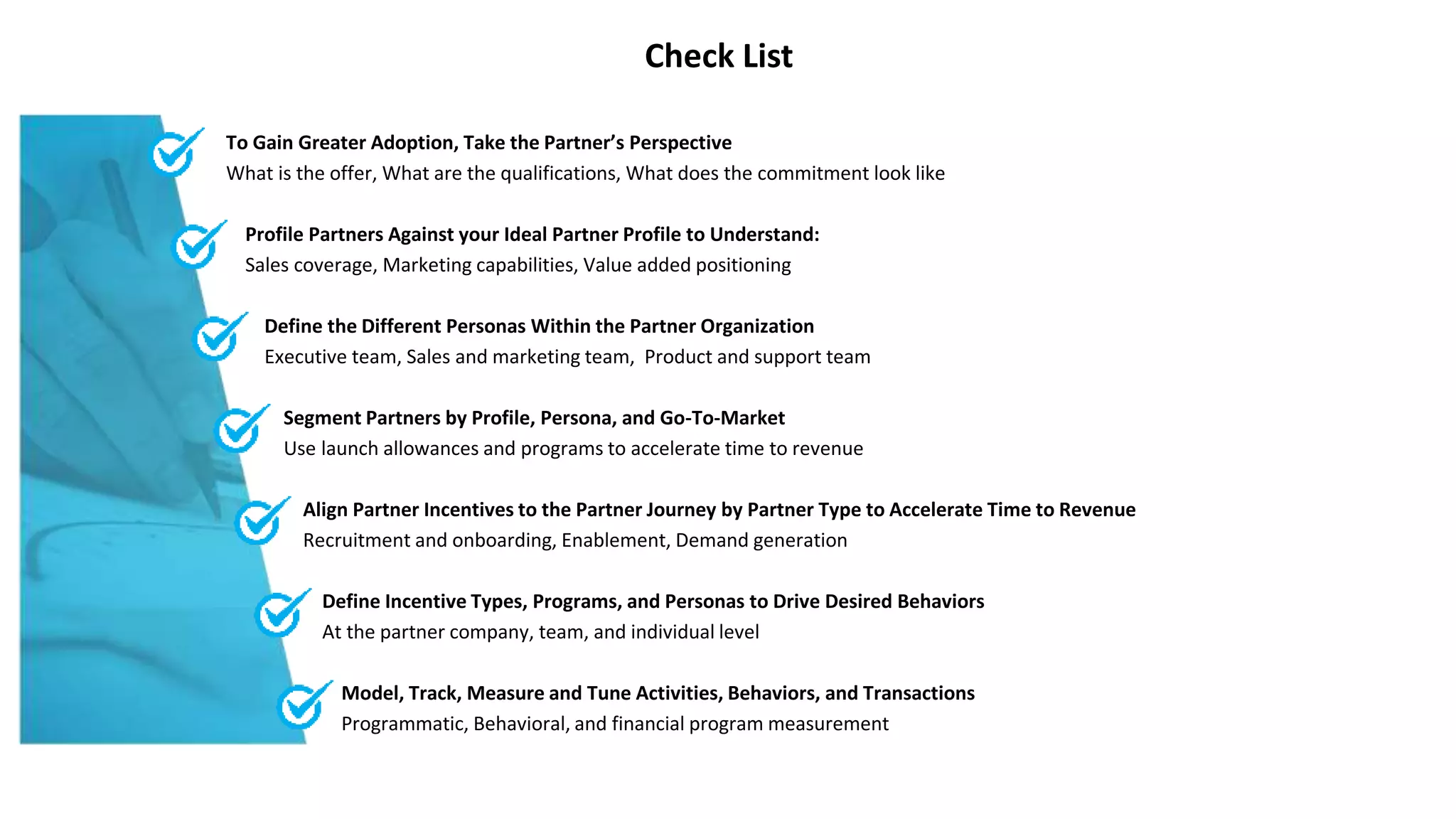
Check List
To Gain Greater Adoption, Take the Partner’s Perspective
What is the offer, What are the qualifications, What does the commitment look like
Profile Partners Against your Ideal Partner Profile to Understand:
Sales coverage, Marketing capabilities, Value added positioning
Define the Different Personas Within the Partner Organization
Executive team, Sales and marketing team, Product and support team
Segment Partners by Profile, Persona, and Go-To-Market
Use launch allowances and programs to accelerate time to revenue
Align Partner Incentives to the Partner Journey by Partner Type to Accelerate Time to Revenue
Recruitment and onboarding, Enablement, Demand generation
Define Incentive Types, Programs, and Personas to Drive Desired Behaviors
At the partner company, team, and individual level
Model, Track, Measure and Tune Activities, Behaviors, and Transactions
Programmatic, Behavioral, and financial program measurement
www.perksww.com
www.perksww.com/contact-us
(501) 707-0360
www.twitter.com/PerksCorp
www.linkedin.com/company/perks.com
plus.google.com+PerksIncentivePrograms/posts
www.facebook.com/perksincentives
Thank You!
This content is copyrighted by Perks WW and SiriusDecisions, Inc. and is presented to you on the understanding that
its contents are copyright and that the ideas, proposals, techniques and creative design concepts expressed in it or
presented as separate examples are intellectual property belonging to Perks WW and SiriusDecisions and cannot be
reproduced or shared without prior expressed written permission from Perks WW and/or SiriusDecisions.
This presentation includes confidential and proprietary data that shall not be disclosed outside the addressed
audience and shall not be duplicated, used or disclosed – in whole or in part – for any purpose other than to
evaluate this framework and methodology.
Other companies and products named herein may be trademarks or registered trademarks of their respective owners,
and are hereby acknowledged.
© 2018 Perks WW | Channel. All Rights Reserved
Copyright
#ChannelWeek
Q&A / Speakers
Claudio Ayub
Perks WW
Terry Moffatt
Channel Marketer Report
#ChannelWeek
Register for more sessions now thru August 24th!
Join Our Next Session: Bridging the Channel Gap: How Corporate Marketing Can
Align Activities With Channel Programs
webinars.demandgenreport.com/channel-week-series/2018
Wednesday, August 22nd
12:00 PM Eastern Time

Accelerate Your Partners' Digital Transformation With Point-Based Rewards

  • 1.
    #ChannelWeek Accelerate Your Partners’Digital Transformation With Point-Based Rewards SPONSORED BY:
  • 2.
    #ChannelWeek Covering The LatestChannel News, Trends & Strategies channelmarketerreport.com twitter.com/channelmktr https://dg-r.co/ChannelMarketer Your Source For The Latest B2B Marketing News & Trends demandgenreport.com twitter.com/DG_Report https://dg-r.co/DG-Specialists
  • 3.
    February 25–27, 2019 SAVETHE DATE: Join Our B2BMXperts community: b2bmx.influitive.com/join/now Hyatt Regency, Scottsdale www.b2bmarketing.exchange
  • 4.
    #ChannelWeek #ChannelWeek Prize Pack:Register & Attend to Win Join all our #ChannelWeek sessions live for the best chance to win • $10 Starbucks gift cards - 1 winner per session • Free passes to #B2BMX - 1 winner per day
  • 5.
    How are wedoing? #ChannelWeek Questions, Tweets, Resources, Survey
  • 6.
  • 7.
  • 8.
    The Key IssuesImpacting Transformation Digital transformation of your partner businesses requires new skill sets, and partner companies willing to adapt and evolve Digital transformation is disrupting existing channel financial and incentive models across every sector, on a global scale Digital transformation has created misalignment of your partner’s sales process, with the new digitally-connected buyer’s journey
  • 9.
    Can Be AddressedWith “Incentive Engineering” Behaviors are easier to track, it is their collective impact that improves channel performance Incentives must be used to remove the “friction” in the transformation process to streamline lead to revenue You can change behaviors, and by extension, the outcome of the cumulative transformation motion
  • 10.
    The Takeaway Today Astep-by-step approach to identifying the most effective combination of incentives at the company, team, and individual level - to deliver partner results Demonstrates that a sales is the results on a number of productive activities and behaviors which when properly orchestrated lead to that sale Aligning the partner’s sales process to the buyers journey, improving demand generation, lead management, and opportunity management; accelerating time to revenue
  • 11.
    Current State ofChannel Demand Business and market realities have created an unprecedented opportunity
  • 12.
    Current State ofChannel Demand 61% of vendors report they offer partner-generated lead programs 61% of vendors report they offer vendor-generated lead programs 41% of vendors report they offer referral lead programs SiriusDecisions 2017 Global CMO Study
  • 13.
    Top Challenges forPartners 72% Inability to connect offerings to buyer needs and challenges 69% Inability to differentiate offerings from competition or status quo 65% Poor content quality or inaccessibility for lack of education Command Center™
  • 14.
    Current Marketing AutomationTool Utilization SiriusDecisions CMM Tool Study 17% of partners actually utilize channel marketing and management (CMM) platforms 10% of partners actually possess dedicated marketing resources. Most only have a role
  • 15.
    What Can WeDo About It?
  • 16.
    Three Key Areasto Focus On The Buyer’s Journey Partners identify and meet the buyer’s information requirements. Marketing Certification Educate them on positioning an offering with their target buyer. Drive Behavior Allocate the reward where the effort is being made
  • 17.
    Marketing Certification Partner enablementis moving beyond product and sales training
  • 18.
    Marketing Accreditation –The Basics Basic Best Practices - Identify the marketing role/associate at the partner - Engage them with learning tracks and rewards - Teach the basics of demand generation & nurturing - Teach them to use your marketing automation tools - Show them your campaign-in-a-box options - Measure results and share with your audience - Reward those who met or exceeded expectations SiriusDecisions research indicates partners are three times more likely to respond to a demand creation program offer after engaging in some form of marketing training
  • 19.
    Marketing Fundamentals Education Buyer’sjourney, digital marketing, ABM, customer marketing, etc. Marketing Sales Demand Generation Content Infographics, Articles, Viral Videos, SEO, Web syndication Lead Management Content Whitepapers, Webinars, Newsletters, Reports, eBooks Opportunity Management Content In-person Events, ROI Calculators, Demos, Testimonials Research Options Business Problem Explore Solutions Research Vendors Determine Strategy Build Shortlist Assess ROI Decision (1 Month)Consideration (3–4 Months) The Buyer’s Journey Awareness (1–2 Months)
  • 20.
    Its Also AboutPlay Execution Step-by-step guide to the marketing campaign
  • 21.
    Partners should be taughtto identify and meet the buyer’s information requirements during each stage of the buying process. Combine Marketing Skill Transfer and Vendor-Specific Information The partner should be taught to position an offering with the target buyer by showing how to align the messaging to the type of demand the partner must try to create. Partners should be trained to develop these leads using multi-touch lead-nurturing programs, as well as learn to use the four critical elements in digital marketing. The Buyer’s Journey Demand Type Multi-Touch
  • 22.
    Marketing Accreditation –How to Get Started Share Incentive 1,350 points ($150) 25 registered attendees Content deployed on the partner website Email sent to 100 contacts Create Incentive: 900 points ($100) Creation within the CMM platform Learn Incentive: 450 points ($50) Passed quiz in the incentive center (with training material) Incentive Event Landing Page + Email Content Syndication Share MetricCreate MetricLearn Metric Marketing Activity Passed training/quiz in the incentive center Passed training/quiz in the incentive center Creation or Implementation of the code Selection within the CMM platform
  • 23.
    Aligning Metrics toBehaviors Makes it Easier to Substantiate ROI These are the basic measurements of partner incentive performance Registrations Participation/Frequency Accruals/Claims/Proposals Engagement Value Breadth Frequency Accreditation/Certification Demand Generation activity Lead Management MQL to SAL New Opportunity Registration Partner Program On-boarding Learning Management System Marketing Automation Deal Registration POS MBO’s Inventory MDF/Co-Op Rebates Rewards Spiffs Company Confidential © 2018 Perks.com All Rights Reserved.
  • 24.
    Digital Buyer’s Journey Aligningthe partner’s sales process to the new digital buyer’s journey
  • 25.
    Commit to Change Loose Status Quo Explore Solutions Research Vendors Determin e Strategy Build Shortlist Assess ROI Decision (1Month)Solution Stage (3–4 Months) The Buyer’s Journey Education Stage (1–2 Months) Commit to a Solution The New Digital Buyer’s Journey Enablement Pre-Sales Post-Sales The Partner’s Sales Cycle Through Partner Marketing Sales, Marketing & Product Training Demand Generation Deal Registration Lead Follow-Up Close Deal Registration Proof of Concept Renewals Addt’l Subscriptions
  • 26.
    Enablement Pre-Sales Post-Sales Commit to Change Loose StatusQuo Explore Solutions Research Vendors Determin e Strategy Build Shortlist Assess ROI Decision (1 Month)Solution Stage (3–4 Months) The Buyer’s Journey Education Stage (1–2 Months) Commit to a Solution The Partner’s Sales Cycle The Partner’s Sales Cycle Length Month 1 Month 2 Month 3 Month 4 Month 5 Month 6 Month 7 Month 8 Through Partner Marketing Sales, Marketing & Product Training Demand Generation Deal Registration Lead Follow-Up Close Deal Registration Proof of Concept Renewals Addt’l Subscriptions Month 1 Month 2 Month 3 Month 4 Aligning Your Partner’s Sales Process
  • 27.
    Enablement Pre-Sales Post-Sales ThePartner’s Sales Cycle Through Partner Marketing Sales, Marketing & Product Training Demand Generation Deal Registration Lead Follow-Up Close Deal Registration Appointment Setting Month 1 Month 2 Month 3 Month 4 Renewals Addt’l Subscriptions Deal Reg Deal Close Incentive Rate 0.50% 2.50% $150 $750 # Deals Reg Closing Ratio Deals Closed Average Value Revenue 240 480 50% 50% 120 240 $30,000 $3,600,000 $7,200,000$30,000 Incremental Revenue $3,600,000 Accelerating Time to Revenue State Current Future
  • 29.
    BTW - GAMIFICATION:noun gam·i·fi·ca·tion ˌgā-mə-fə-ˈkā-shən Gamification in the channel is all about driving and rewarding activity and behavior completion… it’s not about games
  • 30.
    Drive Partner Behavior Allocatingthe reward where the effort is being made
  • 31.
    Understand your partner’sdifferent profiles and business models incentives to the selected partner business model because different partner types require different motivators. Align and select the different personas within the partners you want to target Identify who you are trying to influence, to then segment your incentive program accordingly Understand your partner audience and determine which partners types are in the best position to achieve the target results aligned to channel objectives Consider
  • 32.
    Identify and AlignDesired Behaviors at Individual and Company Levels Financial Goal • Increase sales revenue • Increase pipeline contribution • Customer retention • Upsell and cross-sell Partner Capabilities • Certification/training completion • Joint business planning • Partner scorecard • Increase program engagement Demand Creation • Closed-loop lead reporting • Demand creation participation • Increase partner generated leads • Increase marketing contribution to pipeline
  • 33.
    Influence Those Activitiesand Behaviors with Incentives *Incentive/funding program types Establish a comprehensive incentive strategy incorporating leading and lagging indicators of success, as well as clear goals aligned to “who” is being incented, by aligning incentives to partner personas Co-op Funds* MDF Funds* Revenue Achievement Performance Rebates* Volume Rebates* SPIFFs* Points-based Rewards* Lagging Indicator Incentives Can only be measured when ROI is reached IncentiveTypes Channel Incentive Types: Partner Team Individuals Launch Funds* (discretionary) Deal Registration Onboarding Velocity Certification/Specialization Achievement Enablement/Engagement Incentives MBO/KPI Incentives (Persona-based: Sales, Mktg, Tech, Support, etc.) Points-based Rewards*, Gamification Leading Indicator Incentives Can be measured and adjusted before ROI is reached IncentivePrograms Channel Incentive Programs: Partner Team Individuals Incorporate leading and lagging indicators
  • 34.
    Reward & Recognizewith Intrinsic & Extrinsic Motivators Research by IRF shows that financial (extrinsic) rewards can reduce the effect of meeting intrinsic goals, if they are not balanced* Extrinsic MotivationIntrinsic Motivation *2018 Study by the Incentive Research Foundation
  • 35.
    The incentives framework inaction A systematic approach to incentive plan design
  • 36.
    The Incentive Framework– Activities & Behaviors Sales Accreditation Technical Certification Enablement Pre-Sales Post-Sales Marketing Certification Partner Led Marketing Demand Generation Lead Follow-up Opportunity Registration Sales Pipeline Pipeline Goal Attainment Closed Deals Additional Subscriptions Renewals The 3 key areas to impact partner sales effectiveness are: enablement, pre-sales, and post-sales.
  • 37.
    The Incentive Framework– Tagging Company and Individual Level Influence Sales Accreditation Technical Certification Enablement Pre-Sales Post-Sales Marketing Certification Partner Led Marketing Demand Generation Lead Follow-up Opportunity Registration Sales Pipeline Pipeline Goal Attainment Closed Deals Additional Subscriptions Renewals I CI I I I CC C I I C Incentive Level Individual Company I C All skills and behaviors should be measurable.
  • 38.
    The Incentive Framework– Influencing Behavior Sales Accreditation Technical Certification Enablement Pre-Sales Post-Sales Marketing Certification Partner Led Marketing Demand Generation Lead Follow-up Opportunity Registration Sales Pipeline Pipeline Goal Attainment Closed Deals Additional Subscriptions Renewals Rewards Co-Op SPIFFsI C MDF Rebates Rewards I RewardsI RewardsI I Rewards CC RebatesC I Rewards I RebatesC Incentive Level Individual Company I C Incentive Type Rewards SPIFFs Rebates Co-Op MDF Apply the right incentive program to the behaviors you want to influence.
  • 39.
    The Incentive Framework– Applying The Benchmark Incentive Rate Sales Accreditation Technical Certification Enablement Pre-Sales Post-Sales Marketing Certification Partner Led Marketing Demand Generation Lead Follow-up Opportunity Registration Sales Pipeline Pipeline Goal Attainment Closed Deals Additional Subscriptions Renewals Rewards Co-Op SPIFFsI C MDF Rebates Rewards I RewardsI RewardsI I Rewards CC RebatesC I Rewards I RebatesC Incentive Level Individual Company I C Incentive Type Rewards SPIFFs Rebates Co-Op MDF $300 $500 $300 3% to 5% 2% 0.5% 0.75% 1% 1% to 3% 1% to 2% 1.5% 2% to 3% How much to invest? % of revenue allocated to incentive solution And apply the right incentive value to each program.
  • 40.
    Marketing Sales Demand GenerationContent Infographics, Articles, Viral Videos, SEO, Web syndication Lead Management Content Whitepapers, Webinars, Newsletters, Reports, eBooks Opportunity Management Content In-person Events, ROI Calculators, Demos, Testimonials The Incentive Framework – Putting it all Together Early Opportunity Registration Onboarding Velocity Demand Creation Certification/ Specialization Enablement Pre-Sales Post-Sales Appointment Setting Proof of Concept Deal Reg Closing + Subscriptions & Renewals Research Options Business Problem Explore Solutions Research Vendors Determin e Strategy Build Shortlist Assess ROI Decision (1 Month)Consideration (3–4 Months)The Buyer’s Journey Awareness (1–2 Months) Reward for partner on- boarding within the desired timeframe Reward for early opportunity registration from sales- accepted leads once approved Reward for partners reaching certification/ specialization goals Reward for partner marketing learning and execution of demand creation plays Reward for each appointment they set and complete within 30 days of opportunity registration Reward for each POC completed that includes documentation for how the POC will be carried out Reward for closing deals, on total revenue, participating solutions, and alliance product Reward for additional subscriptions and renewals The Partner’s Journey Incentive Strategy
  • 41.
    Check List To GainGreater Adoption, Take the Partner’s Perspective What is the offer, What are the qualifications, What does the commitment look like Profile Partners Against your Ideal Partner Profile to Understand: Sales coverage, Marketing capabilities, Value added positioning Define the Different Personas Within the Partner Organization Executive team, Sales and marketing team, Product and support team Segment Partners by Profile, Persona, and Go-To-Market Use launch allowances and programs to accelerate time to revenue Align Partner Incentives to the Partner Journey by Partner Type to Accelerate Time to Revenue Recruitment and onboarding, Enablement, Demand generation Define Incentive Types, Programs, and Personas to Drive Desired Behaviors At the partner company, team, and individual level Model, Track, Measure and Tune Activities, Behaviors, and Transactions Programmatic, Behavioral, and financial program measurement
  • 42.
  • 43.
    This content iscopyrighted by Perks WW and SiriusDecisions, Inc. and is presented to you on the understanding that its contents are copyright and that the ideas, proposals, techniques and creative design concepts expressed in it or presented as separate examples are intellectual property belonging to Perks WW and SiriusDecisions and cannot be reproduced or shared without prior expressed written permission from Perks WW and/or SiriusDecisions. This presentation includes confidential and proprietary data that shall not be disclosed outside the addressed audience and shall not be duplicated, used or disclosed – in whole or in part – for any purpose other than to evaluate this framework and methodology. Other companies and products named herein may be trademarks or registered trademarks of their respective owners, and are hereby acknowledged. © 2018 Perks WW | Channel. All Rights Reserved Copyright
  • 44.
    #ChannelWeek Q&A / Speakers ClaudioAyub Perks WW Terry Moffatt Channel Marketer Report
  • 45.
    #ChannelWeek Register for moresessions now thru August 24th! Join Our Next Session: Bridging the Channel Gap: How Corporate Marketing Can Align Activities With Channel Programs webinars.demandgenreport.com/channel-week-series/2018 Wednesday, August 22nd 12:00 PM Eastern Time

Editor's Notes

  • #9 Digital transformation is affecting every sector across every industry on a global scale. Specially demand generation professionals and channel marketers are increasingly seeing the value of adopting digital strategies to grow their business. Yet digital transformation of your partner businesses is a complex, multifaceted endeavor that warrants a new vision and new approaches to partner engagement and incentives. This is mainly due to partners lacking the digital sales and marketing skills to effectively market and sell the vendor’s solutions. One clear example is how digital transformation has created misalignment of your partner’s sales process, with the new digitally-connected buyer’s journey. As a matter of fact, according to a partners’ sales processes study by SiriusDecisions, a scant 12% of respondents stated they have modified their sales process to align with the new buyers journey. Enterprise organizations have never experienced this level of upheaval before, and established brands are scrambling to leverage their through-channel marketing automation technology to deliver ROI.
  • #10 Never the less, the key issues impacting your digital marketing strategies can be addressed with what Forrester Calls “Incentive Engineering” - You can actually change partner behavior and the outcome of the cumulative transformation effort. Think about this, Forrester estimates that sales of through-channel marketing automation technology will climb at a 25% CAGR through 2023 to $1.6 billion. Yet a recent study by SiriusDecisions also revealed that the average utilization of TCMA solutions were under 17%. It’s therefore imperative that vendors engage their partners with comprehensive programs that incent them to take full advantage of these new digital solutions, because what is likely to have the biggest impact on the ROI of vendors investments is how eagerly partner companies adopt the digital marketing tools vendors support.
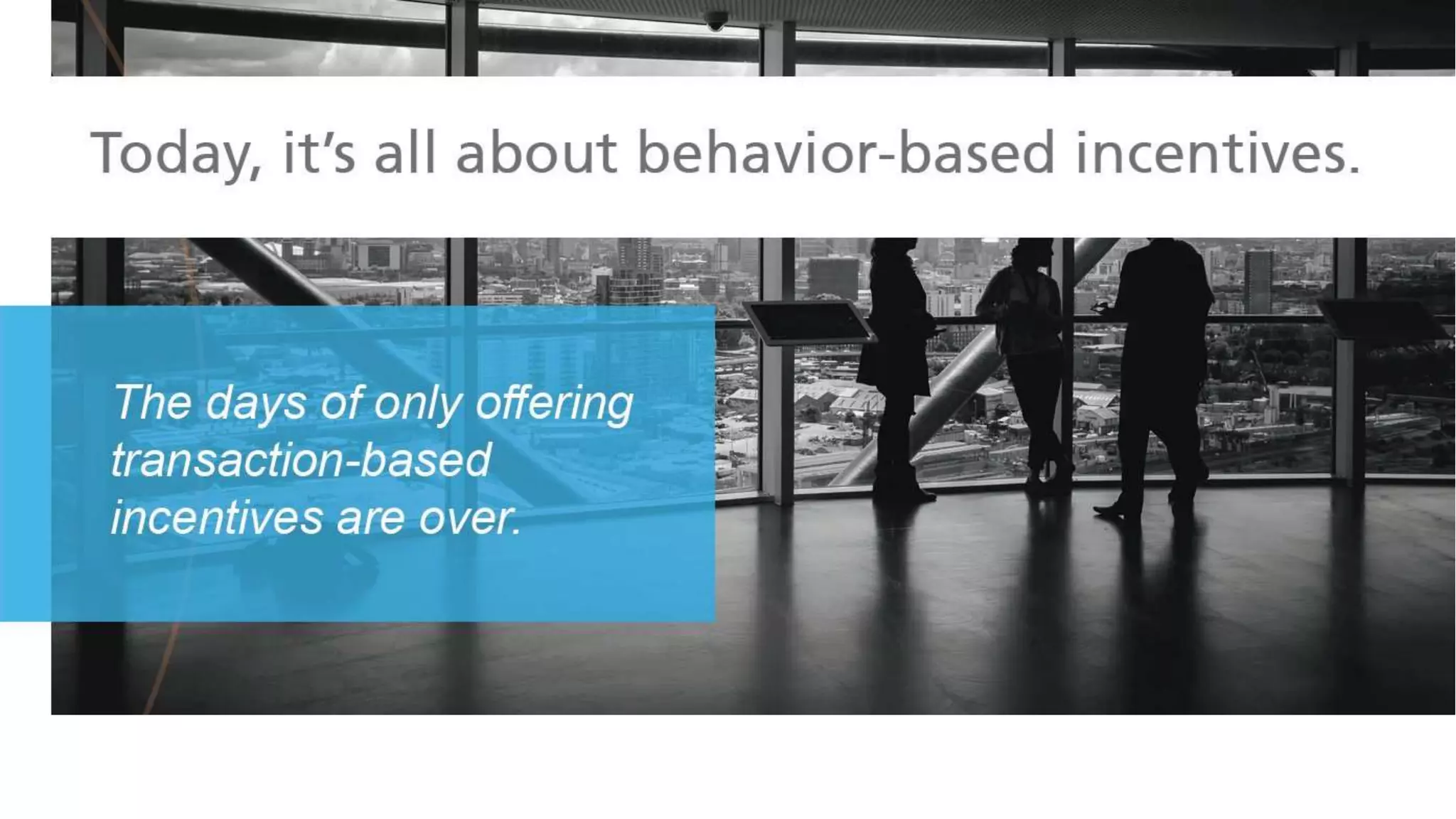
  • #11 So today you will walk away from this webcast with a new channel incentive framework to help you increase and improve your partner’s utilization of your digital sales and marketing tools. This framework provides a step-by-step approach to identifying the most effective combination of incentives at the company, team, and individual level - to drive your digital marketing strategies. In doing this, we will demonstrate how a sales is the results on a number of productive activities and behaviors which when properly orchestrated lead to that sale. We will also review how to align your partner’s sales process to the new digital buyers journey, improving demand generation, lead management, and opportunity management; It’s time to REEVALUATE how you model and design your INCENTIVE PROGRAMS – as The days of only offering transaction-based incentives are gone forever.
  • #12 Let’s start by taking a quick view at the current state of channel demand – as the lack of alignment and proper governance in channel demand management is resulting in inefficiencies, increased costs, lost revenue, and poor partner and buyer experiences. The fact is that Business and market realities have created an unprecedented opportunity for channel leaders to create value for their partner organizations
  • #13 Marketing enablement is more important than ever before, because many channel organizations are increasingly shifting the responsibilities of demand creation to their channel partners. Everyone is doing it –as vendors who strive to expand sales breadth by adding more partners are also investing in these one- to-many, self-service TCMA tools that address partner marketing needs. Yet key limitations often prevent these programs from being successful.
  • #14 Understanding your partner’s challenges associated with channel demand programs is critical for making the improvements required to ensure future success. Your partner’s challenges are many – one of the most critical ones is the partner’s inability to connect offerings to the new digital buyer’s needs and challenges. Yet getting partners to participate in learning tracks requires a concerted effort to engage them, and then lead them to the specific tracks they are in need of. The reality is that many of these challenges can be addressed through an interlock with portfolio marketing, and channel marketing’s enablement of partners through knowledge transfer.
  • #15 To make matters more complex, only 10% of partners actually have a dedicated marketing resource. Most have a marketing role only - someone that does marketing among other things. The key takeaway here is that the partner’s marketing associate or role is a new persona to incent in the vendor/partner relationship. Because these partner marketing individuals lack the sales and marketing skills to effectively sell your solutions. Consequently, you must first identify, tag, and engage these individuals to increase their marketing skills and ensure proper execution.
  • #16 So how can we gain a better understanding of partners’ marketing capabilities, and enable partners to use the digital marketing programs and tools vendor’s provide?
  • #17 Let’s start by focusing on three key areas. First employ a marketing enablement/accreditation or certification program, to ensure partners acquire the skills they need to execute your digital marketing campaigns, and gain their commitment. BTW the top reason why partners are not able to connect offerings to buyer needs and challenges is the misalignment of the partners’ sales process to the digitally connected buyer’s journey. So that’s is the second focus area. 80% of Partners still use an activity based sales process that is totally disconnected from the buyers journey. Understanding your end-customer buyer’s journey and teaching partners how to engage buyers by aligning their sales cycle to the buyer's journey is vital to the success of your partner in this digitally-connected end-customer environment. Third, drive partner behavior using channel incentives as the currency to reward partners after completing the prior two focus areas, leading them to select the right play using the funds offered
  • #18 Alright, so let’s look at how marketing certification is going to help transform partners into taking advantage of all your digital marketing tools. BTW marketing certification should be leveraged as a tool for raising partner commitment levels - for example, using marketing certification as a prerequisite for marketing development funds (MDF).
  • #19 Let’s start with the basics. This type of education tracks targets the marketing role or individual within the partner organization, plus at least one other person who should be certified for participation in demand creation plays. First you need to Identify the marketing role/associate at the partner to then engage them with learning tracks that will teach the basics of demand generation and how to use your marketing automation tools, as well as your campaign-in-a-box options. The people who fill these new roles within partner organizations (and who are designated as marketing leads) should be the primary participants in your marketing certification training and incentive programs. The training should be scheduled to occur during a new product launch, partner on-boarding, or major campaign roll-outs. Second, measure the resulting number of trainings completed and share with your audience. Key metrics to consider include the number of certification programs offered, the number of partners who participate, the number of partners who achieve certification, and the range of skills and markets in the programs.
  • #20 Then follow this with marketing fundamentals learning tracks- While partners do not need to be experts in every nuance of aligning marketing programs to prospective buyers, they must have a baseline set of skills that include educating partners on the common questions that customers will ask at each stage of the buyer’s journey. Common questions and objections can be inserted into a marketing playbook, or described to partners and stored in the partner portal for subsequent use. Second Describe the buyer personas who participates at each stage of the buyer’s journey and which assets can be used to meet their specific requirements. Third, help partners understand what type of demand they will be creating with prospects, which will determine their overall marketing and sales approach
  • #21 Now you then need to follow that up with play execution alignment - Teach partners where to find assets in your marketing automation tool, and how to use them when executing marketing programs. If they will apply marketing development fund (MDF) incentives to request individual tactics/plays from a menu, show them how to access the menu and what processes to follow. Also help them understand what is included in each play they select, the duration of the play, and the reporting expectations.
  • #22 Partners should be taught to identify and meet the buyer’s information requirements during each stage of the buying process. For each product being resold, a list should be provided of questions that partners should be prepared to answer at each stage using marketing assets (e.g., case studies, white papers, ROI calculators). These questions can be communicated to the partners through a one-page summary that addresses the broad phases of the buyer’s journey (education, solution, vendor selection). Suppliers should also train partners on buying roles (e.g., champions, ratifiers), the influence that these roles exert at various stages of the buying process, and how to customize the content or tactics for each role. Now let’s look at Demand Type - Partners should be taught to position an offering with the target buyer by showing how to align the messaging to the type of demand the partner must try to create. This training should help partners develop talk tracks for the solutions they are attempting to resell. Partners should also be able to detect when changes to the delivery of the solution affects the demand type (i.e., software as a service vs on-premise). Worksheets should be created that guide partners through a series of questions to determine the demand type; these worksheets can be reused in partner marketing programs or in the development of call scripts. Let’s now look at multi-touch Lead Development - Because most B2B inquires are generated over the Web - as potential buyers first locate, then educate themselves about potential solutions - partners should be trained to develop these leads using multi- touch lead-nurturing programs. Specifically, they should learn to use four critical elements in digital marketing (messaging, offers, tactics, and data collection) to create a multi-touch program that offers potential buyers appropriate content at each stage of their buying process.
  • #23 So now let’s see some basic tactical examples of marketing accreditation
  • #24 And while these are the basic measurements, there are Leading Indicators (Pre-Sale) where to look for increases in the number of partner-generated leads and conversions of inquiries to marketing qualified leads (MQLs). Suppliers should also see higher conversions of MQLs to sales accepted leads. Remember When suppliers tie specific enablement activities (e.g., training, certification) to demand offers, partners are more likely to engage in those demand offers, resulting in higher levels of participation. Key metrics include the quantity of the campaign materials downloaded, MDF utilization, and the pipeline opportunities that originated as MQLs. Lagging Indicators (Post-Sale) To measure the impact of marketing certification on performance, program performance and marketing contribution reliable metrics are needed. To measure the partner program ROI, the number of deals and the amount of revenue closed as a result of specific demand programs. Suppliers need to know the impact that marketing has on the partner pipelines
  • #28 Claudio: LET’S RECAP – WE STARTED BY MODELING THE PARTNER LIFE CYCLE. REMEMBER KNOWING WHERE TO INVEST BEGINS WITH AN UNDERSTANDING OF THE SPECIFIC BEHAVIORS YOU WANT TO INFLUENCE WITHIN YOUR CHANNEL. THEN MODEL YOUR PARTNER SALES PROCESS ALIGNED TO THE BUYER’S JOURNEY BY EXTENDING THE ENABLEMENT PHASE AND INTRODUCING THE CONCEPTS OF DEMAND TYPE, THE STAGES OF THE BUYER’S JOURNEY, AND HOW TO ALIGN SOLUTION MESSAGING WITH DEMAND TYPE. FOCUS TRAINING ON HELPING PARTNERS EVALUATE THE DEMAND TYPE AND BUYER’S JOURNEY FOR THEIR SPECIFIC AUDIENCES AND OFFERINGS SO THAT THEY CAN TO START CONVERSATIONS WITH THE BUYER. APPLY THE RIGHT INCENTIVE PROGRAM TYPE AND INCENTIVE RATE AN INCENTIVE PROGRAM ALIGNED TO THE BUYER’S AND PARTNER JOURNEY RECOGNIZES THAT A SUCCESSFUL SALE IS THE RESULT OF A STRING OF PRODUCTIVE ACTIVITIES, THAT WHEN COMBINED, LEAD TO THE SALE. - THIS IS ESPECIALLY TRUE FOR PRODUCTS AND SERVICES WITH LONG SALES CYCLES, WHERE MANY DIFFERENT SALES, MARKETING, AND PRODUCT PROCESSES ARE IN ALIGNMENT TO GENERATE LEADS, NURTURE OPPORTUNITIES AND MAINTAIN ENGAGEMENT THROUGH AN INCREASINGLY COMPLEX BUYING PROCESS - YOU REALLY DON’T NEED INCENTIVES AT EVERY STAGE, YOU JUST NEED TO CHOOSE THE RIGHT ONE TO ADVANCE THAT ONE AREA IN NEED OF IMPROVEMENT.
  • #29 In the digital age, you must provide a mix of individual-, team-, and company-level rewards to motivate your partners and their teams to initiate transformation. This can be achieved by combining company-level and individual/team-level incentives into a single program that is built around your partners’ sales cycles. Most current channel rewards programs deliver a benefit only after revenue is attained; therefore, there is no reason for the partner sales rep and sales engineer to engage up front. The result is that programs that initially seem attractive tend to fall by the wayside as partner teams become busy and see no immediate benefit. Even worse are programs that reward individuals for sales that they would have attained anyway.
  • #33 What partner behaviors should incentives motivate? The final step of the model is determining desired partner behaviors. When creating incentive programs, channel leaders should identify the behaviors they want to encourage and design incentives accordingly. Organizations typically look for behaviors from their partners that fall into the following categories:
  • #35 These individuals should be rewarded substantially for training on using the tool, piloting a few of these campaigns-in-a-box, and loading the proof-of-performance. The rewards will result in increased utilization and demand generation drive. Although these incentives cannot compensate for the absence of an easy-to-use CMM tool or effective campaign offerings, they can be effective as part of a holistic strategy for improving partner engagement at both the organizational and individual levels. The individual starter incentives need to be paid only once per training course and per campaign, as these campaigns should yield results that will earn the partner marketing manager top recognition within the business. In many instances, recognition is as important - if not more important - than the incentive itself. Remember You have to allocate the reward where the effort is being made to accomplish your objectives. Research continues to show that financial (extrinsic) rewards can reduce the effect of meeting intrinsic goals, if they are not balanced. Intrinsic motivation is a stronger indicator of job performance, whereas concentrating on monetary rewards takes attention away from the fundamental needs such as learning new skills, nurturing intellectual curiosity, and enjoying tasks that are critical to keeping employees engaged and motivated. A key to designing a successful rewards program should be based on an understanding of employees’ values and the creation of tools that target factors that motivate and inspire. Providing choices other than cash creates an emotional attachment, while cash is an unemotional reward that gets forgotten when spent like a salary.
  • #41 LET’S RECAP – START BY MODELING THE PARTNER LIFE CYCLE. KNOWING WHERE TO INVEST BEGINS WITH AN UNDERSTANDING OF THE SPECIFIC BEHAVIORS YOU WANT TO INFLUENCE WITHIN YOUR CHANNEL. WHEN DECIDING WHICH BEHAVIORS ARE IMPORTANT TO YOU, AND THEREFORE WHERE TO INVEST, . THEN MODEL YOUR PARTNER SALES PROCESS ALIGNED TO THAT JOURNEY BY EXTENDING THE ENABLEMENT PHASE AND INTRODUCING THE CONCEPTS OF DEMAND TYPE, THE STAGES OF THE BUYER’S JOURNEY, AND HOW TO ALIGN SOLUTION MESSAGING WITH DEMAND TYPE. FOCUS TRAINING ON HELPING PARTNERS EVALUATE THE DEMAND TYPE AND BUYER’S JOURNEY FOR THEIR SPECIFIC AUDIENCES AND OFFERINGS SO THAT THEY CAN TO START CONVERSATIONS WITH THE BUYER. APPLY THE RIGHT INCENTIVE PROGRAM TYPE AND INCENTIVE RATE AN INCENTIVE PROGRAM ALIGNED TO THE BUYER’S AND PARTNER JOURNEY RECOGNIZES THAT A SUCCESSFUL SALE IS THE RESULT OF A STRING OF PRODUCTIVE ACTIVITIES, THAT WHEN COMBINED, LEAD TO THE SALE. - THIS IS ESPECIALLY TRUE FOR PRODUCTS AND SERVICES WITH LONG SALES CYCLES, WHERE MANY DIFFERENT SALES, MARKETING, AND PRODUCT PROCESSES ARE IN ALIGNMENT TO GENERATE LEADS, NURTURE OPPORTUNITIES AND MAINTAIN ENGAGEMENT THROUGH AN INCREASINGLY COMPLEX BUYING PROCESS - YOU REALLY DON’T NEED INCENTIVES AT EVERY STAGE, YOU JUST NEED TO CHOOSE THE RIGHT ONE TO ADVANCE THAT ONE AREA IN NEED OF IMPROVEMENT.
  • #42 Claudio