{
Accounting Cycle
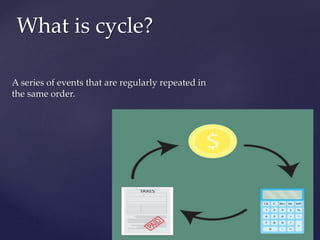
A series of events that are regularly repeated in
the same order.
What is cycle?
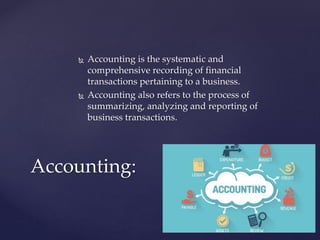
 Accounting is the systematic and
comprehensive recording of financial
transactions pertaining to a business.
 Accounting also refers to the process of
summarizing, analyzing and reporting of
business transactions.
Accounting:
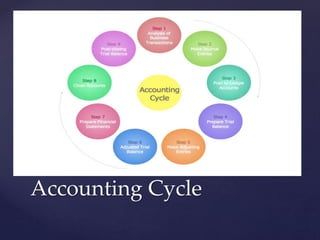
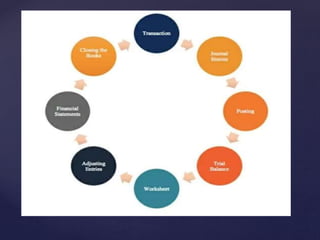
 The accounting cycle is the name given to be
collective process of recording and processing
the accounting events of a company
 We have nine steps in our accounting cycle
Accounting cycle
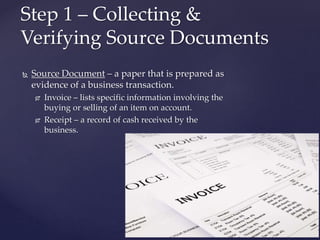
 Source Document – a paper that is prepared as
evidence of a business transaction.
 Invoice – lists specific information involving the
buying or selling of an item on account.
 Receipt – a record of cash received by the
business.
Step 1 – Collecting &
Verifying Source Documents
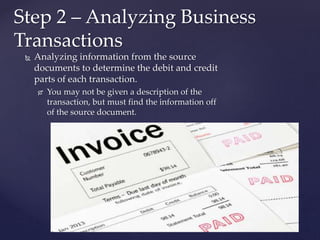
 Analyzing information from the source
documents to determine the debit and credit
parts of each transaction.
 You may not be given a description of the
transaction, but must find the information off
of the source document.
Step 2 – Analyzing Business
Transactions
 Ali sold good for Rs 10,000.
 Aslam purchases computer for Rs. 80,000.
 Pay salaries to employees Rs. 50,000.
Examples of Business
Transaction
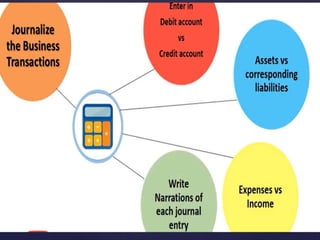
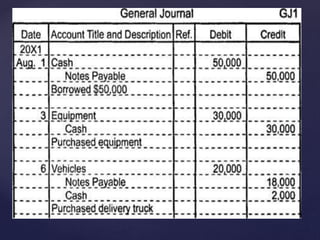
 Journal – a record of the transactions of a
business.
 Kept in chronological order
 Journalizing – the process of recording business
transactions in a journal.
 AKA Record of Original Entry – it is where
transactions are first entered in the accounting
system.
Step 3 – Recording Business
Transactions in a Journal
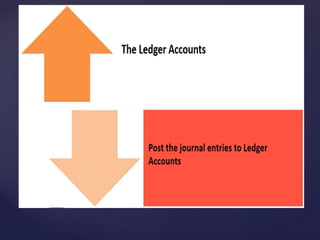
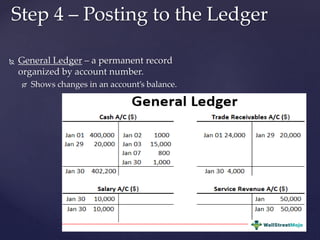
 General Ledger – a permanent record
organized by account number.
 Shows changes in an account’s balance.
Step 4 – Posting to the Ledger
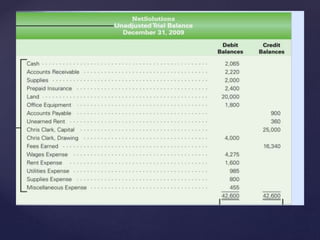
 Trial Balance – a list of all the account names
and their current balances.
 Proving the Ledger – comparing the total of
debits to the total of credits to see if they equal.
Step 5 – Prepare a Trial
Balance
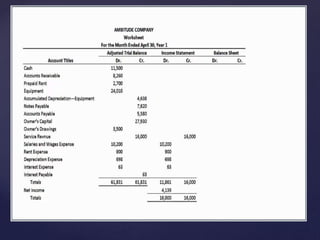
 Worksheet – a working paper used to collect
information from the ledger accounts in one
place.
 Information is needed to prepare financial
Step 6 – Prepare a Worksheet
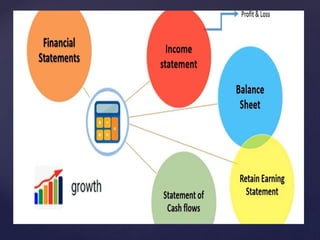
 Financial Statements – summarize the changes
resulting from business transactions that occur
during an accounting period.
 Income Statement – reports net income/loss for a
specific time period.
 Statement of Owner’s Equity – summarizes changes
in the owner’s capital account as a result of business
transactions that occur during the period.
 Balance Sheet – a report of the balances in the
permanent accounts at the end of the period.
 Statement of Cash Flows – summarizes the amount
of cash taken in, sources of cash, amount paid out,
uses of cash.
Step 7 – Prepare Financial
Statements
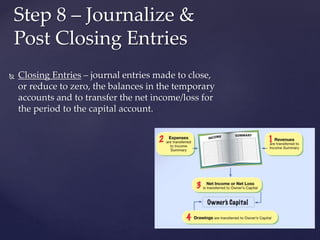
 Closing Entries – journal entries made to close,
or reduce to zero, the balances in the temporary
accounts and to transfer the net income/loss for
the period to the capital account.
Step 8 – Journalize &
Post Closing Entries
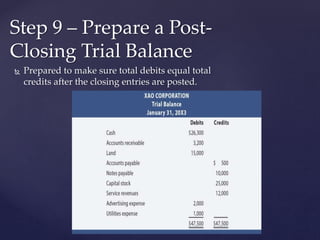
 Prepared to make sure total debits equal total
credits after the closing entries are posted.
Step 9 – Prepare a Post-
Closing Trial Balance
Accounting Cycle.pptx

Accounting Cycle.pptx

  • 1.
  • 2.
  • 3.
    A series ofevents that are regularly repeated in the same order. What is cycle?
  • 4.
     Accounting isthe systematic and comprehensive recording of financial transactions pertaining to a business.  Accounting also refers to the process of summarizing, analyzing and reporting of business transactions. Accounting:
  • 5.
     The accountingcycle is the name given to be collective process of recording and processing the accounting events of a company  We have nine steps in our accounting cycle Accounting cycle
  • 7.
     Source Document– a paper that is prepared as evidence of a business transaction.  Invoice – lists specific information involving the buying or selling of an item on account.  Receipt – a record of cash received by the business. Step 1 – Collecting & Verifying Source Documents
  • 8.
     Analyzing informationfrom the source documents to determine the debit and credit parts of each transaction.  You may not be given a description of the transaction, but must find the information off of the source document. Step 2 – Analyzing Business Transactions
  • 10.
     Ali soldgood for Rs 10,000.  Aslam purchases computer for Rs. 80,000.  Pay salaries to employees Rs. 50,000. Examples of Business Transaction
  • 11.
     Journal –a record of the transactions of a business.  Kept in chronological order  Journalizing – the process of recording business transactions in a journal.  AKA Record of Original Entry – it is where transactions are first entered in the accounting system. Step 3 – Recording Business Transactions in a Journal
  • 15.
     General Ledger– a permanent record organized by account number.  Shows changes in an account’s balance. Step 4 – Posting to the Ledger
  • 16.
     Trial Balance– a list of all the account names and their current balances.  Proving the Ledger – comparing the total of debits to the total of credits to see if they equal. Step 5 – Prepare a Trial Balance
  • 18.
     Worksheet –a working paper used to collect information from the ledger accounts in one place.  Information is needed to prepare financial Step 6 – Prepare a Worksheet
  • 21.
     Financial Statements– summarize the changes resulting from business transactions that occur during an accounting period.  Income Statement – reports net income/loss for a specific time period.  Statement of Owner’s Equity – summarizes changes in the owner’s capital account as a result of business transactions that occur during the period.  Balance Sheet – a report of the balances in the permanent accounts at the end of the period.  Statement of Cash Flows – summarizes the amount of cash taken in, sources of cash, amount paid out, uses of cash. Step 7 – Prepare Financial Statements
  • 23.
     Closing Entries– journal entries made to close, or reduce to zero, the balances in the temporary accounts and to transfer the net income/loss for the period to the capital account. Step 8 – Journalize & Post Closing Entries
  • 25.
     Prepared tomake sure total debits equal total credits after the closing entries are posted. Step 9 – Prepare a Post- Closing Trial Balance