Universidad de las Fuerzas
Armadas
“ESPE”
202
Pedagogíade losidiomasNacionalesy Extranjeros
NAME:Lizbeth Berenise Caza Mediavilla
ACTIVITY Nº 1
SUBJECT: CÁTEDRA INTEG DISEÑ GESTI EVALU MODEL
CURRI CONTEX FLEXI ADAPT ENSEÑ APREN INGLÉ
NRC: 8085
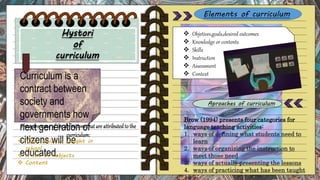
Hystori
of
curriculum
Curriculum is a
contract between
society and
governments how
next generation of
citizens will be
educated.
 That which is taught in
school
 A set os subjects
 Content
Elements of curriculum
 Objetives,goals,desired outcomes
 Knowledge or contents
 Skills
 Instruction
 Assessment
 Context
Aproaches of curriculum
Brow (1994) presents four categories for
language teaching activities:
1. ways of defining what students need to
learn
2. ways of organizing the instruction to
meet those need
3. ways of actually presenting the lessons
4. ways of practicing what has been taught
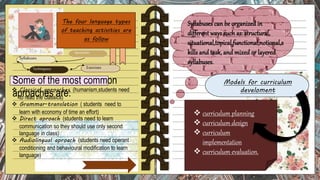
The four language types
of teaching activities are
as follow
 Classical aproaches (humanism,students need
to read the classics)
 Grammar-translation ( students need to
learn with economy of time an effort)
 Direct aproach (students need to learn
communication so they should use only second
language in class)
 Audiolingual aproach (students need operant
conditioning and behavioural modification to learn
language)
Some of the most common
aproaches are:
Aproaches
Syllabuses
Techniquess Exercises
Models for curriculum
develoment
 curriculum planning
 curriculum design
 curriculum
implementation
 curriculum evaluation.
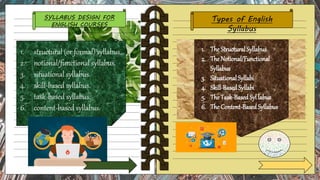
SYLLABUS DESIGN FOR
ENGLISH COURSES
1. structural (or formal) syllabus.
2. notional/functional syllabus.
3. situational syllabus.
4. skill-based syllabus.
5. task-based syllabus.
6. content-based syllabus.
Types of English
Syllabus
1. The StructuralSyllabus
2. The Notional/Functional
Syllabus
3. SituationalSyllabi
4. Skill-Based Syllabi
5. The Task-Based Syllabus
6. The Content-BasedSyllabus
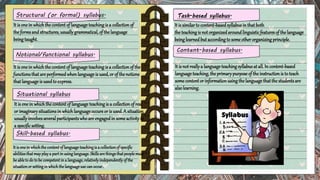
Structural (or formal) syllabus.
It is one in which the content of language teaching is a collection of
the formsand structures,usually grammatical,of the language
being taught.
Notional/functional syllabus.
It is onein which thecontent of language teaching is a collectionof the
functionsthat are performedwhenlanguage is used,or of thenotions
that language is usedto express.
Situational syllabus
It is onein which the content of language teaching is a collection of real
or imaginarysituations in which languageoccurs or is used.A situation
usuallyinvolvesseveral participantswho are engagedin some activityin
a specificsetting.
Skill-based syllabus.
Content-based syllabus.
Task-based syllabus.
It is onein whichthecontentof language teachingis a collectionof specific
abilitiesthatmay playa partin using language. Skills arethingsthatpeoplemust
be ableto do to be competentin a language, relativelyindependentlyof the
situationor settingin which thelanguageuse canoccur..
It is not reallya languageteaching syllabus at all.In content-based
languageteaching,the primarypurposeof the instruction is to teach
some content or information using the language that the studentsare
alsolearning.
It is similar to content-basedsyllabusin that both
the teaching is not organizedaroundlinguisticfeaturesof thelanguage
being learnedbutaccording to some otherorganizing principle.
The Structural Syllabus
The Content-Based
Syllabus
The Task-Based Syl
labus
Skill-Based Syllabi
Situational Syllabi
The Notional/Functional
Syllabus
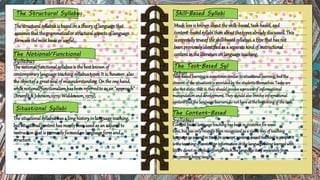
The structural syllabusis basedon a theoryof language that
assumesthat the grammatical or structuralaspectsof language
formare themostbasicor useful.
The notional/functionalsyllabusis the best known of
contemporarylanguage teaching syllabustypes.It is, however,also
the objectof a greatdeal of misunderstanding.On the onehand,
whilenotional/functionalismhas beenreferredto as an "approach"
(Brumfit & Johnson,1979: Widdowson,1979),
The situationalsyllabushas a long historyin language teaching,
butsituational content has mostlybeenusedas an adjunctto
instruction that is primarily focusedon languageformand
structure.
Much lessis knownabout theskill -based,task-based,and
content -basedsyllabithan aboutthe typesalreadydiscussed.This
is especially trueof the skill-basedsyllabus,a typethat has not
beenpreviously identifiedas a separatekindof instructional
content in the literature on language teaching.
Task-basedlearningis sometimessimilarto situationallearning, but the
contentof thesituationsis providedby thestudentsthemselves. Tasksare
alsonotstatic;thatis, theyshouldinvolvea processof informational
manipulationand development. They shouldalsoinvolveinformational
contentthatthe language learnersdo nothave at thebeginningof thetask.
Content-basedlanguageteachinghasbeen in existencefor some
time, buthas only recentlybeen recognizedas a viableway of teaching
languageas an end in itself. In concept, content -basedteachingis simple:It
is theteachingof contentor informationin thelanguagebeinglearnedwith
little r director expliciteffortto teachthelanguageitselfseparatelyfrom
thecontentbeingtaught.
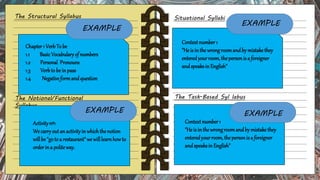
The Structural Syllabus
Chapter1 VerbTo be
1.1 BasicVocabularyof numbers
1.2 Personal Pronouns
1.3 Verbto bein pass
1.4 Negativeformandquestion
EXAMPLE
The Notional/Functional
Syllabus
EXAMPLE
Activitynº1
Wecarryout anactivityinwhichthenotion
willbe "goto a restaurant"wewilllearnhowto
orderina politeway.
Situational Syllabi
EXAMPLE
Contextnumber1
"Heis inthewrongroomandby mistakethey
enteredyourroom,thepersonis a foreigner
andspeaksin English"
The Task-Based Syl labus
EXAMPLE
Contextnumber1
"Heis inthewrongroomandby mistakethey
enteredyourroom,thepersonis a foreigner
andspeaksin English"
A.Caza.Berenise.Catedra integradora

A.Caza.Berenise.Catedra integradora

  • 1.
    Universidad de lasFuerzas Armadas “ESPE” 202 Pedagogíade losidiomasNacionalesy Extranjeros NAME:Lizbeth Berenise Caza Mediavilla ACTIVITY Nº 1 SUBJECT: CÁTEDRA INTEG DISEÑ GESTI EVALU MODEL CURRI CONTEX FLEXI ADAPT ENSEÑ APREN INGLÉ NRC: 8085
  • 2.
    Hystori of curriculum Curriculum is a contractbetween society and governments how next generation of citizens will be educated.  That which is taught in school  A set os subjects  Content Elements of curriculum  Objetives,goals,desired outcomes  Knowledge or contents  Skills  Instruction  Assessment  Context Aproaches of curriculum Brow (1994) presents four categories for language teaching activities: 1. ways of defining what students need to learn 2. ways of organizing the instruction to meet those need 3. ways of actually presenting the lessons 4. ways of practicing what has been taught
  • 3.
    The four languagetypes of teaching activities are as follow  Classical aproaches (humanism,students need to read the classics)  Grammar-translation ( students need to learn with economy of time an effort)  Direct aproach (students need to learn communication so they should use only second language in class)  Audiolingual aproach (students need operant conditioning and behavioural modification to learn language) Some of the most common aproaches are: Aproaches Syllabuses Techniquess Exercises Models for curriculum develoment  curriculum planning  curriculum design  curriculum implementation  curriculum evaluation.
  • 4.
    SYLLABUS DESIGN FOR ENGLISHCOURSES 1. structural (or formal) syllabus. 2. notional/functional syllabus. 3. situational syllabus. 4. skill-based syllabus. 5. task-based syllabus. 6. content-based syllabus. Types of English Syllabus 1. The StructuralSyllabus 2. The Notional/Functional Syllabus 3. SituationalSyllabi 4. Skill-Based Syllabi 5. The Task-Based Syllabus 6. The Content-BasedSyllabus
  • 5.
    Structural (or formal)syllabus. It is one in which the content of language teaching is a collection of the formsand structures,usually grammatical,of the language being taught. Notional/functional syllabus. It is onein which thecontent of language teaching is a collectionof the functionsthat are performedwhenlanguage is used,or of thenotions that language is usedto express. Situational syllabus It is onein which the content of language teaching is a collection of real or imaginarysituations in which languageoccurs or is used.A situation usuallyinvolvesseveral participantswho are engagedin some activityin a specificsetting. Skill-based syllabus. Content-based syllabus. Task-based syllabus. It is onein whichthecontentof language teachingis a collectionof specific abilitiesthatmay playa partin using language. Skills arethingsthatpeoplemust be ableto do to be competentin a language, relativelyindependentlyof the situationor settingin which thelanguageuse canoccur.. It is not reallya languageteaching syllabus at all.In content-based languageteaching,the primarypurposeof the instruction is to teach some content or information using the language that the studentsare alsolearning. It is similar to content-basedsyllabusin that both the teaching is not organizedaroundlinguisticfeaturesof thelanguage being learnedbutaccording to some otherorganizing principle.
  • 6.
    The Structural Syllabus TheContent-Based Syllabus The Task-Based Syl labus Skill-Based Syllabi Situational Syllabi The Notional/Functional Syllabus The structural syllabusis basedon a theoryof language that assumesthat the grammatical or structuralaspectsof language formare themostbasicor useful. The notional/functionalsyllabusis the best known of contemporarylanguage teaching syllabustypes.It is, however,also the objectof a greatdeal of misunderstanding.On the onehand, whilenotional/functionalismhas beenreferredto as an "approach" (Brumfit & Johnson,1979: Widdowson,1979), The situationalsyllabushas a long historyin language teaching, butsituational content has mostlybeenusedas an adjunctto instruction that is primarily focusedon languageformand structure. Much lessis knownabout theskill -based,task-based,and content -basedsyllabithan aboutthe typesalreadydiscussed.This is especially trueof the skill-basedsyllabus,a typethat has not beenpreviously identifiedas a separatekindof instructional content in the literature on language teaching. Task-basedlearningis sometimessimilarto situationallearning, but the contentof thesituationsis providedby thestudentsthemselves. Tasksare alsonotstatic;thatis, theyshouldinvolvea processof informational manipulationand development. They shouldalsoinvolveinformational contentthatthe language learnersdo nothave at thebeginningof thetask. Content-basedlanguageteachinghasbeen in existencefor some time, buthas only recentlybeen recognizedas a viableway of teaching languageas an end in itself. In concept, content -basedteachingis simple:It is theteachingof contentor informationin thelanguagebeinglearnedwith little r director expliciteffortto teachthelanguageitselfseparatelyfrom thecontentbeingtaught.
  • 7.
    The Structural Syllabus Chapter1VerbTo be 1.1 BasicVocabularyof numbers 1.2 Personal Pronouns 1.3 Verbto bein pass 1.4 Negativeformandquestion EXAMPLE The Notional/Functional Syllabus EXAMPLE Activitynº1 Wecarryout anactivityinwhichthenotion willbe "goto a restaurant"wewilllearnhowto orderina politeway. Situational Syllabi EXAMPLE Contextnumber1 "Heis inthewrongroomandby mistakethey enteredyourroom,thepersonis a foreigner andspeaksin English" The Task-Based Syl labus EXAMPLE Contextnumber1 "Heis inthewrongroomandby mistakethey enteredyourroom,thepersonis a foreigner andspeaksin English"