Reference Systems
Styles of Formatting
ACADEMIC WRITING
Systems of Referencing
• several main systems of referencing in
the academic world;
• used by different subjects;
• the most important point is to be
consistent (i.e. to use the same font size,
punctuation, etc. throughout).
Main Referencing Systems
for essays and academic articles
MLA (Modern Language Association) - in various humanities
disciplines, e.g. language arts, cultural studies.
Harvard system - for the social sciences and business
APA (the American Psychological Association) Variation of the
Harvard style – for social sciences, e.g. business, economics,
psychology, sociology, nursing.
IEEE (The Institute of Electronic and Electrical Engineers style) – for
technical fields, particularly computer science.
Vancouver system – for medicine and science.
Chicago/Turabian style – for business, history, literature, and the
Fine Arts
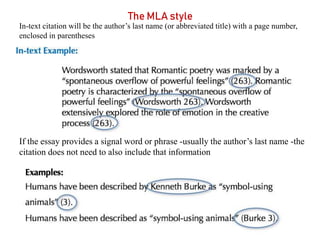
The MLA style
In-text citation will be the author’s last name (or abbreviated title) with a page number,
enclosed in parentheses
If the essay provides a signal word or phrase -usually the author’s last name -the
citation does not need to also include that information
MLA. List of Works Cited
•The first author’s surname comes first in the
reference list.
•This is followed by his or her first name, but
first names then come first for any additional
authors. Dates of the publications are given after
journal titles, or at the end of the references for
books, etc.
•The list is ordered alphabetically.
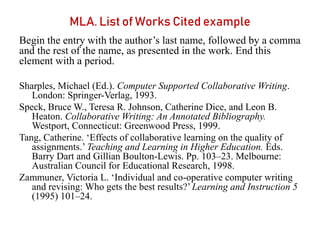
MLA. List of Works Cited example
Begin the entry with the author’s last name, followed by a comma
and the rest of the name, as presented in the work. End this
element with a period.
Sharples, Michael (Ed.). Computer Supported Collaborative Writing.
London: Springer-Verlag, 1993.
Speck, Bruce W., Teresa R. Johnson, Catherine Dice, and Leon B.
Heaton. Collaborative Writing: An Annotated Bibliography.
Westport, Connecticut: Greenwood Press, 1999.
Tang, Catherine. ‘Effects of collaborative learning on the quality of
assignments.’ Teaching and Learning in Higher Education. Eds.
Barry Dart and Gillian Boulton-Lewis. Pp. 103–23. Melbourne:
Australian Council for Educational Research, 1998.
Zammuner, Victoria L. ‘Individual and co-operative computer writing
and revising: Who gets the best results?’Learning and Instruction 5
(1995) 101–24.
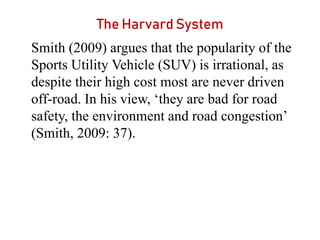
The Harvard System
Smith (2009) argues that the popularity of the
Sports Utility Vehicle (SUV) is irrational, as
despite their high cost most are never driven
off-road. In his view, ‘they are bad for road
safety, the environment and road congestion’
(Smith, 2009: 37).
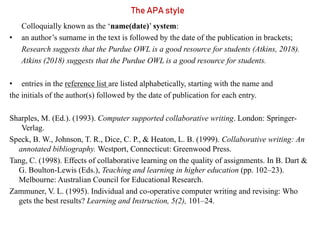
The APA style
Colloquially known as the ‘name(date)’ system:
• an author’s surname in the text is followed by the date of the publication in brackets;
Research suggests that the Purdue OWL is a good resource for students (Atkins, 2018).
Atkins (2018) suggests that the Purdue OWL is a good resource for students.
• entries in the reference list are listed alphabetically, starting with the name and
the initials of the author(s) followed by the date of publication for each entry.
Sharples, M. (Ed.). (1993). Computer supported collaborative writing. London: Springer-
Verlag.
Speck, B. W., Johnson, T. R., Dice, C. P., & Heaton, L. B. (1999). Collaborative writing: An
annotated bibliography. Westport, Connecticut: Greenwood Press.
Tang, C. (1998). Effects of collaborative learning on the quality of assignments. In B. Dart &
G. Boulton-Lewis (Eds.), Teaching and learning in higher education (pp. 102–23).
Melbourne: Australian Council for Educational Research.
Zammuner, V. L. (1995). Individual and co-operative computer writing and revising: Who
gets the best results? Learning and Instruction, 5(2), 101–24.
IEEE
In-text citations: the authors in the text are numbered in order of their appearance
in the text, sometimes without their names, and the numbers are enclosed in square
brackets.
The reference list is then numbered sequentially. Names are presented with the
initial(s) first, followed by surnames.
Dates of the publications are given after journal titles, or at the end of the references
for book, etc.
Journal titles are sometimes abbreviated.
For example:
[1] M. Sharples, Ed., Computer Supported Collaborative Writing. London: Springer-
Verlag, 1993.
[2] V. L. Zammuner, ‘Individual and co-operative computer writing and revising: Who
gets the best results?’ Learning and Instruction,vol. 5, no.2, pp. 101–24, 1995.
[3] C. Tang, ‘Effects of collaborative learning on the quality of assignments,’ in Teaching
and Learning in Higher Education, B. Dart and G. Boulton-Lewis, Eds. Melbourne:
Australian Council for Educational Research, 1998, pp. 102–23.
[4] B. W. M. Speck, T. R. Johnson, C. P. Dice and L. B. Heaton, Collaborative
Writing: An Annotated Bibliography. Westport, Connecticut: Greenwood Press, 1999.
The Vancouver style
Named after its inception following agreements made during a meeting in Vancouver in
1987 by the International Steering Committee of Medical Editors.
• In-text citations (like in IEEE) the authors are numbered in the text in order of their
appearance, and the numbers are enclosed in square brackets.
Jasanoff [5] makes the point that the risk of cross-infection is growing.
References
(5) Jasanoff, M. Tuberculosis: A Sub-Saharan Perspective. New York: Schaffter (2001).
• The reference list is numbered sequentially, but the authors are listed surnames first,
followed by their initials. Again the dates of publications are given after journal titles, or
at the ends of the references for books etc. The key feature of the Vancouver style is its
‘spare’ typography and punctuation, and the use of abbreviated journal titles.
For example:
1 Zammuner VL. Individual and co-operative computer writing and revising: Who gets the
best results? Learn Instruc 1995;5 (Pt 2): 101–24.
2 Tang C. Effects of collaborative learning on the quality of assignments. In: Dart B,
Boulton-Lewis G, editors. Teaching and learning in higher education. Melbourne:
Australian Council for Educational Research, 1998;102–23.
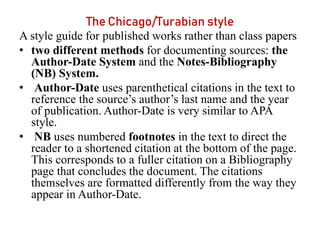
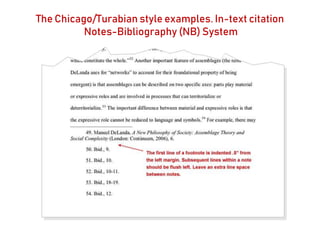
The Chicago/Turabian style
A style guide for published works rather than class papers
• two different methods for documenting sources: the
Author-Date System and the Notes-Bibliography
(NB) System.
• Author-Date uses parenthetical citations in the text to
reference the source’s author’s last name and the year
of publication. Author-Date is very similar to APA
style.
• NB uses numbered footnotes in the text to direct the
reader to a shortened citation at the bottom of the page.
This corresponds to a fuller citation on a Bibliography
page that concludes the document. The citations
themselves are formatted differently from the way they
appear in Author-Date.
The Chicago/Turabian style examples. In-text citation
Author-Date System
The Chicago/Turabian style examples. In-text citation
Notes-Bibliography (NB) System
The Chicago/Turabian style examples. References
Online Resource and Guidelines
• Purdue OWL - formats guidelines and
samples
https://owl.purdue.edu/owl/purdue_owl.html
• EasyBib - free bibliography generator (free
for MLA format)
https://www.easybib.com/mla8-
format/website-citation/custom
• Grammarly - online grammar checker
https://www.grammarly.com/
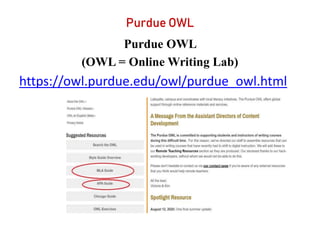
Purdue OWL
Purdue OWL
(OWL = Online Writing Lab)
https://owl.purdue.edu/owl/purdue_owl.html
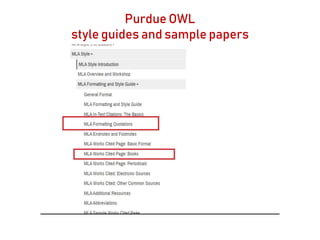
Purdue OWL
style guides and sample papers
MLA
MLA regulates:
•document format
•in-text citations
•works-cited list
MLA. General Guidelines
An MLA Style paper should:
• Be typed on white 8.5’’ x 11’’ paper (standards size);
• Double-space everything;
• Use 12 pt. Times New Roman (or similar) font;
• Leave only one space after punctuation;
• Set all margins to 1 inch on all sides;
• Indent the first line of paragraphs one half-inch;
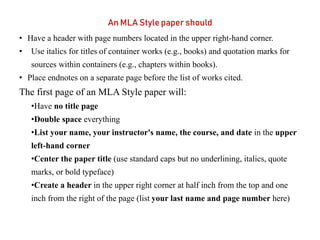
An MLA Style paper should
• Have a header with page numbers located in the upper right-hand corner.
• Use italics for titles of container works (e.g., books) and quotation marks for
sources within containers (e.g., chapters within books).
• Place endnotes on a separate page before the list of works cited.
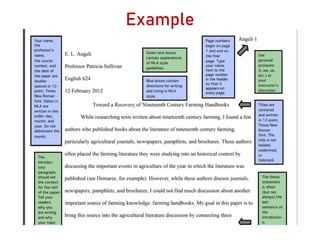
The first page of an MLA Style paper will:
•Have no title page
•Double space everything
•List your name, your instructor's name, the course, and date in the upper
left-hand corner
•Center the paper title (use standard caps but no underlining, italics, quote
marks, or bold typeface)
•Create a header in the upper right corner at half inch from the top and one
inch from the right of the page (list your last name and page number here)
Example
MLA. In-text citations
• It should direct readers to the entry in your
works-cited list for that source.
• It should be integrated (link quotations/
paraphrases/summaries to the sentences
around them).
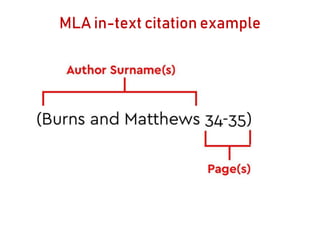
• In general, the in-text citation will be the
author’s last name (or abbreviated title) with
a page number, enclosed in parentheses.
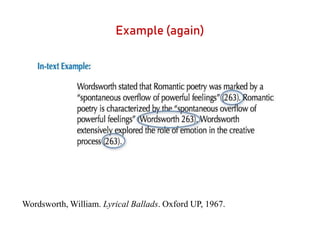
Example (again)
Wordsworth, William. Lyrical Ballads. Oxford UP, 1967.
MLA in-text citation example
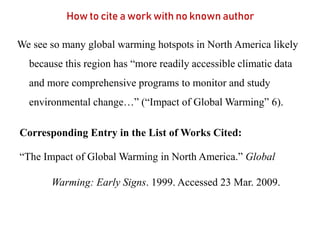
How to cite a work with no known author
We see so many global warming hotspots in North America likely
because this region has “more readily accessible climatic data
and more comprehensive programs to monitor and study
environmental change…” (“Impact of Global Warming” 6).
Corresponding Entry in the List of Works Cited:
“The Impact of Global Warming in North America.” Global
Warming: Early Signs. 1999. Accessed 23 Mar. 2009.
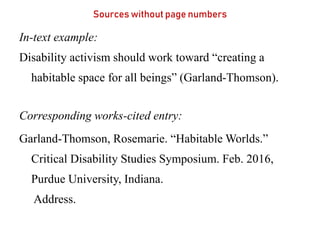
Sources without page numbers
In-text example:
Disability activism should work toward “creating a
habitable space for all beings” (Garland-Thomson).
Corresponding works-cited entry:
Garland-Thomson, Rosemarie. “Habitable Worlds.”
Critical Disability Studies Symposium. Feb. 2016,
Purdue University, Indiana.
Address.
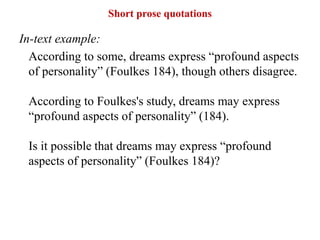
Short prose quotations
In-text example:
According to some, dreams express “profound aspects
of personality” (Foulkes 184), though others disagree.
According to Foulkes's study, dreams may express
“profound aspects of personality” (184).
Is it possible that dreams may express “profound
aspects of personality” (Foulkes 184)?
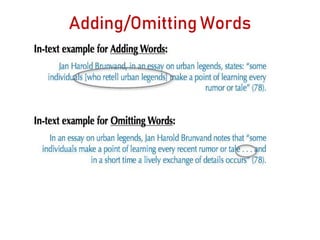
Adding/Omitting Words
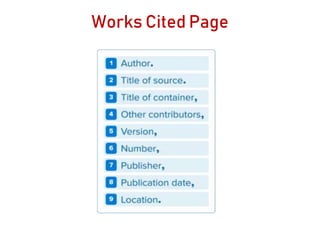
Works Cited Page
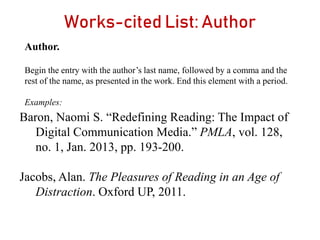
Works-cited List: Author
Author.
Begin the entry with the author’s last name, followed by a comma and the
rest of the name, as presented in the work. End this element with a period.
Examples:
Baron, Naomi S. “Redefining Reading: The Impact of
Digital Communication Media.” PMLA, vol. 128,
no. 1, Jan. 2013, pp. 193-200.
Jacobs, Alan. The Pleasures of Reading in an Age of
Distraction. Oxford UP, 2011.
MLA Works Cited example
Purdue Owl Practice. MLA
Below are several MLA formatting questions. You
should look the information up on Purdue Owl and save it
into a separate .doc file. Then share and discuss what you
find with other students. In addition to explaining your
answer, you can provide a link to the page where you got
your information.
• How do you write an in-text citation in MLA if there is
no author’s name given on the source?
• How do you cite a source in MLA when there are two
authors?
• How do you cite an Internet source in MLA?
• How do you write a Works Cited citation in MLA for a
TV show?
MLA Practice
• Download file ‘for editing 1’ from Moodle.
• Use MLA format for in-text citations and
references
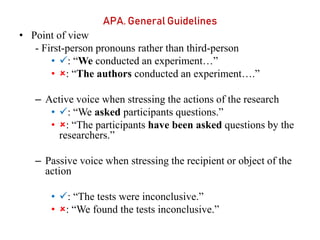
APA. General Guidelines
• Point of view
- First-person pronouns rather than third-person
• : “We conducted an experiment…”
• : “The authors conducted an experiment….”
– Active voice when stressing the actions of the research
• : “We asked participants questions.”
• : “The participants have been asked questions by the
researchers.”
– Passive voice when stressing the recipient or object of the
action
• : “The tests were inconclusive.”
• : “We found the tests inconclusive.”
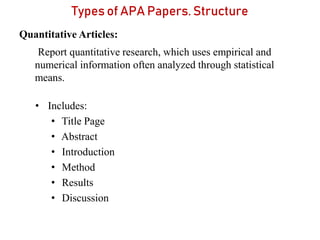
Types of APA Papers. Structure
Quantitative Articles:
Report quantitative research, which uses empirical and
numerical information often analyzed through statistical
means.
• Includes:
• Title Page
• Abstract
• Introduction
• Method
• Results
• Discussion
Types of APA Papers. Structure
Qualitative Articles:
Report qualitative research, which uses scientific practices to
learn more about human experiences that cannot be
numerically quantified.
• Includes:
• Title Page
• Abstract
• Introduction
• Method
• Findings/Results
• Discussion
Types of APA Papers. Structure
The Literature Review:
Summarizes scientific literature on a particular research topic
• While the APA Publication Manual does not require a
specific order for a literature review, a good literature
review typically contains the following components:
• Introduction
• Thesis statement
• Summary and synthesis of sources
• List of References
General APA Format
Your essay should:
• Be typed
• Double-spaced
• Have 1” margins
• Use 10-12pt. Standard font (eg. Times New Roman)
• Be printed on standard-sized paper (8.5”x 11”)
Every page of your essay should include:
• The page number in the upper right
• If it is a professional paper: A page header (shortened
title, all caps) in the upper left-hand corner.
• Student papers do not require running headers.
General APA Format. Student Paper Example
General APA Format. Professional Paper Example
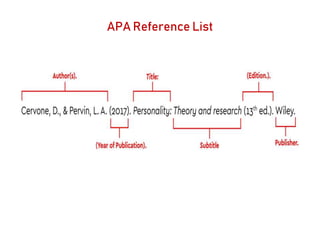
APA Reference List
APA is a complex system of citation. When compiling the reference
list, the strategy below might be useful:
1. Identify the type of source:
– Is it a book? A journal article? A webpage?
2. Find a sample citation for this type of source
– Check a textbook or the OWL APA Guide:
https://owl.purdue.edu/owl/research_and_citation/apa7_style/apa
_formatting_and_style_guide/general_format.html
3. “Mirror” the sample
4. Make sure that the entries are listed in alphabetical order and that
the subsequent lines are indented
APA Reference List
APA In-text Citation: Basics
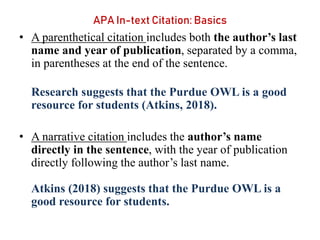
• A parenthetical citation includes both the author’s last
name and year of publication, separated by a comma,
in parentheses at the end of the sentence.
Research suggests that the Purdue OWL is a good
resource for students (Atkins, 2018).
• A narrative citation includes the author’s name
directly in the sentence, with the year of publication
directly following the author’s last name.
Atkins (2018) suggests that the Purdue OWL is a
good resource for students.
APA In-text Citation: Page Numbers
• If the source you’re citing includes page numbers, add that
information to your citation.
For a parenthetical citation, the page number follows the
year of publication, separated by a comma, and with a
lowercase p and a period before the number (p.)
Research suggests that the Purdue OWL is a good
resource for students (Atkins, 2018, p. 12).
• For a narrative citation, the page number comes at the end
of the sentence, once again preceded by a lowercase p and a
period (p.)
Atkins (2018) suggests that the Purdue OWL is a good
resource for students (pp. 12-13).
APA In-Text Citation: Quotations
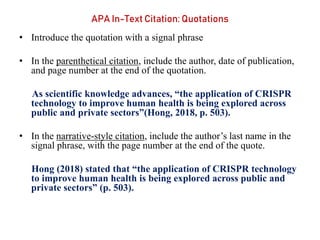
• Introduce the quotation with a signal phrase
• In the parenthetical citation, include the author, date of publication,
and page number at the end of the quotation.
As scientific knowledge advances, “the application of CRISPR
technology to improve human health is being explored across
public and private sectors”(Hong, 2018, p. 503).
• In the narrative-style citation, include the author’s last name in the
signal phrase, with the page number at the end of the quote.
Hong (2018) stated that “the application of CRISPR technology
to improve human health is being explored across public and
private sectors” (p. 503).
APA In-Text Citation: Summary or Paraphrase
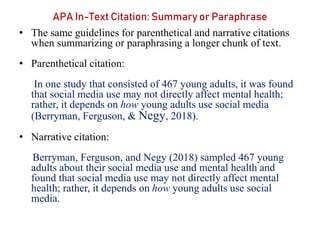
• The same guidelines for parenthetical and narrative citations
when summarizing or paraphrasing a longer chunk of text.
• Parenthetical citation:
In one study that consisted of 467 young adults, it was found
that social media use may not directly affect mental health;
rather, it depends on how young adults use social media
(Berryman, Ferguson, & Negy, 2018).
• Narrative citation:
Berryman, Ferguson, and Negy (2018) sampled 467 young
adults about their social media use and mental health and
found that social media use may not directly affect mental
health; rather, it depends on how young adults use social
media.
APA In-Text Citation: Signal Words
• Introduce quotations with signal phrases, e.g.:
According to Reynolds (2019), “….” (p. 3).
Reynolds (2019) argued that“……” (p. 3).
• Use signal verbs such as:
acknowledged, contended, maintained,
responded, reported, argued, concluded, etc.
• Use the past tense or the present perfect tense of
verbs in signal phrases when they discuss past
events.
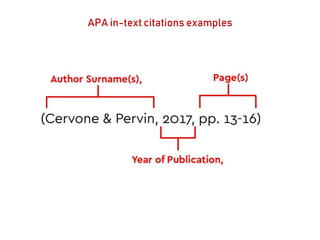
APA in-text citations examples
APA In-Text Citation: Two or More Works
• When the parenthetical citation includes
two or more works:
Order them in the same way they appear in the
reference list—the author’s name, the year of
publication—separated by a semi-colon.
Lorem ipsum dolor sit amet (Adams, 2018;
Collins, 2017).
APA In-Text Citation: Works with Several Authors
When citing a work with two authors:
In the narrative citation, use “and” in between the authors’ names
According to scientists Depietri and McPhearson (2018), “Understanding
the occurrence and impacts of historical climatic hazards is critical to
better interpret current hazard trends” (p. 96).
In the parenthetical citation, use “&” between names
When examining potential climate threats, “Understanding the occurrence
and impacts of historical climatic hazards is critical to better interpret
current hazard trends” (Depietri & McPhearson, 2018, p. 96).
When citing a work with three or more authors: list the name of the
first author plus “et al.” in every citation.
Lin et al. (2019) examined how weather conditions affect the popularity
of the bikesharing program in Beijing.
One study looked at how weather conditions affected the popularity of
bikesharing programs, specifically the Beijing Public Bikesharing Program
(Lin et al., 2019).
APA In-Text Citation: Unknown Author
When citing a work with an unknown author:
Use the source’s full title in the narrative citation.
Cite the first word of the title followed by the year of
publication in the parenthetical citation.
According to “Here’s How Gardening Benefits Your
Health” (2018)
(“Here’s,” 2018)
Titles:
Articles and Chapters = “ ”
Books and Reports = italicize
APA In-Text Citation: No Page Numbers
For parenthetical citation. Use any of the following four methods
•List the heading or section name
One scientist noted that “A cup full of kale can help your body out
in a number of ways” (London, 2019, Health benefits of kale section).
• List an abbreviated heading or section name in quotation marks (if the
heading is too long)
One scientist noted that “A cup full of kale can help your body out in a
number of ways” (London, 2019, “Health benefits” section).
• List the paragraph number
One scientist noted that “A cup full of kale can help your body out in a
number of ways” (London, 2019, para. 2).
• List the heading or section name and the paragraph number
One scientist noted that “A cup full of kale can help your body out in a
number of ways” (London, 2019, Health benefits of kale section, para. 2).
In narrative citation use any of the following four methods
• List the heading or section name
Scientist Jaclyn London (2019, Health benefits of kale section) noted that
“A cup full of kale can help your body out in a number of ways.”
• List an abbreviated heading or section name in quotation marks (if the
heading is too long)
Scientist Jaclyn London (2019, “Health benefits” section) noted that “A
cup full of kale can help your body out in a number of ways.”
• List the paragraph number
Scientist Jaclyn London (2019, para. 2) noted that “A cup full of kale can
help your body out in a number of ways.”
• List the heading or section name and the paragraph number
Scientist Jaclyn London (2019, Health benefits of kale section, para. 2)
noted that “A cup full of kale can help your body out in a number of
ways.”
APA In-Text Citation: No Page Numbers
Purdue Owl Practice. APA
Below are several APA formatting questions. You
should look the information up on Purdue Owl and save it
into a separate .doc file. Then share and discuss what you
find with other students. In addition to explaining your
answer, you can provide a link to the page where you got
your information.
• How do you write an in-text citation in APA if there is
no author’s name given on the source?
• How do you cite a source in APA when there are two
authors?
• How do you cite an Internet source in APA ?
• How do you write a Works Cited citation in APA for a
TV show?

academic-writing-reference-systems-styles-of-forma-teacher-development-material-writing-creative-writ_130382.pptx

  • 1.
    Reference Systems Styles ofFormatting ACADEMIC WRITING
  • 2.
    Systems of Referencing •several main systems of referencing in the academic world; • used by different subjects; • the most important point is to be consistent (i.e. to use the same font size, punctuation, etc. throughout).
  • 3.
    Main Referencing Systems foressays and academic articles MLA (Modern Language Association) - in various humanities disciplines, e.g. language arts, cultural studies. Harvard system - for the social sciences and business APA (the American Psychological Association) Variation of the Harvard style – for social sciences, e.g. business, economics, psychology, sociology, nursing. IEEE (The Institute of Electronic and Electrical Engineers style) – for technical fields, particularly computer science. Vancouver system – for medicine and science. Chicago/Turabian style – for business, history, literature, and the Fine Arts
  • 4.
    The MLA style In-textcitation will be the author’s last name (or abbreviated title) with a page number, enclosed in parentheses If the essay provides a signal word or phrase -usually the author’s last name -the citation does not need to also include that information
  • 5.
    MLA. List ofWorks Cited •The first author’s surname comes first in the reference list. •This is followed by his or her first name, but first names then come first for any additional authors. Dates of the publications are given after journal titles, or at the end of the references for books, etc. •The list is ordered alphabetically.
  • 6.
    MLA. List ofWorks Cited example Begin the entry with the author’s last name, followed by a comma and the rest of the name, as presented in the work. End this element with a period. Sharples, Michael (Ed.). Computer Supported Collaborative Writing. London: Springer-Verlag, 1993. Speck, Bruce W., Teresa R. Johnson, Catherine Dice, and Leon B. Heaton. Collaborative Writing: An Annotated Bibliography. Westport, Connecticut: Greenwood Press, 1999. Tang, Catherine. ‘Effects of collaborative learning on the quality of assignments.’ Teaching and Learning in Higher Education. Eds. Barry Dart and Gillian Boulton-Lewis. Pp. 103–23. Melbourne: Australian Council for Educational Research, 1998. Zammuner, Victoria L. ‘Individual and co-operative computer writing and revising: Who gets the best results?’Learning and Instruction 5 (1995) 101–24.
  • 7.
    The Harvard System Smith(2009) argues that the popularity of the Sports Utility Vehicle (SUV) is irrational, as despite their high cost most are never driven off-road. In his view, ‘they are bad for road safety, the environment and road congestion’ (Smith, 2009: 37).
  • 8.
    The APA style Colloquiallyknown as the ‘name(date)’ system: • an author’s surname in the text is followed by the date of the publication in brackets; Research suggests that the Purdue OWL is a good resource for students (Atkins, 2018). Atkins (2018) suggests that the Purdue OWL is a good resource for students. • entries in the reference list are listed alphabetically, starting with the name and the initials of the author(s) followed by the date of publication for each entry. Sharples, M. (Ed.). (1993). Computer supported collaborative writing. London: Springer- Verlag. Speck, B. W., Johnson, T. R., Dice, C. P., & Heaton, L. B. (1999). Collaborative writing: An annotated bibliography. Westport, Connecticut: Greenwood Press. Tang, C. (1998). Effects of collaborative learning on the quality of assignments. In B. Dart & G. Boulton-Lewis (Eds.), Teaching and learning in higher education (pp. 102–23). Melbourne: Australian Council for Educational Research. Zammuner, V. L. (1995). Individual and co-operative computer writing and revising: Who gets the best results? Learning and Instruction, 5(2), 101–24.
  • 9.
    IEEE In-text citations: theauthors in the text are numbered in order of their appearance in the text, sometimes without their names, and the numbers are enclosed in square brackets. The reference list is then numbered sequentially. Names are presented with the initial(s) first, followed by surnames. Dates of the publications are given after journal titles, or at the end of the references for book, etc. Journal titles are sometimes abbreviated. For example: [1] M. Sharples, Ed., Computer Supported Collaborative Writing. London: Springer- Verlag, 1993. [2] V. L. Zammuner, ‘Individual and co-operative computer writing and revising: Who gets the best results?’ Learning and Instruction,vol. 5, no.2, pp. 101–24, 1995. [3] C. Tang, ‘Effects of collaborative learning on the quality of assignments,’ in Teaching and Learning in Higher Education, B. Dart and G. Boulton-Lewis, Eds. Melbourne: Australian Council for Educational Research, 1998, pp. 102–23. [4] B. W. M. Speck, T. R. Johnson, C. P. Dice and L. B. Heaton, Collaborative Writing: An Annotated Bibliography. Westport, Connecticut: Greenwood Press, 1999.
  • 10.
    The Vancouver style Namedafter its inception following agreements made during a meeting in Vancouver in 1987 by the International Steering Committee of Medical Editors. • In-text citations (like in IEEE) the authors are numbered in the text in order of their appearance, and the numbers are enclosed in square brackets. Jasanoff [5] makes the point that the risk of cross-infection is growing. References (5) Jasanoff, M. Tuberculosis: A Sub-Saharan Perspective. New York: Schaffter (2001). • The reference list is numbered sequentially, but the authors are listed surnames first, followed by their initials. Again the dates of publications are given after journal titles, or at the ends of the references for books etc. The key feature of the Vancouver style is its ‘spare’ typography and punctuation, and the use of abbreviated journal titles. For example: 1 Zammuner VL. Individual and co-operative computer writing and revising: Who gets the best results? Learn Instruc 1995;5 (Pt 2): 101–24. 2 Tang C. Effects of collaborative learning on the quality of assignments. In: Dart B, Boulton-Lewis G, editors. Teaching and learning in higher education. Melbourne: Australian Council for Educational Research, 1998;102–23.
  • 11.
    The Chicago/Turabian style Astyle guide for published works rather than class papers • two different methods for documenting sources: the Author-Date System and the Notes-Bibliography (NB) System. • Author-Date uses parenthetical citations in the text to reference the source’s author’s last name and the year of publication. Author-Date is very similar to APA style. • NB uses numbered footnotes in the text to direct the reader to a shortened citation at the bottom of the page. This corresponds to a fuller citation on a Bibliography page that concludes the document. The citations themselves are formatted differently from the way they appear in Author-Date.
  • 12.
    The Chicago/Turabian styleexamples. In-text citation Author-Date System
  • 13.
    The Chicago/Turabian styleexamples. In-text citation Notes-Bibliography (NB) System
  • 14.
    The Chicago/Turabian styleexamples. References
  • 15.
    Online Resource andGuidelines • Purdue OWL - formats guidelines and samples https://owl.purdue.edu/owl/purdue_owl.html • EasyBib - free bibliography generator (free for MLA format) https://www.easybib.com/mla8- format/website-citation/custom • Grammarly - online grammar checker https://www.grammarly.com/
  • 16.
    Purdue OWL Purdue OWL (OWL= Online Writing Lab) https://owl.purdue.edu/owl/purdue_owl.html
  • 17.
    Purdue OWL style guidesand sample papers
  • 18.
  • 19.
    MLA. General Guidelines AnMLA Style paper should: • Be typed on white 8.5’’ x 11’’ paper (standards size); • Double-space everything; • Use 12 pt. Times New Roman (or similar) font; • Leave only one space after punctuation; • Set all margins to 1 inch on all sides; • Indent the first line of paragraphs one half-inch;
  • 20.
    An MLA Stylepaper should • Have a header with page numbers located in the upper right-hand corner. • Use italics for titles of container works (e.g., books) and quotation marks for sources within containers (e.g., chapters within books). • Place endnotes on a separate page before the list of works cited. The first page of an MLA Style paper will: •Have no title page •Double space everything •List your name, your instructor's name, the course, and date in the upper left-hand corner •Center the paper title (use standard caps but no underlining, italics, quote marks, or bold typeface) •Create a header in the upper right corner at half inch from the top and one inch from the right of the page (list your last name and page number here)
  • 21.
  • 22.
    MLA. In-text citations •It should direct readers to the entry in your works-cited list for that source. • It should be integrated (link quotations/ paraphrases/summaries to the sentences around them). • In general, the in-text citation will be the author’s last name (or abbreviated title) with a page number, enclosed in parentheses.
  • 23.
    Example (again) Wordsworth, William.Lyrical Ballads. Oxford UP, 1967.
  • 24.
  • 25.
    How to citea work with no known author We see so many global warming hotspots in North America likely because this region has “more readily accessible climatic data and more comprehensive programs to monitor and study environmental change…” (“Impact of Global Warming” 6). Corresponding Entry in the List of Works Cited: “The Impact of Global Warming in North America.” Global Warming: Early Signs. 1999. Accessed 23 Mar. 2009.
  • 26.
    Sources without pagenumbers In-text example: Disability activism should work toward “creating a habitable space for all beings” (Garland-Thomson). Corresponding works-cited entry: Garland-Thomson, Rosemarie. “Habitable Worlds.” Critical Disability Studies Symposium. Feb. 2016, Purdue University, Indiana. Address.
  • 27.
    Short prose quotations In-textexample: According to some, dreams express “profound aspects of personality” (Foulkes 184), though others disagree. According to Foulkes's study, dreams may express “profound aspects of personality” (184). Is it possible that dreams may express “profound aspects of personality” (Foulkes 184)?
  • 28.
  • 29.
  • 30.
    Works-cited List: Author Author. Beginthe entry with the author’s last name, followed by a comma and the rest of the name, as presented in the work. End this element with a period. Examples: Baron, Naomi S. “Redefining Reading: The Impact of Digital Communication Media.” PMLA, vol. 128, no. 1, Jan. 2013, pp. 193-200. Jacobs, Alan. The Pleasures of Reading in an Age of Distraction. Oxford UP, 2011.
  • 31.
  • 32.
    Purdue Owl Practice.MLA Below are several MLA formatting questions. You should look the information up on Purdue Owl and save it into a separate .doc file. Then share and discuss what you find with other students. In addition to explaining your answer, you can provide a link to the page where you got your information. • How do you write an in-text citation in MLA if there is no author’s name given on the source? • How do you cite a source in MLA when there are two authors? • How do you cite an Internet source in MLA? • How do you write a Works Cited citation in MLA for a TV show?
  • 33.
    MLA Practice • Downloadfile ‘for editing 1’ from Moodle. • Use MLA format for in-text citations and references
  • 34.
    APA. General Guidelines •Point of view - First-person pronouns rather than third-person • : “We conducted an experiment…” • : “The authors conducted an experiment….” – Active voice when stressing the actions of the research • : “We asked participants questions.” • : “The participants have been asked questions by the researchers.” – Passive voice when stressing the recipient or object of the action • : “The tests were inconclusive.” • : “We found the tests inconclusive.”
  • 35.
    Types of APAPapers. Structure Quantitative Articles: Report quantitative research, which uses empirical and numerical information often analyzed through statistical means. • Includes: • Title Page • Abstract • Introduction • Method • Results • Discussion
  • 36.
    Types of APAPapers. Structure Qualitative Articles: Report qualitative research, which uses scientific practices to learn more about human experiences that cannot be numerically quantified. • Includes: • Title Page • Abstract • Introduction • Method • Findings/Results • Discussion
  • 37.
    Types of APAPapers. Structure The Literature Review: Summarizes scientific literature on a particular research topic • While the APA Publication Manual does not require a specific order for a literature review, a good literature review typically contains the following components: • Introduction • Thesis statement • Summary and synthesis of sources • List of References
  • 38.
    General APA Format Youressay should: • Be typed • Double-spaced • Have 1” margins • Use 10-12pt. Standard font (eg. Times New Roman) • Be printed on standard-sized paper (8.5”x 11”) Every page of your essay should include: • The page number in the upper right • If it is a professional paper: A page header (shortened title, all caps) in the upper left-hand corner. • Student papers do not require running headers.
  • 39.
    General APA Format.Student Paper Example
  • 40.
    General APA Format.Professional Paper Example
  • 41.
    APA Reference List APAis a complex system of citation. When compiling the reference list, the strategy below might be useful: 1. Identify the type of source: – Is it a book? A journal article? A webpage? 2. Find a sample citation for this type of source – Check a textbook or the OWL APA Guide: https://owl.purdue.edu/owl/research_and_citation/apa7_style/apa _formatting_and_style_guide/general_format.html 3. “Mirror” the sample 4. Make sure that the entries are listed in alphabetical order and that the subsequent lines are indented
  • 42.
  • 43.
    APA In-text Citation:Basics • A parenthetical citation includes both the author’s last name and year of publication, separated by a comma, in parentheses at the end of the sentence. Research suggests that the Purdue OWL is a good resource for students (Atkins, 2018). • A narrative citation includes the author’s name directly in the sentence, with the year of publication directly following the author’s last name. Atkins (2018) suggests that the Purdue OWL is a good resource for students.
  • 44.
    APA In-text Citation:Page Numbers • If the source you’re citing includes page numbers, add that information to your citation. For a parenthetical citation, the page number follows the year of publication, separated by a comma, and with a lowercase p and a period before the number (p.) Research suggests that the Purdue OWL is a good resource for students (Atkins, 2018, p. 12). • For a narrative citation, the page number comes at the end of the sentence, once again preceded by a lowercase p and a period (p.) Atkins (2018) suggests that the Purdue OWL is a good resource for students (pp. 12-13).
  • 45.
    APA In-Text Citation:Quotations • Introduce the quotation with a signal phrase • In the parenthetical citation, include the author, date of publication, and page number at the end of the quotation. As scientific knowledge advances, “the application of CRISPR technology to improve human health is being explored across public and private sectors”(Hong, 2018, p. 503). • In the narrative-style citation, include the author’s last name in the signal phrase, with the page number at the end of the quote. Hong (2018) stated that “the application of CRISPR technology to improve human health is being explored across public and private sectors” (p. 503).
  • 46.
    APA In-Text Citation:Summary or Paraphrase • The same guidelines for parenthetical and narrative citations when summarizing or paraphrasing a longer chunk of text. • Parenthetical citation: In one study that consisted of 467 young adults, it was found that social media use may not directly affect mental health; rather, it depends on how young adults use social media (Berryman, Ferguson, & Negy, 2018). • Narrative citation: Berryman, Ferguson, and Negy (2018) sampled 467 young adults about their social media use and mental health and found that social media use may not directly affect mental health; rather, it depends on how young adults use social media.
  • 47.
    APA In-Text Citation:Signal Words • Introduce quotations with signal phrases, e.g.: According to Reynolds (2019), “….” (p. 3). Reynolds (2019) argued that“……” (p. 3). • Use signal verbs such as: acknowledged, contended, maintained, responded, reported, argued, concluded, etc. • Use the past tense or the present perfect tense of verbs in signal phrases when they discuss past events.
  • 48.
  • 49.
    APA In-Text Citation:Two or More Works • When the parenthetical citation includes two or more works: Order them in the same way they appear in the reference list—the author’s name, the year of publication—separated by a semi-colon. Lorem ipsum dolor sit amet (Adams, 2018; Collins, 2017).
  • 50.
    APA In-Text Citation:Works with Several Authors When citing a work with two authors: In the narrative citation, use “and” in between the authors’ names According to scientists Depietri and McPhearson (2018), “Understanding the occurrence and impacts of historical climatic hazards is critical to better interpret current hazard trends” (p. 96). In the parenthetical citation, use “&” between names When examining potential climate threats, “Understanding the occurrence and impacts of historical climatic hazards is critical to better interpret current hazard trends” (Depietri & McPhearson, 2018, p. 96). When citing a work with three or more authors: list the name of the first author plus “et al.” in every citation. Lin et al. (2019) examined how weather conditions affect the popularity of the bikesharing program in Beijing. One study looked at how weather conditions affected the popularity of bikesharing programs, specifically the Beijing Public Bikesharing Program (Lin et al., 2019).
  • 51.
    APA In-Text Citation:Unknown Author When citing a work with an unknown author: Use the source’s full title in the narrative citation. Cite the first word of the title followed by the year of publication in the parenthetical citation. According to “Here’s How Gardening Benefits Your Health” (2018) (“Here’s,” 2018) Titles: Articles and Chapters = “ ” Books and Reports = italicize
  • 52.
    APA In-Text Citation:No Page Numbers For parenthetical citation. Use any of the following four methods •List the heading or section name One scientist noted that “A cup full of kale can help your body out in a number of ways” (London, 2019, Health benefits of kale section). • List an abbreviated heading or section name in quotation marks (if the heading is too long) One scientist noted that “A cup full of kale can help your body out in a number of ways” (London, 2019, “Health benefits” section). • List the paragraph number One scientist noted that “A cup full of kale can help your body out in a number of ways” (London, 2019, para. 2). • List the heading or section name and the paragraph number One scientist noted that “A cup full of kale can help your body out in a number of ways” (London, 2019, Health benefits of kale section, para. 2).
  • 53.
    In narrative citationuse any of the following four methods • List the heading or section name Scientist Jaclyn London (2019, Health benefits of kale section) noted that “A cup full of kale can help your body out in a number of ways.” • List an abbreviated heading or section name in quotation marks (if the heading is too long) Scientist Jaclyn London (2019, “Health benefits” section) noted that “A cup full of kale can help your body out in a number of ways.” • List the paragraph number Scientist Jaclyn London (2019, para. 2) noted that “A cup full of kale can help your body out in a number of ways.” • List the heading or section name and the paragraph number Scientist Jaclyn London (2019, Health benefits of kale section, para. 2) noted that “A cup full of kale can help your body out in a number of ways.” APA In-Text Citation: No Page Numbers
  • 54.
    Purdue Owl Practice.APA Below are several APA formatting questions. You should look the information up on Purdue Owl and save it into a separate .doc file. Then share and discuss what you find with other students. In addition to explaining your answer, you can provide a link to the page where you got your information. • How do you write an in-text citation in APA if there is no author’s name given on the source? • How do you cite a source in APA when there are two authors? • How do you cite an Internet source in APA ? • How do you write a Works Cited citation in APA for a TV show?

Editor's Notes

  • #21 Create a header that numbers all pages consecutively in the upper right-hand corner, one-half inch from the top and flush with the right margin. (Note: Your instructor may ask that you omit the number on your first page. Always follow your instructor's guidelines.) ・Use italics throughout your essay for the titles of longer works ・If you have any endnotes, include them on a separate page before your works-cited list. Title the section Notes (centered, unformatted).
  • #50 Neither is there anyone who loves, pursues or desires pain itself because it is pain
  • #52 Do not include personal communication in the reference list