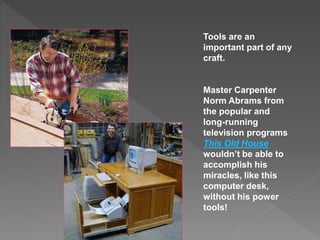




Tools are an
important part of any
craft.
Master Carpenter
Norm Abrams from
the popular and
long-running
television programs
This Old House
wouldn’t be able to
accomplish his
miracles, like this
computer desk,
without his power
tools!
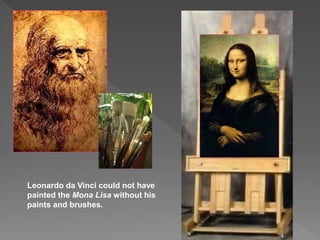
Leonardo da Vinci could not have
painted the Mona Lisa without his
paints and brushes.
A potter could not throw
clay without a wheel or
sell one of his vases
without a kiln.
Yes, these people are all
talented, but would get
nowhere without their
tools or the knowledge
to use them well! Every
craftsperson needs the
tools of the trade, even
writers. After all, writing
IS a craft!
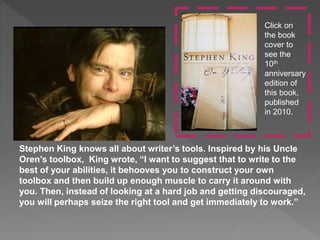
Stephen King knows all about writer’s tools. Inspired by his Uncle
Oren’s toolbox, King wrote, “I want to suggest that to write to the
best of your abilities, it behooves you to construct your own
toolbox and then build up enough muscle to carry it around with
you. Then, instead of looking at a hard job and getting discouraged,
you will perhaps seize the right tool and get immediately to work.”
Click on
the book
cover to
see the
10th
anniversary
edition of
this book,
published
in 2010.
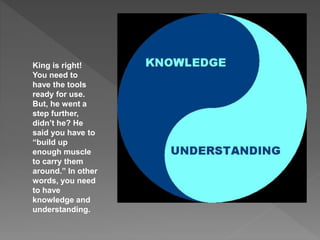
King is right!
You need to
have the tools
ready for use.
But, he went a
step further,
didn’t he? He
said you have to
“build up
enough muscle
to carry them
around.” In other
words, you need
to have
knowledge and
understanding.
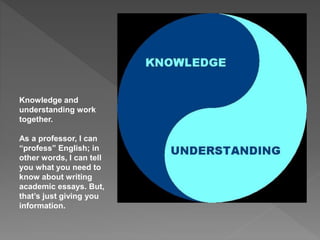
Knowledge and
understanding work
together.
As a professor, I can
“profess” English; in
other words, I can tell
you what you need to
know about writing
academic essays. But,
that’s just giving you
information.
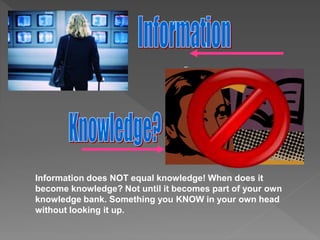
Information does NOT equal knowledge! When does it
become knowledge? Not until it becomes part of your own
knowledge bank. Something you KNOW in your own head
without looking it up.
When does knowledge become understanding? Not until
what you know becomes so much a part of you that your
can explain it to someone else. If you can’t explain it clearly
to someone else, either verbally or in writing, you don’t
really understand it. But, when you do understand it, and
you can use it, that’s when knowledge becomes power!
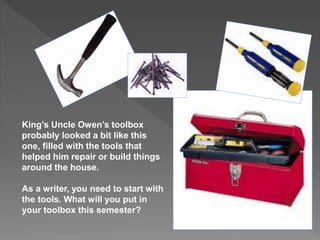
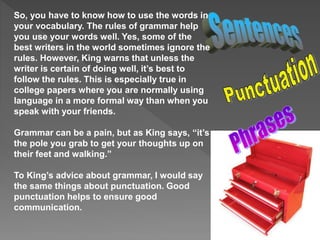
King’s Uncle Owen’s toolbox
probably looked a bit like this
one, filled with the tools that
helped him repair or build things
around the house.
As a writer, you need to start with
the tools. What will you put in
your toolbox this semester?
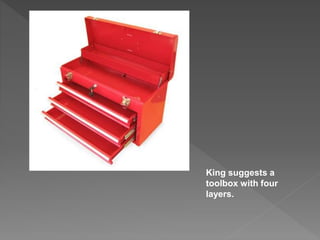
King suggests a
toolbox with four
layers.
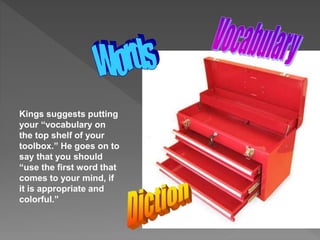
Kings suggests putting
your “vocabulary on
the top shelf of your
toolbox.” He goes on to
say that you should
“use the first word that
comes to your mind, if
it is appropriate and
colorful.”
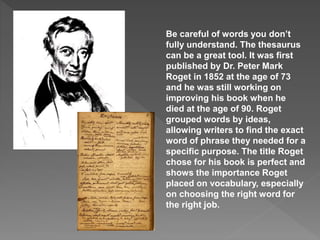
Be careful of words you don’t
fully understand. The thesaurus
can be a great tool. It was first
published by Dr. Peter Mark
Roget in 1852 at the age of 73
and he was still working on
improving his book when he
died at the age of 90. Roget
grouped words by ideas,
allowing writers to find the exact
word of phrase they needed for a
specific purpose. The title Roget
chose for his book is perfect and
shows the importance Roget
placed on vocabulary, especially
on choosing the right word for
the right job.
The word “thesaurus,” while it might sound like some kind of extinct
dinosaur, is actually Latin for “treasury”; and that is exactly what is
a thesaurus is – a treasury of words instead of gold. A thesaurus is
really about vocabulary.
Today, there are many different editions of word collections. in
addition to Roget’s original version, there are print versions that list
words alphabetically and various online versions. Word processing
programs also include a small thesaurus.
However, a thesaurus does not do the work for you. It gives you
words that both mean the same things as the word you want to
replace and words that are only RELATED to it. Not every word a
thesaurus suggests works in every possible situation. You still have
to know the meaning of the words you choose to use.
If you use a thesaurus carefully, though, it can help you build your
vocabulary. While we’re at it, you should know that the word
“vocabulary” is also from the Latin meaning “a list of words” so that
“your vocabulary” means the list of words that you use to compose
sentences that, therefore, communicate your ideas.
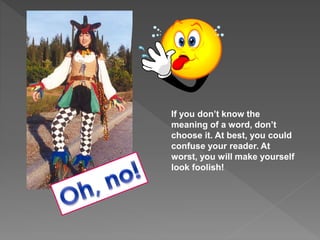
If you don’t know the
meaning of a word, don’t
choose it. At best, you could
confuse your reader. At
worst, you will make yourself
look foolish!
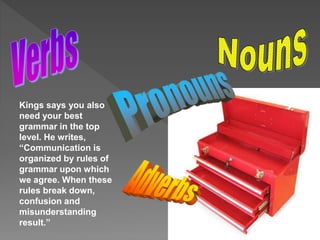
Kings says you also
need your best
grammar in the top
level. He writes,
“Communication is
organized by rules of
grammar upon which
we agree. When these
rules break down,
confusion and
misunderstanding
result.”
So, you have to know how to use the words in
your vocabulary. The rules of grammar help
you use your words well. Yes, some of the
best writers in the world sometimes ignore the
rules. However, King warns that unless the
writer is certain of doing well, it’s best to
follow the rules. This is especially true in
college papers where you are normally using
language in a more formal way than when you
speak with your friends.
Grammar can be a pain, but as King says, “it’s
the pole you grab to get your thoughts up on
their feet and walking.”
To King’s advice about grammar, I would say
the same things about punctuation. Good
punctuation helps to ensure good
communication.
However, extra help is
still available. You can
always come to office
hours and ask about the
revision codes you don’t
understand. Also, you
can get extra help with
grammar and
punctuation at the
Writing Connection,
which is located in
Room 6337. You paid a
fee to use the Writing
Connection, so make
sure you get your
money’s worth!
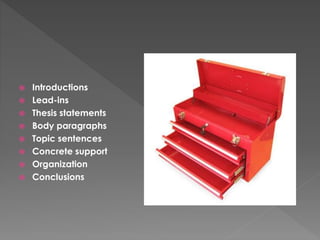
 Introductions
 Lead-ins
 Thesis statements
 Body paragraphs
 Topic sentences
 Concrete support
 Organization
 Conclusions
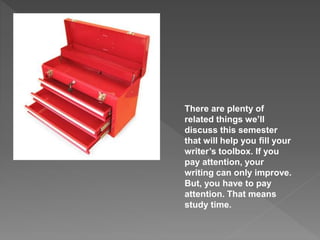
There are plenty of
related things we’ll
discuss this semester
that will help you fill your
writer’s toolbox. If you
pay attention, your
writing can only improve.
But, you have to pay
attention. That means
study time.
How much study time should you set aside for
a college course? The rough estimate is one
hour for every hour spent in class. This might
sound like a lot to you, but it’s a reasonable
estimate. Even if your professor does not
“give” you any homework, in a college
class…if you’re really going to “learn” the
material…you need to study every day. So the
problem may really be that you don’t know how
to really study.
Survey
Question
Read
Write
Read the title and any
headings and
subheadings. If
there’s an
introduction,
summary or
conclusion, read
those, too.
SQRW
SQRW
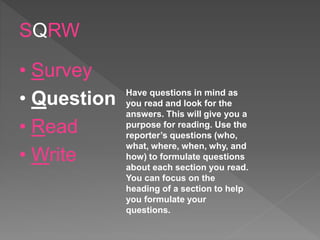
• Survey
• Question
• Read
• Write
Have questions in mind as
you read and look for the
answers. This will give you a
purpose for reading. Use the
reporter’s questions (who,
what, where, when, why, and
how) to formulate questions
about each section you read.
You can focus on the
heading of a section to help
you formulate your
questions.
SQRW
• Survey
• Question
• Read
• Write
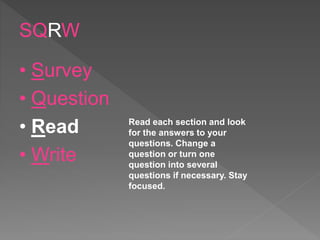
Read each section and look
for the answers to your
questions. Change a
question or turn one
question into several
questions if necessary. Stay
focused.
SQRW
• Survey
• Question
• Read
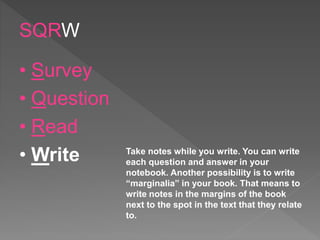
• Write Take notes while you write. You can write
each question and answer in your
notebook. Another possibility is to write
“marginalia” in your book. That means to
write notes in the margins of the book
next to the spot in the text that they relate
to.
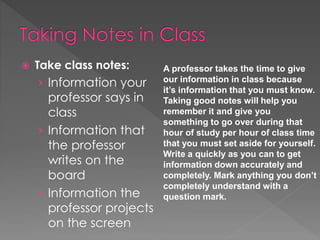
 Take class notes:
› Information your
professor says in
class
› Information that
the professor
writes on the
board
› Information the
professor projects
on the screen
A professor takes the time to give
our information in class because
it’s information that you must know.
Taking good notes will help you
remember it and give you
something to go over during that
hour of study per hour of class time
that you must set aside for yourself.
Write a quickly as you can to get
information down accurately and
completely. Mark anything you don’t
completely understand with a
question mark.
 Rewrite notes:
› Fill in anything
that’s missing
› Make your notes
more accurate
› Do whatever is
needed to make
the information
part of your
knowledge base
During your study hour, rewrite
your notes. This gives you a chance
to review what was given out in
class. More importantly, you can fill
in anything that may be missing
while you still remember it. Use
your textbook or other reference
books to fill in anything that is
missing and to answer any of the
questions you still have about the
information.
 Rewrite notes:
› Fill in anything
that’s missing
› Make your notes
more accurate
› Do whatever is
needed to make
the information
part of your
knowledge base
Remember, you need to turn this
“information” into “knowledge.”
Information becomes knowledge
only when that information
becomes part of your own
knowledge bank. Something you
KNOW in your own head without
looking it up. Everyone has to work
on this in a different way. You need
to find something that works for
you so that when the professor
asks a question in class or on an
exam, you will absolutely know the
right answer.
If there’s anything in your notes
that is still not clear, ask questions
in class. Sometimes, in high
school, students don’t like to ask
questions because of peer
pressure. However, if you let peer
pressure get to you in college, you
are robbing yourself of knowledge.
If you’re in college to learn, you
will have questions. After all, if you
already knew everything about a
subject covered in class, you
would be hailed as a genius and
not need to take the class! So,
expect to have questions and get
them answered.
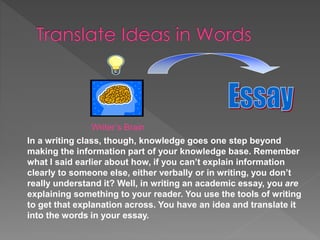
Writer’s Brain
In a writing class, though, knowledge goes one step beyond
making the information part of your knowledge base. Remember
what I said earlier about how, if you can’t explain information
clearly to someone else, either verbally or in writing, you don’t
really understand it? Well, in writing an academic essay, you are
explaining something to your reader. You use the tools of writing
to get that explanation across. You have an idea and translate it
into the words in your essay.
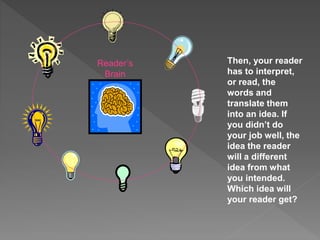
Reader’s
Brain
Then, your reader
has to interpret,
or read, the
words and
translate them
into an idea. If
you didn’t do
your job well, the
idea the reader
will a different
idea from what
you intended.
Which idea will
your reader get?
And, that brings us full
circle back to your toolbox.
Fill it up, know what’s in
there, learn how to use
those tools, then use them
to the best of your ability to
get your ideas across.

Writer's Toolbox

  • 2.
    Tools are an importantpart of any craft. Master Carpenter Norm Abrams from the popular and long-running television programs This Old House wouldn’t be able to accomplish his miracles, like this computer desk, without his power tools!
  • 3.
    Leonardo da Vincicould not have painted the Mona Lisa without his paints and brushes.
  • 4.
    A potter couldnot throw clay without a wheel or sell one of his vases without a kiln. Yes, these people are all talented, but would get nowhere without their tools or the knowledge to use them well! Every craftsperson needs the tools of the trade, even writers. After all, writing IS a craft!
  • 5.
    Stephen King knowsall about writer’s tools. Inspired by his Uncle Oren’s toolbox, King wrote, “I want to suggest that to write to the best of your abilities, it behooves you to construct your own toolbox and then build up enough muscle to carry it around with you. Then, instead of looking at a hard job and getting discouraged, you will perhaps seize the right tool and get immediately to work.” Click on the book cover to see the 10th anniversary edition of this book, published in 2010.
  • 6.
    King is right! Youneed to have the tools ready for use. But, he went a step further, didn’t he? He said you have to “build up enough muscle to carry them around.” In other words, you need to have knowledge and understanding.
  • 7.
    Knowledge and understanding work together. Asa professor, I can “profess” English; in other words, I can tell you what you need to know about writing academic essays. But, that’s just giving you information.
  • 8.
    Information does NOTequal knowledge! When does it become knowledge? Not until it becomes part of your own knowledge bank. Something you KNOW in your own head without looking it up.
  • 9.
    When does knowledgebecome understanding? Not until what you know becomes so much a part of you that your can explain it to someone else. If you can’t explain it clearly to someone else, either verbally or in writing, you don’t really understand it. But, when you do understand it, and you can use it, that’s when knowledge becomes power!
  • 10.
    King’s Uncle Owen’stoolbox probably looked a bit like this one, filled with the tools that helped him repair or build things around the house. As a writer, you need to start with the tools. What will you put in your toolbox this semester?
  • 11.
    King suggests a toolboxwith four layers.
  • 12.
    Kings suggests putting your“vocabulary on the top shelf of your toolbox.” He goes on to say that you should “use the first word that comes to your mind, if it is appropriate and colorful.”
  • 13.
    Be careful ofwords you don’t fully understand. The thesaurus can be a great tool. It was first published by Dr. Peter Mark Roget in 1852 at the age of 73 and he was still working on improving his book when he died at the age of 90. Roget grouped words by ideas, allowing writers to find the exact word of phrase they needed for a specific purpose. The title Roget chose for his book is perfect and shows the importance Roget placed on vocabulary, especially on choosing the right word for the right job.
  • 14.
    The word “thesaurus,”while it might sound like some kind of extinct dinosaur, is actually Latin for “treasury”; and that is exactly what is a thesaurus is – a treasury of words instead of gold. A thesaurus is really about vocabulary. Today, there are many different editions of word collections. in addition to Roget’s original version, there are print versions that list words alphabetically and various online versions. Word processing programs also include a small thesaurus.
  • 15.
    However, a thesaurusdoes not do the work for you. It gives you words that both mean the same things as the word you want to replace and words that are only RELATED to it. Not every word a thesaurus suggests works in every possible situation. You still have to know the meaning of the words you choose to use. If you use a thesaurus carefully, though, it can help you build your vocabulary. While we’re at it, you should know that the word “vocabulary” is also from the Latin meaning “a list of words” so that “your vocabulary” means the list of words that you use to compose sentences that, therefore, communicate your ideas.
  • 16.
    If you don’tknow the meaning of a word, don’t choose it. At best, you could confuse your reader. At worst, you will make yourself look foolish!
  • 17.
    Kings says youalso need your best grammar in the top level. He writes, “Communication is organized by rules of grammar upon which we agree. When these rules break down, confusion and misunderstanding result.”
  • 18.
    So, you haveto know how to use the words in your vocabulary. The rules of grammar help you use your words well. Yes, some of the best writers in the world sometimes ignore the rules. However, King warns that unless the writer is certain of doing well, it’s best to follow the rules. This is especially true in college papers where you are normally using language in a more formal way than when you speak with your friends. Grammar can be a pain, but as King says, “it’s the pole you grab to get your thoughts up on their feet and walking.” To King’s advice about grammar, I would say the same things about punctuation. Good punctuation helps to ensure good communication.
  • 19.
    However, extra helpis still available. You can always come to office hours and ask about the revision codes you don’t understand. Also, you can get extra help with grammar and punctuation at the Writing Connection, which is located in Room 6337. You paid a fee to use the Writing Connection, so make sure you get your money’s worth!
  • 20.
     Introductions  Lead-ins Thesis statements  Body paragraphs  Topic sentences  Concrete support  Organization  Conclusions
  • 21.
    There are plentyof related things we’ll discuss this semester that will help you fill your writer’s toolbox. If you pay attention, your writing can only improve. But, you have to pay attention. That means study time.
  • 22.
    How much studytime should you set aside for a college course? The rough estimate is one hour for every hour spent in class. This might sound like a lot to you, but it’s a reasonable estimate. Even if your professor does not “give” you any homework, in a college class…if you’re really going to “learn” the material…you need to study every day. So the problem may really be that you don’t know how to really study.
  • 23.
    Survey Question Read Write Read the titleand any headings and subheadings. If there’s an introduction, summary or conclusion, read those, too. SQRW
  • 24.
    SQRW • Survey • Question •Read • Write Have questions in mind as you read and look for the answers. This will give you a purpose for reading. Use the reporter’s questions (who, what, where, when, why, and how) to formulate questions about each section you read. You can focus on the heading of a section to help you formulate your questions.
  • 25.
    SQRW • Survey • Question •Read • Write Read each section and look for the answers to your questions. Change a question or turn one question into several questions if necessary. Stay focused.
  • 26.
    SQRW • Survey • Question •Read • Write Take notes while you write. You can write each question and answer in your notebook. Another possibility is to write “marginalia” in your book. That means to write notes in the margins of the book next to the spot in the text that they relate to.
  • 27.
     Take classnotes: › Information your professor says in class › Information that the professor writes on the board › Information the professor projects on the screen A professor takes the time to give our information in class because it’s information that you must know. Taking good notes will help you remember it and give you something to go over during that hour of study per hour of class time that you must set aside for yourself. Write a quickly as you can to get information down accurately and completely. Mark anything you don’t completely understand with a question mark.
  • 28.
     Rewrite notes: ›Fill in anything that’s missing › Make your notes more accurate › Do whatever is needed to make the information part of your knowledge base During your study hour, rewrite your notes. This gives you a chance to review what was given out in class. More importantly, you can fill in anything that may be missing while you still remember it. Use your textbook or other reference books to fill in anything that is missing and to answer any of the questions you still have about the information.
  • 29.
     Rewrite notes: ›Fill in anything that’s missing › Make your notes more accurate › Do whatever is needed to make the information part of your knowledge base Remember, you need to turn this “information” into “knowledge.” Information becomes knowledge only when that information becomes part of your own knowledge bank. Something you KNOW in your own head without looking it up. Everyone has to work on this in a different way. You need to find something that works for you so that when the professor asks a question in class or on an exam, you will absolutely know the right answer.
  • 30.
    If there’s anythingin your notes that is still not clear, ask questions in class. Sometimes, in high school, students don’t like to ask questions because of peer pressure. However, if you let peer pressure get to you in college, you are robbing yourself of knowledge. If you’re in college to learn, you will have questions. After all, if you already knew everything about a subject covered in class, you would be hailed as a genius and not need to take the class! So, expect to have questions and get them answered.
  • 31.
    Writer’s Brain In awriting class, though, knowledge goes one step beyond making the information part of your knowledge base. Remember what I said earlier about how, if you can’t explain information clearly to someone else, either verbally or in writing, you don’t really understand it? Well, in writing an academic essay, you are explaining something to your reader. You use the tools of writing to get that explanation across. You have an idea and translate it into the words in your essay.
  • 32.
    Reader’s Brain Then, your reader hasto interpret, or read, the words and translate them into an idea. If you didn’t do your job well, the idea the reader will a different idea from what you intended. Which idea will your reader get?
  • 33.
    And, that bringsus full circle back to your toolbox. Fill it up, know what’s in there, learn how to use those tools, then use them to the best of your ability to get your ideas across.