Academic Library Acquisitions: Workflows and Challenges Barbara Dunham Serials & Electronic Resources Librarian Dracine Hodges Interim Head, Monographs Department The Ohio State University Libraries March 2, 2011
Agenda Introductions Print Acquisitions - Monographs - Continuations E-Acquisitions Licensing e-Serials e-Books Concluding Remarks Questions
The Ohio State University Libraries $10 million for OSU collections  Acquisitions divided between Monographs Department and Serials/Electronic Resources Department Monographs Department staffed with 1 librarian and 13 staff members Serials/Electronic Resources Department staffed with 1 librarian and 2 staff members Supported by Systems Librarians and IT
Digital vs. Other Formats $8 million serials allocation  $2 million monographs allocation  72% of serial expenditures were for digital formats 17% of monograph expenditures were for digital formats
Membership Impact State funded and member funded Committee on Institutional Cooperation (CIC) – the twelve, soon to be thirteen Big Ten universities regional service provider for OCLC
Print Acquisitions
Some Key Components of Monographs Acquisition Work Bibliographic Verification  Vendor selection: Cost, Speed, Services Fund designation Payment (Invoice, P-card) Receipt and Copy Cataloging Auditing Compliance
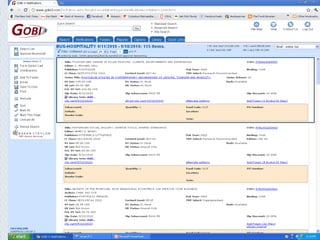
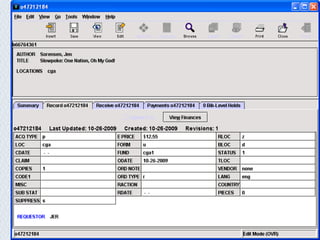
Monographs Selection Methods Virtual Approval -  GOBI 3, Aux Amateurs, Harrassowitz Firm Orders -  Millennium Gathering Plans -  Worldwide, Cassalini, Hogarth, Kenny Gifts -  Highlights, Rudolph, Unsolicited
 
 
Some Key Components of Serials Acquisition Work Agents or Aggregators Careful budgeting, encumbered funds Renewals Inflation and serial prices problem
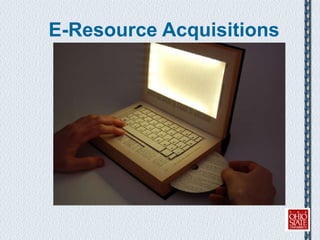
E-Resource Acquisitions
Arrival of Electronic Format Serials staff entered the e-revolution before other library departments Journals were a natural fit for the online environment Databases fit more cleanly into serials work than anywhere else
Licensing – The Barrier to Acquisition Licenses began to appear in early-mid 1990s Complex legal contracts designed to protect publisher interests Librarians soon learned not to sign these contracts without appropriate negotiations and began to push back
Role of the Agent/Publisher Still have an important role to play More challenging work than ever to track variant pricing models and up charges Working to enter the licensing arena as agents between libraries and publishers Developing new online self-service systems for library clients with automatic report generation and direct ordering/claiming
Electronic Journal Pricing Models Free with print subscription Combined format price Online format only Backfile  -included with current subscription -rolling backfile -acquire for an additional charge
Database Pricing Models Per search Number of Full Time Equivalent (FTE) students Number of faculty and students by discipline Carnegie classification Tiered pricing: size, budget, FTE, institutional type Number of simultaneous users
E-Serials Selection Methods Database content Open access content (Free) Local acquisition/identification projects Purchased/leased collections Consortia OSU
Management of E-Resources New responsibility for most acquisitions and serials staff Tools for a toolkit may be acquired from many different vendors Maintenance of A-Z ejournal and database lists Troubleshooting and customer service Usage data
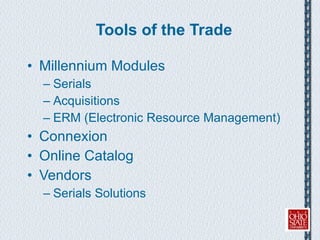
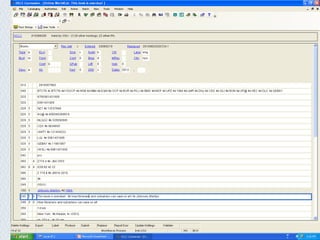
Tools of the Trade Millennium Modules Serials Acquisitions ERM (Electronic Resource Management) Connexion Online Catalog  Vendors Serials Solutions
 
Major Issues Now Big deal packages – good or bad? Aggregators vs. publishers ERAMS providers Perpetual access or archival rights Ownership vs. access Explosion of interlibrary loan
E-books, an Acquired Taste Electronic monographs began slowly, but gaining momentum Print vs. electronic publishing problematic E-books are becoming more ubiquitous and demand is increasing Some disciplines slower to adopt
Evolution of User Attitudes and Expectations Technology improved, user expectations changed Users now demand online access 24/7 accessibility OSU LibQUAL trend data has allowed us to watch this progress
 
Re-evaluation of Selection Libraries spent significant amounts of time selecting e-resources Selection and acquisition methods must sync with expectation that academic libraries collections budgets will be largely spent on electronic formats Some libraries are placing selection in the hands of end-users
E-Book Purchase Models One-time purchase (perpetual access) Lease/subscription access Packaged content model Open access E-book approval plans Patron-driven acquisition (PDA)
Patron Initiated Acquisitions Suggestion box, ILPOD, Netlibrary, ebrary ILL requests approved for purchase Purchases automatically triggered based on usage measured by page views, copies, and prints. Some libraries have begun using this model for 50% of acquisitions.
Policy  & Processing Issues Licensing Concurrent users v. single use Restrictions on use ILL rights Access Provision of URLs Authentication method functional Multiple vendor platforms
Acquisition Issues Communication critical in increasingly complex work environment Tools and procedures are paramount for communication management and collaboration -ERM, Serials Solutions -Close Vendor Relationships -Streamlined Workflows
Hard Questions Should I use an agent or go directly to the publisher? Is it possible to have an all electronic collection?
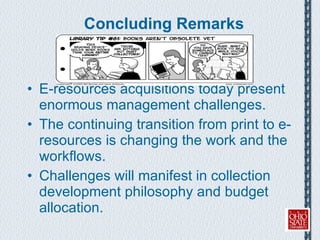
Concluding Remarks E-resources acquisitions today present enormous management challenges. The continuing transition from print to e-resources is changing the work and the workflows.  Challenges will manifest in collection development philosophy and budget allocation.
Thank You! Barbara Dunham E-mail:  [email_address] Dracine Hodges E-mail:  [email_address] The Ohio State University

Academic libraries acq_march_2011

  • 1.
    Academic Library Acquisitions:Workflows and Challenges Barbara Dunham Serials & Electronic Resources Librarian Dracine Hodges Interim Head, Monographs Department The Ohio State University Libraries March 2, 2011
  • 2.
    Agenda Introductions PrintAcquisitions - Monographs - Continuations E-Acquisitions Licensing e-Serials e-Books Concluding Remarks Questions
  • 3.
    The Ohio StateUniversity Libraries $10 million for OSU collections Acquisitions divided between Monographs Department and Serials/Electronic Resources Department Monographs Department staffed with 1 librarian and 13 staff members Serials/Electronic Resources Department staffed with 1 librarian and 2 staff members Supported by Systems Librarians and IT
  • 4.
    Digital vs. OtherFormats $8 million serials allocation $2 million monographs allocation 72% of serial expenditures were for digital formats 17% of monograph expenditures were for digital formats
  • 5.
    Membership Impact Statefunded and member funded Committee on Institutional Cooperation (CIC) – the twelve, soon to be thirteen Big Ten universities regional service provider for OCLC
  • 6.
  • 7.
    Some Key Componentsof Monographs Acquisition Work Bibliographic Verification Vendor selection: Cost, Speed, Services Fund designation Payment (Invoice, P-card) Receipt and Copy Cataloging Auditing Compliance
  • 8.
    Monographs Selection MethodsVirtual Approval - GOBI 3, Aux Amateurs, Harrassowitz Firm Orders - Millennium Gathering Plans - Worldwide, Cassalini, Hogarth, Kenny Gifts - Highlights, Rudolph, Unsolicited
  • 9.
  • 10.
  • 11.
    Some Key Componentsof Serials Acquisition Work Agents or Aggregators Careful budgeting, encumbered funds Renewals Inflation and serial prices problem
  • 12.
  • 13.
    Arrival of ElectronicFormat Serials staff entered the e-revolution before other library departments Journals were a natural fit for the online environment Databases fit more cleanly into serials work than anywhere else
  • 14.
    Licensing – TheBarrier to Acquisition Licenses began to appear in early-mid 1990s Complex legal contracts designed to protect publisher interests Librarians soon learned not to sign these contracts without appropriate negotiations and began to push back
  • 15.
    Role of theAgent/Publisher Still have an important role to play More challenging work than ever to track variant pricing models and up charges Working to enter the licensing arena as agents between libraries and publishers Developing new online self-service systems for library clients with automatic report generation and direct ordering/claiming
  • 16.
    Electronic Journal PricingModels Free with print subscription Combined format price Online format only Backfile -included with current subscription -rolling backfile -acquire for an additional charge
  • 17.
    Database Pricing ModelsPer search Number of Full Time Equivalent (FTE) students Number of faculty and students by discipline Carnegie classification Tiered pricing: size, budget, FTE, institutional type Number of simultaneous users
  • 18.
    E-Serials Selection MethodsDatabase content Open access content (Free) Local acquisition/identification projects Purchased/leased collections Consortia OSU
  • 19.
    Management of E-ResourcesNew responsibility for most acquisitions and serials staff Tools for a toolkit may be acquired from many different vendors Maintenance of A-Z ejournal and database lists Troubleshooting and customer service Usage data
  • 20.
    Tools of theTrade Millennium Modules Serials Acquisitions ERM (Electronic Resource Management) Connexion Online Catalog Vendors Serials Solutions
  • 21.
  • 22.
    Major Issues NowBig deal packages – good or bad? Aggregators vs. publishers ERAMS providers Perpetual access or archival rights Ownership vs. access Explosion of interlibrary loan
  • 23.
    E-books, an AcquiredTaste Electronic monographs began slowly, but gaining momentum Print vs. electronic publishing problematic E-books are becoming more ubiquitous and demand is increasing Some disciplines slower to adopt
  • 24.
    Evolution of UserAttitudes and Expectations Technology improved, user expectations changed Users now demand online access 24/7 accessibility OSU LibQUAL trend data has allowed us to watch this progress
  • 25.
  • 26.
    Re-evaluation of SelectionLibraries spent significant amounts of time selecting e-resources Selection and acquisition methods must sync with expectation that academic libraries collections budgets will be largely spent on electronic formats Some libraries are placing selection in the hands of end-users
  • 27.
    E-Book Purchase ModelsOne-time purchase (perpetual access) Lease/subscription access Packaged content model Open access E-book approval plans Patron-driven acquisition (PDA)
  • 28.
    Patron Initiated AcquisitionsSuggestion box, ILPOD, Netlibrary, ebrary ILL requests approved for purchase Purchases automatically triggered based on usage measured by page views, copies, and prints. Some libraries have begun using this model for 50% of acquisitions.
  • 29.
    Policy &Processing Issues Licensing Concurrent users v. single use Restrictions on use ILL rights Access Provision of URLs Authentication method functional Multiple vendor platforms
  • 30.
    Acquisition Issues Communicationcritical in increasingly complex work environment Tools and procedures are paramount for communication management and collaboration -ERM, Serials Solutions -Close Vendor Relationships -Streamlined Workflows
  • 31.
    Hard Questions ShouldI use an agent or go directly to the publisher? Is it possible to have an all electronic collection?
  • 32.
    Concluding Remarks E-resourcesacquisitions today present enormous management challenges. The continuing transition from print to e-resources is changing the work and the workflows. Challenges will manifest in collection development philosophy and budget allocation.
  • 33.
    Thank You! BarbaraDunham E-mail: [email_address] Dracine Hodges E-mail: [email_address] The Ohio State University

Editor's Notes

  • #4 Supported by Systems Librarians and IT
  • #6 Major research institutions, CIC partnered w/ Google, collectively saved all Institutions 5.6 million
  • #8 Question to students: have you ever done this type of work?
  • #19 OSU usually uses aggregators: SWETS, EBSCO
  • #20 Move behind # 19
  • #21 Question to students: have any of you used these tools?
  • #23 Good point to take a break?
  • #24 Illustration or graphics heavy, foreign language publishers
  • #25 ebrary, Kindle, phone apps, off-campus access via EZ Proxy
  • #27 Elaborate decision-making committee processes set in motion in early 1990s are obsolete
  • #28 GOBI3, ebrary, via individual publisher, open access = free, but associated costs
  • #31 Move to the end
  • #33 -Streamlined workflows -New positions created ; i.e. rights mgmt,e-reserves, licensing -Librarians getting law degrees