Challenges and Opportunities in
Electronic Resources
Eugenia Beh
Texas A&M University Libraries
11/15/10
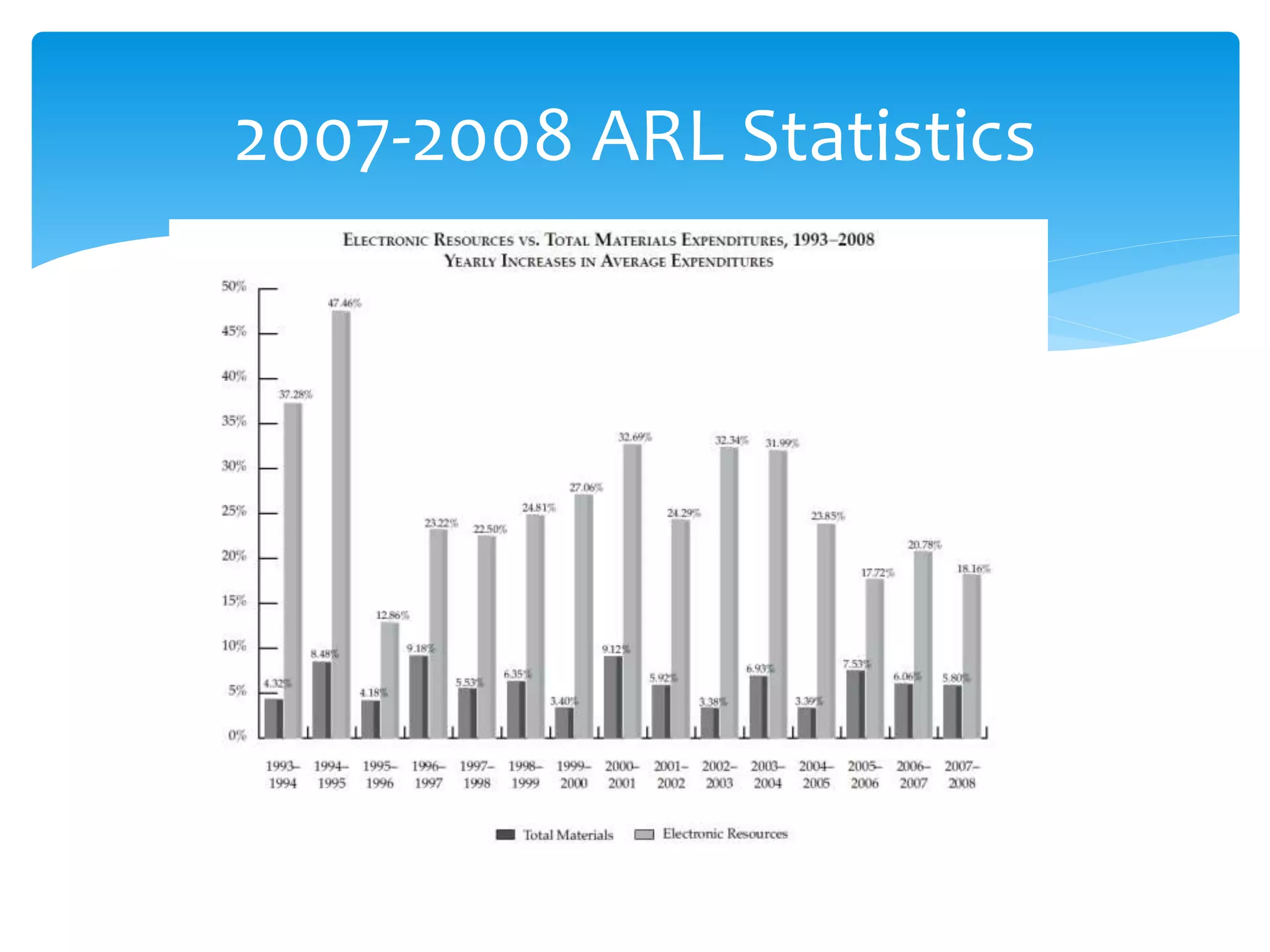
2007-2008 ARL Statistics
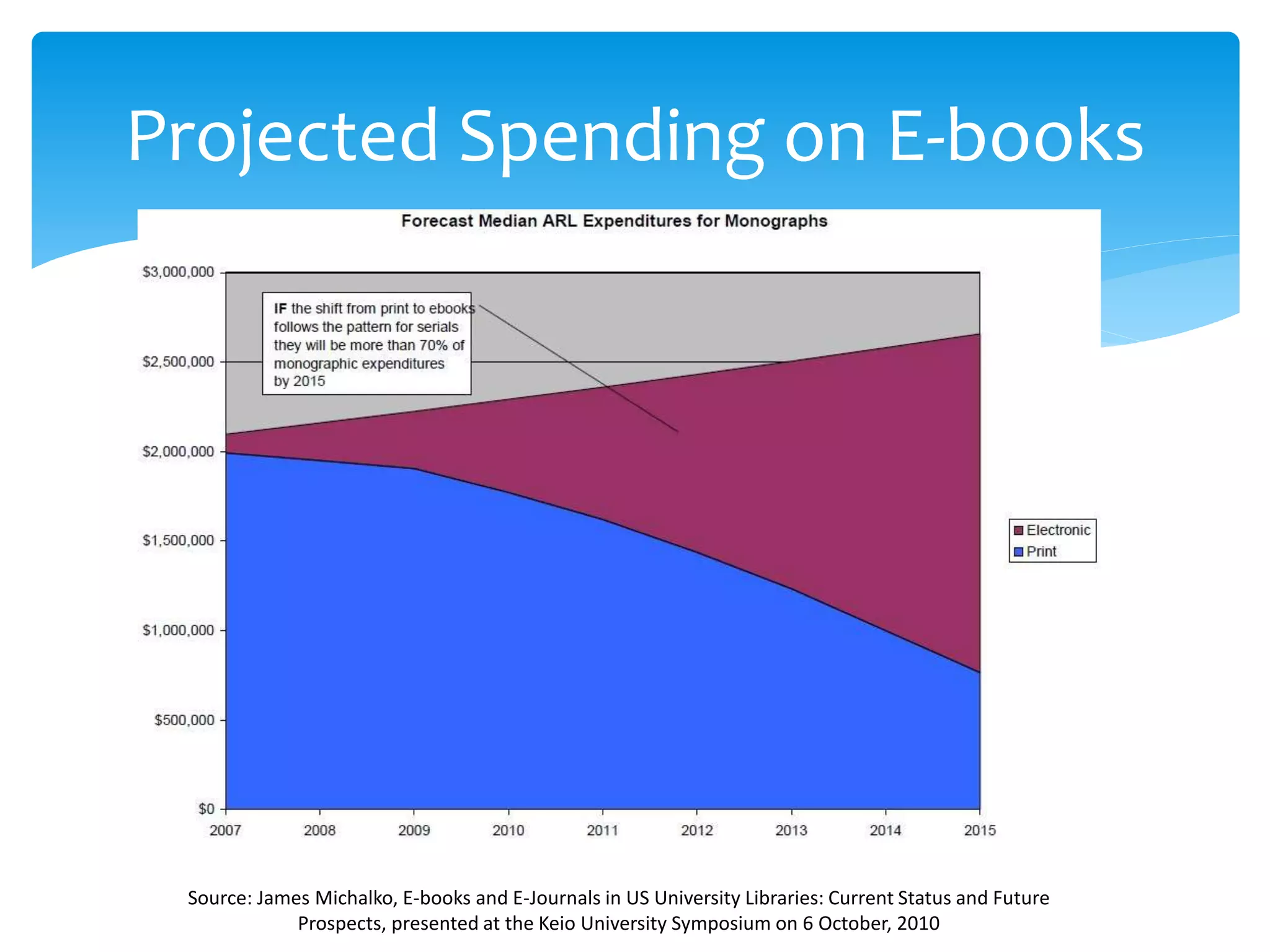
Projected Spending on E-books
Source: James Michalko, E-books and E-Journals in US University Libraries: Current Status and Future
Prospects, presented at the Keio University Symposium on 6 October, 2010
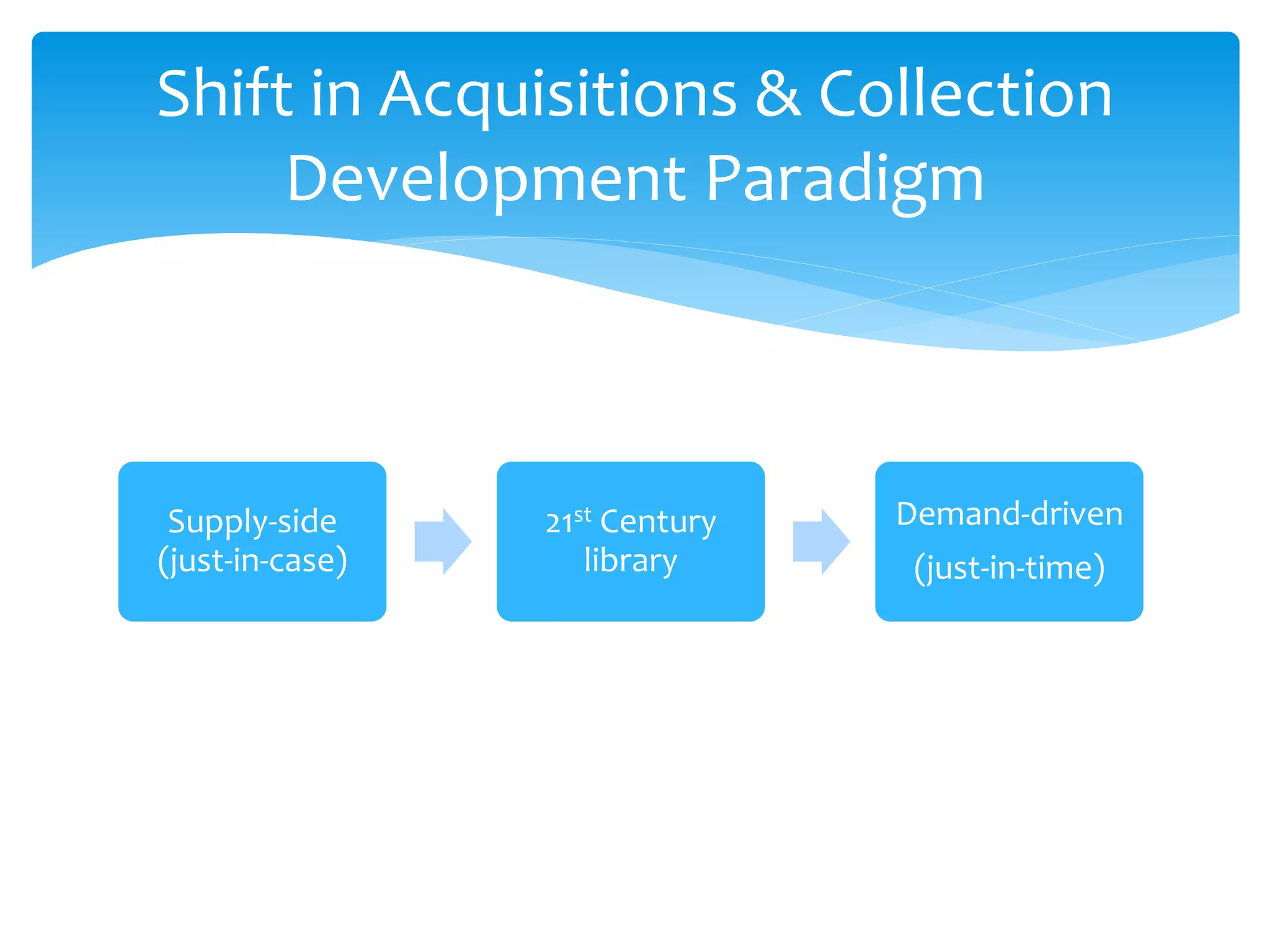
Shift in Acquisitions & Collection
Development Paradigm
Supply-side
(just-in-case)
21st Century
library
Demand-driven
(just-in-time)
Challenges
 External factors (what we can’t
control)
 Constant change
 Institutional factors (what we
can attempt to influence)
 Shrinking budgets
 Reduced staff
 Outcomes-based assessment
 User expectations
 Library factors (what we can
control)
 E-resources acquisitions and
management workflow
Library Challenges:
E-resources Acquisitions and
Management
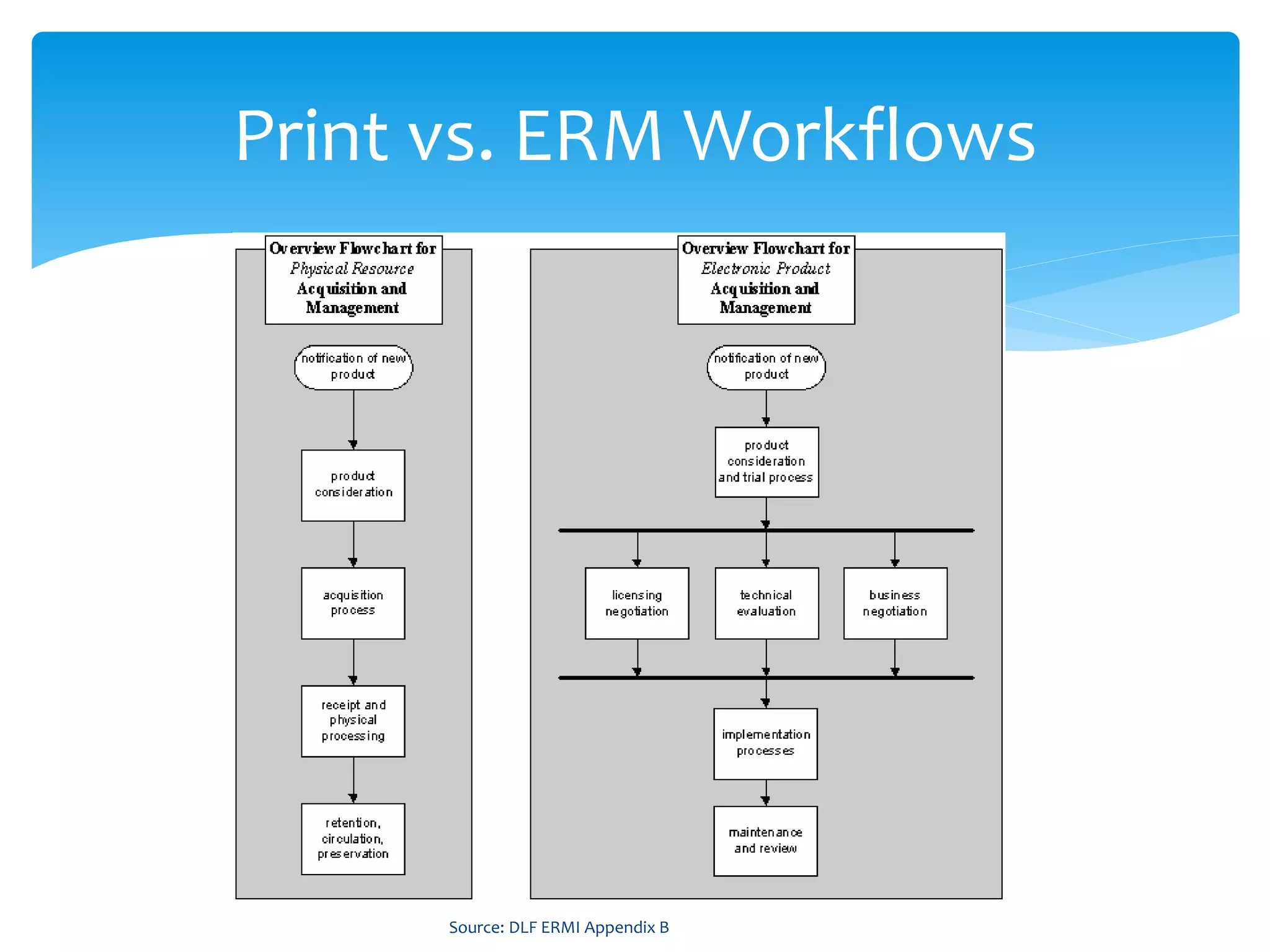
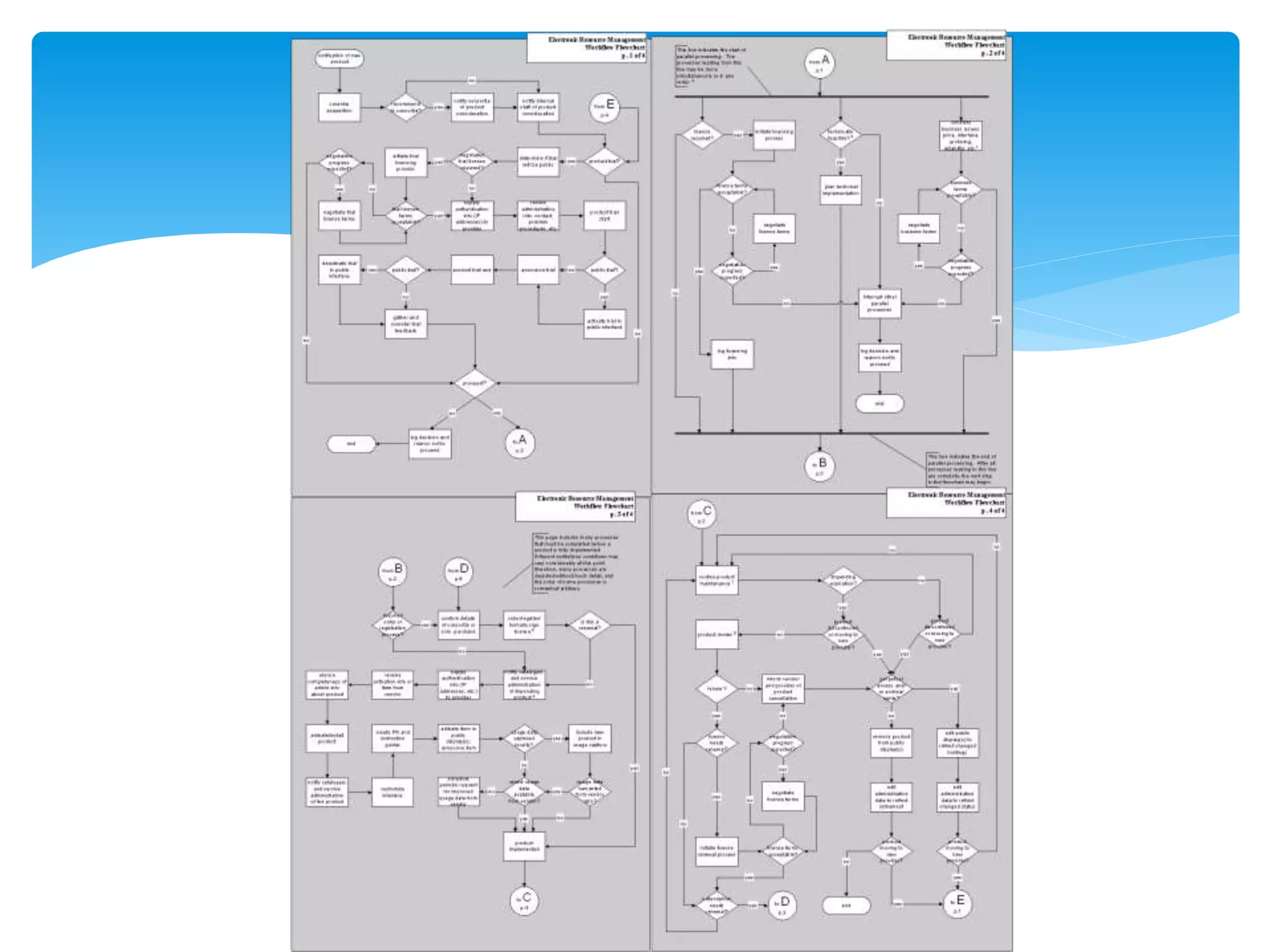
Print vs. ERM Workflows
Source: DLF ERMI Appendix B
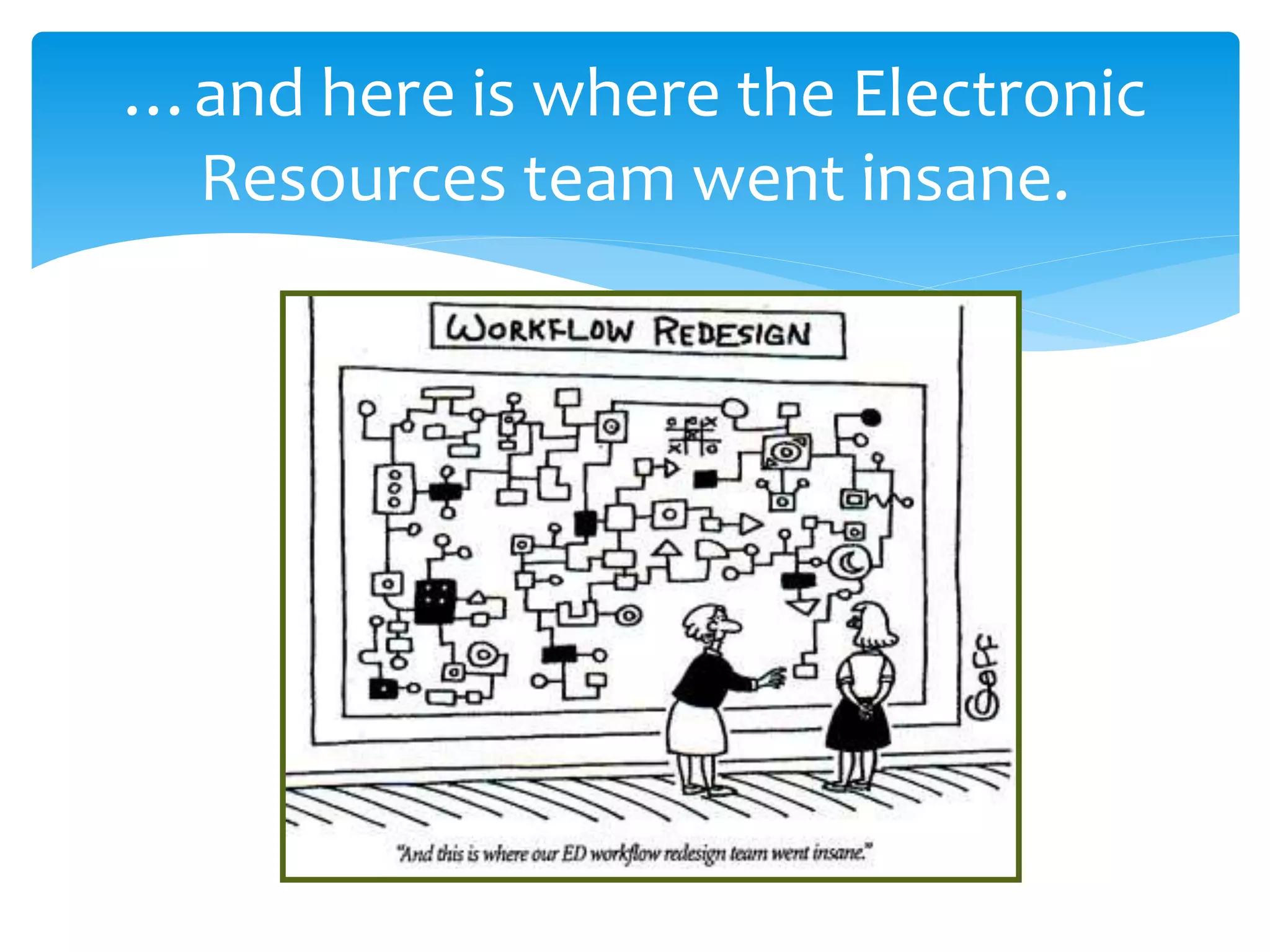
…and here is where the Electronic
Resources team went insane.
E-resources Acquisitions and
Management Workflow
 Licensing
 Negotiation
 Managing licensing
information
 Cataloging
 Administration and
support
 Monitoring e-resources
 OpenURL link resolvers
 Evaluation
 Usage statistics
 Preservation
 How and what to
preserve?
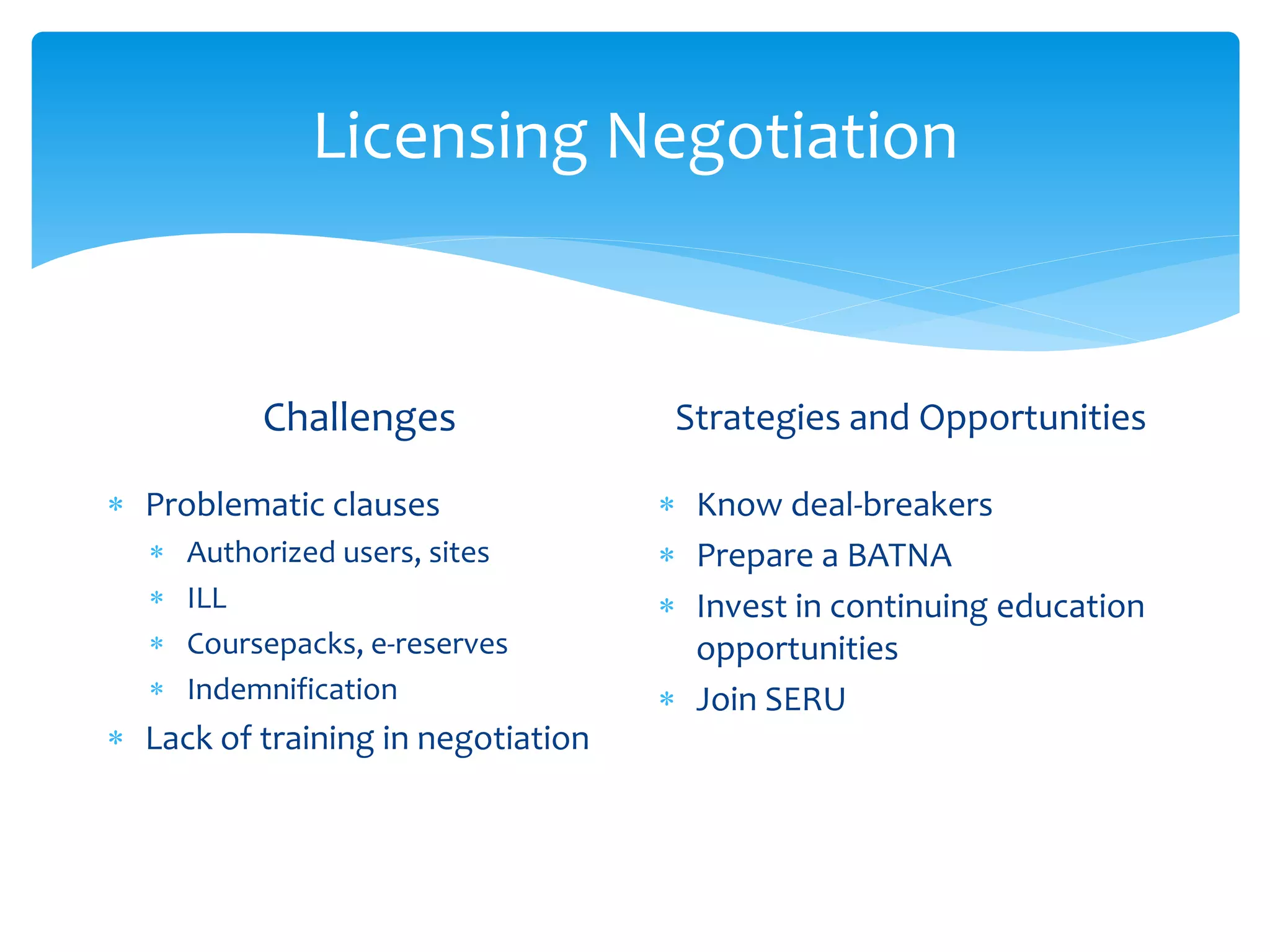
Licensing Negotiation
Challenges
 Problematic clauses
 Authorized users, sites
 ILL
 Coursepacks, e-reserves
 Indemnification
 Lack of training in negotiation
Strategies and Opportunities
 Know deal-breakers
 Prepare a BATNA
 Invest in continuing education
opportunities
 Join SERU
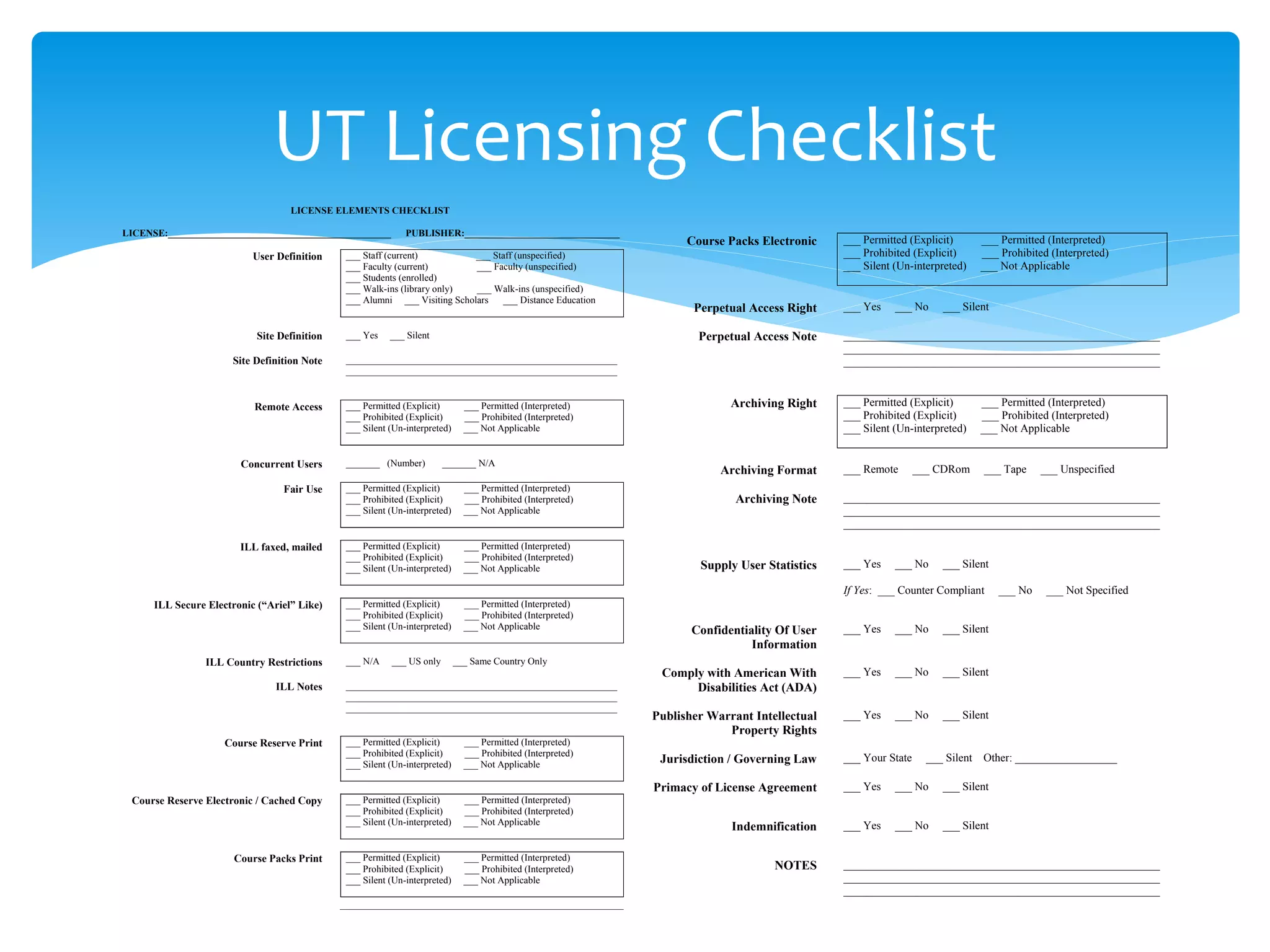
UT Licensing Checklist
LICENSE ELEMENTS CHECKLIST
LICENSE:______________________________________________ PUBLISHER:________________________________
User Definition ___ Staff (current) ___ Staff (unspecified)
___ Faculty (current) ___ Faculty (unspecified)
___ Students (enrolled)
___ Walk-ins (library only) ___ Walk-ins (unspecified)
___ Alumni ___ Visiting Scholars ___ Distance Education
Site Definition ___ Yes ___ Silent
Site Definition Note ________________________________________________________
________________________________________________________
Remote Access ___ Permitted (Explicit) ___ Permitted (Interpreted)
___ Prohibited (Explicit) ___ Prohibited (Interpreted)
___ Silent (Un-interpreted) ___ Not Applicable
Concurrent Users _______ (Number) _______ N/A
Fair Use ___ Permitted (Explicit) ___ Permitted (Interpreted)
___ Prohibited (Explicit) ___ Prohibited (Interpreted)
___ Silent (Un-interpreted) ___ Not Applicable
ILL faxed, mailed ___ Permitted (Explicit) ___ Permitted (Interpreted)
___ Prohibited (Explicit) ___ Prohibited (Interpreted)
___ Silent (Un-interpreted) ___ Not Applicable
ILL Secure Electronic (“Ariel” Like) ___ Permitted (Explicit) ___ Permitted (Interpreted)
___ Prohibited (Explicit) ___ Prohibited (Interpreted)
___ Silent (Un-interpreted) ___ Not Applicable
ILL Country Restrictions ___ N/A ___ US only ___ Same Country Only
ILL Notes ________________________________________________________
________________________________________________________
________________________________________________________
Course Reserve Print ___ Permitted (Explicit) ___ Permitted (Interpreted)
___ Prohibited (Explicit) ___ Prohibited (Interpreted)
___ Silent (Un-interpreted) ___ Not Applicable
Course Reserve Electronic / Cached Copy ___ Permitted (Explicit) ___ Permitted (Interpreted)
___ Prohibited (Explicit) ___ Prohibited (Interpreted)
___ Silent (Un-interpreted) ___ Not Applicable
Course Packs Print ___ Permitted (Explicit) ___ Permitted (Interpreted)
___ Prohibited (Explicit) ___ Prohibited (Interpreted)
___ Silent (Un-interpreted) ___ Not Applicable
Course Packs Electronic ___ Permitted (Explicit) ___ Permitted (Interpreted)
___ Prohibited (Explicit) ___ Prohibited (Interpreted)
___ Silent (Un-interpreted) ___ Not Applicable
Perpetual Access Right ___ Yes ___ No ___ Silent
Perpetual Access Note ________________________________________________________
________________________________________________________
________________________________________________________
Archiving Right ___ Permitted (Explicit) ___ Permitted (Interpreted)
___ Prohibited (Explicit) ___ Prohibited (Interpreted)
___ Silent (Un-interpreted) ___ Not Applicable
Archiving Format ___ Remote ___ CDRom ___ Tape ___ Unspecified
Archiving Note ________________________________________________________
________________________________________________________
________________________________________________________
Supply User Statistics ___ Yes ___ No ___ Silent
If Yes: ___ Counter Compliant ___ No ___ Not Specified
Confidentiality Of User
Information
___ Yes ___ No ___ Silent
Comply with American With
Disabilities Act (ADA)
___ Yes ___ No ___ Silent
Publisher Warrant Intellectual
Property Rights
___ Yes ___ No ___ Silent
Jurisdiction / Governing Law ___ Your State ___ Silent Other: __________________
Primacy of License Agreement ___ Yes ___ No ___ Silent
Indemnification ___ Yes ___ No ___ Silent
NOTES ________________________________________________________
________________________________________________________
________________________________________________________
Managing Licensing Information
Challenges
 Consolidating subscription
information
 Tracking licensing changes
 Electronic Resource
Management Systems (ERMS)
Opportunities
 CORAL (open-source ERMS)
 CORE (Cost of Resource
Exchange)
 ONIX-PL (ONline
Information eXchange for
Publication License)
Cataloging
Challenges
 What approach?
 Single-record
 Separate records
 Aggregator-neutral record
 Provider-neutral record (e-books)
 Put links in the catalog or
provide access through link
resolver?
Strategies and Opportunities
 Prepare for RDA (Resource
Description and Access)
implementation
 Successor to AACR2
 Not yet adopted in U.S.
 Impact on e-resources?
Administration /Support
Challenges
 Monitoring e-resources
 Should we and/or do we
monitor e-access?
 If we do – when, how, and how
often?
Strategies and Opportunities
 Monitor problematic e-
resources
 Use online reporting form for
troubleshooting and resolving
e-access problems
 *Use screencasting software
to troubleshoot problems
OpenURL Link Resolvers
Challenges
 Link failures
 Provides title-level rather than
item-level access
 Interoperability with non-ISSN-
based formats
Strategies and Opportunities
 Link checking software
 http://nj.oclc.org/linkevaluator/
 KBART (Knowledge Bases and
Related Tools)
 IOTA (Improving OpenURL
Through Analytics)
 Web-scale discovery services
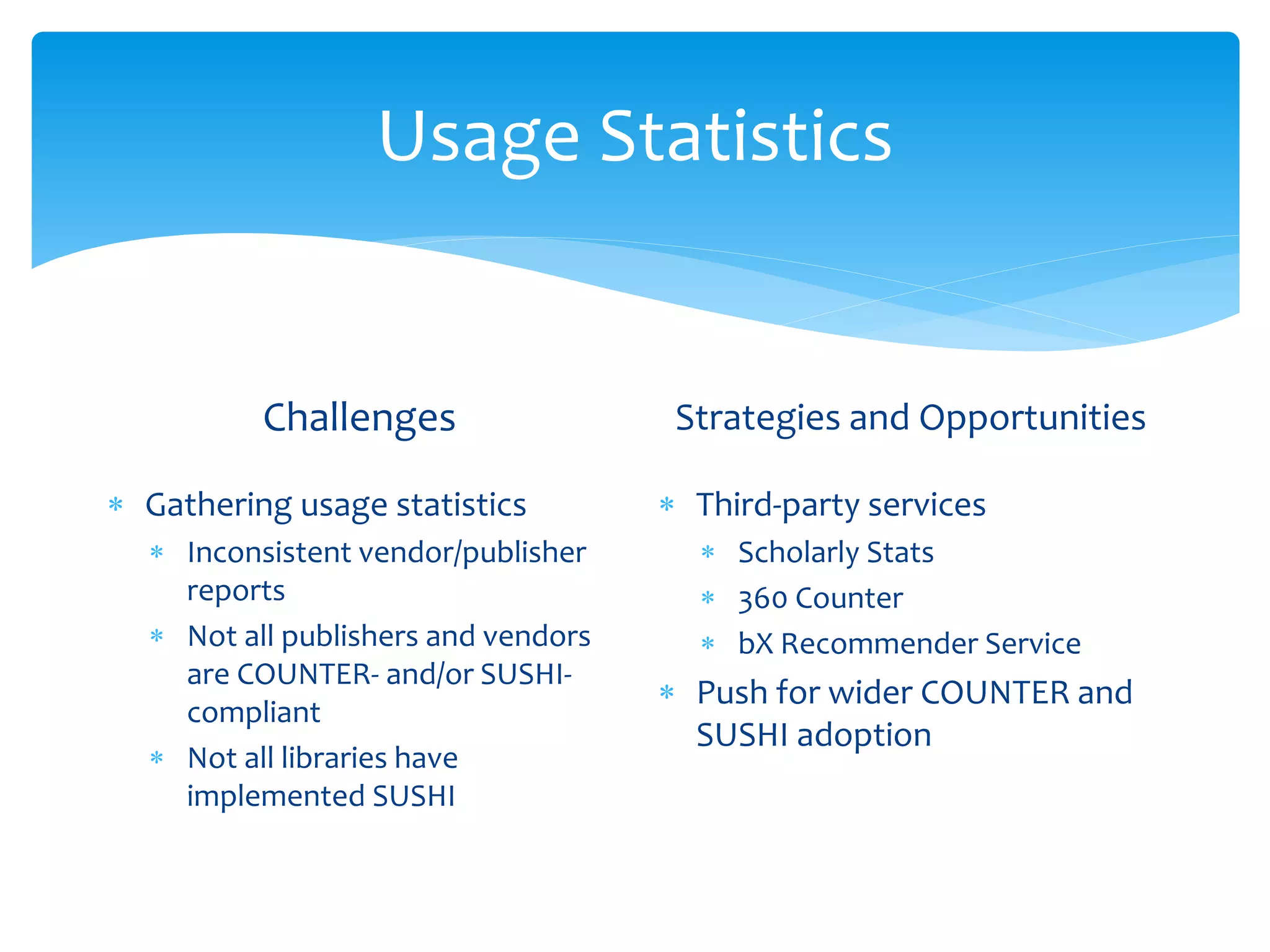
Usage Statistics
Challenges
 Gathering usage statistics
 Inconsistent vendor/publisher
reports
 Not all publishers and vendors
are COUNTER- and/or SUSHI-
compliant
 Not all libraries have
implemented SUSHI
Strategies and Opportunities
 Third-party services
 Scholarly Stats
 360 Counter
 bX Recommender Service
 Push for wider COUNTER and
SUSHI adoption
Preservation
Challenges
 Preserve content and/or also
interface?
 Convert files to a new format?
Strategies and Opportunities
 LOCKSS
 CLOCKSS
 Portico
 Institutional repositories
 HathiTrust
Institutional Challenges:
Budgets, Staffing, Assessment,
User Expectations
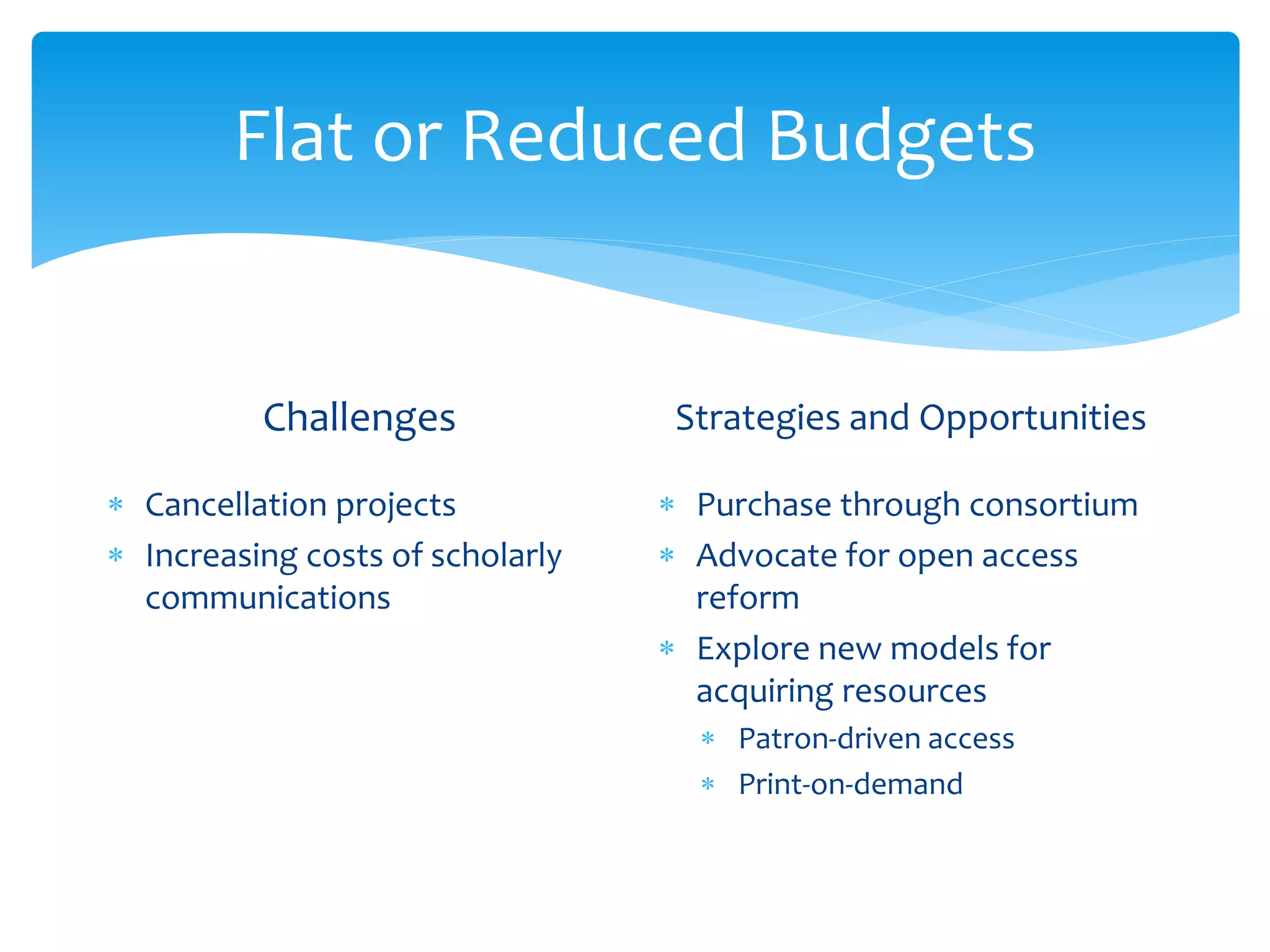
Flat or Reduced Budgets
Challenges
 Cancellation projects
 Increasing costs of scholarly
communications
Strategies and Opportunities
 Purchase through consortium
 Advocate for open access
reform
 Explore new models for
acquiring resources
 Patron-driven access
 Print-on-demand
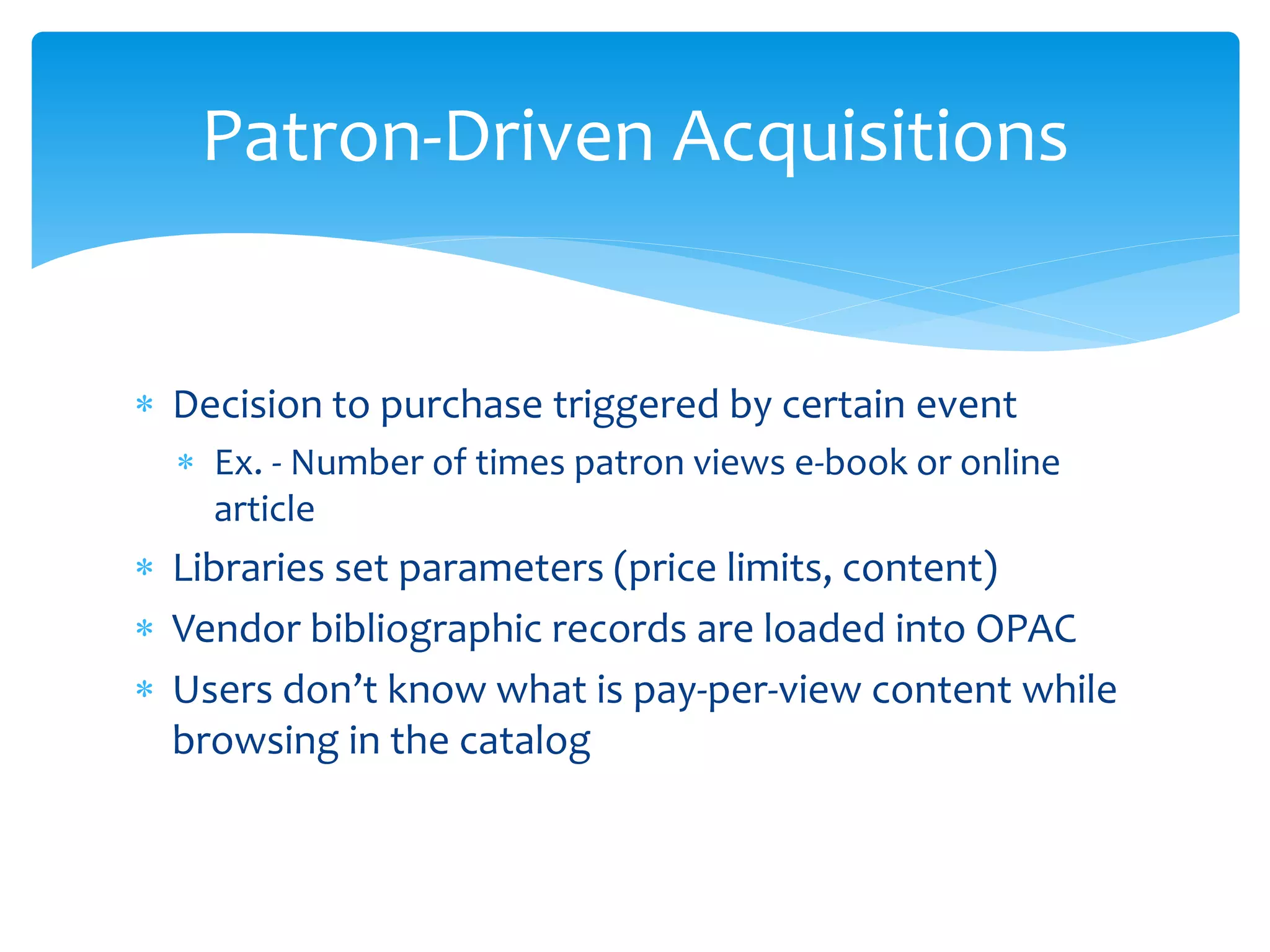
 Decision to purchase triggered by certain event
 Ex. - Number of times patron views e-book or online
article
 Libraries set parameters (price limits, content)
 Vendor bibliographic records are loaded into OPAC
 Users don’t know what is pay-per-view content while
browsing in the catalog
Patron-Driven Acquisitions
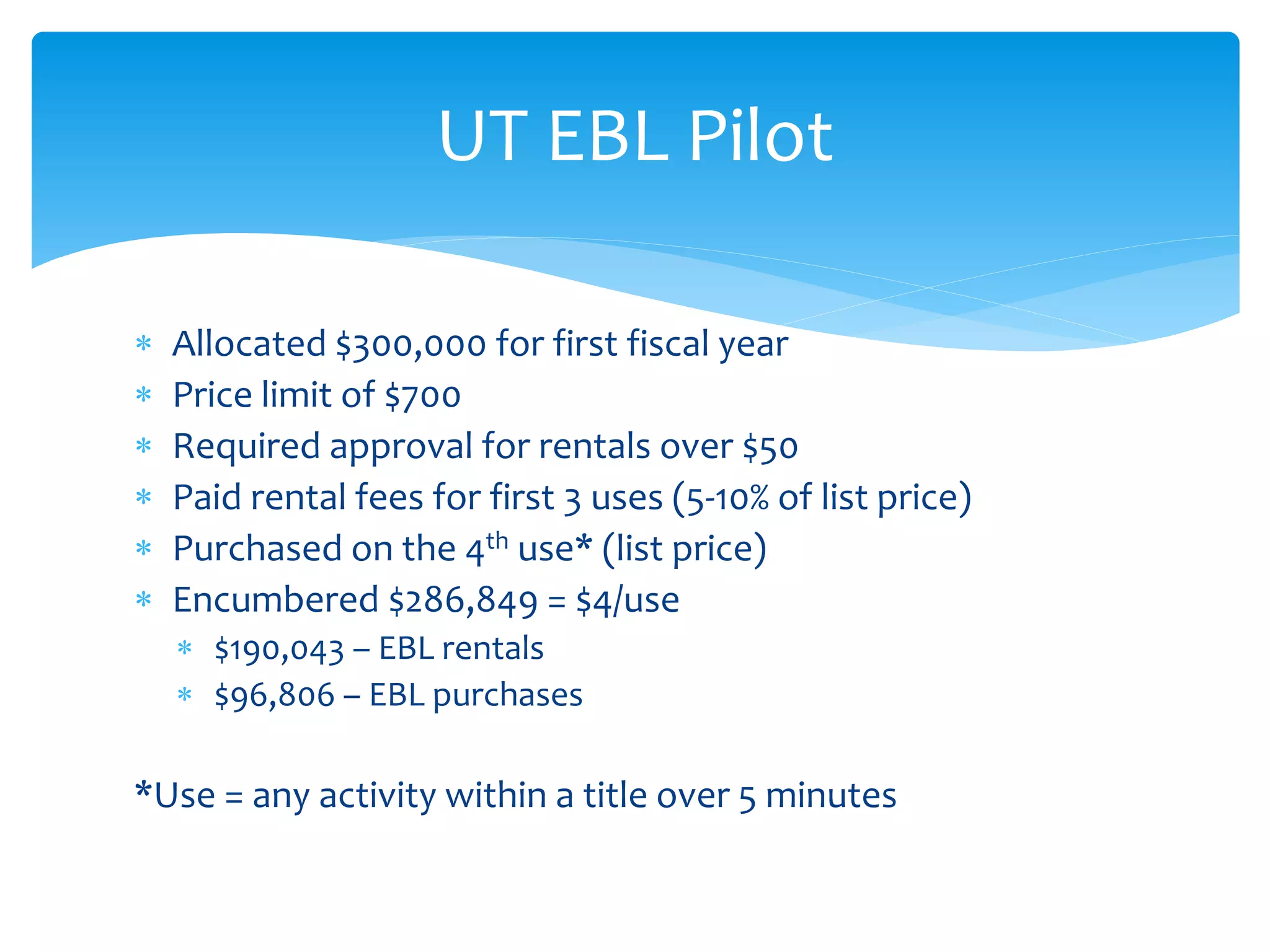
 Allocated $300,000 for first fiscal year
 Price limit of $700
 Required approval for rentals over $50
 Paid rental fees for first 3 uses (5-10% of list price)
 Purchased on the 4th use* (list price)
 Encumbered $286,849 = $4/use
 $190,043 – EBL rentals
 $96,806 – EBL purchases
*Use = any activity within a title over 5 minutes
UT EBL Pilot
EBL (cont.)
Challenges
 Initial resistance from librarians
 Vendor-provided MARC
records needed improvement
 Lack of interoperability with
SFX
 Determining parameters
Opportunities
 Improved purchasing power
 Hope to expand PDA model to
print resources
 YBP and EBL demand-driven
approval plan?
 Schell, L. E., Ginanni, K., & Heet, B. (2010). Playing the
Field: Pay-Per-View E-journals and E-books. The Serials
Librarian, 58(1), 87.
 Macicak, S., & Schell, L. E. (2009). Patron-driven,
librarian-approved: a pay-per-view model for e-books.
Serials: The Journal for the Serials Community, 22(3),
S31-S38.
For more details
Print-on-Demand
(POD)
 Prints individual copies of
books as users want them
 Espresso Book Machine
 2007 Time Magazine Best
Invention
 “Vending machine” for
books
 Prints, binds and trims 300-
page book in under 4
minutes
 Prints up to 830 pages
POD (cont.)
Challenges
 Poor metadata
 Discoverability
 Mechanical failures
 Sustainable model?
Opportunities
 Together with PDA, may
change the way publishers do
business
 Shift from book /journal
suppliers to service providers?
POD (cont.)
Challenges
 Poor metadata
 Discoverability
 Mechanical failures
 Sustainable model?
Opportunities
 Together with PDA, may
change the way publishers do
business
 Shift from book /journal
suppliers to service providers?
UT Burnt Orange Book Machine
(BOB)
 Owned and operated by
Co-Op (not Libraries)
 Prints out-of-print, back
list, public domain, UT
Libraries and UT Press
titles
 Agreements with Google
Books, Lightning Source
and Flatworld Knowledge
 Forty Acres Press -
http://www.fortyacrespress.com/mb_intro_1.html
 Lee, A. (2010, November). Burnt Orange Book
Machine offers opportunity to publish, print on
demand in five minutes. Inside Our Campus. Retrieved
from http://insideourcampus.com/2010/11/burnt-
orange-book-machine-offers-opportunity-to-publish-
print-on-demand-in-five-minutes/
For more information
Reduced Staff
Challenges
 Unfilled vacancies
 E-resources are added at a
faster rate than staff
 Gatekeeper librarian syndrome
Strategies and Opportunities
 Internal transfers
 Staff share
 Cross-train staff
 Print-based technical services
staff
 Public services staff
Outcomes-Based Assessment
Challenges
 Libraries must justify continued
value to stakeholders
Strategies and Opportunities
 ROI
 Quantify and demonstrate the
library’s economic value to the
institution
 Complement usage statistics
with data taken from user
feedback
 Partner within and outside of
library
User Expectations
Challenges
 Users expect 24/7 immediate
access to any resource in any
and all formats
Strategies and Opportunities
 Try to avoid e-access problems
before they arise
 Alert public services staff of
any anticipated e-access
problems
 Collaborate with public
services to educate users
about e-resources
External Challenges:
Change
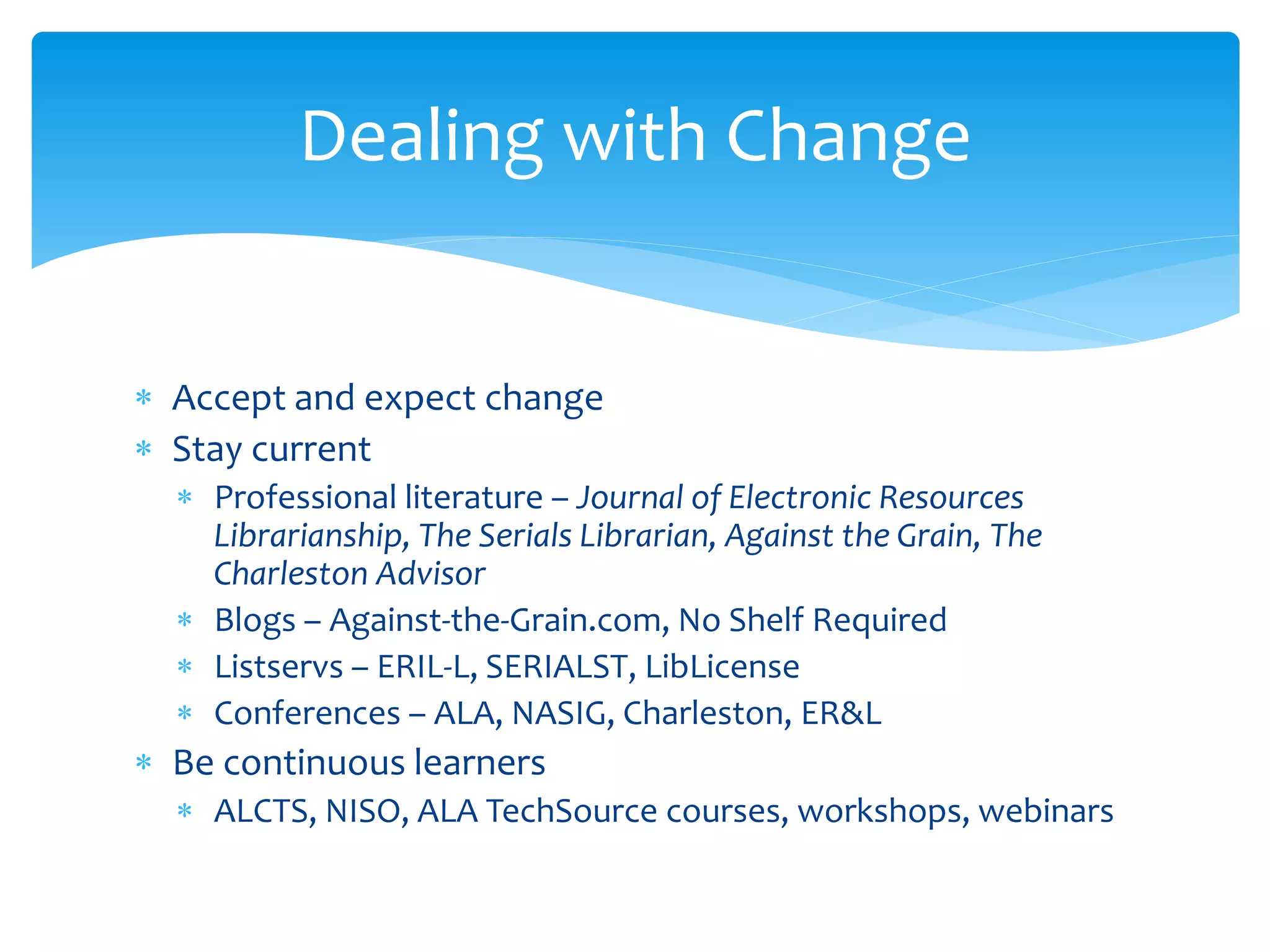
 Accept and expect change
 Stay current
 Professional literature – Journal of Electronic Resources
Librarianship, The Serials Librarian, Against the Grain, The
Charleston Advisor
 Blogs – Against-the-Grain.com, No Shelf Required
 Listservs – ERIL-L, SERIALST, LibLicense
 Conferences – ALA, NASIG, Charleston, ER&L
 Be continuous learners
 ALCTS, NISO, ALA TechSource courses, workshops, webinars
Dealing with Change
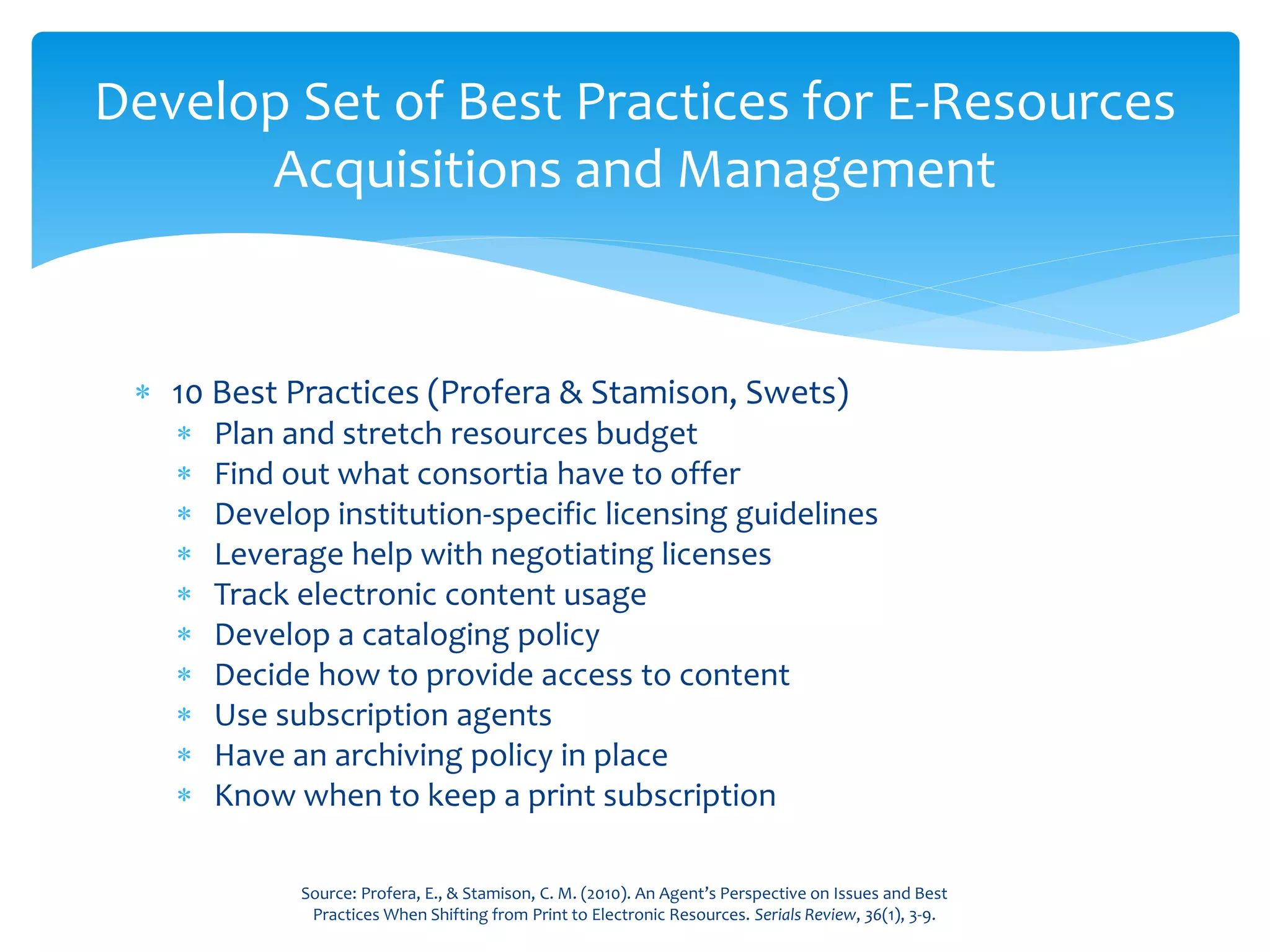
 10 Best Practices (Profera & Stamison, Swets)
 Plan and stretch resources budget
 Find out what consortia have to offer
 Develop institution-specific licensing guidelines
 Leverage help with negotiating licenses
 Track electronic content usage
 Develop a cataloging policy
 Decide how to provide access to content
 Use subscription agents
 Have an archiving policy in place
 Know when to keep a print subscription
Develop Set of Best Practices for E-Resources
Acquisitions and Management
Source: Profera, E., & Stamison, C. M. (2010). An Agent’s Perspective on Issues and Best
Practices When Shifting from Print to Electronic Resources. Serials Review, 36(1), 3-9.
 ALA-accredited MLIS
 Experience with an integrated library system
 Ability to work collaboratively
 Customer service orientation
 Analytical and problem solving skills
 Experience managing/maintaining e-resources
 Experience with link resolvers and knowledge of OpenURL
standards
 Experience licensing e-resources
 Flexibility in the face of change
 Experience with or knowledge of serials/e-resources acquisitions
 Experience with or knowledge of electronic resources
management systems
 Experience working with e-resources vendors
Develop Core Competencies for
E-Resources Librarians
(2010) "2010 Conference Reports," NASIG Newsletter:
Vol. 25: No. 3, Article 11.
 SERU
 ONIX-PL
 COUNTER
 SUSHI
 CORE
 KBART
Push for Standards Adoption
 Change-oriented
 User-centered
 Technologically specialized
 Cost-efficient
Lead Change
 Contact: Eugenia Beh
 eugenia_beh@yahoo.com
Questions?
 (2010) "2010 Conference Reports," NASIG Newsletter: Vol. 25: No. 3, Article 11.
 Fleming-May, R., & Grogg, J. E. (2010, November 9). Evaluating and Selecting Online
Resources: An American Library Association TechSource Workshop.
 Forty Acres Press. (n.d.). . Retrieved November 13, 2010, from
http://www.fortyacrespress.com/mb_intro_1.html
 Grant, C. (2010, October 30). Commentary from Carl Grant: "Gladiators" to perform sleight-
of-hand at Charleston Conference. Retrieved November 13, 2010, from
http://commentary.exlibrisgroup.com/2010/10/gladiators-to-perform-sleight-of-hand.html
 Timothy D. Jewell, U. O. W., Ivy Anderson, H. U., Adam Chandler, C. U., Sharon E. Farb, U.,
Kimberly Parker, Y. U., Angela Riggio, U., & Nathan D. M. Robertson, T. J. H. U. (2004, August
18). Electronic Resource Management. The Report of the DLF Initiative. text, . Retrieved
November 13, 2010, from http://www.diglib.org/pubs/dlf102/
 Kyrillidou, M., & Bland, L. (2009). ARL Statistics 2007-2008. Association of Research Libraries.
Retrieved from http://www.arl.org/bm~doc/arlstat08.pdf
 Lee, A. (2010, November). Burnt Orange Book Machine offers opportunity to publish, print
on demand in five minutes. Inside Our Campus. Retrieved from
http://insideourcampus.com/2010/11/burnt-orange-book-machine-offers-opportunity-to-
publish-print-on-demand-in-five-minutes/
Sources
 Macicak, S., & Schell, L. E. (2009). Patron-driven, librarian-approved: a pay-per-view model
for e-books. Serials: The Journal for the Serials Community, 22(3), S31-S38. doi:10.1629/22S31
 Michalko, J. (2010, October 6). E-books and E-Journals in US University Libraries: Current
Status and Future Prospects. Presented at the Keio Symposium, Tokyo, Japan.
 Profera, E., & Stamison, C. M. (2010). An Agent’s Perspective on Issues and Best Practices
When Shifting from Print to Electronic Resources. Serials Review, 36(1), 3-9.
 Rowe, R. (2010). Web-Scale Discovery: A Review of Summon, EBSCO Discovery Service, and
WorldCat Local. The Charleston Advisor, 12(1), 5-10. doi:10.5260/chara.12.1.5
 Schell, L. E., Ginanni, K., & Heet, B. (2010). Playing the Field: Pay-Per-View E-journals and E-
books. The Serials Librarian, 58(1), 87. doi:10.1080/03615261003623062
 Smyth, S. (2010). Currency trends and collection building. College & Research Libraries News,
71(10), 547 -566.
 Tenopir, C. (2010). Measuring the Value of the Academic Library: Return on Investment and
Other Value Measures. The Serials Librarian, 58(1), 39.
 Trainor, C., & Price, J. (2010). Chapter 1: Introduction. Library Technology Reports, 46(7), 5-10.
 Wisniewski, J. (2010). Web Scale Discovery: The Future's So Bright, I Gotta Wear Shades.
Online, 34(4), 55-7.
Sources (cont.)

A&M presentation

  • 1.
    Challenges and Opportunitiesin Electronic Resources Eugenia Beh Texas A&M University Libraries 11/15/10
  • 2.
  • 3.
    Projected Spending onE-books Source: James Michalko, E-books and E-Journals in US University Libraries: Current Status and Future Prospects, presented at the Keio University Symposium on 6 October, 2010
  • 4.
    Shift in Acquisitions& Collection Development Paradigm Supply-side (just-in-case) 21st Century library Demand-driven (just-in-time)
  • 5.
    Challenges  External factors(what we can’t control)  Constant change  Institutional factors (what we can attempt to influence)  Shrinking budgets  Reduced staff  Outcomes-based assessment  User expectations  Library factors (what we can control)  E-resources acquisitions and management workflow
  • 6.
  • 7.
    Print vs. ERMWorkflows Source: DLF ERMI Appendix B
  • 9.
    …and here iswhere the Electronic Resources team went insane.
  • 10.
    E-resources Acquisitions and ManagementWorkflow  Licensing  Negotiation  Managing licensing information  Cataloging  Administration and support  Monitoring e-resources  OpenURL link resolvers  Evaluation  Usage statistics  Preservation  How and what to preserve?
  • 11.
    Licensing Negotiation Challenges  Problematicclauses  Authorized users, sites  ILL  Coursepacks, e-reserves  Indemnification  Lack of training in negotiation Strategies and Opportunities  Know deal-breakers  Prepare a BATNA  Invest in continuing education opportunities  Join SERU
  • 12.
    UT Licensing Checklist LICENSEELEMENTS CHECKLIST LICENSE:______________________________________________ PUBLISHER:________________________________ User Definition ___ Staff (current) ___ Staff (unspecified) ___ Faculty (current) ___ Faculty (unspecified) ___ Students (enrolled) ___ Walk-ins (library only) ___ Walk-ins (unspecified) ___ Alumni ___ Visiting Scholars ___ Distance Education Site Definition ___ Yes ___ Silent Site Definition Note ________________________________________________________ ________________________________________________________ Remote Access ___ Permitted (Explicit) ___ Permitted (Interpreted) ___ Prohibited (Explicit) ___ Prohibited (Interpreted) ___ Silent (Un-interpreted) ___ Not Applicable Concurrent Users _______ (Number) _______ N/A Fair Use ___ Permitted (Explicit) ___ Permitted (Interpreted) ___ Prohibited (Explicit) ___ Prohibited (Interpreted) ___ Silent (Un-interpreted) ___ Not Applicable ILL faxed, mailed ___ Permitted (Explicit) ___ Permitted (Interpreted) ___ Prohibited (Explicit) ___ Prohibited (Interpreted) ___ Silent (Un-interpreted) ___ Not Applicable ILL Secure Electronic (“Ariel” Like) ___ Permitted (Explicit) ___ Permitted (Interpreted) ___ Prohibited (Explicit) ___ Prohibited (Interpreted) ___ Silent (Un-interpreted) ___ Not Applicable ILL Country Restrictions ___ N/A ___ US only ___ Same Country Only ILL Notes ________________________________________________________ ________________________________________________________ ________________________________________________________ Course Reserve Print ___ Permitted (Explicit) ___ Permitted (Interpreted) ___ Prohibited (Explicit) ___ Prohibited (Interpreted) ___ Silent (Un-interpreted) ___ Not Applicable Course Reserve Electronic / Cached Copy ___ Permitted (Explicit) ___ Permitted (Interpreted) ___ Prohibited (Explicit) ___ Prohibited (Interpreted) ___ Silent (Un-interpreted) ___ Not Applicable Course Packs Print ___ Permitted (Explicit) ___ Permitted (Interpreted) ___ Prohibited (Explicit) ___ Prohibited (Interpreted) ___ Silent (Un-interpreted) ___ Not Applicable Course Packs Electronic ___ Permitted (Explicit) ___ Permitted (Interpreted) ___ Prohibited (Explicit) ___ Prohibited (Interpreted) ___ Silent (Un-interpreted) ___ Not Applicable Perpetual Access Right ___ Yes ___ No ___ Silent Perpetual Access Note ________________________________________________________ ________________________________________________________ ________________________________________________________ Archiving Right ___ Permitted (Explicit) ___ Permitted (Interpreted) ___ Prohibited (Explicit) ___ Prohibited (Interpreted) ___ Silent (Un-interpreted) ___ Not Applicable Archiving Format ___ Remote ___ CDRom ___ Tape ___ Unspecified Archiving Note ________________________________________________________ ________________________________________________________ ________________________________________________________ Supply User Statistics ___ Yes ___ No ___ Silent If Yes: ___ Counter Compliant ___ No ___ Not Specified Confidentiality Of User Information ___ Yes ___ No ___ Silent Comply with American With Disabilities Act (ADA) ___ Yes ___ No ___ Silent Publisher Warrant Intellectual Property Rights ___ Yes ___ No ___ Silent Jurisdiction / Governing Law ___ Your State ___ Silent Other: __________________ Primacy of License Agreement ___ Yes ___ No ___ Silent Indemnification ___ Yes ___ No ___ Silent NOTES ________________________________________________________ ________________________________________________________ ________________________________________________________
  • 13.
    Managing Licensing Information Challenges Consolidating subscription information  Tracking licensing changes  Electronic Resource Management Systems (ERMS) Opportunities  CORAL (open-source ERMS)  CORE (Cost of Resource Exchange)  ONIX-PL (ONline Information eXchange for Publication License)
  • 14.
    Cataloging Challenges  What approach? Single-record  Separate records  Aggregator-neutral record  Provider-neutral record (e-books)  Put links in the catalog or provide access through link resolver? Strategies and Opportunities  Prepare for RDA (Resource Description and Access) implementation  Successor to AACR2  Not yet adopted in U.S.  Impact on e-resources?
  • 15.
    Administration /Support Challenges  Monitoringe-resources  Should we and/or do we monitor e-access?  If we do – when, how, and how often? Strategies and Opportunities  Monitor problematic e- resources  Use online reporting form for troubleshooting and resolving e-access problems  *Use screencasting software to troubleshoot problems
  • 16.
    OpenURL Link Resolvers Challenges Link failures  Provides title-level rather than item-level access  Interoperability with non-ISSN- based formats Strategies and Opportunities  Link checking software  http://nj.oclc.org/linkevaluator/  KBART (Knowledge Bases and Related Tools)  IOTA (Improving OpenURL Through Analytics)  Web-scale discovery services
  • 17.
    Usage Statistics Challenges  Gatheringusage statistics  Inconsistent vendor/publisher reports  Not all publishers and vendors are COUNTER- and/or SUSHI- compliant  Not all libraries have implemented SUSHI Strategies and Opportunities  Third-party services  Scholarly Stats  360 Counter  bX Recommender Service  Push for wider COUNTER and SUSHI adoption
  • 18.
    Preservation Challenges  Preserve contentand/or also interface?  Convert files to a new format? Strategies and Opportunities  LOCKSS  CLOCKSS  Portico  Institutional repositories  HathiTrust
  • 19.
    Institutional Challenges: Budgets, Staffing,Assessment, User Expectations
  • 20.
    Flat or ReducedBudgets Challenges  Cancellation projects  Increasing costs of scholarly communications Strategies and Opportunities  Purchase through consortium  Advocate for open access reform  Explore new models for acquiring resources  Patron-driven access  Print-on-demand
  • 21.
     Decision topurchase triggered by certain event  Ex. - Number of times patron views e-book or online article  Libraries set parameters (price limits, content)  Vendor bibliographic records are loaded into OPAC  Users don’t know what is pay-per-view content while browsing in the catalog Patron-Driven Acquisitions
  • 22.
     Allocated $300,000for first fiscal year  Price limit of $700  Required approval for rentals over $50  Paid rental fees for first 3 uses (5-10% of list price)  Purchased on the 4th use* (list price)  Encumbered $286,849 = $4/use  $190,043 – EBL rentals  $96,806 – EBL purchases *Use = any activity within a title over 5 minutes UT EBL Pilot
  • 23.
    EBL (cont.) Challenges  Initialresistance from librarians  Vendor-provided MARC records needed improvement  Lack of interoperability with SFX  Determining parameters Opportunities  Improved purchasing power  Hope to expand PDA model to print resources  YBP and EBL demand-driven approval plan?
  • 24.
     Schell, L.E., Ginanni, K., & Heet, B. (2010). Playing the Field: Pay-Per-View E-journals and E-books. The Serials Librarian, 58(1), 87.  Macicak, S., & Schell, L. E. (2009). Patron-driven, librarian-approved: a pay-per-view model for e-books. Serials: The Journal for the Serials Community, 22(3), S31-S38. For more details
  • 25.
    Print-on-Demand (POD)  Prints individualcopies of books as users want them  Espresso Book Machine  2007 Time Magazine Best Invention  “Vending machine” for books  Prints, binds and trims 300- page book in under 4 minutes  Prints up to 830 pages
  • 26.
    POD (cont.) Challenges  Poormetadata  Discoverability  Mechanical failures  Sustainable model? Opportunities  Together with PDA, may change the way publishers do business  Shift from book /journal suppliers to service providers?
  • 27.
    POD (cont.) Challenges  Poormetadata  Discoverability  Mechanical failures  Sustainable model? Opportunities  Together with PDA, may change the way publishers do business  Shift from book /journal suppliers to service providers?
  • 28.
    UT Burnt OrangeBook Machine (BOB)  Owned and operated by Co-Op (not Libraries)  Prints out-of-print, back list, public domain, UT Libraries and UT Press titles  Agreements with Google Books, Lightning Source and Flatworld Knowledge
  • 29.
     Forty AcresPress - http://www.fortyacrespress.com/mb_intro_1.html  Lee, A. (2010, November). Burnt Orange Book Machine offers opportunity to publish, print on demand in five minutes. Inside Our Campus. Retrieved from http://insideourcampus.com/2010/11/burnt- orange-book-machine-offers-opportunity-to-publish- print-on-demand-in-five-minutes/ For more information
  • 30.
    Reduced Staff Challenges  Unfilledvacancies  E-resources are added at a faster rate than staff  Gatekeeper librarian syndrome Strategies and Opportunities  Internal transfers  Staff share  Cross-train staff  Print-based technical services staff  Public services staff
  • 31.
    Outcomes-Based Assessment Challenges  Librariesmust justify continued value to stakeholders Strategies and Opportunities  ROI  Quantify and demonstrate the library’s economic value to the institution  Complement usage statistics with data taken from user feedback  Partner within and outside of library
  • 32.
    User Expectations Challenges  Usersexpect 24/7 immediate access to any resource in any and all formats Strategies and Opportunities  Try to avoid e-access problems before they arise  Alert public services staff of any anticipated e-access problems  Collaborate with public services to educate users about e-resources
  • 33.
  • 34.
     Accept andexpect change  Stay current  Professional literature – Journal of Electronic Resources Librarianship, The Serials Librarian, Against the Grain, The Charleston Advisor  Blogs – Against-the-Grain.com, No Shelf Required  Listservs – ERIL-L, SERIALST, LibLicense  Conferences – ALA, NASIG, Charleston, ER&L  Be continuous learners  ALCTS, NISO, ALA TechSource courses, workshops, webinars Dealing with Change
  • 35.
     10 BestPractices (Profera & Stamison, Swets)  Plan and stretch resources budget  Find out what consortia have to offer  Develop institution-specific licensing guidelines  Leverage help with negotiating licenses  Track electronic content usage  Develop a cataloging policy  Decide how to provide access to content  Use subscription agents  Have an archiving policy in place  Know when to keep a print subscription Develop Set of Best Practices for E-Resources Acquisitions and Management Source: Profera, E., & Stamison, C. M. (2010). An Agent’s Perspective on Issues and Best Practices When Shifting from Print to Electronic Resources. Serials Review, 36(1), 3-9.
  • 36.
     ALA-accredited MLIS Experience with an integrated library system  Ability to work collaboratively  Customer service orientation  Analytical and problem solving skills  Experience managing/maintaining e-resources  Experience with link resolvers and knowledge of OpenURL standards  Experience licensing e-resources  Flexibility in the face of change  Experience with or knowledge of serials/e-resources acquisitions  Experience with or knowledge of electronic resources management systems  Experience working with e-resources vendors Develop Core Competencies for E-Resources Librarians (2010) "2010 Conference Reports," NASIG Newsletter: Vol. 25: No. 3, Article 11.
  • 37.
     SERU  ONIX-PL COUNTER  SUSHI  CORE  KBART Push for Standards Adoption
  • 38.
     Change-oriented  User-centered Technologically specialized  Cost-efficient Lead Change
  • 39.
     Contact: EugeniaBeh  eugenia_beh@yahoo.com Questions?
  • 40.
     (2010) "2010Conference Reports," NASIG Newsletter: Vol. 25: No. 3, Article 11.  Fleming-May, R., & Grogg, J. E. (2010, November 9). Evaluating and Selecting Online Resources: An American Library Association TechSource Workshop.  Forty Acres Press. (n.d.). . Retrieved November 13, 2010, from http://www.fortyacrespress.com/mb_intro_1.html  Grant, C. (2010, October 30). Commentary from Carl Grant: "Gladiators" to perform sleight- of-hand at Charleston Conference. Retrieved November 13, 2010, from http://commentary.exlibrisgroup.com/2010/10/gladiators-to-perform-sleight-of-hand.html  Timothy D. Jewell, U. O. W., Ivy Anderson, H. U., Adam Chandler, C. U., Sharon E. Farb, U., Kimberly Parker, Y. U., Angela Riggio, U., & Nathan D. M. Robertson, T. J. H. U. (2004, August 18). Electronic Resource Management. The Report of the DLF Initiative. text, . Retrieved November 13, 2010, from http://www.diglib.org/pubs/dlf102/  Kyrillidou, M., & Bland, L. (2009). ARL Statistics 2007-2008. Association of Research Libraries. Retrieved from http://www.arl.org/bm~doc/arlstat08.pdf  Lee, A. (2010, November). Burnt Orange Book Machine offers opportunity to publish, print on demand in five minutes. Inside Our Campus. Retrieved from http://insideourcampus.com/2010/11/burnt-orange-book-machine-offers-opportunity-to- publish-print-on-demand-in-five-minutes/ Sources
  • 41.
     Macicak, S.,& Schell, L. E. (2009). Patron-driven, librarian-approved: a pay-per-view model for e-books. Serials: The Journal for the Serials Community, 22(3), S31-S38. doi:10.1629/22S31  Michalko, J. (2010, October 6). E-books and E-Journals in US University Libraries: Current Status and Future Prospects. Presented at the Keio Symposium, Tokyo, Japan.  Profera, E., & Stamison, C. M. (2010). An Agent’s Perspective on Issues and Best Practices When Shifting from Print to Electronic Resources. Serials Review, 36(1), 3-9.  Rowe, R. (2010). Web-Scale Discovery: A Review of Summon, EBSCO Discovery Service, and WorldCat Local. The Charleston Advisor, 12(1), 5-10. doi:10.5260/chara.12.1.5  Schell, L. E., Ginanni, K., & Heet, B. (2010). Playing the Field: Pay-Per-View E-journals and E- books. The Serials Librarian, 58(1), 87. doi:10.1080/03615261003623062  Smyth, S. (2010). Currency trends and collection building. College & Research Libraries News, 71(10), 547 -566.  Tenopir, C. (2010). Measuring the Value of the Academic Library: Return on Investment and Other Value Measures. The Serials Librarian, 58(1), 39.  Trainor, C., & Price, J. (2010). Chapter 1: Introduction. Library Technology Reports, 46(7), 5-10.  Wisniewski, J. (2010). Web Scale Discovery: The Future's So Bright, I Gotta Wear Shades. Online, 34(4), 55-7. Sources (cont.)

Editor's Notes

  • #6 Constant change – vendors, publishers, titles, mergers, additions, drops from packages Outcomes-based assessment Global, domestic and local economy
  • #16  Use subscription agents Use COUNTER-compliant publishers and/or usage statistics products Troubleshoot access problems before patrons discover them Use a subscription agent or vendor to provide technical support, request and setup access, organize content Choose COUNTER-compliant publishers or statistics-gathering products (EBSCO’s Scholarly Stats, Thomson’s Journal Use Reports, Serial Solutions’ 360 Counter, etc.) to monitor electronic resource use Include perpetual access and/or archival rights in licensing guidelines