DATABASE MANAGEMENT SYSTEM
FOR ACADEMIC INSTITUTIONS
Introduction
Assumption of current scenario:
 All facets of an academic institution from administration, finance, academics, and
admission is done manually by ink and paper, which is very, slow and time
consuming.
 Requirement to design a computerized management system to automate all processes.
 Reduce the manpower and manual errors as well as speed up all facets.
 The main goal of the system is to automate the process carried out in the institution
with improved performance and realize the vision of complete paperless work.
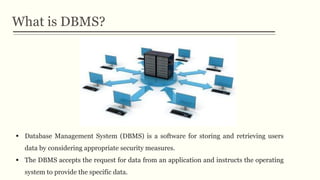
What is DBMS?
 Database Management System (DBMS) is a software for storing and retrieving users
data by considering appropriate security measures.
 The DBMS accepts the request for data from an application and instructs the operating
system to provide the specific data.
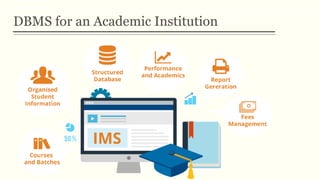
DBMS for an Academic Institution
What is IMS?
 IMS (Information Management System) is a database and transaction management
system.
 The data is systematically arranged so that its integrity is ensured, and the storage and
retrieval process is optimized.
 The main goal is to simplify the process of information management in a particular
academic institution (say an Engineering college n Delhi for this presentation purpose).
 IMS TM controls I/O (input/output) processing, provides formatting, logging, and
recovery of messages, maintains communications security, and oversees the scheduling
and execution of programs.
 Thus we can safely store and retrieve any information as and when required.
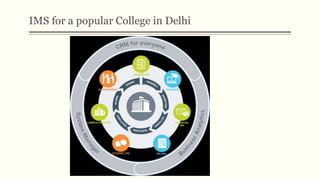
IMS for a popular College in Delhi
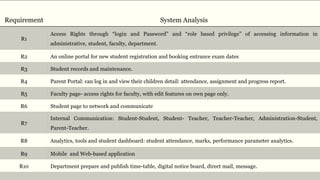
Requirement System Analysis
R1
Access Rights through “login and Password” and “role based privilege” of accessing information in
administrative, student, faculty, department.
R2 An online portal for new student registration and booking entrance exam dates
R3 Student records and maintenance.
R4 Parent Portal: can log in and view their children detail: attendance, assignment and progress report.
R5 Faculty page- access rights for faculty, with edit features on own page only.
R6 Student page to network and communicate
R7
Internal Communication: Student-Student, Student- Teacher, Teacher-Teacher, Administration-Student,
Parent-Teacher.
R8 Analytics, tools and student dashboard: student attendance, marks, performance parameter analytics.
R9 Mobile and Web-based application
R10 Department prepare and publish time-table, digital notice board, direct mail, message.
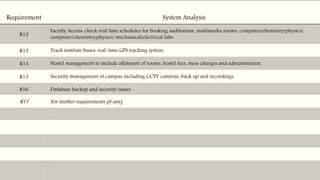
Requirement System Analysis
R12
Faculty Access: check real time schedules for booking auditorium, multimedia rooms, computer/chemistry/physics/
computer/chemistry/physics/ mechanical/electrical labs.
R13 Track institute buses: real-time GPS tracking system.
R14 Hostel management to include allotment of rooms, hostel fees, mess charges and administration.
R15 Security management of campus including CCTV cameras, back up and recordings.
R16 Database backup and security issues.
R17 For further requirements (if any)
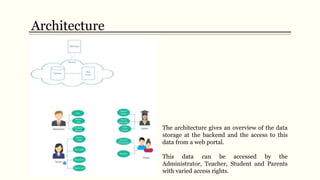
Architecture
The architecture gives an overview of the data
storage at the backend and the access to this
data from a web portal.
This data can be accessed by the
Administrator, Teacher, Student and Parents
with varied access rights.
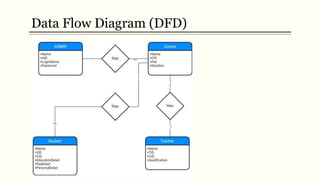
Data Flow Diagram (DFD)
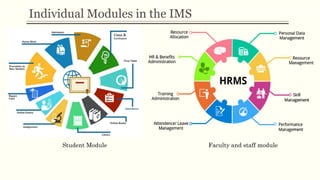
Individual Modules in the IMS
Student Module Faculty and staff module
Automation of all processes related to students:
 Online registration for admission
 Online fee payments
 Student network- share notes, lectures, homework discussion, study together
 Access library, register book pick ups, get notified on book requests, download eBooks
 Access class curriculum: time table, notes and lectures
 Check attendance, marks, check self performance parameter subjects/ credit wise
 Schedule request for group study, extra help
 Network with the Alumni
Students
Academics is the back bone of any institution and has sub-modules.
The sub-modules (according to the need of the users)are mentioned below:
 Principal
 Faculty
 Admin
 Students
 Alumni
 However, some functions of the sub-modules may overlap.
 All the records are maintained with different access privileges for students, faculties & heads.
Academics
 A well maintained and organized account system.
 Automates all functions like fees management, salary slips and all expenditures of the
institute.
 A payroll system for the staff and the faculty.
Finance & Accounts
 Provide Login Access to students, staff and faculty.
 Check biometric attendance.
 Transport Management.
 House keeping staff and supply management.
 Institute Inventory Management.
 Automated timetable generation:
The automated timetable generation feature of the system provides the class
arrangement through by just protecting the gaps between the classes for less stress
learning environment. It automatically designs the timetable, the admin just needs to fill
the necessary details rather than creating the complex timetable.
Admin
 The Department of Training & Placement is the major concern of any institute.
 Practical Training for Students is an integral part of the curriculum and in-built into
the programs of study. The students are introduced to industrial practices through
training in the college workshops and in factories, corporates, installation work etc.
This cell needs to manage and maintain information regarding:
 Repository of all companies for placement and scheduling campus interviews
 Alumni database
 Simulator training software for students, training programs
Training and Placement Cell
 The objective of this module is to capture information with respect to various parameters
that are required during setting of examination information and process the captured data
to churn out required results.
 A college software’s examination module is mainly concerned with in-college examination
including sessional and practical.
Exam Management:
Admit card managing;
External exams managing of colleges centred in the college
Schedule management:
This module will look upon all basic as well as advanced needs of an examination cell.
Examination Cell
Hostel
Hostel is also a very important entity and needs managing in its point of concern.
Provides a system that manages the required data and would requires sub-divisions
that are to be given individual emphasis on:
 Hostel Rooms availability
 Mess
 Hostel Committee
 Use of facilities
 A library is a collection of information, sources, resources, books, and services, and the
structure in which it is housed.
 This module emphasises on:
Administrator privileges management;
Book circulation;
Advanced book search options;
Proper regulation of special items like CD’s and journals.
Library
Automation of all processes related to staff:
 payroll
 attendance
 leave
 scheduling of lectures
Staff
Conclusion
 The IMS provides a single source of data repository for streamlining all processes
and for reporting purposes.
 It has a simple user interface and is intuitive.
 Efficient security features provide data privacy and maintains data integrity.
 Supports an Institution’s daily operations by eliminating duplicate data entry,
sharing the most up-to-date information, maintaining a detailed history of essential
records.
Thank You

Academic dbms

  • 1.
    DATABASE MANAGEMENT SYSTEM FORACADEMIC INSTITUTIONS
  • 2.
    Introduction Assumption of currentscenario:  All facets of an academic institution from administration, finance, academics, and admission is done manually by ink and paper, which is very, slow and time consuming.  Requirement to design a computerized management system to automate all processes.  Reduce the manpower and manual errors as well as speed up all facets.  The main goal of the system is to automate the process carried out in the institution with improved performance and realize the vision of complete paperless work.
  • 3.
    What is DBMS? Database Management System (DBMS) is a software for storing and retrieving users data by considering appropriate security measures.  The DBMS accepts the request for data from an application and instructs the operating system to provide the specific data.
  • 4.
    DBMS for anAcademic Institution
  • 5.
    What is IMS? IMS (Information Management System) is a database and transaction management system.  The data is systematically arranged so that its integrity is ensured, and the storage and retrieval process is optimized.  The main goal is to simplify the process of information management in a particular academic institution (say an Engineering college n Delhi for this presentation purpose).  IMS TM controls I/O (input/output) processing, provides formatting, logging, and recovery of messages, maintains communications security, and oversees the scheduling and execution of programs.  Thus we can safely store and retrieve any information as and when required.
  • 6.
    IMS for apopular College in Delhi
  • 7.
    Requirement System Analysis R1 AccessRights through “login and Password” and “role based privilege” of accessing information in administrative, student, faculty, department. R2 An online portal for new student registration and booking entrance exam dates R3 Student records and maintenance. R4 Parent Portal: can log in and view their children detail: attendance, assignment and progress report. R5 Faculty page- access rights for faculty, with edit features on own page only. R6 Student page to network and communicate R7 Internal Communication: Student-Student, Student- Teacher, Teacher-Teacher, Administration-Student, Parent-Teacher. R8 Analytics, tools and student dashboard: student attendance, marks, performance parameter analytics. R9 Mobile and Web-based application R10 Department prepare and publish time-table, digital notice board, direct mail, message.
  • 8.
    Requirement System Analysis R12 FacultyAccess: check real time schedules for booking auditorium, multimedia rooms, computer/chemistry/physics/ computer/chemistry/physics/ mechanical/electrical labs. R13 Track institute buses: real-time GPS tracking system. R14 Hostel management to include allotment of rooms, hostel fees, mess charges and administration. R15 Security management of campus including CCTV cameras, back up and recordings. R16 Database backup and security issues. R17 For further requirements (if any)
  • 9.
    Architecture The architecture givesan overview of the data storage at the backend and the access to this data from a web portal. This data can be accessed by the Administrator, Teacher, Student and Parents with varied access rights.
  • 10.
  • 11.
    Individual Modules inthe IMS Student Module Faculty and staff module
  • 12.
    Automation of allprocesses related to students:  Online registration for admission  Online fee payments  Student network- share notes, lectures, homework discussion, study together  Access library, register book pick ups, get notified on book requests, download eBooks  Access class curriculum: time table, notes and lectures  Check attendance, marks, check self performance parameter subjects/ credit wise  Schedule request for group study, extra help  Network with the Alumni Students
  • 13.
    Academics is theback bone of any institution and has sub-modules. The sub-modules (according to the need of the users)are mentioned below:  Principal  Faculty  Admin  Students  Alumni  However, some functions of the sub-modules may overlap.  All the records are maintained with different access privileges for students, faculties & heads. Academics
  • 14.
     A wellmaintained and organized account system.  Automates all functions like fees management, salary slips and all expenditures of the institute.  A payroll system for the staff and the faculty. Finance & Accounts
  • 15.
     Provide LoginAccess to students, staff and faculty.  Check biometric attendance.  Transport Management.  House keeping staff and supply management.  Institute Inventory Management.  Automated timetable generation: The automated timetable generation feature of the system provides the class arrangement through by just protecting the gaps between the classes for less stress learning environment. It automatically designs the timetable, the admin just needs to fill the necessary details rather than creating the complex timetable. Admin
  • 16.
     The Departmentof Training & Placement is the major concern of any institute.  Practical Training for Students is an integral part of the curriculum and in-built into the programs of study. The students are introduced to industrial practices through training in the college workshops and in factories, corporates, installation work etc. This cell needs to manage and maintain information regarding:  Repository of all companies for placement and scheduling campus interviews  Alumni database  Simulator training software for students, training programs Training and Placement Cell
  • 17.
     The objectiveof this module is to capture information with respect to various parameters that are required during setting of examination information and process the captured data to churn out required results.  A college software’s examination module is mainly concerned with in-college examination including sessional and practical. Exam Management: Admit card managing; External exams managing of colleges centred in the college Schedule management: This module will look upon all basic as well as advanced needs of an examination cell. Examination Cell
  • 18.
    Hostel Hostel is alsoa very important entity and needs managing in its point of concern. Provides a system that manages the required data and would requires sub-divisions that are to be given individual emphasis on:  Hostel Rooms availability  Mess  Hostel Committee  Use of facilities
  • 19.
     A libraryis a collection of information, sources, resources, books, and services, and the structure in which it is housed.  This module emphasises on: Administrator privileges management; Book circulation; Advanced book search options; Proper regulation of special items like CD’s and journals. Library
  • 20.
    Automation of allprocesses related to staff:  payroll  attendance  leave  scheduling of lectures Staff
  • 21.
    Conclusion  The IMSprovides a single source of data repository for streamlining all processes and for reporting purposes.  It has a simple user interface and is intuitive.  Efficient security features provide data privacy and maintains data integrity.  Supports an Institution’s daily operations by eliminating duplicate data entry, sharing the most up-to-date information, maintaining a detailed history of essential records.
  • 22.