





English Language teaching and
    learning in the Age of
         Technology

        Vera Menezes
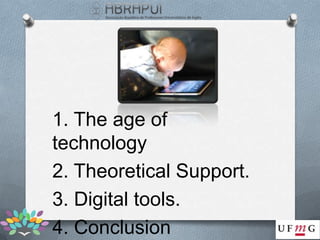
1. The age of
technology
2. Theoretical Support.
3. Digital tools.
4. Conclusion
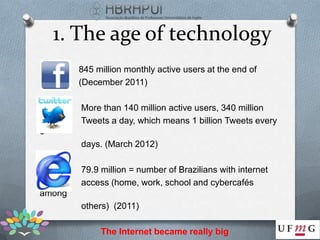
1. The age of technology
        845 million monthly active users at the end of
        (December 2011)

        More than 140 million active users, 340 million
        Tweets a day, which means 1 billion Tweets every
3
        days. (March 2012)

        79.9 million = number of Brazilians with internet
        access (home, work, school and cybercafés
among
        others) (2011)

             The Internet became really big
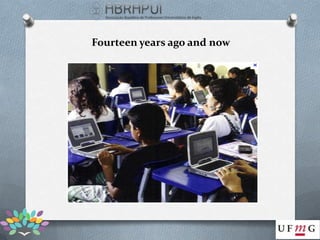
Fourteen years ago and now
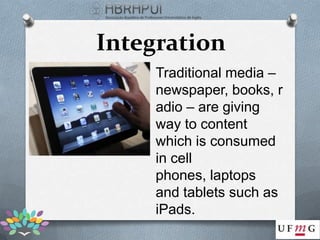
Integration
     Traditional media –
     newspaper, books, r
     adio – are giving
     way to content
     which is consumed
     in cell
     phones, laptops
     and tablets such as
     iPads.
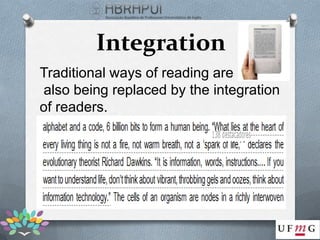
Integration
Traditional ways of reading are
also being replaced by the integration
of readers.
The fantastic flying books of Mr. Morris Lessmore
                 by William Joyce
http://www.youtube.com/watch?v=eW775HIlVMg
2. Theories
 Connectivism
 (SIEMENS, 2006, 2006)
 New literacies
 (RHEINGOLD, 2012)
 Framework for technology-
 based teaching and learning
 (SCHNEIDERMAN, 2003).
Connectivism
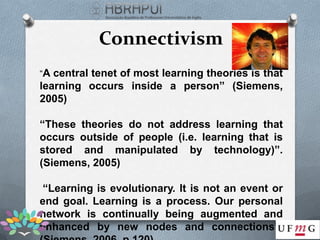
“A central tenet of most learning theories is that
learning occurs inside a person” (Siemens,
2005)

“These theories do not address learning that
occurs outside of people (i.e. learning that is
stored and manipulated by technology)”.
(Siemens, 2005)

 “Learning is evolutionary. It is not an event or
end goal. Learning is a process. Our personal
network is continually being augmented and
enhanced by new nodes and connections”.
Connectivism
Siemens (2005, 2006) proposes an
alternative      theory      integrating
“principles    explored    by    chaos,
network, and complexity and self-
organization theories. He calls it
Connectivism – “the assertion that
learning is primarily a network-forming
process” (Siemens 2006, p. 15).
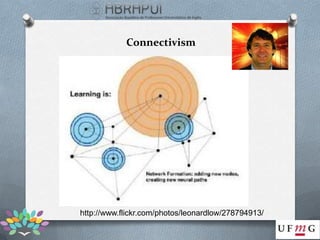
Connectivism


http://www.flickr.com/photos/leonardlow/278794913/
Principles of connectivism

 Learning and knowledge rests in
  diversity of opinions.
 Learning is a process of connecting
  specialized nodes or information
  sources.
 Learning may reside in non-human
  appliances.
Principles of connectivism

Capacity to know more is more
 critical than what is currently known.
Nurturing and maintaining
 connections is needed to facilitate
 continual learning.
Ability to see connections between
 fields, ideas, and concepts is a core
 skill.
Principles of connectivism
Currency (accurate, up-to-date
knowledge) is the intent of all
connectivist learning activities.
Decision-making is itself a learning
 process.
Choosing what to learn and the
 meaning of incoming information is
 seen through the lens of a shifting
 reality. While there is a right answer, it
 may be wrong tomorrow due to
 alterations in the information climate
Principles of connectivism
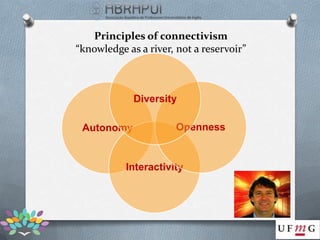
“knowledge as a river, not a reservoir”


             Diversity

 Autonomy             Openness


           Interactivity
Examples of connectivism

UFMG =Ingrede Project: 1500 students
(Moodle platform)
Diversity of opinions and learning routes
Autonomy :digital library and a collective
glossary
Interactivity: reading and posting
Openness ; new material brought by the
students themselves.
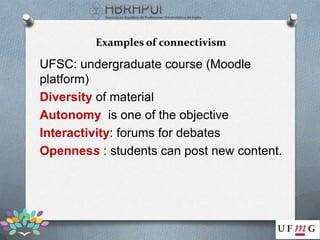
Examples of connectivism

UFSC: undergraduate course (Moodle
platform)
Diversity of material
Autonomy is one of the objective
Interactivity: forums for debates
Openness : students can post new content.
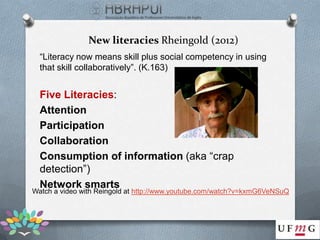
New literacies Rheingold (2012)
  “Literacy now means skill plus social competency in using
  that skill collaboratively”. (K.163)


  Five Literacies:
  Attention
  Participation
  Collaboration
  Consumption of information (aka “crap
  detection”)
  Network smarts
Watch a video with Reingold at http://www.youtube.com/watch?v=kxmG6VeNSuQ
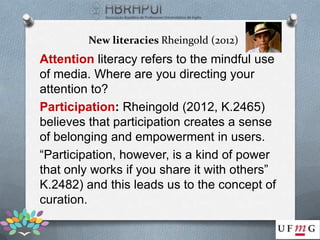
New literacies Rheingold (2012)
Attention literacy refers to the mindful use
of media. Where are you directing your
attention to?
Participation: Rheingold (2012, K.2465)
believes that participation creates a sense
of belonging and empowerment in users.
“Participation, however, is a kind of power
that only works if you share it with others”
K.2482) and this leads us to the concept of
curation.
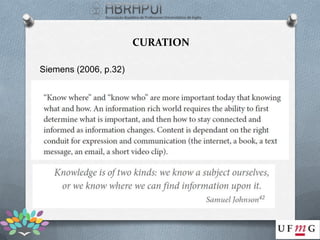
CURATION

Siemens (2006, p.32)
http://www.youtube.com/watch?v=eW775HIlVMg
CURATION


http://www.scoop.it
New literacies Rheingold (2012)
Collaboration is a key concept in Rheingold’s
proposal. He says that “Collaboration is the most
purposeful means of collective action”.

A typical educational design based on collaboration
is tandem learning.
Examples: the work of João Telles and his
collaborators at UNESP. Braga (2004) and Souza
(1998) at UFMG.

          Attention/Participation/Collaboration/Consumption
          of information/Network smarts
New literacies Rheingold (2012)
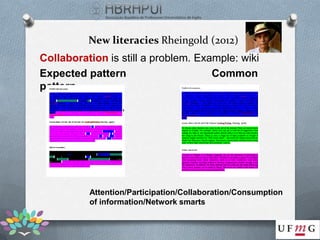
Collaboration is still a problem. Example: wiki
Expected pattern                     Common
pattern


          Attention/Participation/Collaboration/Consumption
          of information/Network smarts
New literacies Rheingold (2012)


Consumption of information (aka “crap
detection”):
critical consumption of information

Network smarts: “the internet and the cell phone
have transformed communication from house to
house to person-to-person”. “,The person has
become the portal”. Network smarts are the ones
who are aware of their networks and the power of
getting things Attention/Participation/Collaboration/Consumpt
               done.
                ion of information/Network smarts
Shneiderman (2003)


  “You are evaluated
  today by “how many
  messages you get a
  day, how many groups
  you contribute to, and
  how many other people
  link to your Web
  pages”.
  (Shneiderman,2003, K, 1062)
Shneiderman (2003)


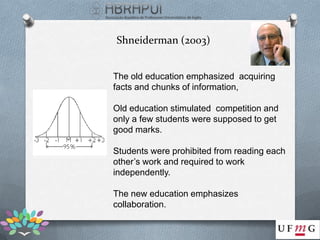
The old education emphasized acquiring
facts and chunks of information,

Old education stimulated competition and
only a few students were supposed to get
good marks.

Students were prohibited from reading each
other’s work and required to work
independently.

The new education emphasizes
collaboration.
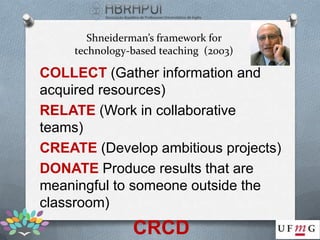
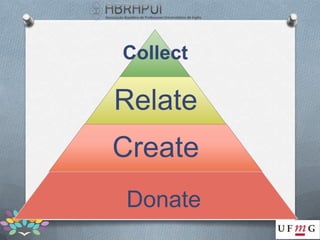
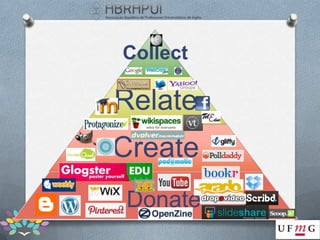
Shneiderman’s framework for
     technology-based teaching (2003)

COLLECT (Gather information and
acquired resources)
RELATE (Work in collaborative
teams)
CREATE (Develop ambitious projects)
DONATE Produce results that are
meaningful to someone outside the
classroom)
                CRCD
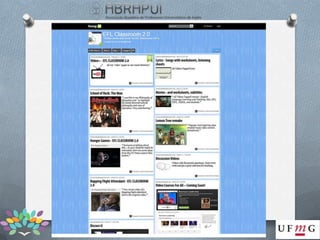
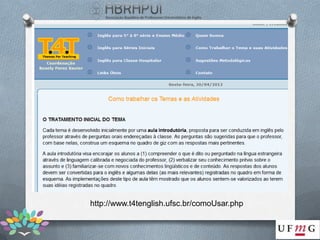
http://www.t4tenglish.ufsc.br/comoUsar.php
http://www.letras.ufmg.br/arado/
3. Web tools
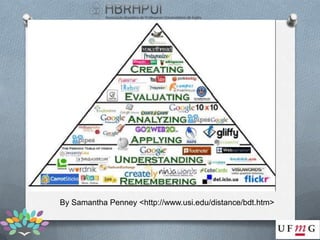
By Samantha Penney <http://www.usi.edu/distance/bdt.htm>
Collect

Relate
Create
Donate
Collect

Relate
Create
Donate
In spite of the natural resistance to
innovations, it seems that digital tools
have been gradually incorporated into
different kinds of learning contexts:
from face-to-face to blended or online
learning contexts.
We never know what new
tools will appear and
how they will affect us.


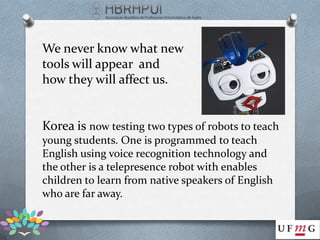
Korea is now testing two types of robots to teach
young students. One is programmed to teach
English using voice recognition technology and
the other is a telepresence robot with enables
children to learn from native speakers of English
who are far away.
http://www.youtube.com/watch?v=M0T6uEEpiuQ
One 10-year-old boy said he was a little
nervous about the robot at first, but he
    liked its singing and dancing.

His classmate, 10-year-old girl, said, “I
  like the robot teacher better than
           human teachers.”
I do not think we will compete with
 robots in Brazil, but I think we will
surely be invited to produce more and
        more digital material.

 That seems to be the direction our
  government intends to pursue.
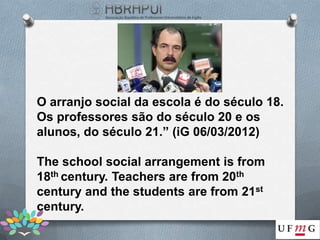
O arranjo social da escola é do século 18.
Os professores são do século 20 e os
alunos, do século 21.” (iG 06/03/2012)

The school social arrangement is from
18th century. Teachers are from 20th
century and the students are from 21st
century.
Thank
You for your
 attention!

Vera Menezes


  http://www.veramenezes.com/

Abrapui2012

  • 1.
    English Language teachingand learning in the Age of Technology Vera Menezes
  • 2.
    1. The ageof technology 2. Theoretical Support. 3. Digital tools. 4. Conclusion
  • 3.
    1. The ageof technology 845 million monthly active users at the end of (December 2011) More than 140 million active users, 340 million Tweets a day, which means 1 billion Tweets every 3 days. (March 2012) 79.9 million = number of Brazilians with internet access (home, work, school and cybercafés among others) (2011) The Internet became really big
  • 4.
  • 5.
    Integration Traditional media – newspaper, books, r adio – are giving way to content which is consumed in cell phones, laptops and tablets such as iPads.
  • 6.
    Integration Traditional ways ofreading are also being replaced by the integration of readers.
  • 7.
    The fantastic flyingbooks of Mr. Morris Lessmore by William Joyce
  • 8.
  • 9.
    2. Theories  Connectivism (SIEMENS, 2006, 2006)  New literacies (RHEINGOLD, 2012)  Framework for technology- based teaching and learning (SCHNEIDERMAN, 2003).
  • 10.
    Connectivism “A central tenetof most learning theories is that learning occurs inside a person” (Siemens, 2005) “These theories do not address learning that occurs outside of people (i.e. learning that is stored and manipulated by technology)”. (Siemens, 2005) “Learning is evolutionary. It is not an event or end goal. Learning is a process. Our personal network is continually being augmented and enhanced by new nodes and connections”.
  • 11.
    Connectivism Siemens (2005, 2006)proposes an alternative theory integrating “principles explored by chaos, network, and complexity and self- organization theories. He calls it Connectivism – “the assertion that learning is primarily a network-forming process” (Siemens 2006, p. 15).
  • 12.
  • 13.
    Principles of connectivism Learning and knowledge rests in diversity of opinions. Learning is a process of connecting specialized nodes or information sources. Learning may reside in non-human appliances.
  • 14.
    Principles of connectivism Capacityto know more is more critical than what is currently known. Nurturing and maintaining connections is needed to facilitate continual learning. Ability to see connections between fields, ideas, and concepts is a core skill.
  • 15.
    Principles of connectivism Currency(accurate, up-to-date knowledge) is the intent of all connectivist learning activities. Decision-making is itself a learning process. Choosing what to learn and the meaning of incoming information is seen through the lens of a shifting reality. While there is a right answer, it may be wrong tomorrow due to alterations in the information climate
  • 16.
    Principles of connectivism “knowledgeas a river, not a reservoir” Diversity Autonomy Openness Interactivity
  • 17.
    Examples of connectivism UFMG=Ingrede Project: 1500 students (Moodle platform) Diversity of opinions and learning routes Autonomy :digital library and a collective glossary Interactivity: reading and posting Openness ; new material brought by the students themselves.
  • 18.
    Examples of connectivism UFSC:undergraduate course (Moodle platform) Diversity of material Autonomy is one of the objective Interactivity: forums for debates Openness : students can post new content.
  • 19.
    New literacies Rheingold(2012) “Literacy now means skill plus social competency in using that skill collaboratively”. (K.163) Five Literacies: Attention Participation Collaboration Consumption of information (aka “crap detection”) Network smarts Watch a video with Reingold at http://www.youtube.com/watch?v=kxmG6VeNSuQ
  • 20.
    New literacies Rheingold(2012) Attention literacy refers to the mindful use of media. Where are you directing your attention to? Participation: Rheingold (2012, K.2465) believes that participation creates a sense of belonging and empowerment in users. “Participation, however, is a kind of power that only works if you share it with others” K.2482) and this leads us to the concept of curation.
  • 21.
  • 22.
  • 23.
  • 25.
    New literacies Rheingold(2012) Collaboration is a key concept in Rheingold’s proposal. He says that “Collaboration is the most purposeful means of collective action”. A typical educational design based on collaboration is tandem learning. Examples: the work of João Telles and his collaborators at UNESP. Braga (2004) and Souza (1998) at UFMG. Attention/Participation/Collaboration/Consumption of information/Network smarts
  • 26.
    New literacies Rheingold(2012) Collaboration is still a problem. Example: wiki Expected pattern Common pattern Attention/Participation/Collaboration/Consumption of information/Network smarts
  • 27.
    New literacies Rheingold(2012) Consumption of information (aka “crap detection”): critical consumption of information Network smarts: “the internet and the cell phone have transformed communication from house to house to person-to-person”. “,The person has become the portal”. Network smarts are the ones who are aware of their networks and the power of getting things Attention/Participation/Collaboration/Consumpt done. ion of information/Network smarts
  • 28.
    Shneiderman (2003) “You are evaluated today by “how many messages you get a day, how many groups you contribute to, and how many other people link to your Web pages”. (Shneiderman,2003, K, 1062)
  • 29.
    Shneiderman (2003) The oldeducation emphasized acquiring facts and chunks of information, Old education stimulated competition and only a few students were supposed to get good marks. Students were prohibited from reading each other’s work and required to work independently. The new education emphasizes collaboration.
  • 30.
    Shneiderman’s framework for technology-based teaching (2003) COLLECT (Gather information and acquired resources) RELATE (Work in collaborative teams) CREATE (Develop ambitious projects) DONATE Produce results that are meaningful to someone outside the classroom) CRCD
  • 31.
  • 32.
  • 33.
  • 34.
    By Samantha Penney<http://www.usi.edu/distance/bdt.htm>
  • 35.
  • 36.
  • 37.
    In spite ofthe natural resistance to innovations, it seems that digital tools have been gradually incorporated into different kinds of learning contexts: from face-to-face to blended or online learning contexts.
  • 38.
    We never knowwhat new tools will appear and how they will affect us. Korea is now testing two types of robots to teach young students. One is programmed to teach English using voice recognition technology and the other is a telepresence robot with enables children to learn from native speakers of English who are far away.
  • 39.
  • 40.
    One 10-year-old boysaid he was a little nervous about the robot at first, but he liked its singing and dancing. His classmate, 10-year-old girl, said, “I like the robot teacher better than human teachers.”
  • 41.
    I do notthink we will compete with robots in Brazil, but I think we will surely be invited to produce more and more digital material. That seems to be the direction our government intends to pursue.
  • 42.
    O arranjo socialda escola é do século 18. Os professores são do século 20 e os alunos, do século 21.” (iG 06/03/2012) The school social arrangement is from 18th century. Teachers are from 20th century and the students are from 21st century.
  • 43.
    Thank You for your attention! Vera Menezes http://www.veramenezes.com/