Above the Clouds: A Berkeley View of Cloud Computing
Michael Armbrust, Armando Fox, Rean Griffith, Anthony D. Joseph, Randy Katz, Andy
Konwinski, Gunho Lee, David Patterson, Ariel Rabkin, Ion Stoica, and Matei Zaharia
On
February 10, 2009These people wrote the paper.
We are simply summarizing It
Supported From : UC Berkeley Reliable Adaptive Distributed Systems Laboratory
Presented By: Mala Deep Upadhaya, Bikash Pokharel and Rabeena Shrestha
Computer Science
Kathmandu University
2019-11-26
Outline
1. Executive Summary
2. Cloud Computing: An Old Idea Whose Time Has (Finally) Come
3. What is Cloud Computing?
4. Clouds in a Perfect Storm: Why Now, Not Then?
5. Classes of Utility Computing
6. Cloud Computing Economics
7. Top 10 Obstacles and Opportunities for Cloud Computing
8. Conclusion and Questions about the Clouds of Tomorrow
9. Personal’s Additional Thought
Objectives
To provide simple formulas to quantify comparison between
cloud and conventional Computing
To identify top technical and non-technical obstacles along
with opportunity of Cloud Computing
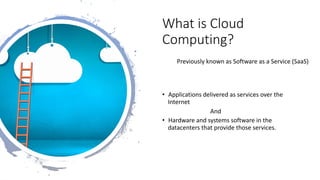
• Applications delivered as services over the
Internet
And
• Hardware and systems software in the
datacenters that provide those services.
Previously known as Software as a Service (SaaS)
What is Cloud
Computing?
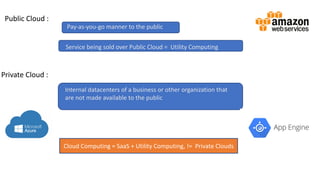
Public Cloud :
Service being sold over Public Cloud = Utility Computing
Pay-as-you-go manner to the public
Private Cloud :
Internal datacenters of a business or other organization that
are not made available to the public
Cloud Computing = SaaS + Utility Computing, != Private Clouds
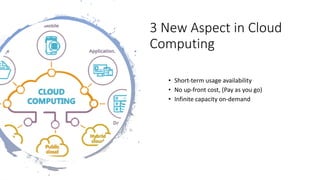
• Short-term usage availability
• No up-front cost, (Pay as you go)
• Infinite capacity on-demand
3 New Aspect in Cloud
Computing
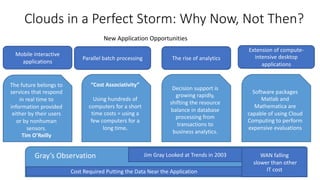
Clouds in a Perfect Storm: Why Now, Not Then?
Mobile interactive
applications
The rise of analyticsParallel batch processing
The future belongs to
services that respond
in real time to
information provided
either by their users
or by nonhuman
sensors.
Tim O’Reilly
New Application Opportunities
“Cost Associativity”
Using hundreds of
computers for a short
time costs = using a
few computers for a
long time.
Decision support is
growing rapidly,
shifting the resource
balance in database
processing from
transactions to
business analytics.
Software packages
Matlab and
Mathematica are
capable of using Cloud
Computing to perform
expensive evaluations
Extension of compute-
intensive desktop
applications
Jim Gray Looked at Trends in 2003 WAN falling
slower than other
IT costCost Required Putting the Data Near the Application
Gray’s Observation
Classes of Utility Computing
Different utility computing offerings are differed on:
The level of
abstraction presented
to the programmer
The level of
management of the
resources
• Users can control nearly the entire
software stack and Physical
Hardware
• Targeted exclusively at traditional
web applications
• Must have stateless computation
tier and a stateful storage tier
• Not suitable for general-purpose
computing.
• Intermediate point on this
spectrum of flexibility vs.
programmer convenience
• Supports general-purpose
computing, rather than a single
category of application.
Azure is intermediate between complete application frameworks
like AppEngine on the one hand, on the other hand hardware
virtual machines like EC2.
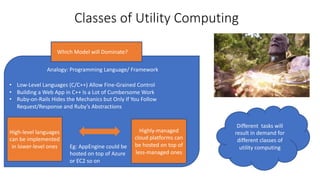
Classes of Utility Computing
Which Model will Dominate?
Analogy: Programming Language/ Framework
• Low-Level Languages (C/C++) Allow Fine-Grained Control
• Building a Web App in C++ Is a Lot of Cumbersome Work
• Ruby-on-Rails Hides the Mechanics but Only If You Follow
Request/Response and Ruby’s Abstractions
Highly-managed
cloud platforms can
be hosted on top of
less-managed ones
High-level languages
can be implemented
in lower-level ones Eg: AppEngine could be
hosted on top of Azure
or EC2 so on
Different tasks will
result in demand for
different classes of
utility computing
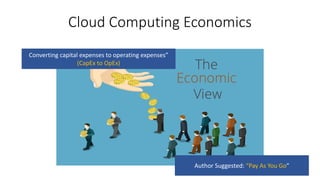
Cloud Computing Economics
Converting capital expenses to operating expenses”
(CapEx to OpEx)
Author Suggested: “Pay As You Go”
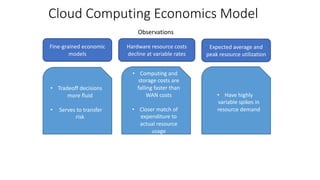
Cloud Computing Economics Model
Fine-grained economic
models
Expected average and
peak resource utilization
Hardware resource costs
decline at variable rates
• Tradeoff decisions
more fluid
• Serves to transfer
risk
Observations
• Computing and
storage costs are
falling faster than
WAN costs
• Closer match of
expenditure to
actual resource
usage
• Have highly
variable spikes in
resource demand
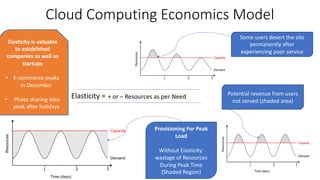
Cloud Computing Economics Model
Elasticity = + or – Resources as per Need
Provisioning For Peak
Load
Without Elasticity:
wastage of Resources
During Peak Time
(Shaded Region)
Elasticity is valuable
to established
companies as well as
startups
• E-commerce peaks
in December
• Photo sharing sites
peak after holidays
Some users desert the site
permanently after
experiencing poor service
Potential revenue from users
not served (shaded area)
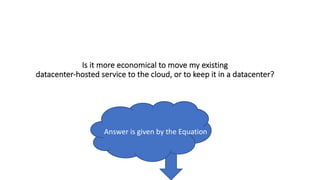
Is it more economical to move my existing
datacenter-hosted service to the cloud, or to keep it in a datacenter?
Answer is given by the Equation
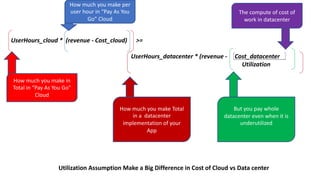
UserHours_cloud * (revenue - Cost_cloud) >=
UserHours_datacenter * (revenue - Cost_datacenter
Utilization
How much you make per
user hour in “Pay As You
Go” Cloud
How much you make in
Total in “Pay As You Go”
Cloud
The compute of cost of
work in datacenter
But you pay whole
datacenter even when it is
underutilized
How much you make Total
in a datacenter
implementation of your
App
Utilization Assumption Make a Big Difference in Cost of Cloud vs Data center
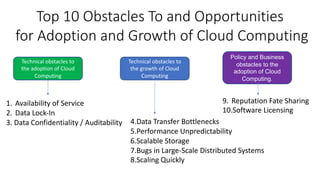
Top 10 Obstacles To and Opportunities
for Adoption and Growth of Cloud Computing
Technical obstacles to
the adoption of Cloud
Computing
Technical obstacles to
the growth of Cloud
Computing
Policy and Business
obstacles to the
adoption of Cloud
Computing.
1. Availability of Service
2. Data Lock-In
3. Data Confidentiality / Auditability 4.Data Transfer Bottlenecks
5.Performance Unpredictability
6.Scalable Storage
7.Bugs in Large-Scale Distributed Systems
8.Scaling Quickly
9. Reputation Fate Sharing
10.Software Licensing
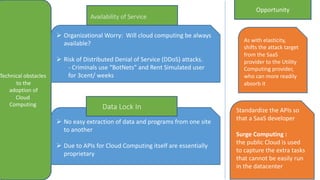
Technical obstacles
to the
adoption of
Cloud
Computing
Ø Organizational Worry: Will cloud computing be always
available?
Ø Risk of Distributed Denial of Service (DDoS) attacks.
- Criminals use “BotNets” and Rent Simulated user
for 3cent/ weeks
Ø No easy extraction of data and programs from one site
to another
Ø Due to APIs for Cloud Computing itself are essentially
proprietary
As with elasticity,
shifts the attack target
from the SaaS
provider to the Utility
Computing provider,
who can more readily
absorb it
Standardize the APIs so
that a SaaS developer
Surge Computing :
the public Cloud is used
to capture the extra tasks
that cannot be easily run
in the datacenter
Opportunity
Availability of Service
Data Lock In
Technical obstacles
to the growth of
Cloud Computing
Data Lock In
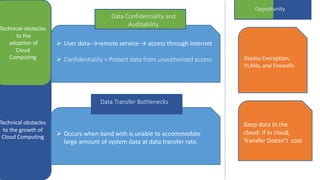
Ø User data-→remote service-→ access through Internet
Ø Confidentiality = Protect data from unauthorized access
Ø Occurs when band with is unable to accommodate
large amount of system data at data transfer rate.
Deploy Encryption,
VLANs, and Firewalls
Keep data in the
cloud: If in cloud,
Transfer Doesn’t cost
Data Confidentiality and
Auditability
Data Transfer Bottlenecks
Technical obstacles
to the
adoption of
Cloud
Computing
Opportunity
Technical obstacles
to the growth of
Cloud Computing
Data Lock In
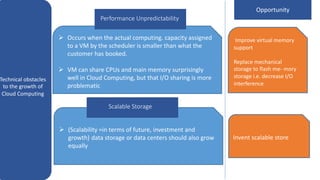
Ø Occurs when the actual computing. capacity assigned
to a VM by the scheduler is smaller than what the
customer has booked.
Ø VM can share CPUs and main memory surprisingly
well in Cloud Computing, but that I/O sharing is more
problematic
Ø (Scalability =in terms of future, investment and
growth) data storage or data centers should also grow
equally
Improve virtual memory
support
Replace mechanical
storage to flash me- mory
storage i.e. decrease I/O
interference
Invent scalable store
Opportunity
Performance Unpredictability
Scalable Storage
Technical obstacles
to the growth of
Cloud Computing
Data Lock In
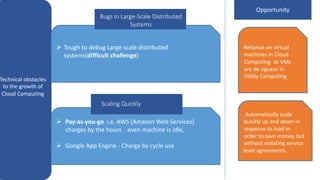
Ø Tough to debug Large scale distributed
systems(difficult challenge)
Ø Pay-as-you-go i.e. AWS (Amazon Web Services)
charges by the hours even machine is idle,
Ø Google App Engine - Charge by cycle use
Reliance on virtual
machines in Cloud
Computing as VMs
are de rigueur in
Utility Computing
Automatically scale
quickly up and down in
response to load in
order to save money, but
without violating service
level agreements.
Opportunity
Bugs in Large-Scale Distributed
Systems
Scaling Quickly
Policy and
Business
obstacles to the
adoption of
Cloud
Data Lock In
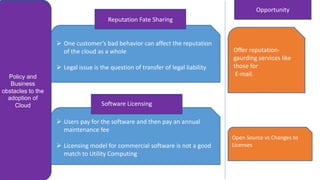
Ø One customer’s bad behavior can affect the reputation
of the cloud as a whole
Ø Legal issue is the question of transfer of legal liability
Ø Users pay for the software and then pay an annual
maintenance fee
Ø Licensing model for commercial software is not a good
match to Utility Computing
Offer reputation-
gaurding services like
those for
E-mail.
Open Source vs Changes to
Licenses
Opportunity
Reputation Fate Sharing
Software Licensing
Policy and
Business
obstacles to the
adoption of
Cloud
Conclusion and Questions
About the Clouds of Tomorrow
Ø Long dreamed vision of computing as a utility
is finally emerging
Cloud provider’s view
Ø Making a profit by statistically multiplexing
among a large group of customers
i.e.(it is much economical to use cloud services
rather than to build its own datacenter.)
Cloud user’s view
Ø Established organizations take advantage
of the elasticity of Cloud Computing regularly
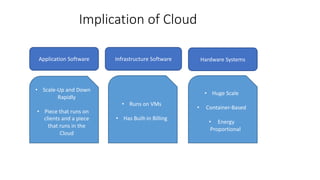
Implication of Cloud
Application Software Hardware SystemsInfrastructure Software
• Scale-Up and Down
Rapidly
• Piece that runs on
clients and a piece
that runs in the
Cloud
• Runs on VMs
• Has Built-in Billing
• Huge Scale
• Container-Based
• Energy
Proportional
Our Views
Liked Top 10 obstacles to and opportunities for growth :
Shined light on future research directions
References
[1]. Armbrust, & Michael, & Fox, Armando & Armando, & Griffith, & Rean, & Joseph, & Katz, Randy & H, Randy &
Konwinski, Andy & Andrew, & Lee, Gunho & Gunho, & Patterson, & A, David & Rabkin, & Ariel, & Stoica, & Matei,. (2009).
Above the Clouds: A Berkeley View of Cloud Computing.
Images : Found on Google / No copyright infringed

Above the Clouds: A Berkeley View of Cloud Computing: Paper Review

  • 1.
    Above the Clouds:A Berkeley View of Cloud Computing Michael Armbrust, Armando Fox, Rean Griffith, Anthony D. Joseph, Randy Katz, Andy Konwinski, Gunho Lee, David Patterson, Ariel Rabkin, Ion Stoica, and Matei Zaharia On February 10, 2009These people wrote the paper. We are simply summarizing It Supported From : UC Berkeley Reliable Adaptive Distributed Systems Laboratory Presented By: Mala Deep Upadhaya, Bikash Pokharel and Rabeena Shrestha Computer Science Kathmandu University 2019-11-26
  • 2.
    Outline 1. Executive Summary 2.Cloud Computing: An Old Idea Whose Time Has (Finally) Come 3. What is Cloud Computing? 4. Clouds in a Perfect Storm: Why Now, Not Then? 5. Classes of Utility Computing 6. Cloud Computing Economics 7. Top 10 Obstacles and Opportunities for Cloud Computing 8. Conclusion and Questions about the Clouds of Tomorrow 9. Personal’s Additional Thought
  • 3.
    Objectives To provide simpleformulas to quantify comparison between cloud and conventional Computing To identify top technical and non-technical obstacles along with opportunity of Cloud Computing
  • 4.
    • Applications deliveredas services over the Internet And • Hardware and systems software in the datacenters that provide those services. Previously known as Software as a Service (SaaS) What is Cloud Computing?
  • 5.
    Public Cloud : Servicebeing sold over Public Cloud = Utility Computing Pay-as-you-go manner to the public Private Cloud : Internal datacenters of a business or other organization that are not made available to the public Cloud Computing = SaaS + Utility Computing, != Private Clouds
  • 6.
    • Short-term usageavailability • No up-front cost, (Pay as you go) • Infinite capacity on-demand 3 New Aspect in Cloud Computing
  • 7.
    Clouds in aPerfect Storm: Why Now, Not Then? Mobile interactive applications The rise of analyticsParallel batch processing The future belongs to services that respond in real time to information provided either by their users or by nonhuman sensors. Tim O’Reilly New Application Opportunities “Cost Associativity” Using hundreds of computers for a short time costs = using a few computers for a long time. Decision support is growing rapidly, shifting the resource balance in database processing from transactions to business analytics. Software packages Matlab and Mathematica are capable of using Cloud Computing to perform expensive evaluations Extension of compute- intensive desktop applications Jim Gray Looked at Trends in 2003 WAN falling slower than other IT costCost Required Putting the Data Near the Application Gray’s Observation
  • 8.
    Classes of UtilityComputing Different utility computing offerings are differed on: The level of abstraction presented to the programmer The level of management of the resources • Users can control nearly the entire software stack and Physical Hardware • Targeted exclusively at traditional web applications • Must have stateless computation tier and a stateful storage tier • Not suitable for general-purpose computing. • Intermediate point on this spectrum of flexibility vs. programmer convenience • Supports general-purpose computing, rather than a single category of application. Azure is intermediate between complete application frameworks like AppEngine on the one hand, on the other hand hardware virtual machines like EC2.
  • 9.
    Classes of UtilityComputing Which Model will Dominate? Analogy: Programming Language/ Framework • Low-Level Languages (C/C++) Allow Fine-Grained Control • Building a Web App in C++ Is a Lot of Cumbersome Work • Ruby-on-Rails Hides the Mechanics but Only If You Follow Request/Response and Ruby’s Abstractions Highly-managed cloud platforms can be hosted on top of less-managed ones High-level languages can be implemented in lower-level ones Eg: AppEngine could be hosted on top of Azure or EC2 so on Different tasks will result in demand for different classes of utility computing
  • 10.
    Cloud Computing Economics Convertingcapital expenses to operating expenses” (CapEx to OpEx) Author Suggested: “Pay As You Go”
  • 11.
    Cloud Computing EconomicsModel Fine-grained economic models Expected average and peak resource utilization Hardware resource costs decline at variable rates • Tradeoff decisions more fluid • Serves to transfer risk Observations • Computing and storage costs are falling faster than WAN costs • Closer match of expenditure to actual resource usage • Have highly variable spikes in resource demand
  • 12.
    Cloud Computing EconomicsModel Elasticity = + or – Resources as per Need Provisioning For Peak Load Without Elasticity: wastage of Resources During Peak Time (Shaded Region) Elasticity is valuable to established companies as well as startups • E-commerce peaks in December • Photo sharing sites peak after holidays Some users desert the site permanently after experiencing poor service Potential revenue from users not served (shaded area)
  • 13.
    Is it moreeconomical to move my existing datacenter-hosted service to the cloud, or to keep it in a datacenter? Answer is given by the Equation
  • 14.
    UserHours_cloud * (revenue- Cost_cloud) >= UserHours_datacenter * (revenue - Cost_datacenter Utilization How much you make per user hour in “Pay As You Go” Cloud How much you make in Total in “Pay As You Go” Cloud The compute of cost of work in datacenter But you pay whole datacenter even when it is underutilized How much you make Total in a datacenter implementation of your App Utilization Assumption Make a Big Difference in Cost of Cloud vs Data center
  • 15.
    Top 10 ObstaclesTo and Opportunities for Adoption and Growth of Cloud Computing Technical obstacles to the adoption of Cloud Computing Technical obstacles to the growth of Cloud Computing Policy and Business obstacles to the adoption of Cloud Computing. 1. Availability of Service 2. Data Lock-In 3. Data Confidentiality / Auditability 4.Data Transfer Bottlenecks 5.Performance Unpredictability 6.Scalable Storage 7.Bugs in Large-Scale Distributed Systems 8.Scaling Quickly 9. Reputation Fate Sharing 10.Software Licensing
  • 16.
    Technical obstacles to the adoptionof Cloud Computing Ø Organizational Worry: Will cloud computing be always available? Ø Risk of Distributed Denial of Service (DDoS) attacks. - Criminals use “BotNets” and Rent Simulated user for 3cent/ weeks Ø No easy extraction of data and programs from one site to another Ø Due to APIs for Cloud Computing itself are essentially proprietary As with elasticity, shifts the attack target from the SaaS provider to the Utility Computing provider, who can more readily absorb it Standardize the APIs so that a SaaS developer Surge Computing : the public Cloud is used to capture the extra tasks that cannot be easily run in the datacenter Opportunity Availability of Service Data Lock In
  • 17.
    Technical obstacles to thegrowth of Cloud Computing Data Lock In Ø User data-→remote service-→ access through Internet Ø Confidentiality = Protect data from unauthorized access Ø Occurs when band with is unable to accommodate large amount of system data at data transfer rate. Deploy Encryption, VLANs, and Firewalls Keep data in the cloud: If in cloud, Transfer Doesn’t cost Data Confidentiality and Auditability Data Transfer Bottlenecks Technical obstacles to the adoption of Cloud Computing Opportunity
  • 18.
    Technical obstacles to thegrowth of Cloud Computing Data Lock In Ø Occurs when the actual computing. capacity assigned to a VM by the scheduler is smaller than what the customer has booked. Ø VM can share CPUs and main memory surprisingly well in Cloud Computing, but that I/O sharing is more problematic Ø (Scalability =in terms of future, investment and growth) data storage or data centers should also grow equally Improve virtual memory support Replace mechanical storage to flash me- mory storage i.e. decrease I/O interference Invent scalable store Opportunity Performance Unpredictability Scalable Storage
  • 19.
    Technical obstacles to thegrowth of Cloud Computing Data Lock In Ø Tough to debug Large scale distributed systems(difficult challenge) Ø Pay-as-you-go i.e. AWS (Amazon Web Services) charges by the hours even machine is idle, Ø Google App Engine - Charge by cycle use Reliance on virtual machines in Cloud Computing as VMs are de rigueur in Utility Computing Automatically scale quickly up and down in response to load in order to save money, but without violating service level agreements. Opportunity Bugs in Large-Scale Distributed Systems Scaling Quickly
  • 20.
    Policy and Business obstacles tothe adoption of Cloud Data Lock In Ø One customer’s bad behavior can affect the reputation of the cloud as a whole Ø Legal issue is the question of transfer of legal liability Ø Users pay for the software and then pay an annual maintenance fee Ø Licensing model for commercial software is not a good match to Utility Computing Offer reputation- gaurding services like those for E-mail. Open Source vs Changes to Licenses Opportunity Reputation Fate Sharing Software Licensing Policy and Business obstacles to the adoption of Cloud
  • 21.
    Conclusion and Questions Aboutthe Clouds of Tomorrow Ø Long dreamed vision of computing as a utility is finally emerging Cloud provider’s view Ø Making a profit by statistically multiplexing among a large group of customers i.e.(it is much economical to use cloud services rather than to build its own datacenter.) Cloud user’s view Ø Established organizations take advantage of the elasticity of Cloud Computing regularly
  • 22.
    Implication of Cloud ApplicationSoftware Hardware SystemsInfrastructure Software • Scale-Up and Down Rapidly • Piece that runs on clients and a piece that runs in the Cloud • Runs on VMs • Has Built-in Billing • Huge Scale • Container-Based • Energy Proportional
  • 23.
    Our Views Liked Top10 obstacles to and opportunities for growth : Shined light on future research directions References [1]. Armbrust, & Michael, & Fox, Armando & Armando, & Griffith, & Rean, & Joseph, & Katz, Randy & H, Randy & Konwinski, Andy & Andrew, & Lee, Gunho & Gunho, & Patterson, & A, David & Rabkin, & Ariel, & Stoica, & Matei,. (2009). Above the Clouds: A Berkeley View of Cloud Computing. Images : Found on Google / No copyright infringed