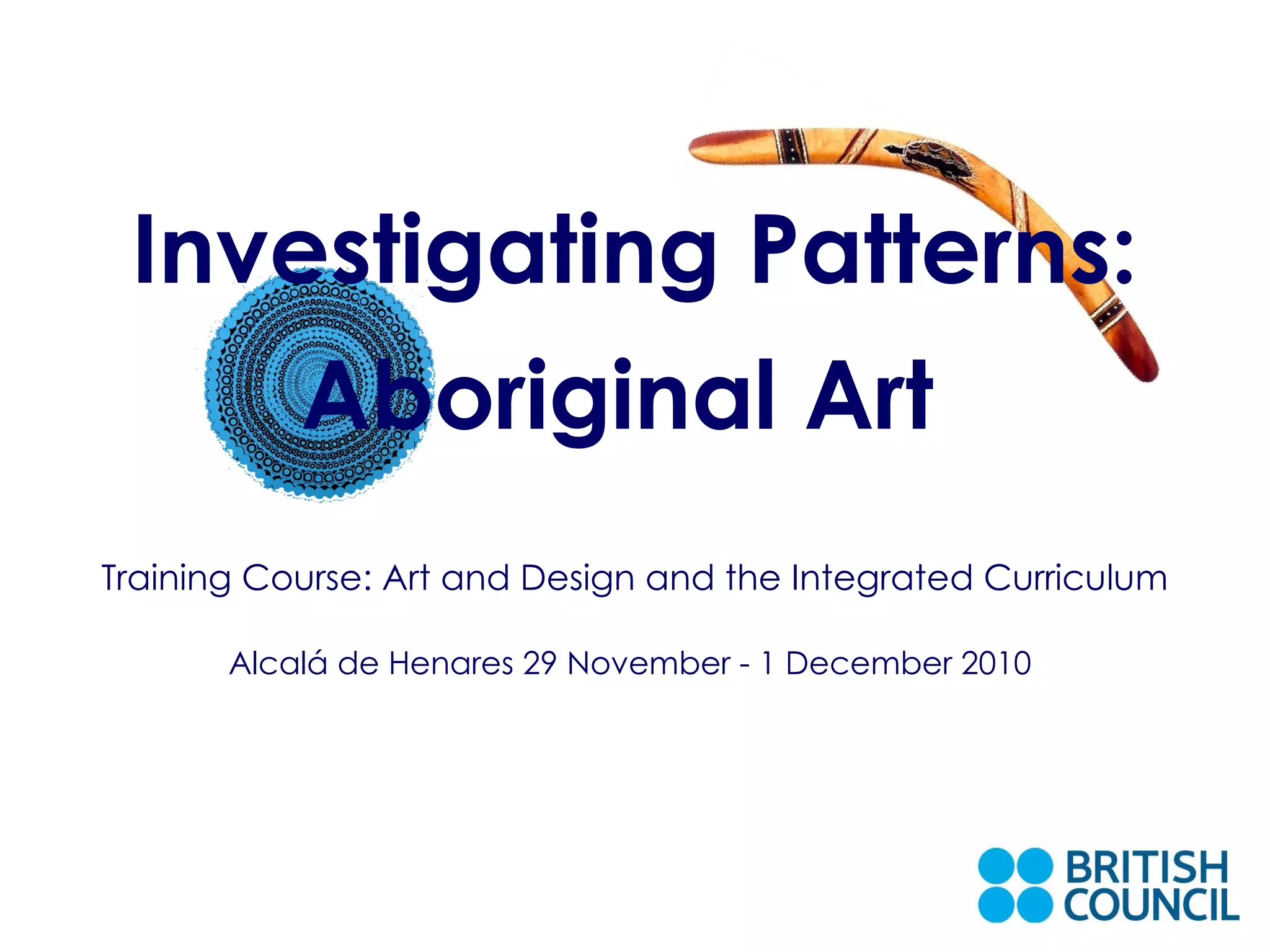
Training Course: Art and Design and the Integrated Curriculum   Alcalá de Henares 29 November - 1 December 2010 Investigating Patterns: Aboriginal Art
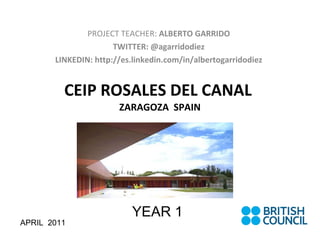
CEIP ROSALES DEL CANAL  ZARAGOZA  SPAIN PROJECT TEACHER:  ALBERTO GARRIDO TWITTER: @agarridodiez LINKEDIN: http://es.linkedin.com/in/albertogarridodiez APRIL  2011 YEAR 1
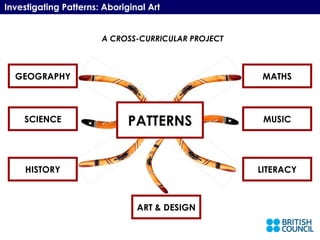
Investigating Patterns: Aboriginal Art PATTERNS MATHS LITERACY HISTORY GEOGRAPHY MUSIC SCIENCE ART & DESIGN A CROSS-CURRICULAR PROJECT
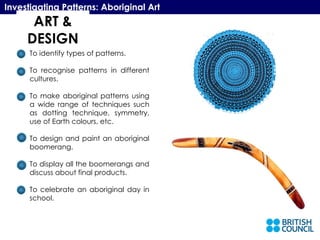
ART & DESIGN Investigating Patterns: Aboriginal Art To identify types of patterns. To recognise patterns in different cultures. To make aboriginal patterns using a wide range of techniques such as dotting technique, symmetry, use of Earth colours, etc. To design and paint an aboriginal boomerang. To display all the boomerangs and discuss about final products. To celebrate an aboriginal day in school.
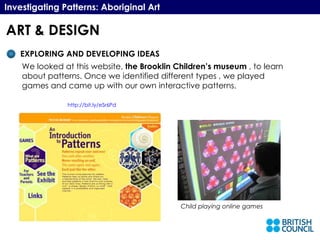
Investigating Patterns: Aboriginal Art EXPLORING AND DEVELOPING IDEAS http://bit.ly/eSr6Pd We looked at this website,  the Brooklin Children’s museum  , to learn about patterns. Once we identified different types , we played games and came up with our own interactive patterns.  Child playing online games ART & DESIGN
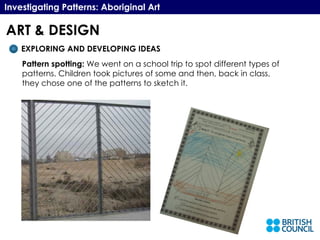
Investigating Patterns: Aboriginal Art EXPLORING AND DEVELOPING IDEAS Pattern spotting:  We went on a school trip to spot different types of patterns. Children took pictures of some and then, back in class, they chose one of the patterns to sketch it. ART & DESIGN
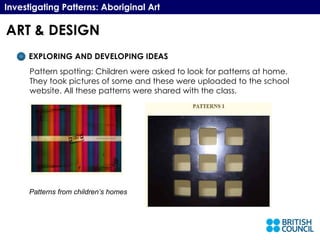
Investigating Patterns: Aboriginal Art EXPLORING AND DEVELOPING IDEAS Pattern spotting: Children were asked to look for patterns at home. They took pictures of some and these were uploaded to the school website. All these patterns were shared with the class. Patterns from children’s homes ART & DESIGN
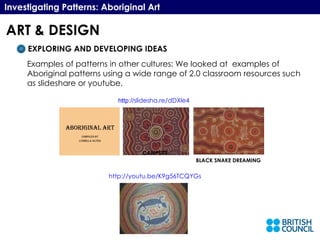
BLACK SNAKE DREAMING Investigating Patterns: Aboriginal Art EXPLORING AND DEVELOPING IDEAS Examples of patterns in other cultures: We looked at  examples of Aboriginal patterns using a wide range of 2.0 classroom resources such as slideshare or youtube. http://youtu.be/K9g56TCQYGs CAMPSITE http:// slidesha.re/dDXle4 ART & DESIGN
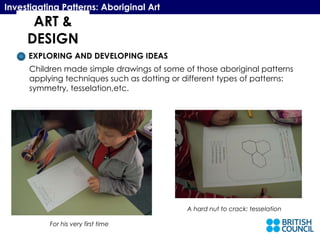
ART & DESIGN Investigating Patterns: Aboriginal Art EXPLORING AND DEVELOPING IDEAS Children made simple drawings of some of those aboriginal patterns applying techniques such as dotting or different types of patterns:  symmetry, tesselation,etc.  For his very first time A hard nut to crack: tesselation
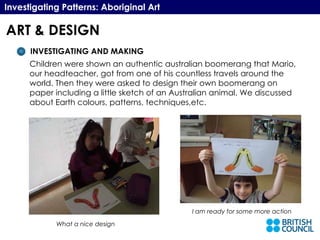
Investigating Patterns: Aboriginal Art INVESTIGATING AND MAKING Children were shown an authentic australian boomerang that Mario, our headteacher, got from one of his countless travels around the world. Then they were asked to design their own boomerang on paper including a little sketch of an Australian animal. We discussed  about Earth colours, patterns, techniques,etc. What a nice design I am ready for some more action ART & DESIGN
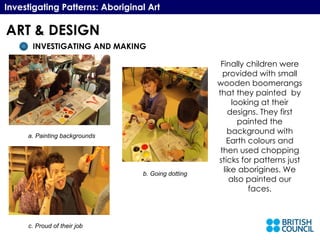
Investigating Patterns: Aboriginal Art Finally children were provided with small wooden boomerangs that they painted  by looking at their designs. They first painted the background with Earth colours and then used chopping sticks for patterns just like aborigines. We also painted our faces. a. Painting backgrounds b. Going dotting c. Proud of their job ART & DESIGN INVESTIGATING AND MAKING
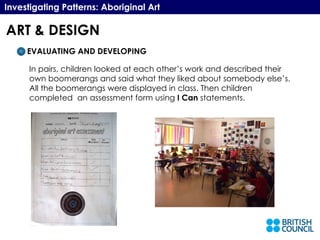
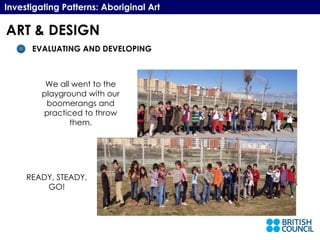
Investigating Patterns: Aboriginal Art EVALUATING AND DEVELOPING In pairs, children looked at each other’s work and described their own boomerangs and said what they liked about somebody else’s. All the boomerangs were displayed in class. Then children completed  an assessment form using  I Can  statements. ART & DESIGN
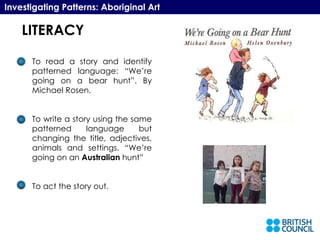
Investigating Patterns: Aboriginal Art EVALUATING AND DEVELOPING We all went to the playground with our boomerangs and practiced to throw them. READY, STEADY, GO! ART & DESIGN
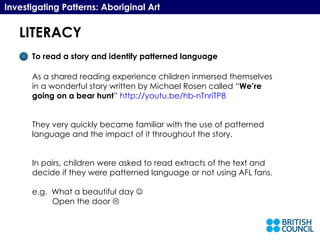
LITERACY Investigating Patterns: Aboriginal Art To read a story and identify patterned language: “We’re going on a bear hunt”. By Michael Rosen. To write a story using the same patterned language but changing the title, adjectives, animals and settings. “We’re going on an  Australian  hunt” To act the story out. LITERACY
LITERACY Investigating Patterns: Aboriginal Art To read a story and identify patterned language As a shared reading experience children inmersed themselves in a wonderful story written by Michael Rosen called “ We’re going on a bear hunt ”  http://youtu.be/hb-nTnriTP8 They very quickly became familiar with the use of patterned language and the impact of it throughout the story. In pairs, children were asked to read extracts of the text and decide if they were patterned language or not using AFL fans. e.g.  What a beautiful day   Open the door  
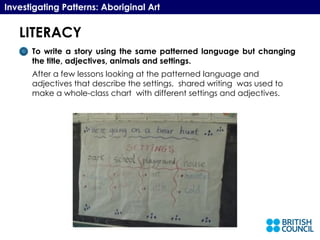
LITERACY Investigating Patterns: Aboriginal Art To write a story using the same patterned language but changing the title, adjectives, animals and settings.  After a few lessons looking at the patterned language and adjectives that describe the settings,  shared writing  was used to make a whole-class chart  with different settings and adjectives.
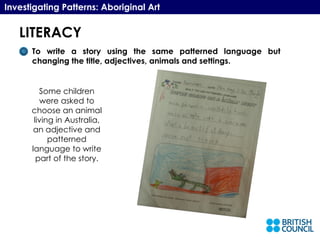
LITERACY Investigating Patterns: Aboriginal Art To write a story using the same patterned language but changing the title, adjectives, animals and settings.  Some children were asked to choose an animal living in Australia, an adjective and patterned language to write part of the story.
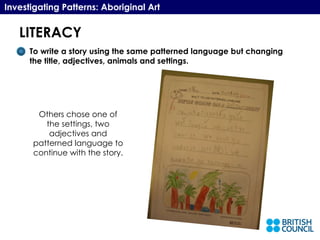
LITERACY Investigating Patterns: Aboriginal Art To write a story using the same patterned language but changing the title, adjectives, animals and settings.  Others chose one of the settings, two adjectives and patterned language to continue with the story.
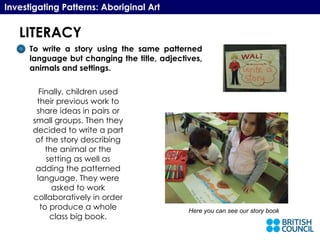
LITERACY Investigating Patterns: Aboriginal Art To write a story using the same patterned language but changing the title, adjectives, animals and settings.  Finally, children used their previous work to share ideas in pairs or small groups. Then they decided to write a part of the story describing the animal or the setting as well as adding the patterned language. They were asked to work collaboratively in order to produce a whole class big book. Here you can see our story book
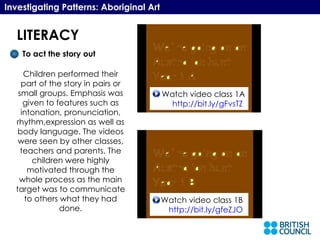
LITERACY Investigating Patterns: Aboriginal Art To act the story out Children performed their part of the story in pairs or small groups. Emphasis was given to features such as intonation, pronunciation, rhythm,expression as well as body language. The videos were seen by other classes, teachers and parents. The children were highly motivated through the whole process as the main target was to communicate to others what they had done. Watch video class 1A http://bit.ly/gFvsTZ   Watch video class 1B  http://bit.ly/gfeZJO
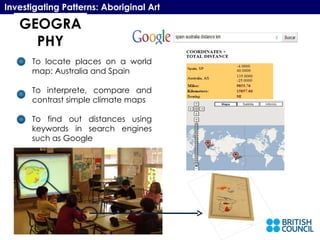
GEOGRAPHY Investigating Patterns: Aboriginal Art To locate places on a world map: Australia and Spain To interprete, compare and contrast simple climate maps To find out distances using keywords in search engines such as Google
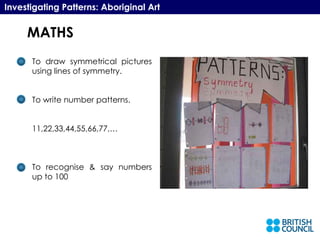
MATHS Investigating Patterns: Aboriginal Art To draw symmetrical pictures using lines of symmetry. To write number patterns. 11,22,33,44,55,66,77,… To recognise & say numbers up to 100
HISTORY Investigating Patterns: Aboriginal Art To find out facts about the life of the Aborigines in Australia. To answer questions through observation. Watch video  http://youtu.be/jKjj66pRXZA
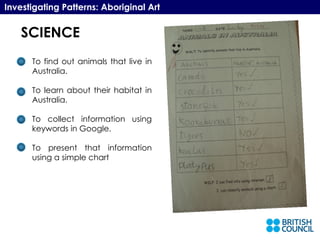
SCIENCE Investigating Patterns: Aboriginal Art To find out animals that live in Australia. To learn about their habitat in Australia. To collect information using keywords in Google. To present that information using a simple chart
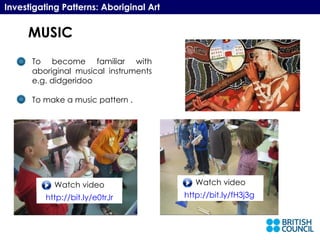
MUSIC Investigating Patterns: Aboriginal Art To become familiar with aboriginal musical instruments e.g. didgeridoo To make a music pattern . http://bit.ly/e0trJr Watch video http://bit.ly/fH3j3g   Watch video
CEIP ROSALES DEL CANAL  ZARAGOZA  SPAIN PROJECT TEACHER:  ALBERTO GARRIDO TWITTER: @agarridodiez LINKEDIN: http://es.linkedin.com/in/albertogarridodiez APRIL  2011 YEAR 1

Aboriginal art presentation

  • 1.
    Training Course: Artand Design and the Integrated Curriculum Alcalá de Henares 29 November - 1 December 2010 Investigating Patterns: Aboriginal Art
  • 2.
    CEIP ROSALES DELCANAL ZARAGOZA SPAIN PROJECT TEACHER: ALBERTO GARRIDO TWITTER: @agarridodiez LINKEDIN: http://es.linkedin.com/in/albertogarridodiez APRIL 2011 YEAR 1
  • 3.
    Investigating Patterns: AboriginalArt PATTERNS MATHS LITERACY HISTORY GEOGRAPHY MUSIC SCIENCE ART & DESIGN A CROSS-CURRICULAR PROJECT
  • 4.
    ART & DESIGNInvestigating Patterns: Aboriginal Art To identify types of patterns. To recognise patterns in different cultures. To make aboriginal patterns using a wide range of techniques such as dotting technique, symmetry, use of Earth colours, etc. To design and paint an aboriginal boomerang. To display all the boomerangs and discuss about final products. To celebrate an aboriginal day in school.
  • 5.
    Investigating Patterns: AboriginalArt EXPLORING AND DEVELOPING IDEAS http://bit.ly/eSr6Pd We looked at this website, the Brooklin Children’s museum , to learn about patterns. Once we identified different types , we played games and came up with our own interactive patterns. Child playing online games ART & DESIGN
  • 6.
    Investigating Patterns: AboriginalArt EXPLORING AND DEVELOPING IDEAS Pattern spotting: We went on a school trip to spot different types of patterns. Children took pictures of some and then, back in class, they chose one of the patterns to sketch it. ART & DESIGN
  • 7.
    Investigating Patterns: AboriginalArt EXPLORING AND DEVELOPING IDEAS Pattern spotting: Children were asked to look for patterns at home. They took pictures of some and these were uploaded to the school website. All these patterns were shared with the class. Patterns from children’s homes ART & DESIGN
  • 8.
    BLACK SNAKE DREAMINGInvestigating Patterns: Aboriginal Art EXPLORING AND DEVELOPING IDEAS Examples of patterns in other cultures: We looked at examples of Aboriginal patterns using a wide range of 2.0 classroom resources such as slideshare or youtube. http://youtu.be/K9g56TCQYGs CAMPSITE http:// slidesha.re/dDXle4 ART & DESIGN
  • 9.
    ART & DESIGNInvestigating Patterns: Aboriginal Art EXPLORING AND DEVELOPING IDEAS Children made simple drawings of some of those aboriginal patterns applying techniques such as dotting or different types of patterns: symmetry, tesselation,etc. For his very first time A hard nut to crack: tesselation
  • 10.
    Investigating Patterns: AboriginalArt INVESTIGATING AND MAKING Children were shown an authentic australian boomerang that Mario, our headteacher, got from one of his countless travels around the world. Then they were asked to design their own boomerang on paper including a little sketch of an Australian animal. We discussed about Earth colours, patterns, techniques,etc. What a nice design I am ready for some more action ART & DESIGN
  • 11.
    Investigating Patterns: AboriginalArt Finally children were provided with small wooden boomerangs that they painted by looking at their designs. They first painted the background with Earth colours and then used chopping sticks for patterns just like aborigines. We also painted our faces. a. Painting backgrounds b. Going dotting c. Proud of their job ART & DESIGN INVESTIGATING AND MAKING
  • 12.
    Investigating Patterns: AboriginalArt EVALUATING AND DEVELOPING In pairs, children looked at each other’s work and described their own boomerangs and said what they liked about somebody else’s. All the boomerangs were displayed in class. Then children completed an assessment form using I Can statements. ART & DESIGN
  • 13.
    Investigating Patterns: AboriginalArt EVALUATING AND DEVELOPING We all went to the playground with our boomerangs and practiced to throw them. READY, STEADY, GO! ART & DESIGN
  • 14.
    LITERACY Investigating Patterns:Aboriginal Art To read a story and identify patterned language: “We’re going on a bear hunt”. By Michael Rosen. To write a story using the same patterned language but changing the title, adjectives, animals and settings. “We’re going on an Australian hunt” To act the story out. LITERACY
  • 15.
    LITERACY Investigating Patterns:Aboriginal Art To read a story and identify patterned language As a shared reading experience children inmersed themselves in a wonderful story written by Michael Rosen called “ We’re going on a bear hunt ” http://youtu.be/hb-nTnriTP8 They very quickly became familiar with the use of patterned language and the impact of it throughout the story. In pairs, children were asked to read extracts of the text and decide if they were patterned language or not using AFL fans. e.g. What a beautiful day  Open the door 
  • 16.
    LITERACY Investigating Patterns:Aboriginal Art To write a story using the same patterned language but changing the title, adjectives, animals and settings. After a few lessons looking at the patterned language and adjectives that describe the settings, shared writing was used to make a whole-class chart with different settings and adjectives.
  • 17.
    LITERACY Investigating Patterns:Aboriginal Art To write a story using the same patterned language but changing the title, adjectives, animals and settings. Some children were asked to choose an animal living in Australia, an adjective and patterned language to write part of the story.
  • 18.
    LITERACY Investigating Patterns:Aboriginal Art To write a story using the same patterned language but changing the title, adjectives, animals and settings. Others chose one of the settings, two adjectives and patterned language to continue with the story.
  • 19.
    LITERACY Investigating Patterns:Aboriginal Art To write a story using the same patterned language but changing the title, adjectives, animals and settings. Finally, children used their previous work to share ideas in pairs or small groups. Then they decided to write a part of the story describing the animal or the setting as well as adding the patterned language. They were asked to work collaboratively in order to produce a whole class big book. Here you can see our story book
  • 20.
    LITERACY Investigating Patterns:Aboriginal Art To act the story out Children performed their part of the story in pairs or small groups. Emphasis was given to features such as intonation, pronunciation, rhythm,expression as well as body language. The videos were seen by other classes, teachers and parents. The children were highly motivated through the whole process as the main target was to communicate to others what they had done. Watch video class 1A http://bit.ly/gFvsTZ Watch video class 1B http://bit.ly/gfeZJO
  • 21.
    GEOGRAPHY Investigating Patterns:Aboriginal Art To locate places on a world map: Australia and Spain To interprete, compare and contrast simple climate maps To find out distances using keywords in search engines such as Google
  • 22.
    MATHS Investigating Patterns:Aboriginal Art To draw symmetrical pictures using lines of symmetry. To write number patterns. 11,22,33,44,55,66,77,… To recognise & say numbers up to 100
  • 23.
    HISTORY Investigating Patterns:Aboriginal Art To find out facts about the life of the Aborigines in Australia. To answer questions through observation. Watch video http://youtu.be/jKjj66pRXZA
  • 24.
    SCIENCE Investigating Patterns:Aboriginal Art To find out animals that live in Australia. To learn about their habitat in Australia. To collect information using keywords in Google. To present that information using a simple chart
  • 25.
    MUSIC Investigating Patterns:Aboriginal Art To become familiar with aboriginal musical instruments e.g. didgeridoo To make a music pattern . http://bit.ly/e0trJr Watch video http://bit.ly/fH3j3g Watch video
  • 26.
    CEIP ROSALES DELCANAL ZARAGOZA SPAIN PROJECT TEACHER: ALBERTO GARRIDO TWITTER: @agarridodiez LINKEDIN: http://es.linkedin.com/in/albertogarridodiez APRIL 2011 YEAR 1