Abnormal Semen Analysis-
What Next?
Dr Sujoy Dasgupta
MBBS (Gold Medalist, Hons)
MS (OBGY- Gold Medalist)
DNB (New Delhi)
MRCOG (London)
Advanced ART Course for Clinicians (NUHS, Singapore)
M Sc, Sexual and Reproductive Medicine (South Wales, UK)
Consultant: Reproductive Medicine, Genome Fertility Centre, Kolkata
Managing Committee Member, BOGS, 2022-23
Executive Committee Member, ISAR Bengal, 2022-24
Clinical Examiner, MRCOG Part 3 Examination
Winner, Prof Geoffrey Chamberlain Award, RCOG World Congress, London,
2019
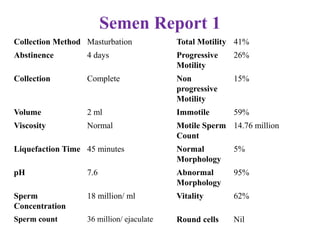
Semen Report 1
Collection Method Masturbation Total Motility 41%
Abstinence 4 days Progressive
Motility
26%
Collection Complete Non
progressive
Motility
15%
Volume 2 ml Immotile 59%
Viscosity Normal Motile Sperm
Count
14.76 million
Liquefaction Time 45 minutes Normal
Morphology
5%
pH 7.6 Abnormal
Morphology
95%
Sperm
Concentration
18 million/ ml Vitality 62%
Sperm count 36 million/ ejaculate Round cells Nil
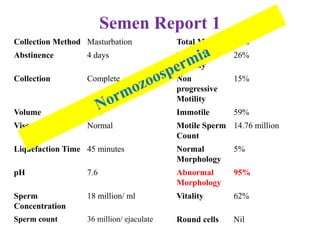
Semen Report 1
Collection Method Masturbation Total Motility 41%
Abstinence 4 days Progressive
Motility
26%
Collection Complete Non
progressive
Motility
15%
Volume 2 ml Immotile 59%
Viscosity Normal Motile Sperm
Count
14.76 million
Liquefaction Time 45 minutes Normal
Morphology
5%
pH 7.6 Abnormal
Morphology
95%
Sperm
Concentration
18 million/ ml Vitality 62%
Sperm count 36 million/ ejaculate Round cells Nil
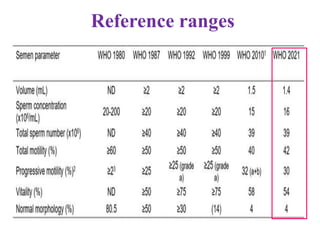
Reference ranges
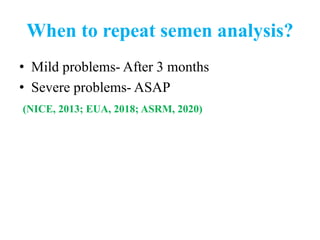
When to repeat semen analysis?
• Mild problems- After 3 months
• Severe problems- ASAP
(NICE, 2013; EUA, 2018; ASRM, 2020)
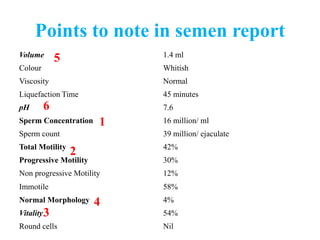
Points to note in semen report
Volume 1.4 ml
Colour Whitish
Viscosity Normal
Liquefaction Time 45 minutes
pH 7.6
Sperm Concentration 16 million/ ml
Sperm count 39 million/ ejaculate
Total Motility 42%
Progressive Motility 30%
Non progressive Motility 12%
Immotile 58%
Normal Morphology 4%
Vitality 54%
Round cells Nil
1
2
3
4
5
6
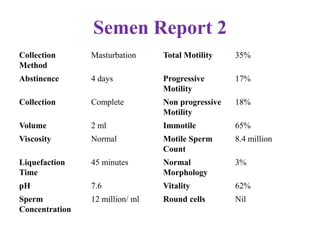
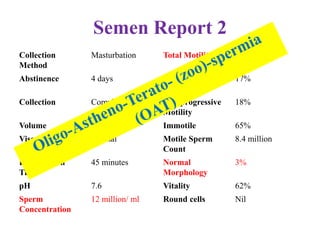
Semen Report 2
Collection
Method
Masturbation Total Motility 35%
Abstinence 4 days Progressive
Motility
17%
Collection Complete Non progressive
Motility
18%
Volume 2 ml Immotile 65%
Viscosity Normal Motile Sperm
Count
8.4 million
Liquefaction
Time
45 minutes Normal
Morphology
3%
pH 7.6 Vitality 62%
Sperm
Concentration
12 million/ ml Round cells Nil
Semen Report 2
Collection
Method
Masturbation Total Motility 35%
Abstinence 4 days Progressive
Motility
17%
Collection Complete Non progressive
Motility
18%
Volume 2 ml Immotile 65%
Viscosity Normal Motile Sperm
Count
8.4 million
Liquefaction
Time
45 minutes Normal
Morphology
3%
pH 7.6 Vitality 62%
Sperm
Concentration
12 million/ ml Round cells Nil
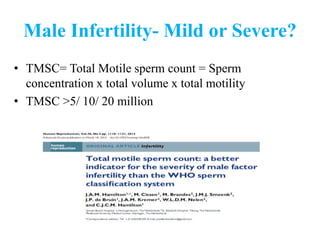
Male Infertility- Mild or Severe?
• TMSC= Total Motile sperm count = Sperm
concentration x total volume x total motility
• TMSC >5/ 10/ 20 million
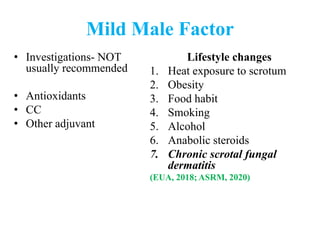
Mild Male Factor
• Investigations- NOT
usually recommended
• Antioxidants
• CC
• Other adjuvant
Lifestyle changes
1. Heat exposure to scrotum
2. Obesity
3. Food habit
4. Smoking
5. Alcohol
6. Anabolic steroids
7. Chronic scrotal fungal
dermatitis
(EUA, 2018; ASRM, 2020)
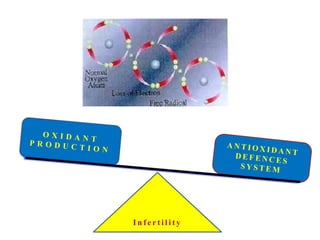
I n f e r t i l i t y
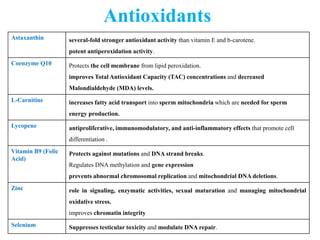
Antioxidants
Astaxanthin several-fold stronger antioxidant activity than vitamin E and b-carotene.
potent antiperoxidation activity.
Coenzyme Q10 Protects the cell membrane from lipid peroxidation.
improves Total Antioxidant Capacity (TAC) concentrations and decreased
Malondialdehyde (MDA) levels.
L-Carnitine increases fatty acid transport into sperm mitochondria which are needed for sperm
energy production.
Lycopene antiproliferative, immunomodulatory, and anti-inflammatory effects that promote cell
differentiation .
Vitamin B9 (Folic
Acid)
Protects against mutations and DNA strand breaks.
Regulates DNA methylation and gene expression
prevents abnormal chromosomal replication and mitochondrial DNA deletions.
Zinc role in signaling, enzymatic activities, sexual maturation and managing mitochondrial
oxidative stress.
improves chromatin integrity
Selenium Suppresses testicular toxicity and modulate DNA repair.
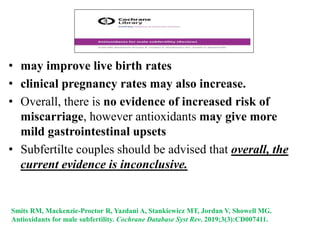
Smits RM, Mackenzie-Proctor R, Yazdani A, Stankiewicz MT, Jordan V, Showell MG.
Antioxidants for male subfertility. Cochrane Database Syst Rev. 2019;3(3):CD007411.
• may improve live birth rates
• clinical pregnancy rates may also increase.
• Overall, there is no evidence of increased risk of
miscarriage, however antioxidants may give more
mild gastrointestinal upsets
• Subfertilte couples should be advised that overall, the
current evidence is inconclusive.
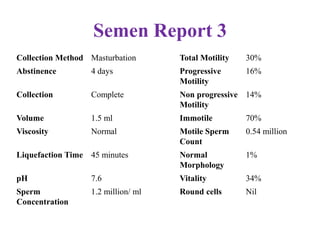
Semen Report 3
Collection Method Masturbation Total Motility 30%
Abstinence 4 days Progressive
Motility
16%
Collection Complete Non progressive
Motility
14%
Volume 1.5 ml Immotile 70%
Viscosity Normal Motile Sperm
Count
0.54 million
Liquefaction Time 45 minutes Normal
Morphology
1%
pH 7.6 Vitality 34%
Sperm
Concentration
1.2 million/ ml Round cells Nil
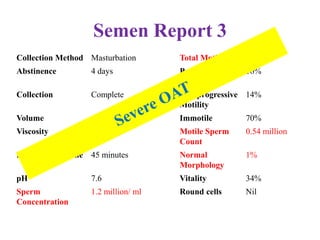
Semen Report 3
Collection Method Masturbation Total Motility 30%
Abstinence 4 days Progressive
Motility
16%
Collection Complete Non progressive
Motility
14%
Volume 1.5 ml Immotile 70%
Viscosity Normal Motile Sperm
Count
0.54 million
Liquefaction Time 45 minutes Normal
Morphology
1%
pH 7.6 Vitality 34%
Sperm
Concentration
1.2 million/ ml Round cells Nil
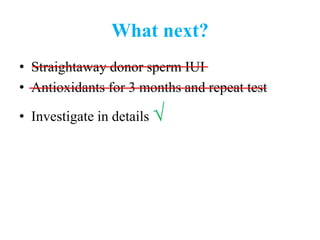
What next?
• Straightaway donor sperm IUI
• Antioxidants for 3 months and repeat test
• Investigate in details √
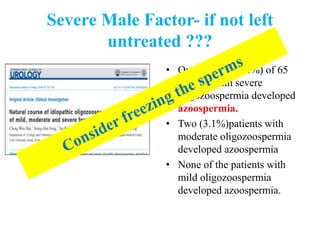
Severe Male Factor- if not left
untreated ???
• Overall, 16 (24.6%) of 65
patients with severe
oligozoospermia developed
azoospermia.
• Two (3.1%)patients with
moderate oligozoospermia
developed azoospermia
• None of the patients with
mild oligozoospermia
developed azoospermia.
Severe Male Factor is NOT ONLY a fertility
problem
• Diabetes
• Cardiovascular diseases
• Lymphoma, extragonadal
germ cell tumours, peritoneal
cancers
• Repeated hospitalization
• Increased mortality
• Testicular Cancer
Choy and Eisenberg, 2020; Bungum et
al., 2018; Eisenberg et al., 2013;
Jungwirth et al., 2018; Hotaling and
Walsh, 2009
Self-Testicular
Examination
•Atrophic Testes
•H/O undescended testicles
•Testicular microcalcification
(post-mumps or others)
Revisiting History
• Age
• Duration of subfertility
• Previous pregnancy- can have secondary male
subfertility
• Lifestyle
• Occupation- Driving, IT, chemical industry (heavy
metal, pesticides)
• Medical history- Diabetes, Mumps, Cancer
• Surgical history- Hernia, Orchidopexy, Pituitary
Surgery, Bladder neck surgery
• Drug history- Sulphasalazine, Finesteride,
cytotoxic drugs, steroids
• Sexual history- Low libido, ED
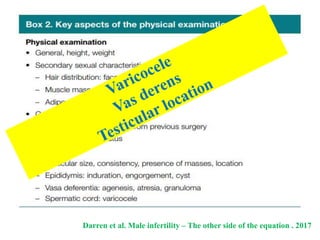
Darren et al. Male infertility – The other side of the equation . 2017
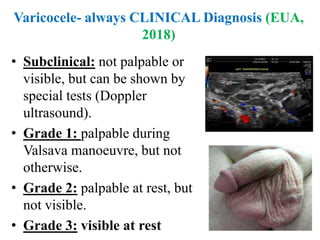
Varicocele- always CLINICAL Diagnosis (EUA,
2018)
• Subclinical: not palpable or
visible, but can be shown by
special tests (Doppler
ultrasound).
• Grade 1: palpable during
Valsava manoeuvre, but not
otherwise.
• Grade 2: palpable at rest, but
not visible.
• Grade 3: visible at rest
Surgery for Varicocele
(EUA, 2018)
• Grade 3 varicocele
• Ipsilateral testicular atrophy
• Abnormal semen parameters
• No other fertility factors in the couple
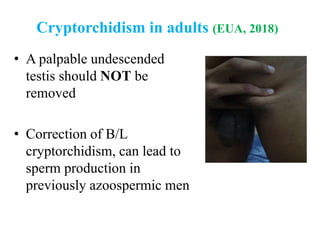
Cryptorchidism in adults (EUA, 2018)
• A palpable undescended
testis should NOT be
removed
• Correction of B/L
cryptorchidism, can lead to
sperm production in
previously azoospermic men
Imaging
Scrotal ultrasound
1. Clinically abnormal findings-
mass/ atrophy
2. Tight scrotum (Cremasteric
reflex)
3. Obese patient
• NOT for Varicocele detection
• NOT the replacement for
clinical examination
(EUA, 2018; ASRM, 2020)
Transrectal ultrasound (TRUS)
1. Low volume and pH of semen
2. Ejaculatory disorders
(EUA, 2018; ASRM, 2020)
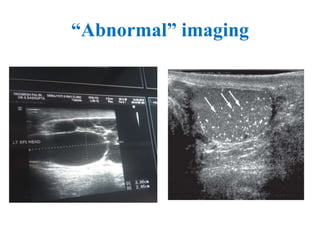
“Abnormal” imaging
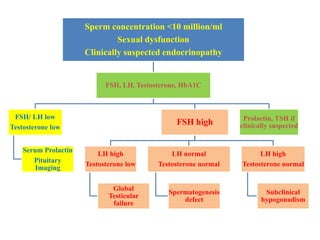
Sperm concentration <10 million/ml
Sexual dysfunction
Clinically suspected endocrinopathy
FSH, LH, Testosterone, HbA1C
FSH/ LH low
Testosterone low
Serum Prolactin
Pituitary
Imaging
FSH high
LH high
Testosterone low
Global
Testicular
failure
LH normal
Testosterone normal
Spermatogenesis
defect
LH high
Testosterone normal
Subclinical
hypogonadism
Prolactin, TSH if
clinically suspected
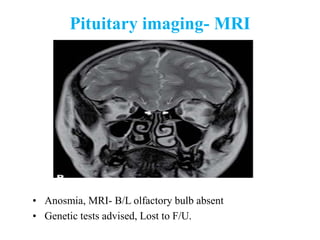
Pituitary imaging- MRI
• Anosmia, MRI- B/L olfactory bulb absent
• Genetic tests advised, Lost to F/U.
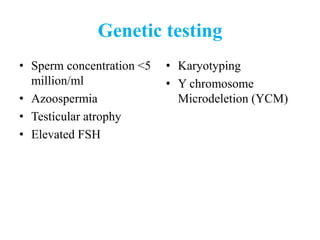
Genetic testing
• Sperm concentration <5
million/ml
• Azoospermia
• Testicular atrophy
• Elevated FSH
• Karyotyping
• Y chromosome
Microdeletion (YCM)
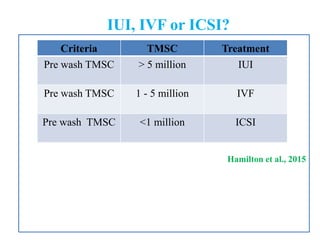
Hamilton et al., 2015
Criteria TMSC Treatment
Pre wash TMSC > 5 million IUI
Pre wash TMSC 1 - 5 million IVF
Pre wash TMSC <1 million ICSI
IUI, IVF or ICSI?
TMSC <5 mil/ml and IUI
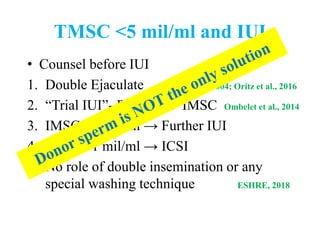
• Counsel before IUI
1. Double Ejaculate Kucuc et al., 2004; Oritz et al., 2016
2. “Trial IUI”- Post wash- IMSC Ombelet et al., 2014
3. IMSC >1 mil/ml → Further IUI
4. IMSC <1 mil/ml → ICSI
5. No role of double insemination or any
special washing technique ESHRE, 2018
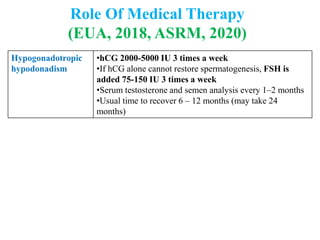
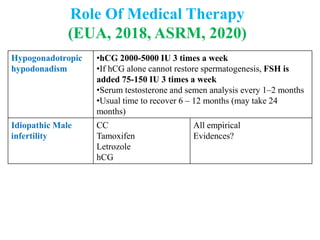
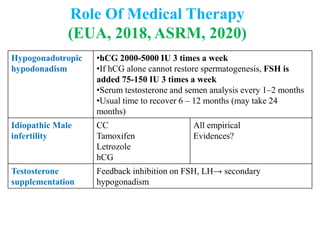
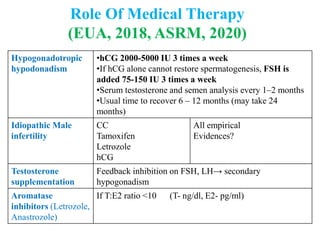
Role Of Medical Therapy
(EUA, 2018, ASRM, 2020)
Hypogonadotropic
hypodonadism
•hCG 2000-5000 IU 3 times a week
•If hCG alone cannot restore spermatogenesis, FSH is
added 75-150 IU 3 times a week
•Serum testosterone and semen analysis every 1–2 months
•Usual time to recover 6 – 12 months (may take 24
months)
Idiopathic Male
infertility
CC
Tamoxifen
Letrozole
hCG
All empirical
Evidences?
Testosterone
supplementation
Feedback inhibition on FSH, LH→ secondary
hypogonadism
Aromatase
inhibitors (Letrozole,
Anastrozole)
If T:E2 ratio <10 (T- ng/dl, E2- pg/ml)
Role Of Medical Therapy
(EUA, 2018, ASRM, 2020)
Hypogonadotropic
hypodonadism
•hCG 2000-5000 IU 3 times a week
•If hCG alone cannot restore spermatogenesis, FSH is
added 75-150 IU 3 times a week
•Serum testosterone and semen analysis every 1–2 months
•Usual time to recover 6 – 12 months (may take 24
months)
Idiopathic Male
infertility
CC
Tamoxifen
Letrozole
hCG
All empirical
Evidences?
Testosterone
supplementation
Feedback inhibition on FSH, LH→ secondary
hypogonadism
Aromatase
inhibitors (Letrozole,
Anastrozole)
If T:E2 ratio <10 (T- ng/dl, E2- pg/ml)
Role Of Medical Therapy
(EUA, 2018, ASRM, 2020)
Hypogonadotropic
hypodonadism
•hCG 2000-5000 IU 3 times a week
•If hCG alone cannot restore spermatogenesis, FSH is
added 75-150 IU 3 times a week
•Serum testosterone and semen analysis every 1–2 months
•Usual time to recover 6 – 12 months (may take 24
months)
Idiopathic Male
infertility
CC
Tamoxifen
Letrozole
hCG
All empirical
Evidences?
Testosterone
supplementation
Feedback inhibition on FSH, LH→ secondary
hypogonadism
Aromatase
inhibitors (Letrozole,
Anastrozole)
If T:E2 ratio <10 (T- ng/dl, E2- pg/ml)
Role Of Medical Therapy
(EUA, 2018, ASRM, 2020)
Hypogonadotropic
hypodonadism
•hCG 2000-5000 IU 3 times a week
•If hCG alone cannot restore spermatogenesis, FSH is
added 75-150 IU 3 times a week
•Serum testosterone and semen analysis every 1–2 months
•Usual time to recover 6 – 12 months (may take 24
months)
Idiopathic Male
infertility
CC
Tamoxifen
Letrozole
hCG
All empirical
Evidences?
Testosterone
supplementation
Feedback inhibition on FSH, LH→ secondary
hypogonadism
Aromatase
inhibitors (Letrozole,
Anastrozole)
If T:E2 ratio <10 (T- ng/dl, E2- pg/ml)
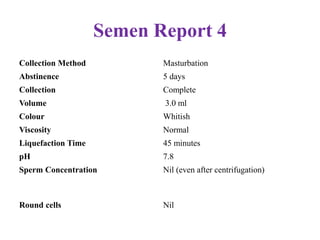
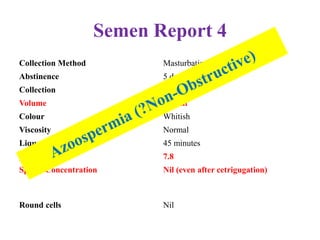
Semen Report 4
Collection Method Masturbation
Abstinence 5 days
Collection Complete
Volume 3.0 ml
Colour Whitish
Viscosity Normal
Liquefaction Time 45 minutes
pH 7.8
Sperm Concentration Nil (even after centrifugation)
Round cells Nil
Semen Report 4
Collection Method Masturbation
Abstinence 5 days
Collection Complete
Volume 3.0 ml
Colour Whitish
Viscosity Normal
Liquefaction Time 45 minutes
pH 7.8
Sperm Concentration Nil (even after cetrigugation)
Round cells Nil
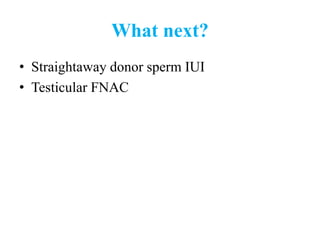
What next?
• Straightaway donor sperm IUI
• Testicular FNAC
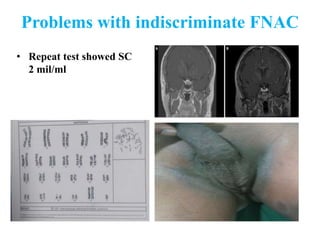
Problems with indiscriminate FNAC
• Repeat test showed SC
2 mil/ml
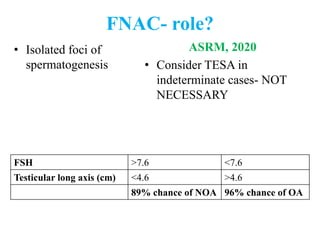
FNAC- role?
• Isolated foci of
spermatogenesis
ASRM, 2020
• Consider TESA in
indeterminate cases- NOT
NECESSARY
FSH >7.6 <7.6
Testicular long axis (cm) <4.6 >4.6
89% chance of NOA 96% chance of OA
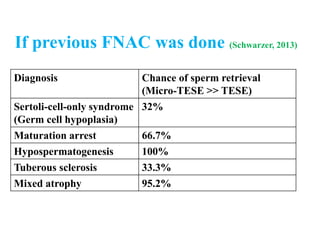
If previous FNAC was done (Schwarzer, 2013)
Diagnosis Chance of sperm retrieval
(Micro-TESE >> TESE)
Sertoli-cell-only syndrome
(Germ cell hypoplasia)
32%
Maturation arrest 66.7%
Hypospermatogenesis 100%
Tuberous sclerosis 33.3%
Mixed atrophy 95.2%
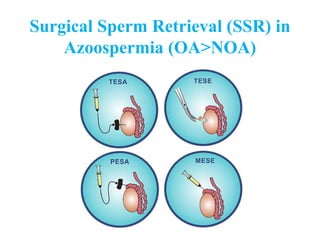
Surgical Sperm Retrieval (SSR) in
Azoospermia (OA>NOA)
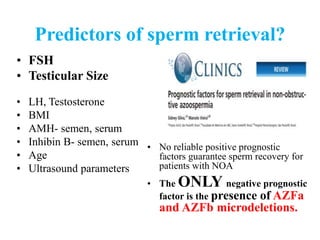
Predictors of sperm retrieval?
• FSH
• Testicular Size
• LH, Testosterone
• BMI
• AMH- semen, serum
• Inhibin B- semen, serum
• Age
• Ultrasound parameters
• No reliable positive prognostic
factors guarantee sperm recovery for
patients with NOA
• The ONLY negative prognostic
factor is the presence of AZFa
and AZFb microdeletions.
In presence of genetic defect
• Sperm Aneuploidy testing by FISH
• PGT-SR (previously- PGD)
• Prenatal invasive testing (EUA, 2018;
ASRM, 2020)
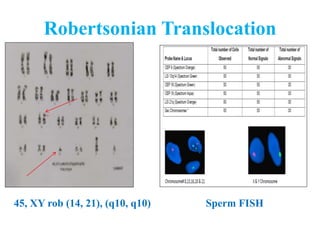
Robertsonian Translocation
45, XY rob (14, 21), (q10, q10) Sperm FISH
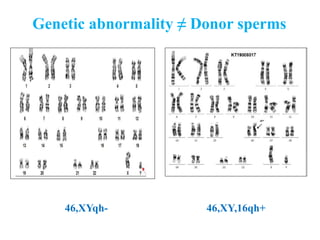
Genetic abnormality ≠ Donor sperms
46,XYqh- 46,XY,16qh+
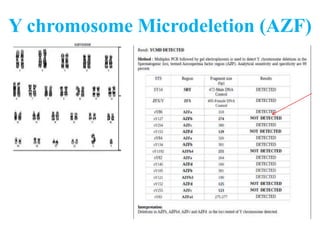
Y chromosome Microdeletion (AZF)
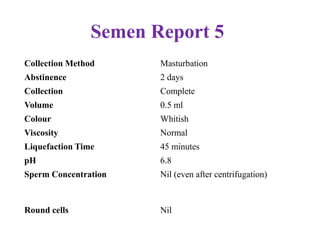
Semen Report 5
Collection Method Masturbation
Abstinence 2 days
Collection Complete
Volume 0.5 ml
Colour Whitish
Viscosity Normal
Liquefaction Time 45 minutes
pH 6.8
Sperm Concentration Nil (even after centrifugation)
Round cells Nil
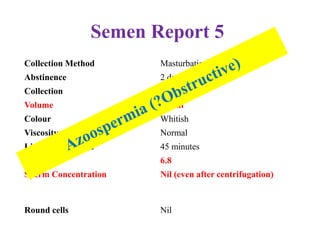
Semen Report 5
Collection Method Masturbation
Abstinence 2 days
Collection Complete
Volume 0.5 ml
Colour Whitish
Viscosity Normal
Liquefaction Time 45 minutes
pH 6.8
Sperm Concentration Nil (even after centrifugation)
Round cells Nil
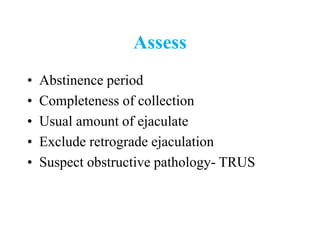
Assess
• Abstinence period
• Completeness of collection
• Usual amount of ejaculate
• Exclude retrograde ejaculation
• Suspect obstructive pathology- TRUS
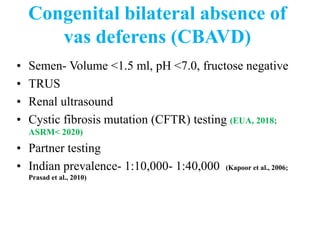
Congenital bilateral absence of
vas deferens (CBAVD)
• Semen- Volume <1.5 ml, pH <7.0, fructose negative
• TRUS
• Renal ultrasound
• Cystic fibrosis mutation (CFTR) testing (EUA, 2018;
ASRM< 2020)
• Partner testing
• Indian prevalence- 1:10,000- 1:40,000 (Kapoor et al., 2006;
Prasad et al., 2010)
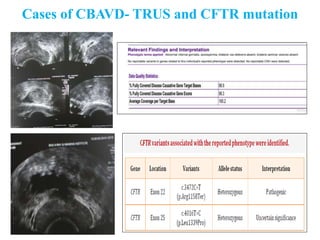
Cases of CBAVD- TRUS and CFTR mutation
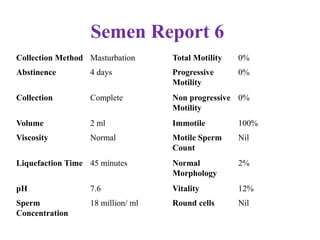
Semen Report 6
Collection Method Masturbation Total Motility 0%
Abstinence 4 days Progressive
Motility
0%
Collection Complete Non progressive
Motility
0%
Volume 2 ml Immotile 100%
Viscosity Normal Motile Sperm
Count
Nil
Liquefaction Time 45 minutes Normal
Morphology
2%
pH 7.6 Vitality 12%
Sperm
Concentration
18 million/ ml Round cells Nil
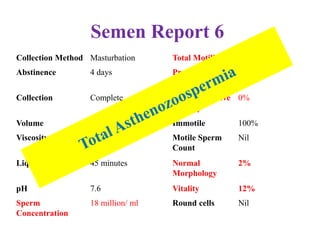
Semen Report 6
Collection Method Masturbation Total Motility 0%
Abstinence 4 days Progressive
Motility
0%
Collection Complete Non progressive
Motility
0%
Volume 2 ml Immotile 100%
Viscosity Normal Motile Sperm
Count
Nil
Liquefaction Time 45 minutes Normal
Morphology
2%
pH 7.6 Vitality 12%
Sperm
Concentration
18 million/ ml Round cells Nil
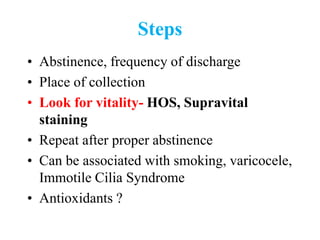
Steps
• Abstinence, frequency of discharge
• Place of collection
• Look for vitality- HOS, Supravital
staining
• Repeat after proper abstinence
• Can be associated with smoking, varicocele,
Immotile Cilia Syndrome
• Antioxidants ?
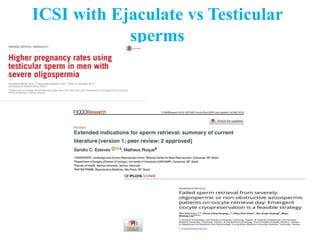
ICSI with Ejaculate vs Testicular
sperms
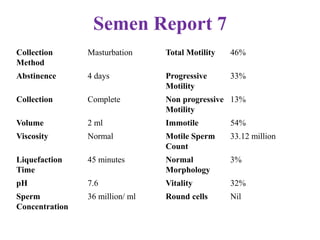
Semen Report 7
Collection
Method
Masturbation Total Motility 46%
Abstinence 4 days Progressive
Motility
33%
Collection Complete Non progressive
Motility
13%
Volume 2 ml Immotile 54%
Viscosity Normal Motile Sperm
Count
33.12 million
Liquefaction
Time
45 minutes Normal
Morphology
3%
pH 7.6 Vitality 32%
Sperm
Concentration
36 million/ ml Round cells Nil
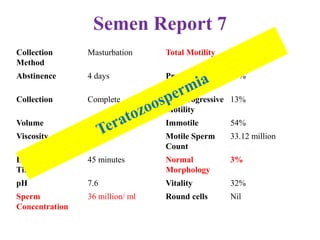
Semen Report 7
Collection
Method
Masturbation Total Motility 46%
Abstinence 4 days Progressive
Motility
33%
Collection Complete Non progressive
Motility
13%
Volume 2 ml Immotile 54%
Viscosity Normal Motile Sperm
Count
33.12 million
Liquefaction
Time
45 minutes Normal
Morphology
3%
pH 7.6 Vitality 32%
Sperm
Concentration
36 million/ ml Round cells Nil
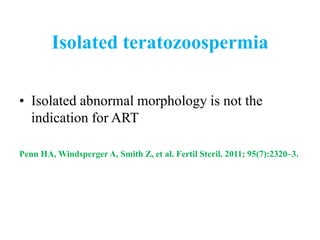
Isolated teratozoospermia
• Isolated abnormal morphology is not the
indication for ART
Penn HA, Windsperger A, Smith Z, et al. Fertil Steril. 2011; 95(7):2320–3.
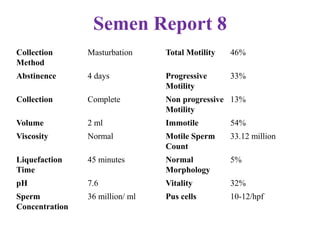
Semen Report 8
Collection
Method
Masturbation Total Motility 46%
Abstinence 4 days Progressive
Motility
33%
Collection Complete Non progressive
Motility
13%
Volume 2 ml Immotile 54%
Viscosity Normal Motile Sperm
Count
33.12 million
Liquefaction
Time
45 minutes Normal
Morphology
5%
pH 7.6 Vitality 32%
Sperm
Concentration
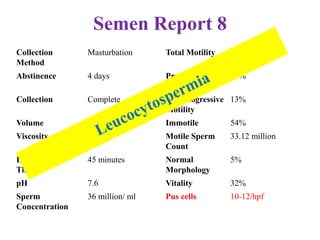
36 million/ ml Pus cells 10-12/hpf
Semen Report 8
Collection
Method
Masturbation Total Motility 46%
Abstinence 4 days Progressive
Motility
33%
Collection Complete Non progressive
Motility
13%
Volume 2 ml Immotile 54%
Viscosity Normal Motile Sperm
Count
33.12 million
Liquefaction
Time
45 minutes Normal
Morphology
5%
pH 7.6 Vitality 32%
Sperm
Concentration
36 million/ ml Pus cells 10-12/hpf
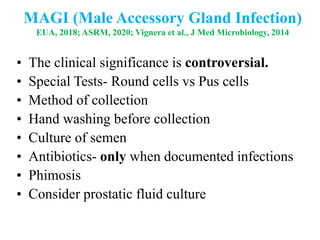
MAGI (Male Accessory Gland Infection)
EUA, 2018; ASRM, 2020; Vignera et al., J Med Microbiology, 2014
• The clinical significance is controversial.
• Special Tests- Round cells vs Pus cells
• Method of collection
• Hand washing before collection
• Culture of semen
• Antibiotics- only when documented infections
• Phimosis
• Consider prostatic fluid culture
 Meticulous semen analysis in a standard laboratory
 Physical examination and rational investigations
 Avoid non-evidence based drugs for long time
 Antioxidants- May be useful in mild problem
 Antioxidants- Not reliable in severe problem
 Donor sperm is NOT the only solution
 IUI or IVF/ICSI- depends on the overall assessment
Take Home Messages
Treatment burden for MALE
infertility falls on FEMALE

Abnormal Semen- What next?

  • 1.
    Abnormal Semen Analysis- WhatNext? Dr Sujoy Dasgupta MBBS (Gold Medalist, Hons) MS (OBGY- Gold Medalist) DNB (New Delhi) MRCOG (London) Advanced ART Course for Clinicians (NUHS, Singapore) M Sc, Sexual and Reproductive Medicine (South Wales, UK) Consultant: Reproductive Medicine, Genome Fertility Centre, Kolkata Managing Committee Member, BOGS, 2022-23 Executive Committee Member, ISAR Bengal, 2022-24 Clinical Examiner, MRCOG Part 3 Examination Winner, Prof Geoffrey Chamberlain Award, RCOG World Congress, London, 2019
  • 2.
    Semen Report 1 CollectionMethod Masturbation Total Motility 41% Abstinence 4 days Progressive Motility 26% Collection Complete Non progressive Motility 15% Volume 2 ml Immotile 59% Viscosity Normal Motile Sperm Count 14.76 million Liquefaction Time 45 minutes Normal Morphology 5% pH 7.6 Abnormal Morphology 95% Sperm Concentration 18 million/ ml Vitality 62% Sperm count 36 million/ ejaculate Round cells Nil
  • 3.
    Semen Report 1 CollectionMethod Masturbation Total Motility 41% Abstinence 4 days Progressive Motility 26% Collection Complete Non progressive Motility 15% Volume 2 ml Immotile 59% Viscosity Normal Motile Sperm Count 14.76 million Liquefaction Time 45 minutes Normal Morphology 5% pH 7.6 Abnormal Morphology 95% Sperm Concentration 18 million/ ml Vitality 62% Sperm count 36 million/ ejaculate Round cells Nil
  • 4.
  • 5.
    When to repeatsemen analysis? • Mild problems- After 3 months • Severe problems- ASAP (NICE, 2013; EUA, 2018; ASRM, 2020)
  • 6.
    Points to notein semen report Volume 1.4 ml Colour Whitish Viscosity Normal Liquefaction Time 45 minutes pH 7.6 Sperm Concentration 16 million/ ml Sperm count 39 million/ ejaculate Total Motility 42% Progressive Motility 30% Non progressive Motility 12% Immotile 58% Normal Morphology 4% Vitality 54% Round cells Nil 1 2 3 4 5 6
  • 8.
    Semen Report 2 Collection Method MasturbationTotal Motility 35% Abstinence 4 days Progressive Motility 17% Collection Complete Non progressive Motility 18% Volume 2 ml Immotile 65% Viscosity Normal Motile Sperm Count 8.4 million Liquefaction Time 45 minutes Normal Morphology 3% pH 7.6 Vitality 62% Sperm Concentration 12 million/ ml Round cells Nil
  • 9.
    Semen Report 2 Collection Method MasturbationTotal Motility 35% Abstinence 4 days Progressive Motility 17% Collection Complete Non progressive Motility 18% Volume 2 ml Immotile 65% Viscosity Normal Motile Sperm Count 8.4 million Liquefaction Time 45 minutes Normal Morphology 3% pH 7.6 Vitality 62% Sperm Concentration 12 million/ ml Round cells Nil
  • 10.
    Male Infertility- Mildor Severe? • TMSC= Total Motile sperm count = Sperm concentration x total volume x total motility • TMSC >5/ 10/ 20 million
  • 11.
    Mild Male Factor •Investigations- NOT usually recommended • Antioxidants • CC • Other adjuvant Lifestyle changes 1. Heat exposure to scrotum 2. Obesity 3. Food habit 4. Smoking 5. Alcohol 6. Anabolic steroids 7. Chronic scrotal fungal dermatitis (EUA, 2018; ASRM, 2020)
  • 12.
    I n fe r t i l i t y
  • 13.
    Antioxidants Astaxanthin several-fold strongerantioxidant activity than vitamin E and b-carotene. potent antiperoxidation activity. Coenzyme Q10 Protects the cell membrane from lipid peroxidation. improves Total Antioxidant Capacity (TAC) concentrations and decreased Malondialdehyde (MDA) levels. L-Carnitine increases fatty acid transport into sperm mitochondria which are needed for sperm energy production. Lycopene antiproliferative, immunomodulatory, and anti-inflammatory effects that promote cell differentiation . Vitamin B9 (Folic Acid) Protects against mutations and DNA strand breaks. Regulates DNA methylation and gene expression prevents abnormal chromosomal replication and mitochondrial DNA deletions. Zinc role in signaling, enzymatic activities, sexual maturation and managing mitochondrial oxidative stress. improves chromatin integrity Selenium Suppresses testicular toxicity and modulate DNA repair.
  • 15.
    Smits RM, Mackenzie-ProctorR, Yazdani A, Stankiewicz MT, Jordan V, Showell MG. Antioxidants for male subfertility. Cochrane Database Syst Rev. 2019;3(3):CD007411. • may improve live birth rates • clinical pregnancy rates may also increase. • Overall, there is no evidence of increased risk of miscarriage, however antioxidants may give more mild gastrointestinal upsets • Subfertilte couples should be advised that overall, the current evidence is inconclusive.
  • 16.
    Semen Report 3 CollectionMethod Masturbation Total Motility 30% Abstinence 4 days Progressive Motility 16% Collection Complete Non progressive Motility 14% Volume 1.5 ml Immotile 70% Viscosity Normal Motile Sperm Count 0.54 million Liquefaction Time 45 minutes Normal Morphology 1% pH 7.6 Vitality 34% Sperm Concentration 1.2 million/ ml Round cells Nil
  • 17.
    Semen Report 3 CollectionMethod Masturbation Total Motility 30% Abstinence 4 days Progressive Motility 16% Collection Complete Non progressive Motility 14% Volume 1.5 ml Immotile 70% Viscosity Normal Motile Sperm Count 0.54 million Liquefaction Time 45 minutes Normal Morphology 1% pH 7.6 Vitality 34% Sperm Concentration 1.2 million/ ml Round cells Nil
  • 18.
    What next? • Straightawaydonor sperm IUI • Antioxidants for 3 months and repeat test • Investigate in details √
  • 19.
    Severe Male Factor-if not left untreated ??? • Overall, 16 (24.6%) of 65 patients with severe oligozoospermia developed azoospermia. • Two (3.1%)patients with moderate oligozoospermia developed azoospermia • None of the patients with mild oligozoospermia developed azoospermia.
  • 20.
    Severe Male Factoris NOT ONLY a fertility problem • Diabetes • Cardiovascular diseases • Lymphoma, extragonadal germ cell tumours, peritoneal cancers • Repeated hospitalization • Increased mortality • Testicular Cancer Choy and Eisenberg, 2020; Bungum et al., 2018; Eisenberg et al., 2013; Jungwirth et al., 2018; Hotaling and Walsh, 2009 Self-Testicular Examination •Atrophic Testes •H/O undescended testicles •Testicular microcalcification (post-mumps or others)
  • 21.
    Revisiting History • Age •Duration of subfertility • Previous pregnancy- can have secondary male subfertility • Lifestyle • Occupation- Driving, IT, chemical industry (heavy metal, pesticides) • Medical history- Diabetes, Mumps, Cancer • Surgical history- Hernia, Orchidopexy, Pituitary Surgery, Bladder neck surgery • Drug history- Sulphasalazine, Finesteride, cytotoxic drugs, steroids • Sexual history- Low libido, ED
  • 22.
    Darren et al.Male infertility – The other side of the equation . 2017
  • 23.
    Varicocele- always CLINICALDiagnosis (EUA, 2018) • Subclinical: not palpable or visible, but can be shown by special tests (Doppler ultrasound). • Grade 1: palpable during Valsava manoeuvre, but not otherwise. • Grade 2: palpable at rest, but not visible. • Grade 3: visible at rest
  • 24.
    Surgery for Varicocele (EUA,2018) • Grade 3 varicocele • Ipsilateral testicular atrophy • Abnormal semen parameters • No other fertility factors in the couple
  • 25.
    Cryptorchidism in adults(EUA, 2018) • A palpable undescended testis should NOT be removed • Correction of B/L cryptorchidism, can lead to sperm production in previously azoospermic men
  • 26.
    Imaging Scrotal ultrasound 1. Clinicallyabnormal findings- mass/ atrophy 2. Tight scrotum (Cremasteric reflex) 3. Obese patient • NOT for Varicocele detection • NOT the replacement for clinical examination (EUA, 2018; ASRM, 2020) Transrectal ultrasound (TRUS) 1. Low volume and pH of semen 2. Ejaculatory disorders (EUA, 2018; ASRM, 2020)
  • 27.
  • 28.
    Sperm concentration <10million/ml Sexual dysfunction Clinically suspected endocrinopathy FSH, LH, Testosterone, HbA1C FSH/ LH low Testosterone low Serum Prolactin Pituitary Imaging FSH high LH high Testosterone low Global Testicular failure LH normal Testosterone normal Spermatogenesis defect LH high Testosterone normal Subclinical hypogonadism Prolactin, TSH if clinically suspected
  • 29.
    Pituitary imaging- MRI •Anosmia, MRI- B/L olfactory bulb absent • Genetic tests advised, Lost to F/U.
  • 30.
    Genetic testing • Spermconcentration <5 million/ml • Azoospermia • Testicular atrophy • Elevated FSH • Karyotyping • Y chromosome Microdeletion (YCM)
  • 31.
    Hamilton et al.,2015 Criteria TMSC Treatment Pre wash TMSC > 5 million IUI Pre wash TMSC 1 - 5 million IVF Pre wash TMSC <1 million ICSI IUI, IVF or ICSI?
  • 32.
    TMSC <5 mil/mland IUI • Counsel before IUI 1. Double Ejaculate Kucuc et al., 2004; Oritz et al., 2016 2. “Trial IUI”- Post wash- IMSC Ombelet et al., 2014 3. IMSC >1 mil/ml → Further IUI 4. IMSC <1 mil/ml → ICSI 5. No role of double insemination or any special washing technique ESHRE, 2018
  • 33.
    Role Of MedicalTherapy (EUA, 2018, ASRM, 2020) Hypogonadotropic hypodonadism •hCG 2000-5000 IU 3 times a week •If hCG alone cannot restore spermatogenesis, FSH is added 75-150 IU 3 times a week •Serum testosterone and semen analysis every 1–2 months •Usual time to recover 6 – 12 months (may take 24 months) Idiopathic Male infertility CC Tamoxifen Letrozole hCG All empirical Evidences? Testosterone supplementation Feedback inhibition on FSH, LH→ secondary hypogonadism Aromatase inhibitors (Letrozole, Anastrozole) If T:E2 ratio <10 (T- ng/dl, E2- pg/ml)
  • 34.
    Role Of MedicalTherapy (EUA, 2018, ASRM, 2020) Hypogonadotropic hypodonadism •hCG 2000-5000 IU 3 times a week •If hCG alone cannot restore spermatogenesis, FSH is added 75-150 IU 3 times a week •Serum testosterone and semen analysis every 1–2 months •Usual time to recover 6 – 12 months (may take 24 months) Idiopathic Male infertility CC Tamoxifen Letrozole hCG All empirical Evidences? Testosterone supplementation Feedback inhibition on FSH, LH→ secondary hypogonadism Aromatase inhibitors (Letrozole, Anastrozole) If T:E2 ratio <10 (T- ng/dl, E2- pg/ml)
  • 35.
    Role Of MedicalTherapy (EUA, 2018, ASRM, 2020) Hypogonadotropic hypodonadism •hCG 2000-5000 IU 3 times a week •If hCG alone cannot restore spermatogenesis, FSH is added 75-150 IU 3 times a week •Serum testosterone and semen analysis every 1–2 months •Usual time to recover 6 – 12 months (may take 24 months) Idiopathic Male infertility CC Tamoxifen Letrozole hCG All empirical Evidences? Testosterone supplementation Feedback inhibition on FSH, LH→ secondary hypogonadism Aromatase inhibitors (Letrozole, Anastrozole) If T:E2 ratio <10 (T- ng/dl, E2- pg/ml)
  • 36.
    Role Of MedicalTherapy (EUA, 2018, ASRM, 2020) Hypogonadotropic hypodonadism •hCG 2000-5000 IU 3 times a week •If hCG alone cannot restore spermatogenesis, FSH is added 75-150 IU 3 times a week •Serum testosterone and semen analysis every 1–2 months •Usual time to recover 6 – 12 months (may take 24 months) Idiopathic Male infertility CC Tamoxifen Letrozole hCG All empirical Evidences? Testosterone supplementation Feedback inhibition on FSH, LH→ secondary hypogonadism Aromatase inhibitors (Letrozole, Anastrozole) If T:E2 ratio <10 (T- ng/dl, E2- pg/ml)
  • 37.
    Semen Report 4 CollectionMethod Masturbation Abstinence 5 days Collection Complete Volume 3.0 ml Colour Whitish Viscosity Normal Liquefaction Time 45 minutes pH 7.8 Sperm Concentration Nil (even after centrifugation) Round cells Nil
  • 38.
    Semen Report 4 CollectionMethod Masturbation Abstinence 5 days Collection Complete Volume 3.0 ml Colour Whitish Viscosity Normal Liquefaction Time 45 minutes pH 7.8 Sperm Concentration Nil (even after cetrigugation) Round cells Nil
  • 39.
    What next? • Straightawaydonor sperm IUI • Testicular FNAC
  • 40.
    Problems with indiscriminateFNAC • Repeat test showed SC 2 mil/ml
  • 41.
    FNAC- role? • Isolatedfoci of spermatogenesis ASRM, 2020 • Consider TESA in indeterminate cases- NOT NECESSARY FSH >7.6 <7.6 Testicular long axis (cm) <4.6 >4.6 89% chance of NOA 96% chance of OA
  • 42.
    If previous FNACwas done (Schwarzer, 2013) Diagnosis Chance of sperm retrieval (Micro-TESE >> TESE) Sertoli-cell-only syndrome (Germ cell hypoplasia) 32% Maturation arrest 66.7% Hypospermatogenesis 100% Tuberous sclerosis 33.3% Mixed atrophy 95.2%
  • 43.
    Surgical Sperm Retrieval(SSR) in Azoospermia (OA>NOA)
  • 44.
    Predictors of spermretrieval? • FSH • Testicular Size • LH, Testosterone • BMI • AMH- semen, serum • Inhibin B- semen, serum • Age • Ultrasound parameters • No reliable positive prognostic factors guarantee sperm recovery for patients with NOA • The ONLY negative prognostic factor is the presence of AZFa and AZFb microdeletions.
  • 45.
    In presence ofgenetic defect • Sperm Aneuploidy testing by FISH • PGT-SR (previously- PGD) • Prenatal invasive testing (EUA, 2018; ASRM, 2020)
  • 46.
    Robertsonian Translocation 45, XYrob (14, 21), (q10, q10) Sperm FISH
  • 47.
    Genetic abnormality ≠Donor sperms 46,XYqh- 46,XY,16qh+
  • 48.
  • 49.
    Semen Report 5 CollectionMethod Masturbation Abstinence 2 days Collection Complete Volume 0.5 ml Colour Whitish Viscosity Normal Liquefaction Time 45 minutes pH 6.8 Sperm Concentration Nil (even after centrifugation) Round cells Nil
  • 50.
    Semen Report 5 CollectionMethod Masturbation Abstinence 2 days Collection Complete Volume 0.5 ml Colour Whitish Viscosity Normal Liquefaction Time 45 minutes pH 6.8 Sperm Concentration Nil (even after centrifugation) Round cells Nil
  • 51.
    Assess • Abstinence period •Completeness of collection • Usual amount of ejaculate • Exclude retrograde ejaculation • Suspect obstructive pathology- TRUS
  • 52.
    Congenital bilateral absenceof vas deferens (CBAVD) • Semen- Volume <1.5 ml, pH <7.0, fructose negative • TRUS • Renal ultrasound • Cystic fibrosis mutation (CFTR) testing (EUA, 2018; ASRM< 2020) • Partner testing • Indian prevalence- 1:10,000- 1:40,000 (Kapoor et al., 2006; Prasad et al., 2010)
  • 53.
    Cases of CBAVD-TRUS and CFTR mutation
  • 54.
    Semen Report 6 CollectionMethod Masturbation Total Motility 0% Abstinence 4 days Progressive Motility 0% Collection Complete Non progressive Motility 0% Volume 2 ml Immotile 100% Viscosity Normal Motile Sperm Count Nil Liquefaction Time 45 minutes Normal Morphology 2% pH 7.6 Vitality 12% Sperm Concentration 18 million/ ml Round cells Nil
  • 55.
    Semen Report 6 CollectionMethod Masturbation Total Motility 0% Abstinence 4 days Progressive Motility 0% Collection Complete Non progressive Motility 0% Volume 2 ml Immotile 100% Viscosity Normal Motile Sperm Count Nil Liquefaction Time 45 minutes Normal Morphology 2% pH 7.6 Vitality 12% Sperm Concentration 18 million/ ml Round cells Nil
  • 56.
    Steps • Abstinence, frequencyof discharge • Place of collection • Look for vitality- HOS, Supravital staining • Repeat after proper abstinence • Can be associated with smoking, varicocele, Immotile Cilia Syndrome • Antioxidants ?
  • 57.
    ICSI with Ejaculatevs Testicular sperms
  • 58.
    Semen Report 7 Collection Method MasturbationTotal Motility 46% Abstinence 4 days Progressive Motility 33% Collection Complete Non progressive Motility 13% Volume 2 ml Immotile 54% Viscosity Normal Motile Sperm Count 33.12 million Liquefaction Time 45 minutes Normal Morphology 3% pH 7.6 Vitality 32% Sperm Concentration 36 million/ ml Round cells Nil
  • 59.
    Semen Report 7 Collection Method MasturbationTotal Motility 46% Abstinence 4 days Progressive Motility 33% Collection Complete Non progressive Motility 13% Volume 2 ml Immotile 54% Viscosity Normal Motile Sperm Count 33.12 million Liquefaction Time 45 minutes Normal Morphology 3% pH 7.6 Vitality 32% Sperm Concentration 36 million/ ml Round cells Nil
  • 60.
    Isolated teratozoospermia • Isolatedabnormal morphology is not the indication for ART Penn HA, Windsperger A, Smith Z, et al. Fertil Steril. 2011; 95(7):2320–3.
  • 61.
    Semen Report 8 Collection Method MasturbationTotal Motility 46% Abstinence 4 days Progressive Motility 33% Collection Complete Non progressive Motility 13% Volume 2 ml Immotile 54% Viscosity Normal Motile Sperm Count 33.12 million Liquefaction Time 45 minutes Normal Morphology 5% pH 7.6 Vitality 32% Sperm Concentration 36 million/ ml Pus cells 10-12/hpf
  • 62.
    Semen Report 8 Collection Method MasturbationTotal Motility 46% Abstinence 4 days Progressive Motility 33% Collection Complete Non progressive Motility 13% Volume 2 ml Immotile 54% Viscosity Normal Motile Sperm Count 33.12 million Liquefaction Time 45 minutes Normal Morphology 5% pH 7.6 Vitality 32% Sperm Concentration 36 million/ ml Pus cells 10-12/hpf
  • 63.
    MAGI (Male AccessoryGland Infection) EUA, 2018; ASRM, 2020; Vignera et al., J Med Microbiology, 2014 • The clinical significance is controversial. • Special Tests- Round cells vs Pus cells • Method of collection • Hand washing before collection • Culture of semen • Antibiotics- only when documented infections • Phimosis • Consider prostatic fluid culture
  • 64.
     Meticulous semenanalysis in a standard laboratory  Physical examination and rational investigations  Avoid non-evidence based drugs for long time  Antioxidants- May be useful in mild problem  Antioxidants- Not reliable in severe problem  Donor sperm is NOT the only solution  IUI or IVF/ICSI- depends on the overall assessment Take Home Messages
  • 65.
    Treatment burden forMALE infertility falls on FEMALE