






Case Scenarios on Different Semen
Analysis Results
Sujoy Dasgupta
MBBS (Gold Medalist, Hons)
MS (OBGY- Gold Medalist)
DNB (New Delhi)
MRCOG (London)
Advanced ART Course for Clinicians (NUHS, Singapore)
Consultant: Reproductive Medicine, Genome Fertility Centre, Kolkata
Managing Committee Member, Bengal Obstetric & Gynaecological Society
(BOGS)- 2019-20
Secretary, Subfertility and Reproductive Endocrinology Committee, BOGS-
2019-20
Winner, Prof Geoffrey Chamberlain Award, RCOG World Congress,
London, 2019
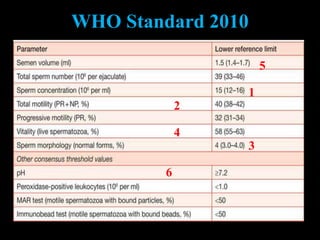
WHO Standard 2010
1
2
3
4
5
6
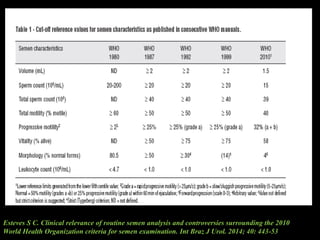
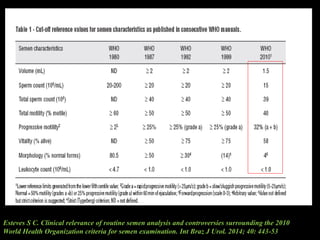
Esteves S C. Clinical relevance of routine semen analysis and controversies surrounding the 2010
World Health Organization criteria for semen examination. Int Braz J Urol. 2014; 40: 443-53
Esteves S C. Clinical relevance of routine semen analysis and controversies surrounding the 2010
World Health Organization criteria for semen examination. Int Braz J Urol. 2014; 40: 443-53
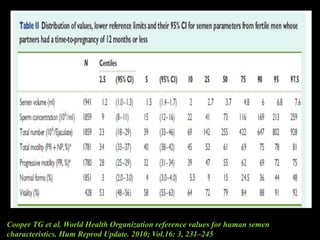
Cooper TG et al. World Health Organization reference values for human semen
characteristics. Hum Reprod Update. 2010; Vol.16: 3, 231–245
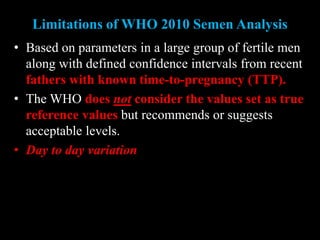
Limitations of WHO 2010 Semen Analysis
• Based on parameters in a large group of fertile men
along with defined confidence intervals from recent
fathers with known time-to-pregnancy (TTP).
• The WHO does not consider the values set as true
reference values but recommends or suggests
acceptable levels.
• Day to day variation
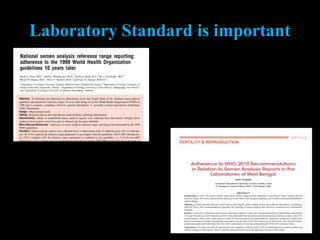
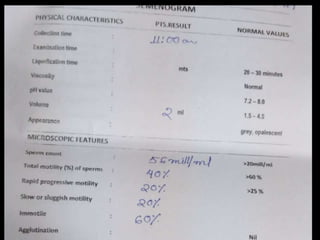
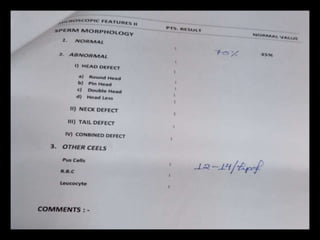
Laboratory Standard is important
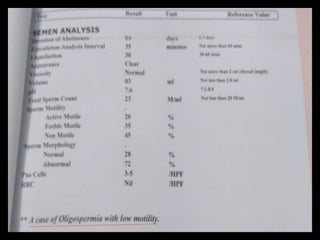
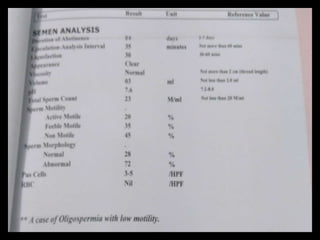
Case Scenario 1
What to do
• Method of collection
• Hand washing before collection
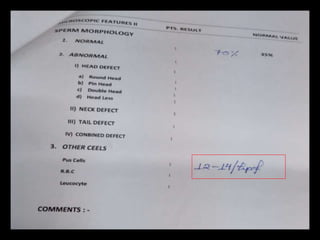
• Special Tests- Round cells vs Pus cells
• History
• Culture
• Antibiotics?
EUA Guideline, 2018
• The clinical significance of an increased
concentration of leukocytes in the ejaculate is
controversial.
• Although leukocytospermia is a sign of
inflammation, it is not necessarily associated
with bacterial or viral infections.
• More leukocytes found in men with
prostatitis compared to those without
inflammation
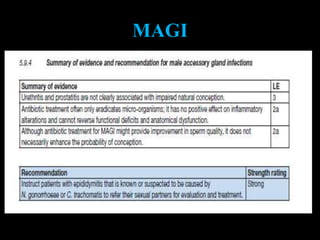
MAGI
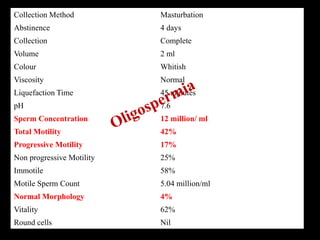
Case Scenario 2
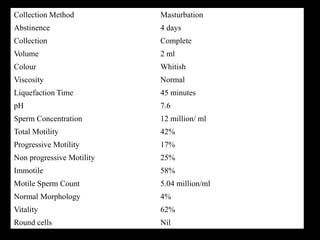
Collection Method Masturbation
Abstinence 4 days
Collection Complete
Volume 2 ml
Colour Whitish
Viscosity Normal
Liquefaction Time 45 minutes
pH 7.6
Sperm Concentration 12 million/ ml
Total Motility 42%
Progressive Motility 17%
Non progressive Motility 25%
Immotile 58%
Motile Sperm Count 5.04 million/ml
Normal Morphology 4%
Vitality 62%
Round cells Nil
Collection Method Masturbation
Abstinence 4 days
Collection Complete
Volume 2 ml
Colour Whitish
Viscosity Normal
Liquefaction Time 45 minutes
pH 7.6
Sperm Concentration 12 million/ ml
Total Motility 42%
Progressive Motility 17%
Non progressive Motility 25%
Immotile 58%
Motile Sperm Count 5.04 million/ml
Normal Morphology 4%
Vitality 62%
Round cells Nil
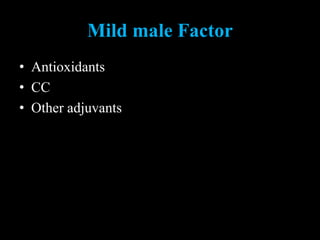
Mild male Factor
• Antioxidants
• CC
• Other adjuvants
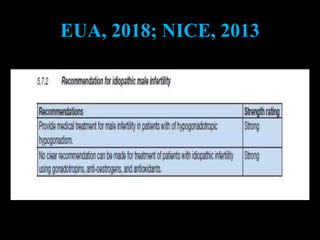
EUA, 2018; NICE, 2013
• Antioxidants do not appear to improve semen
parameters or DNA fragmentation among men with
male factor infertility.
• While previous data suggest that antioxidants improve
pregnancy rates in in vitro fertilization, these data
suggest they do not improve in vivo conception.
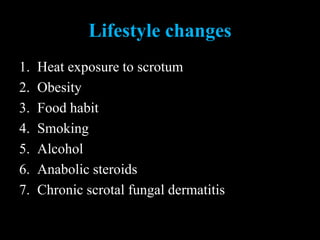
Lifestyle changes
1. Heat exposure to scrotum
2. Obesity
3. Food habit
4. Smoking
5. Alcohol
6. Anabolic steroids
7. Chronic scrotal fungal dermatitis
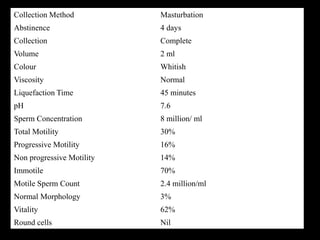
After 3 months of antioxidants here
Collection Method Masturbation
Abstinence 4 days
Collection Complete
Volume 2 ml
Colour Whitish
Viscosity Normal
Liquefaction Time 45 minutes
pH 7.6
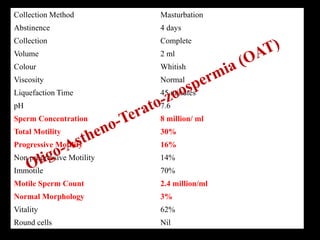
Sperm Concentration 8 million/ ml
Total Motility 30%
Progressive Motility 16%
Non progressive Motility 14%
Immotile 70%
Motile Sperm Count 2.4 million/ml
Normal Morphology 3%
Vitality 62%
Round cells Nil
Collection Method Masturbation
Abstinence 4 days
Collection Complete
Volume 2 ml
Colour Whitish
Viscosity Normal
Liquefaction Time 45 minutes
pH 7.6
Sperm Concentration 8 million/ ml
Total Motility 30%
Progressive Motility 16%
Non progressive Motility 14%
Immotile 70%
Motile Sperm Count 2.4 million/ml
Normal Morphology 3%
Vitality 62%
Round cells Nil
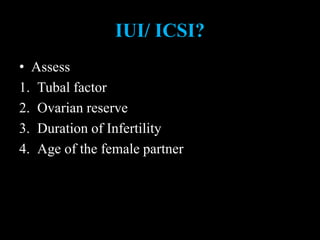
IUI/ ICSI?
• Assess
1. Tubal factor
2. Ovarian reserve
3. Duration of Infertility
4. Age of the female partner
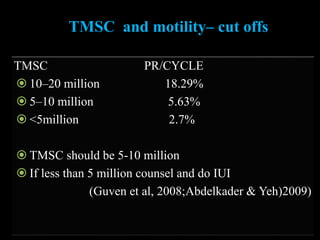
TMSC and motility– cut offs
TMSC PR/CYCLE
 10–20 million 18.29%
 5–10 million 5.63%
 <5million 2.7%
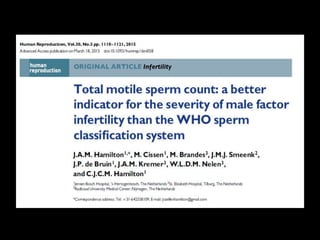
 TMSC should be 5-10 million
 If less than 5 million counsel and do IUI
(Guven et al, 2008;Abdelkader & Yeh)2009)
Post wash and decide
• “Trial IUI”
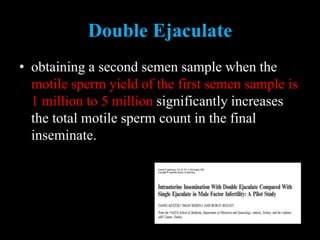
Double Ejaculate
• obtaining a second semen sample when the
motile sperm yield of the first semen sample is
1 million to 5 million significantly increases
the total motile sperm count in the final
inseminate.
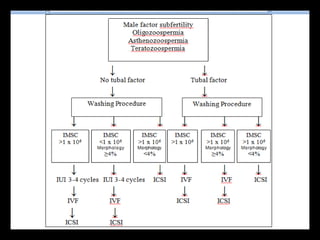
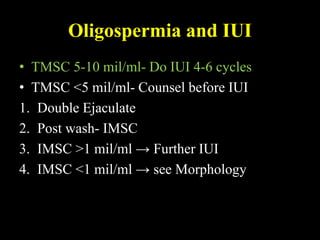
Oligospermia and IUI
• TMSC 5-10 mil/ml- Do IUI 4-6 cycles
• TMSC <5 mil/ml- Counsel before IUI
1. Double Ejaculate
2. Post wash- IMSC
3. IMSC >1 mil/ml → Further IUI
4. IMSC <1 mil/ml → see Morphology
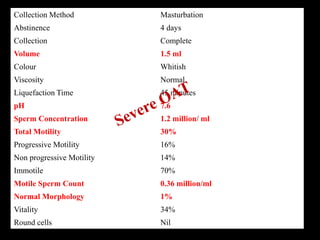
Case Scenario 3
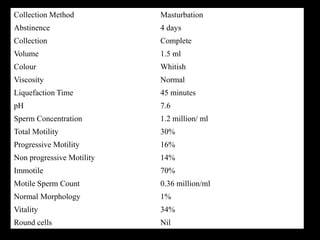
Collection Method Masturbation
Abstinence 4 days
Collection Complete
Volume 1.5 ml
Colour Whitish
Viscosity Normal
Liquefaction Time 45 minutes
pH 7.6
Sperm Concentration 1.2 million/ ml
Total Motility 30%
Progressive Motility 16%
Non progressive Motility 14%
Immotile 70%
Motile Sperm Count 0.36 million/ml
Normal Morphology 1%
Vitality 34%
Round cells Nil
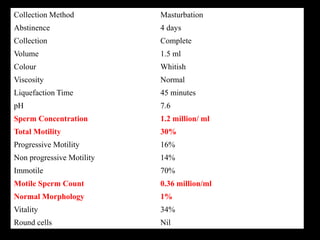
Collection Method Masturbation
Abstinence 4 days
Collection Complete
Volume 1.5 ml
Colour Whitish
Viscosity Normal
Liquefaction Time 45 minutes
pH 7.6
Sperm Concentration 1.2 million/ ml
Total Motility 30%
Progressive Motility 16%
Non progressive Motility 14%
Immotile 70%
Motile Sperm Count 0.36 million/ml
Normal Morphology 1%
Vitality 34%
Round cells Nil
Collection Method Masturbation
Abstinence 4 days
Collection Complete
Volume 1.5 ml
Colour Whitish
Viscosity Normal
Liquefaction Time 45 minutes
pH 7.6
Sperm Concentration 1.2 million/ ml
Total Motility 30%
Progressive Motility 16%
Non progressive Motility 14%
Immotile 70%
Motile Sperm Count 0.36 million/ml
Normal Morphology 1%
Vitality 34%
Round cells Nil
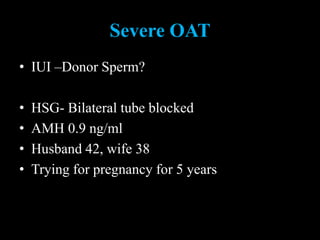
Severe OAT
• IUI –Donor Sperm?
• HSG- Bilateral tube blocked
• AMH 0.9 ng/ml
• Husband 42, wife 38
• Trying for pregnancy for 5 years
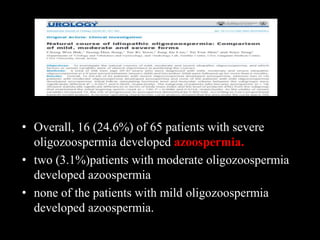
• Overall, 16 (24.6%) of 65 patients with severe
oligozoospermia developed azoospermia.
• two (3.1%)patients with moderate oligozoospermia
developed azoospermia
• none of the patients with mild oligozoospermia
developed azoospermia.
Treatment should NOT be delayed
• Antioxidants
• Consider freezing
• ICSI
• In extreme cases- may need preparation for
TESA
• As in azoospermia, in extreme cases of
oligozoospermia (spermatozoa < 1
million/mL), there is an increased incidence
of obstruction of the male genital tract and
genetic abnormalities.
History Taking
• Lifestyle
• Medical history- Diabetes, Mumps, Cancer
• Surgical history- Hernia, Orchidopexy,
Pituitary Surgery
• Drugs history- Sulphasalazine, cytotoxic
drugs, steroids
• Sexual history
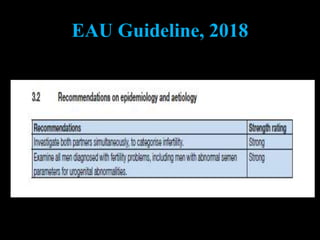
EAU Guideline, 2018
Physical Examination
• May diagnose serious disorders
• General body habitus, secondary sex
characters, gynaecomastia
• Testicular size and consistency
• Varicocele
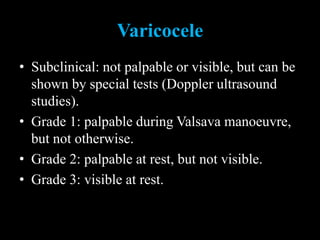
Varicocele
• Subclinical: not palpable or visible, but can be
shown by special tests (Doppler ultrasound
studies).
• Grade 1: palpable during Valsava manoeuvre,
but not otherwise.
• Grade 2: palpable at rest, but not visible.
• Grade 3: visible at rest.
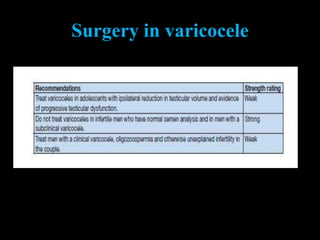
Surgery in varicocele
Investigations
• Endocrine
• Urological
• Genetic testing
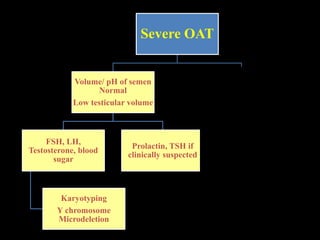
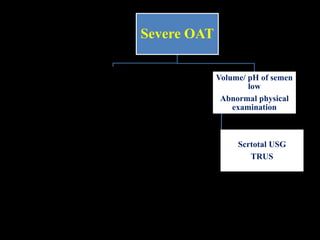
Severe OAT
Volume/ pH of semen
Normal
Low testicular volume
FSH, LH,
Testosterone, blood
sugar
Karyotyping
Y chromosome
Microdeletion
Prolactin, TSH if
clinically suspected
Volume/ pH of semen
low
Abnormal physical
examination
Scrtotal USG
TRUS
Severe OAT
Volume/ pH of semen
Normal
Low testicular volume
FSH, LH,
Testosterone, blood
sugar
Karyotyping
Y chromosome
Microdeletion
Prolactin, TSH if
clinically suspected
Volume/ pH of semen
low
Abnormal physical
examination
Scrtotal USG
TRUS
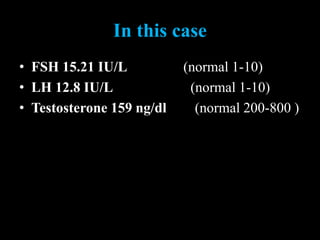
In this case
• FSH 15.21 IU/L (normal 1-10)
• LH 12.8 IU/L (normal 1-10)
• Testosterone 159 ng/dl (normal 200-800 )
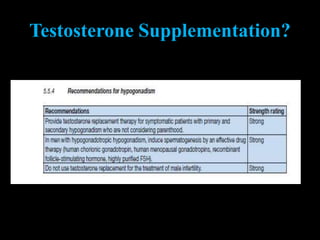
Testosterone Supplementation?
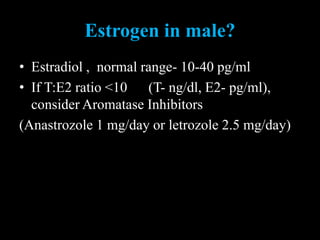
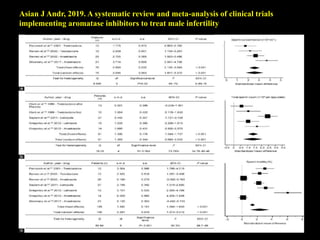
Estrogen in male?
• Estradiol , normal range- 10-40 pg/ml
• If T:E2 ratio <10 (T- ng/dl, E2- pg/ml),
consider Aromatase Inhibitors
(Anastrozole 1 mg/day or letrozole 2.5 mg/day)
Asian J Andr, 2019. A systematic review and meta-analysis of clinical trials
implementing aromatase inhibitors to treat male infertility
Case Scenario 4
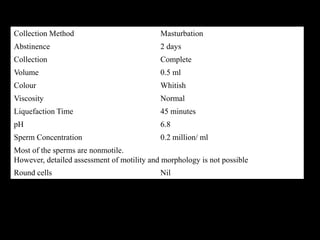
Collection Method Masturbation
Abstinence 2 days
Collection Complete
Volume 0.5 ml
Colour Whitish
Viscosity Normal
Liquefaction Time 45 minutes
pH 6.8
Sperm Concentration 0.2 million/ ml
Most of the sperms are nonmotile.
However, detailed assessment of motility and morphology is not possible
Round cells Nil
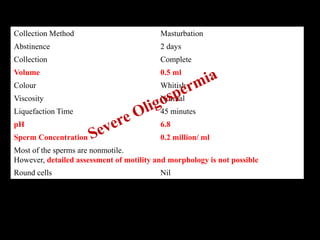
Collection Method Masturbation
Abstinence 2 days
Collection Complete
Volume 0.5 ml
Colour Whitish
Viscosity Normal
Liquefaction Time 45 minutes
pH 6.8
Sperm Concentration 0.2 million/ ml
Most of the sperms are nonmotile.
However, detailed assessment of motility and morphology is not possible
Round cells Nil
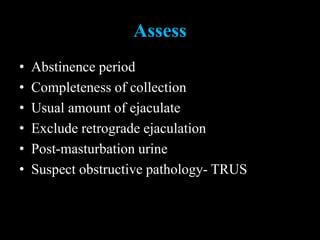
Assess
• Abstinence period
• Completeness of collection
• Usual amount of ejaculate
• Exclude retrograde ejaculation
• Post-masturbation urine
• Suspect obstructive pathology- TRUS
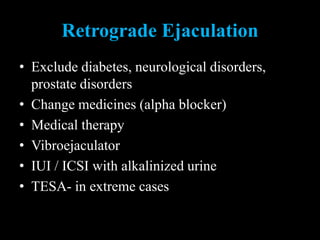
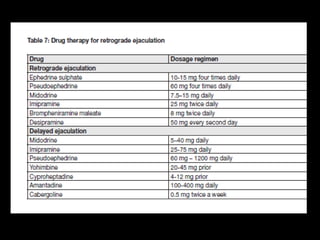
Retrograde Ejaculation
• Exclude diabetes, neurological disorders,
prostate disorders
• Change medicines (alpha blocker)
• Medical therapy
• Vibroejaculator
• IUI / ICSI with alkalinized urine
• TESA- in extreme cases
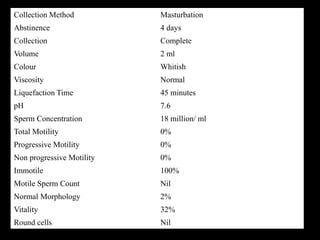
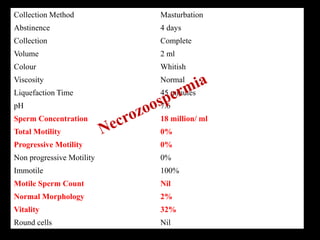
Case Scenario 5
Collection Method Masturbation
Abstinence 4 days
Collection Complete
Volume 2 ml
Colour Whitish
Viscosity Normal
Liquefaction Time 45 minutes
pH 7.6
Sperm Concentration 18 million/ ml
Total Motility 0%
Progressive Motility 0%
Non progressive Motility 0%
Immotile 100%
Motile Sperm Count Nil
Normal Morphology 2%
Vitality 32%
Round cells Nil
Collection Method Masturbation
Abstinence 4 days
Collection Complete
Volume 2 ml
Colour Whitish
Viscosity Normal
Liquefaction Time 45 minutes
pH 7.6
Sperm Concentration 18 million/ ml
Total Motility 0%
Progressive Motility 0%
Non progressive Motility 0%
Immotile 100%
Motile Sperm Count Nil
Normal Morphology 2%
Vitality 32%
Round cells Nil
Collection Method Masturbation
Abstinence 4 days
Collection Complete
Volume 2 ml
Colour Whitish
Viscosity Normal
Liquefaction Time 45 minutes
pH 7.6
Sperm Concentration 18 million/ ml
Total Motility 0%
Progressive Motility 0%
Non progressive Motility 0%
Immotile 100%
Motile Sperm Count Nil
Normal Morphology 2%
Vitality 32%
Round cells Nil
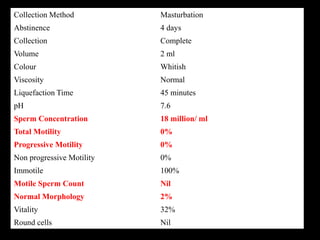
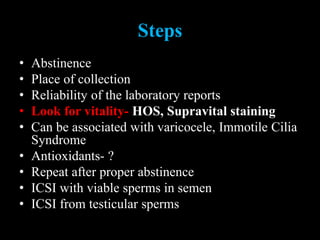
Steps
• Abstinence
• Place of collection
• Reliability of the laboratory reports
• Look for vitality- HOS, Supravital staining
• Can be associated with varicocele, Immotile Cilia
Syndrome
• Antioxidants- ?
• Repeat after proper abstinence
• ICSI with viable sperms in semen
• ICSI from testicular sperms
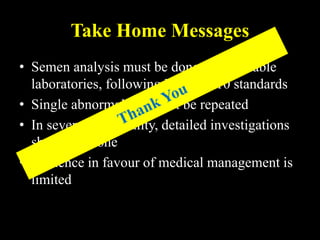
Take Home Messages
• Semen analysis must be done from reliable
laboratories, following WHO 2010 standards
• Single abnormal test must be repeated
• In severe abnormality, detailed investigations
should be done
• Evidence in favour of medical management is
limited

Case Scenarios in Different Semen Analysis Results

  • 1.
    Case Scenarios onDifferent Semen Analysis Results Sujoy Dasgupta MBBS (Gold Medalist, Hons) MS (OBGY- Gold Medalist) DNB (New Delhi) MRCOG (London) Advanced ART Course for Clinicians (NUHS, Singapore) Consultant: Reproductive Medicine, Genome Fertility Centre, Kolkata Managing Committee Member, Bengal Obstetric & Gynaecological Society (BOGS)- 2019-20 Secretary, Subfertility and Reproductive Endocrinology Committee, BOGS- 2019-20 Winner, Prof Geoffrey Chamberlain Award, RCOG World Congress, London, 2019
  • 3.
  • 4.
    Esteves S C.Clinical relevance of routine semen analysis and controversies surrounding the 2010 World Health Organization criteria for semen examination. Int Braz J Urol. 2014; 40: 443-53
  • 5.
    Esteves S C.Clinical relevance of routine semen analysis and controversies surrounding the 2010 World Health Organization criteria for semen examination. Int Braz J Urol. 2014; 40: 443-53
  • 6.
    Cooper TG etal. World Health Organization reference values for human semen characteristics. Hum Reprod Update. 2010; Vol.16: 3, 231–245
  • 7.
    Limitations of WHO2010 Semen Analysis • Based on parameters in a large group of fertile men along with defined confidence intervals from recent fathers with known time-to-pregnancy (TTP). • The WHO does not consider the values set as true reference values but recommends or suggests acceptable levels. • Day to day variation
  • 9.
  • 10.
  • 14.
    What to do •Method of collection • Hand washing before collection • Special Tests- Round cells vs Pus cells • History • Culture • Antibiotics?
  • 15.
    EUA Guideline, 2018 •The clinical significance of an increased concentration of leukocytes in the ejaculate is controversial. • Although leukocytospermia is a sign of inflammation, it is not necessarily associated with bacterial or viral infections. • More leukocytes found in men with prostatitis compared to those without inflammation
  • 16.
  • 17.
  • 18.
    Collection Method Masturbation Abstinence4 days Collection Complete Volume 2 ml Colour Whitish Viscosity Normal Liquefaction Time 45 minutes pH 7.6 Sperm Concentration 12 million/ ml Total Motility 42% Progressive Motility 17% Non progressive Motility 25% Immotile 58% Motile Sperm Count 5.04 million/ml Normal Morphology 4% Vitality 62% Round cells Nil
  • 19.
    Collection Method Masturbation Abstinence4 days Collection Complete Volume 2 ml Colour Whitish Viscosity Normal Liquefaction Time 45 minutes pH 7.6 Sperm Concentration 12 million/ ml Total Motility 42% Progressive Motility 17% Non progressive Motility 25% Immotile 58% Motile Sperm Count 5.04 million/ml Normal Morphology 4% Vitality 62% Round cells Nil
  • 20.
    Mild male Factor •Antioxidants • CC • Other adjuvants
  • 21.
  • 22.
    • Antioxidants donot appear to improve semen parameters or DNA fragmentation among men with male factor infertility. • While previous data suggest that antioxidants improve pregnancy rates in in vitro fertilization, these data suggest they do not improve in vivo conception.
  • 23.
    Lifestyle changes 1. Heatexposure to scrotum 2. Obesity 3. Food habit 4. Smoking 5. Alcohol 6. Anabolic steroids 7. Chronic scrotal fungal dermatitis
  • 24.
    After 3 monthsof antioxidants here
  • 25.
    Collection Method Masturbation Abstinence4 days Collection Complete Volume 2 ml Colour Whitish Viscosity Normal Liquefaction Time 45 minutes pH 7.6 Sperm Concentration 8 million/ ml Total Motility 30% Progressive Motility 16% Non progressive Motility 14% Immotile 70% Motile Sperm Count 2.4 million/ml Normal Morphology 3% Vitality 62% Round cells Nil
  • 26.
    Collection Method Masturbation Abstinence4 days Collection Complete Volume 2 ml Colour Whitish Viscosity Normal Liquefaction Time 45 minutes pH 7.6 Sperm Concentration 8 million/ ml Total Motility 30% Progressive Motility 16% Non progressive Motility 14% Immotile 70% Motile Sperm Count 2.4 million/ml Normal Morphology 3% Vitality 62% Round cells Nil
  • 27.
    IUI/ ICSI? • Assess 1.Tubal factor 2. Ovarian reserve 3. Duration of Infertility 4. Age of the female partner
  • 29.
    TMSC and motility–cut offs TMSC PR/CYCLE  10–20 million 18.29%  5–10 million 5.63%  <5million 2.7%  TMSC should be 5-10 million  If less than 5 million counsel and do IUI (Guven et al, 2008;Abdelkader & Yeh)2009)
  • 30.
    Post wash anddecide • “Trial IUI”
  • 32.
    Double Ejaculate • obtaininga second semen sample when the motile sperm yield of the first semen sample is 1 million to 5 million significantly increases the total motile sperm count in the final inseminate.
  • 33.
    Oligospermia and IUI •TMSC 5-10 mil/ml- Do IUI 4-6 cycles • TMSC <5 mil/ml- Counsel before IUI 1. Double Ejaculate 2. Post wash- IMSC 3. IMSC >1 mil/ml → Further IUI 4. IMSC <1 mil/ml → see Morphology
  • 34.
  • 35.
    Collection Method Masturbation Abstinence4 days Collection Complete Volume 1.5 ml Colour Whitish Viscosity Normal Liquefaction Time 45 minutes pH 7.6 Sperm Concentration 1.2 million/ ml Total Motility 30% Progressive Motility 16% Non progressive Motility 14% Immotile 70% Motile Sperm Count 0.36 million/ml Normal Morphology 1% Vitality 34% Round cells Nil
  • 36.
    Collection Method Masturbation Abstinence4 days Collection Complete Volume 1.5 ml Colour Whitish Viscosity Normal Liquefaction Time 45 minutes pH 7.6 Sperm Concentration 1.2 million/ ml Total Motility 30% Progressive Motility 16% Non progressive Motility 14% Immotile 70% Motile Sperm Count 0.36 million/ml Normal Morphology 1% Vitality 34% Round cells Nil
  • 37.
    Collection Method Masturbation Abstinence4 days Collection Complete Volume 1.5 ml Colour Whitish Viscosity Normal Liquefaction Time 45 minutes pH 7.6 Sperm Concentration 1.2 million/ ml Total Motility 30% Progressive Motility 16% Non progressive Motility 14% Immotile 70% Motile Sperm Count 0.36 million/ml Normal Morphology 1% Vitality 34% Round cells Nil
  • 38.
    Severe OAT • IUI–Donor Sperm? • HSG- Bilateral tube blocked • AMH 0.9 ng/ml • Husband 42, wife 38 • Trying for pregnancy for 5 years
  • 39.
    • Overall, 16(24.6%) of 65 patients with severe oligozoospermia developed azoospermia. • two (3.1%)patients with moderate oligozoospermia developed azoospermia • none of the patients with mild oligozoospermia developed azoospermia.
  • 40.
    Treatment should NOTbe delayed • Antioxidants • Consider freezing • ICSI • In extreme cases- may need preparation for TESA
  • 41.
    • As inazoospermia, in extreme cases of oligozoospermia (spermatozoa < 1 million/mL), there is an increased incidence of obstruction of the male genital tract and genetic abnormalities.
  • 42.
    History Taking • Lifestyle •Medical history- Diabetes, Mumps, Cancer • Surgical history- Hernia, Orchidopexy, Pituitary Surgery • Drugs history- Sulphasalazine, cytotoxic drugs, steroids • Sexual history
  • 43.
  • 44.
    Physical Examination • Maydiagnose serious disorders • General body habitus, secondary sex characters, gynaecomastia • Testicular size and consistency • Varicocele
  • 45.
    Varicocele • Subclinical: notpalpable or visible, but can be shown by special tests (Doppler ultrasound studies). • Grade 1: palpable during Valsava manoeuvre, but not otherwise. • Grade 2: palpable at rest, but not visible. • Grade 3: visible at rest.
  • 46.
  • 47.
  • 48.
    Severe OAT Volume/ pHof semen Normal Low testicular volume FSH, LH, Testosterone, blood sugar Karyotyping Y chromosome Microdeletion Prolactin, TSH if clinically suspected Volume/ pH of semen low Abnormal physical examination Scrtotal USG TRUS
  • 49.
    Severe OAT Volume/ pHof semen Normal Low testicular volume FSH, LH, Testosterone, blood sugar Karyotyping Y chromosome Microdeletion Prolactin, TSH if clinically suspected Volume/ pH of semen low Abnormal physical examination Scrtotal USG TRUS
  • 50.
    In this case •FSH 15.21 IU/L (normal 1-10) • LH 12.8 IU/L (normal 1-10) • Testosterone 159 ng/dl (normal 200-800 )
  • 51.
  • 52.
    Estrogen in male? •Estradiol , normal range- 10-40 pg/ml • If T:E2 ratio <10 (T- ng/dl, E2- pg/ml), consider Aromatase Inhibitors (Anastrozole 1 mg/day or letrozole 2.5 mg/day)
  • 53.
    Asian J Andr,2019. A systematic review and meta-analysis of clinical trials implementing aromatase inhibitors to treat male infertility
  • 54.
  • 55.
    Collection Method Masturbation Abstinence2 days Collection Complete Volume 0.5 ml Colour Whitish Viscosity Normal Liquefaction Time 45 minutes pH 6.8 Sperm Concentration 0.2 million/ ml Most of the sperms are nonmotile. However, detailed assessment of motility and morphology is not possible Round cells Nil
  • 56.
    Collection Method Masturbation Abstinence2 days Collection Complete Volume 0.5 ml Colour Whitish Viscosity Normal Liquefaction Time 45 minutes pH 6.8 Sperm Concentration 0.2 million/ ml Most of the sperms are nonmotile. However, detailed assessment of motility and morphology is not possible Round cells Nil
  • 57.
    Assess • Abstinence period •Completeness of collection • Usual amount of ejaculate • Exclude retrograde ejaculation • Post-masturbation urine • Suspect obstructive pathology- TRUS
  • 58.
    Retrograde Ejaculation • Excludediabetes, neurological disorders, prostate disorders • Change medicines (alpha blocker) • Medical therapy • Vibroejaculator • IUI / ICSI with alkalinized urine • TESA- in extreme cases
  • 60.
  • 61.
    Collection Method Masturbation Abstinence4 days Collection Complete Volume 2 ml Colour Whitish Viscosity Normal Liquefaction Time 45 minutes pH 7.6 Sperm Concentration 18 million/ ml Total Motility 0% Progressive Motility 0% Non progressive Motility 0% Immotile 100% Motile Sperm Count Nil Normal Morphology 2% Vitality 32% Round cells Nil
  • 62.
    Collection Method Masturbation Abstinence4 days Collection Complete Volume 2 ml Colour Whitish Viscosity Normal Liquefaction Time 45 minutes pH 7.6 Sperm Concentration 18 million/ ml Total Motility 0% Progressive Motility 0% Non progressive Motility 0% Immotile 100% Motile Sperm Count Nil Normal Morphology 2% Vitality 32% Round cells Nil
  • 63.
    Collection Method Masturbation Abstinence4 days Collection Complete Volume 2 ml Colour Whitish Viscosity Normal Liquefaction Time 45 minutes pH 7.6 Sperm Concentration 18 million/ ml Total Motility 0% Progressive Motility 0% Non progressive Motility 0% Immotile 100% Motile Sperm Count Nil Normal Morphology 2% Vitality 32% Round cells Nil
  • 64.
    Steps • Abstinence • Placeof collection • Reliability of the laboratory reports • Look for vitality- HOS, Supravital staining • Can be associated with varicocele, Immotile Cilia Syndrome • Antioxidants- ? • Repeat after proper abstinence • ICSI with viable sperms in semen • ICSI from testicular sperms
  • 65.
    Take Home Messages •Semen analysis must be done from reliable laboratories, following WHO 2010 standards • Single abnormal test must be repeated • In severe abnormality, detailed investigations should be done • Evidence in favour of medical management is limited