Jose Mercado, invested 10,000 and borrowed
50,000 to start his business. He purchased
photocopying machine for 30,000 and supplies for
10,000. He paid two months’ rent for 10,000, salary
for 4,000 and business permit for 2,000. the
business consumed electricity for 2,500 payable the
following month. During the first month of business
operations, the photocopying service generated
10,000 revenue.
Which of the amounts cited above do you think will be
included in the business financial reports? What is your
reason for including said amounts?
Generally Accepted Accounting Principles
(GAAP)
A widely accepted set of rules, concepts, principles
and procedure issued by Financial Accounting
Standard Board
Accounting Standards
Philippine Accounting Standards and
Philippine Financial Reporting
Standards.
Adopted by International Financial Reporting
Standards.
Accounting standards are set by a
nation’s financial authorities to streamline
the accounting process. This indeed
helped many countries understand the
economic growth of any company in a
structured manner
Fundamental Concepts of Accounting
 Accounting concepts, principles and assumptions serve as the
foundation of accounting of accounting in order to avoid
misunderstanding and enhance and enhance the understanding
and enhance the understanding and usefulness of the financial
statements (Valix et. Al. 2013)
Accounting Concepts are important ideas which
accountants assume in recording business
transactions
Business
entity
Going
concern
Time
period
accrual
Monetary
unit
Accounting concepts are similar throughout the
nation. It helps;
The accounting information to be complete in all
aspects
The accounting information to be available for the
stakeholders on a timely basis.
The accounting information to be understandable by
anyone.
Also, in presenting the accounting information relevant
to the analyzer.
1. Entity Concept
Personal transactions of the owner are separate
from that the business he/she owns.
The business is treated as a unit or entity separate from
its owners.
• Amount invested by the proprietor is shown as liability.
• Amount paid for personal expenses of proprietor are
shown as drawings from capital or the proprietor.
2. Dual Aspect Concept
Every business transaction has two effects. Investing One
Million in business is treated in two ways, Capital Account
and Asset Account, Business’ asset is 1 Million while the
company also owes the person who invested 1 million is
recorded separately
Under this concept;
Every debit entry there is a credit entry. Briefly expressed under:
Assets + Liabilities = Capital
3. Periodicity Concept
An entity’s life can be meaningfully subdivided into equal
time periods for reporting purposes.
This concept allows the users to obtain timely
information to serve as a basis on making decisions
about future activities.
For the purpose of reporting to outsiders, one year is the
usual accounting period.
It is necessary too know at frequent intervals “how things are
going”.
Twelve month period is usually adopted for this purpose. This time
4. Going Concern
This is an assumption made that the business shall
run forever and the forced sale value of assets is
not valued. It will continue for indefinite period.
Financial statements are normally prepared on the
assumption that the reporting entity is a going
concern and will continue in operation for the
foreseeable future.
5. Money measurement
concept
Every aspect of a
business is recorded as
money using this concept.
Only those transactions
are recorded which can
be expressed in monetary
terms.
The Philippine peso is a reasonable unit of
6. Cost Concept
The cost is considered to be the same as what is paid in
the beginning and never its realizable value at a later
point in time.
Fixed Assets are recorded at cost price and are
systematically reduced by the process called
depreciation.
These assets will disappear from balance sheet at the
end of their economic life when they have been fully
depreciated and sold as scrap.
7. Accrual Accounting
The fundamental idea of accrual accounting can be stated
as follows:
The effects of business transactions should be
recognized in the period in which they occurred.
 Income should be recognized in the period when it is
carried regardless of when payment is received.
Expenses should be recognized in the period when it is
incurred regardless of when expenses are earned.
8. Realisation Concept
Revenue is considered earned of the day
 Transfer goods to customer in exchange of
valuable consideration.
This is of great importance in stopping
business from inflating their profit.
The accountant usually use dates
Accounting standards
set by a nation’s financial authorities to streamline the
accounting process.
helped many countries understand the economic
growth of any company in a structured manner
Financial reporting
made easily understandable by these rules and regulations
Unbiased, clear accounting is the order of the day, and it is achieved
following the strict guidelines
Accounting concepts and Accounting
principles
Are the two related ?
The main difference between Accounting Concepts
and Accounting Principles is; Accounting concepts
are the important conventions with which the
accounting data is recorded based on certain
assumptions whereas Accounting principles are
the rules to be followed while reporting financial
data. The former is the data recorder while the
latter is the data presenter.
Parameter of
Comparison
Accounting Concept Accounting Principle
Meaning/Definiti
on
Accounting concepts are the
assumptions upon which the
accounting data is recorded.
Accounting Principles are the rules
to be followed while reporting the
final
data.
Purpose The purpose is to record data
based on the concepts.
The purpose is to report financial
data based on regulatory norms.
Usage Accounting concepts are purely
internal as the companies record
data as per the concepts.
Accounting principles are internal
aspects that need to be presented
to the external bodies for
verification.
Hierarchy of
process
Accounting concepts precede
accounting principles.
Accounting principles succeed the
accounting concepts.
Major Outcome Accounting concepts help in giving
clarity to the data recorded for
Accounting principles must follow
GAAP norms to even avail for a
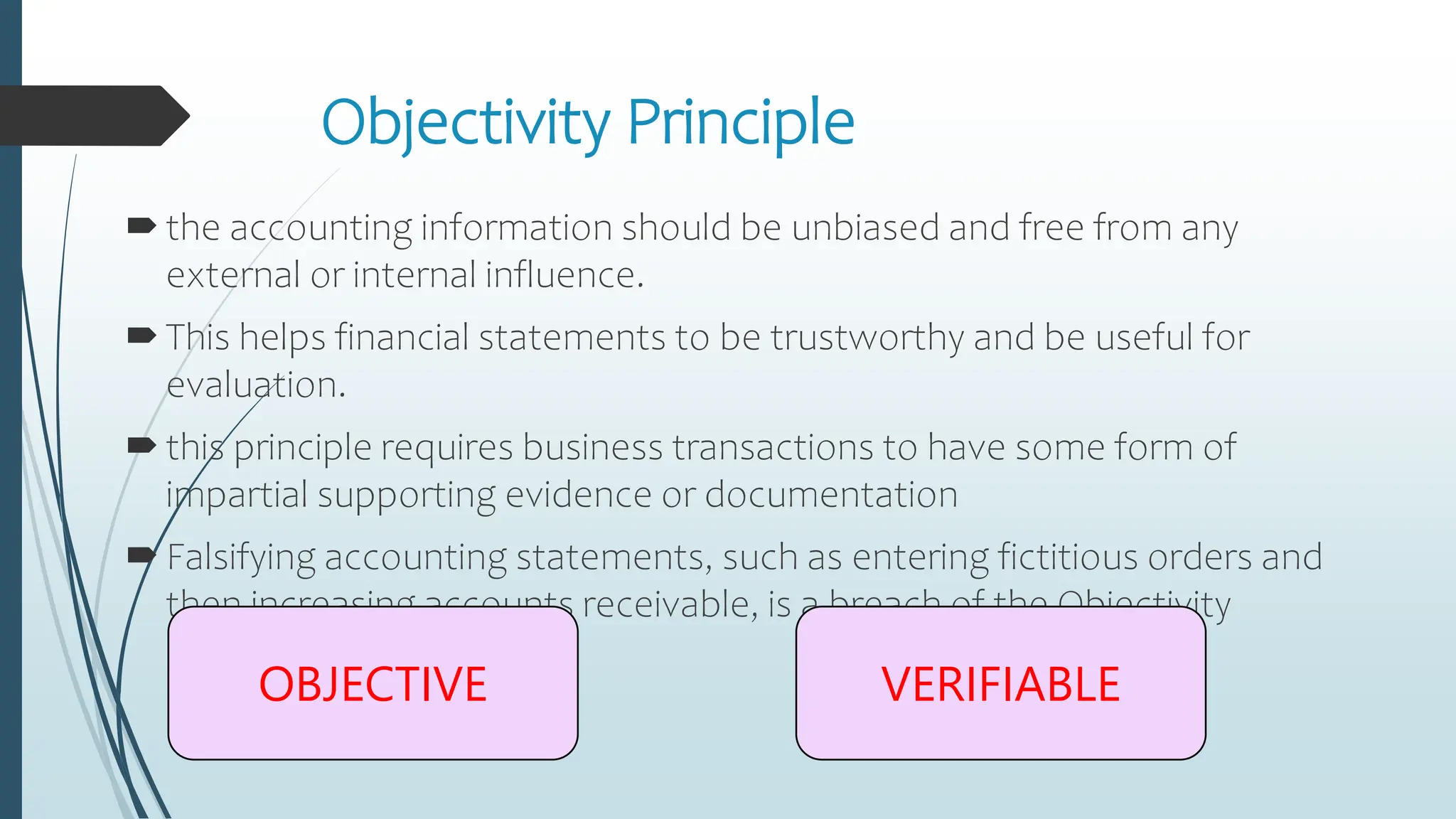
Objectivity Principle
the accounting information should be unbiased and free from any
external or internal influence.
This helps financial statements to be trustworthy and be useful for
evaluation.
this principle requires business transactions to have some form of
impartial supporting evidence or documentation
Falsifying accounting statements, such as entering fictitious orders and
then increasing accounts receivable, is a breach of the Objectivity
Principle.
OBJECTIVE VERIFIABLE
Cost Principle/Historical Cost
Principle
assets be recorded at the original purchase price,
rather than their current market value
When an asset you purchased a year ago may
suddenly gain value for a variety of reasons, the
cost principle maintains that the asset value
remains the same as its original, or purchase, cost
regardless of later changes in market value..
Cost Principle/Historical Cost
Principle
Example:
Year 2020
Land– 2,000,000
Car-300,000
Building- 1,500,000
Year 2021
Land– 3,000,000
Car-200,000
Building- 1,500,000
Matching Principle
Profit is must important factor for the
proprietor to keep the business activities.
Revenue and their related expense in the
same accounting period.
Matching revenues with expenses to
know the profit of the business
Revenue Recognition Principle
the heart of all business performance
Analyst prefer that the revenue recognition
policies for one company are also standard for the
entire industry.
Recognize revenue when goods are sold or
services are rendered, regardless of cash receipt.
there must be a reasonable level of certainty that earned
revenue payment will be received
Five Steps Needed To Satisfy The Updated
Revenue Recognition Principle:
 Identify the contract with the customer.
Identify the contractual performance obligations.
Determine the amount of consideration/price for the
transaction.
Allocate the determined amount of consideration/price
to the contractual obligations.
 Recognize revenue when the performing party satisfies
the performance obligation.
Expense Recognition Principle
Expenses should be recognized in the
accounting period in which goods and
services are used up to produce revenue and
not when the entity pays for those goods and
services.
Adequate Disclosure or Full Disclosure
Principle
Requires that all relevant information
that would affect the user’s
understanding and assessment of the
accounting entity disclosed in loothe
financial statements.
Adequate Disclosure or Full Disclosure
Principle
Example: Land bought 2M pesos in 2022
may be indicated trough a footnote.
Materiality Principle
Financial reporting is only concerned with the
information that is significant enough to affect
evaluation
Materiality depends on the size and nature of the
item judged in the circumstances of its omission. In
deciding whether an item or an aggregate of the
items is material, the nature and the size of the
item are evaluated together.
Materiality Principle
Land Used by the Business Worth 1M
Pesos
Personal Laptop worth 50,000
One pc notebook worth 30 pesos for
business log
Scotch tape worth 5.00 used for
business event
Conservatism/Prudence
There are two acceptable
alternatives in a situation,
choose alternative that will
result in lesser income or
resource.
Consistency Principle
the accounting principle that requires an entity to apply the
same accounting methods, policies, and standards for
preparing and reporting its financial statements
should be followed consistently in future accounting periods.
Firms should use the same accounting method from period to
period to achieve comparability over time within a single
enterprise
However, changes are permitted if justifiable and disclosed in
the financial statements.
The main objective of the consistency principle is to avoid
any intention from management using an inconsistency
approach to manipulate the financial information to ensure
their financial statements look healthy.
Consistency Principle
Example; Income for first half of the
year 2022
Jan----- 1,000
Feb---- 2,000
March– 1,500
April---- $200
Exercise
A company requires that
expenses must be
matched with revenues.
Matching Principle
Exercise
Aling Line sold a piece of cupcake
to her neighbor. Apparently, her
customer is out cash so Aling Line
had to consider it as credit but still
recorded it in her books.
Accrual Concern Concept
Exercise
Dale started a business
assuming that it will not enter
into a liquidation and the
business will run forever.
Going Concern Concept
Exercise
A professional judgement is
needed to decide if an
amount is insignificant or
immaterial.
Materiality Principle
Exercise
An entrepreneur considers the
original amount of the item
bought regardless of the time of
purchase to be shown in the
financial statements
Historical Cost Principle
Exercise
When creating a business, the
entity of the owner must be
separated from the business
Economic Entity Concept
Exercise
The life of a business may be
reported either monthly or
yearly depending on the
period of the business
Time Period Concept
Exercise
Sufficient information must
be disclosed in the financial
statements.
Full Disclosure
Exercise
In order to Bookkeeping
must be free of bias and
prejudice
Objectivity Principle
Exercise
A principle states that the recording
of acquired properties and services
should be recorded at their actual
cost and not at what management
thinks they are worth as at reporting
date.
Historical/Cost Principle
Exercise
A fundamental concept that uses a
Philippine peso for economic activities which
allows the accountants to add and subtract
peso amounts as though each peso has the
same purchasing power as any other peso at
any time.
Monetary Unit Concept
ABM1_Concepts and Principles.pptxABM1_Concepts and Principles.pptx

ABM1_Concepts and Principles.pptxABM1_Concepts and Principles.pptx

  • 2.
    Jose Mercado, invested10,000 and borrowed 50,000 to start his business. He purchased photocopying machine for 30,000 and supplies for 10,000. He paid two months’ rent for 10,000, salary for 4,000 and business permit for 2,000. the business consumed electricity for 2,500 payable the following month. During the first month of business operations, the photocopying service generated 10,000 revenue. Which of the amounts cited above do you think will be included in the business financial reports? What is your reason for including said amounts?
  • 3.
    Generally Accepted AccountingPrinciples (GAAP) A widely accepted set of rules, concepts, principles and procedure issued by Financial Accounting Standard Board Accounting Standards Philippine Accounting Standards and Philippine Financial Reporting Standards. Adopted by International Financial Reporting Standards.
  • 4.
    Accounting standards areset by a nation’s financial authorities to streamline the accounting process. This indeed helped many countries understand the economic growth of any company in a structured manner
  • 5.
    Fundamental Concepts ofAccounting  Accounting concepts, principles and assumptions serve as the foundation of accounting of accounting in order to avoid misunderstanding and enhance and enhance the understanding and enhance the understanding and usefulness of the financial statements (Valix et. Al. 2013) Accounting Concepts are important ideas which accountants assume in recording business transactions Business entity Going concern Time period accrual Monetary unit
  • 6.
    Accounting concepts aresimilar throughout the nation. It helps; The accounting information to be complete in all aspects The accounting information to be available for the stakeholders on a timely basis. The accounting information to be understandable by anyone. Also, in presenting the accounting information relevant to the analyzer.
  • 8.
    1. Entity Concept Personaltransactions of the owner are separate from that the business he/she owns. The business is treated as a unit or entity separate from its owners. • Amount invested by the proprietor is shown as liability. • Amount paid for personal expenses of proprietor are shown as drawings from capital or the proprietor.
  • 9.
    2. Dual AspectConcept Every business transaction has two effects. Investing One Million in business is treated in two ways, Capital Account and Asset Account, Business’ asset is 1 Million while the company also owes the person who invested 1 million is recorded separately Under this concept; Every debit entry there is a credit entry. Briefly expressed under: Assets + Liabilities = Capital
  • 10.
    3. Periodicity Concept Anentity’s life can be meaningfully subdivided into equal time periods for reporting purposes. This concept allows the users to obtain timely information to serve as a basis on making decisions about future activities. For the purpose of reporting to outsiders, one year is the usual accounting period. It is necessary too know at frequent intervals “how things are going”. Twelve month period is usually adopted for this purpose. This time
  • 11.
    4. Going Concern Thisis an assumption made that the business shall run forever and the forced sale value of assets is not valued. It will continue for indefinite period. Financial statements are normally prepared on the assumption that the reporting entity is a going concern and will continue in operation for the foreseeable future.
  • 12.
    5. Money measurement concept Everyaspect of a business is recorded as money using this concept. Only those transactions are recorded which can be expressed in monetary terms. The Philippine peso is a reasonable unit of
  • 13.
    6. Cost Concept Thecost is considered to be the same as what is paid in the beginning and never its realizable value at a later point in time. Fixed Assets are recorded at cost price and are systematically reduced by the process called depreciation. These assets will disappear from balance sheet at the end of their economic life when they have been fully depreciated and sold as scrap.
  • 14.
    7. Accrual Accounting Thefundamental idea of accrual accounting can be stated as follows: The effects of business transactions should be recognized in the period in which they occurred.  Income should be recognized in the period when it is carried regardless of when payment is received. Expenses should be recognized in the period when it is incurred regardless of when expenses are earned.
  • 16.
    8. Realisation Concept Revenueis considered earned of the day  Transfer goods to customer in exchange of valuable consideration. This is of great importance in stopping business from inflating their profit. The accountant usually use dates
  • 17.
    Accounting standards set bya nation’s financial authorities to streamline the accounting process. helped many countries understand the economic growth of any company in a structured manner Financial reporting made easily understandable by these rules and regulations Unbiased, clear accounting is the order of the day, and it is achieved following the strict guidelines
  • 18.
    Accounting concepts andAccounting principles Are the two related ? The main difference between Accounting Concepts and Accounting Principles is; Accounting concepts are the important conventions with which the accounting data is recorded based on certain assumptions whereas Accounting principles are the rules to be followed while reporting financial data. The former is the data recorder while the latter is the data presenter.
  • 19.
    Parameter of Comparison Accounting ConceptAccounting Principle Meaning/Definiti on Accounting concepts are the assumptions upon which the accounting data is recorded. Accounting Principles are the rules to be followed while reporting the final data. Purpose The purpose is to record data based on the concepts. The purpose is to report financial data based on regulatory norms. Usage Accounting concepts are purely internal as the companies record data as per the concepts. Accounting principles are internal aspects that need to be presented to the external bodies for verification. Hierarchy of process Accounting concepts precede accounting principles. Accounting principles succeed the accounting concepts. Major Outcome Accounting concepts help in giving clarity to the data recorded for Accounting principles must follow GAAP norms to even avail for a
  • 21.
    Objectivity Principle the accountinginformation should be unbiased and free from any external or internal influence. This helps financial statements to be trustworthy and be useful for evaluation. this principle requires business transactions to have some form of impartial supporting evidence or documentation Falsifying accounting statements, such as entering fictitious orders and then increasing accounts receivable, is a breach of the Objectivity Principle. OBJECTIVE VERIFIABLE
  • 22.
    Cost Principle/Historical Cost Principle assetsbe recorded at the original purchase price, rather than their current market value When an asset you purchased a year ago may suddenly gain value for a variety of reasons, the cost principle maintains that the asset value remains the same as its original, or purchase, cost regardless of later changes in market value..
  • 23.
    Cost Principle/Historical Cost Principle Example: Year2020 Land– 2,000,000 Car-300,000 Building- 1,500,000 Year 2021 Land– 3,000,000 Car-200,000 Building- 1,500,000
  • 24.
    Matching Principle Profit ismust important factor for the proprietor to keep the business activities. Revenue and their related expense in the same accounting period. Matching revenues with expenses to know the profit of the business
  • 25.
    Revenue Recognition Principle theheart of all business performance Analyst prefer that the revenue recognition policies for one company are also standard for the entire industry. Recognize revenue when goods are sold or services are rendered, regardless of cash receipt. there must be a reasonable level of certainty that earned revenue payment will be received
  • 26.
    Five Steps NeededTo Satisfy The Updated Revenue Recognition Principle:  Identify the contract with the customer. Identify the contractual performance obligations. Determine the amount of consideration/price for the transaction. Allocate the determined amount of consideration/price to the contractual obligations.  Recognize revenue when the performing party satisfies the performance obligation.
  • 27.
    Expense Recognition Principle Expensesshould be recognized in the accounting period in which goods and services are used up to produce revenue and not when the entity pays for those goods and services.
  • 28.
    Adequate Disclosure orFull Disclosure Principle Requires that all relevant information that would affect the user’s understanding and assessment of the accounting entity disclosed in loothe financial statements.
  • 29.
    Adequate Disclosure orFull Disclosure Principle Example: Land bought 2M pesos in 2022 may be indicated trough a footnote.
  • 30.
    Materiality Principle Financial reportingis only concerned with the information that is significant enough to affect evaluation Materiality depends on the size and nature of the item judged in the circumstances of its omission. In deciding whether an item or an aggregate of the items is material, the nature and the size of the item are evaluated together.
  • 31.
    Materiality Principle Land Usedby the Business Worth 1M Pesos Personal Laptop worth 50,000 One pc notebook worth 30 pesos for business log Scotch tape worth 5.00 used for business event
  • 32.
    Conservatism/Prudence There are twoacceptable alternatives in a situation, choose alternative that will result in lesser income or resource.
  • 33.
    Consistency Principle the accountingprinciple that requires an entity to apply the same accounting methods, policies, and standards for preparing and reporting its financial statements should be followed consistently in future accounting periods. Firms should use the same accounting method from period to period to achieve comparability over time within a single enterprise However, changes are permitted if justifiable and disclosed in the financial statements. The main objective of the consistency principle is to avoid any intention from management using an inconsistency approach to manipulate the financial information to ensure their financial statements look healthy.
  • 34.
    Consistency Principle Example; Incomefor first half of the year 2022 Jan----- 1,000 Feb---- 2,000 March– 1,500 April---- $200
  • 36.
    Exercise A company requiresthat expenses must be matched with revenues. Matching Principle
  • 37.
    Exercise Aling Line solda piece of cupcake to her neighbor. Apparently, her customer is out cash so Aling Line had to consider it as credit but still recorded it in her books. Accrual Concern Concept
  • 38.
    Exercise Dale started abusiness assuming that it will not enter into a liquidation and the business will run forever. Going Concern Concept
  • 39.
    Exercise A professional judgementis needed to decide if an amount is insignificant or immaterial. Materiality Principle
  • 40.
    Exercise An entrepreneur considersthe original amount of the item bought regardless of the time of purchase to be shown in the financial statements Historical Cost Principle
  • 41.
    Exercise When creating abusiness, the entity of the owner must be separated from the business Economic Entity Concept
  • 42.
    Exercise The life ofa business may be reported either monthly or yearly depending on the period of the business Time Period Concept
  • 43.
    Exercise Sufficient information must bedisclosed in the financial statements. Full Disclosure
  • 44.
    Exercise In order toBookkeeping must be free of bias and prejudice Objectivity Principle
  • 45.
    Exercise A principle statesthat the recording of acquired properties and services should be recorded at their actual cost and not at what management thinks they are worth as at reporting date. Historical/Cost Principle
  • 46.
    Exercise A fundamental conceptthat uses a Philippine peso for economic activities which allows the accountants to add and subtract peso amounts as though each peso has the same purchasing power as any other peso at any time. Monetary Unit Concept

Editor's Notes

  • #4 GAAP-rules, procedures , standards and techniques – preparation of financial statements
  • #6 These serve as the bedrock of accounting and they are also known as postulates or accounting assumptions, according to Valencia, E. and Roxas, GF. (2014). Accounting concepts are the guidelines or rules to be followed while recording the data for accounting purposes. They may also be called postulates which are to be followed during accounting processes.
  • #8 Concepts- “IIDEAS” --- Mag exercise ako bukas, mag diet– your choice how something you want to be done. Not all business are doing it Principle – Basic rule--- no choice but have to follow- if not to meet, licence will be
  • #11 Jan 1- Dec. 31– calendar year 12 month period starts on any month of the tear other than January 1- FISCAL YEAR May 1, 2016 ends on April 30, 2017. (backward-forward
  • #12 May forever Ang business ko ay..
  • #15 Incurred- na received mo na ang product from seller. Accrual –is when it happens
  • #23 It refers to the amount spent (cash or the cash equivalent) when an item was originally obtained, whether that purchased happened last year or ten years ago; amounts are not adjusted upward for inflation. Example: Buying Land, Car and BUilding
  • #24 It refers to the amount spent (cash or the cash equivalent) when an item was originally obtained, whether that purchased happened last year or ten years ago; amounts are not adjusted upward for inflation. Example: Buying Land, Car and BUilding
  • #29 All material facts must be indicated Example: Land bought at 2M pesos in 2020 may be indicated in the financial statement for through footnote Parenthetical note. (Current market value is 3M)
  • #30 All material facts must be indicated Example: Land bought at 2M pesos in 2020 may be indicated in the financial statement for through footnote Parenthetical note. (Current market value is 3M)
  • #31 Something an amount nagkamali yoing FS pag decision nagbag dahil sa pagkakamali.. If it affects your decision because of that error or statement. Company has cash 100,milyon may kulang na 1,000. it depends on professional judgement. if nagbabago ang decision…
  • #33 Mas palugi- uncertainty to forsee in If not sure do not record the income Record the expenses meron in the future.
  • #36 Fundamental- yon na talaga dapat Enhancing- pagagandahin