






Incorporating hardened vegetated buffers along levees Tim Abbe,  PhD, PEG, PHG ENTRIX, Inc Tom Nelson, Pierce County, WA Al Zehni, PE Pierce County, WA 2009 California Water Conference:  Changing Tides in the Inland Sea – A Confluence of Challenges and Opportunities
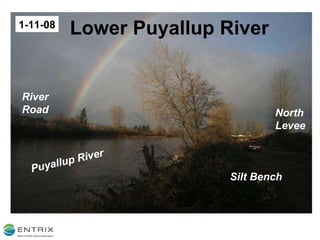
1-11-08 River Road Silt Bench North Levee Puyallup River Lower Puyallup River
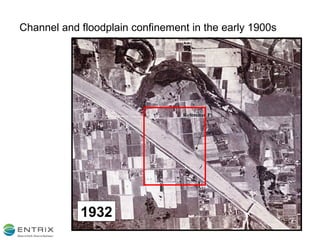
1932 Channel and floodplain confinement in the early 1900s
Problem:  Bank erosion threatening critical levee
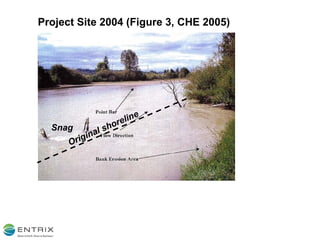
Project Site 2004 (Figure 3, CHE 2005) Original shoreline Snag
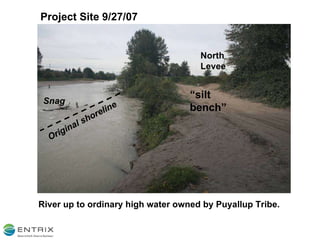
Project Site 9/27/07 Original shoreline Snag River up to ordinary high water owned by Puyallup Tribe. “ silt bench” North Levee
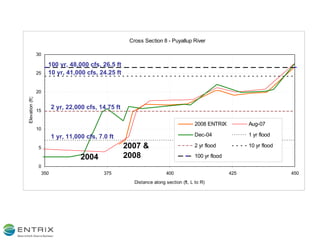
2004 2007 & 2008 10 yr, 41,000 cfs, 24.25 ft 100 yr, 48,000 cfs, 26.5 ft 2 yr, 22,000 cfs, 14.75 ft 1 yr, 11,000 cfs, 7.0 ft
Predicted 10 year flood velocities (RMA2) at the project site are between 6 to 7 fps.
Historic North Levee Structure
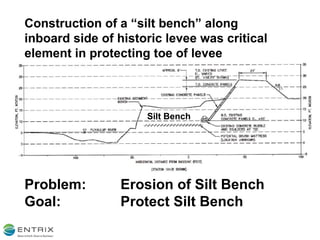
Construction of a “silt bench” along inboard side of historic levee was critical element in protecting toe of levee Silt Bench Problem:  Erosion of Silt Bench Goal:  Protect Silt Bench
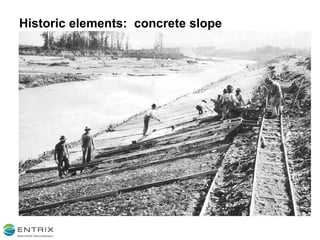
Historic elements:  concrete slope
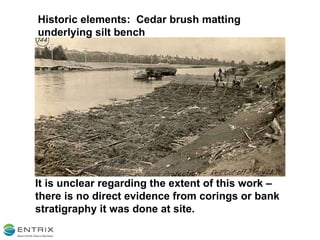
Historic elements:  Cedar brush matting underlying silt bench It is unclear regarding the extent of this work – there is no direct evidence from corings or bank stratigraphy it was done at site.
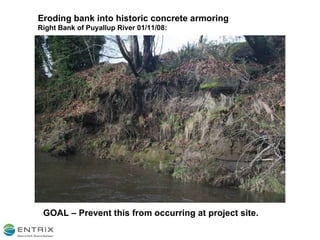
Eroding bank into historic concrete armoring Right Bank of Puyallup River 01/11/08:  GOAL – Prevent this from occurring at project site.
Existing Bank Conditions along Lower Puyallup River
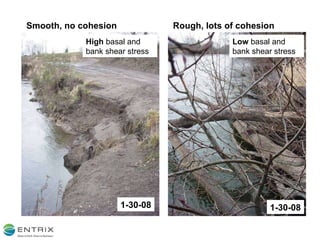
1-30-08 1-30-08 Smooth, no cohesion Rough, lots of cohesion High  basal and bank shear stress Low  basal and bank shear stress
Natural bank evolution
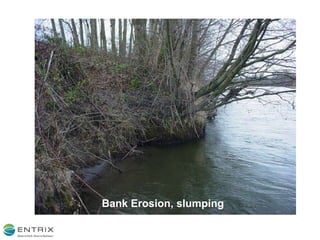
Bank Erosion, slumping
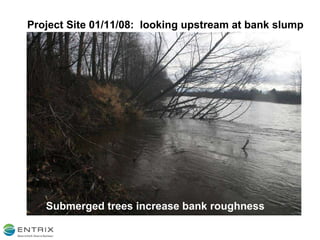
Project Site 01/11/08:  looking upstream at bank slump Submerged trees increase bank roughness
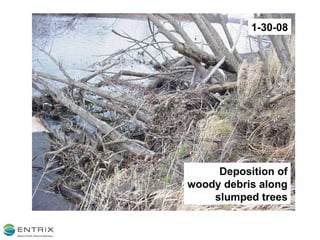
1-30-08 Deposition of woody debris along slumped trees
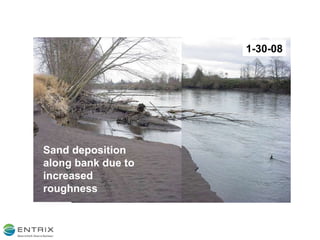
1-30-08 Sand deposition along bank due to increased roughness
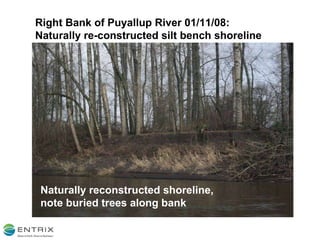
Right Bank of Puyallup River 01/11/08:  Naturally re-constructed silt bench shoreline Naturally reconstructed shoreline, note buried trees along bank
Key factors not considered in previous engineering investigations that developed expensivee heavily engineered bank protection options: Vegetation cohesion Boundary roughness attributed to vegetation and snags  Self-anchoring characteristics of snags Natural shoreline development & regime theory
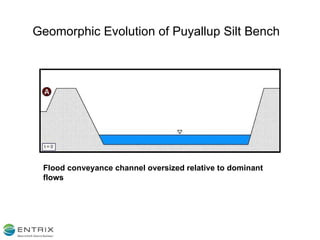
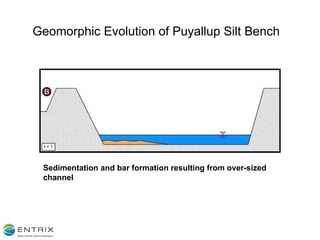
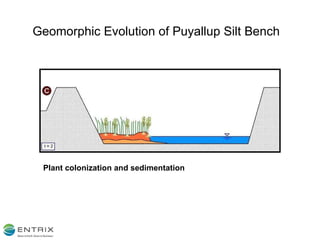
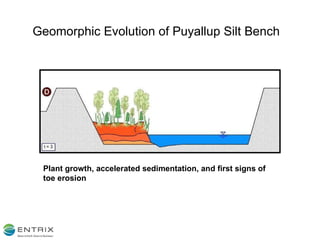
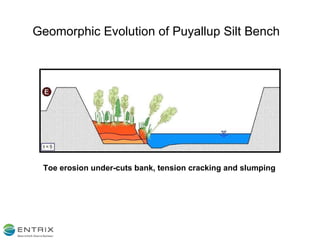
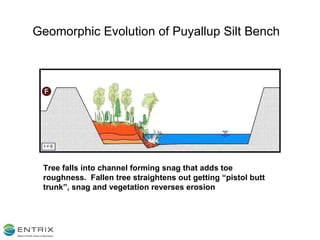
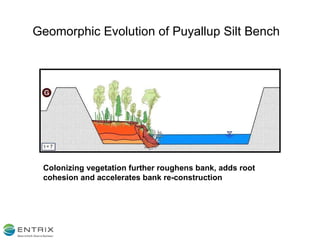
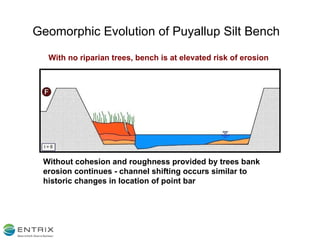
Conceptual Model Illustrating the Geomorphic Evolution of Silt Bench  or the ‘natural’ evolution of  an inset floodplain in an oversized channel
Geomorphic Evolution of Puyallup Silt Bench Flood conveyance channel oversized relative to dominant flows
Geomorphic Evolution of Puyallup Silt Bench Sedimentation and bar formation resulting from over-sized channel
Geomorphic Evolution of Puyallup Silt Bench Plant colonization and sedimentation
Geomorphic Evolution of Puyallup Silt Bench Plant growth, accelerated sedimentation, and first signs of toe erosion
Geomorphic Evolution of Puyallup Silt Bench Toe erosion under-cuts bank, tension cracking and slumping
Geomorphic Evolution of Puyallup Silt Bench Tree falls into channel forming snag that adds toe roughness.  Fallen tree straightens out getting “pistol butt trunk”, snag and vegetation reverses erosion
Geomorphic Evolution of Puyallup Silt Bench Colonizing vegetation further roughens bank, adds root cohesion and accelerates bank re-construction
Geomorphic Evolution of Puyallup Silt Bench Without cohesion and roughness provided by trees bank erosion continues - channel shifting occurs similar to historic changes in location of point bar  With no riparian trees, bench is at elevated risk of erosion
Evidence is mounting that riparian vegetation is effective in slowing erosion Allen, Stephen B., John P. Dwyer, Douglas C. Wallace, and Elizabeth A. Cook, 2003. Missouri River Flood of 1993: Role of Woody Corridor Width in Levee Protection. J. of the American Water Resources Association (JAWRA) 39(4):923-933. The presence of woody corridors played a significant role in preventing damage to levees and reduced failure lengths by half  along a 353-mile segment of the lower Missouri River during the flood of 1993.
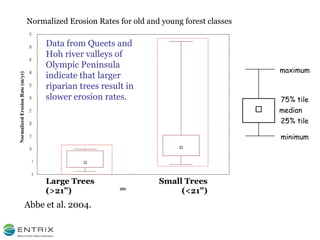
Normalized Erosion Rates for old and young forest classes Abbe et al. 2004.  Data from Queets and Hoh river valleys of Olympic Peninsula indicate that larger riparian trees result in slower erosion rates. Large Trees (>21”) Small Trees (<21”) median 75% tile 25% tile maximum minimum
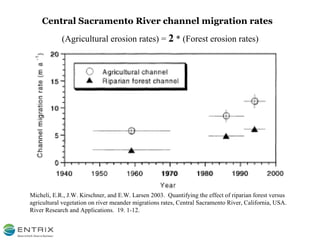
Micheli, E.R., J.W. Kirschner, and E.W. Larsen 2003.  Quantifying the effect of riparian forest versus agricultural vegetation on river meander migrations rates, Central Sacramento River, California, USA.  River Research and Applications.  19. 1-12. Central Sacramento River channel migration rates (Agricultural erosion rates) =  2  * (Forest erosion rates)
Developing levee protection alternatives that work emulate natural processes in the Lower Puyallup
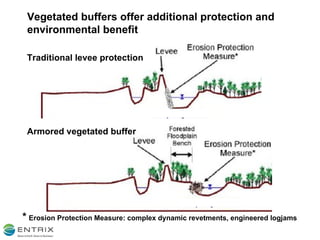
*   Erosion Protection Measure: complex dynamic revetments, engineered logjams Vegetated buffers offer additional protection and environmental benefit Traditional levee protection a Armored vegetated buffer
How do we reinforce the silt bench? How do we do it without raising 100 yr flood wsel? How can we design for scour? How can we reduce cost of structure? Can we ultimately design a ‘self-mitigating’ design to satisfy stakeholders while providing the desired flood protection confidence? The key was seeking a “biomimicry” solution by simulating the natural anchoring and interlocking characteristics of trees and snags. Design Issues
The Answer A self-settling, interlocking “dynamic” revetment A complex revetment to reduce near bank shear stress and create edge habitat Incorporation of natural materials into revetment:  woody debris and vegetation Design that would allow in-water construction. Simple construction. Structure designed to “evolve” with natural processes of the site.
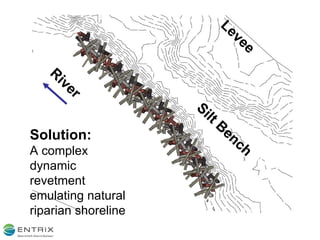
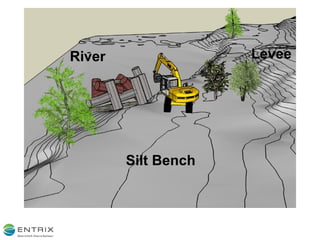
Solution: A complex dynamic revetment emulating natural riparian shoreline Silt Bench Levee River
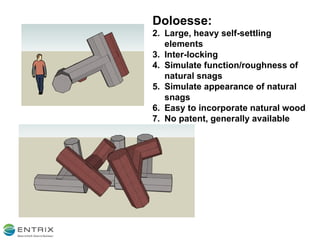
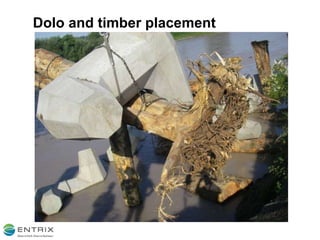
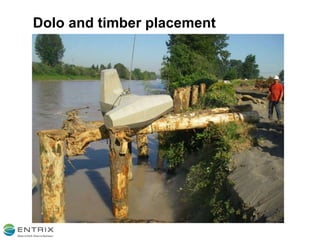
Doloesse: Large, heavy self-settling elements Inter-locking Simulate function/roughness of natural snags Simulate appearance of natural snags Easy to incorporate natural wood No patent, generally available
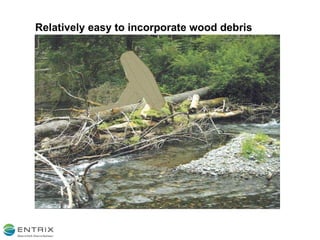
Relatively easy to incorporate wood debris
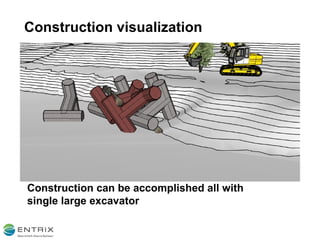
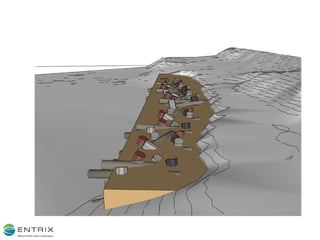
Construction visualization Construction can be accomplished all with single large excavator
Silt Bench River Levee


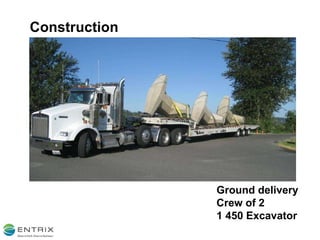
Construction Ground delivery Crew of 2 1 450 Excavator
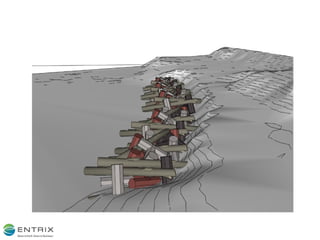
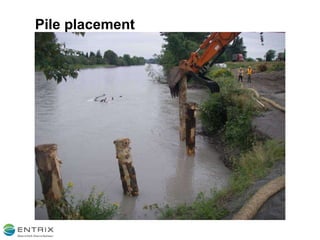
Pile placement
Dolo and timber placement
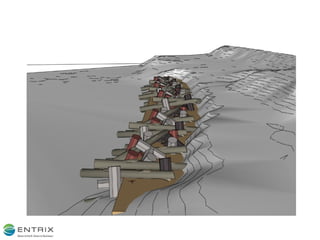
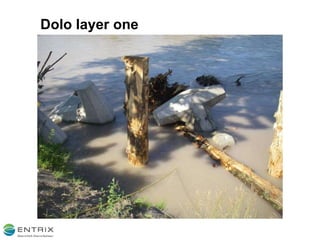
Dolo layer one
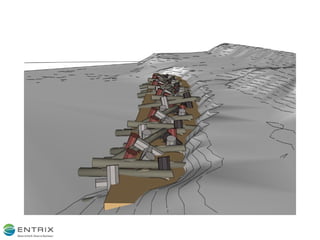
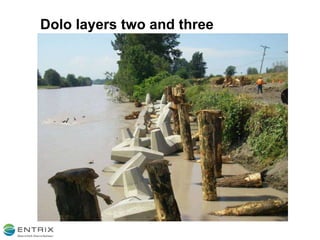
Dolo layers two and three
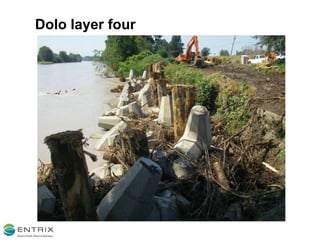
Dolo layer four
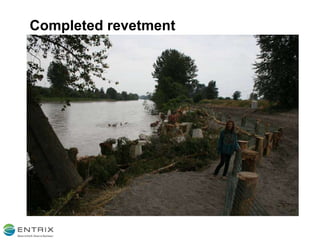
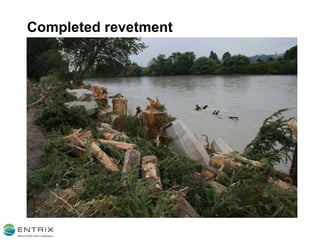
Completed revetment
Completed revetment
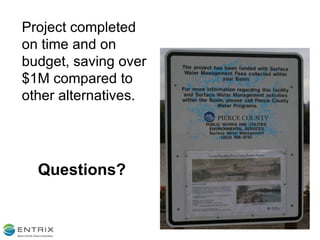
Questions? Project completed on time and on budget, saving over $1M compared to other alternatives.

Abbe Sess10 101309

  • 1.
    Incorporating hardened vegetatedbuffers along levees Tim Abbe, PhD, PEG, PHG ENTRIX, Inc Tom Nelson, Pierce County, WA Al Zehni, PE Pierce County, WA 2009 California Water Conference: Changing Tides in the Inland Sea – A Confluence of Challenges and Opportunities
  • 2.
    1-11-08 River RoadSilt Bench North Levee Puyallup River Lower Puyallup River
  • 3.
    1932 Channel andfloodplain confinement in the early 1900s
  • 4.
    Problem: Bankerosion threatening critical levee
  • 5.
    Project Site 2004(Figure 3, CHE 2005) Original shoreline Snag
  • 6.
    Project Site 9/27/07Original shoreline Snag River up to ordinary high water owned by Puyallup Tribe. “ silt bench” North Levee
  • 7.
    2004 2007 &2008 10 yr, 41,000 cfs, 24.25 ft 100 yr, 48,000 cfs, 26.5 ft 2 yr, 22,000 cfs, 14.75 ft 1 yr, 11,000 cfs, 7.0 ft
  • 8.
    Predicted 10 yearflood velocities (RMA2) at the project site are between 6 to 7 fps.
  • 9.
  • 10.
    Construction of a“silt bench” along inboard side of historic levee was critical element in protecting toe of levee Silt Bench Problem: Erosion of Silt Bench Goal: Protect Silt Bench
  • 11.
    Historic elements: concrete slope
  • 12.
    Historic elements: Cedar brush matting underlying silt bench It is unclear regarding the extent of this work – there is no direct evidence from corings or bank stratigraphy it was done at site.
  • 13.
    Eroding bank intohistoric concrete armoring Right Bank of Puyallup River 01/11/08: GOAL – Prevent this from occurring at project site.
  • 14.
    Existing Bank Conditionsalong Lower Puyallup River
  • 15.
    1-30-08 1-30-08 Smooth,no cohesion Rough, lots of cohesion High basal and bank shear stress Low basal and bank shear stress
  • 16.
  • 17.
  • 18.
    Project Site 01/11/08: looking upstream at bank slump Submerged trees increase bank roughness
  • 19.
    1-30-08 Deposition ofwoody debris along slumped trees
  • 20.
    1-30-08 Sand depositionalong bank due to increased roughness
  • 21.
    Right Bank ofPuyallup River 01/11/08: Naturally re-constructed silt bench shoreline Naturally reconstructed shoreline, note buried trees along bank
  • 22.
    Key factors notconsidered in previous engineering investigations that developed expensivee heavily engineered bank protection options: Vegetation cohesion Boundary roughness attributed to vegetation and snags Self-anchoring characteristics of snags Natural shoreline development & regime theory
  • 23.
    Conceptual Model Illustratingthe Geomorphic Evolution of Silt Bench or the ‘natural’ evolution of an inset floodplain in an oversized channel
  • 24.
    Geomorphic Evolution ofPuyallup Silt Bench Flood conveyance channel oversized relative to dominant flows
  • 25.
    Geomorphic Evolution ofPuyallup Silt Bench Sedimentation and bar formation resulting from over-sized channel
  • 26.
    Geomorphic Evolution ofPuyallup Silt Bench Plant colonization and sedimentation
  • 27.
    Geomorphic Evolution ofPuyallup Silt Bench Plant growth, accelerated sedimentation, and first signs of toe erosion
  • 28.
    Geomorphic Evolution ofPuyallup Silt Bench Toe erosion under-cuts bank, tension cracking and slumping
  • 29.
    Geomorphic Evolution ofPuyallup Silt Bench Tree falls into channel forming snag that adds toe roughness. Fallen tree straightens out getting “pistol butt trunk”, snag and vegetation reverses erosion
  • 30.
    Geomorphic Evolution ofPuyallup Silt Bench Colonizing vegetation further roughens bank, adds root cohesion and accelerates bank re-construction
  • 31.
    Geomorphic Evolution ofPuyallup Silt Bench Without cohesion and roughness provided by trees bank erosion continues - channel shifting occurs similar to historic changes in location of point bar With no riparian trees, bench is at elevated risk of erosion
  • 32.
    Evidence is mountingthat riparian vegetation is effective in slowing erosion Allen, Stephen B., John P. Dwyer, Douglas C. Wallace, and Elizabeth A. Cook, 2003. Missouri River Flood of 1993: Role of Woody Corridor Width in Levee Protection. J. of the American Water Resources Association (JAWRA) 39(4):923-933. The presence of woody corridors played a significant role in preventing damage to levees and reduced failure lengths by half along a 353-mile segment of the lower Missouri River during the flood of 1993.
  • 33.
    Normalized Erosion Ratesfor old and young forest classes Abbe et al. 2004. Data from Queets and Hoh river valleys of Olympic Peninsula indicate that larger riparian trees result in slower erosion rates. Large Trees (>21”) Small Trees (<21”) median 75% tile 25% tile maximum minimum
  • 34.
    Micheli, E.R., J.W.Kirschner, and E.W. Larsen 2003. Quantifying the effect of riparian forest versus agricultural vegetation on river meander migrations rates, Central Sacramento River, California, USA. River Research and Applications. 19. 1-12. Central Sacramento River channel migration rates (Agricultural erosion rates) = 2 * (Forest erosion rates)
  • 35.
    Developing levee protectionalternatives that work emulate natural processes in the Lower Puyallup
  • 36.
    * Erosion Protection Measure: complex dynamic revetments, engineered logjams Vegetated buffers offer additional protection and environmental benefit Traditional levee protection a Armored vegetated buffer
  • 37.
    How do wereinforce the silt bench? How do we do it without raising 100 yr flood wsel? How can we design for scour? How can we reduce cost of structure? Can we ultimately design a ‘self-mitigating’ design to satisfy stakeholders while providing the desired flood protection confidence? The key was seeking a “biomimicry” solution by simulating the natural anchoring and interlocking characteristics of trees and snags. Design Issues
  • 38.
    The Answer Aself-settling, interlocking “dynamic” revetment A complex revetment to reduce near bank shear stress and create edge habitat Incorporation of natural materials into revetment: woody debris and vegetation Design that would allow in-water construction. Simple construction. Structure designed to “evolve” with natural processes of the site.
  • 39.
    Solution: A complexdynamic revetment emulating natural riparian shoreline Silt Bench Levee River
  • 40.
    Doloesse: Large, heavyself-settling elements Inter-locking Simulate function/roughness of natural snags Simulate appearance of natural snags Easy to incorporate natural wood No patent, generally available
  • 41.
    Relatively easy toincorporate wood debris
  • 42.
    Construction visualization Constructioncan be accomplished all with single large excavator
  • 43.
  • 44.
  • 45.
  • 46.
  • 47.
  • 48.
    Construction Ground deliveryCrew of 2 1 450 Excavator
  • 49.
  • 50.
    Dolo and timberplacement
  • 51.
    Dolo and timberplacement
  • 52.
  • 53.
    Dolo layers twoand three
  • 54.
  • 55.
  • 56.
  • 57.
    Questions? Project completedon time and on budget, saving over $1M compared to other alternatives.