HOLIDAYS HOME WORK NAME:AAKASH SAINI CLASS:8th-c ROLLno.:17
Agriculture  is the production of food and goods through farming. Agriculture was the key development that led to the rise of  human   civilization , with the  husbandry  of  domesticated   animals  and plants (i.e.  crops ) creating food  surpluses  that enabled the development of more  densely populated  and  stratified  societies. The study of agriculture is known as  agricultural science . Agriculture is also observed in certain species of  ant  and  termite . AGRICULTURE
Agriculture encompasses a wide variety of specialties and techniques, including ways to expand the lands suitable for plant raising, by digging water-channels and other forms of irrigation.  Cultivation  of crops on  arable land  and the  pastoral   herding  of  livestock  on  rangeland  remain at the foundation of agriculture. In the past century there has been increasing concern to identify and quantify various forms of agriculture. In the developed world the range usually extends between  sustainable agriculture  (e.g.  permaculture  or  organic agriculture ) and  intensive farming  (e.g.  industrial agriculture ).  AGRICULTURE
Modern  agronomy ,  plant breeding ,  pesticides  and  fertilizers , and technological improvements have sharply increased yields from cultivation, and at the same time have caused widespread ecological damage and negative human health effects. Selective  breeding  and modern practices in animal husbandry such as  intensive pig farming  (and similar practices applied to the  chicken ) have similarly increased the output of  meat , but have raised concerns about  animal cruelty  and the health effects of the  antibiotics ,  growth hormones , and other chemicals commonly used in industrial meat production.  AGRICULTURE
The major agricultural products can be broadly grouped into  foods ,  fibers ,  fuels , and  raw materials . In the 2000s, plants have been used to grow bibfuls,  biopharmaceuticals ,  bioplastics , and pharmaceuticals. Specific foods include  cereals ,  vegetables ,  fruits , and  meat .  Fibers  include  cotton ,  wool ,  hemp ,  silk  and  flax .  Raw materials  include lumber and bamboo. Other useful materials are produced by plants, such as  resins . Befouls include  methane  from  biomass ,  ethanol , and biddies.  Cut flowers ,  nursery plants , tropical fish and birds for the pet trade are some of the ornamental products.  AGRICULTURAL PRODUCTS
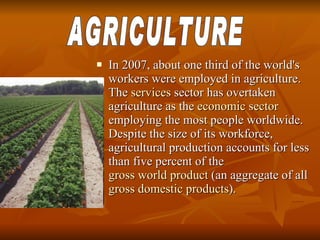
In 2007, about one third of the world's workers were employed in agriculture. The  services  sector has overtaken agriculture as the  economic sector  employing the most people worldwide. Despite the size of its workforce, agricultural production accounts for less than five percent of the  gross world product  (an aggregate of all  gross domestic products ).  AGRICULTURE
Agriculture has played a key role in the development of human  civilization . Until the  Industrial Revolution , the vast majority of the human population labored in agriculture. Development of agricultural techniques has steadily increased agricultural productivity, and the widespread diffusion of these techniques during a time period is often called an  agricultural revolution . A remarkable shift in agricultural practices has occurred over the past century in response to new technologies. In particular, the  Haber-Bosch  method for synthesizing  ammonium nitrate  made the traditional practice of recycling  nutrients  with  crop rotation  and animal  manure  less necessary.  OVERVIEW
Since its development roughly 10,000 years ago, [24]  agriculture has expanded vastly in geographical coverage and yields. Throughout this expansion, new technologies and new crops were integrated. Even then crops were modified through cross-breeding for better yields. Agricultural practices such as  irrigation ,  crop rotation ,  fertilizers , and  pesticides  were developed long ago, but have made great strides in the past century. The  history of agriculture  has played a major role in  human history , as agricultural progress has been a crucial factor in worldwide  socio-economic change .  Wealth -concentration and  militaristic  specializations rarely seen in  hunter-gatherer  cultures are commonplace in societies which practice agriculture.  HISTORY OF AGRICULTURE
So, too, are arts such as epic literature and monumental architecture, as well as codified legal systems. When farmers became capable of producing food beyond the needs of their own families, others in their society were freed to devote themselves to projects other than food acquisition. Historians and anthropologists have long argued that the development of agriculture made civilization possible.  HISTORY OF AGRICULTURE(2)
Since the 1940s, agricultural productivity has increased dramatically, due largely to the increased use of energy-intensive  mechanization ,  fertilizers  and  pesticides . The vast majority of this energy input comes from fossil fuel sources. Between 1950 and 1984, the  Green Revolution  transformed agriculture around the globe, with world grain production increasing by 250% [104] [105]  as  world population  doubled. Modern agriculture's heavy reliance on petrochemicals and mechanization has raised concerns that oil shortages could increase costs and reduce agricultural output, causing food shortages.  ENERGY AND AGRICULTURE
Agriculture in  India  has a  long history  dating back to ten thousand years. Today, India  ranks second  worldwide in farm output.  Agriculture  and allied sectors like  forestry  and  logging  accounted for 16.6% of the GDP in 2007, employed 52% of the total workforce and despite a steady decline of its share in the GDP, is still the largest economic amen and plays a significant role in the overall socio-economic development of India. India is the largest producer in the world of  milk ,  cashew nuts ,  coconuts ,  tea ,  ginger ,  turmeric  and  black pepper . AGRICUTURE IN INDIA
Indian agriculture began by 9000 BCE as a result of early cultivation of plants, and domestication of crops and animals. Settled life soon followed with implements and techniques being developed for agriculture. Double  monsoons  led to two harvests being reaped in one year. Indian products soon reached the world via existing trading networks and foreign crops were introduced to India. Plants and animals—considered essential to their survival by the Indians—came to be worshiped and venerated. The  middle ages  saw irrigation channels reach a new level of sophistication in India and Indian crops affecting the economies of other regions of the world under  Islamic  patronage.  HISTORY OF AGRICULTURE
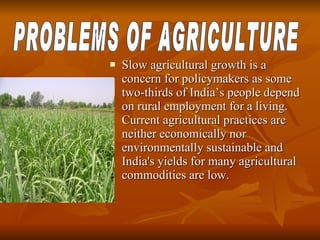
Slow agricultural growth is a concern for policymakers as some two-thirds of India’s people depend on rural employment for a living. Current agricultural practices are neither economically nor environmentally sustainable and India's yields for many agricultural commodities are low. PROBLEMS OF AGRICULTURE
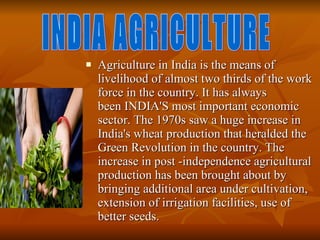
Agriculture in India is the means of livelihood of almost two thirds of the work force in the country. It has always been INDIA'S most important economic sector. The 1970s saw a huge increase in India's wheat production that heralded the Green Revolution in the country. The increase in post -independence agricultural production has been brought about by bringing additional area under cultivation, extension of irrigation facilities, use of better seeds. INDIA AGRICULTURE
Dependence on India agricultural imports in the early 1960s convinced planners that India's growing population, as well as concerns about national independence, security, and political stability, required self-sufficiency in food production. This perception led to a program of agricultural improvement called the Green Revolution, to a public distribution system, and to price supports for farmers. The growth in food-grain production is a result of concentrated efforts to increase all the Green Revolution inputs needed for higher yields: better seed, more fertilizer, improved irrigation, and education of farmers. Although increased irrigation has helped to lessen year-to-year fluctuations in farm production resulting from the vagaries of the monsoons, it has not eliminated those fluctuations.  INDIA AGRICULTURE
Non traditional crops of India, such as summer mung (a variety of lentil, part of the pulse family), soybeans, peanuts, and sunflowers, were gradually gaining importance. Steps have been taken to ensure an increase in the supply of non-chemical fertilizers at reasonable prices. There are 53 fertilizer quality control laboratories in the country. Realizing the importance of Indian agricultural production for economic development, the central Government of India has played an active role in all aspects of agricultural development. Planning is centralized, and plan priorities, policies, and resource allocations are decided at the central level.  INDIA AGRICULTURE

Aakash

  • 1.
    HOLIDAYS HOME WORKNAME:AAKASH SAINI CLASS:8th-c ROLLno.:17
  • 2.
    Agriculture isthe production of food and goods through farming. Agriculture was the key development that led to the rise of human civilization , with the husbandry of domesticated animals and plants (i.e. crops ) creating food surpluses that enabled the development of more densely populated and stratified societies. The study of agriculture is known as agricultural science . Agriculture is also observed in certain species of ant and termite . AGRICULTURE
  • 3.
    Agriculture encompasses awide variety of specialties and techniques, including ways to expand the lands suitable for plant raising, by digging water-channels and other forms of irrigation. Cultivation of crops on arable land and the pastoral herding of livestock on rangeland remain at the foundation of agriculture. In the past century there has been increasing concern to identify and quantify various forms of agriculture. In the developed world the range usually extends between sustainable agriculture (e.g. permaculture or organic agriculture ) and intensive farming (e.g. industrial agriculture ). AGRICULTURE
  • 4.
    Modern agronomy, plant breeding , pesticides and fertilizers , and technological improvements have sharply increased yields from cultivation, and at the same time have caused widespread ecological damage and negative human health effects. Selective breeding and modern practices in animal husbandry such as intensive pig farming (and similar practices applied to the chicken ) have similarly increased the output of meat , but have raised concerns about animal cruelty and the health effects of the antibiotics , growth hormones , and other chemicals commonly used in industrial meat production. AGRICULTURE
  • 5.
    The major agriculturalproducts can be broadly grouped into foods , fibers , fuels , and raw materials . In the 2000s, plants have been used to grow bibfuls, biopharmaceuticals , bioplastics , and pharmaceuticals. Specific foods include cereals , vegetables , fruits , and meat . Fibers include cotton , wool , hemp , silk and flax . Raw materials include lumber and bamboo. Other useful materials are produced by plants, such as resins . Befouls include methane from biomass , ethanol , and biddies. Cut flowers , nursery plants , tropical fish and birds for the pet trade are some of the ornamental products. AGRICULTURAL PRODUCTS
  • 6.
    In 2007, aboutone third of the world's workers were employed in agriculture. The services sector has overtaken agriculture as the economic sector employing the most people worldwide. Despite the size of its workforce, agricultural production accounts for less than five percent of the gross world product (an aggregate of all gross domestic products ). AGRICULTURE
  • 7.
    Agriculture has playeda key role in the development of human civilization . Until the Industrial Revolution , the vast majority of the human population labored in agriculture. Development of agricultural techniques has steadily increased agricultural productivity, and the widespread diffusion of these techniques during a time period is often called an agricultural revolution . A remarkable shift in agricultural practices has occurred over the past century in response to new technologies. In particular, the Haber-Bosch method for synthesizing ammonium nitrate made the traditional practice of recycling nutrients with crop rotation and animal manure less necessary. OVERVIEW
  • 8.
    Since its developmentroughly 10,000 years ago, [24] agriculture has expanded vastly in geographical coverage and yields. Throughout this expansion, new technologies and new crops were integrated. Even then crops were modified through cross-breeding for better yields. Agricultural practices such as irrigation , crop rotation , fertilizers , and pesticides were developed long ago, but have made great strides in the past century. The history of agriculture has played a major role in human history , as agricultural progress has been a crucial factor in worldwide socio-economic change . Wealth -concentration and militaristic specializations rarely seen in hunter-gatherer cultures are commonplace in societies which practice agriculture. HISTORY OF AGRICULTURE
  • 9.
    So, too, arearts such as epic literature and monumental architecture, as well as codified legal systems. When farmers became capable of producing food beyond the needs of their own families, others in their society were freed to devote themselves to projects other than food acquisition. Historians and anthropologists have long argued that the development of agriculture made civilization possible. HISTORY OF AGRICULTURE(2)
  • 10.
    Since the 1940s,agricultural productivity has increased dramatically, due largely to the increased use of energy-intensive mechanization , fertilizers and pesticides . The vast majority of this energy input comes from fossil fuel sources. Between 1950 and 1984, the Green Revolution transformed agriculture around the globe, with world grain production increasing by 250% [104] [105] as world population doubled. Modern agriculture's heavy reliance on petrochemicals and mechanization has raised concerns that oil shortages could increase costs and reduce agricultural output, causing food shortages. ENERGY AND AGRICULTURE
  • 11.
    Agriculture in India has a long history dating back to ten thousand years. Today, India ranks second worldwide in farm output. Agriculture and allied sectors like forestry and logging accounted for 16.6% of the GDP in 2007, employed 52% of the total workforce and despite a steady decline of its share in the GDP, is still the largest economic amen and plays a significant role in the overall socio-economic development of India. India is the largest producer in the world of milk , cashew nuts , coconuts , tea , ginger , turmeric and black pepper . AGRICUTURE IN INDIA
  • 12.
    Indian agriculture beganby 9000 BCE as a result of early cultivation of plants, and domestication of crops and animals. Settled life soon followed with implements and techniques being developed for agriculture. Double monsoons led to two harvests being reaped in one year. Indian products soon reached the world via existing trading networks and foreign crops were introduced to India. Plants and animals—considered essential to their survival by the Indians—came to be worshiped and venerated. The middle ages saw irrigation channels reach a new level of sophistication in India and Indian crops affecting the economies of other regions of the world under Islamic patronage. HISTORY OF AGRICULTURE
  • 13.
    Slow agricultural growthis a concern for policymakers as some two-thirds of India’s people depend on rural employment for a living. Current agricultural practices are neither economically nor environmentally sustainable and India's yields for many agricultural commodities are low. PROBLEMS OF AGRICULTURE
  • 14.
    Agriculture in Indiais the means of livelihood of almost two thirds of the work force in the country. It has always been INDIA'S most important economic sector. The 1970s saw a huge increase in India's wheat production that heralded the Green Revolution in the country. The increase in post -independence agricultural production has been brought about by bringing additional area under cultivation, extension of irrigation facilities, use of better seeds. INDIA AGRICULTURE
  • 15.
    Dependence on Indiaagricultural imports in the early 1960s convinced planners that India's growing population, as well as concerns about national independence, security, and political stability, required self-sufficiency in food production. This perception led to a program of agricultural improvement called the Green Revolution, to a public distribution system, and to price supports for farmers. The growth in food-grain production is a result of concentrated efforts to increase all the Green Revolution inputs needed for higher yields: better seed, more fertilizer, improved irrigation, and education of farmers. Although increased irrigation has helped to lessen year-to-year fluctuations in farm production resulting from the vagaries of the monsoons, it has not eliminated those fluctuations. INDIA AGRICULTURE
  • 16.
    Non traditional cropsof India, such as summer mung (a variety of lentil, part of the pulse family), soybeans, peanuts, and sunflowers, were gradually gaining importance. Steps have been taken to ensure an increase in the supply of non-chemical fertilizers at reasonable prices. There are 53 fertilizer quality control laboratories in the country. Realizing the importance of Indian agricultural production for economic development, the central Government of India has played an active role in all aspects of agricultural development. Planning is centralized, and plan priorities, policies, and resource allocations are decided at the central level. INDIA AGRICULTURE