ESF provides the COST Office
through a European Commission contract
COST is supported
by the EU Framework Programme
ENERGIC (European Network
Exploring research into
geospatial information
crowdsourcing)
IC1203
Start date: 05/12/2012
End date: 04/12/2016
Chair Cristina Capineri, University of Siena (Italy)
Vice Chair Muki Haklay, UCL London, UK
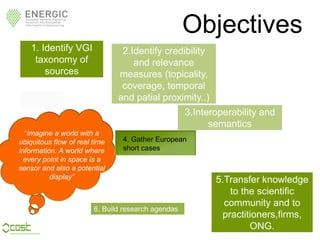
Objectives
1. Identify VGI
taxonomy of
sources
2.Identify credibility
and relevance
measures (topicality,
coverage, temporal
and patial proximity..)
5.Transfer knowledge
to the scientific
community and to
practitioners,firms,
ONG.
“Imagine a world with a
ubiquitous flow of real time
information. A world where
every point in space is a
sensor and also a potential
display”
6. Build research agendas
3.Interoperability and
semantics
4. Gather European
short cases
3
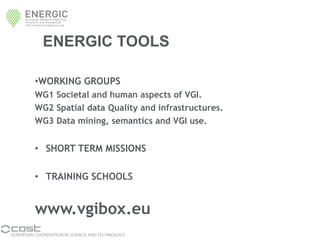
ENERGIC TOOLS
•WORKING GROUPS
WG1 Societal and human aspects of VGI.
WG2 Spatial data Quality and infrastructures.
WG3 Data mining, semantics and VGI use.
• SHORT TERM MISSIONS
• TRAINING SCHOOLS
www.vgibox.eu
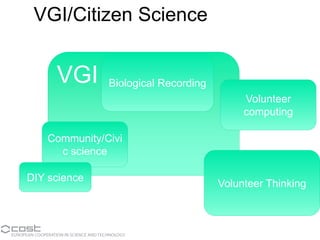
VGI Biological Recording
Community/Civi
c science
Volunteer
computing
DIY science
Volunteer Thinking
VGI/Citizen Science
OSM Studies
• OSM != VGI – they are not the same things.
Without comparing OSM to the wider
‘universe’ of VGI and citizen science projects,
it is wrong to generalise
• OSM deserve special attention, because of
scale, importance to humanitarian activities
and because it’s the biggest open mapping
project.
• But OSM can also benefit from other cases.
OSM, VGI, Citizen Science
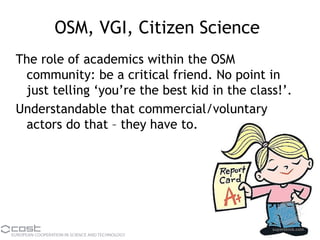
The role of academics within the OSM
community: be a critical friend. No point in
just telling ‘you’re the best kid in the class!’.
Understandable that commercial/voluntary
actors do that – they have to.
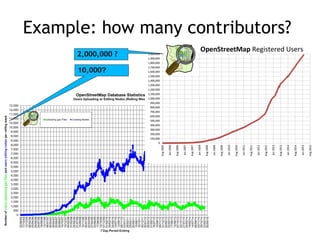
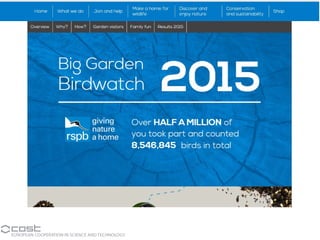
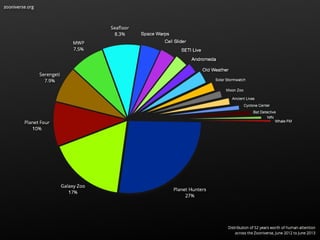
Example: how many contributors?
2,000,000 ?
10,000?
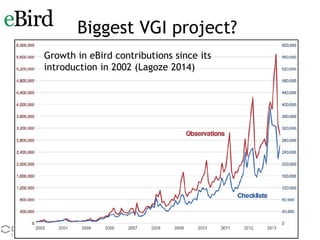
Biggest VGI project?
Growth in eBird contributions since its
introduction in 2002 (Lagoze 2014)
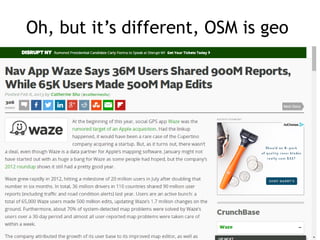
Oh, but it’s different, OSM is geo
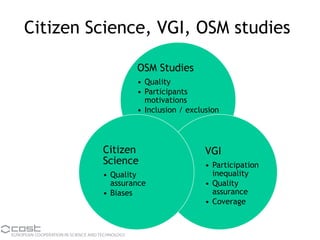
Citizen Science, VGI, OSM studies
OSM Studies
• Quality
• Participants
motivations
• Inclusion / exclusion
VGI
• Participation
inequality
• Quality
assurance
• Coverage
Citizen
Science
• Quality
assurance
• Biases
‘Code of engagement’ for
OpenStreetMap research
Rule 1 – even if you are just going to use the
data, do some mapping, and understand the
process. Join a mapping party.
This will help you avoiding misinterpretations
such as ‘the data is collected by users from
the GPS trails’
‘Code of engagement’ for
OpenStreetMap research
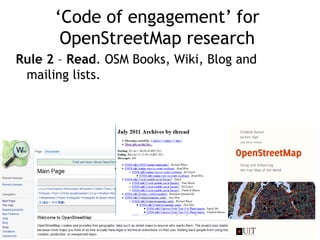
Rule 2 – Read. OSM Books, Wiki, Blog and
mailing lists.
‘Code of engagement’ for
OpenStreetMap research
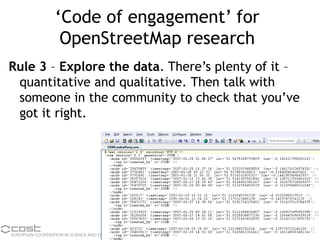
Rule 3 – Explore the data. There’s plenty of it –
quantitative and qualitative. Then talk with
someone in the community to check that you’ve
got it right.
‘Code of engagement’ for
OpenStreetMap research
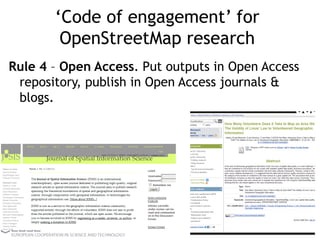
Rule 4 – Open Access. Put outputs in Open Access
repository, publish in Open Access journals &
blogs.
‘Code of engagement’ for
OpenStreetMap research
Rule 5 - Open Knowledge. Publish and share
the data that you’ve processed, and ideally
the code so other people can use it for their
purposes.
Rule 6 - You have a responsibility to your
academic field, and the OpenStreetMap
community can deal with criticism – be a
critical friend.
‘Code of engagement’ for
OpenStreetMap research
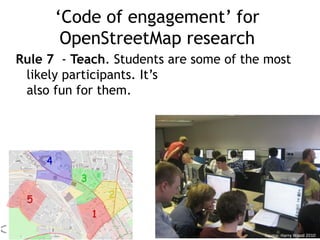
Rule 7 - Teach. Students are some of the most
likely participants. It’s
also fun for them.
Source: Harry Wood 2010
‘Code of engagement’ for
OpenStreetMap research
Maintain links with the OSM community – it will
pay off and will help you to identify new
research directions
Also maintain links within the VGI research
community – even if the term is awkward, the
research is valuable
Explore comparisons and parallels – it’s important
to learn what is going on in other projects

AAG 2015 - COST Energic, VGI, Citizen Science and OpenStreetMap

  • 1.
    ESF provides theCOST Office through a European Commission contract COST is supported by the EU Framework Programme ENERGIC (European Network Exploring research into geospatial information crowdsourcing) IC1203 Start date: 05/12/2012 End date: 04/12/2016 Chair Cristina Capineri, University of Siena (Italy) Vice Chair Muki Haklay, UCL London, UK
  • 2.
    Objectives 1. Identify VGI taxonomyof sources 2.Identify credibility and relevance measures (topicality, coverage, temporal and patial proximity..) 5.Transfer knowledge to the scientific community and to practitioners,firms, ONG. “Imagine a world with a ubiquitous flow of real time information. A world where every point in space is a sensor and also a potential display” 6. Build research agendas 3.Interoperability and semantics 4. Gather European short cases
  • 3.
    3 ENERGIC TOOLS •WORKING GROUPS WG1Societal and human aspects of VGI. WG2 Spatial data Quality and infrastructures. WG3 Data mining, semantics and VGI use. • SHORT TERM MISSIONS • TRAINING SCHOOLS www.vgibox.eu
  • 4.
    VGI Biological Recording Community/Civi cscience Volunteer computing DIY science Volunteer Thinking VGI/Citizen Science
  • 5.
    OSM Studies • OSM!= VGI – they are not the same things. Without comparing OSM to the wider ‘universe’ of VGI and citizen science projects, it is wrong to generalise • OSM deserve special attention, because of scale, importance to humanitarian activities and because it’s the biggest open mapping project. • But OSM can also benefit from other cases.
  • 6.
    OSM, VGI, CitizenScience The role of academics within the OSM community: be a critical friend. No point in just telling ‘you’re the best kid in the class!’. Understandable that commercial/voluntary actors do that – they have to.
  • 7.
    Example: how manycontributors? 2,000,000 ? 10,000?
  • 8.
    Biggest VGI project? Growthin eBird contributions since its introduction in 2002 (Lagoze 2014)
  • 11.
    Oh, but it’sdifferent, OSM is geo
  • 12.
    Citizen Science, VGI,OSM studies OSM Studies • Quality • Participants motivations • Inclusion / exclusion VGI • Participation inequality • Quality assurance • Coverage Citizen Science • Quality assurance • Biases
  • 13.
    ‘Code of engagement’for OpenStreetMap research Rule 1 – even if you are just going to use the data, do some mapping, and understand the process. Join a mapping party. This will help you avoiding misinterpretations such as ‘the data is collected by users from the GPS trails’
  • 14.
    ‘Code of engagement’for OpenStreetMap research Rule 2 – Read. OSM Books, Wiki, Blog and mailing lists.
  • 15.
    ‘Code of engagement’for OpenStreetMap research Rule 3 – Explore the data. There’s plenty of it – quantitative and qualitative. Then talk with someone in the community to check that you’ve got it right.
  • 16.
    ‘Code of engagement’for OpenStreetMap research Rule 4 – Open Access. Put outputs in Open Access repository, publish in Open Access journals & blogs.
  • 17.
    ‘Code of engagement’for OpenStreetMap research Rule 5 - Open Knowledge. Publish and share the data that you’ve processed, and ideally the code so other people can use it for their purposes. Rule 6 - You have a responsibility to your academic field, and the OpenStreetMap community can deal with criticism – be a critical friend.
  • 18.
    ‘Code of engagement’for OpenStreetMap research Rule 7 - Teach. Students are some of the most likely participants. It’s also fun for them. Source: Harry Wood 2010
  • 19.
    ‘Code of engagement’for OpenStreetMap research Maintain links with the OSM community – it will pay off and will help you to identify new research directions Also maintain links within the VGI research community – even if the term is awkward, the research is valuable Explore comparisons and parallels – it’s important to learn what is going on in other projects