Extreme Citizen Science: the socio-
political potential of citizen science
Muki Haklay & Jerome Lewis
Extreme Citizen Science (ExCiteS) research group, UCL
@mahakly
Source: iMP
Outline
• Citizen Science within the 3 eras of
environmental information
– 1969 ~ 1992 By experts, For experts
– 1992 ~ 2005 By experts, For experts & public
– 2005 onward By experts & public, For experts &
public
• The limits of ‘business as usual’ citizen science
• Extending citizen science to
‘collegial’/’extreme’/’up-science’ – process &
technology
First era: 1969-[1987-92]
Expert
Public Decision Makers
Expert
http://wp.me/p7DNf-gx
First era: 1969-[1987-92]
• Experts responsible for creating
environmental information and using it to
advise government
• Top-down attitude to environmental decision
making
• ‘Information Deficit’ model towards the public
• Environmental information by experts, for
experts
http://wp.me/p7DNf-gx
Second era: 1992 – [2005-12]
• Rio Principle 10, Aarhus Convention
• Public access to environmental information is
a prerequisite to participation, civil society
organisations as intermediaries
• The Web as the dissemination medium
• Information by experts, for experts and the
public (but in expert form)
http://wp.me/p7DNf-gx
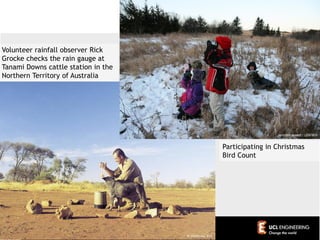
Volunteer rainfall observer Rick
Grocke checks the rain gauge at
Tanami Downs cattle station in the
Northern Territory of Australia
© WMO–No. 919
© Audubon Cal.
Jennifer Jewett / USFWS
Participating in Christmas
Bird Count
http://wp.me/p7DNf-gx
Third era: since 2005-2012
Government
Experts
Citizens
Citizen Science in the 3rd Era
• Citizen Science becoming increasing accepted
• Integrated in legislations and operational
programmes (EEA, SEPA, US EPA …)
• Benefiting from societal transition (levels of
education, longevity of healthy life, increase in
leisure time) and technological changes
(smartphones, web, standards)
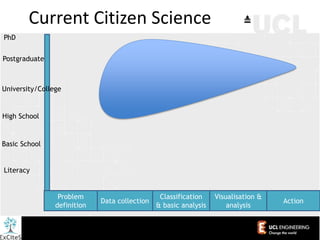
Problem
definition
Data collection
Visualisation &
analysis
Action
Classification
& basic analysis
Basic School
High School
University/College
Postgraduate
PhD
Literacy
Current Citizen Science
Zooniverse – Feb 2014
IBM World Community Grid:
Aug 2013 survey (15,000 responses)
Problem
definition
Data collection
Visualisation &
analysis
Action
Classification
& basic analysis
Basic School
High School
University/College
Postgraduate
PhD
Literacy
Typology of Citizen Science
• Contractual projects, communities ask professional
researchers to conduct a specific scientific investigation
• Contributory projects, generally designed by scientists and
for which members of the public primarily contribute data;
• Collaborative projects, generally designed by scientists and
members of the public contribute data but might refine
project design, analyze data, and/or disseminate findings;
• Co-Created projects, designed by scientists and members of
the public working together and some of the public
participants are actively involved in most or all aspects of the
research process;
• Collegial contributions, non-credentialed individuals conduct
research independently with varying degrees of expected
recognition by institutionalized science and/or professionals.
Shirk et al. 2012. Public participation in scientific research: a framework for
deliberate design. Ecology and Society 17(2): 29.
After Cooper, Dickinson, Phillips & Bonney, 2007, Citizen Science as tool for conservation in residential ecosystems. Ecology and
Society 12(2)
Question
Study Design
Data Collection
Data Analysis and
Interpretation
Understanding
results
Management Action
Geographic scope
of project
Nature of people
taking action
Research priority
Education priority
Traditional
Science
Scientific
Consulting*
Citizen
Science*
Collaborative
Citizen
Science
Participatory
Action
Research
Variable Narrow NarrowBroad Broad
Managers
Community
Groups Managers Individuals
Community
Groups
Highest Medium High High Medium
Low Medium High High High
*often called Science Shops
Community Science
Co-created
Citizen
Science
Narrow
High
High
All
√
√√√
√
√
√
√
√
√
√ √
√
√
√
√
√
√
√
√
√
√ √
√
√
√Public Scientists
√
√
√
Participation in citizen science
• Collaborative science – problem
definition, data collection and analysis
Level 4 ‘Extreme/
Up-Science’
• Participation in problem definition
and data collection
Level 3 ‘Participatory
science’
• Citizens as basic interpreters
Level 2 ‘Distributed
intelligence’
• Citizens as sensors
Level 1
‘Crowdsourcing’
Haklay. 2013. Citizen Science and volunteered geographic information: Overview
and typology of participation, Crowdsourcing Geographic Knowledge
Extreme Citizen Science
Extreme Citizen Science (ExCiteS) is a situated,
bottom-up practice that takes into account
local needs, practices and culture and works
with broad networks of people to design and
build new devices and knowledge creation
processes that can transform the world.
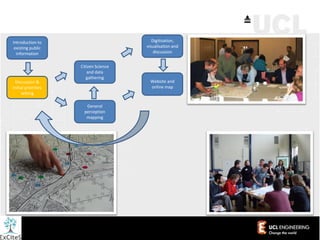
Introduction to
existing public
information
General
perception
mapping
Discussion &
initial priorities
setting
Digitisation,
visualisation
and discussion
Website and
online map
Citizen Science
and data
gathering
Engagement Process
Participatory Approach:
Co-design
Co-determination
Flexibility
Iterative cycles
Alternative pathways for
different levels of
participation
Varies according to nature
of community engaged
A discussion leads to
the list of issues that
should be mapped
and the way they will
be mapped
Introduction to
existing public
information
General
perception
mapping
Discussion &
initial priorities
setting
Digitisation,
visualisation and
discussion
Website and
online map
Citizen Science
and data
gathering
Technology role
• Technology is an enabler that can allow
communities to carry out their own projects
• Technology must be contextualised and used
while respecting local culture and sensitivies
Community Maps
https://new.communitymaps.org.uk/#/welcome
http://geokey.org.uk/
Towards Intelligent Maps
Engagement Methods
26
1) A detailed process of Free, Prior
and Informed Consent (FPIC)
2) Iterative, participatory software
development to ensure the
ExCiteS tools are relevant and
usable
3) Building Community Protocols
for engagement with:
a) The project itself
b) Other stakeholders in the
data to be collected
Ashaninka village “Apiwtxa”
Picture by José Frank Melo
Developing monitoring
Ju|'hoansi people (Namibia)
http://www.crowdfunder.co.uk/juhoansi-to-use-smartphones-for-conservation-1/
http://bit.ly/1Ihxv6Q
Source: Paul Weinberg
http://bit.ly/1Ihxv6Q
Conclusions
• Citizen Science is on the rise and the collegiate
model is starting to appear in more places,
demand for co-creation also on the rise
• It requires the assistance of intermediaries,
such as conservation organisations and NGOs
• Challenges in sharing and aggregating
information beyond the local project –
another role for trusted intermediaries
• Follow us:
– http://www.ucl.ac.uk/excites
– Twitter: @UCL_ExCiteS
– Blog: http://uclexcites.wordpress.com

Extreme Citizen Science: the socio-political potential of citizen science

  • 1.
    Extreme Citizen Science:the socio- political potential of citizen science Muki Haklay & Jerome Lewis Extreme Citizen Science (ExCiteS) research group, UCL @mahakly Source: iMP
  • 2.
    Outline • Citizen Sciencewithin the 3 eras of environmental information – 1969 ~ 1992 By experts, For experts – 1992 ~ 2005 By experts, For experts & public – 2005 onward By experts & public, For experts & public • The limits of ‘business as usual’ citizen science • Extending citizen science to ‘collegial’/’extreme’/’up-science’ – process & technology
  • 3.
    First era: 1969-[1987-92] Expert PublicDecision Makers Expert http://wp.me/p7DNf-gx
  • 4.
    First era: 1969-[1987-92] •Experts responsible for creating environmental information and using it to advise government • Top-down attitude to environmental decision making • ‘Information Deficit’ model towards the public • Environmental information by experts, for experts http://wp.me/p7DNf-gx
  • 5.
  • 6.
    Second era: 1992– [2005-12] • Rio Principle 10, Aarhus Convention • Public access to environmental information is a prerequisite to participation, civil society organisations as intermediaries • The Web as the dissemination medium • Information by experts, for experts and the public (but in expert form) http://wp.me/p7DNf-gx
  • 7.
    Volunteer rainfall observerRick Grocke checks the rain gauge at Tanami Downs cattle station in the Northern Territory of Australia © WMO–No. 919 © Audubon Cal. Jennifer Jewett / USFWS Participating in Christmas Bird Count
  • 8.
    http://wp.me/p7DNf-gx Third era: since2005-2012 Government Experts Citizens
  • 9.
    Citizen Science inthe 3rd Era • Citizen Science becoming increasing accepted • Integrated in legislations and operational programmes (EEA, SEPA, US EPA …) • Benefiting from societal transition (levels of education, longevity of healthy life, increase in leisure time) and technological changes (smartphones, web, standards)
  • 10.
    Problem definition Data collection Visualisation & analysis Action Classification &basic analysis Basic School High School University/College Postgraduate PhD Literacy Current Citizen Science
  • 11.
  • 12.
    IBM World CommunityGrid: Aug 2013 survey (15,000 responses)
  • 13.
    Problem definition Data collection Visualisation & analysis Action Classification &basic analysis Basic School High School University/College Postgraduate PhD Literacy
  • 14.
    Typology of CitizenScience • Contractual projects, communities ask professional researchers to conduct a specific scientific investigation • Contributory projects, generally designed by scientists and for which members of the public primarily contribute data; • Collaborative projects, generally designed by scientists and members of the public contribute data but might refine project design, analyze data, and/or disseminate findings; • Co-Created projects, designed by scientists and members of the public working together and some of the public participants are actively involved in most or all aspects of the research process; • Collegial contributions, non-credentialed individuals conduct research independently with varying degrees of expected recognition by institutionalized science and/or professionals. Shirk et al. 2012. Public participation in scientific research: a framework for deliberate design. Ecology and Society 17(2): 29.
  • 15.
    After Cooper, Dickinson,Phillips & Bonney, 2007, Citizen Science as tool for conservation in residential ecosystems. Ecology and Society 12(2) Question Study Design Data Collection Data Analysis and Interpretation Understanding results Management Action Geographic scope of project Nature of people taking action Research priority Education priority Traditional Science Scientific Consulting* Citizen Science* Collaborative Citizen Science Participatory Action Research Variable Narrow NarrowBroad Broad Managers Community Groups Managers Individuals Community Groups Highest Medium High High Medium Low Medium High High High *often called Science Shops Community Science Co-created Citizen Science Narrow High High All √ √√√ √ √ √ √ √ √ √ √ √ √ √ √ √ √ √ √ √ √ √ √ √ √Public Scientists √ √ √
  • 16.
    Participation in citizenscience • Collaborative science – problem definition, data collection and analysis Level 4 ‘Extreme/ Up-Science’ • Participation in problem definition and data collection Level 3 ‘Participatory science’ • Citizens as basic interpreters Level 2 ‘Distributed intelligence’ • Citizens as sensors Level 1 ‘Crowdsourcing’ Haklay. 2013. Citizen Science and volunteered geographic information: Overview and typology of participation, Crowdsourcing Geographic Knowledge
  • 17.
    Extreme Citizen Science ExtremeCitizen Science (ExCiteS) is a situated, bottom-up practice that takes into account local needs, practices and culture and works with broad networks of people to design and build new devices and knowledge creation processes that can transform the world.
  • 18.
    Introduction to existing public information General perception mapping Discussion& initial priorities setting Digitisation, visualisation and discussion Website and online map Citizen Science and data gathering Engagement Process Participatory Approach: Co-design Co-determination Flexibility Iterative cycles Alternative pathways for different levels of participation Varies according to nature of community engaged
  • 19.
    A discussion leadsto the list of issues that should be mapped and the way they will be mapped Introduction to existing public information General perception mapping Discussion & initial priorities setting Digitisation, visualisation and discussion Website and online map Citizen Science and data gathering
  • 20.
    Technology role • Technologyis an enabler that can allow communities to carry out their own projects • Technology must be contextualised and used while respecting local culture and sensitivies
  • 21.
  • 22.
  • 24.
  • 26.
    Engagement Methods 26 1) Adetailed process of Free, Prior and Informed Consent (FPIC) 2) Iterative, participatory software development to ensure the ExCiteS tools are relevant and usable 3) Building Community Protocols for engagement with: a) The project itself b) Other stakeholders in the data to be collected
  • 29.
  • 30.
  • 31.
  • 32.
  • 33.
    Conclusions • Citizen Scienceis on the rise and the collegiate model is starting to appear in more places, demand for co-creation also on the rise • It requires the assistance of intermediaries, such as conservation organisations and NGOs • Challenges in sharing and aggregating information beyond the local project – another role for trusted intermediaries
  • 34.
    • Follow us: –http://www.ucl.ac.uk/excites – Twitter: @UCL_ExCiteS – Blog: http://uclexcites.wordpress.com