Company
          DÉPARTEMENT DES SCIENCES GÉOMATIQUES
LOGO


     Towards a socio-economical
       evaluation framework of
Volunteered Geographic Information (VGI)


          Anisur Rahman Gazi –PhD Student
          Dr. Stéphane Roche –Professor & Research Director
Main Field of Research

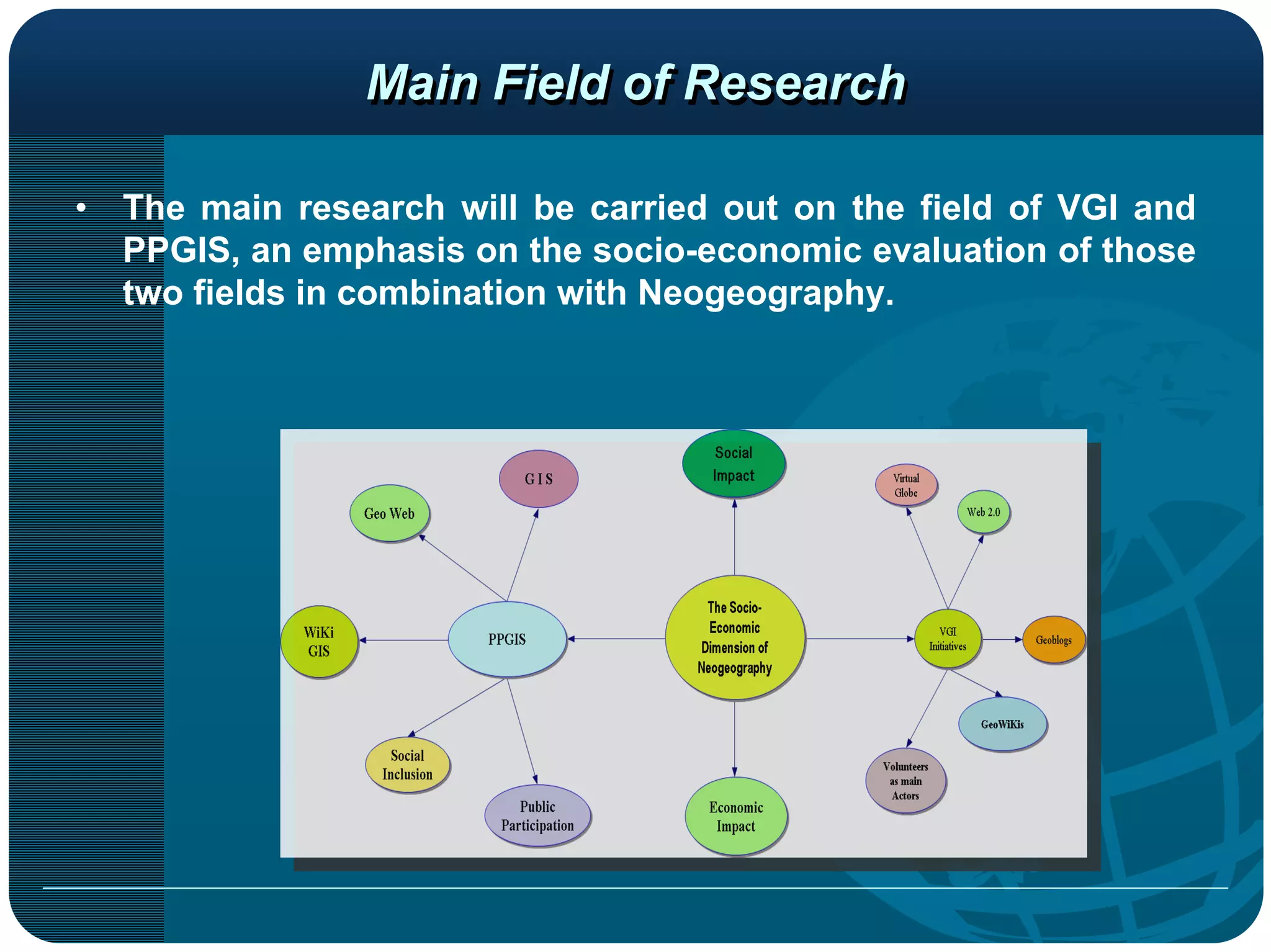
•   The main research will be carried out on the field of VGI and
    PPGIS, an emphasis on the socio-economic evaluation of those
    two fields in combination with Neogeography.
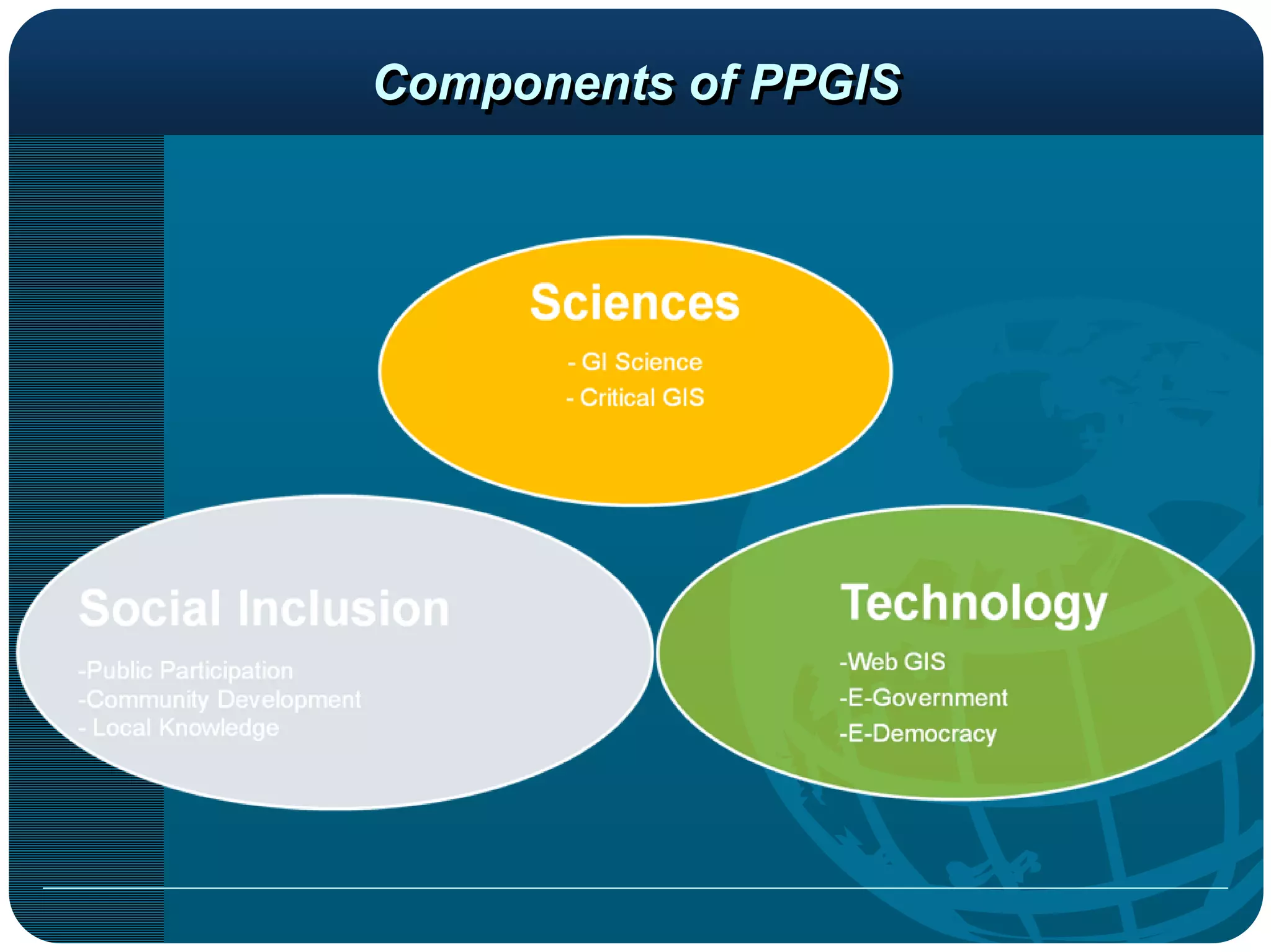
Components of PPGIS
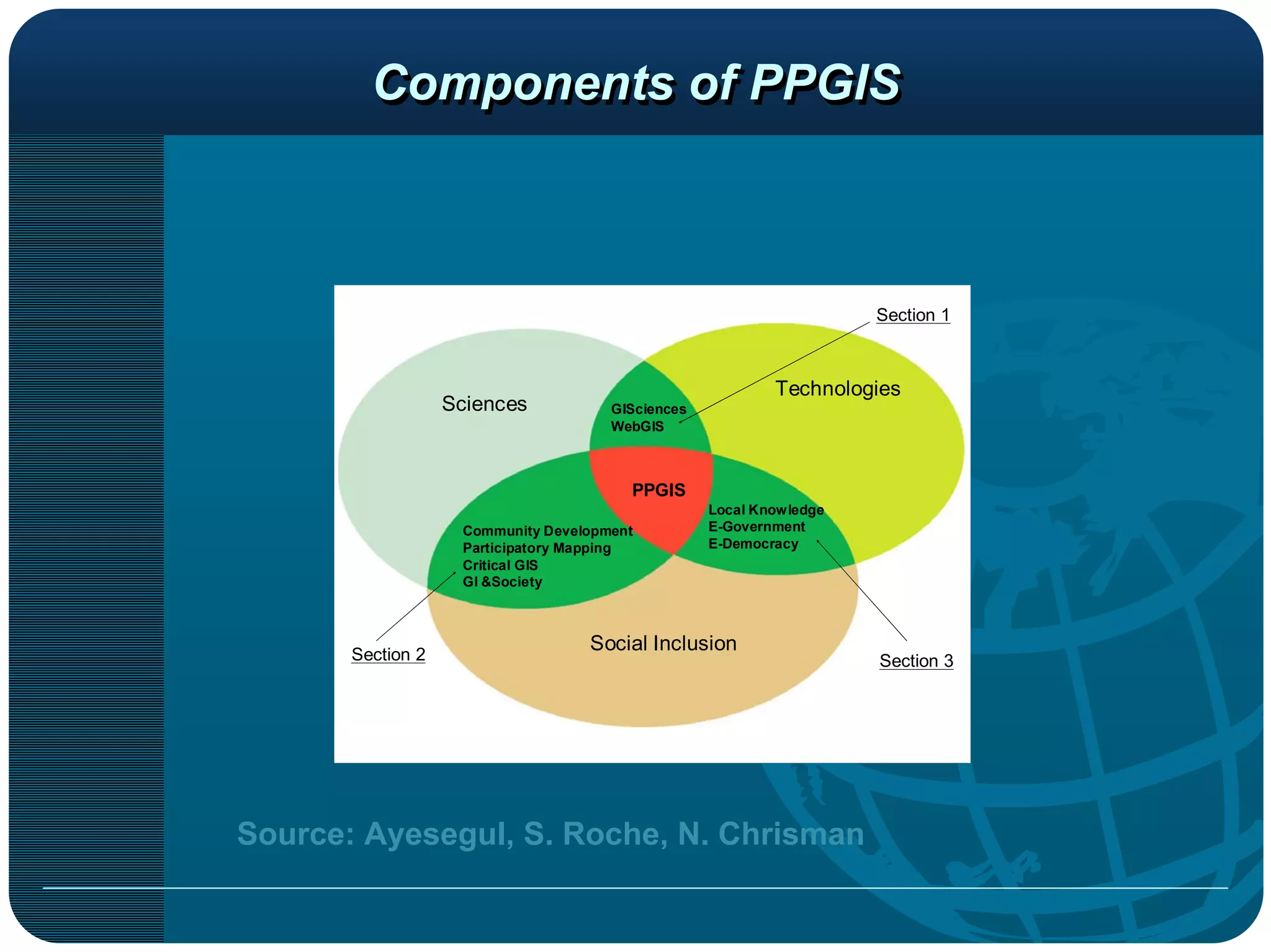
Components of PPGIS


                                                                     Section 1


                                                           Technologies
                   Sciences           GISciences
                                      WebGIS


                                        PPGIS
                                                   Local Knowledge
                    Community Development          E-Government
                    Participatory Mapping          E-Democracy
                    Critical GIS
                    GI &Society


       Section 2
                                   Social Inclusion
                                                                     Section 3


Source: Ayesegul, S. Roche, N. Chrisman
Volunteered Geographic Information (VGI)

•   The term “volunteered geographic information” (VGI) refers to GI
    which is created in collaboration by users who usually don't have
    special skills in handling spatial data. This makes it difficult to
    incorporate such GI in applications depending on high quality
    data.

•   Volunteered Geographic Information (VGI) has the potential to be
    a significant source of geographers’ understanding of the surface
    of the Earth’’- (Michael Goodchild, 2007). Goodchild has also
    termed this phenomenon as user-generated content.

•   User-generated geospatial content through the web is part of
    Geospatial components of the Web 2.0 and, an example of
    Neogeography.
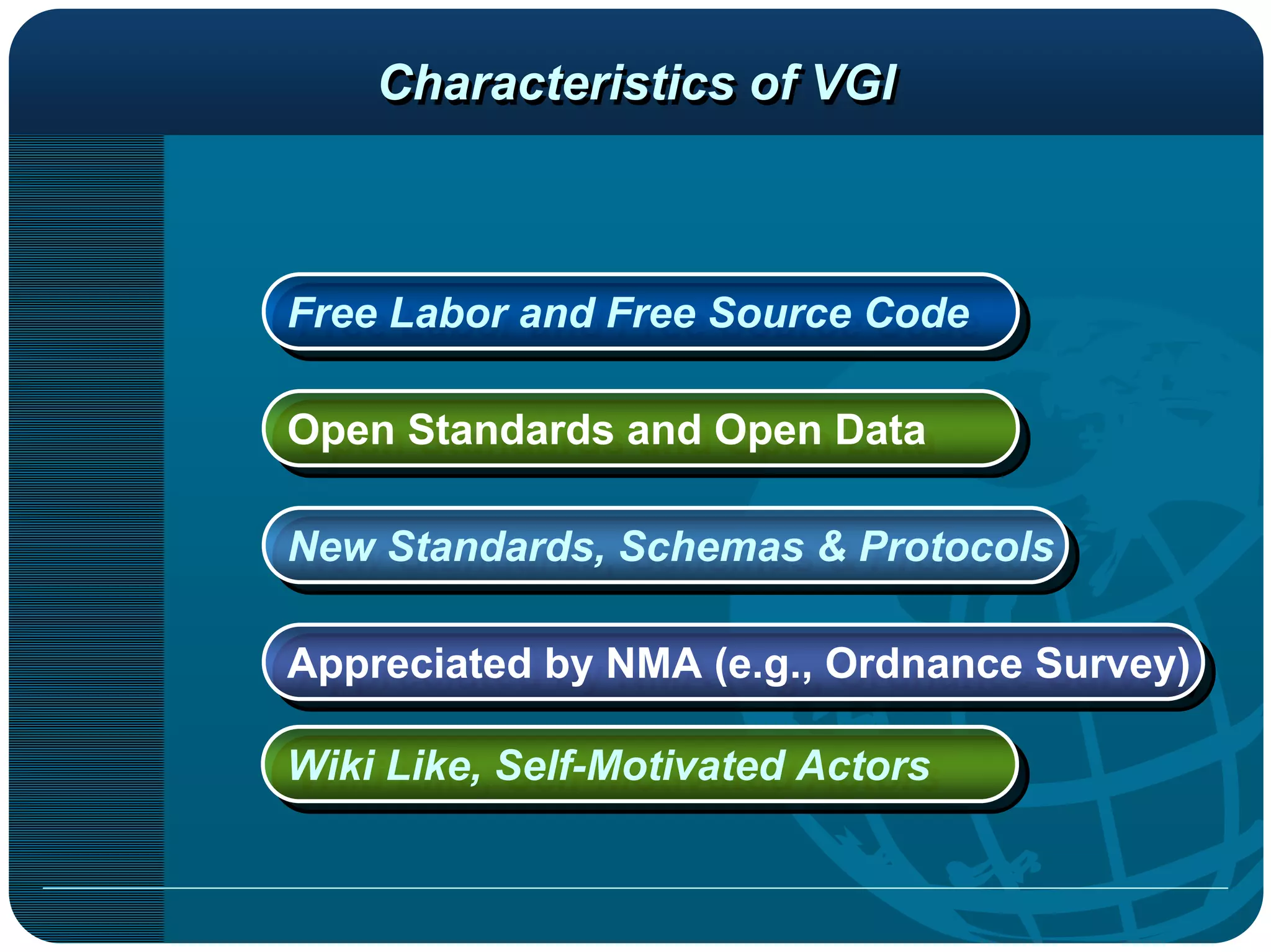
Characteristics of VGI


Free Labor and Free Source Code

Open Standards and Open Data

New Standards, Schemas & Protocols

Appreciated by NMA (e.g., Ordnance Survey)

Wiki Like, Self-Motivated Actors
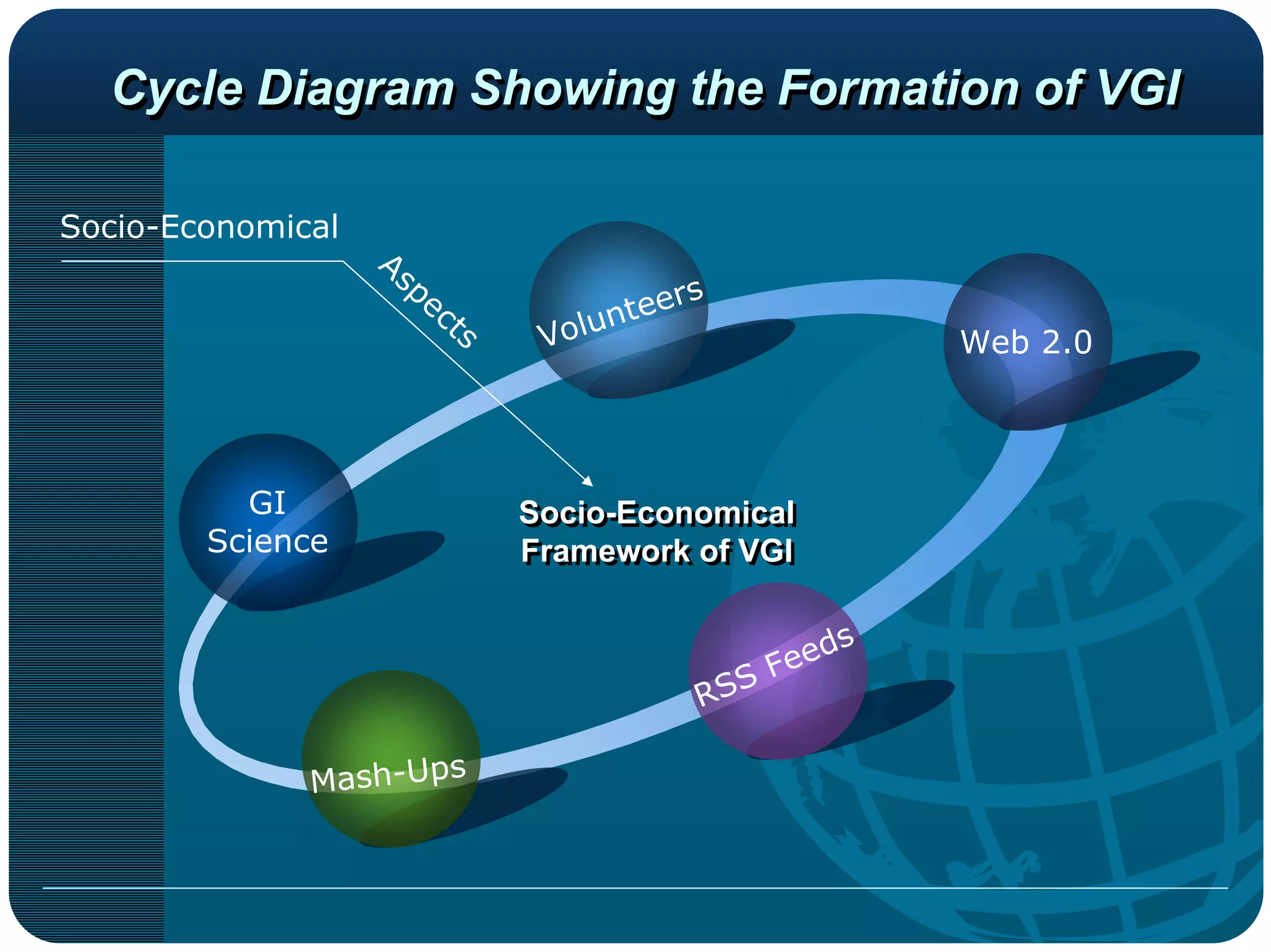
Cycle Diagram Showing the Formation of VGI

Socio-Economical
                   As
                     pe                      s
                          ct           n teer
                             s    Volu                    Web 2.0


          GI                     Socio-Economical
                                 Socio-Economical
        Science                  Framework of VGI
                                 Framework of VGI

                                                      s
                                                  Feed
                                             R SS

              Mash-Ups
What Neogeography is???

•   Neogeography is telling the story of a place in one’s own
    way. The tools can be tagging, blogging, photo sharing
    and script writing about the geography of a place. It is the
    new way of thinking about geography.

•   Adding and describing a newly discovered place on the
    map, telling the changes of the map, landuse, Road
    network and structure of an area.

•   It is followed by the daily update of the map, it is a new
    way of sharing one’s experience of vacation in a new and
    exciting place. It is the easiest way to to create maps and
    of sharing the locations of a one’s interest and history.
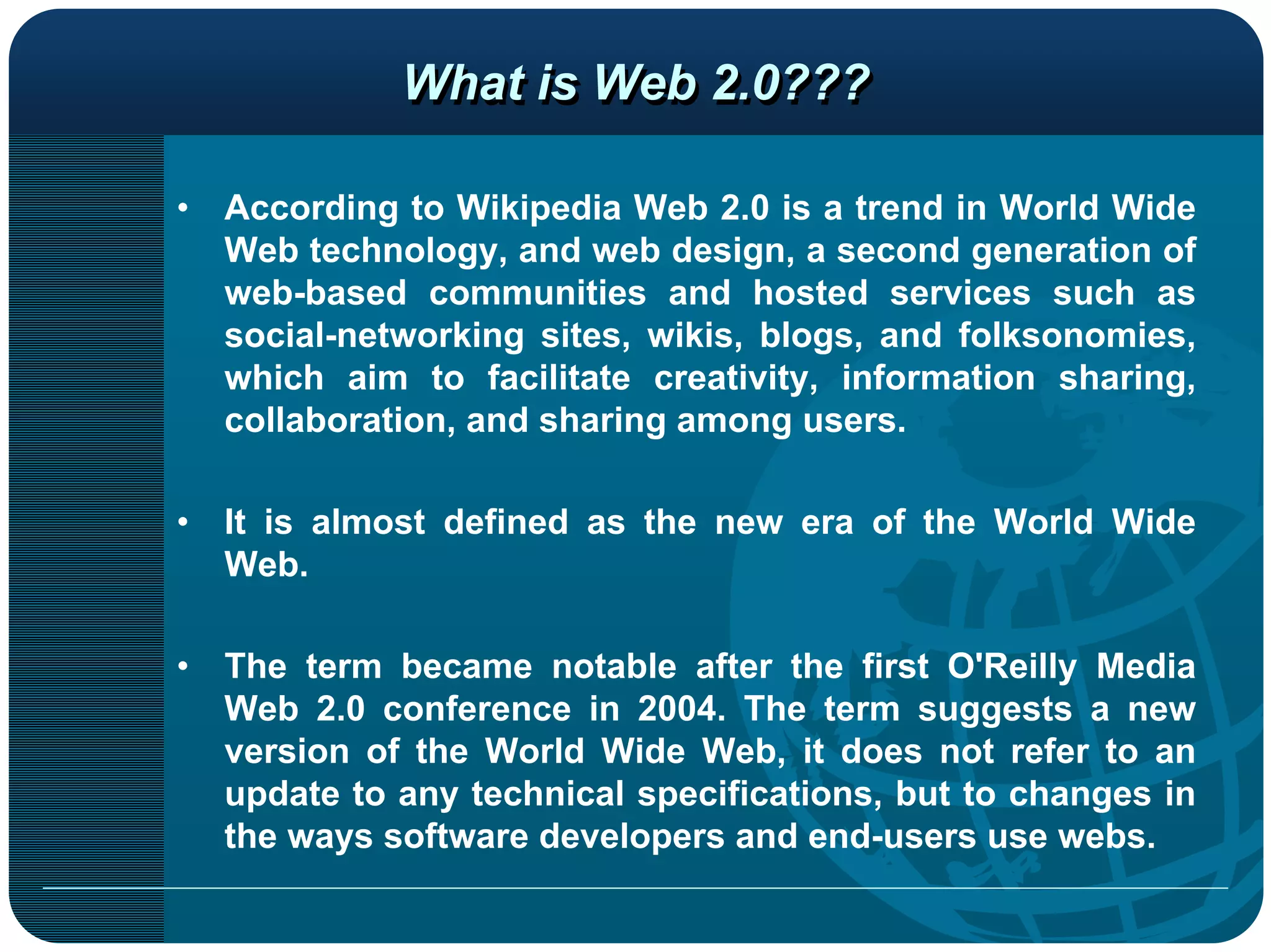
What is Web 2.0???

•   According to Wikipedia Web 2.0 is a trend in World Wide
    Web technology, and web design, a second generation of
    web-based communities and hosted services such as
    social-networking sites, wikis, blogs, and folksonomies,
    which aim to facilitate creativity, information sharing,
    collaboration, and sharing among users.

•   It is almost defined as the new era of the World Wide
    Web.

•   The term became notable after the first O'Reilly Media
    Web 2.0 conference in 2004. The term suggests a new
    version of the World Wide Web, it does not refer to an
    update to any technical specifications, but to changes in
    the ways software developers and end-users use webs.
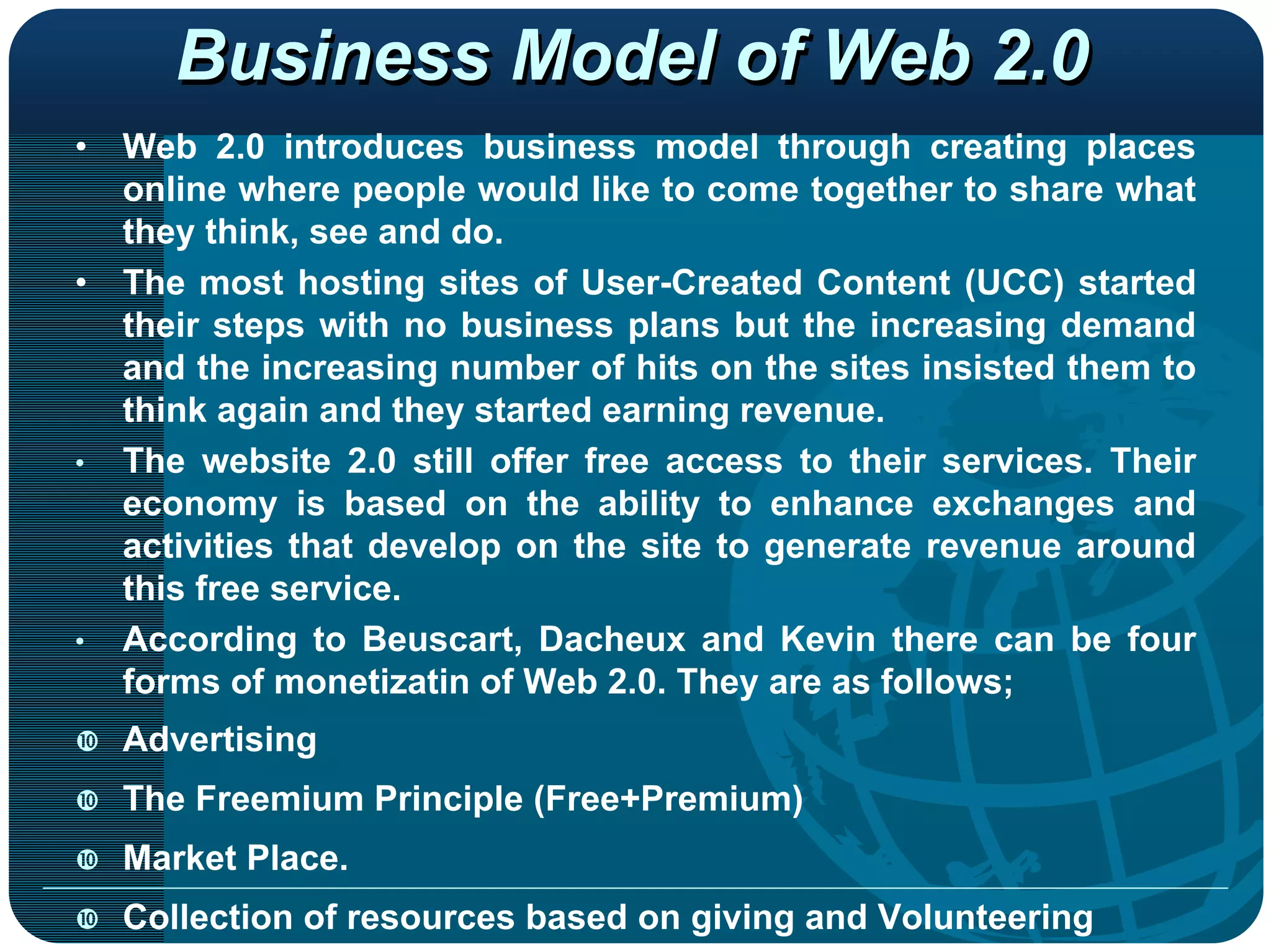
Business Model of Web 2.0
•   Web 2.0 introduces business model through creating places
    online where people would like to come together to share what
    they think, see and do.
•   The most hosting sites of User-Created Content (UCC) started
    their steps with no business plans but the increasing demand
    and the increasing number of hits on the sites insisted them to
    think again and they started earning revenue.
•   The website 2.0 still offer free access to their services. Their
    economy is based on the ability to enhance exchanges and
    activities that develop on the site to generate revenue around
    this free service.
•   According to Beuscart, Dacheux and Kevin there can be four
    forms of monetizatin of Web 2.0. They are as follows;
    Advertising
    The Freemium Principle (Free+Premium)
    Market Place.
    Collection of resources based on giving and Volunteering
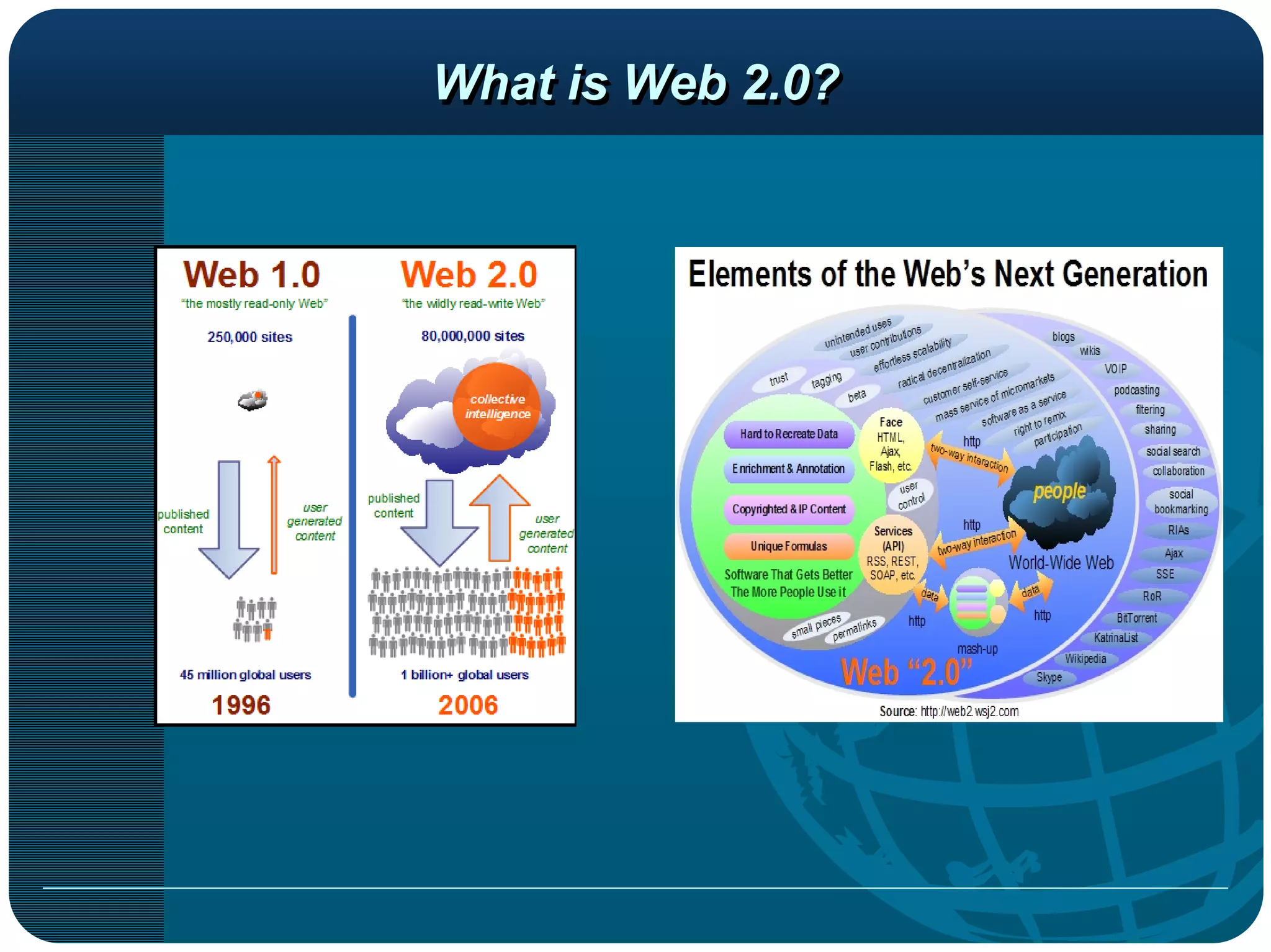
What is Web 2.0?
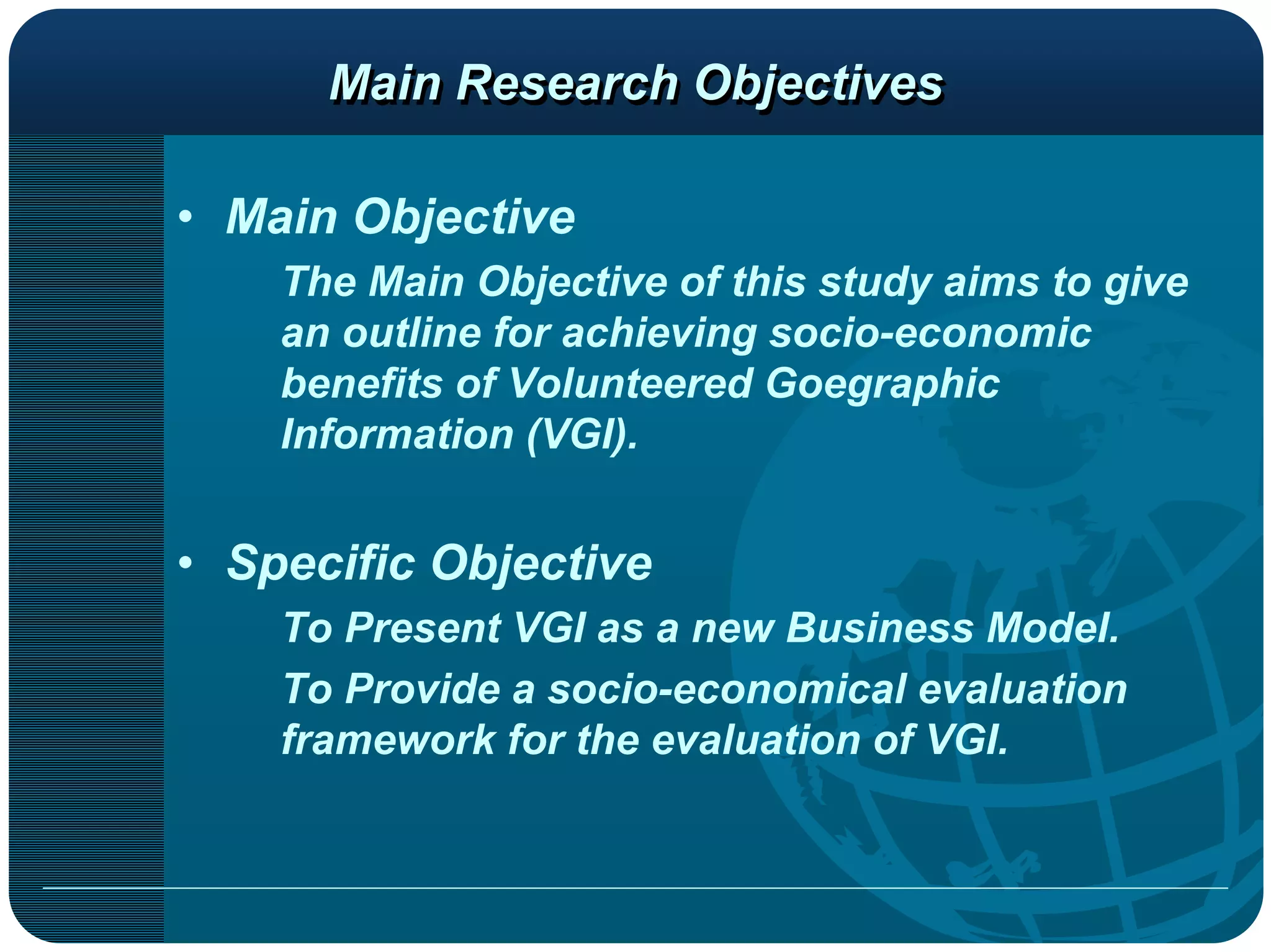
Main Research Objectives

• Main Objective
    The Main Objective of this study aims to give
    an outline for achieving socio-economic
    benefits of Volunteered Goegraphic
    Information (VGI).


• Specific Objective
    To Present VGI as a new Business Model.
    To Provide a socio-economical evaluation
    framework for the evaluation of VGI.
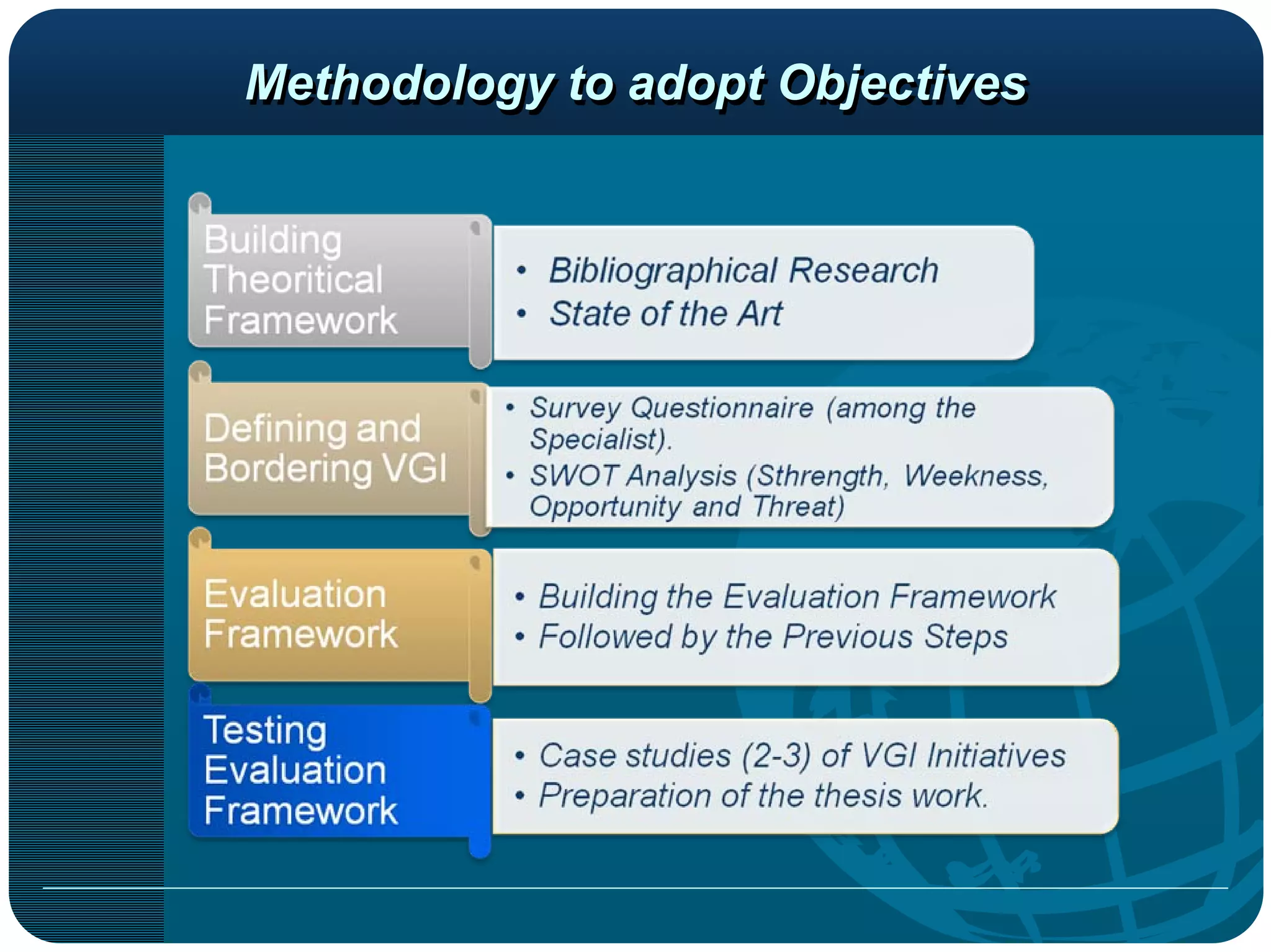
Methodology to adopt Objectives
Ethical Background

• Present mapping world is looking forward to be
  more faithful to reality coping with the
  development of 3D maps.

• Mobile mapping and remote sensing are
  inherently prone to human errors, needs more
  revisit rates and cover no story about places.

• In this sense, neogeography can be considered
  as an up- to- date mapping technic in
  comparison to mobile mapping and remote
  sensing.
Political and Social Acceptance

• Increasing new interest by the tax authorities.

• The Governments are having off-line economic
  gains.(OECD, 2007)

• Virtual transactions but treated as underground
  economy (OECD, 2007).

• Building a digital Society through Web 2.0. The
  Facebook community can be an example of
  digital neighbourhood.
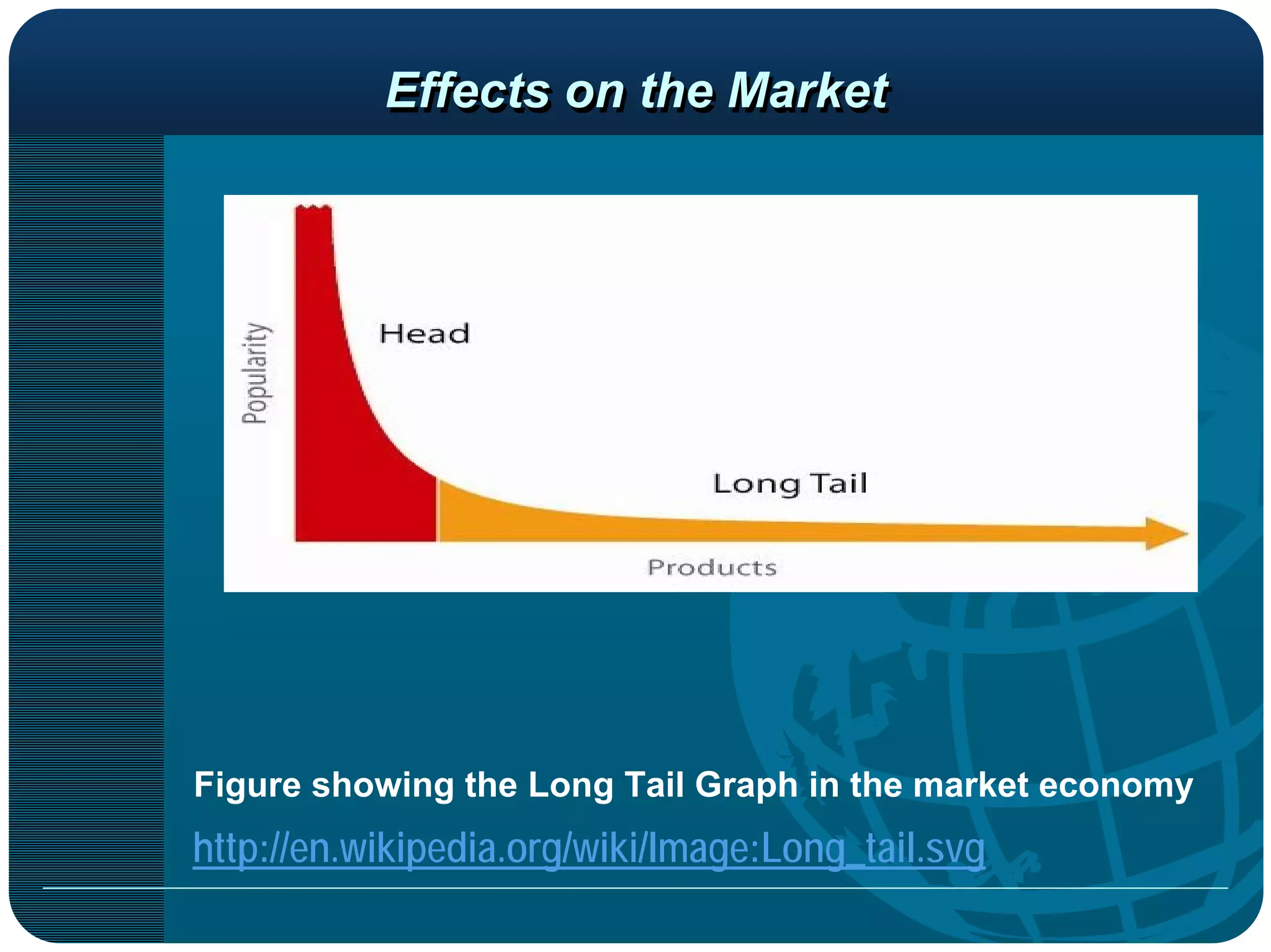
Effects on the Market


Figure showing the Long Tail Graph in the market economy
http://en.wikipedia.org/wiki/Image:Long_tail.svg
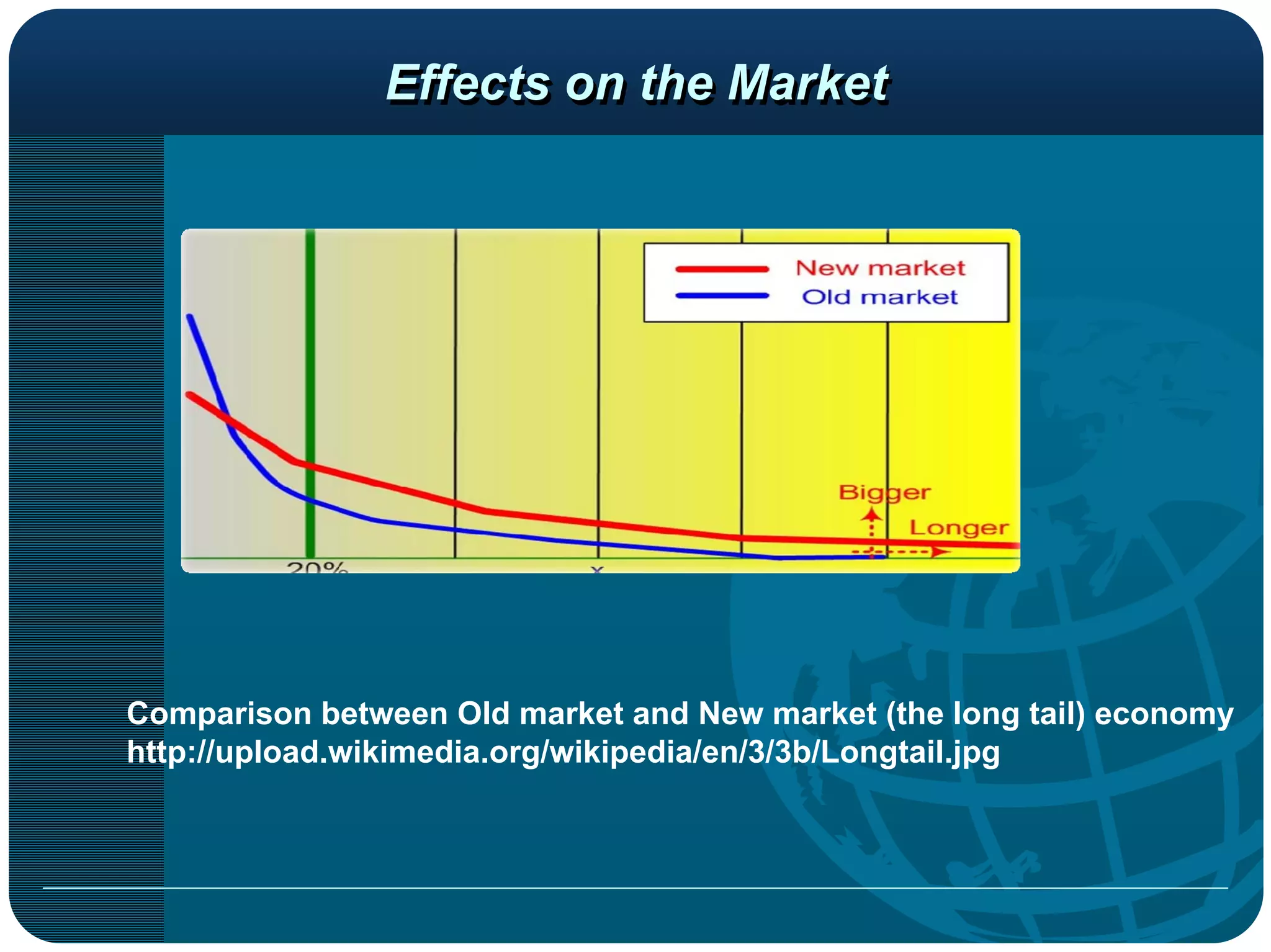
Effects on the Market


Comparison between Old market and New market (the long tail) economy
http://upload.wikimedia.org/wikipedia/en/3/3b/Longtail.jpg
Conclusion

• Neogeography with VGI has the potential to save
  thousands of lives and billions of Dollars a year in
  the US. (Wilson, C.2007)

• The users are making the contents freely, so the
  products being cheap.

• Increase for consumer deals in big sale and the big
  sale decrease the cost of products. A long tail
  graphics is created in the market.

• VGI is supposed to bring a positive effect in
  mapping science and on the market of Geospatial
  database which will be positive for both the
  consumers and suppliers.
Acknowledgements


        The Authors are Acknowledged to


Géomatiques   C R G      ECOGEO-II    GOOGLE
ULAVAL        ULAVAL     GEOIDE       Wikipedia

Towards a Socio-Economical Evaluation Framework of VGI

  • 1.
    Company DÉPARTEMENT DES SCIENCES GÉOMATIQUES LOGO Towards a socio-economical evaluation framework of Volunteered Geographic Information (VGI) Anisur Rahman Gazi –PhD Student Dr. Stéphane Roche –Professor & Research Director
  • 2.
    Main Field ofResearch • The main research will be carried out on the field of VGI and PPGIS, an emphasis on the socio-economic evaluation of those two fields in combination with Neogeography.
  • 3.
  • 4.
    Components of PPGIS Section 1 Technologies Sciences GISciences WebGIS PPGIS Local Knowledge Community Development E-Government Participatory Mapping E-Democracy Critical GIS GI &Society Section 2 Social Inclusion Section 3 Source: Ayesegul, S. Roche, N. Chrisman
  • 5.
    Volunteered Geographic Information(VGI) • The term “volunteered geographic information” (VGI) refers to GI which is created in collaboration by users who usually don't have special skills in handling spatial data. This makes it difficult to incorporate such GI in applications depending on high quality data. • Volunteered Geographic Information (VGI) has the potential to be a significant source of geographers’ understanding of the surface of the Earth’’- (Michael Goodchild, 2007). Goodchild has also termed this phenomenon as user-generated content. • User-generated geospatial content through the web is part of Geospatial components of the Web 2.0 and, an example of Neogeography.
  • 6.
    Characteristics of VGI FreeLabor and Free Source Code Free Labor and Free Source Code Open Standards and Open Data Open Standards and Open Data New Standards, Schemas & Protocols New Standards, Schemas & Protocols Appreciated by NMA (e.g., Ordnance Survey) Appreciated by NMA (e.g., Ordnance Survey) Wiki Like, Self-Motivated Actors Wiki Like, Self-Motivated Actors
  • 7.
    Cycle Diagram Showingthe Formation of VGI Socio-Economical As pe s ct n teer s Volu Web 2.0 GI Socio-Economical Socio-Economical Science Framework of VGI Framework of VGI s Feed R SS Mash-Ups
  • 8.
    What Neogeography is??? • Neogeography is telling the story of a place in one’s own way. The tools can be tagging, blogging, photo sharing and script writing about the geography of a place. It is the new way of thinking about geography. • Adding and describing a newly discovered place on the map, telling the changes of the map, landuse, Road network and structure of an area. • It is followed by the daily update of the map, it is a new way of sharing one’s experience of vacation in a new and exciting place. It is the easiest way to to create maps and of sharing the locations of a one’s interest and history.
  • 9.
    What is Web2.0??? • According to Wikipedia Web 2.0 is a trend in World Wide Web technology, and web design, a second generation of web-based communities and hosted services such as social-networking sites, wikis, blogs, and folksonomies, which aim to facilitate creativity, information sharing, collaboration, and sharing among users. • It is almost defined as the new era of the World Wide Web. • The term became notable after the first O'Reilly Media Web 2.0 conference in 2004. The term suggests a new version of the World Wide Web, it does not refer to an update to any technical specifications, but to changes in the ways software developers and end-users use webs.
  • 10.
    Business Model ofWeb 2.0 • Web 2.0 introduces business model through creating places online where people would like to come together to share what they think, see and do. • The most hosting sites of User-Created Content (UCC) started their steps with no business plans but the increasing demand and the increasing number of hits on the sites insisted them to think again and they started earning revenue. • The website 2.0 still offer free access to their services. Their economy is based on the ability to enhance exchanges and activities that develop on the site to generate revenue around this free service. • According to Beuscart, Dacheux and Kevin there can be four forms of monetizatin of Web 2.0. They are as follows; Advertising The Freemium Principle (Free+Premium) Market Place. Collection of resources based on giving and Volunteering
  • 11.
  • 12.
    Main Research Objectives •Main Objective The Main Objective of this study aims to give an outline for achieving socio-economic benefits of Volunteered Goegraphic Information (VGI). • Specific Objective To Present VGI as a new Business Model. To Provide a socio-economical evaluation framework for the evaluation of VGI.
  • 13.
  • 14.
    Ethical Background • Presentmapping world is looking forward to be more faithful to reality coping with the development of 3D maps. • Mobile mapping and remote sensing are inherently prone to human errors, needs more revisit rates and cover no story about places. • In this sense, neogeography can be considered as an up- to- date mapping technic in comparison to mobile mapping and remote sensing.
  • 15.
    Political and SocialAcceptance • Increasing new interest by the tax authorities. • The Governments are having off-line economic gains.(OECD, 2007) • Virtual transactions but treated as underground economy (OECD, 2007). • Building a digital Society through Web 2.0. The Facebook community can be an example of digital neighbourhood.
  • 16.
    Effects on theMarket Figure showing the Long Tail Graph in the market economy http://en.wikipedia.org/wiki/Image:Long_tail.svg
  • 17.
    Effects on theMarket Comparison between Old market and New market (the long tail) economy http://upload.wikimedia.org/wikipedia/en/3/3b/Longtail.jpg
  • 18.
    Conclusion • Neogeography withVGI has the potential to save thousands of lives and billions of Dollars a year in the US. (Wilson, C.2007) • The users are making the contents freely, so the products being cheap. • Increase for consumer deals in big sale and the big sale decrease the cost of products. A long tail graphics is created in the market. • VGI is supposed to bring a positive effect in mapping science and on the market of Geospatial database which will be positive for both the consumers and suppliers.
  • 19.
    Acknowledgements The Authors are Acknowledged to Géomatiques C R G ECOGEO-II GOOGLE ULAVAL ULAVAL GEOIDE Wikipedia