Lessons learned from
the winter cycling
survey
Martin Loidl
Department of Geoinformatics, Z_GIS
University of Salzburg
martin.loidl@sbg.ac.at | http://gicycle.wordpress.com
Overview
 Background
 Project context for winter cycling survey
 Information as part of cycling promotion strategies
 Methodological/technical aspects, study design
 Aim
 Design & sampling
 Acquisition of respondents
 Results
2
Lessons learned
Project context
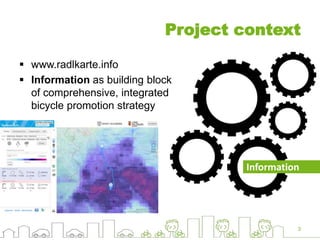
 www.radlkarte.info
 Information as building block
of comprehensive, integrated
bicycle promotion strategy
3
Information
Winter cycling
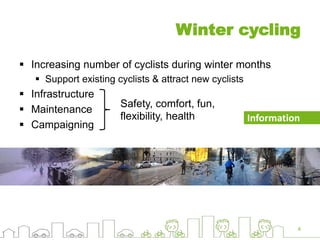
 Increasing number of cyclists during winter months
 Support existing cyclists & attract new cyclists
 Infrastructure
 Maintenance
 Campaigning
4
Safety, comfort, fun,
flexibility, health Information
Project context
 Information provision for winter cyclists
 Road maintenance (snow removal) priority map
 Live status road condition
 Live tracking maintenance vehicles
 Communication tool
 Weather push service
 Graphical elements in web portal
 What’s the return of investment?
 What do cyclists actually need?
5
Survey
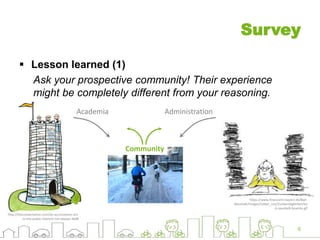
 Lesson learned (1)
Ask your prospective community! Their experience
might be completely different from your reasoning.
6
http://theconversation.com/do-accountants-act-
in-the-public-interest-not-always-4698
https://www.finanzamt.bayern.de/Bad-
Neustadt/Images/Ueber_uns/Zustaendigkeiten/ba
d-neustadt-beamte.gif
AdministrationAcademia
Community
Aim of the Survey
 Attitudes and requirements of (winter-) cyclists
 Role of information
 Design
 Content
 Evidence for future information services
7
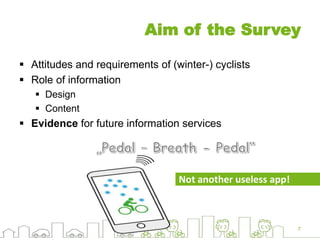
Not another useless app!
Study Design
 Online questionnaire (survey monkey)
 Closed questions, partly multiple answers
 36 obligatory questions + 1 remark question
 4 sections
 Demographic details
 General mobility habits
 Winter cycling and safety threats
 Information requirements
 Note: number of questions and obligation to answer =
potential limiting factor!
8
Dissemination
 Social media (Facebook, Twitter)
 E-Mail lists (university employees & students, Green
Campus newsletter, newsletter Land Salzburg)
 Print media
 Approx. 25,000 people reached
9
http://www.fertig-reisen.de/cms/upload/Fotolia_Bilder/sonstige/Pusteblume_2.jpg
Dissemination
 Lesson learned (2)
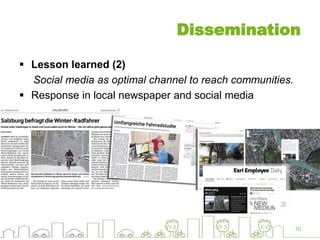
Social media as optimal channel to reach communities.
 Response in local newspaper and social media
10
Survey
11
Respondents
Completed
Comments
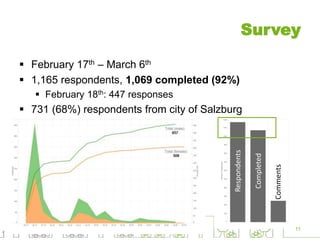
 February 17th – March 6th
 1,165 respondents, 1,069 completed (92%)
 February 18th: 447 responses
 731 (68%) respondents from city of Salzburg
Survey
12
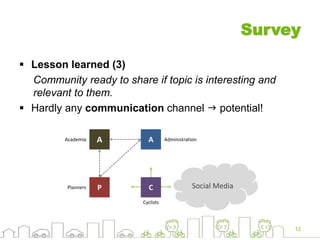
 Lesson learned (3)
Community ready to share if topic is interesting and
relevant to them.
 Hardly any communication channel  potential!
A
CP
A
Social Media
Academia
Planners
Administration
Cyclists
13
Results
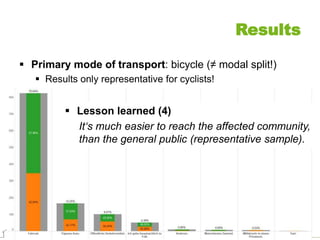
 Primary mode of transport: bicycle (≠ modal split!)
 Results only representative for cyclists!
 Lesson learned (4)
It‘s much easier to reach the affected community,
than the general public (representative sample).
Results
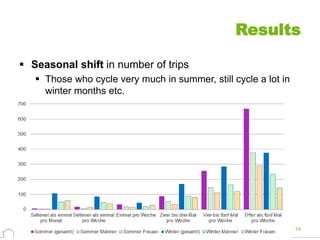
 Seasonal shift in number of trips
 Those who cycle very much in summer, still cycle a lot in
winter months etc.
14
Results
15
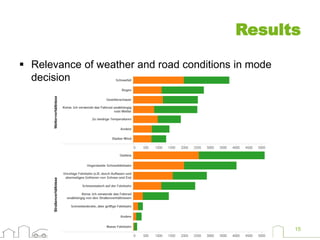
 Relevance of weather and road conditions in mode
decision
Results
16
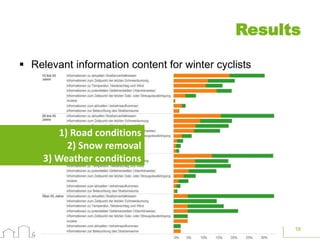
 Relevant information content for winter cyclists
1) Road conditions
2) Snow removal
3) Weather conditions
Results
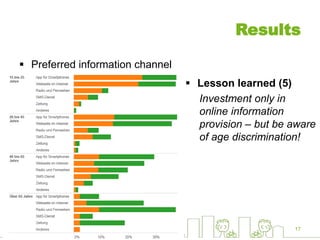
 Preferred information channel
17
 Lesson learned (5)
Investment only in
online information
provision – but be aware
of age discrimination!
Results
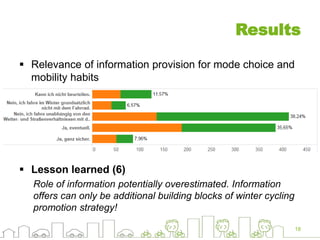
 Relevance of information provision for mode choice and
mobility habits
 Lesson learned (6)
Role of information potentially overestimated. Information
offers can only be additional building blocks of winter cycling
promotion strategy!
18
Conclusion
 Launching survey benefitial in several regards:
 Engage with affected community and relevant stake
holders
 „Research PR“
 Relevant insights for current and future R & D work
 Lessons learned:
19
1) Ask your prospective community.
2) Social media as optimal channel
to reach communities.
3) Community ready to share if
topic is interesting and relevant
to them.
4) It‘s much easier to reach the affected
community, than the general public.
5) Investment only in online information
provision
6) Role of information potentially
overestimated.
@gicycle_
gicycle.wordpress.com
Get connected

Lessons learned from the winter cycling survey

  • 1.
    Lessons learned from thewinter cycling survey Martin Loidl Department of Geoinformatics, Z_GIS University of Salzburg martin.loidl@sbg.ac.at | http://gicycle.wordpress.com
  • 2.
    Overview  Background  Projectcontext for winter cycling survey  Information as part of cycling promotion strategies  Methodological/technical aspects, study design  Aim  Design & sampling  Acquisition of respondents  Results 2 Lessons learned
  • 3.
    Project context  www.radlkarte.info Information as building block of comprehensive, integrated bicycle promotion strategy 3 Information
  • 4.
    Winter cycling  Increasingnumber of cyclists during winter months  Support existing cyclists & attract new cyclists  Infrastructure  Maintenance  Campaigning 4 Safety, comfort, fun, flexibility, health Information
  • 5.
    Project context  Informationprovision for winter cyclists  Road maintenance (snow removal) priority map  Live status road condition  Live tracking maintenance vehicles  Communication tool  Weather push service  Graphical elements in web portal  What’s the return of investment?  What do cyclists actually need? 5
  • 6.
    Survey  Lesson learned(1) Ask your prospective community! Their experience might be completely different from your reasoning. 6 http://theconversation.com/do-accountants-act- in-the-public-interest-not-always-4698 https://www.finanzamt.bayern.de/Bad- Neustadt/Images/Ueber_uns/Zustaendigkeiten/ba d-neustadt-beamte.gif AdministrationAcademia Community
  • 7.
    Aim of theSurvey  Attitudes and requirements of (winter-) cyclists  Role of information  Design  Content  Evidence for future information services 7 Not another useless app!
  • 8.
    Study Design  Onlinequestionnaire (survey monkey)  Closed questions, partly multiple answers  36 obligatory questions + 1 remark question  4 sections  Demographic details  General mobility habits  Winter cycling and safety threats  Information requirements  Note: number of questions and obligation to answer = potential limiting factor! 8
  • 9.
    Dissemination  Social media(Facebook, Twitter)  E-Mail lists (university employees & students, Green Campus newsletter, newsletter Land Salzburg)  Print media  Approx. 25,000 people reached 9 http://www.fertig-reisen.de/cms/upload/Fotolia_Bilder/sonstige/Pusteblume_2.jpg
  • 10.
    Dissemination  Lesson learned(2) Social media as optimal channel to reach communities.  Response in local newspaper and social media 10
  • 11.
    Survey 11 Respondents Completed Comments  February 17th– March 6th  1,165 respondents, 1,069 completed (92%)  February 18th: 447 responses  731 (68%) respondents from city of Salzburg
  • 12.
    Survey 12  Lesson learned(3) Community ready to share if topic is interesting and relevant to them.  Hardly any communication channel  potential! A CP A Social Media Academia Planners Administration Cyclists
  • 13.
    13 Results  Primary modeof transport: bicycle (≠ modal split!)  Results only representative for cyclists!  Lesson learned (4) It‘s much easier to reach the affected community, than the general public (representative sample).
  • 14.
    Results  Seasonal shiftin number of trips  Those who cycle very much in summer, still cycle a lot in winter months etc. 14
  • 15.
    Results 15  Relevance ofweather and road conditions in mode decision
  • 16.
    Results 16  Relevant informationcontent for winter cyclists 1) Road conditions 2) Snow removal 3) Weather conditions
  • 17.
    Results  Preferred informationchannel 17  Lesson learned (5) Investment only in online information provision – but be aware of age discrimination!
  • 18.
    Results  Relevance ofinformation provision for mode choice and mobility habits  Lesson learned (6) Role of information potentially overestimated. Information offers can only be additional building blocks of winter cycling promotion strategy! 18
  • 19.
    Conclusion  Launching surveybenefitial in several regards:  Engage with affected community and relevant stake holders  „Research PR“  Relevant insights for current and future R & D work  Lessons learned: 19 1) Ask your prospective community. 2) Social media as optimal channel to reach communities. 3) Community ready to share if topic is interesting and relevant to them. 4) It‘s much easier to reach the affected community, than the general public. 5) Investment only in online information provision 6) Role of information potentially overestimated. @gicycle_ gicycle.wordpress.com Get connected