AQA 2016
Science Fiction Films
REPRESENTATION
Representation
• Representation is the way the media reflects the ‘real
world’ back to us.
• The media’s presentation is never ‘transparent.’
• Every representation is biased, even by what is included
and what is left out.
• All representations reflect the ideas, biases and
assumptions of the producers.
• The audience can also read the representations in a
biased way, or from a particular point of view.
• It can be a problem if we believe the media represents
reality, and if we forget that it is a constructed, created
and biased view of the world.
Representation in science fiction
Science fiction films often rely on ‘stock’ characters:
• The main hero
• The sidekick
• The evil villain
• The victims who need saving
• The authorities / experts / scientists who can be arrogant
or foolish, and the hero has to fight them too
Watch the trailer for Monsters
Watch the trailer for Mad Max Fury Road
Try to identify the character types. Are there other
categories needed?
hw Monsters
Characters
• Victims who need
saving
• Heroes
• Authorities
• Evil Villain-
Monsters
Mad Max Fury
Road Characters
• Main villain
• Group of enemies
• Experts
• Society is the
victim in this case
Stereotypes
• Stereotypes are simplified views of groups of people.
• Often one or two characteristics are used to represent the
whole person, and the whole group they belong to.
• For example, ‘dumb blondes’: the whole person is
characterised simply as a ‘blonde’, and all people with blonde
hair are grouped together as being the same.
• Does it matter? It can do if the stereotype is negative, if it
used against people, or if certain social groups have more
power to create and use stereotypes than other social groups.
• Stereotypes are often used in the media as they are easy to
recognise and understand. They are a convenient ‘shorthand.’
hw Stereotypes in films
• Films often use stereotypes as a shorthand to communicate ideas.
• The audience finds stereotypes (e.g. the good-looking but untrustworthy woman; the self-
sacrificing mother; the daredevil teen; the brave old man) easy to recognise and easy to
understand.
• It is easier for producers to present an easy stereotype rather than a more complex
character.
• People who don’t fit the stereotype aren’t represented in films – they become ‘invisible'
• Do you think this is true? And if it is true, is it OK?
• I think it is true to a certain extent. Every single film includes some kind of stereotype, it
has to in order for mainstreamers to be able to relate to the film. Although stereotypes can
be offensive often they are true, e.g. most boys do like football, so if in a film the main
character was a boy who loved football, a lot of other boys could relate to the film.
Therefore really it is ok for films to have some stereotypes as otherwise how could the film
make money? The audience need to be able to have some kind of interaction- uses and
gratifications theory. However I don't think its true that films show people who aren't in
stereotypes as invisible, often someone who doesn't fit in is one of the main focuses;
allowing people who ‘don't fit into society’ also relate to the film and that characters
feelings. I don't think its ok for films to use stereotypes to a extent where they are
offensive but surely films without stereotypes would have very limited audiences as only
limited amounts of people could relate.
Stereotypes and countertypes
• Countertypes are characters who are not stereotypes.
• They may be almost the opposite of a stereotype, or just
different.
• Countertypes can challenge traditional stereotypes and
offer new ways of representing people.
• For example, Sigourney Weaver played Ripley in the
Alien franchise – she was one of the first female action
heroes in a sci-fi horror. At the time, she was a
countertype, although now it is more common to have
women action heroes.
• For example, Attack the Block featured a black urban
teen as the hero – another countertype.
hw Heroes and villains
Heroes and villains are often stereotyped.
o Villains tend to be:
Evil, cowardly, less intelligent, charismatic, easily tricked…
They can tend to be: old, ugly, ‘foreign’
o Heroes tend to be:
Resourceful, strong, brave, determined, good…
They also tend to be American, male, white and young or middle-aged.
o This reinforces the idea that good-looking people are good and trustworthy
and ugly people are evil or untrustworthy. Is this fair?
-No this isn't fair; its completely wrong. This is brainwashing people to think
in this manner and isolate people from society. It is also creating gullible
generations; anyone who is good looking is trust worthy- no this not the case
and could actually cause a lot of dangerous situations. People shouldn't
grow up in a society were they are taught these stereotypes as it will do a lot
more harm than good. In fact it will do no good at all.
Gender representations.
• Consider how men and women are
represented. Who looks big and strong? Who
looks sexy? Who has most / least clothes on?
Who is positioned to show their body the most?
Who is in control / the leader?
o Poster for The Matrix
o Poster for X Men 2
Find some posters which have non-stereotypical
representations of gender.
hw- Representation on posters
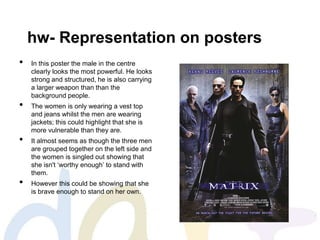
• In this poster the male in the centre
clearly looks the most powerful. He looks
strong and structured, he is also carrying
a larger weapon than than the
background people.
• The women is only wearing a vest top
and jeans whilst the men are wearing
jackets; this could highlight that she is
more vulnerable than they are.
• It almost seems as though the three men
are grouped together on the left side and
the women is singled out showing that
she isn't ‘worthy enough’ to stand with
them.
• However this could be showing that she
is brave enough to stand on her own.
hw- Non stereotypical film posters
hw- Comparing representations of gender
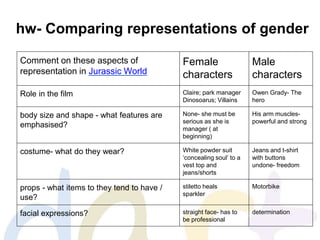
Comment on these aspects of
representation in Jurassic World
Female
characters
Male
characters
Role in the film Claire; park manager
Dinosoarus; Villains
Owen Grady- The
hero
body size and shape - what features are
emphasised?
None- she must be
serious as she is
manager ( at
beginning)
His arm muscles-
powerful and strong
costume- what do they wear? White powder suit
‘concealing soul’ to a
vest top and
jeans/shorts
Jeans and t-shirt
with buttons
undone- freedom
props - what items to they tend to have /
use?
stiletto heals
sparkler
Motorbike
facial expressions? straight face- has to
be professional
determination
hw Representations
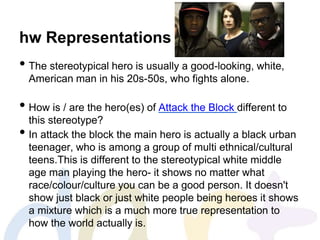
• The stereotypical hero is usually a good-looking, white,
American man in his 20s-50s, who fights alone.
• How is / are the hero(es) of Attack the Block different to
this stereotype?
• In attack the block the main hero is actually a black urban
teenager, who is among a group of multi ethnical/cultural
teens.This is different to the stereotypical white middle
age man playing the hero- it shows no matter what
race/colour/culture you can be a good person. It doesn't
show just black or just white people being heroes it shows
a mixture which is a much more true representation to
how the world actually is.
hw Ideology: messages about the
world
1. What kind of messages do typical science fiction films contain
• Science fiction films usually have message which suggests that society must change in order for the world
to carry on peacefully. Usually there is some kind of moral threat which is of course exaggerated, for
example if we don't completely stop burning fossil fuels the world will explode with climate change. Or if we
carry on developing technology we will start a generation of robots.
2. Do they suggest certain things are normal or right? For example, certain ways of looking or dressing or
behaving?
• Science fiction films often have two sides to society- the good and the bad. There will be a theme with the
kind of people on each side, weather it be clothing, skin colour, ethnicity ect… so yes science fiction films do
suggest certain behaviours are good/bad or normal/abnormal.
3. Do films rely on old-fashioned ideas of feminine and masculine, or black and white, or ‘foreign’?
• No I don't think so, films nowadays are really changing the way they divide men and women and are starting
to have female heroes. They are being much more ‘careful’ in how they represent people as there has
previously been a lot of controversy.
4. Do films present an impossible body image to girls (‘thin is beautiful’), and boys (muscular and buff)?
• Yes I think films do represent certain body types are better than others. When do you ever see a overweight
female as the hero, or a thin male as the hero. You never do; the heroes are always very toned and
muscular and are made to look photoshopped suggesting certain images are better than others.
5. Do only good looking, young, usually heterosexual people feature in films?
• Usually attractive people are used as the main characters in order to sell the film. An attractive muscular
male on the front cover of a film poster will intrigue more women than maybe a not so attractive male.
Typically heterosexual people feature as main characters and usually weddings are between opposing
genders. However I don't think only young people feature in films; in several films older people feature as a
wise character who you can go to for advice e.g. obi wan kenobe.
6. Does this all give viewers a false impression of what is ‘normal’?
• Yes I do think viewers are highly influenced by the media therefore watching films with main characters who
are constantly- thin, muscular, heterosexual, attractive, heroic ect.. - cause people to have a puzzled view
on normality and start to believe they must be like these people which I believe is very unhealthy.
hw Does it matter?
• The cultivation theory suggests that the more time someone spends
watching TV the more they believe the version of the world it
promotes.
• Similarly, the reinforcement theory says the media can only reinforce
or confirm our existing beliefs.
• What do you think?
• Well I think both theories are guilty because they both work with one
another. The reinforcement theory allows us to become ‘sure’ on what
we think is the correct image however the cultivation theory adds to
this then as the more you watch the show or read the paper; the more
you are reinforced then the more you believe it and the more sure you
become.
hw Are non-stereotypical films possible?
o Do you think audiences would enjoy non-stereotypical films? Why / why
not?
o Yes I do think they would at first because it would be really interesting to
see new representations of people and the people who don't fit into
stereotypes would appreciate it.
o However after a while if all films did this people would start to become
disconnected to films because at the end of the day a lot of stereotypes are
true; they were created for a reason and that reason being the majority of
people in that group acted a certain way. For example someone who is
strong realistically will be more likely to win a battle than a weaker person
as they have the physical ability. Films would become unrealistic without
stereotypes and just a bit fake- almost too careful not to offend people.
o Also non stereotypical films will just create more stereotypes and new
versions of normal. At the end of the day stereotypes basically arose due to
films so creating ‘non stereotypical films’ will just turn into the stereotypical!
Further reading
Read these articles / blogs about
representation in science fiction:
• Where’s the diversity, Hollywood?
• It sucks when sci-fi reinforces stereotypes
• 6 insane stereotypes that movies can’t seem
to get over
hw Explain these terms. Use
examples.
Representation- The portrayal of someone in a particular way. e.g. a women
crying on a film poster; represented as weak/vulnerable.
Bias- Prejudice for or against one group in a way which is considered unfair.
e.g. the writer of a film saying its the best film ever written.
Stereotype- A widely fixed image of particular group/ person/ thing. e.g.
people who wear glasses are nerds.
Counter-type- A positive stereotype which emphasises the stereotypes good
features. e.g. people who are religious are kind.
Ideology- Set of opinions/ beliefs e.g. in a film the ideology could be climate
change causes civil unrest.
Cultivation theory- The more you consume media for more you believe what it
tells you. e.g. if you watch a show where the world ends in 2018 everyday you will
believe it after a while.
Reinforcement theory- The media just backs up the ideas you were already
believing. e.g. you hear a rumour that the world is going to end in 2017 , you watch
a show that mentions this and assume that it must be true as the show just backed
up your belief.

Sci fi Representation

  • 1.
    AQA 2016 Science FictionFilms REPRESENTATION
  • 2.
    Representation • Representation isthe way the media reflects the ‘real world’ back to us. • The media’s presentation is never ‘transparent.’ • Every representation is biased, even by what is included and what is left out. • All representations reflect the ideas, biases and assumptions of the producers. • The audience can also read the representations in a biased way, or from a particular point of view. • It can be a problem if we believe the media represents reality, and if we forget that it is a constructed, created and biased view of the world.
  • 3.
    Representation in sciencefiction Science fiction films often rely on ‘stock’ characters: • The main hero • The sidekick • The evil villain • The victims who need saving • The authorities / experts / scientists who can be arrogant or foolish, and the hero has to fight them too Watch the trailer for Monsters Watch the trailer for Mad Max Fury Road Try to identify the character types. Are there other categories needed?
  • 4.
    hw Monsters Characters • Victimswho need saving • Heroes • Authorities • Evil Villain- Monsters Mad Max Fury Road Characters • Main villain • Group of enemies • Experts • Society is the victim in this case
  • 5.
    Stereotypes • Stereotypes aresimplified views of groups of people. • Often one or two characteristics are used to represent the whole person, and the whole group they belong to. • For example, ‘dumb blondes’: the whole person is characterised simply as a ‘blonde’, and all people with blonde hair are grouped together as being the same. • Does it matter? It can do if the stereotype is negative, if it used against people, or if certain social groups have more power to create and use stereotypes than other social groups. • Stereotypes are often used in the media as they are easy to recognise and understand. They are a convenient ‘shorthand.’
  • 6.
    hw Stereotypes infilms • Films often use stereotypes as a shorthand to communicate ideas. • The audience finds stereotypes (e.g. the good-looking but untrustworthy woman; the self- sacrificing mother; the daredevil teen; the brave old man) easy to recognise and easy to understand. • It is easier for producers to present an easy stereotype rather than a more complex character. • People who don’t fit the stereotype aren’t represented in films – they become ‘invisible' • Do you think this is true? And if it is true, is it OK? • I think it is true to a certain extent. Every single film includes some kind of stereotype, it has to in order for mainstreamers to be able to relate to the film. Although stereotypes can be offensive often they are true, e.g. most boys do like football, so if in a film the main character was a boy who loved football, a lot of other boys could relate to the film. Therefore really it is ok for films to have some stereotypes as otherwise how could the film make money? The audience need to be able to have some kind of interaction- uses and gratifications theory. However I don't think its true that films show people who aren't in stereotypes as invisible, often someone who doesn't fit in is one of the main focuses; allowing people who ‘don't fit into society’ also relate to the film and that characters feelings. I don't think its ok for films to use stereotypes to a extent where they are offensive but surely films without stereotypes would have very limited audiences as only limited amounts of people could relate.
  • 7.
    Stereotypes and countertypes •Countertypes are characters who are not stereotypes. • They may be almost the opposite of a stereotype, or just different. • Countertypes can challenge traditional stereotypes and offer new ways of representing people. • For example, Sigourney Weaver played Ripley in the Alien franchise – she was one of the first female action heroes in a sci-fi horror. At the time, she was a countertype, although now it is more common to have women action heroes. • For example, Attack the Block featured a black urban teen as the hero – another countertype.
  • 8.
    hw Heroes andvillains Heroes and villains are often stereotyped. o Villains tend to be: Evil, cowardly, less intelligent, charismatic, easily tricked… They can tend to be: old, ugly, ‘foreign’ o Heroes tend to be: Resourceful, strong, brave, determined, good… They also tend to be American, male, white and young or middle-aged. o This reinforces the idea that good-looking people are good and trustworthy and ugly people are evil or untrustworthy. Is this fair? -No this isn't fair; its completely wrong. This is brainwashing people to think in this manner and isolate people from society. It is also creating gullible generations; anyone who is good looking is trust worthy- no this not the case and could actually cause a lot of dangerous situations. People shouldn't grow up in a society were they are taught these stereotypes as it will do a lot more harm than good. In fact it will do no good at all.
  • 9.
    Gender representations. • Considerhow men and women are represented. Who looks big and strong? Who looks sexy? Who has most / least clothes on? Who is positioned to show their body the most? Who is in control / the leader? o Poster for The Matrix o Poster for X Men 2 Find some posters which have non-stereotypical representations of gender.
  • 10.
    hw- Representation onposters • In this poster the male in the centre clearly looks the most powerful. He looks strong and structured, he is also carrying a larger weapon than than the background people. • The women is only wearing a vest top and jeans whilst the men are wearing jackets; this could highlight that she is more vulnerable than they are. • It almost seems as though the three men are grouped together on the left side and the women is singled out showing that she isn't ‘worthy enough’ to stand with them. • However this could be showing that she is brave enough to stand on her own.
  • 11.
  • 12.
    hw- Comparing representationsof gender Comment on these aspects of representation in Jurassic World Female characters Male characters Role in the film Claire; park manager Dinosoarus; Villains Owen Grady- The hero body size and shape - what features are emphasised? None- she must be serious as she is manager ( at beginning) His arm muscles- powerful and strong costume- what do they wear? White powder suit ‘concealing soul’ to a vest top and jeans/shorts Jeans and t-shirt with buttons undone- freedom props - what items to they tend to have / use? stiletto heals sparkler Motorbike facial expressions? straight face- has to be professional determination
  • 13.
    hw Representations • Thestereotypical hero is usually a good-looking, white, American man in his 20s-50s, who fights alone. • How is / are the hero(es) of Attack the Block different to this stereotype? • In attack the block the main hero is actually a black urban teenager, who is among a group of multi ethnical/cultural teens.This is different to the stereotypical white middle age man playing the hero- it shows no matter what race/colour/culture you can be a good person. It doesn't show just black or just white people being heroes it shows a mixture which is a much more true representation to how the world actually is.
  • 14.
    hw Ideology: messagesabout the world 1. What kind of messages do typical science fiction films contain • Science fiction films usually have message which suggests that society must change in order for the world to carry on peacefully. Usually there is some kind of moral threat which is of course exaggerated, for example if we don't completely stop burning fossil fuels the world will explode with climate change. Or if we carry on developing technology we will start a generation of robots. 2. Do they suggest certain things are normal or right? For example, certain ways of looking or dressing or behaving? • Science fiction films often have two sides to society- the good and the bad. There will be a theme with the kind of people on each side, weather it be clothing, skin colour, ethnicity ect… so yes science fiction films do suggest certain behaviours are good/bad or normal/abnormal. 3. Do films rely on old-fashioned ideas of feminine and masculine, or black and white, or ‘foreign’? • No I don't think so, films nowadays are really changing the way they divide men and women and are starting to have female heroes. They are being much more ‘careful’ in how they represent people as there has previously been a lot of controversy. 4. Do films present an impossible body image to girls (‘thin is beautiful’), and boys (muscular and buff)? • Yes I think films do represent certain body types are better than others. When do you ever see a overweight female as the hero, or a thin male as the hero. You never do; the heroes are always very toned and muscular and are made to look photoshopped suggesting certain images are better than others. 5. Do only good looking, young, usually heterosexual people feature in films? • Usually attractive people are used as the main characters in order to sell the film. An attractive muscular male on the front cover of a film poster will intrigue more women than maybe a not so attractive male. Typically heterosexual people feature as main characters and usually weddings are between opposing genders. However I don't think only young people feature in films; in several films older people feature as a wise character who you can go to for advice e.g. obi wan kenobe. 6. Does this all give viewers a false impression of what is ‘normal’? • Yes I do think viewers are highly influenced by the media therefore watching films with main characters who are constantly- thin, muscular, heterosexual, attractive, heroic ect.. - cause people to have a puzzled view on normality and start to believe they must be like these people which I believe is very unhealthy.
  • 15.
    hw Does itmatter? • The cultivation theory suggests that the more time someone spends watching TV the more they believe the version of the world it promotes. • Similarly, the reinforcement theory says the media can only reinforce or confirm our existing beliefs. • What do you think? • Well I think both theories are guilty because they both work with one another. The reinforcement theory allows us to become ‘sure’ on what we think is the correct image however the cultivation theory adds to this then as the more you watch the show or read the paper; the more you are reinforced then the more you believe it and the more sure you become.
  • 16.
    hw Are non-stereotypicalfilms possible? o Do you think audiences would enjoy non-stereotypical films? Why / why not? o Yes I do think they would at first because it would be really interesting to see new representations of people and the people who don't fit into stereotypes would appreciate it. o However after a while if all films did this people would start to become disconnected to films because at the end of the day a lot of stereotypes are true; they were created for a reason and that reason being the majority of people in that group acted a certain way. For example someone who is strong realistically will be more likely to win a battle than a weaker person as they have the physical ability. Films would become unrealistic without stereotypes and just a bit fake- almost too careful not to offend people. o Also non stereotypical films will just create more stereotypes and new versions of normal. At the end of the day stereotypes basically arose due to films so creating ‘non stereotypical films’ will just turn into the stereotypical!
  • 17.
    Further reading Read thesearticles / blogs about representation in science fiction: • Where’s the diversity, Hollywood? • It sucks when sci-fi reinforces stereotypes • 6 insane stereotypes that movies can’t seem to get over
  • 18.
    hw Explain theseterms. Use examples. Representation- The portrayal of someone in a particular way. e.g. a women crying on a film poster; represented as weak/vulnerable. Bias- Prejudice for or against one group in a way which is considered unfair. e.g. the writer of a film saying its the best film ever written. Stereotype- A widely fixed image of particular group/ person/ thing. e.g. people who wear glasses are nerds. Counter-type- A positive stereotype which emphasises the stereotypes good features. e.g. people who are religious are kind. Ideology- Set of opinions/ beliefs e.g. in a film the ideology could be climate change causes civil unrest. Cultivation theory- The more you consume media for more you believe what it tells you. e.g. if you watch a show where the world ends in 2018 everyday you will believe it after a while. Reinforcement theory- The media just backs up the ideas you were already believing. e.g. you hear a rumour that the world is going to end in 2017 , you watch a show that mentions this and assume that it must be true as the show just backed up your belief.