A2 Media
MS4 - Text
Exam Approaches
 There are no right or wrong answers (apart from factual details)
and there is likely to be a variety of responses to the questions ‒ this is
wholly acceptable and each response will be considered individually.
Candidates are expected to refer to three texts within each answer but
it is not expected that the texts will be referred to equally.
 If you do not refer to three texts in your answer marks will be
deducted no matter how good the response may be.
 There is no definitive list for each question and examiners will be
open-minded and engage with what the candidates have written.
Relevant answers will be rewarded on merit and each response will be
considered individually as long as clear and detailed engagement is
made with the questions.
General Guidelines
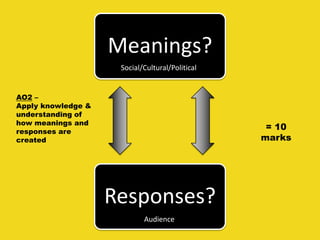
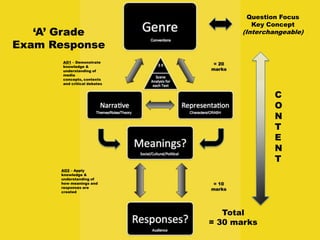
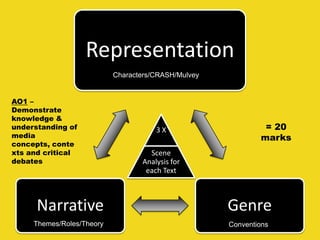
Genre
RepresentationNarrative
Conventions
Themes/Roles/Theory Characters/CRASH
3 X
Scene
Analysis for
each Text
= 20
marks
AO1 –
Demonstrate
knowledge &
understanding of
media concepts,
contexts and
critical debates
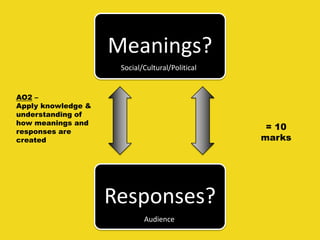
Meanings?
Responses?
Audience
Social/Cultural/Political
= 10
marks
AO2 –
Apply knowledge &
understanding of
how meanings and
responses are
created
Total
= 30 marks
‘A’ Grade
Exam Response
AO1 – Demonstrate
knowledge &
understanding of
media
concepts, contexts
and critical debates
AO2 – Apply
knowledge &
understanding of
how meanings and
responses are
created
Question Focus
Key Concept
(Interchangeable)
C
O
N
T
E
N
T
A2. How typical are your three main texts of their genre?
[30]
This question does invite candidates to contextualise their
chosen texts within a genre and to discuss elements of
typicality. Depending on the texts selected candidates may
argue that the tests are either typical or untypical. Look for
coherence of argument. Points about genre may include
references to:
Key signifiers and iconography
Storylines and plots
Characters and their functions
Stars/celebrities
Use of camera, sound, editing
Use of dialogue, language, music.
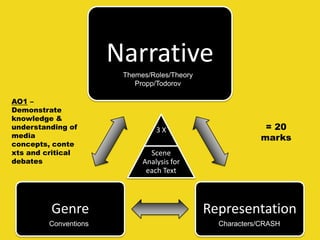
Narrative
RepresentationGenre
Conventions
Themes/Roles/Theory
Propp/Todorov
Characters/CRASH
3 X
Scene
Analysis for
each Text
= 20
marks
AO1 –
Demonstrate
knowledge &
understanding of
media
concepts, conte
xts and critical
debates
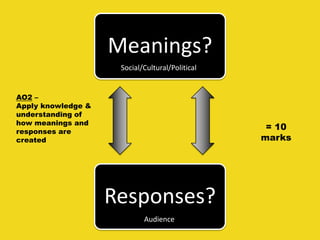
Meanings?
Responses?
Audience
Social/Cultural/Political
= 10
marks
AO2 –
Apply knowledge &
understanding of
how meanings and
responses are
created
A2. How important are characters to the narrative of your
three main texts? (30)
Candidates may argue that they are, or are not, important
depending on the texts selected. Please mark on merit
and look for coherence of argument – and for points being
backed-up. Lower grade candidates may just describe
characters; higher grade candidates should be engaging
with the how important part of the question. Please take
character to mean performer within the narrative.
Points made might include reference to:
• Character description (mark on merit)
• Role or function of the character within the narrative
• Reference to theory (e.g. Propp, Todorov etc) – please
ensure used relevantly.
Representation
GenreNarrative
ConventionsThemes/Roles/Theory
Characters/CRASH/Mulvey
3 X
Scene
Analysis for
each Text
= 20
marks
AO1 –
Demonstrate
knowledge &
understanding of
media
concepts, conte
xts and critical
debates
Meanings?
Responses?
Audience
Social/Cultural/Political
= 10
marks
AO2 –
Apply knowledge &
understanding of
how meanings and
responses are
created
A1. Explore the different ways in which people are
represented in your three main texts. [30]
This is quite an open question so please be prepared to
mark seen responses on merit. In the texts ‘people’ may be
fictionalised characters, but it is important – in order to
access higher level ‒ that candidates are discussing the
ways in which they are represented within the text and not
simply describing roles.
Points covered may include reference to:
Characters, roles and attitudes
Appearance – dress codes, body language, mode of
address
Stereotypes, traditional or unconventional representations
Theory as appropriate – for example Mulvey, etc.
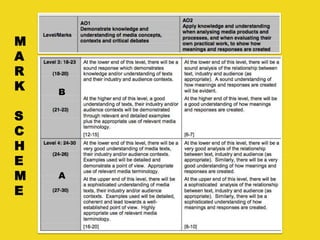
M
A
R
K
S
C
H
E
M
E
B
A

A2 media exam approaches

  • 1.
    A2 Media MS4 -Text Exam Approaches
  • 2.
     There areno right or wrong answers (apart from factual details) and there is likely to be a variety of responses to the questions ‒ this is wholly acceptable and each response will be considered individually. Candidates are expected to refer to three texts within each answer but it is not expected that the texts will be referred to equally.  If you do not refer to three texts in your answer marks will be deducted no matter how good the response may be.  There is no definitive list for each question and examiners will be open-minded and engage with what the candidates have written. Relevant answers will be rewarded on merit and each response will be considered individually as long as clear and detailed engagement is made with the questions. General Guidelines
  • 3.
    Genre RepresentationNarrative Conventions Themes/Roles/Theory Characters/CRASH 3 X Scene Analysisfor each Text = 20 marks AO1 – Demonstrate knowledge & understanding of media concepts, contexts and critical debates
  • 4.
    Meanings? Responses? Audience Social/Cultural/Political = 10 marks AO2 – Applyknowledge & understanding of how meanings and responses are created
  • 5.
    Total = 30 marks ‘A’Grade Exam Response AO1 – Demonstrate knowledge & understanding of media concepts, contexts and critical debates AO2 – Apply knowledge & understanding of how meanings and responses are created Question Focus Key Concept (Interchangeable) C O N T E N T
  • 6.
    A2. How typicalare your three main texts of their genre? [30] This question does invite candidates to contextualise their chosen texts within a genre and to discuss elements of typicality. Depending on the texts selected candidates may argue that the tests are either typical or untypical. Look for coherence of argument. Points about genre may include references to: Key signifiers and iconography Storylines and plots Characters and their functions Stars/celebrities Use of camera, sound, editing Use of dialogue, language, music.
  • 7.
    Narrative RepresentationGenre Conventions Themes/Roles/Theory Propp/Todorov Characters/CRASH 3 X Scene Analysis for eachText = 20 marks AO1 – Demonstrate knowledge & understanding of media concepts, conte xts and critical debates
  • 8.
    Meanings? Responses? Audience Social/Cultural/Political = 10 marks AO2 – Applyknowledge & understanding of how meanings and responses are created
  • 9.
    A2. How importantare characters to the narrative of your three main texts? (30) Candidates may argue that they are, or are not, important depending on the texts selected. Please mark on merit and look for coherence of argument – and for points being backed-up. Lower grade candidates may just describe characters; higher grade candidates should be engaging with the how important part of the question. Please take character to mean performer within the narrative. Points made might include reference to: • Character description (mark on merit) • Role or function of the character within the narrative • Reference to theory (e.g. Propp, Todorov etc) – please ensure used relevantly.
  • 10.
    Representation GenreNarrative ConventionsThemes/Roles/Theory Characters/CRASH/Mulvey 3 X Scene Analysis for eachText = 20 marks AO1 – Demonstrate knowledge & understanding of media concepts, conte xts and critical debates
  • 11.
    Meanings? Responses? Audience Social/Cultural/Political = 10 marks AO2 – Applyknowledge & understanding of how meanings and responses are created
  • 12.
    A1. Explore thedifferent ways in which people are represented in your three main texts. [30] This is quite an open question so please be prepared to mark seen responses on merit. In the texts ‘people’ may be fictionalised characters, but it is important – in order to access higher level ‒ that candidates are discussing the ways in which they are represented within the text and not simply describing roles. Points covered may include reference to: Characters, roles and attitudes Appearance – dress codes, body language, mode of address Stereotypes, traditional or unconventional representations Theory as appropriate – for example Mulvey, etc.
  • 13.