THE
COSMOLOGICAL
ARGUMENT
PLAN
SECTION 1
 Cosmos = universe
 Aposteriori, inductive.
INTRO
KEY IDEAS
 Must accept universe is intelligible
 Must question universe
 God is supreme and requires no explanation, the universe
does.
AQUINAS – WAY 1, 2 & 3
 Motion = first mover
 Cause = first cause
 Contingency = creator.
LEIBNIZ
 Principle of sufficient reason
 “Nothing takes place without a sufficient reason”
 Known / unknown explanation for everything.
COPLESTON
 Some things in the world do not contain within themselves
the reason for their own existence
 The explanation is separate and outside of the world
 This is God.
KALAM / W. L. CRAIG
 Muslim scholars, 9th century
 WLC: “The Kalam Cosmological Argument
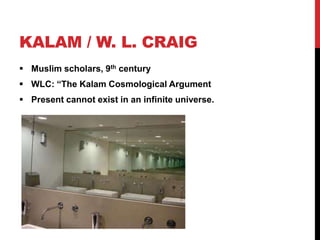
 Present cannot exist in an infinite universe.
SECTION 2
S - SCIENCE HAS NO
ALTERNATIVE
 Science has not yet discovered an alternative explanation.
 We live in a scientifically developed age…
S - LOGICAL AND
COHERENT
 Each step builds in the previous
 It is possible to either agree or disagree, not both.
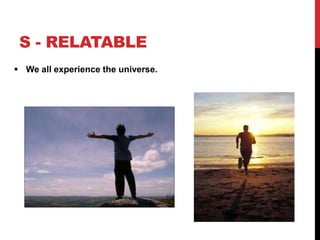
S - RELATABLE
 We all experience the universe.
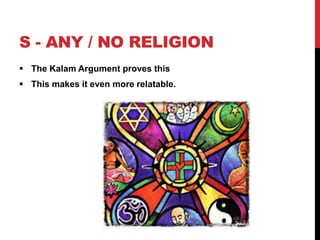
S - ANY / NO RELIGION
 The Kalam Argument proves this
 This makes it even more relatable.
W – FIRST PREMISE
FAILS
 If you don’t question the universe.
 Bertrand Russell – “Ultimate Brute Fact,” “Just there, and
that’s all,” C/R debate
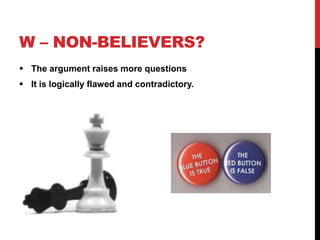
W – NON-BELIEVERS?
 The argument raises more questions
 It is logically flawed and contradictory.
W – BBT COULD BE
WRONG
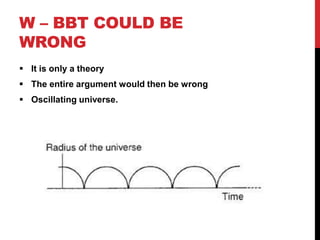
 It is only a theory
 The entire argument would then be wrong
 Oscillating universe.
W – DAVID HUME & I.
KANT
 Hume – we never experience causation, it is an illusion
born out of habit
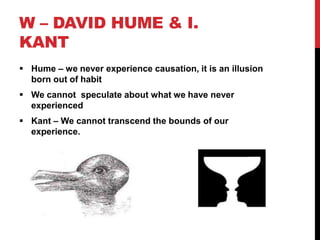
 We cannot speculate about what we have never
experienced
 Kant – We cannot transcend the bounds of our
experience.

The cosmological argument

  • 1.
  • 2.
  • 3.
     Cosmos =universe  Aposteriori, inductive. INTRO
  • 4.
    KEY IDEAS  Mustaccept universe is intelligible  Must question universe  God is supreme and requires no explanation, the universe does.
  • 5.
    AQUINAS – WAY1, 2 & 3  Motion = first mover  Cause = first cause  Contingency = creator.
  • 6.
    LEIBNIZ  Principle ofsufficient reason  “Nothing takes place without a sufficient reason”  Known / unknown explanation for everything.
  • 7.
    COPLESTON  Some thingsin the world do not contain within themselves the reason for their own existence  The explanation is separate and outside of the world  This is God.
  • 8.
    KALAM / W.L. CRAIG  Muslim scholars, 9th century  WLC: “The Kalam Cosmological Argument  Present cannot exist in an infinite universe.
  • 9.
  • 10.
    S - SCIENCEHAS NO ALTERNATIVE  Science has not yet discovered an alternative explanation.  We live in a scientifically developed age…
  • 11.
    S - LOGICALAND COHERENT  Each step builds in the previous  It is possible to either agree or disagree, not both.
  • 12.
    S - RELATABLE We all experience the universe.
  • 13.
    S - ANY/ NO RELIGION  The Kalam Argument proves this  This makes it even more relatable.
  • 14.
    W – FIRSTPREMISE FAILS  If you don’t question the universe.  Bertrand Russell – “Ultimate Brute Fact,” “Just there, and that’s all,” C/R debate
  • 15.
    W – NON-BELIEVERS? The argument raises more questions  It is logically flawed and contradictory.
  • 16.
    W – BBTCOULD BE WRONG  It is only a theory  The entire argument would then be wrong  Oscillating universe.
  • 17.
    W – DAVIDHUME & I. KANT  Hume – we never experience causation, it is an illusion born out of habit  We cannot speculate about what we have never experienced  Kant – We cannot transcend the bounds of our experience.