Algebra 2
Chapter 6 Study Guide

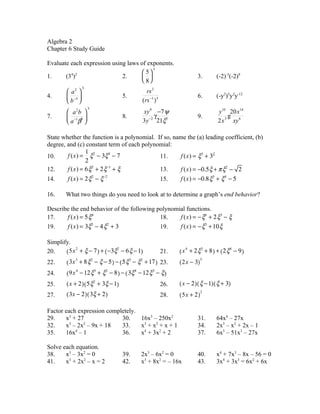
Evaluate each expression using laws of exponents.
                                          3
         4 2                          5
1.     (3 )                  2.                                     3.        (-2)-3(-2)9
                                      8
                   3
         a2                                rs 2
4.       b −3                      5.                               6.        (-y2)5y2y-12
                                         (rs −1 )3
                       3
         a 2b                            xy 9 −7 ψ                             y10 20x14
7.       a −1β5                    8.         γ                     9.             g
                                         3y −2 21ξ5                            2x 3 xy 6

State whether the function is a polynomial. If so, name the (a) leading coefficient, (b)
degree, and (c) constant term of each polynomial:
                1
10.     f (x) = ξ2 − 3ξ4 − 7                 11.     f (x) = ξ3 + 3ξ
                2
12.     f (x) = 6 ξ2 + 2 ξ−1 + ξ             13.     f (x) = −0.5 ξ + π ξ2 − 2
14.     f (x) = 2 ξ2 − ξ−2                   15.     f (x) = −0.8 ξ3 + ξ4 − 5

16.    What two things do you need to look at to determine a graph’s end behavior?

Describe the end behavior of the following polynomial functions.
17.    f (x) = 5 ξ4                         18.    f (x) = − ξ6 + 2 ξ3 − ξ
19.    f (x) = 3ξ5 − 4 ξ2 + 3               19.    f (x) = − ξ3 + 10 ξ

Simplify.
       ( 5x + ξ − 7 ) + ( −3ξ − 6 ξ − 1)                     ( x + 2ξ + 8) + (2 ξ − 9)
           2                 2                                  4    3           4
20.                                                    21.
                                                                         3
        ( 3x + 8 ξ − ξ − 5 ) − ( 5 ξ − ξ + 17 ) 23.
                  2                 3   2
                                                             ( 2x − 3)
            3
22.
        ( 9x − 12 ξ + ξ − 8 ) − ( 3ξ − 12 ξ − ξ)
            4      3   2            4      3
24.
25.     ( x + 2 ) ( 5 ξ2 + 3ξ − 1)                     26.   ( x − 2 ) ( ξ − 1) ( ξ + 3)
                                                                          2
27.     ( 3x − 2 ) ( 3ξ + 2 )                          28.   ( 5x + 2 )

Factor each expression completely.
29.    x3 + 27              30.    16x5 – 250x2                       31.       64x4 – 27x
32.    x3 – 2x2 – 9x + 18   33.    x3 + x2 + x + 1                    34.       2x3 – x2 + 2x – 1
           4
35.    16x – 1              36.    x4 + 3x2 + 2                       37.       6x5 – 51x3 – 27x

Solve each equation.
38.    x3 – 3x2 = 0                  39.   2x3 – 6x2 = 0              40.       x4 + 7x3 – 8x – 56 = 0
41.    x3 + 2x2 – x = 2              42.   x3 + 8x2 = – 16x           43.       3x4 + 3x3 = 6x2 + 6x
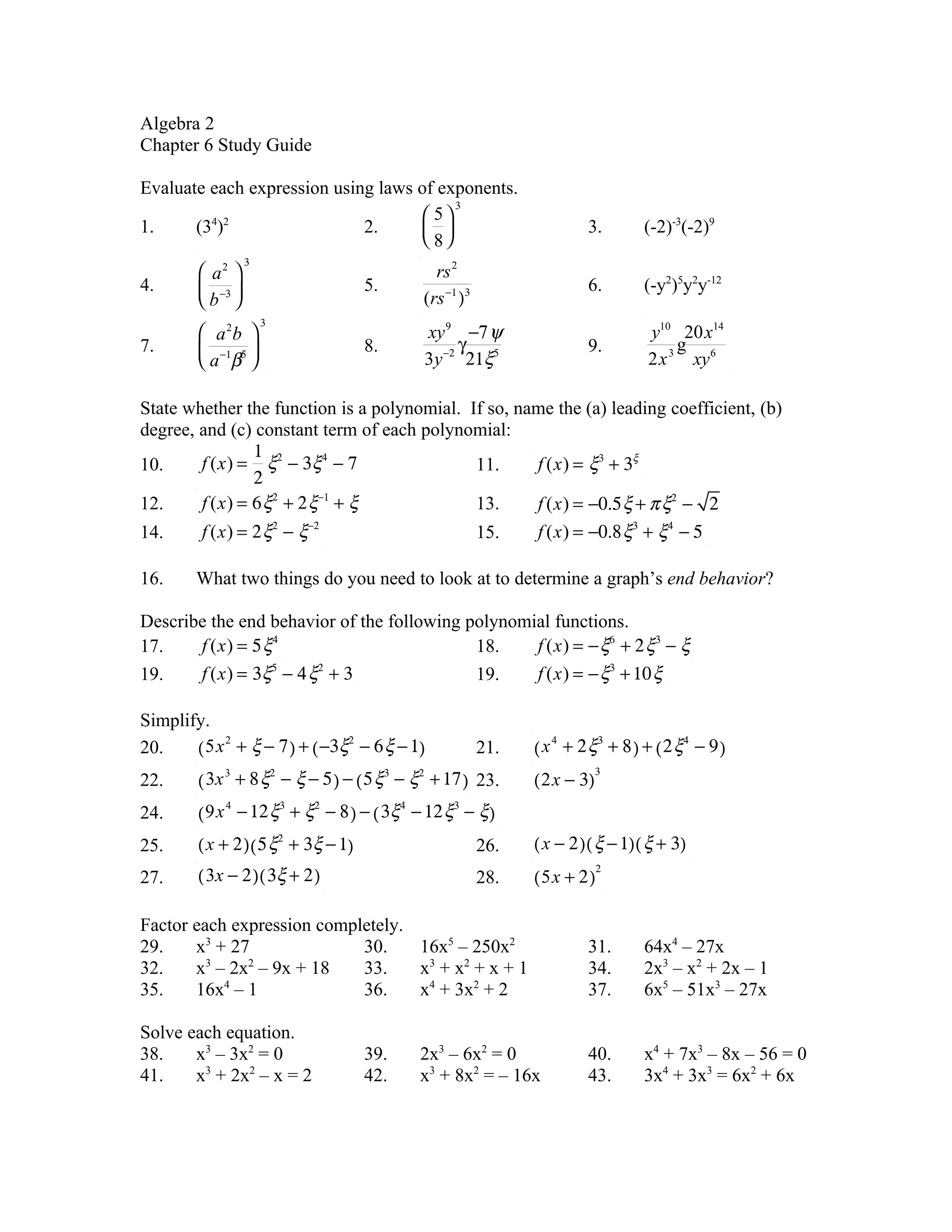
Use long division to divide the following polynomials.
44.    (2x 4 + 3ξ3 + 5 ξ − 1) ÷ ( ξ2 − 2 ξ + 2) 45. (x 4 + 2 ξ2 − ξ + 5) ÷ ( ξ2 − ξ + 1)
46.    (10x 3 + 27 ξ2 + 14 ξ + 5) ÷ ( ξ2 + 2 ξ) 47. (5x 4 + 14 ξ3 + 9 ξ) ÷ ( ξ2 + 3ξ)

Use synthetic division to divide the following polynomials.
48.    (x 3 − 7 ξ − 6) ÷ ( ξ − 2)            49.     (4 x 2 + 5 ξ − 4) ÷ ( ξ − 2)
50.    (3x 2 − 10 ξ) ÷ ( ξ − 6)              51.     (x 4 − 6 ξ3 − 40 ξ + 33) ÷ ( ξ − 7)

Find all the zeros of each polynomial.
52.      f (x) = ξ3 + 2 ξ2 − 11ξ − 12             53.   f (x) =   ξ3 − 4 ξ2 − 11ξ + 30
54.      f (x) = ξ3 − ξ2 − 9 ξ + 9                55.   f (x) =   ξ3 − 7 ξ2 + 10 ξ + 6
56.      f (x) = 10 ξ4 − 3ξ3 − 29 ξ2 + 5 ξ + 12   57.   f (x) =   ξ3 − 7 ξ2 + 2 ξ + 40
58.      f (x) = ξ5 − 2 ξ4 + 8 ξ2 − 13ξ + 6       59.   f (x) =   ξ4 + 3ξ3 − 8 ξ2 − 22 ξ − 24

Write a polynomial f of least degree that has real coefficients, a leading coefficient of 1,
and the following zeros.
60.    1, 2, 1 + i             61.    5, 2i, and -2i          62.      1 and -2 + i
63.    3 – i and 5i            64.    -2, -2, 3, -4i          65.      4, 4, 2 + i

66.     If 3 is a zero of polynomial f, then __________ is a factor of f(x).
67.     If (x + 2) is a factor of f(x), then ________ is an x-intercept of the graph of f(x).

Graph each polynomial.
               1
68.    f (x) = ( ξ + 2)( ξ − 1)2                  69.   f (x) = −2( ξ2 − 9)( ξ + 4)
               4
70.    f (x) = ξ3 + 2 ξ2 − 5 ξ + 1                71.   f (x) = 2 ξ4 − 5 ξ3 − 4 ξ2 − 6

Write an equation to model the polynomial given the following points.
72.    (-1, 0)(-2, 0)(0, 0)(1, -3)         73.     (1, 0)(3, 0)(-2, 0)(2, 1)
74.    (3, 0)(2, 0)(-1, 0)(1, 4)                   75.     (0, 0)(-3, 0)(5, 0)(-2, 3)

Show that the nth-order differences for the given function of degree n are nonzero and
constant.
76.     f (x) = ξ2 − 3ξ + 7                   77.    f (x) = − ξ3 + 3ξ2 − 2 ξ − 3
78.     f (x) = 2 ξ4 − 20                     79.    f (x) = 3ξ3 − 5 ξ2 − 2

Use finite differences and a system of equations to find the polynomial function that fits
the data.
x             1            2            3             4            5           6
f(x)          -4           0            10            26           48          76

A2 Chapter 6 Study Guide

  • 1.
    Algebra 2 Chapter 6Study Guide Evaluate each expression using laws of exponents. 3 4 2  5 1. (3 ) 2.   3. (-2)-3(-2)9  8 3  a2  rs 2 4.  b −3  5. 6. (-y2)5y2y-12   (rs −1 )3 3  a 2b  xy 9 −7 ψ y10 20x14 7.  a −1β5  8. γ 9. g   3y −2 21ξ5 2x 3 xy 6 State whether the function is a polynomial. If so, name the (a) leading coefficient, (b) degree, and (c) constant term of each polynomial: 1 10. f (x) = ξ2 − 3ξ4 − 7 11. f (x) = ξ3 + 3ξ 2 12. f (x) = 6 ξ2 + 2 ξ−1 + ξ 13. f (x) = −0.5 ξ + π ξ2 − 2 14. f (x) = 2 ξ2 − ξ−2 15. f (x) = −0.8 ξ3 + ξ4 − 5 16. What two things do you need to look at to determine a graph’s end behavior? Describe the end behavior of the following polynomial functions. 17. f (x) = 5 ξ4 18. f (x) = − ξ6 + 2 ξ3 − ξ 19. f (x) = 3ξ5 − 4 ξ2 + 3 19. f (x) = − ξ3 + 10 ξ Simplify. ( 5x + ξ − 7 ) + ( −3ξ − 6 ξ − 1) ( x + 2ξ + 8) + (2 ξ − 9) 2 2 4 3 4 20. 21. 3 ( 3x + 8 ξ − ξ − 5 ) − ( 5 ξ − ξ + 17 ) 23. 2 3 2 ( 2x − 3) 3 22. ( 9x − 12 ξ + ξ − 8 ) − ( 3ξ − 12 ξ − ξ) 4 3 2 4 3 24. 25. ( x + 2 ) ( 5 ξ2 + 3ξ − 1) 26. ( x − 2 ) ( ξ − 1) ( ξ + 3) 2 27. ( 3x − 2 ) ( 3ξ + 2 ) 28. ( 5x + 2 ) Factor each expression completely. 29. x3 + 27 30. 16x5 – 250x2 31. 64x4 – 27x 32. x3 – 2x2 – 9x + 18 33. x3 + x2 + x + 1 34. 2x3 – x2 + 2x – 1 4 35. 16x – 1 36. x4 + 3x2 + 2 37. 6x5 – 51x3 – 27x Solve each equation. 38. x3 – 3x2 = 0 39. 2x3 – 6x2 = 0 40. x4 + 7x3 – 8x – 56 = 0 41. x3 + 2x2 – x = 2 42. x3 + 8x2 = – 16x 43. 3x4 + 3x3 = 6x2 + 6x
  • 2.
    Use long divisionto divide the following polynomials. 44. (2x 4 + 3ξ3 + 5 ξ − 1) ÷ ( ξ2 − 2 ξ + 2) 45. (x 4 + 2 ξ2 − ξ + 5) ÷ ( ξ2 − ξ + 1) 46. (10x 3 + 27 ξ2 + 14 ξ + 5) ÷ ( ξ2 + 2 ξ) 47. (5x 4 + 14 ξ3 + 9 ξ) ÷ ( ξ2 + 3ξ) Use synthetic division to divide the following polynomials. 48. (x 3 − 7 ξ − 6) ÷ ( ξ − 2) 49. (4 x 2 + 5 ξ − 4) ÷ ( ξ − 2) 50. (3x 2 − 10 ξ) ÷ ( ξ − 6) 51. (x 4 − 6 ξ3 − 40 ξ + 33) ÷ ( ξ − 7) Find all the zeros of each polynomial. 52. f (x) = ξ3 + 2 ξ2 − 11ξ − 12 53. f (x) = ξ3 − 4 ξ2 − 11ξ + 30 54. f (x) = ξ3 − ξ2 − 9 ξ + 9 55. f (x) = ξ3 − 7 ξ2 + 10 ξ + 6 56. f (x) = 10 ξ4 − 3ξ3 − 29 ξ2 + 5 ξ + 12 57. f (x) = ξ3 − 7 ξ2 + 2 ξ + 40 58. f (x) = ξ5 − 2 ξ4 + 8 ξ2 − 13ξ + 6 59. f (x) = ξ4 + 3ξ3 − 8 ξ2 − 22 ξ − 24 Write a polynomial f of least degree that has real coefficients, a leading coefficient of 1, and the following zeros. 60. 1, 2, 1 + i 61. 5, 2i, and -2i 62. 1 and -2 + i 63. 3 – i and 5i 64. -2, -2, 3, -4i 65. 4, 4, 2 + i 66. If 3 is a zero of polynomial f, then __________ is a factor of f(x). 67. If (x + 2) is a factor of f(x), then ________ is an x-intercept of the graph of f(x). Graph each polynomial. 1 68. f (x) = ( ξ + 2)( ξ − 1)2 69. f (x) = −2( ξ2 − 9)( ξ + 4) 4 70. f (x) = ξ3 + 2 ξ2 − 5 ξ + 1 71. f (x) = 2 ξ4 − 5 ξ3 − 4 ξ2 − 6 Write an equation to model the polynomial given the following points. 72. (-1, 0)(-2, 0)(0, 0)(1, -3) 73. (1, 0)(3, 0)(-2, 0)(2, 1) 74. (3, 0)(2, 0)(-1, 0)(1, 4) 75. (0, 0)(-3, 0)(5, 0)(-2, 3) Show that the nth-order differences for the given function of degree n are nonzero and constant. 76. f (x) = ξ2 − 3ξ + 7 77. f (x) = − ξ3 + 3ξ2 − 2 ξ − 3 78. f (x) = 2 ξ4 − 20 79. f (x) = 3ξ3 − 5 ξ2 − 2 Use finite differences and a system of equations to find the polynomial function that fits the data. x 1 2 3 4 5 6 f(x) -4 0 10 26 48 76