This document discusses the application of duality theory in multi-objective linear programming (MOLP) problems, comparing three solution methods: weighted sum, e-constraint, and a combined approach. Utilizing a bank's investment data, it analyzes which method is most effective, ultimately concluding that the merged weighted sum/e-constraint method outperforms the others. The study highlights the importance of accurately representing multiple conflicting criteria in decision-making scenarios.
![Duality Theory In Multi Objective…
www.theijes.com The IJES Page 3
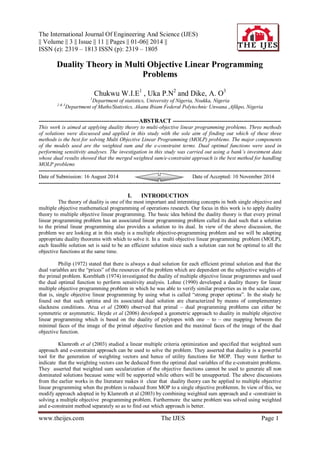
WEIGHTED-SUM APPROACH : In the weighted sum approach, a weighted sum of the objective functions
is maximized or minimized as the case may be. These objective functions of MOLP are pooled together using
the strictly positive weighting vectors say {û є Rk
: û > 0, Σ ûί =1}, such that the MOLP becomes SOP given by
Max z = ûT
C (x)
Subject to Ax ≤ b; x ≥ 0
e-CONSTRAINT APPROACH : In the e-constraint approach, one objective function out of the objectives of
the MOLP is retained as a scalar – valued objective while all the other objective functions are made new
constraints by assigning goals/targets (to be achieved) to them. Hence, the ith
objective e-constraint program
becomes:
Max z = Ci(x);
Subject to Nj(x) ≥ ej Jij
;
Ax ≤ b; x ≥ 0
Where: Cix is one out of the given objective functions
Njx ≥ ej = the remaining objective functions (with the targets, ej assigned to them) which now form part of the
constraint equations. Hence they are called e-constraint equations.
The Merged Weighted Sum/ e-Constraint Approach :In MOLP, goals could be set by the decision maker
and such goals can either be overachieved or underachieved. Usually interest is to achieve goals set in any firm
and in view of this we always try to minimize any trace of underachievement and/or overachievement which
may sometimes occur. In this work also, considering the assignment of targets; since the interest of the decision
maker is to minimize the deviations from the targets as discussed earlier, we now obtain another single model
that comprises both the weighted sum and e-constraint terms in which the objective is to minimize the weighted
sum of these deviations. The weights are assigned according to the levels of minimization decided by the
decision maker. In the linear programming simplex approach, such deviations are called slack variables
whereas in MOLP, these slack terms are either positive or negative indicating overachievement or
underachievement of the set goals and not only are they real variables but are also the only terms in the
objective function which is to be minimized. Hence the resultant program becomes
Min z = WT
dj
Subject to Nj(x) + dj ≥ ej Ji j
;
Ax ≤ b; x ≥ 0; dj ≥ 0.
Where W = the weight assigned by the decision maker; dj which is the deviational variable can be
-
j
dor
j
d
depending on the objective of the decision maker;
j
d = overachievement of the assigned goal;
-
j
d = is the underachievement of the assigned goal
All these approaches to solutions were demonstrated in the analyses and the results discussed in chapter
four.
DATA COLLECTION ON BANK’S INVESTMENT : Every investor must trade off return versus risk in
deciding how to allocate his or her available funds. The opportunities that promise the greatest profits are almost
always the ones that present the most serious risks. Investment banks must be especially careful in balancing
return and risk because legal and ethical obligations demand that they avoid undo hazards. Yet their goal as a
business enterprise is to maximize profit and also minimize risk.The investment bank in discussion whose name
is not to be mentioned for security and integrity reasons has about N20 billion as the capital with N150 billion in
demand deposits and N80 billion in time deposits. The chart (table) below provides every detail about the
investment.
Bank investment category (j) Return rate (%) Liquid part (%) Required capital (%) Risk asset (%)
1 Cash 0.0 100.0 0.0 No
2 Short term 4.0 99.5 0.5 No
3 Government:2 years 4.5 96.0 4.0 No
4 Government:4 years 5.5 90.0 5.0 No
5 Government:6 years 7.0 85.0 7.5 No
6 Installment loans 10.5 0.0 10.0 Yes
7 Mortgage loans 8.5 0.0 10.0 Yes
8 Commercial loans 9.2 0.0 10.0 Yes
The first goal of any business enterprise is to maximize profit. Hence, using the rates of return from
the above table, the objective function becomes
Max P = 0.040X2 + 0.045X3 + 0.055X4 + 0.070X5 + 0.105X6 + 0.085X7 + 0.092X8 [profit]](https://image.slidesharecdn.com/a0311010106-150218040130-conversion-gate02/85/Duality-Theory-in-Multi-Objective-Linear-Programming-Problems-3-320.jpg)
![Duality Theory In Multi Objective…
www.theijes.com The IJES Page 4
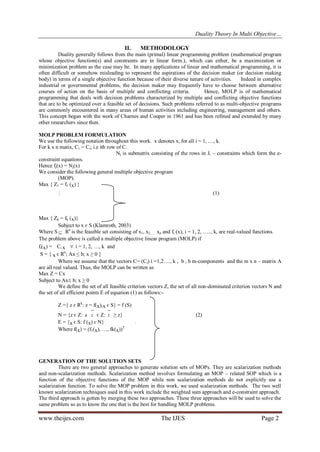
In order to quantify investment risk, we employ the two commonly used ratio measures. The first is the
capital adequacy ratio which is expressed as the ratio of the required capital to the actual capital. A low value
indicates minimum risk and vise versa. The second objective function becomes
Min C =
20
1 (0.005X2 + 0.040X3 + 0.050X4 + 0.075X5 + 0.100X6 + 0.100X7 + 0.100X8)
[capital-adequacy]
Another measure of risk focuses on illiquid risk assets which is measured by the ratio of risk asset to
the actual capital and a low ratio indicates a financially secure institution. Hence the third objective function
becomes
Min R =
20
1 (X6 + X7 + X8) [Risk-asset]
The following information from the bank presents the relevant constraints.
(1) Investment must sum to the available capital and deposit funds.
(2) Cash reserves must be at least 14% of demand deposit plus 4% of time deposits.
(3) The portion of investments considered liquid should be at least 47% of demand deposits plus 36% of time
deposits.
(4) At least 5% of funds should be invested in each of the eight categories, for diversity.
(5) At least 30% funds should be invested in commercial loans, to maintain the bank’s community status.
ANALYSIS OF DATA : Combining the three objective functions above with these five systems of constraints,
the multiple objective linear programming model of this Bank’s investment becomes
Max P = 0.040X2 + 0.045X3 + 0.055X4 + 0.070X5 + 0.105X6 + 0.085X7 + 0.092X8 [Profit]
Min C =
20
1 (0.005X2 + 0.040X3 + 0.050X4 + 0.075X5 + 0.100X6 + 0.100X7 + 0.100X8)
[Capital-adequacy]
Min R =
20
1 (X6 + X7 + X8) [Risk-asset]
Subject to:
X1 + X2 + X3 + X4 + X5 + X6 + X7 + X8 = 250 [Invest all]
X1 ≥ 24.2 [Cash reserve]
1.00X1 + 0.995X2 + 0.960X3 + 0.900X4 + 0.850X5 ≥ 99.3 [liquidity]
Xj ≥ 12.5 for all j = 1, 2, …, 8 [ diversification]
X8 ≥ 75 [commercial]
Here solutions are evaluated on three criteria namely profit, capital-adequacy ratio and risk-asset ratio.
The above problem was solved using the weighted sum approach with a weighting vector
3
1
.
With the set goals for the three criteria as follows
Profit ≥ 18.5
Capital-adequacy ratio ≤ 0.8
Risk-asset ratio ≤ 7.0,
the three objective functions can then be stated in the following manner
Goal 1 0.040X2 + 0.045X3 + 0.055X4 + 0.070X5 + 0.105X6 + 0.085X7 + 0.092X8 ≥ 18.5 [profit ]
Goal 2
20
1 (0.005X2 + 0.040X3 + 0.050X4 + 0.075X5 + 0.100X6 + 0.100X7 + 0.100X8) ≤ 0.8
[capital-adequacy]
Goal 3
20
1 (X6 + X7 + X8) ≤ 7.0 [risk-asset]
Subject to the constraints as used above. The problem was solved using the e-constraint approach
Also, considering the Bank’s investment problem, each of the given goals can either be overachieved or
underachieved designated by positive deviational variables and negative deviational variables respectively.
For goal 1, our interest is to minimize underachievement since overachievement increases the profit.
For goals 2 & 3, our interest is to minimize overachievement of risk.
Hence we define the following deviational variables of interest
1
d = amount with which profit falls short of its goal
2
d = amount with which capital-adequacy ratio exceeds its goal.
3
d = amount with which risk-asset ratio exceeds its goal.](https://image.slidesharecdn.com/a0311010106-150218040130-conversion-gate02/85/Duality-Theory-in-Multi-Objective-Linear-Programming-Problems-4-320.jpg)
![Duality Theory In Multi Objective…
www.theijes.com The IJES Page 5
The objective function which now comprises these deviational variables in a minimization sense is
written as
Min Z =
1
d +
2
d +
3
d
Subject to the above given constraints with goal constraints inclusive.
In the analyses, we consider both equal and unequal goal weights.
Using equal goal weights w1 = w2 = w3 = 1, the Bank’s investment problem has the following linear
goal programming model.
Min Z =
1
d +
2
d +
3
d
Subject to
0.040X2 + 0.045X3 + 0.055X4 + 0.070X5 + 0.105X6 + 0.085X7 + 0.092X8 +
1
d ≥ 18.5 [profit]
0.00025X2 + 0.002X3 + 0.0025X4 + 0.00375X5 + 0.005X6 + 0.005X7 + 0.005X8 –
2
d ≤ 0.8
[capital-adequacy]
0.05X6 + 0.05X7 + 0.05X8 –
3
d ≤ 7.0 [risk-asset]
X1 + X2 + X3 + X4 + X5 + X6 + X7 + X8 = 250 [invest all]
X1 ≥ 24.2 [cash reserve]
1.00X1 + 0.995X2 + 0.960X3 + 0.900X4 + 0.850X5 ≥ 99.3 [liquidity]
Xj ≥ 12.5 for all j = 1, …, 8 [diversification]
X8 ≥ 75 [commercial]
X1, …, X8, d1, …, d3 ≥ 0
Using unequal weights of say
w1 = 7, w2 = 3, w3 = 1, we now have
Min Z =
321
37 ddd
Subject to the same constraints as above.
The problems above were solved using the merged approach.
We used two phase method in solving the above problems because of the presence of both equality and
inequality signs.
Tora software was also used in solving the problem
FINDINGS : This work comprises analyses on each of the methods of solutions discussed above and the dual
results are discussed below as follows:
For the weighted sum approach, even though it converges faster than the e-constraint approach (that is, it has a
fewer number of iterations than the e-constraint approach), it does not achieve the targets of the decision maker
in the sense that goals are underachieved and/or overachieved; hence the values
(-4.458, 5.418, 5) instead of (18.5, 0.8, 7), where -4.458 and 5.418 are non-suported solutions and the 3rd
value,
5 is a supported solution. All these values are obtained by substituting the values of the decision variable of the
weighted sum optimization in the given objective functions (Klamroth et al, 2003).
For the e-constraint approach; it involves more number of iterations than the other two approaches. It is also
more complex to use in the sense that each of the objective functions has to be used individually. Furthermore, it
still does not achieve the targets of the decision maker in the sense that it has the underachievement of the profit
goal and overachievement of the investment risks; hence the values (17.324, 0.928, 8.01) instead of (18.5, 0.8,
7). All these values are in billions of Naira.
However, for the merged approach in which the objective is to minimize the deviational variables of interest;
not only that it has a fewer number of iterations; all the deviational variables
321
,, ddd denoted by (x9,
x10 and x11) are minimized to zero showing that all the investment targets are met.
III. CONCLUSION
Applying duality theory to multi objective linear programming is an interesting concept in
mathematical programming. Duality generally arises from the fact that most times, it is more difficult to solve a
linear programming problem in its original (primal) form and as a result, the dual aspect is generated from the
primal and solved.
In this work, to generate solutions to the MOLP problem, we used scalarization methods (approaches)
which involve formulating an MOP-related SOP which is a function of the objective functions of the MOP. The
three secularization approaches used include: the weighted sum approach, e-constraint approach and the merged
weighted sum/e-constraints approach. Each approach was used to solve the same problem with the sole aim of](https://image.slidesharecdn.com/a0311010106-150218040130-conversion-gate02/85/Duality-Theory-in-Multi-Objective-Linear-Programming-Problems-5-320.jpg)
![Duality Theory In Multi Objective…
www.theijes.com The IJES Page 6
finding which approach handles MOLP problems better and why. Hence a real life example was used to
demonstrate the discussion above with theS findings as seen in the discussion of the analyses. Based on these
findings, we conclude that multi objective linear programming problems are better and easier solved using
duality method applied to the merged approach in which the objective function comprises the deviational
variables from the originally given objectives of the decision maker since in most cases it involves fewer or at
worst the same number of iterations as in primal problem and all the deviational variables most times are
minimized to zero (which is better than either overachievement or underachievement as the case may be)
showing that the targets of the decision maker are all met.
IV. RECOMMENDATIONS
The researcher has been able to carry out some analyses using real life collected data and would like to
give the following recommendations.
[1] The researcher recommends that the method of solution involving the weighted sum and e-constraint terms
is the best for solving MOLP problems since it minimizes the deviational variables to zero or at worst
close to zero and also has a fewer number of iterations.
[2] The researcher also recommends that further work should be done on the weighted sum approach so as to
know why sometimes it does not provide an optimal solution to least one of the objective functions of an
MOLP problem.
[3] Application of duality theory to multi objective linear programming should also be adapted to problems
related to everyday life.
[4] Application of duality theory should also be extended to some other areas of soperations research such as
convex programming, games theory etc.
[5] Finally, the researcher recommends that the investment bank should increase their rates of return so that
they will be able to attain the target set for profit and avoid underachieving it.
REFERENCES
[1] Arua, A.I., Okafor, F.C., and Chigbu, P.E. (2000) Advanced statistics for higher education vol 1.
[2] Charnes, A. and Cooper, W. (1961) Management models and industrial application of linear programming vol. 1, Wiley, New York.
[3] Evans Gerald W. (1984) An overview of technique for solving Multi-objective mathematical programs, vol 30 No., 1
[4] Heyde, F. and Lohne, A. (2006) A geometric approach to duality in multiple objective linear programming.
[5] Heyde, F., Lohne, A. and Tammer, C. (2006) Duality in multi objective linear programming, draft.
[6] Huntley N., (1998) Definition of duality in the free online Encyclopedia.
[7] Klamroth K. and Sibylle Z. (2003) Linear multiple criteria optimization involving both the weighted sums approach and e-
constraint approach.
[8] Kornbluth, J.S.H., (1974) Duality, indifference and sensitivity analysis in multi objective linear programming. Operations Research
Quarterly 25, pp 599 – 614.
[9] Lohne, A. (1990) Duality theory for linear multiple objective programming problems.
[10] Philip, J. (1972) Algorithms for vector maximization problem. Mathematical program vol 2, p. 207.
[11] Robert, B.A. (1972) Real analysis and probability.
[12] Taha, H.A. (2007) An introduction to operations research (Eight edition).](https://image.slidesharecdn.com/a0311010106-150218040130-conversion-gate02/85/Duality-Theory-in-Multi-Objective-Linear-Programming-Problems-6-320.jpg)


