Download to read offline
![IOSR Journal of Electronics and Communication Engineering (IOSR-JECE)
e-ISSN: 2278-2834,p- ISSN: 2278-8735.Volume 10, Issue 4, Ver. III (Jul - Aug .2015), PP 01-07
www.iosrjournals.org
DOI: 10.9790/2834-10430107 www.iosrjournals.org 1 | Page
Behavioral control of swarm robots with implicit communication:
A New approach
Saikiran Ambati1
, Sukesh Ramini1
, Chinnaaiah.M.C2
1
Under graduate student, Professor2
Department of ECE ,BVRIT Hyderabad, INDIA
Abstract: The Practical Swarm Optimization (PSO) algorithms are required behavioral control to perform
successful navigation. The role of communication with behavioral control is an important issue in swarm
robotics. This paper presents how the leader and follower robots can change their mode of behavioral control
by switching between centralization and decentralization processing methods with a new approach using
implicit communication. The target of the robots is to reach the goal point, which is placed with IR beacon. The
robots can avoid obstacles with the help of IR sensors (1 meter range) and communicates with RF Transceivers
(2.4GHz).If there is no obstacle in between leader and follower, then follower continues to follow the leader as
per centralization behavior mode. In this process if obstacle arrives between the leader and follower, it can
avoid with IR sensor’s information. When both of them are away from original path, then they are decentralized
and plan to reach the goal individually. The customized prototype Robots are developed with Arduino Uno
ATMEGA328P which is used as the control unit for both leader and follower with a transceiver pair of
NRF24L01 (2.4 GHz) to achieve inter – swarm communication. The proposed algorithm is implemented in our
laboratory and this design is pragmatic in industrial and medical fields.
IndexTerms: centralization, decentralization, obstacle avoidance, swarm robotics
I. Introduction
Man being a social animal need to communicate with each other to live in society for his smoothness of
living, by using language and gestures. Similarly in case of robots there is a vast research going on the way
about a group of robots does the work by communicating each other there by emerging a field called swarm
robotics with behavioral control.
The swarm robotics navigation and behavior control are majorly inspired by biological axis of ants,
bees and even humans [1]. This has its advantages in flexibility, robustness, scalability over a single robot path
planning. This field has got its importance in present robotic research that is in way of synchronizing of multiple
robots to perform particular task.[2]Jung and Zelinsky (2000) have designed a heterogeneous cooperative multi
robot system that was inspired by communication method of biological systems.
The robot path planning is one the most rattling issue in research which can be classified basing on the
environment it is defined as known and unknown environment .which is done with the technique of SLAM
(simultaneous localization and mapping) where the robots completely reckon on sensor information for
exploring of unknown environment. The research axes was classified by swarm size, communication range,
communication bandwidth, swarm reconfigurability by [3] Dudek et al. (1993).
The obstacle avoidance is one of main constraint in robot navigation. The single robot obstacle
avoidances are proposed by Lumelsky et al [6] & [7].The new versions of obstacle avoidance by tangent bug
algorithms [8]. The intensity based algorithm for improvement of the bug algorithms by Taylor et al [9]. In
similar lines the obstacle avoidance in swarm robotics also creates more hurdles in path planning of robots.The
other side of axes of the research influenced with obstacles disturbances, which creates the communication gap
in between robots .In this scenario the robots changes from centralization to decentralization methods.
The centralization in robotics mean that robotic system or community where any one of them will be
responsible for the work done by whole swarm which is cited to be leader robot, while other robots (follower)
take its command from leader and acts accordingly. Similarly the decentralization inrobotic community is
dwelled with fully autonomous robots which act independently for decision making. The authors [11] R.hamed
et al is proposed algorithm regarding the obstacle avoidance of the robots in decentralization environment. In the
swarm robotics navigation the centralization and decentralization methods are having their own advantages and
disadvantages [1]. This paper presents the new approach of the behavioral control of multi robot which can
swap between centralized and decentralized processing methods. The Microcontroller robots are best in
implementation of algorithm with less power consumption [10]. It is economical and reconfigurable.
This paper is machinated as follows, section II deals with the proposed algorithm of the behavioral
control between robots. The section III presents about design setup of embedded robots. Section IV is regarding
the experimental results for proposed algorithm. Section V concludes the importance of algorithm.](https://image.slidesharecdn.com/a010430107-160805100712/85/A010430107-1-320.jpg)
![IOSR Journal of Electronics and Communication Engineering (IOSR-JECE)
e-ISSN: 2278-2834,p- ISSN: 2278-8735.Volume 10, Issue 4, Ver. III (Jul - Aug .2015), PP 01-07
www.iosrjournals.org
DOI: 10.9790/2834-10430107 www.iosrjournals.org 1 | Page
Behavioral control of swarm robots with implicit communication:
A New approach
Saikiran Ambati1
, Sukesh Ramini1
, Chinnaaiah.M.C2
1
Under graduate student, Professor2
Department of ECE ,BVRIT Hyderabad, INDIA
Abstract: The Practical Swarm Optimization (PSO) algorithms are required behavioral control to perform
successful navigation. The role of communication with behavioral control is an important issue in swarm
robotics. This paper presents how the leader and follower robots can change their mode of behavioral control
by switching between centralization and decentralization processing methods with a new approach using
implicit communication. The target of the robots is to reach the goal point, which is placed with IR beacon. The
robots can avoid obstacles with the help of IR sensors (1 meter range) and communicates with RF Transceivers
(2.4GHz).If there is no obstacle in between leader and follower, then follower continues to follow the leader as
per centralization behavior mode. In this process if obstacle arrives between the leader and follower, it can
avoid with IR sensor’s information. When both of them are away from original path, then they are decentralized
and plan to reach the goal individually. The customized prototype Robots are developed with Arduino Uno
ATMEGA328P which is used as the control unit for both leader and follower with a transceiver pair of
NRF24L01 (2.4 GHz) to achieve inter – swarm communication. The proposed algorithm is implemented in our
laboratory and this design is pragmatic in industrial and medical fields.
IndexTerms: centralization, decentralization, obstacle avoidance, swarm robotics
I. Introduction
Man being a social animal need to communicate with each other to live in society for his smoothness of
living, by using language and gestures. Similarly in case of robots there is a vast research going on the way
about a group of robots does the work by communicating each other there by emerging a field called swarm
robotics with behavioral control.
The swarm robotics navigation and behavior control are majorly inspired by biological axis of ants,
bees and even humans [1]. This has its advantages in flexibility, robustness, scalability over a single robot path
planning. This field has got its importance in present robotic research that is in way of synchronizing of multiple
robots to perform particular task.[2]Jung and Zelinsky (2000) have designed a heterogeneous cooperative multi
robot system that was inspired by communication method of biological systems.
The robot path planning is one the most rattling issue in research which can be classified basing on the
environment it is defined as known and unknown environment .which is done with the technique of SLAM
(simultaneous localization and mapping) where the robots completely reckon on sensor information for
exploring of unknown environment. The research axes was classified by swarm size, communication range,
communication bandwidth, swarm reconfigurability by [3] Dudek et al. (1993).
The obstacle avoidance is one of main constraint in robot navigation. The single robot obstacle
avoidances are proposed by Lumelsky et al [6] & [7].The new versions of obstacle avoidance by tangent bug
algorithms [8]. The intensity based algorithm for improvement of the bug algorithms by Taylor et al [9]. In
similar lines the obstacle avoidance in swarm robotics also creates more hurdles in path planning of robots.The
other side of axes of the research influenced with obstacles disturbances, which creates the communication gap
in between robots .In this scenario the robots changes from centralization to decentralization methods.
The centralization in robotics mean that robotic system or community where any one of them will be
responsible for the work done by whole swarm which is cited to be leader robot, while other robots (follower)
take its command from leader and acts accordingly. Similarly the decentralization inrobotic community is
dwelled with fully autonomous robots which act independently for decision making. The authors [11] R.hamed
et al is proposed algorithm regarding the obstacle avoidance of the robots in decentralization environment. In the
swarm robotics navigation the centralization and decentralization methods are having their own advantages and
disadvantages [1]. This paper presents the new approach of the behavioral control of multi robot which can
swap between centralized and decentralized processing methods. The Microcontroller robots are best in
implementation of algorithm with less power consumption [10]. It is economical and reconfigurable.
This paper is machinated as follows, section II deals with the proposed algorithm of the behavioral
control between robots. The section III presents about design setup of embedded robots. Section IV is regarding
the experimental results for proposed algorithm. Section V concludes the importance of algorithm.](https://image.slidesharecdn.com/a010430107-160805100712/75/A010430107-1-2048.jpg)
![Behavioral control of swarm robots with implicit communication: A New approach
DOI: 10.9790/2834-10430107 www.iosrjournals.org 2 | Page
II. Proposed Algorithm For Swarm Robotics
Key idea:-
The behavioral control based swarm robotic algorithm proposed here is to have communication
between swarm robots. This algorithm is mainly developed with two aspects. The first key idea is development of
communication between two robots using RF transceivers for behavioral control of robots. In this method the
robots maintained to operate with centralization process. The leader always leads in this method, the follower
robots follows the leader to reach targeted goal. The second level of algorithm is switching of robots from
centralization to decentralization when situation demands. The both robots are navigated to goal independently
with intensity based concept [4][9]. The both the robots are equipped with the IR seeker, there are navigated
towards goal which is developed with IR beacon.
The Robots coordination with behavioral control is new approach in the swarm robotics. The control
unit for each robot is developed in modes one is for centralization and other is decentralization.
CENTRALIZATION AND DECENTRALIZATION APPROACH:
The leader follower approach is one of basic concept of centralization. In this paper the leader robot is
decision maker and it plans to traverse in the indoor environment in centralization approach. The leader robot
checks the follower robot behavior at every 0.5 secs of time period. The leader realizes either the follower robot is
followingit or not,by mode of implicit communication.
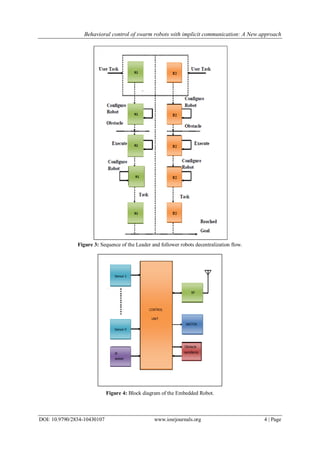
Initially the task is assigned to the leader robot by external user.The leader robot starts communicating the
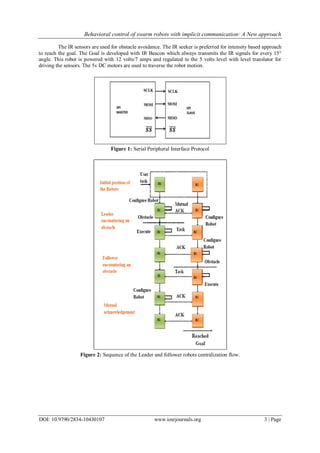
follower robot using RF transceivers (NRF24L01) for implicit mode communication. The SPI protocol is used to
interface the RF transceivers with control unit board. The robots are also avoiding the obstacle in real time for
both static and dynamic scenarios.
The static type obstacle avoidance is developed on similar lines of „M‟algorithm. If the obstacle is dynamic it
waits for 2 sec‟s time period and checks the scenario. After completion of obstacle avoidance the leader checks
the status of the follower. If the follower is also performed the obstacle avoidance in the guide lines of the leader
robot then it acknowledge its status to the leader robot.
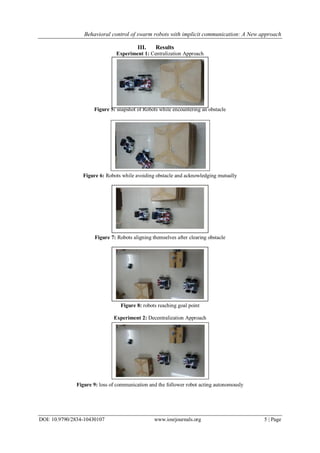
In this process if the status of the follower is away from the original path of the leader, then both will switch
into decentralization control mode.In the decentralization mode each robot plans to navigate successfully towards
goal. They are predesigned with the obstacle avoidance module to overcome the obstacle in indoor environment.
The both leader and follower robotsused IR seeker to traverse towards the goal point.
Algorithm steps of behavioral control of swarm robots
Step 1: Initialization of the robots with the task by the external user, then the leader robot communicates with
follower robot.
Step 2: The leader plans to traverse towards the goal with the intensity based method and every time checks the
behavior of follower. When the leader is in forward motion until it encounters an obstacle and follower does the
same by following leader that is in centralized mode.
Step 3: When the leader is confronted with obstacle it can avoid it withIR sensors and overcome with obstacle
avoidance mechanism. The same information is transmitted to follower through RF transceiver ensuring that
even follower avoids the obstacle.
Step 4: In centralized mode there is a chance of loss of communication between robots in that case the both
robots switches to decentralized mode and individually reaches the goal with the help of intensity from IR
beacon.
Remark 1: In centralization mode if there is an obstacle in path of follower it communicates this information to
leader and avoids the obstacle by sensor values. The leader waits until the follower clears obstacle.
Design setup of Embedded Robot:
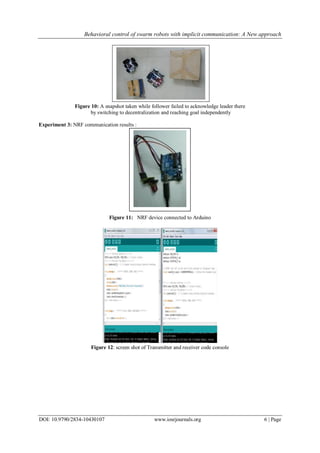
The Embedded Robots both leader and follower are designed and developed with sensors like five pairs
of IR sensor, IR seeker and RF Transceiver module. All the modules are implemented on the device Arduino
Uno ATMEGA328P as shown in Figure 4. The control unit module is heart of the embedded robot. The RF
Transceiver module interfaced with devices NRF24L01 (RF transceivers), this interfacing developed with SPI
(Serial Peripheral Interface) protocol as shown in Figure 1. The RF transceivers play key role in the algorithm
for implicit communication.](https://image.slidesharecdn.com/a010430107-160805100712/85/A010430107-2-320.jpg)
![Behavioral control of swarm robots with implicit communication: A New approach
DOI: 10.9790/2834-10430107 www.iosrjournals.org 7 | Page
Figure 13: serial monitor displaying transmitter and receiver information
Figure 14: serial monitor displaying the information of communication loss
IV. Conclusion
Theme of this paper is about the behavioral control of multi homogenous robots and way they
communicate each other for their synchronization in doing a particular task. Despites of the lot of research in
this field there is still lots of improvement should be done for its full-fledged implementation in real world.
References
[1]. Swarm Robotics: An Extensive Research Review Yogeswaran M. and Ponnambalam S. G. School of Engineering, Monash
University, Sunway Campus. 46150 Petaling Jaya, Selangor, Malaysia.
[2]. Jung, D. & Zelinsky, A. (2000). Grounded Symbolic Communication between Heterogeneous Cooperating Robots, Autonomous
Robots.
[3]. Dudek, G., Jenkin, M., Milios, E. & Wilkes, D. (1993). Taxonomy for Swarm Robots, Intelligent Robots and Systems‟ 93,
IROS‟93. Proceedings of the 1993 IEEE/RSJ International Conference.
[4]. Chinnaaiah .M.C. “A novel approach in implementation of rendezvous behavioral control between FPGA robots” published in
Advanced Robotics and Intelligent Systems (ARIS), 2014 International Conference.
[5]. D‟Angelo, A. &Pagello, E. (2005). Making Collective Behaviors to Work Through Implicit Communication, Robotics and
Automation, 2005.ICRA 2005. Proceedings of the 2005IEEE International Conference.
[6]. Lumelsky, V.; Mukhopadhyay, S.; Sun, K., "Sensor-Based Terrain Acquisition: a "Seed Spreader" Strategy," Intelligent Robots and
Systems '89. The Autonomous Mobile Robots and Its Applications. IROS '89. Proceedings. IEEE/RSJ International Workshop on ,
vol., no., pp.62,67, 4-6 Sep 1989.
[7]. Lumelsky, V.J.; Mukhopadhyay, S.; Sun, K., "Dynamic path planning in sensor-based terrain acquisition," Robotics and
Automation, IEEE Transactions on, vol.6, no.4, pp.462, 472, Aug 1990.
[8]. Haro, F.; Torres, M., "A Comparison of Path Planning Algorithms for Omni-Directional Robots in Dynamic
Environments," Robotics Symposium, 2006. LARS '06. IEEE 3rd Latin American, vol., no., pp.18, 25, 26-27 Oct. 2006.
[9]. Taylor, K.; LaValle, S.M., "I-Bug: An intensity-based bug algorithm," Robotics and Automation, 2009. ICRA '09. IEEE
International Conference on, vol., no., pp.3981, 3986, 12-17 May 2009.
[10]. Kioumars, A.H.; Liqiong Tang, "ATmega and XBee-based wireless sensing," Automation, Robotics and Applications (ICARA),
2011 5th International Conference on , vol., no., pp.351,356, 6-8 Dec. 2011.
[11]. Rezaee, H.; Abdollahi, F., "A Decentralized Cooperative Control Scheme With Obstacle Avoidance for a Team of Mobile
Robots," Industrial Electronics, IEEE Transactions on , vol.61, no.1, pp.347,354, Jan. 2014.](https://image.slidesharecdn.com/a010430107-160805100712/85/A010430107-7-320.jpg)

This document describes a new approach for behavioral control of swarm robots using implicit communication. The key aspects of the proposed algorithm are: 1) Robots can operate in either a centralized or decentralized mode. In centralized mode, one robot acts as the leader and others follow. In decentralized mode, each robot plans its path individually. 2) Robots can switch between these modes depending on obstacles. If an obstacle disrupts communication between the leader and follower, they switch to decentralized mode. 3) Robots are equipped with sensors like IR sensors for obstacle avoidance and an IR seeker to navigate toward a goal. RF transceivers enable implicit communication between robots. 4) The algorithm was implemented using


