A Web-based Service for Image
Tampering Detection
Symeon (Akis) Papadopoulos - @sympap
Information Technologies Institute (ITI) /
Centre for Research and Technology Hellas (CERTH)
Experts’ Meeting on Digital Image Authentication and Classification
Dec 6-7, 2017 @ Geneva, Switzerland
The problem & the promise
https://www.npr.org/templates/story/story.php?storyId=92442928
Types of image tampering
• Splicing
– addition of new objects from a different image
• Inpainting
– Fill in part of image using software, similar effect
as splicing
• Copy-move (cloning)
• Cropping
• Image enhancement
– colour/contrast/brightness/gamma
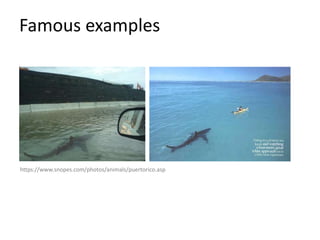
Famous examples
https://www.snopes.com/photos/animals/puertorico.asp
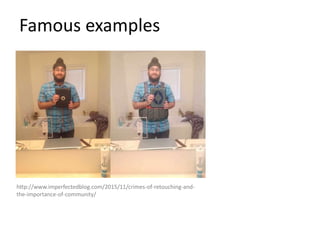
Famous examples
http://www.imperfectedblog.com/2015/11/crimes-of-retouching-and-
the-importance-of-community/
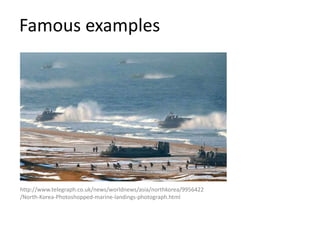
Famous examples
http://www.telegraph.co.uk/news/worldnews/asia/northkorea/9956422
/North-Korea-Photoshopped-marine-landings-photograph.html
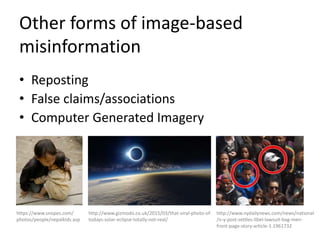
Other forms of image-based
misinformation
• Reposting
• False claims/associations
• Computer Generated Imagery
https://www.snopes.com/
photos/people/nepalkids.asp
http://www.gizmodo.co.uk/2015/03/that-viral-photo-of-
todays-solar-eclipse-totally-not-real/
http://www.nydailynews.com/news/national
/n-y-post-settles-libel-lawsuit-bag-men-
front-page-story-article-1.1961732
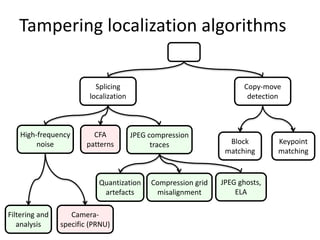
Tampering localization algorithms
Splicing
localization
Copy-move
detection
Block
matching
Keypoint
matching
High-frequency
noise
CFA
patterns
JPEG compression
traces
Filtering and
analysis
Camera-
specific (PRNU)
Quantization
artefacts
Compression grid
misalignment
JPEG ghosts,
ELA
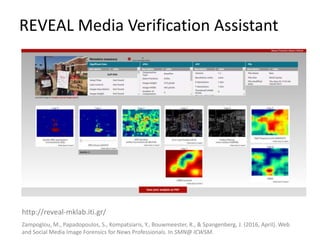
REVEAL Media Verification Assistant
http://reveal-mklab.iti.gr/
Zampoglou, M., Papadopoulos, S., Kompatsiaris, Y., Bouwmeester, R., & Spangenberg, J. (2016, April). Web
and Social Media Image Forensics for News Professionals. In SMN@ ICWSM.
Background
• Development funded by FP7 REVEAL project (2013-
2016)
• Core development team
– Dr. Markos Zampoglou (lead researcher)
– Dr. Chryssanthi Iakovidou (CAGI algorithm)
– Olga Papadopoulou (back-end development)
– Lazaros Apostolidis (front-end development)
• Iterative design and evaluation with the help of Ruben
Bouwmeester and colleagues from DW
• Second round of testing as part of the InVID plug-in
• Further development and support by MKLAB
Features
• Tampering localization heat maps
– Based on six state-of-the-art algorithms and one
newly proposed (CAGI)
– Zoom-in and overlay of heat map over image
• Auxiliary features
– Metadata: full listing, GPS geolocation, Exif
thumbnail extraction
– Reverse image search: auto-generation of link to
perform search on Google Images
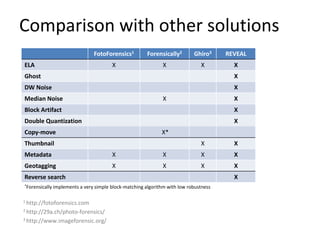
Comparison with other solutions
FotoForensics1 Forensically2 Ghiro3 REVEAL
ELA X X X X
Ghost X
DW Noise X
Median Noise X X
Block Artifact X
Double Quantization X
Copy-move X*
Thumbnail X X
Metadata X X X X
Geotagging X X X X
Reverse search X
1 http://fotoforensics.com
2 http://29a.ch/photo-forensics/
3 http://www.imageforensic.org/
*Forensically implements a very simple block-matching algorithm with low robustness
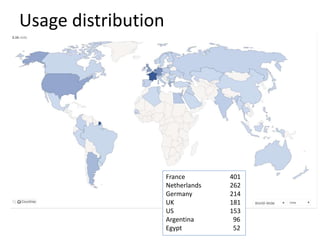
Usage distribution
France 401
Netherlands 262
Germany 214
UK 181
US 153
Argentina 96
Egypt 52
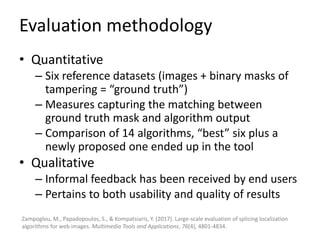
Evaluation methodology
• Quantitative
– Six reference datasets (images + binary masks of
tampering = “ground truth”)
– Measures capturing the matching between
ground truth mask and algorithm output
– Comparison of 14 algorithms, “best” six plus a
newly proposed one ended up in the tool
• Qualitative
– Informal feedback has been received by end users
– Pertains to both usability and quality of results
Zampoglou, M., Papadopoulos, S., & Kompatsiaris, Y. (2017). Large-scale evaluation of splicing localization
algorithms for web images. Multimedia Tools and Applications, 76(4), 4801-4834.
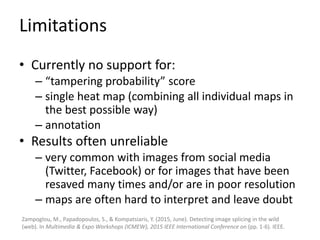
Limitations
• Currently no support for:
– “tampering probability” score
– single heat map (combining all individual maps in
the best possible way)
– annotation
• Results often unreliable
– very common with images from social media
(Twitter, Facebook) or for images that have been
resaved many times and/or are in poor resolution
– maps are often hard to interpret and leave doubt
Zampoglou, M., Papadopoulos, S., & Kompatsiaris, Y. (2015, June). Detecting image splicing in the wild
(web). In Multimedia & Expo Workshops (ICMEW), 2015 IEEE International Conference on (pp. 1-6). IEEE.
Usage & plans
• Public version is free to use “as is” for testing and
demo purposes
– no technical support, no SLA
• Plans
– add a tampering probability score
– generate a “merged” tampering heat map
– test new approaches based on deep learning
– implement usability improvements
• Funding is sought to support our research and
development roadmap
Relevant projects from our team
Tweet Verification Assistant
http://reveal-mklab.iti.gr/reveal/fake/
Disturbing Image Content Detection
http://reveal-mklab.iti.gr/reveal/disturbing/
Context Analysis & Aggregation
http://caa.iti.gr/
Reverse Video Search
In progress…
Thank you!
http://reveal-mklab.iti.gr/
https://github.com/MKLab-ITI/image-forensics
Get in touch!
Akis Papadopoulos papadop@iti.gr
Markos Zampoglou markzampoglou@iti.gr
References
• Bianchi, T, De Rosa, A. & Piva, A. (2011). Improved DCT coefficient analysis for forgery localization in
JPEG images. In IEEE International Conference on Acoustics, Speech and Signal Processing (ICASSP),
pp. 2444-2447. IEEE, 2011
• Pasquale, F., Bianchi, T., De Rosa, A., & Piva, A. (2012). Image forgery localization via fine-grained
analysis of CFA artifacts. IEEE Transactions on Information Forensics and Security 7(5): 1566-1577
• Farid, H. (2009). Exposing digital forgeries from JPEG ghosts. IEEE Transactions on Information
Forensics and Security 4(1): 154-160.
• Fontani, M., Bianchi, T., De Rosa, A., Piva, A., & Barni, M. (2013). A framework for decision fusion in
image forensics based on dempster–shafer theory of evidence. IEEE Transactions on Information
Forensics and Security 8(4): 593-607.
• Lin, Z., He, J., Tang, X., & Tang, C.-K. (2009). Fast, automatic and fine-grained tampered JPEG image
detection via DCT coefficient analysis. Pattern Recognition 42(11): 2492-2501.
• Mahdian, B. & Saic, S. (2009). Using noise inconsistencies for blind image forensics. Image and
Vision Computing 27(10), pp. 1497–1503.
• Zampoglou, M., Papadopoulos, S., & Kompatsiaris, Y. (2015, June). Detecting image splicing in the
wild (web). In IEEE International Conference on Multimedia & Expo Workshops (ICMEW), pp. 1-6.
• Zampoglou, M., Papadopoulos, S., Kompatsiaris, Y., Bouwmeester, R., & Spangenberg, J. (2016,
April). Web and Social Media Image Forensics for News Professionals. In SMN@ ICWSM
• Zampoglou, M., Papadopoulos, S., & Kompatsiaris, Y. (2017). Large-scale evaluation of splicing
localization algorithms for web images. Multimedia Tools and Applications, 76(4), 4801-4834

A Web-based Service for Image Tampering Detection

  • 1.
    A Web-based Servicefor Image Tampering Detection Symeon (Akis) Papadopoulos - @sympap Information Technologies Institute (ITI) / Centre for Research and Technology Hellas (CERTH) Experts’ Meeting on Digital Image Authentication and Classification Dec 6-7, 2017 @ Geneva, Switzerland
  • 2.
    The problem &the promise https://www.npr.org/templates/story/story.php?storyId=92442928
  • 3.
    Types of imagetampering • Splicing – addition of new objects from a different image • Inpainting – Fill in part of image using software, similar effect as splicing • Copy-move (cloning) • Cropping • Image enhancement – colour/contrast/brightness/gamma
  • 4.
  • 5.
  • 6.
  • 7.
    Other forms ofimage-based misinformation • Reposting • False claims/associations • Computer Generated Imagery https://www.snopes.com/ photos/people/nepalkids.asp http://www.gizmodo.co.uk/2015/03/that-viral-photo-of- todays-solar-eclipse-totally-not-real/ http://www.nydailynews.com/news/national /n-y-post-settles-libel-lawsuit-bag-men- front-page-story-article-1.1961732
  • 8.
    Tampering localization algorithms Splicing localization Copy-move detection Block matching Keypoint matching High-frequency noise CFA patterns JPEGcompression traces Filtering and analysis Camera- specific (PRNU) Quantization artefacts Compression grid misalignment JPEG ghosts, ELA
  • 9.
    REVEAL Media VerificationAssistant http://reveal-mklab.iti.gr/ Zampoglou, M., Papadopoulos, S., Kompatsiaris, Y., Bouwmeester, R., & Spangenberg, J. (2016, April). Web and Social Media Image Forensics for News Professionals. In SMN@ ICWSM.
  • 10.
    Background • Development fundedby FP7 REVEAL project (2013- 2016) • Core development team – Dr. Markos Zampoglou (lead researcher) – Dr. Chryssanthi Iakovidou (CAGI algorithm) – Olga Papadopoulou (back-end development) – Lazaros Apostolidis (front-end development) • Iterative design and evaluation with the help of Ruben Bouwmeester and colleagues from DW • Second round of testing as part of the InVID plug-in • Further development and support by MKLAB
  • 11.
    Features • Tampering localizationheat maps – Based on six state-of-the-art algorithms and one newly proposed (CAGI) – Zoom-in and overlay of heat map over image • Auxiliary features – Metadata: full listing, GPS geolocation, Exif thumbnail extraction – Reverse image search: auto-generation of link to perform search on Google Images
  • 12.
    Comparison with othersolutions FotoForensics1 Forensically2 Ghiro3 REVEAL ELA X X X X Ghost X DW Noise X Median Noise X X Block Artifact X Double Quantization X Copy-move X* Thumbnail X X Metadata X X X X Geotagging X X X X Reverse search X 1 http://fotoforensics.com 2 http://29a.ch/photo-forensics/ 3 http://www.imageforensic.org/ *Forensically implements a very simple block-matching algorithm with low robustness
  • 13.
    Usage distribution France 401 Netherlands262 Germany 214 UK 181 US 153 Argentina 96 Egypt 52
  • 14.
    Evaluation methodology • Quantitative –Six reference datasets (images + binary masks of tampering = “ground truth”) – Measures capturing the matching between ground truth mask and algorithm output – Comparison of 14 algorithms, “best” six plus a newly proposed one ended up in the tool • Qualitative – Informal feedback has been received by end users – Pertains to both usability and quality of results Zampoglou, M., Papadopoulos, S., & Kompatsiaris, Y. (2017). Large-scale evaluation of splicing localization algorithms for web images. Multimedia Tools and Applications, 76(4), 4801-4834.
  • 15.
    Limitations • Currently nosupport for: – “tampering probability” score – single heat map (combining all individual maps in the best possible way) – annotation • Results often unreliable – very common with images from social media (Twitter, Facebook) or for images that have been resaved many times and/or are in poor resolution – maps are often hard to interpret and leave doubt Zampoglou, M., Papadopoulos, S., & Kompatsiaris, Y. (2015, June). Detecting image splicing in the wild (web). In Multimedia & Expo Workshops (ICMEW), 2015 IEEE International Conference on (pp. 1-6). IEEE.
  • 16.
    Usage & plans •Public version is free to use “as is” for testing and demo purposes – no technical support, no SLA • Plans – add a tampering probability score – generate a “merged” tampering heat map – test new approaches based on deep learning – implement usability improvements • Funding is sought to support our research and development roadmap
  • 17.
    Relevant projects fromour team Tweet Verification Assistant http://reveal-mklab.iti.gr/reveal/fake/ Disturbing Image Content Detection http://reveal-mklab.iti.gr/reveal/disturbing/ Context Analysis & Aggregation http://caa.iti.gr/ Reverse Video Search In progress…
  • 18.
    Thank you! http://reveal-mklab.iti.gr/ https://github.com/MKLab-ITI/image-forensics Get intouch! Akis Papadopoulos papadop@iti.gr Markos Zampoglou markzampoglou@iti.gr
  • 19.
    References • Bianchi, T,De Rosa, A. & Piva, A. (2011). Improved DCT coefficient analysis for forgery localization in JPEG images. In IEEE International Conference on Acoustics, Speech and Signal Processing (ICASSP), pp. 2444-2447. IEEE, 2011 • Pasquale, F., Bianchi, T., De Rosa, A., & Piva, A. (2012). Image forgery localization via fine-grained analysis of CFA artifacts. IEEE Transactions on Information Forensics and Security 7(5): 1566-1577 • Farid, H. (2009). Exposing digital forgeries from JPEG ghosts. IEEE Transactions on Information Forensics and Security 4(1): 154-160. • Fontani, M., Bianchi, T., De Rosa, A., Piva, A., & Barni, M. (2013). A framework for decision fusion in image forensics based on dempster–shafer theory of evidence. IEEE Transactions on Information Forensics and Security 8(4): 593-607. • Lin, Z., He, J., Tang, X., & Tang, C.-K. (2009). Fast, automatic and fine-grained tampered JPEG image detection via DCT coefficient analysis. Pattern Recognition 42(11): 2492-2501. • Mahdian, B. & Saic, S. (2009). Using noise inconsistencies for blind image forensics. Image and Vision Computing 27(10), pp. 1497–1503. • Zampoglou, M., Papadopoulos, S., & Kompatsiaris, Y. (2015, June). Detecting image splicing in the wild (web). In IEEE International Conference on Multimedia & Expo Workshops (ICMEW), pp. 1-6. • Zampoglou, M., Papadopoulos, S., Kompatsiaris, Y., Bouwmeester, R., & Spangenberg, J. (2016, April). Web and Social Media Image Forensics for News Professionals. In SMN@ ICWSM • Zampoglou, M., Papadopoulos, S., & Kompatsiaris, Y. (2017). Large-scale evaluation of splicing localization algorithms for web images. Multimedia Tools and Applications, 76(4), 4801-4834

Editor's Notes

  • #6 Vereender Jubbal, Canadian Sikh man
  • #9 Noise patterns unique noise patterns due to different camera (e.g. PRNU: Photo Response Non-Uniformity), capture parameters and post-processing Colour Filter Array (CFA) patterns misalignment of underlying CFA grids JPEG compression traces DCT quantization artefacts, JPEG compression grid misalignment Other traces or patterns Motion blur inconsistencies, discontinuities in illumination colour, inconsistencies in shadow params Minimize the computational cost of search Maximize flexibility with respect to transformations
  • #10 Minimize the computational cost of search Maximize flexibility with respect to transformations
  • #11 Created within the REVEAL project Result of collaboration between professionals from computer engineering (CERTH) and journalism (DW) Features: Metadata: listing, GPS geolocation, EXIF thumbnail extraction Reverse image search: Google Images integration Tampering detection: implementation of eight state-of-the-art algorithms Aims: Provide a comprehensive, self-contained toolset for image verification Serve as an evaluation framework for verification tools and protocols